The balance sheet formula is Assets = Liabilities + Equity
The Balance Sheet Formula: Understanding Financial Health
The balance sheet formula is Assets = Liabilities + Equity. It means everything a business owns must be financed by either money it owes or ownership value. The SEC describes the same accounting equation as assets…
12 min read
Practice investing with Finelo
Build practical investing skills with guided lessons, simulator practice, and structured challenges.
Want to learn more?
Build practical investing skills with guided lessons, simulator practice, and structured challenges.
Explore FineloExplore Finelo's 28-day challenges
Turn learning into a daily habit with guided challenge paths.
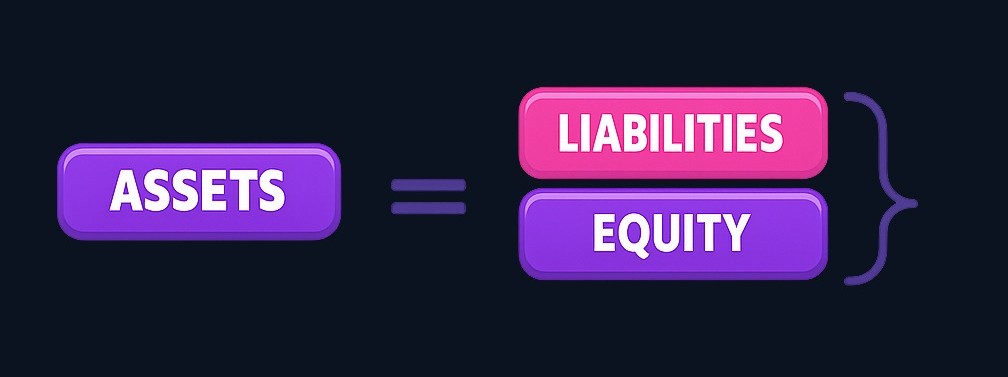
. It means everything a business owns must be financed by either money it owes or ownership value. The SEC describes the same accounting equation as assets equaling liabilities plus shareholders’ equity, and says a balance sheet shows what a company owns and owes at a fixed point in time (SEC).
If you are asking for the best answer to “balance sheet formula,” use this:
Assets = Liabilities + Equity
For a small business, “equity” usually means owner’s equity. For a corporation, it is often called shareholders’ equity. The U.S. Small Business Administration also defines a balance sheet, or statement of financial position, as a report of assets, liabilities, and equity at a specific time, with the formula Assets = Liabilities + Equity (SBA glossary).
This page is for beginners, business owners, and early investors who want to read a balance sheet without getting lost in accounting jargon. By the end, you should be able to build a simple balance sheet, check whether it balances, and use it to ask better questions about a company’s financial health.
Components of the Balance Sheet Formula
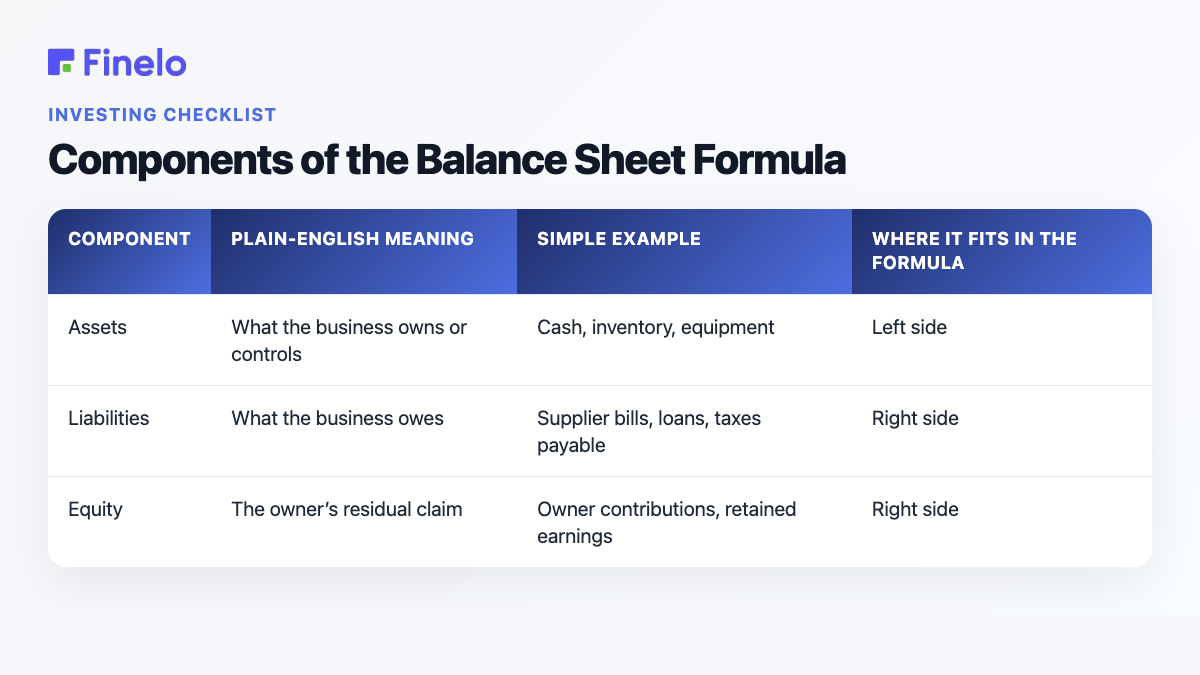
The balance sheet formula has three parts: assets, liabilities, and equity. Think of it as a funding map. Assets show what the business controls. Liabilities show what outsiders have a claim on. Equity shows what owners have a claim on after liabilities are considered.
| Component | Plain-English meaning | Simple example | Where it fits in the formula |
|---|---|---|---|
| Assets | What the business owns or controls | Cash, inventory, equipment | Left side |
| Liabilities | What the business owes | Supplier bills, loans, taxes payable | Right side |
| Equity | The owner’s residual claim | Owner contributions, retained earnings | Right side |
Assets
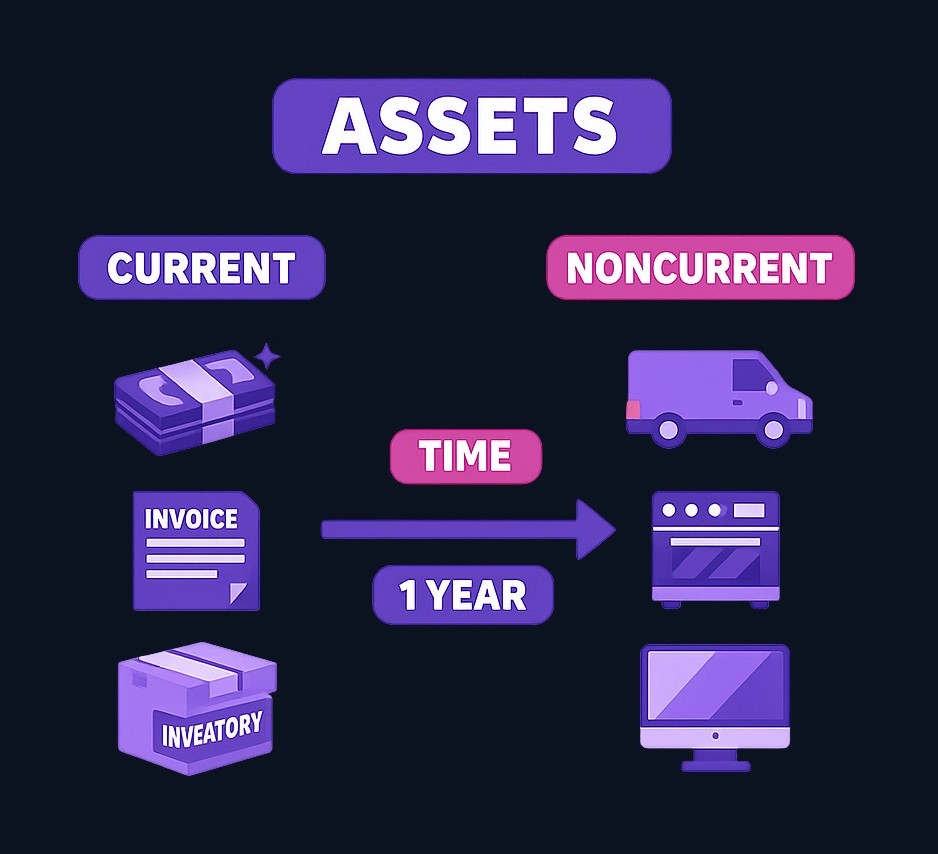
Assets are resources with value. The SEC describes assets as things a company owns that can be sold or used to make products or provide services, including cash, equipment, inventory, property, trademarks, and patents (SEC). In a small business, assets might include a checking account, customer invoices not yet paid, product inventory, a delivery van, software licenses, or office equipment.
Assets are often grouped by how quickly they can become cash. The SEC explains that current assets are expected to convert to cash within one year, while noncurrent assets are not expected to convert within one year or may take longer to sell (SEC). A bakery’s flour inventory may be a current asset because it will be used and sold through products soon. Its oven is usually a longer-term asset because it supports operations over time.
Liabilities
Liabilities are obligations the business owes to others. The SEC lists examples such as bank borrowing, rent, supplier amounts, payroll owed to employees, taxes owed, environmental cleanup costs, and obligations to provide goods or services in the future (SEC).
Liabilities are also often grouped by timing. The SEC says current liabilities are obligations expected to be paid within the year, while long-term liabilities are due more than one year away (SEC). If the bakery owes a supplier for this month’s ingredients, that is usually current. If it has a multi-year equipment loan, that is usually longer-term.
Equity
Equity is what remains for owners after liabilities are subtracted from assets. The SEC describes shareholders’ equity as the amount that would be left if a company sold all assets and paid all liabilities (SEC). The SBA explains owner’s equity in broad terms the same way: what would be left for owners from company assets after paying liabilities (SBA).
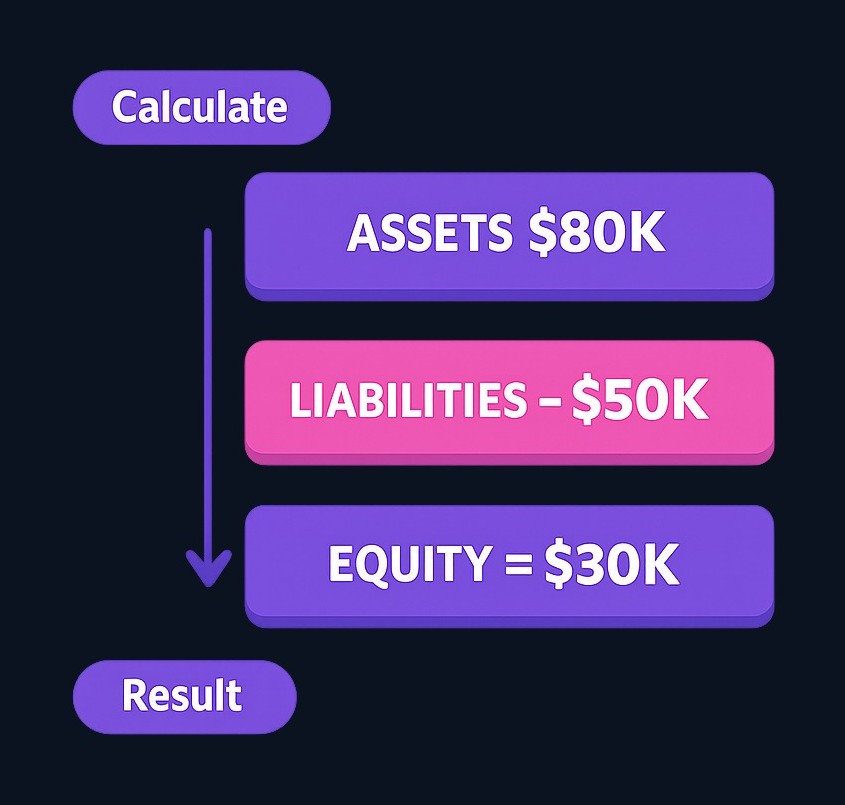
For example, if a fictional shop has $80,000 in assets and $50,000 in liabilities, its equity is $30,000. That does not mean the owner has $30,000 in spendable cash. It means the accounting value left after subtracting obligations from recorded assets is $30,000.
How to Calculate the Balance Sheet Formula
To calculate the balance sheet formula, list all assets, list all liabilities, calculate equity, then check whether assets equal liabilities plus equity. The goal is not just to make the numbers match. The goal is to understand what the business owns, what it owes, and how much of the asset base is supported by owner value.
Use this process:
- Choose the balance sheet date.
- List current assets.
- List noncurrent assets.
- Add total assets.
- List current liabilities.
- List long-term liabilities.
- Add total liabilities.
- Calculate equity.
- Confirm that assets equal liabilities plus equity.
The date matters because a balance sheet is a snapshot. The SEC says a balance sheet shows assets, liabilities, and shareholders’ equity at the end of a reporting period, not the flows into and out of accounts during the period (SEC). That is why a balance sheet for March 31 can look different from one for June 30.
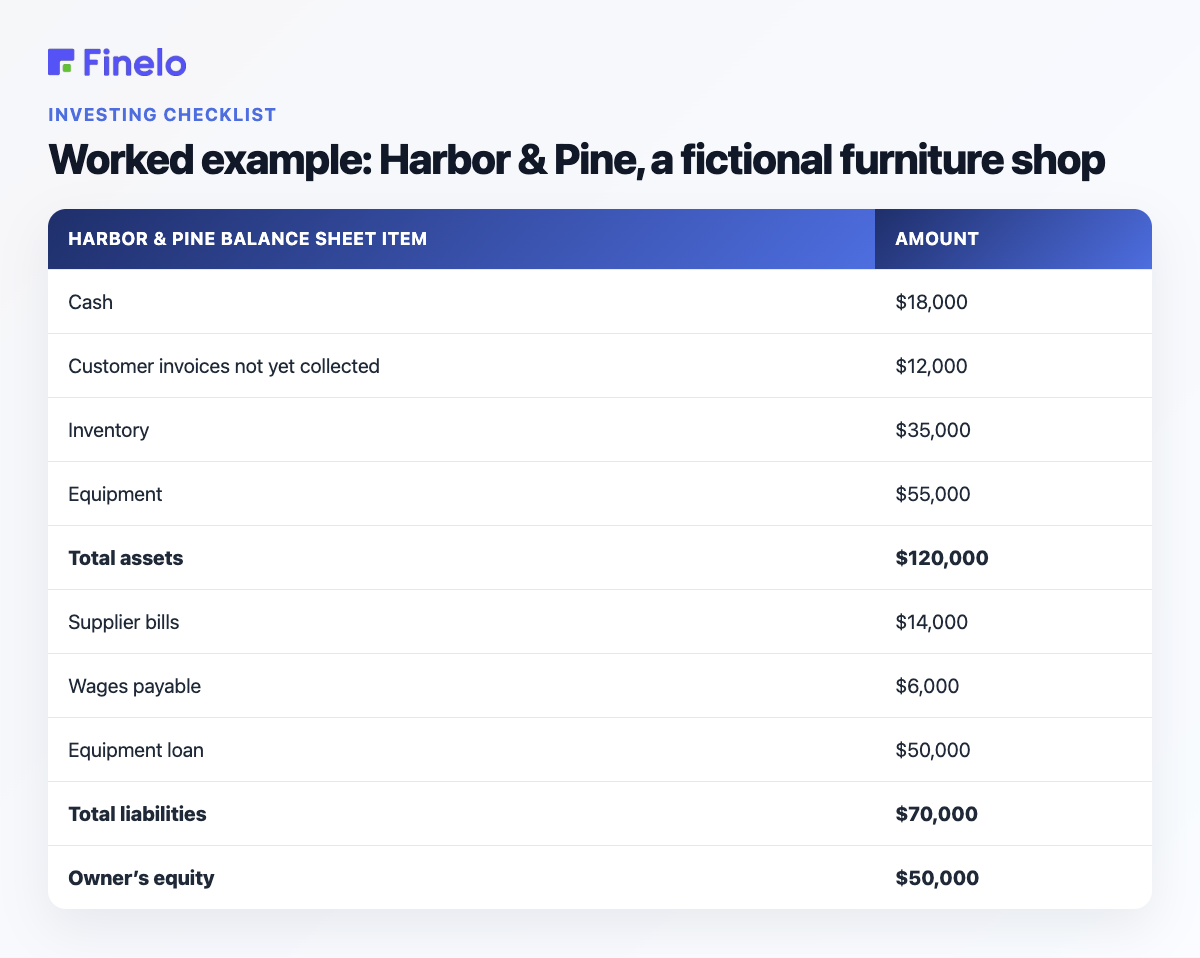
Worked example: Harbor & Pine, a fictional furniture shop
Imagine Harbor & Pine is a small furniture shop preparing a month-end balance sheet. The owner gathers account balances from the company’s bank account, sales records, supplier statements, and loan documents.
| Harbor & Pine balance sheet item | Amount |
|---|---|
| Cash | $18,000 |
| Customer invoices not yet collected | $12,000 |
| Inventory | $35,000 |
| Equipment | $55,000 |
| Total assets | $120,000 |
| Supplier bills | $14,000 |
| Wages payable | $6,000 |
| Equipment loan | $50,000 |
| Total liabilities | $70,000 |
| Owner’s equity | $50,000 |
Now apply the formula:
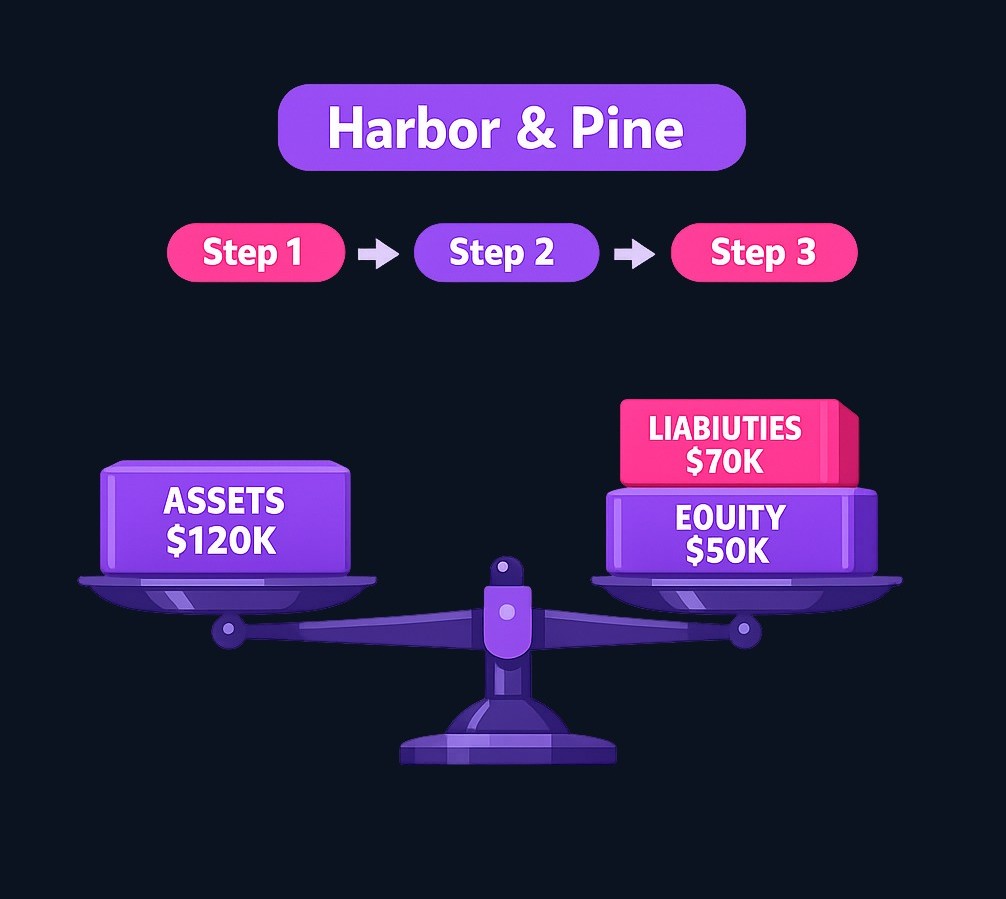
Assets = Liabilities + Equity
$120,000 = $70,000 + $50,000
The statement balances. Harbor & Pine owns $120,000 of recorded assets. Those assets are financed by $70,000 of obligations and $50,000 of owner value.
The same information can also answer the related question “How do I calculate equity?” Rearrange the formula:
Equity = Assets − Liabilities
Using Harbor & Pine:
$50,000 = $120,000 − $70,000
Copy-and-paste balance sheet template
Use this simple worksheet when you prepare your own first balance sheet. Replace the example line items with your own accounts.
| Category | Line item | Amount |
|---|---|---|
| Current assets | Cash | |
| Current assets | Accounts receivable | |
| Current assets | Inventory | |
| Noncurrent assets | Equipment | |
| Noncurrent assets | Property or long-term assets | |
| Total assets | ||
| Current liabilities | Supplier bills | |
| Current liabilities | Wages, taxes, or short-term amounts owed | |
| Long-term liabilities | Loans or long-term obligations | |
| Total liabilities | ||
| Equity | Owner contributions and retained earnings | |
| Total liabilities + equity |
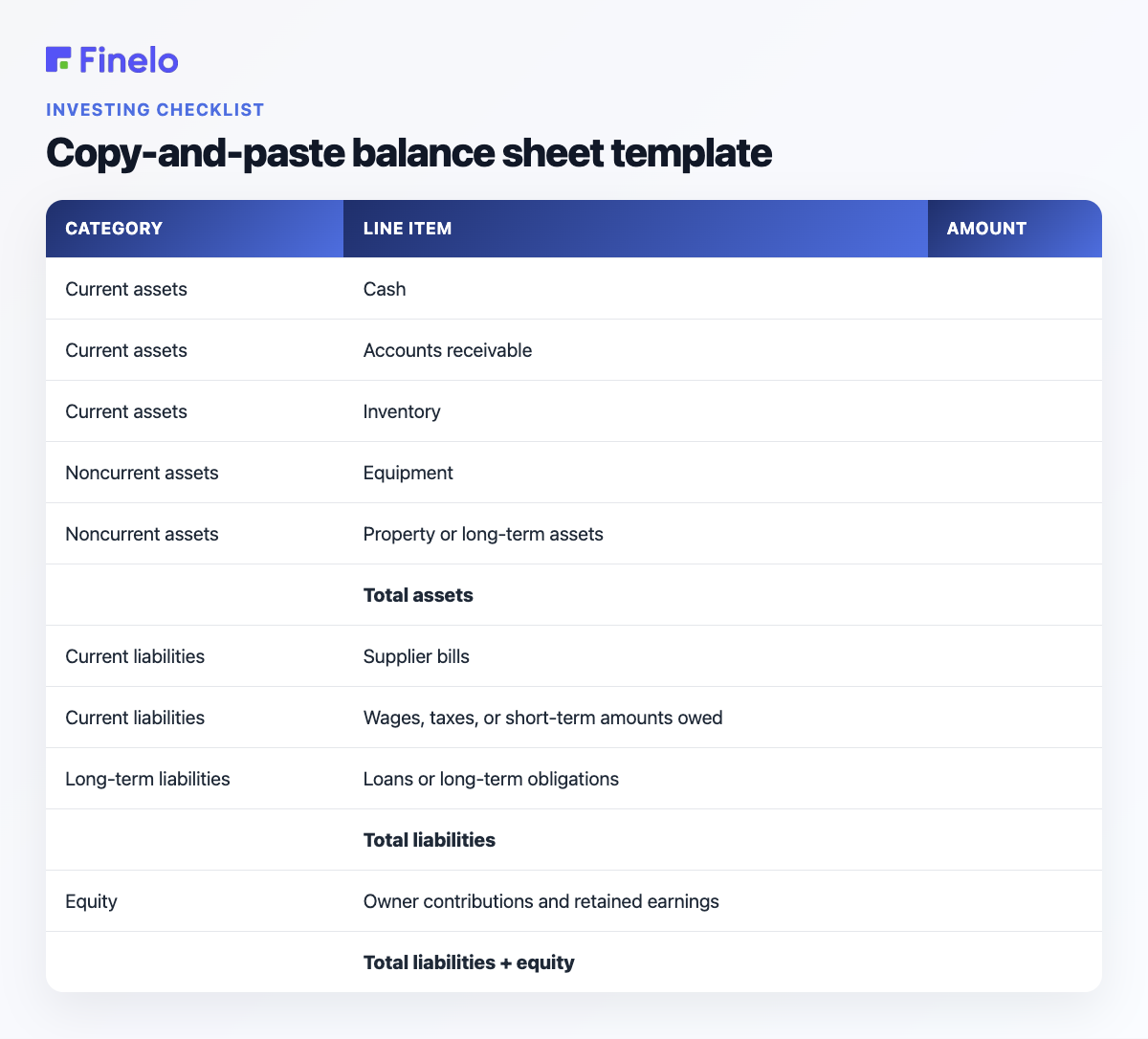
The final check is simple: total assets should equal total liabilities plus equity. If they do not, the balance sheet is telling you there is a classification, timing, or arithmetic problem somewhere.
Common Mistakes in Balance Sheet Preparation
Balance sheets often fail for ordinary reasons. The mistake is usually not a mysterious accounting problem. It is usually a missing account, a duplicated amount, a timing mismatch, or a line item placed in the wrong category.
Mistake 1: Treating cash flow as the same thing as financial health
A business can have cash today and still be carrying too much debt. It can also be short on cash while owning valuable assets. The SEC explains that a balance sheet is a snapshot of assets, liabilities, and shareholders’ equity at a point in time, while a cash flow statement shows cash moving in and out over a period (SEC).
Example: Harbor & Pine receives a $40,000 loan. Cash rises, so the bank account looks stronger. But liabilities also rise. The business has more cash, yet it also has a new obligation. A good balance sheet shows both sides.
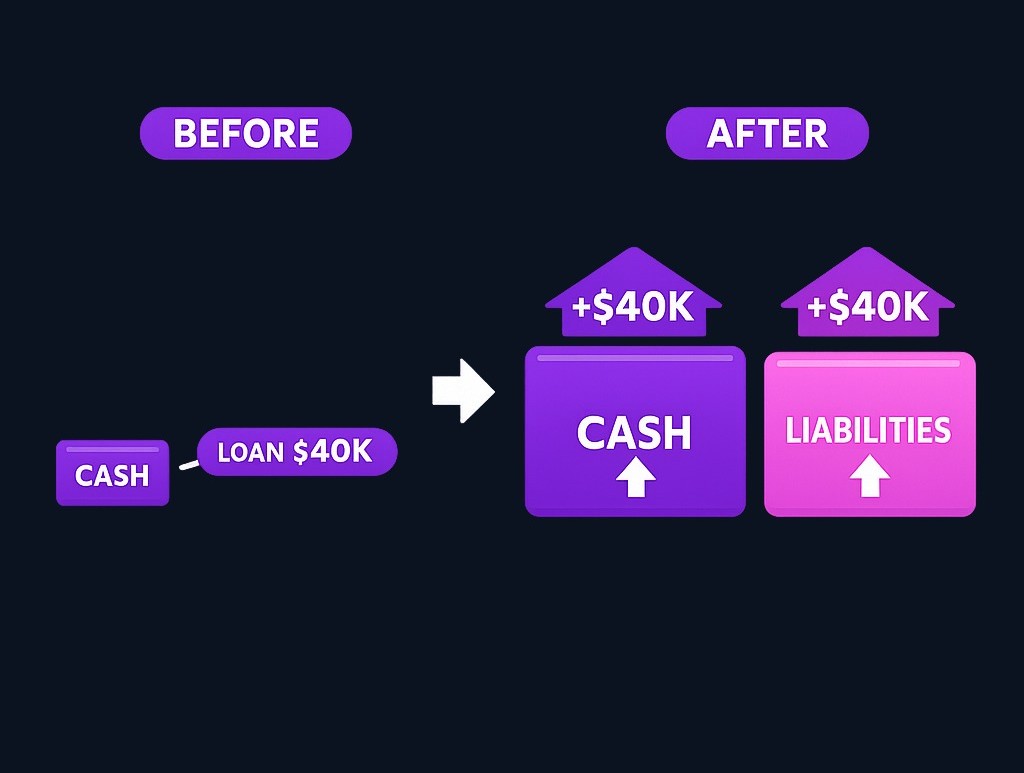
How to fix it: review cash together with liabilities. Do not judge the business from the bank balance alone.
Mistake 2: Putting assets in the wrong timing bucket
Some beginners group all assets together and stop there. That may be enough for a rough draft, but it hides liquidity. Liquidity means how quickly something can become cash without disrupting the business. The SEC’s distinction between current and noncurrent assets helps readers see which assets are expected to convert to cash within one year and which are longer-term (SEC).
Example: A retailer lists inventory and store fixtures as one combined “assets” line. That makes the company look less clear. Inventory may sell soon. Fixtures may support the business for years.
How to fix it: separate assets by timing. Current assets help with near-term obligations. Noncurrent assets support longer-term operations.
Mistake 3: Forgetting liabilities that do not look like loans
Loans are easy to notice. Other obligations are easier to miss. The SEC’s examples of liabilities include supplier amounts, payroll owed, taxes owed, rent obligations, and obligations to provide goods or services later (SEC).
Example: A consulting firm collects payment before delivering a project. The cash is in the bank, but the firm still owes the client the service. If the firm ignores that obligation, equity may look overstated.
How to fix it: ask, “Do we owe money, goods, services, taxes, wages, or another obligation?” If yes, the item may belong in liabilities.
Mistake 4: Using market value and book value inconsistently
A beginner may value one asset at its original cost and another at what they think it could sell for today. That creates a messy statement. The balance sheet should follow a consistent accounting method, especially if it will be shared with lenders, investors, or tax professionals.
Example: A business records equipment at its purchase cost but records a vehicle at an informal resale estimate. That mix can make asset totals harder to interpret.
How to fix it: choose a consistent accounting approach and work with a qualified accountant when the balance sheet will support financing, taxes, or investor decisions.
Mistake 5: Forcing the balance instead of finding the cause
If assets do not equal liabilities plus equity, do not plug the difference into equity and move on. That hides the error.
Example: Harbor & Pine’s assets total $120,000, liabilities total $70,000, and equity is listed as $45,000. The formula gives $120,000 on the left and $115,000 on the right. The missing $5,000 could be an omitted asset, an overstated liability, a missed owner contribution, or a math error.
How to fix it: trace the difference. Recheck source records, subtotals, account categories, and the date used for each balance.
Practice investing with Finelo
Build practical investing skills with guided lessons, simulator practice, and structured challenges.
Real-World Applications of the Balance Sheet Formula
A balance sheet is useful because it turns scattered business facts into a clear picture. The SBA says a balance sheet helps track assets, liabilities, and equity and can provide insights when a business separates and analyzes parts of its operations (SBA).
Use it to assess debt pressure
The formula shows how much of the asset base is supported by liabilities versus equity. The SBA describes the debt ratio as total liabilities divided by total assets and notes that acceptable debt levels vary by industry (SBA).
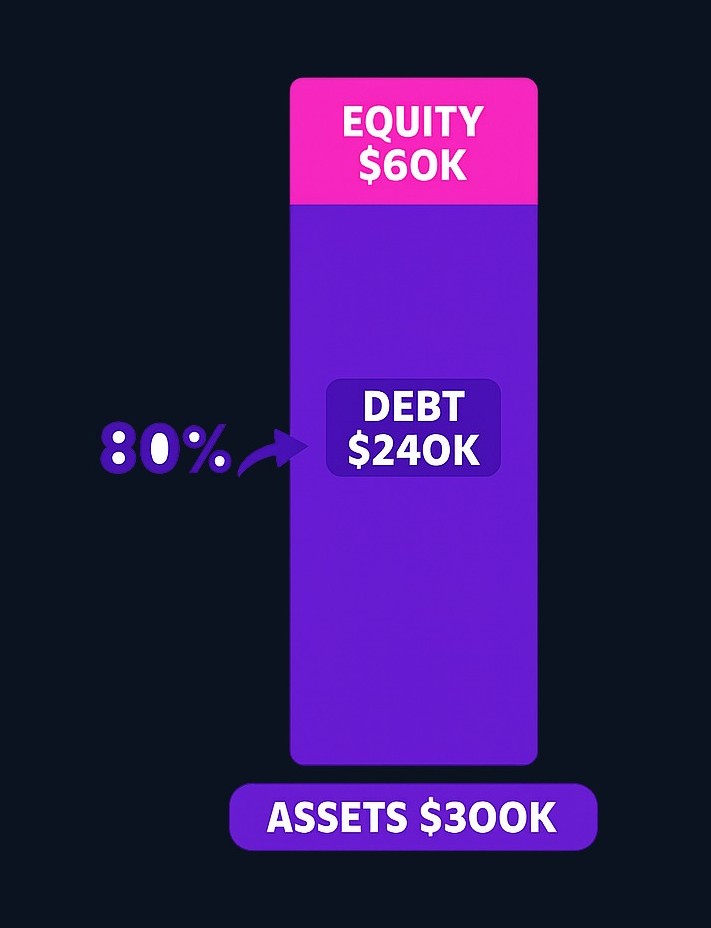
Example: A fictional contractor has $300,000 in assets and $240,000 in liabilities. Its debt ratio is 80%. That does not automatically mean the business is failing, but it does mean the owner should look closely at payment timing, interest costs, and whether revenue can support the obligations.
Use it to spot working-capital strain
Working capital is current assets minus current liabilities, according to the SEC’s financial statement ratio examples (SEC). It helps answer a practical question: after near-term obligations are considered, does the business have enough near-term resources?
Example: A seasonal shop has strong annual sales, but most of its cash arrives in one quarter. A balance sheet can show whether current assets are enough to cover supplier bills, wages, and other short-term liabilities before the busy season returns.
Use it before making a major business decision
A balance sheet can make growth plans more realistic. If a company wants to buy equipment, hire staff, or open a new location, the owner can use the formula to see whether the move would add assets, liabilities, or both.
Example: Harbor & Pine considers buying a new delivery truck. If the shop buys it with a loan, assets rise because it owns the truck, and liabilities rise because it owes the lender. The formula still balances, but the decision changes the company’s risk profile.
Use it as an investor reading tool
Investors use balance sheets to understand financial position, but a balance sheet should not be read alone. The SEC says financial statements help show where a company’s money came from, where it went, and where it is now, and it describes balance sheets, income statements, cash flow statements, and statements of shareholders’ equity as the main financial statements (SEC).
Example: A company may show rising assets, but the income statement and cash flow statement may reveal whether those assets are producing revenue and cash. The balance sheet gives the position. The other statements help explain movement.
If you are learning to connect statements, Finelo offers educational investing content and practice around research, diversification, and portfolio thinking through its AI Investing Challenge. Use it as education, not personalized financial advice.
Balance Sheet Preparation Checklist
Use this checklist before you rely on a balance sheet:
- Set one clear reporting date.
- Use account balances from that same date.
- Separate current assets from noncurrent assets.
- Separate current liabilities from long-term liabilities.
- Check whether customer prepayments create future obligations.
- Confirm supplier bills, wages, taxes, and loan balances.
- Recalculate total assets.
- Recalculate total liabilities.
- Calculate equity as assets minus liabilities.
- Confirm assets equal liabilities plus equity.
- Review whether the numbers make business sense, not just whether they add up.
Here is the practical test: if a knowledgeable person asked why each item is in its category, could you explain it? If not, review the line item before you use the statement for a loan, investor discussion, tax planning, or major business decision.
Conclusion and Next Steps
The balance sheet formula is simple, but it is powerful: Assets = Liabilities + Equity. It tells you whether the business’s recorded resources are funded by obligations, owner value, or both. It also helps you ask better questions about liquidity, debt, and financial resilience.
Your next step is to build a basic balance sheet for one date. List assets, list liabilities, calculate equity, and check whether the formula balances. Then look beyond the math. Ask whether the business has enough current assets, whether liabilities are manageable, and whether equity is moving in a healthy direction over time.
For important decisions, use the balance sheet with the income statement and cash flow statement. And if the numbers will affect taxes, financing, investment decisions, or legal reporting, review them with a qualified professional.
Frequently asked questions
What is a balance sheet?
A balance sheet is a financial statement that shows a company’s assets, liabilities, and shareholders’ equity at a fixed point in time ([SEC](https://www.sec.gov/about/reports-publications/beginners-guide-financial-statements)). In plain English, it shows what the business owns, what it owes, and what is left for owners.
What does the balance sheet formula represent?
The formula represents how a business’s assets are financed. Assets come from either liabilities, such as money owed to others, or equity, such as owner value. The SEC summarizes the formula as **Assets = Liabilities + Shareholders’ Equity** ([SEC](https://www.sec.gov/about/reports-publications/beginners-guide-financial-statements)).
How do I calculate my company’s equity?
Use **Equity = Assets − Liabilities**. If a fictional business has $200,000 in assets and $125,000 in liabilities, equity is $75,000. For corporations, this is often called shareholders’ equity; for many small businesses, it is often discussed as owner’s equity.
What should I do if my balance sheet does not balance?
Do not force the difference into equity. Check whether you used one reporting date, missed a liability, duplicated an asset, placed an item in the wrong category, or made an arithmetic error. The balance sheet should balance because assets equal liabilities plus equity, not because the final number was plugged.
InvestingBeginnerFinancial StatementsMarkets
Practice investing with Finelo
Build practical investing skills with guided lessons, simulator practice, and structured challenges.
About the author
Finelo Team
The Finelo Team creates practical investing and trading education designed to help beginners learn faster with structured challenges, simulator practice, and bite-sized lessons.
Keep reading — Related articles

Investing
Yield to Call vs Yield to Maturity: Assumptions and Bond Risks
Yield to call (YTC) estimates a bond's yield if the issuer redeems it on an eligible call date; yield to maturity (YTM) estimates yield if it remains outstanding to final maturity.
Finelo Team

Investing
Will My Employer Know If I Take a 401(k) Loan?
Who this page is for: readers new to 401(k) loans who want a practical, privacy‑focused explanation — what your employer can see, how to limit visibility, and the financial tradeoffs to weigh.
Finelo Team

Investing
What Medical Expenses Qualify for a 401(k) Hardship Withdrawal?
Before you decide, confirm three things with your plan administrator:
Finelo Team


