Blockchain is a system for recording and coordinating data across a network; cryptocurrency is a digital asset that may use such a system to record ownership and transfers. They are not interchangeable. Use “blockchain” when discussing the infrastructure, rules, and shared ledger. Use “cryptocurrency” when discussing the asset, payment unit, token economics, custody, or investment risk.
Blockchain vs Cryptocurrency: A Comprehensive Comparison
Blockchain is a system for recording and coordinating data across a network; cryptocurrency is a digital asset that may use such a system to record ownership and transfers. They are not interchangeable. Use…
12 min read
Practice investing with Finelo
Build practical investing skills with guided lessons, simulator practice, and structured challenges.
Want to learn more?
Build practical investing skills with guided lessons, simulator practice, and structured challenges.
Explore FineloExplore Finelo's 28-day challenges
Turn learning into a daily habit with guided challenge paths.
This comparison is for readers who know the terms but want to understand what each one does, where they overlap, and which questions matter before using, building, or investing in either.
What Is Blockchain?
A blockchain is a shared record made from ordered groups of data called blocks. Each block is connected to earlier data through cryptographic references. Network participants follow an agreed process for proposing, checking, and accepting new records.
The important idea is not simply that data sits in blocks. It is that several participants can work from a shared history without one party quietly rewriting past entries. How well that works depends on the network design, who can participate, how consensus is reached, and what happens when someone submits invalid or disputed information.
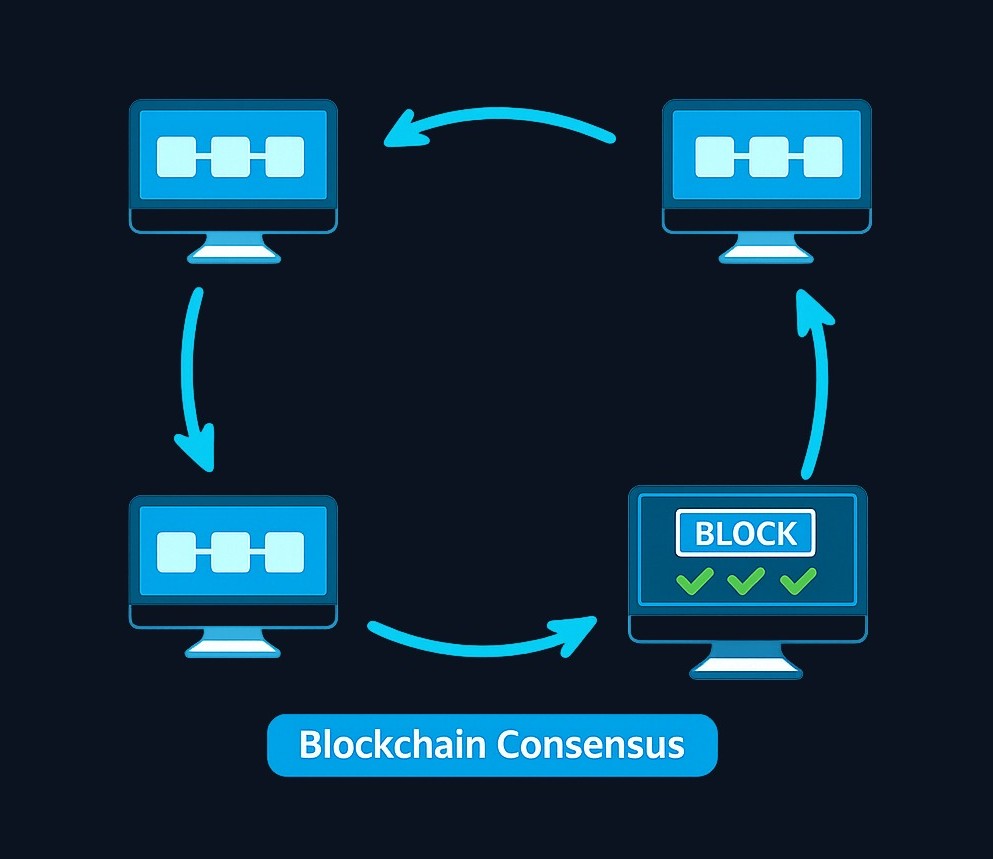
The basic components
- Ledger: The history of accepted records.
- Nodes: Computers or organisations that store, check, or relay data.
- Transactions: Proposed changes to the ledger.
- Consensus: The rules participants use to agree on valid updates.
- Cryptography: Mathematical methods used to verify data and control access.
- Governance: The process for changing software, resolving disputes, and responding to failures.
A blockchain can be public, allowing broad participation, or permissioned, limiting access to approved parties. It may use a native digital token, but a publicly traded cryptocurrency is not required for every blockchain design.
A useful mental model
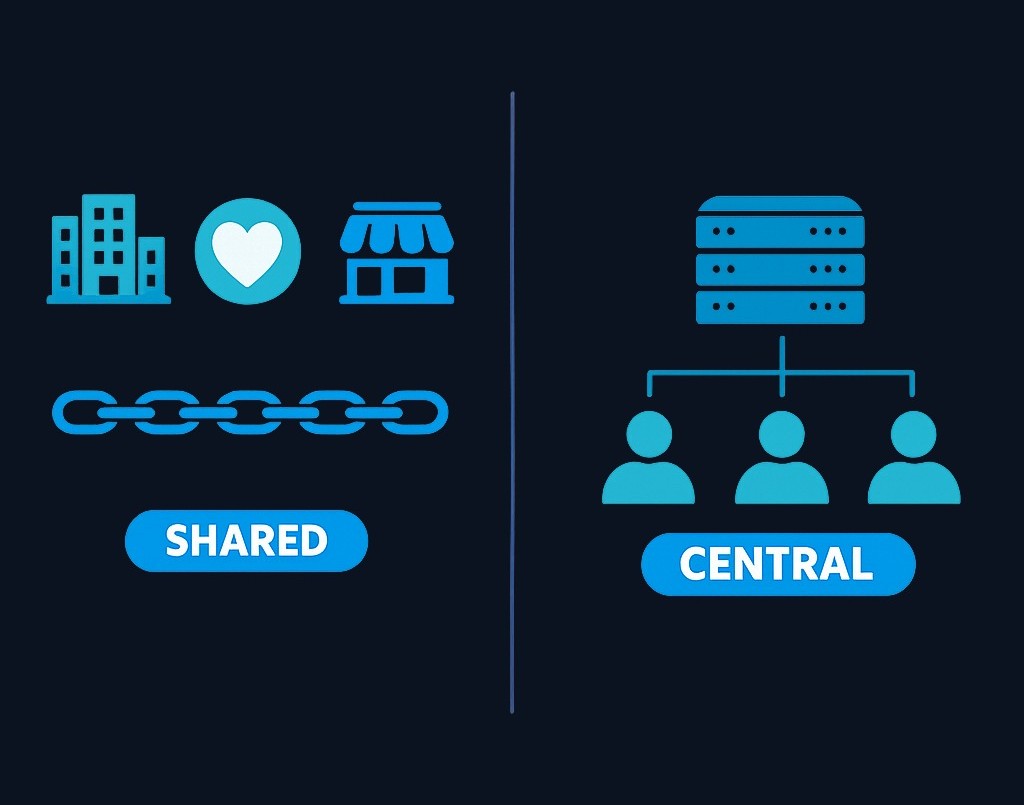
Imagine several companies that repeatedly reconcile separate spreadsheets. Each business keeps its own copy, and disagreements require emails, calls, and manual corrections. A shared ledger could give authorised participants one agreed sequence of events.
That does not make the information automatically true. If someone enters a false shipment quantity, the ledger may preserve that false entry accurately. A blockchain can help protect record integrity after data is accepted; it cannot guarantee that the original real-world input was honest or correct.
When blockchain may be worth considering
A blockchain becomes more relevant when:
- Several parties need to write to a shared record.
- The parties do not want one participant to control the entire database.
- A traceable history matters.
- Participants can agree on common data and governance rules.
- The benefits of shared coordination justify the added complexity.
If one trusted organisation controls every user and record, a conventional database may be simpler, faster to modify, and easier to govern.
What Is Cryptocurrency?
Cryptocurrency is a digital asset governed by software rules. A network may use cryptography and a distributed ledger to track which addresses control units and whether a proposed transfer is valid.
The asset and the network are separate concepts. The cryptocurrency is the unit that users hold or transfer. The blockchain or other ledger is the infrastructure that records activity. A single network may support a native asset as well as other tokens created under its rules.
How a cryptocurrency transfer works conceptually
- A user creates a transfer instruction.
- The user authorises it with a private key or another approved method.
- The network checks the instruction against its rules.
- The accepted transaction becomes part of the shared record.
- Wallet software displays the updated balance or ownership state.
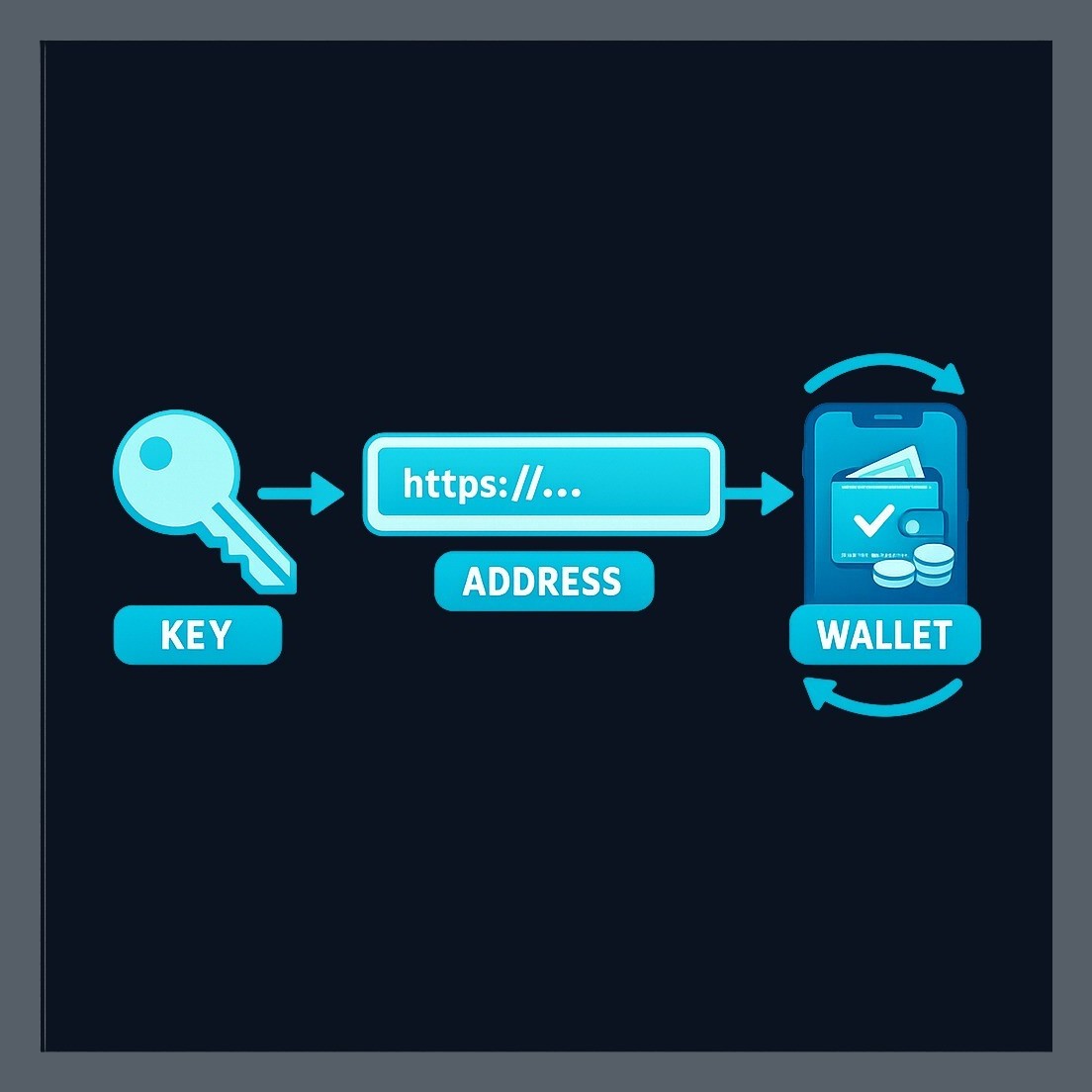
A private key is a secret used to authorise actions. A public address is an identifier that others may use when sending assets. Wallet software helps users manage these credentials and interact with a network, but the wallet does not necessarily hold coins like a physical wallet holds cash. It commonly manages the credentials used to control ledger entries.
Cryptocurrency is a broad category
Different cryptocurrencies may be designed for different roles:
| Category | Intended role | Questions to ask |
|---|---|---|
| Payment-focused asset | Transferring value between users | How are transactions validated, and how variable are fees and settlement times? |
| Network token | Paying for activity on a programmable network | What creates demand for the token, and how can network rules change? |
| Stable-value token | Tracking an external reference value | What supports the value, who manages reserves or collateral, and how can redemption fail? |
| Governance token | Participating in protocol decisions | What rights does the token provide, and how concentrated is voting power? |
| Utility token | Accessing a service or application | Is the token necessary, and does the service have genuine users? |
| Privacy-oriented asset | Reducing the visibility of transaction details | What privacy is provided, and what legal or exchange restrictions may apply? |
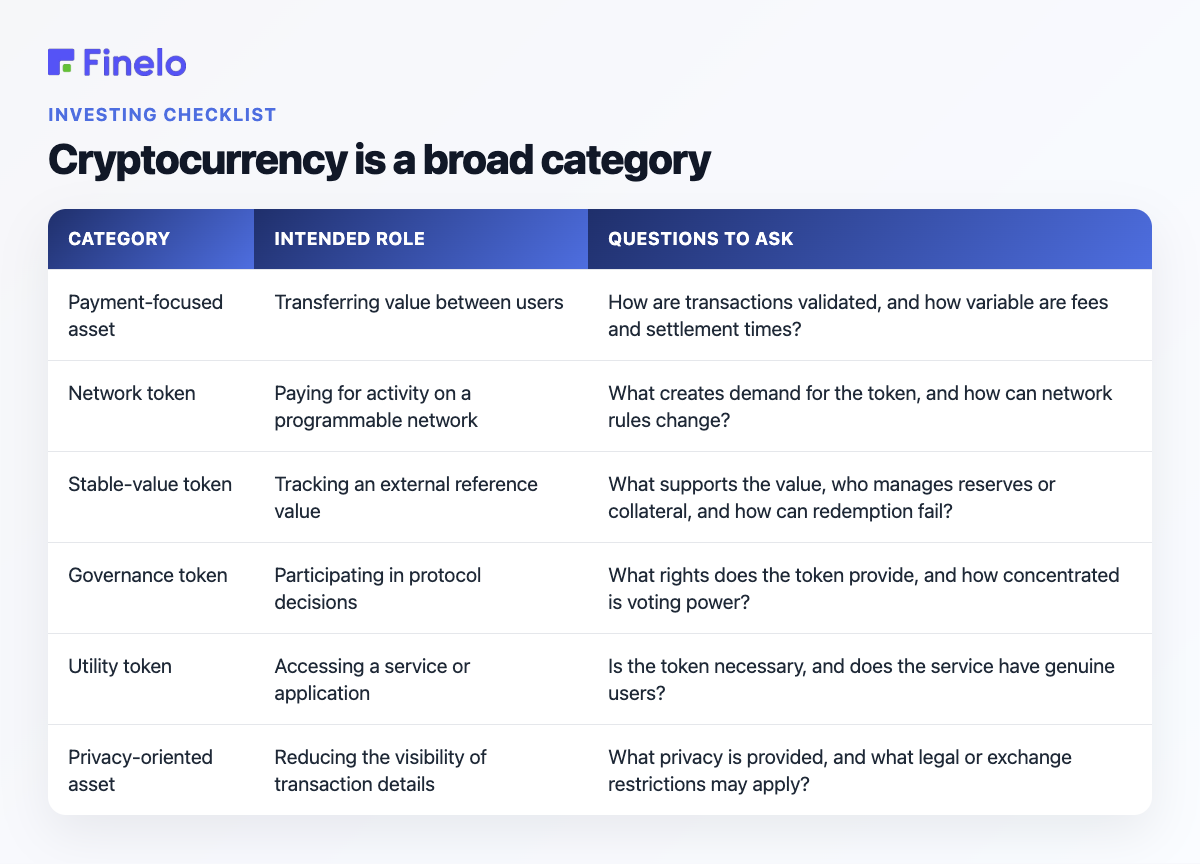
These categories can overlap. A token label is not proof that the product works as described, has lasting demand, or is suitable as an investment.
Ownership and custody risks
Cryptocurrency control depends heavily on custody. With self-custody, the user manages the credentials and recovery process. With third-party custody, an exchange or service controls access under its own terms.
Neither arrangement removes risk. Self-custody can fail through lost credentials, phishing, malware, or poor backups. Third-party custody adds dependence on the provider’s security, solvency, access controls, withdrawal policies, and legal obligations.
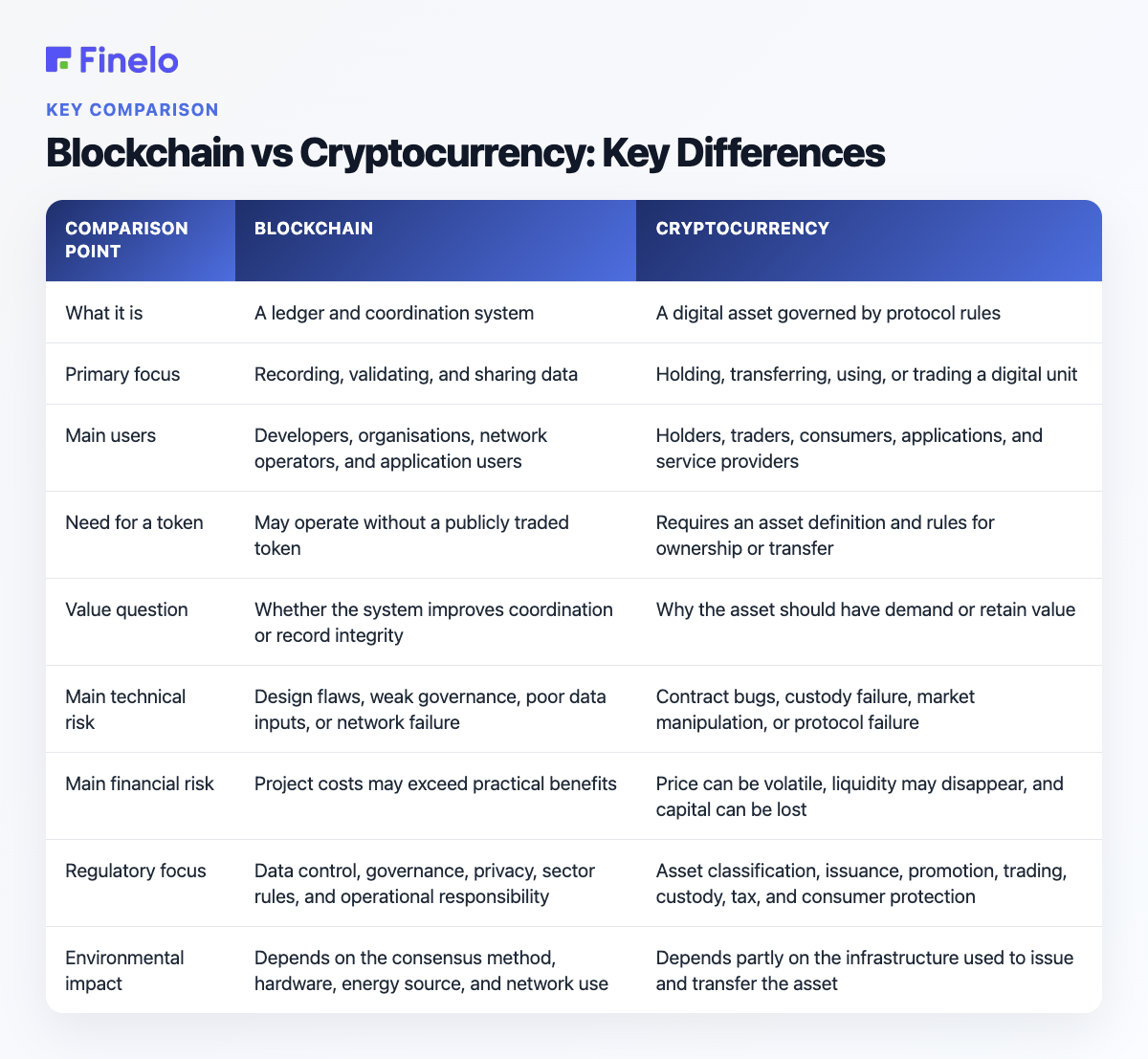
Blockchain vs Cryptocurrency: Key Differences
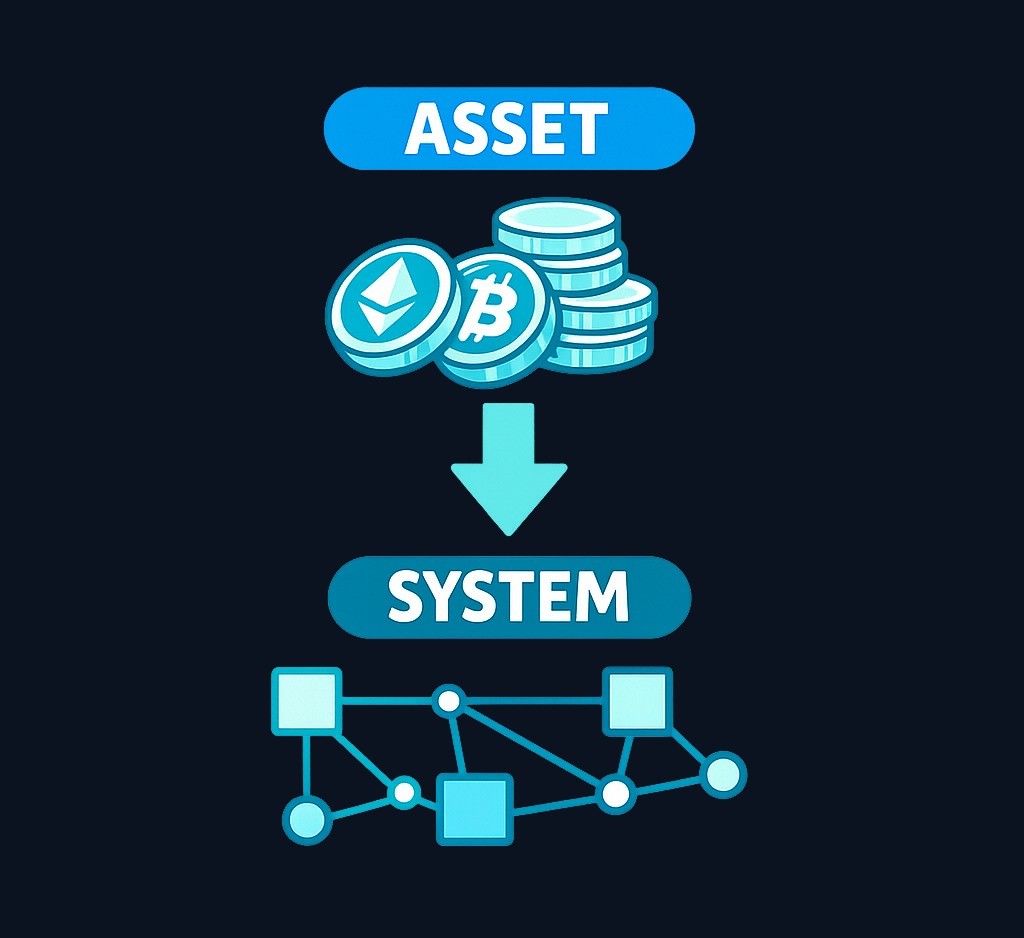
The simplest distinction is system versus asset. Blockchain describes a way to maintain a shared record. Cryptocurrency describes a digital asset whose ownership and transfers may be recorded by such a system.
| Comparison point | Blockchain | Cryptocurrency |
|---|---|---|
| What it is | A ledger and coordination system | A digital asset governed by protocol rules |
| Primary focus | Recording, validating, and sharing data | Holding, transferring, using, or trading a digital unit |
| Main users | Developers, organisations, network operators, and application users | Holders, traders, consumers, applications, and service providers |
| Need for a token | May operate without a publicly traded token | Requires an asset definition and rules for ownership or transfer |
| Value question | Whether the system improves coordination or record integrity | Why the asset should have demand or retain value |
| Main technical risk | Design flaws, weak governance, poor data inputs, or network failure | Contract bugs, custody failure, market manipulation, or protocol failure |
| Main financial risk | Project costs may exceed practical benefits | Price can be volatile, liquidity may disappear, and capital can be lost |
| Regulatory focus | Data control, governance, privacy, sector rules, and operational responsibility | Asset classification, issuance, promotion, trading, custody, tax, and consumer protection |
| Environmental impact | Depends on the consensus method, hardware, energy source, and network use | Depends partly on the infrastructure used to issue and transfer the asset |
Purpose: coordination versus economic unit
Blockchain is useful only when its method of coordination solves a real problem. Cryptocurrency needs an additional explanation: why the digital unit is necessary and why users would want it.
A blockchain project can be useful without creating an investable token. A cryptocurrency can also have active trading while the associated application has little practical use. Do not use token price as a shortcut for judging technical quality or adoption.
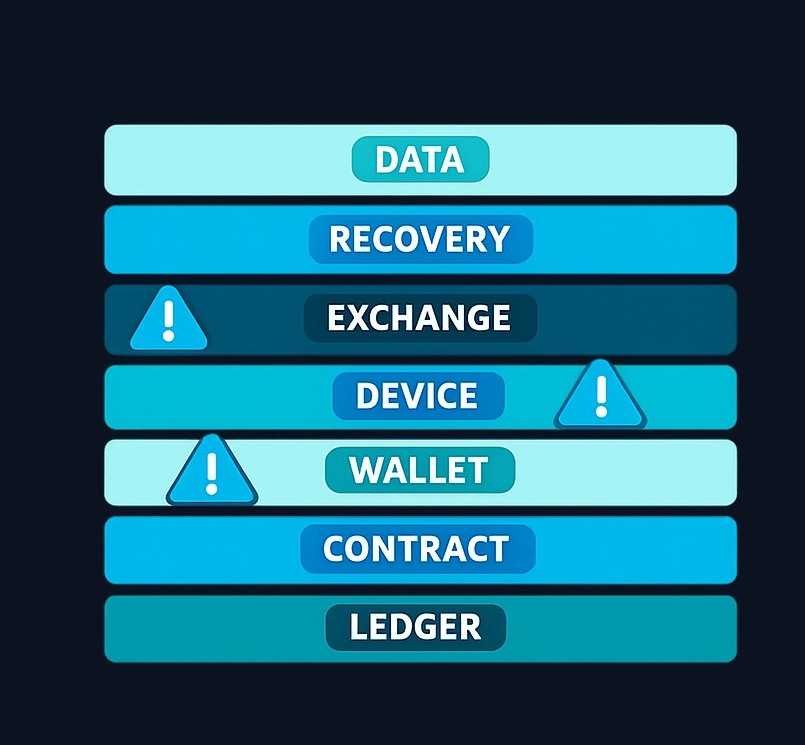
Security: a property of the whole system
“Uses blockchain” does not mean “cannot be hacked.” Security depends on several layers:
- The network’s consensus and software
- Smart contracts or application code
- Wallet and key management
- Exchanges, custodians, and bridges
- User devices and account recovery
- Governance and incident response
- The quality of data entering from outside the network
A blockchain history may resist unauthorised changes while a user still loses assets through a stolen key. A well-designed protocol may remain operational while a connected application contains a serious flaw.
Evaluate the weakest relevant layer, not only the underlying ledger.
Transparency and privacy
Public blockchains can make transaction data widely visible. That transparency may help independent verification, but it can create privacy problems when addresses are linked to people or businesses.
Permissioned systems may restrict who can view or submit information. This can improve confidentiality, but it also concentrates control among approved participants.
The useful question is not whether a system is simply “transparent” or “private.” Ask:
- Which data is visible?
- Who can write or change records?
- Can personal information be corrected or removed?
- Who can link an address to a real identity?
- What happens when privacy rules conflict with permanent records?
Regulation: technology and activity are treated differently
Regulation usually depends on what people are doing, where they are doing it, and which rights the asset provides. A blockchain used for internal record-keeping may face data, cybersecurity, industry, and contract requirements. A cryptocurrency project may also face rules covering issuance, trading, custody, promotion, taxation, anti-money-laundering controls, and consumer protection.
The same token can be treated differently across jurisdictions or uses. Businesses and users should check current local rules with qualified legal or tax professionals rather than assuming that a technology label determines the outcome.
Environmental impact: design matters more than the label
Blockchain systems do not all consume resources in the same way. Environmental impact may depend on:
- The consensus mechanism
- The amount and type of computing hardware
- Energy sources
- Network demand
- Data storage and replication
- Hardware replacement
- Whether the system replaces or duplicates existing infrastructure
Proof-of-work designs generally rely on participants performing computational work to compete for validation. Other designs may select validators through different mechanisms and use less competitive computation. Lower computing demand does not answer every environmental question: storage, hardware, data centres, and duplicated systems still matter.
Compare the complete system and the useful work it performs. Do not infer impact from the word blockchain or cryptocurrency alone.
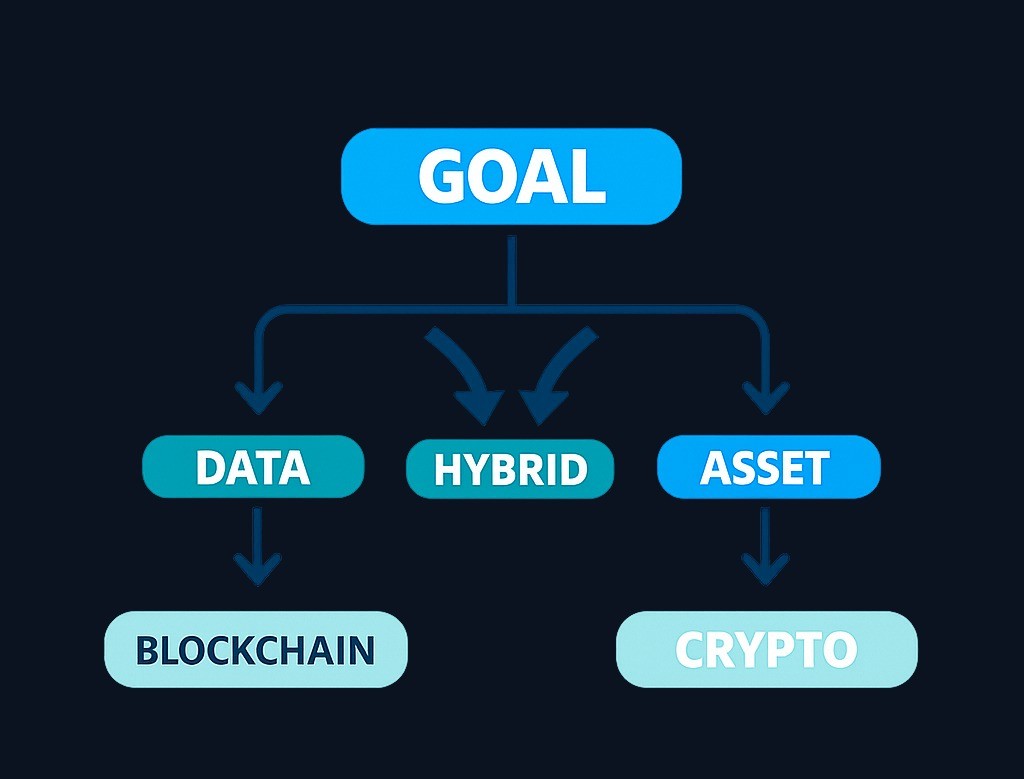
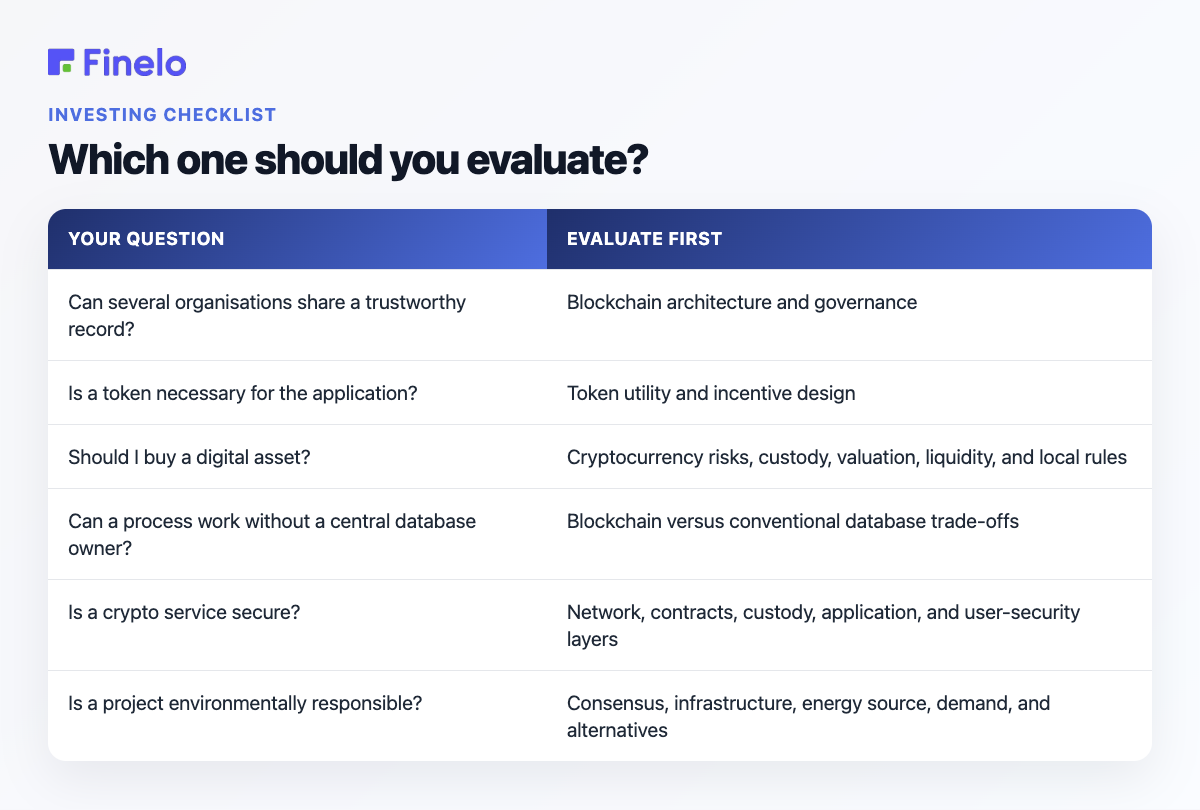
Which one should you evaluate?
Use this decision guide:
| Your question | Evaluate first |
|---|---|
| Can several organisations share a trustworthy record? | Blockchain architecture and governance |
| Is a token necessary for the application? | Token utility and incentive design |
| Should I buy a digital asset? | Cryptocurrency risks, custody, valuation, liquidity, and local rules |
| Can a process work without a central database owner? | Blockchain versus conventional database trade-offs |
| Is a crypto service secure? | Network, contracts, custody, application, and user-security layers |
| Is a project environmentally responsible? | Consensus, infrastructure, energy source, demand, and alternatives |
Practice investing with Finelo
Build practical investing skills with guided lessons, simulator practice, and structured challenges.
Applications of Blockchain Beyond Cryptocurrency
Blockchain is not automatically the right answer for every shared-data problem. Its strongest potential use cases involve multiple parties, repeated reconciliation, a need for traceable records, and limited willingness to trust one database owner.
Supply-chain event tracking
Manufacturers, carriers, inspectors, and retailers may need to record events about the same goods. A shared ledger could preserve a common sequence of production, inspection, shipment, and receipt records.
The difficult part is connecting the ledger to reality. A sensor can malfunction. A person can attach the wrong identifier. A supplier can submit misleading data. Effective implementation still needs audits, access rules, correction procedures, and consequences for false entries.
Shared financial and operational records
Organisations may use a distributed ledger to reconcile invoices, asset ownership, settlement instructions, or intercompany events. The potential benefit is fewer conflicting copies.
Before building, compare that benefit with a shared conventional database. Consider transaction volume, privacy, integration cost, error correction, governance, and who pays when the system fails.
Digital credentials
A blockchain-based credential system could allow an issuer to record or verify that a credential exists while the holder presents proof when needed. Possible uses include training records, licences, memberships, or product certifications.
Sensitive personal data should not be placed on a permanent public ledger without careful design. A better approach may store only a cryptographic proof on-chain while protected information remains elsewhere.
Document history and timestamping
A system can record a digital fingerprint of a document. Later, users can compare the current file with that fingerprint to check whether it has changed.
This can support an audit trail, but it does not prove that the original document was truthful, properly authorised, or legally valid.
Tokenised claims
A blockchain can represent a claim connected to an external asset, service, or right. The token is only as reliable as the legal agreement, custodian, issuer, and redemption process behind it.
Ask:
- Who controls the underlying asset?
- What legal right does the token holder receive?
- How is ownership enforced outside the blockchain?
- Can the token be redeemed?
- What happens if the issuer or custodian fails?
Voting and governance
A blockchain may help create a traceable sequence of votes or proposals. That does not solve voter identity, coercion, device security, ballot secrecy, accessibility, or dispute resolution.
For high-stakes voting, technical transparency must be balanced with privacy, verifiability, and a credible recovery process. A permanent ledger is one component, not a complete election system.
A blockchain adoption test
Before choosing blockchain, answer six questions:
- Are several independent parties writing to the same record?
- Is there a real cost from reconciliation or distrust?
- Why should no single party control the database?
- Which data must be shared, and which must remain private?
- Who can correct errors and change the rules?
- Would a conventional database solve the problem more simply?
If the team cannot answer these questions, creating a token or selecting a consensus mechanism is premature.
The Future of Blockchain and Cryptocurrency
Blockchain and cryptocurrency may develop together, but they face different tests.
Blockchain projects must prove that shared ledgers improve a real workflow. Cryptocurrency projects must also explain token demand, custody, liquidity, governance, and legal treatment. Technical activity alone does not demonstrate economic value.
Trends worth watching
Permissioned and hybrid systems: Organisations may combine restricted participation with independently verifiable records. The trade-off is greater control at the cost of some openness.
Tokenisation: More projects may represent financial or real-world claims digitally. Success depends on enforceable rights, reliable custody, redemption, and accurate off-chain data.
Interoperability: Networks and applications may try to exchange data or assets. Connections add convenience but can create new security and governance dependencies.
Privacy tools: Developers may reduce how much transaction information is publicly exposed while preserving certain forms of verification. Regulators and institutions may still require identity and compliance controls.
Usability and custody: Adoption depends on making key management, recovery, fees, and transaction confirmation understandable. Simplifying the interface can shift risk to a service provider rather than eliminate it.
Regulatory separation: Rules may increasingly distinguish among payment assets, investment-like tokens, stable-value arrangements, custody services, exchanges, and non-financial blockchain systems. Outcomes will remain jurisdiction-specific.
How to judge future claims
Use a three-layer test:
- Technical: Does the system work under realistic conditions?
- Operational: Can users, businesses, and service providers use it reliably?
- Economic: Does it solve a problem at a cost and risk that make sense?
Add a fourth layer for tokens: Why must value flow through this asset?
A project may succeed technically but fail economically. Another may attract speculative trading before it proves useful. Separate adoption, activity, token price, and genuine user value.
How to Use This Comparison
If you are evaluating technology, begin with the shared-record problem and compare blockchain with a conventional database. If you are evaluating a cryptocurrency, analyse the asset separately: what it does, why it is needed, who controls changes, how custody works, and what could make demand disappear.
For a structured next step, explore the Finelo AI Investing Challenge, which its official page describes as an educational program for research, thesis building, portfolio construction, and evaluating AI-generated analysis while keeping decisions with the user.
Blockchain can be useful without cryptocurrency, and cryptocurrency cannot be understood by studying blockchain alone. Keep the system, the application, and the asset as three separate layers. That distinction makes technical claims clearer and investment risks harder to hide.
Cryptocurrency and other digital assets can lose substantial value. This comparison is educational and does not provide personalised financial, legal, or tax advice.
Frequently asked questions
Can blockchain exist without cryptocurrency?
Yes. A permissioned or private blockchain may record shared data without issuing a publicly traded cryptocurrency. It may still use internal permissions, cryptographic verification, and consensus rules to coordinate participants.
Is Bitcoin the same as blockchain?
No. Bitcoin is a cryptocurrency and network application; blockchain describes the type of ledger structure and coordination method it uses. Other systems can use blockchain designs for different assets or non-cryptocurrency records.
Can blockchain be hacked?
No system should be treated as unhackable. An attacker might target consensus, software, smart contracts, connected services, wallets, user credentials, or governance. Security depends on the complete implementation, not only the ledger design.
Is cryptocurrency a good investment?
That depends on the specific asset, its purpose, governance, liquidity, custody, valuation, legal treatment, and your ability to bear a total loss. A technology narrative or rising price is not enough. Treat cryptocurrency as a high-risk decision requiring independent research rather than a guaranteed route to returns.
InvestingBeginnerCryptoMarkets
Practice investing with Finelo
Build practical investing skills with guided lessons, simulator practice, and structured challenges.
About the author
Finelo Team
The Finelo Team creates practical investing and trading education designed to help beginners learn faster with structured challenges, simulator practice, and bite-sized lessons.
Keep reading — Related articles
Investing
Yield to Call vs Yield to Maturity: Assumptions and Bond Risks
Yield to call (YTC) estimates a bond's yield if the issuer redeems it on an eligible call date; yield to maturity (YTM) estimates yield if it remains outstanding to final maturity.
Finelo Team

Investing
Will My Employer Know If I Take a 401(k) Loan?
Who this page is for: readers new to 401(k) loans who want a practical, privacy‑focused explanation — what your employer can see, how to limit visibility, and the financial tradeoffs to weigh.
Finelo Team
Investing
What Medical Expenses Qualify for a 401(k) Hardship Withdrawal?
Before you decide, confirm three things with your plan administrator:
Finelo Team


