A bond fund pools money from many investors into one professionally managed portfolio of bonds. It offers daily liquidity and broad diversification from a modest starting investment. An individual bond is different. It's a direct loan to one issuer. Hold it to maturity, and — if the issuer doesn't default — you get your full principal back on a fixed date. Building a diversified basket of individual bonds usually takes far more money and far more hands-on work than buying one bond fund.
Bond Funds vs Individual Bonds: A Comprehensive Comparison
A bond fund pools money from many investors into one professionally managed portfolio of bonds. It offers daily liquidity and broad diversification from a modest starting investment. An individual bond is different…
12 min read
Practice investing with Finelo
Build practical investing skills with guided lessons, simulator practice, and structured challenges.
Want to learn more?
Build practical investing skills with guided lessons, simulator practice, and structured challenges.
Explore FineloExplore Finelo's 28-day challenges
Turn learning into a daily habit with guided challenge paths.
This comparison is for investors who already know basic bond terms and are deciding how to structure their fixed-income holdings. It's not a first introduction to what a bond is. If a term below is new, read the two definition sections first. If you already know the basics, skip to the decision framework near the end for a direct recommendation.
What are Bond Funds?
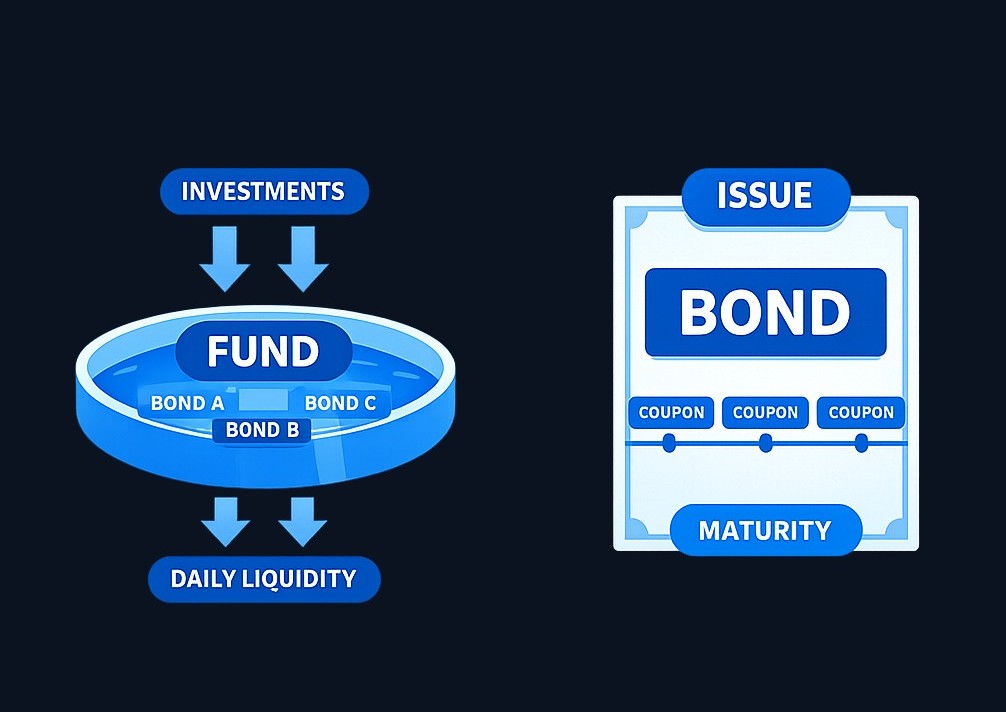
A bond fund works like a stock mutual fund. You put money into a shared pool, and a professional manager invests it across many bonds. The fund buys and sells bonds continuously. It doesn't hold each one to maturity the way you would on your own. Most funds pay out income to shareholders monthly.
Advantages of Bond Funds
- Built-in diversification. Bond funds are often spread across hundreds or even thousands of issuers. One issuer's trouble barely dents the fund.
- Low minimum investment. Fund minimums are usually low enough to buy far more diversification than the same dollar amount in individual bonds.
- Daily liquidity. Mutual fund shares can be redeemed each day, and bond ETFs trade all day like a stock.
- Professional management. Managers handle credit research, sector weighting, and yield curve positioning for you.
Disadvantages of Bond Funds
- Ongoing cost. A fund charges an expense ratio every year. A bond you simply hold doesn't.
- No fixed payoff date. The fund has no maturity date and is priced fresh every day. There's no date when you're guaranteed to get a set amount back.
- Surprise tax bills are possible. Because the fund trades constantly, its trades can trigger taxable capital gains for every shareholder in a given year — even ones who never sold a share.
What are Individual Bonds?
A bond is a loan you make to a government or company. In return, it pays you fixed interest — the coupon — on a set schedule, then returns your principal at maturity. Bond funds themselves treat individual bonds this way: investors who hold to maturity generally aren't affected by rate swings that happened in between, because they still collect full principal at the end.
Advantages of Individual Bonds
- A known payoff date. Hold to maturity, and the issuer doesn't default, and you get your exact principal back — a fixed outcome no fund can promise.
- Predictable income. Coupon payments arrive on a schedule you know in advance.
- Full control. You pick the exact issuer, coupon, and maturity. No manager decides for you.
- Rate swings matter less if you hold on. Interest rate risk barely touches you if you're holding to maturity rather than planning to sell early.
- Possible tax edge. Certain bond types, including U.S. Treasuries, can carry tax advantages worth checking against your own situation.
Disadvantages of Individual Bonds
- Real capital required. Fidelity points to several hundred thousand dollars as a rough amount needed to spread credit risk across enough issuers — though Treasurys and FDIC-insured CDs can start around $1,000.
- Liquidity depends on the bond. Treasurys and many corporate bonds trade fairly easily; most municipal bonds trade in thinner markets and can be harder to sell early.
- No safety net from other issuers. Default risk is concentrated. If your one issuer can't pay, you can lose part or all of that investment. A fund spreads that same risk across many issuers, so one default barely registers.
- You do the work. You choose and manage every holding yourself, with no professional research behind the picks.
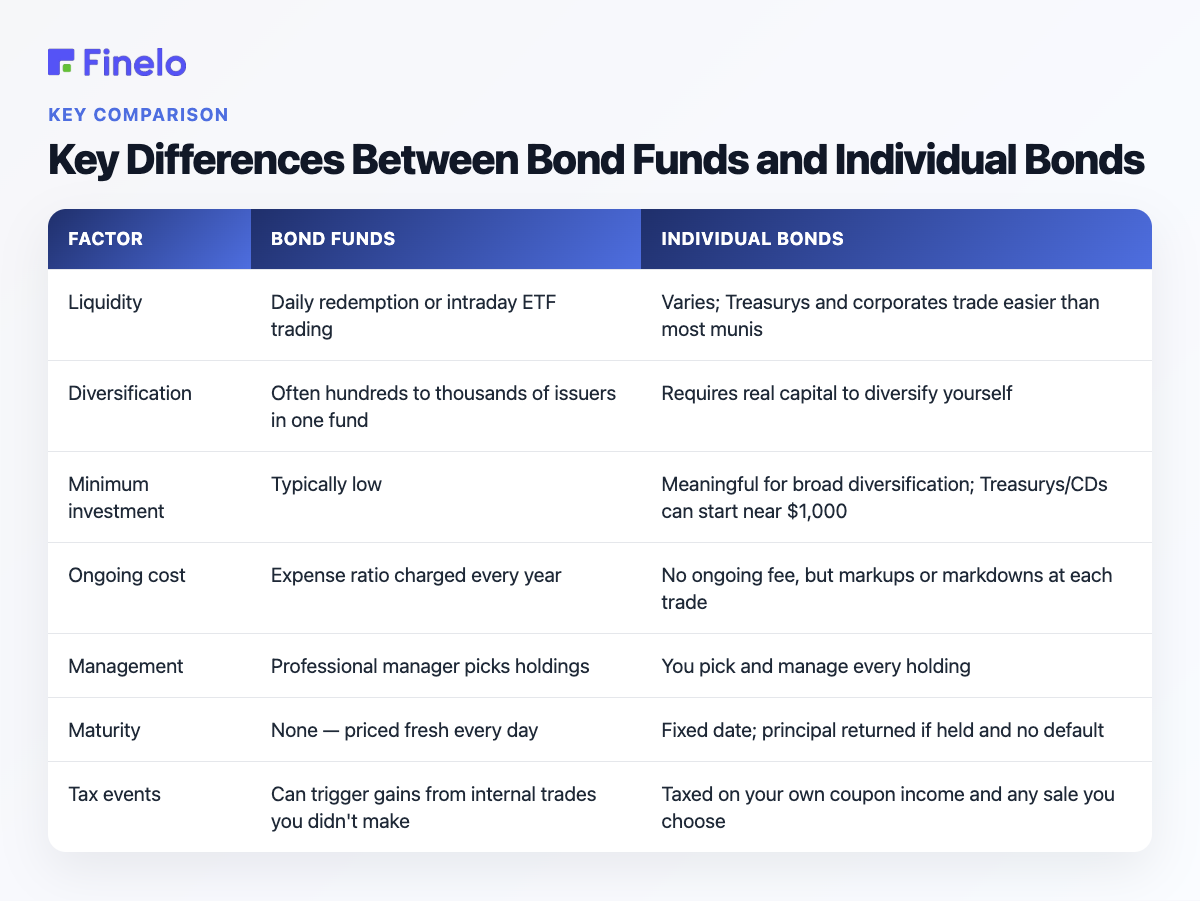
Key Differences Between Bond Funds and Individual Bonds
| Factor | Bond Funds | Individual Bonds |
|---|---|---|
| Liquidity | Daily redemption or intraday ETF trading | Varies; Treasurys and corporates trade easier than most munis |
| Diversification | Often hundreds to thousands of issuers in one fund | Requires real capital to diversify yourself |
| Minimum investment | Typically low | Meaningful for broad diversification; Treasurys/CDs can start near $1,000 |
| Ongoing cost | Expense ratio charged every year | No ongoing fee, but markups or markdowns at each trade |
| Management | Professional manager picks holdings | You pick and manage every holding |
| Maturity | None — priced fresh every day | Fixed date; principal returned if held and no default |
| Tax events | Can trigger gains from internal trades you didn't make | Taxed on your own coupon income and any sale you choose |
Interest Rate Risk: The Real Difference
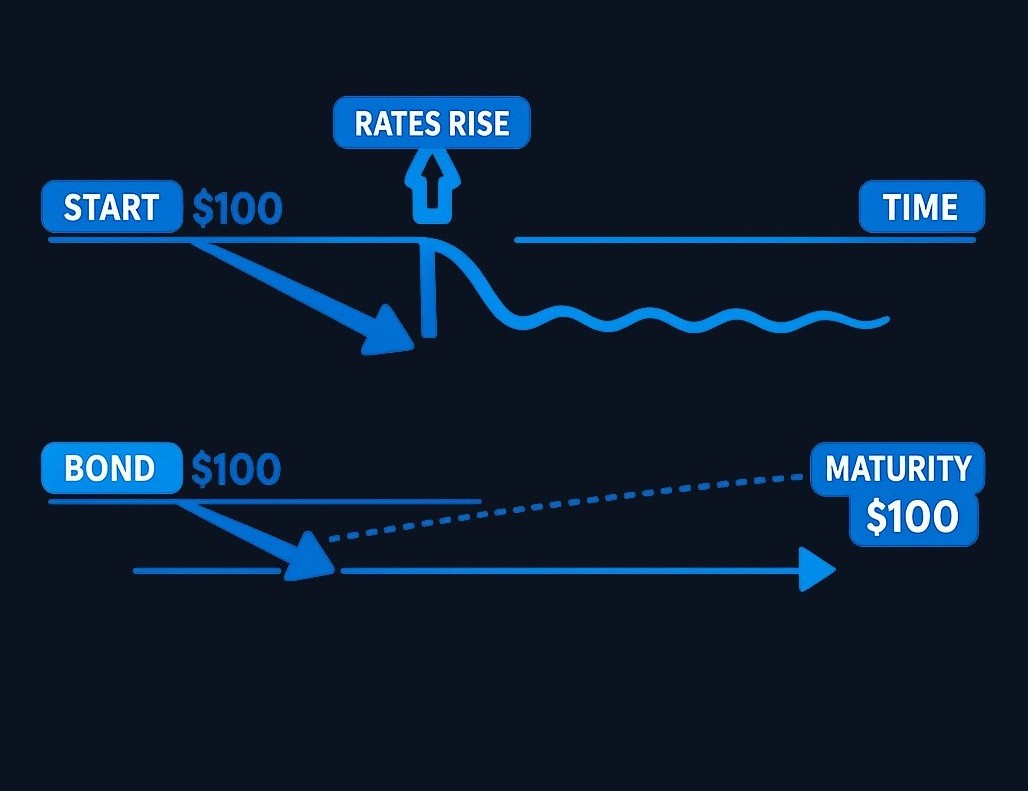
Rates move both types of bonds the same way in the short term — up when rates fall, down when rates rise. The difference is what happens next. A bond fund never reaches a maturity date, so a sustained rate increase can leave its price permanently lower than where you bought in. It just keeps rolling into new bonds at whatever rate is current. An individual bond is different: hold it to maturity, and you still collect full face value, no matter what rates did along the way. Neither wins outright. The real question is whether you need a fixed date or want ongoing flexibility more.
How Taxes Differ
A bond fund trades constantly inside its own portfolio. That trading can hand every shareholder a taxable capital gain in a given year, even if you never sold a share. An individual bond you hold yourself is simpler: you're only taxed on the coupon income you receive and on any sale you personally make. One more wrinkle worth knowing: municipal bonds are marketed as tax-free, but that label has limits — muni interest can still affect Alternative Minimum Tax exposure, and it can push more of your Social Security benefit into taxable territory or raise Medicare premiums for higher earners. Check with a tax professional before assuming "tax-free" means zero impact.
Tradeoffs and Caveats
Every choice here trades one thing for another. None of them is risk-free.
Common Mistakes to Avoid
- Assuming a bond fund "matures" like a bond does. It doesn't. There's no date when the fund promises to hand back a fixed amount.
- Assuming diversification removes all risk. A diversified bond fund can still lose value in a rate spike. Diversification softens single-issuer risk. It doesn't erase market-wide risk.
- Treating "hold to maturity" as risk-free. It only protects you from interest rate swings. It does nothing if the issuer defaults.
- Assuming munis are always tax-free. As shown above, that's not always true once AMT, Social Security, and Medicare rules enter the picture.
Honest Limitations of Both Choices
Bond funds can lose value, and a manager's skill doesn't guarantee a good outcome in every market. Individual bonds can default, and selling one early — before maturity — can mean taking a loss instead of the fixed return you expected. Past yields and past fund performance don't guarantee what happens next in either choice. Treat every number in this article as a snapshot, not a promise, and verify current rates and terms before investing any money.
Practice investing with Finelo
Build practical investing skills with guided lessons, simulator practice, and structured challenges.
When to Choose Bond Funds
Bond funds tend to fit best when:
- You're starting with limited capital. A few thousand dollars buys real diversification in a fund. The same amount in individual bonds might only buy one or two issuers.
- You want hands-off management. You'd rather delegate credit research and rebalancing than do it yourself.
- You don't have one fixed date you're saving toward. A fund's daily liquidity and lack of a maturity date aren't a drawback if you're not targeting a specific payout date.
- You want exposure that's hard to buy piece by piece — high-yield corporate bonds, mortgage-backed securities, or international bonds, where a fund's scale beats assembling individual holdings yourself.
- You're investing through an automated account. Target-date funds, robo-advisors, and most 401(k) menus lean on bond funds because their built-in diversification suits hands-off investing.
- You want income reinvested automatically. A fund's monthly payout can be set to reinvest without you shopping for a replacement bond every time one matures.
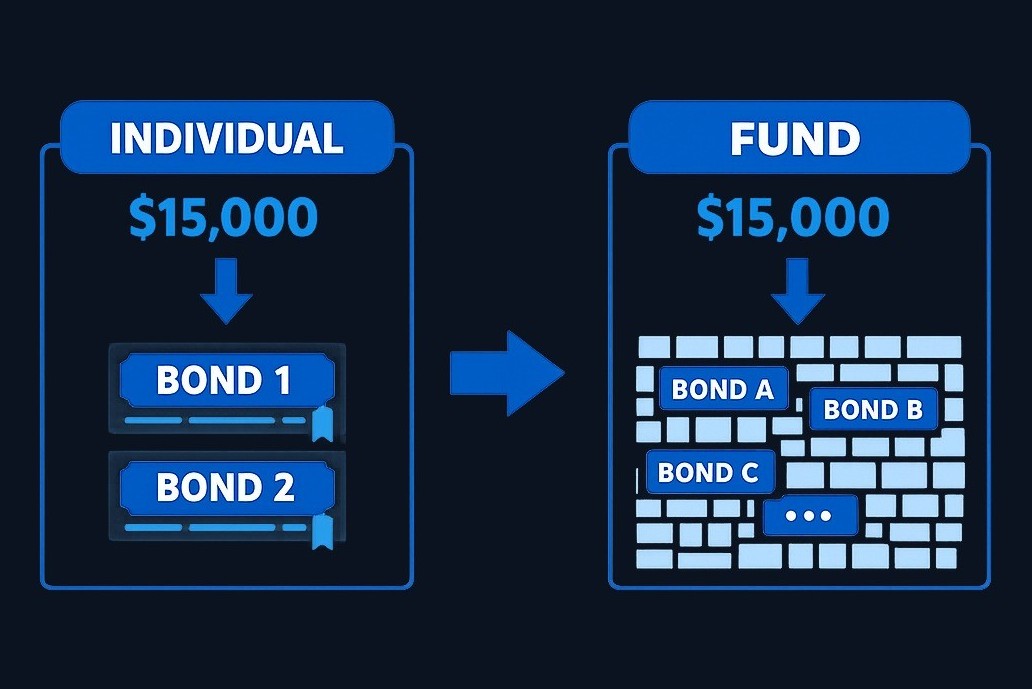
A realistic scenario: an investor with $15,000 to put into fixed income doesn't have enough to build a diversified basket of individual corporate bonds. One intermediate-term bond fund gets that investor exposure to hundreds of issuers immediately, at a fraction of the capital individual bonds would need for the same spread of risk.
When to Choose Individual Bonds
Individual bonds tend to fit best when:
- You have a specific expense on a specific future date — tuition in six years, a mortgage payoff, a planned retirement date — and you want an investment that returns a known amount on that exact date.
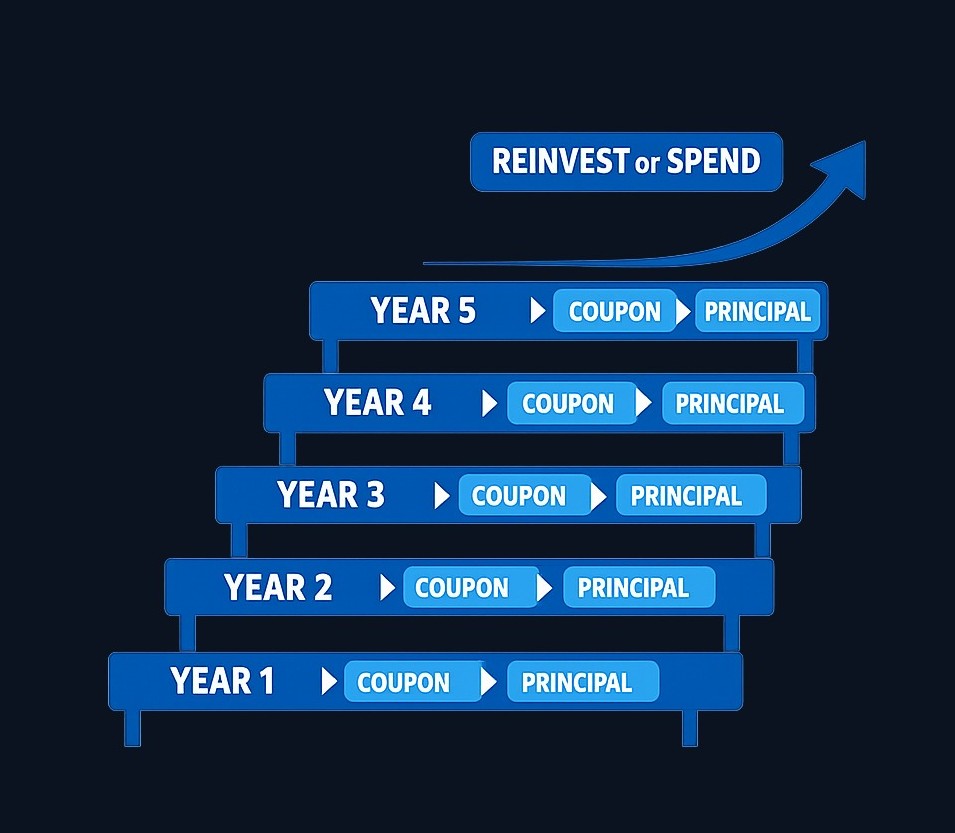
- You want to build a bond ladder. A ladder means buying several bonds or CDs with maturity dates staggered across future years, so something matures on a predictable schedule. Each rung's coupon payments and principal repayment stay fixed and scheduled, even as the bond's market price moves in between.
- You have enough capital to diversify on your own. With substantial assets — Fidelity points to several hundred thousand dollars as a rough threshold for spreading credit risk across issuers — you can build a custom ladder without paying an ongoing expense ratio.
- You want to control your own tax timing. Since you decide if and when to sell, you also decide when to realize a gain — unlike a fund that can distribute gains from trades you had no part in.
- You're comfortable doing your own homework on a specific issuer's credit profile instead of delegating that call to a fund manager.
A realistic scenario: an investor planning to leave a job in five years ladders bonds or CDs maturing in years one through five. Each rung matures on schedule, creating supplemental income that bridges the gap without forcing an early sale of anything.
Building a basic ladder: pick your time horizon — say, five years. Divide your investable amount across that many maturities. Buy one bond or CD maturing in each of years one through five. As each rung matures, either reinvest the proceeds in a new long rung, or spend it if that was the goal. The mechanics are simple. The discipline is making sure each rung's maturity actually lines up with when you'll need the money.
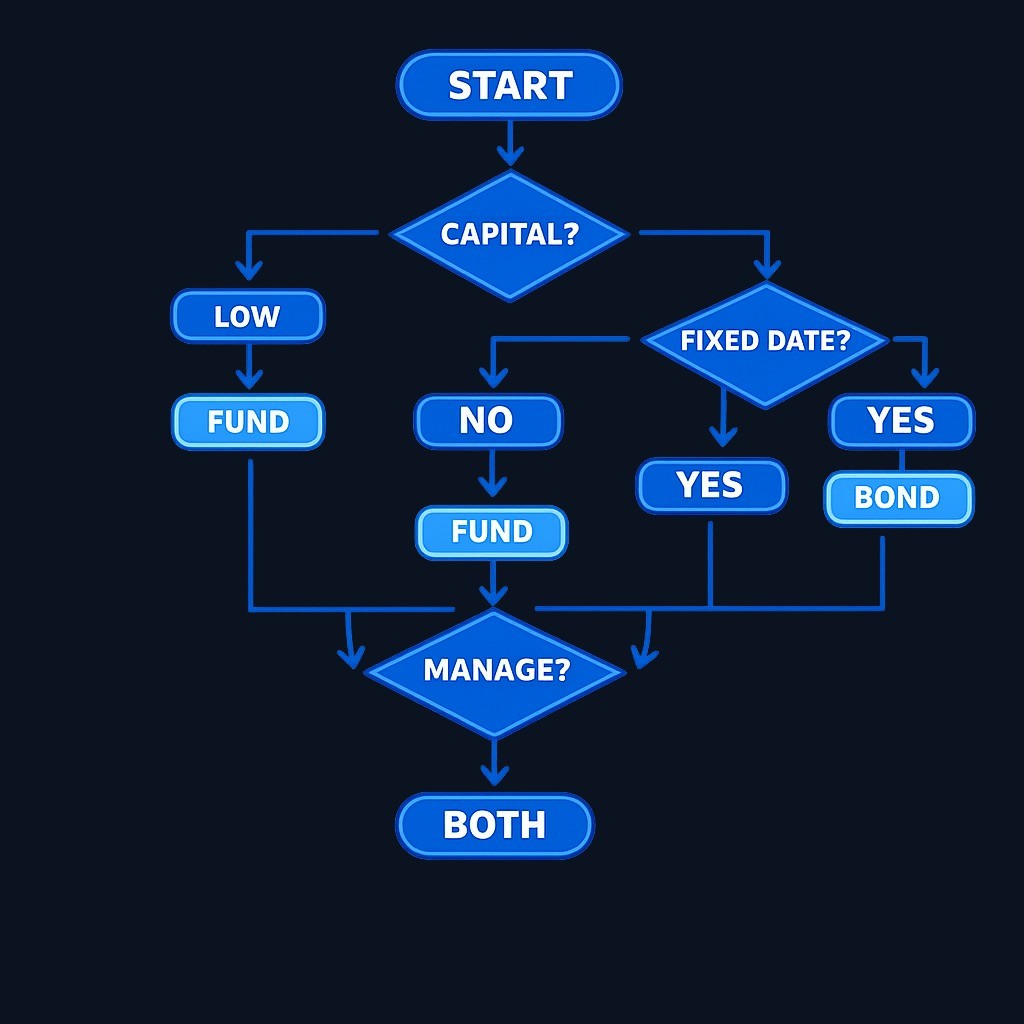
Decision Framework: Bond Funds vs Individual Bonds
Answer these questions in order:
| Question | Bond funds fit better if... | Individual bonds fit better if... |
|---|---|---|
| How much capital do you have for fixed income? | Under roughly $25,000–$50,000 | Enough to diversify across issuers, or you're using Treasurys/CDs that need less |
| Do you need the money back on a specific date? | No — ongoing exposure is fine | Yes — a ladder or single bond can target that date directly |
| How hands-on do you want to be? | You'd rather delegate research and trading | You want to pick and manage every holding yourself |
| How do you feel about surprise tax bills? | You accept that funds can distribute gains you didn't cause | You want full control over when you realize a taxable gain |
| Do you need daily liquidity? | Yes — redemption or intraday trading matters | Not critical — you plan to hold to maturity anyway |
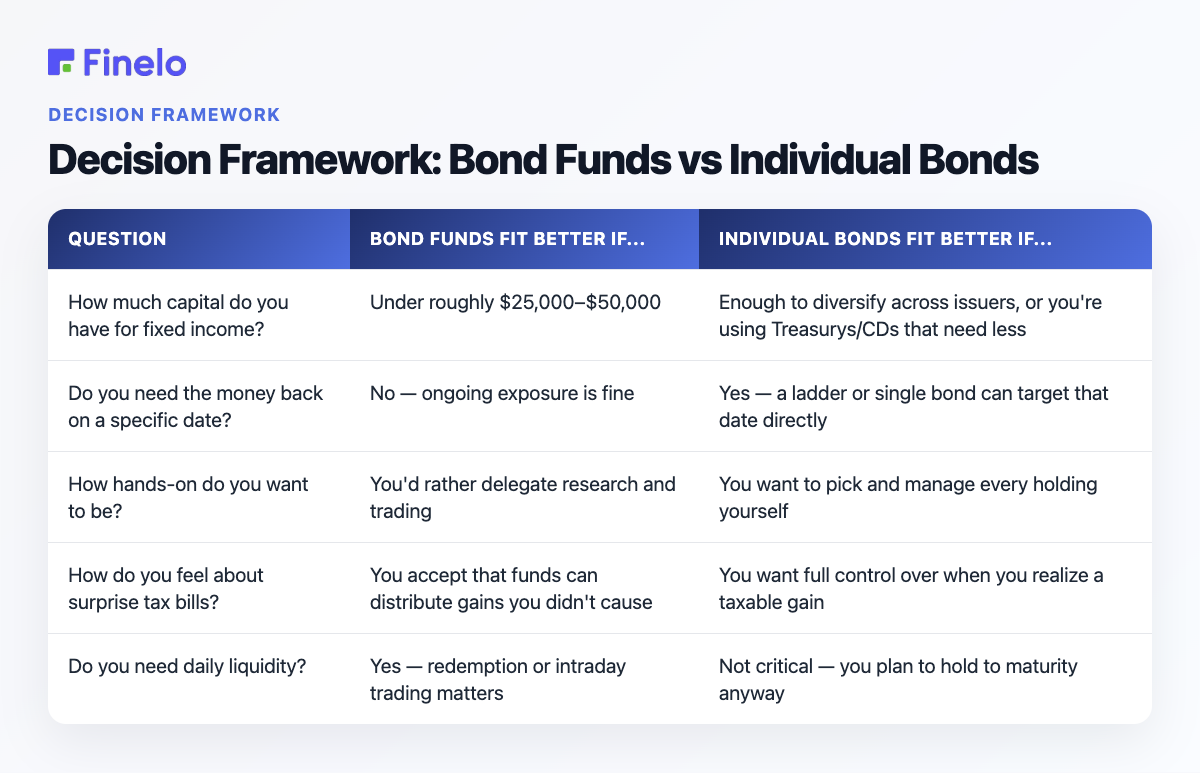
Most investors don't have to pick one side and stay there. Many blend both: a core bond fund for broad, low-effort diversification, plus individual bonds layered in for a specific goal, like a ladder timed to a known future need. If your answers split between the two columns, that split is itself a reasonable signal to hold both.
Conclusion
Neither option wins outright. Bond funds win on diversification per dollar, daily liquidity, and delegated management. Individual bonds win on fixed-date certainty, control, and avoiding fund-level tax surprises. The framework above turns your capital, time horizon, and appetite for hands-on management into a starting answer. Many investors reasonably hold both, using each where it fits best.
Your next step: total up how much you have for fixed income. Decide whether you're saving toward one specific date. Then run those two answers through the table above before choosing where your next contribution goes.
This article is educational, not personalized financial advice. Bond values, tax treatment, and yields change with market conditions. Verify current details and consult a qualified professional before investing. If you want a structured way to build this kind of decision-making skill further, Finelo's Wealth Growth Quiz matches you with a learning path suited to your experience level.
Frequently asked questions
What is the main difference between individual bonds and bond funds?
An individual bond is a direct loan that returns a fixed principal at a set maturity date. A bond fund pools many bonds under professional management, with no maturity date of its [own](https://www.fidelity.com/learning-center/investment-products/mutual-funds/bond-vs-bond-funds). The fund trades fixed-date certainty for diversification and daily liquidity.
What is a bond ladder and how does it work?
A bond ladder means buying several bonds or CDs with maturity dates staggered across future [years](https://www.fidelity.com/learning-center/personal-finance/bond-bridge), so one matures on a predictable schedule while fixed coupon payments keep arriving in between. It's a way to use individual bonds for planned, date-specific income without guessing where rates will be later.
Are bond funds suitable for retirement accounts?
Many retirement portfolios use bond funds because their built-in diversification and daily liquidity suit automated, hands-off investing — which is why target-date funds and many 401(k) menus lean on them. Individual bonds can also sit in a retirement account, but they need the same capital and diligence there as in a taxable account.
What are the tax implications of bond funds versus individual bonds?
A bond fund's internal trading can generate taxable capital gains for every shareholder in a given year, even if you never sold your [shares](https://www.fidelity.com/tax-information/tax-topics/mutual-funds). An individual bond you hold directly is taxed only on the coupon income you receive and any sale you choose to make — though municipal bond interest, despite its tax-free reputation, can still affect AMT exposure and Social Security or Medicare [calculations](https://www.schwab.com/learn/story/not-always-tax-free-7-municipal-bond-tax-traps).
InvestingBeginnerBondsMarkets
Practice investing with Finelo
Build practical investing skills with guided lessons, simulator practice, and structured challenges.
About the author
Finelo Team
The Finelo Team creates practical investing and trading education designed to help beginners learn faster with structured challenges, simulator practice, and bite-sized lessons.
Keep reading — Related articles
Investing
Yield to Call vs Yield to Maturity: Assumptions and Bond Risks
Yield to call (YTC) estimates a bond's yield if the issuer redeems it on an eligible call date; yield to maturity (YTM) estimates yield if it remains outstanding to final maturity.
Finelo Team
Investing
Will My Employer Know If I Take a 401(k) Loan?
Who this page is for: readers new to 401(k) loans who want a practical, privacy‑focused explanation — what your employer can see, how to limit visibility, and the financial tradeoffs to weigh.
Finelo Team
Investing
What Medical Expenses Qualify for a 401(k) Hardship Withdrawal?
Before you decide, confirm three things with your plan administrator:
Finelo Team