Choose an IRA when the money is primarily for retirement and you can follow contribution and withdrawal rules in exchange for tax advantages. Choose a taxable brokerage account when flexible access, fewer contribution restrictions, or a non-retirement goal matters more. Many investors use both: an IRA for long-term retirement assets and a brokerage account for additional investing or goals that may arrive sooner.
Brokerage Account vs IRA: Key Differences and Considerations
Choose an IRA when the money is primarily for retirement and you can follow contribution and withdrawal rules in exchange for tax advantages. Choose a taxable brokerage account when flexible access, fewer contribution…
11 min read
Practice investing with Finelo
Build practical investing skills with guided lessons, simulator practice, and structured challenges.
Want to learn more?
Build practical investing skills with guided lessons, simulator practice, and structured challenges.
Explore FineloExplore Finelo's 28-day challenges
Turn learning into a daily habit with guided challenge paths.
This Finelo educational comparison helps readers compare the accounts by purpose, access, taxes, investment choices, and real-life use—not by labels alone.
What Is a Brokerage Account?
A brokerage account is an account used to buy, hold, and sell investments. For this comparison, “brokerage account” means a regular taxable account rather than a retirement account housed at a brokerage firm.
The word taxable is important. The account does not place the same retirement-focused tax wrapper around investment activity as an IRA. Depending on the asset, transaction, income, and tax rules that apply to you, selling an investment at a gain or receiving a distribution may create a current tax consequence.
Brokerage accounts are usually chosen for flexibility. They may support:
- Investing for a goal before retirement
- Adding investments after using available retirement-account space
- Holding money without retirement-specific contribution rules
- Withdrawing available cash without classifying the withdrawal as a retirement distribution
- Building a portfolio that serves several future goals
Flexible access does not mean instant, free, or tax-neutral access. You may need to sell an investment, wait for the transaction to settle, account for market losses, maintain collateral for another position, or pay applicable fees and taxes. The provider’s account agreement controls the operational details.
Imagine an investor saving for a home that may be purchased in several years. A brokerage account avoids tying every dollar to retirement rules. However, investing near-term goal money in volatile assets can create a separate problem: the market may be down when the money is needed. Account flexibility cannot replace a suitable investment time horizon.
What Is an IRA?
An individual retirement account, or IRA, is a retirement-focused account with tax rules governing contributions, investments, and withdrawals. The two common versions are Traditional and Roth IRAs.
Traditional IRA
A Traditional IRA may offer a current tax deduction for an eligible contribution, depending on the rules and the contributor’s circumstances. Investment activity inside the account is generally not taxed in the same way as activity in a regular taxable account. Withdrawals can create taxable income, and additional consequences may apply when money is taken out early or outside an exception.
This structure may appeal to someone who values a possible tax benefit today and expects to use the money in retirement. The value of that tradeoff depends on eligibility, current and future tax circumstances, and withdrawal timing.
Roth IRA
A Roth IRA generally uses contributions made with money that has already been taxed. It does not usually provide the same upfront deduction as a Traditional IRA, but qualified withdrawals can receive favorable tax treatment. Income eligibility and other rules may affect whether and how someone can contribute.
This structure may appeal to someone who prefers to pay tax before contributing and wants the potential for qualified retirement withdrawals without another income-tax charge. That benefit depends on meeting the applicable rules.
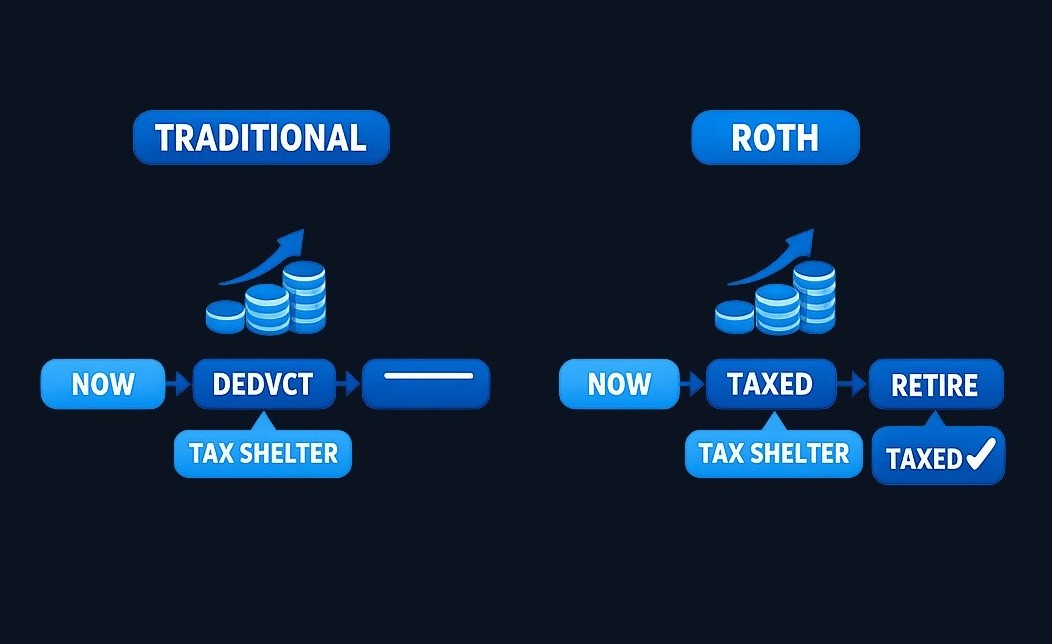
Both IRA types have contribution and withdrawal restrictions that can change. Check the current limits, eligibility tests, deadlines, distribution rules, and exceptions before contributing or withdrawing. An IRA is also an account type, not an investment. Opening one does not automatically invest the cash placed inside it.
Brokerage Account vs IRA: Key Differences
| Decision factor | Taxable brokerage account | Traditional or Roth IRA |
|---|---|---|
| Main purpose | Flexible investing for many goals | Retirement-focused investing |
| Contribution rules | Generally not governed by an IRA-style annual contribution limit | Contributions are subject to annual rules and eligibility requirements |
| Access to cash | Available cash can generally be withdrawn without an IRA early-distribution analysis | Withdrawals may trigger taxes, penalties, or other consequences depending on type and circumstances |
| Tax treatment while invested | Sales, dividends, interest, and distributions may create current tax consequences | Investment activity receives the account’s retirement tax treatment |
| Upfront tax benefit | No retirement-account deduction for adding money | A Traditional IRA contribution may be deductible when conditions are met |
| Treatment of qualified withdrawals | No special IRA qualification; tax depends on the investments and transactions | Traditional and Roth withdrawals follow different tax rules |
| Investment menu | Depends on the brokerage and account permissions | Depends on the IRA custodian and retirement-account restrictions |
| Income eligibility | Usually no retirement-style income test to fund the account | Some IRA contribution or deduction rules can depend on income and other factors |
| Required recordkeeping | Track purchases, sales, income, and tax basis | Track contributions, conversions, withdrawals, and IRA type |
| Best fit | Flexibility, non-retirement goals, or additional investing | Long-term retirement saving with tax advantages |
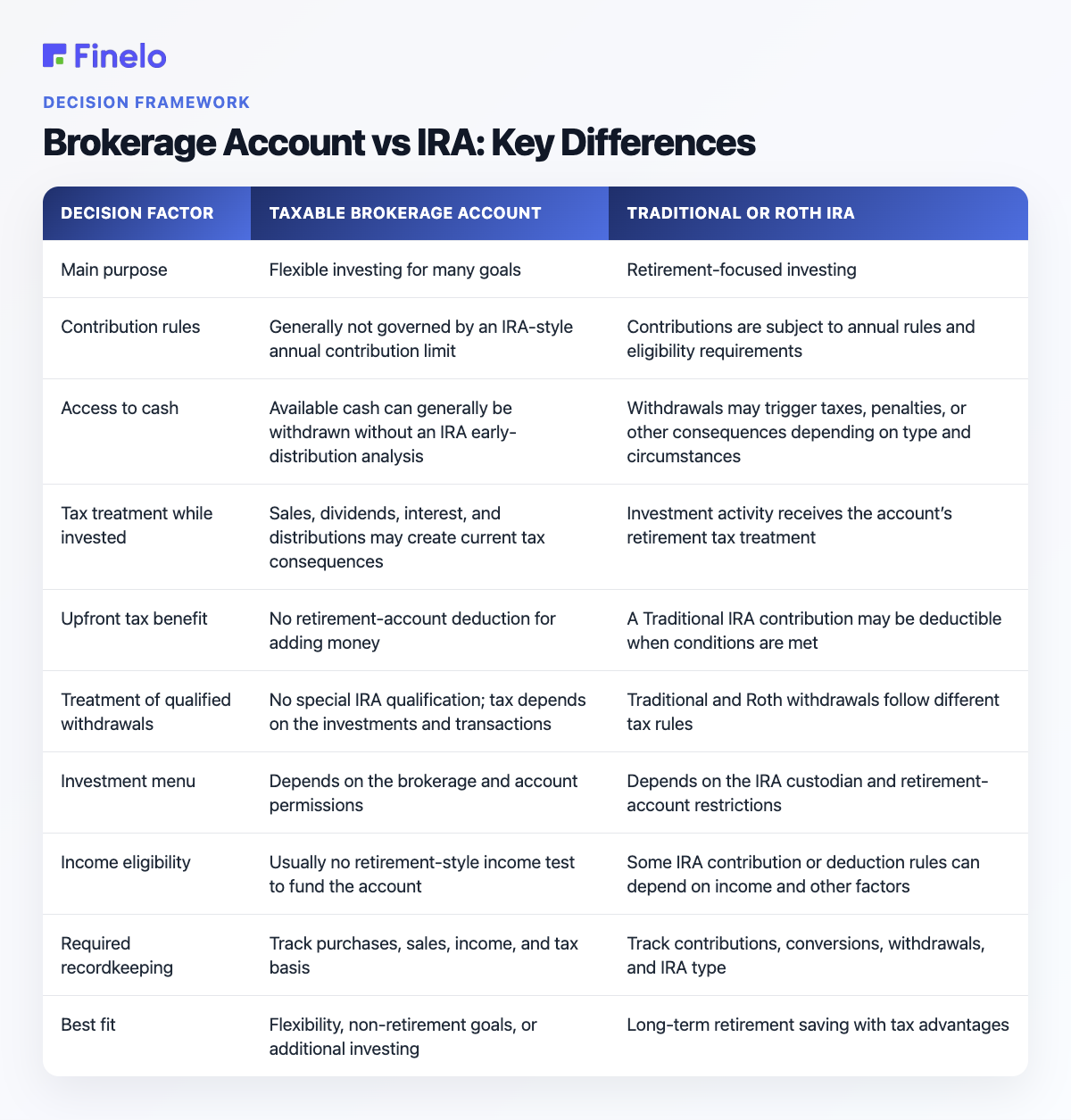
The most important difference is the trade between flexibility now and retirement tax treatment.
A brokerage account generally makes access easier, but it can create taxes during the investing journey. An IRA can shelter or defer some of those tax effects, but it adds contribution and distribution rules. That is why the better account depends on when the money may be needed and which tax treatment applies.
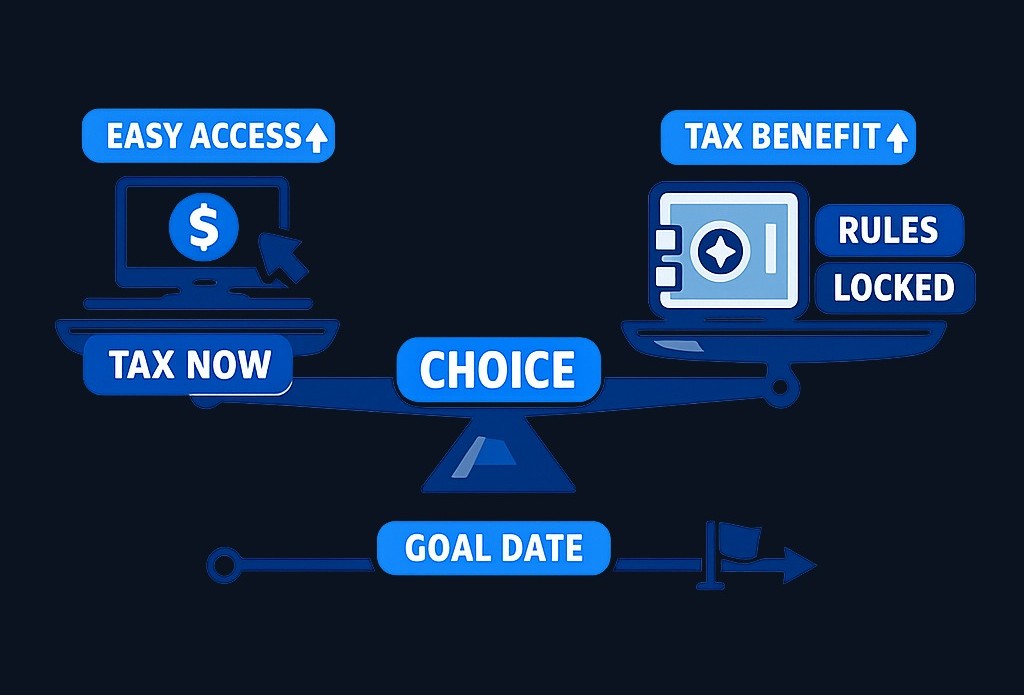
Do not compare only account names. Compare the full package:
- The goal and target date
- The probability of needing the money early
- Current IRA eligibility
- The expected investments
- Current and future tax considerations
- Fees and provider restrictions
- The records you can maintain
Investment Options Available
The account and the investment are separate decisions. A brokerage account or IRA is the container. Stocks, bonds, funds, cash products, and other eligible assets are what may go inside.
Availability varies by provider, account agreement, jurisdiction, and investment. Use this table as a comparison checklist rather than a promise that every platform offers every item.
| Investment or feature | Brokerage account | IRA |
|---|---|---|
| Individual stocks | Often available | Often available |
| Bonds | Often available | Often available |
| Mutual funds | Often available | Often available |
| Exchange-traded funds | Often available | Often available |
| Cash or settlement fund | Typically needed for transactions | Typically needed for transactions |
| Certificates or fixed-term cash products | May be available | May be available |
| Options trading | May be available with approval | May be limited by provider and retirement-account rules |
| Margin borrowing | May be available with approval | Often restricted or unavailable in standard form |
| Alternative or private assets | Provider-dependent and may require specialized custody | May require a specialized custodian and additional review |
| Automated investing | May be available | May be available |
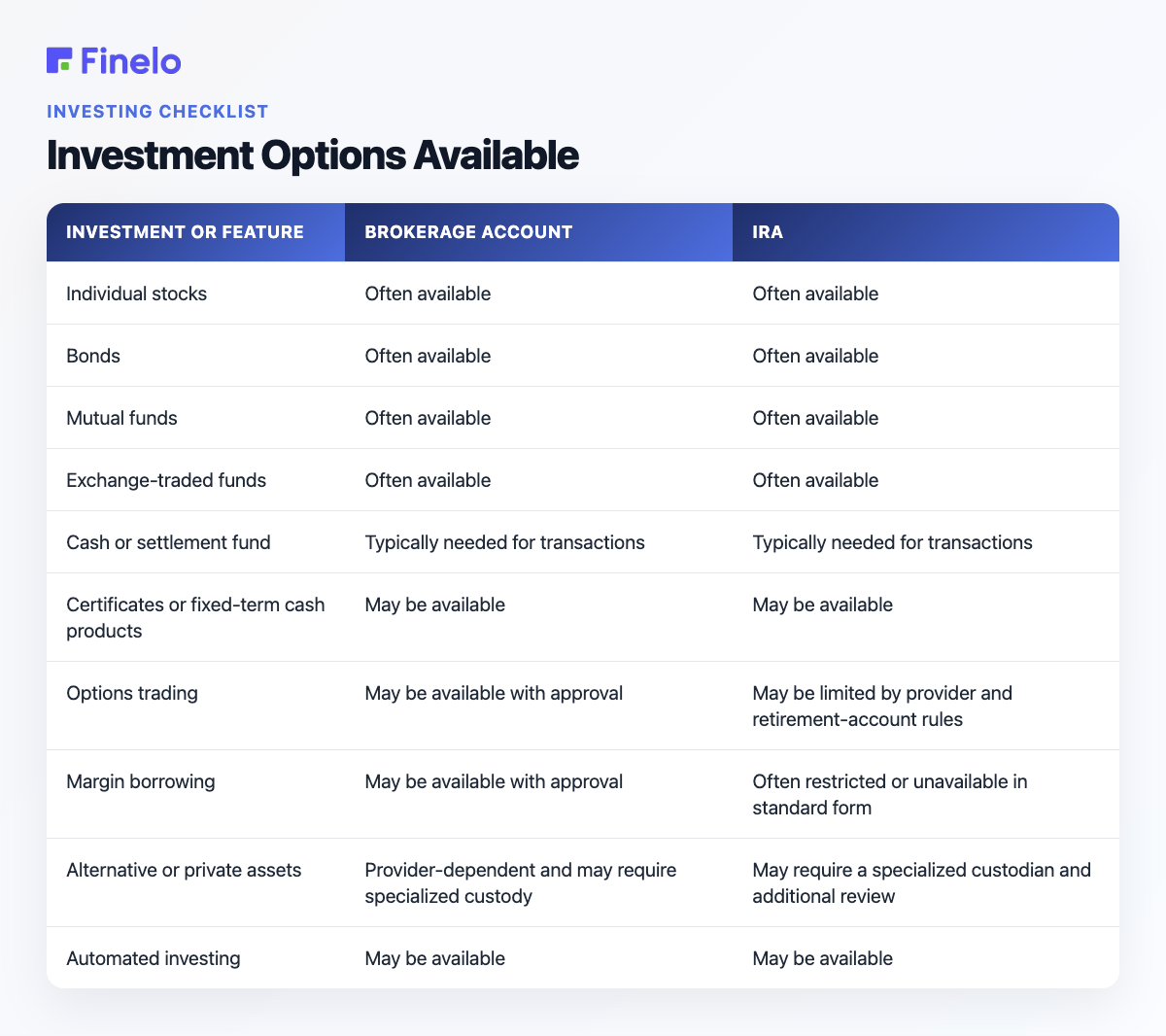
The right investment menu depends on the goal. A broad list is not automatically better. An account with hundreds of complex products can still be a poor fit if the investor needs only a diversified long-term portfolio and low ongoing costs.
When comparing providers, check:
- Which investments are actually available in the specific account
- Trading commissions and transaction charges
- Fund expense ratios
- Account, advisory, transfer, and closure fees
- Minimum investment requirements
- Automatic contribution and reinvestment settings
- Research, statements, tax documents, and customer support
- Restrictions on options, borrowing, or specialized assets
Also look for duplication. Owning several funds across a brokerage account and IRA may feel diversified while exposing the investor to the same companies, sectors, or risks repeatedly.
Practice investing with Finelo
Build practical investing skills with guided lessons, simulator practice, and structured challenges.
Tax Implications and Withdrawal Rules
Tax treatment is usually the hardest part of this comparison because the answer depends on account type, income, investment activity, holding period, withdrawal purpose, and jurisdiction. Use the following framework to identify the questions that need current tax guidance.
Taxable brokerage account
Adding money to a regular brokerage account does not normally create an IRA-style contribution deduction. Tax consequences can arise from investment income, fund distributions, and sales. A withdrawal itself is not necessarily the event that creates the tax result; selling an asset or receiving income may be the relevant event.
For example, imagine that an investor sells part of a portfolio to pay for a home deposit. The cash can generally leave the brokerage account after the sale settles, but the sale may create a gain or loss. Withdrawing the same amount from idle cash may produce a different tax result because no investment sale is needed.
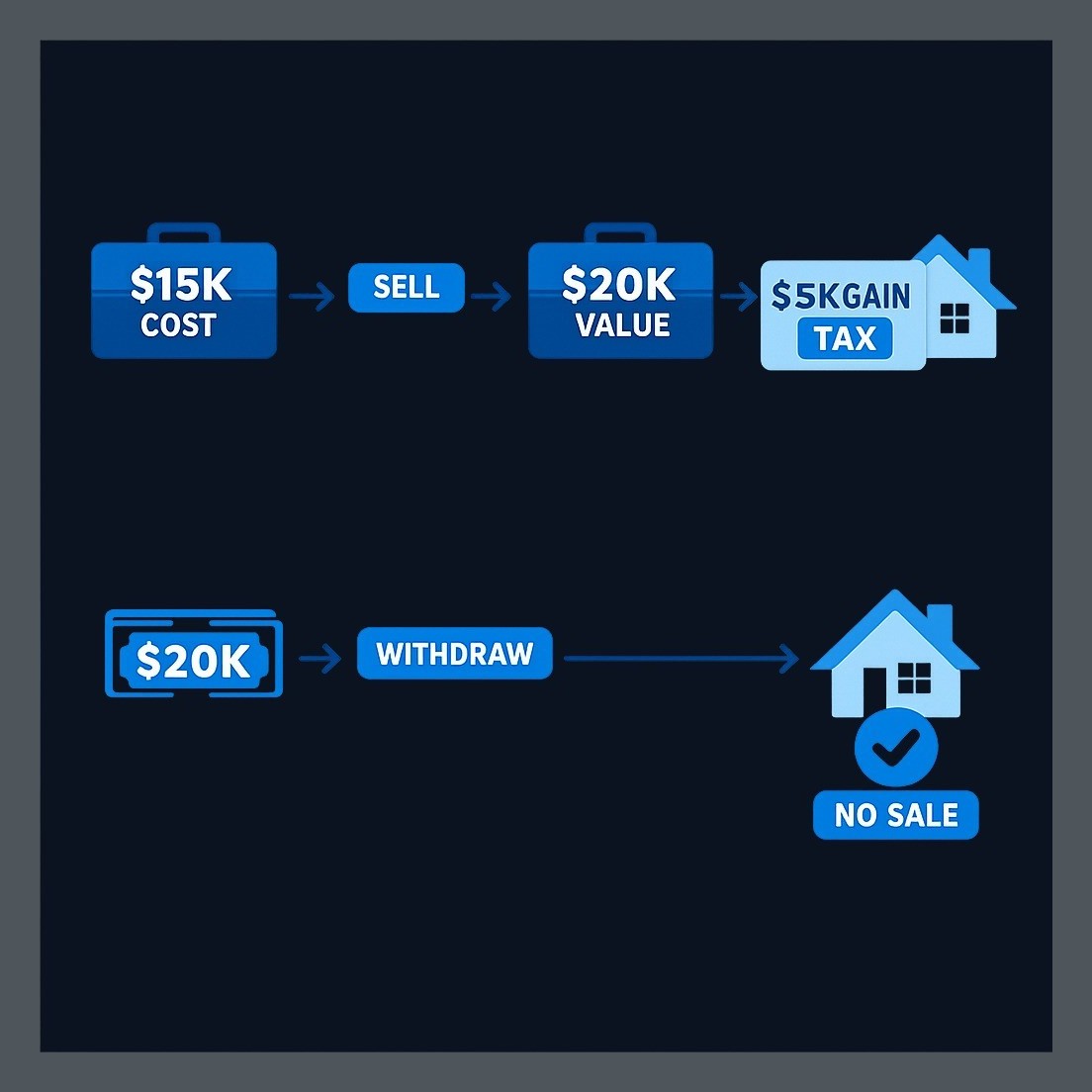
Recordkeeping matters. Track purchase dates, purchase amounts, reinvested distributions, sales, fees, and any adjustments. Do not assume the account balance alone contains everything needed for a tax return.
Traditional IRA
A Traditional IRA moves the tax decision toward contribution eligibility and eventual distributions. A contribution may or may not produce a current deduction. Withdrawals may be taxable, and early distributions may have additional consequences unless an exception applies.
The practical question is not simply, “Can I withdraw?” It is, “What portion can I withdraw, how will it be classified, and what tax or penalty could follow?” Confirm the answer before moving money.
Roth IRA
A Roth IRA usually receives contributions that did not create an upfront deduction. Its potential advantage is favorable treatment for qualified withdrawals. Different rules can apply to regular contributions, converted amounts, and investment earnings, so do not treat the entire balance as one unrestricted pool.
Before a Roth withdrawal, identify where the money came from, how long the account and each relevant amount have been held, the purpose of the withdrawal, and whether an exception applies.
State and local taxes
Do not assume federal treatment answers the entire question. State or local rules may differ in how they handle deductions, income, gains, or retirement distributions. Check the rules that apply where you file.
This article cannot determine an individual tax outcome. Verify current rules with the relevant tax authority and use a qualified tax professional when a contribution, conversion, or withdrawal could materially affect the return.
When to Choose a Brokerage Account vs an IRA
Start with the money’s job.
Choose an IRA first when:
- The goal is retirement.
- The money is unlikely to be needed early.
- You are eligible to contribute.
- The tax treatment supports your wider plan.
- You understand the withdrawal restrictions.
Choose a brokerage account first when:
- The goal may occur before retirement.
- Flexible access is essential.
- You want to invest more than current IRA rules allow.
- You are not eligible for the IRA contribution you intended.
- You need an investment or account feature unavailable in the IRA.
Consider using both when:
- Retirement and pre-retirement goals are being funded together.
- Available IRA space is not enough for the planned investing amount.
- You want different investments or tax treatments for different goals.
- Keeping accessible assets reduces the chance of an early IRA withdrawal.
Use this decision path:
Is the money primarily for retirement?
├─ No → Start by evaluating a brokerage account.
└─ Yes
├─ Might you need the money earlier? → Build accessible savings first,
│ then decide how much can remain committed to an IRA.
└─ Unlikely to need it early
├─ Eligible and comfortable with IRA rules? → Compare Traditional and Roth.
└─ Not eligible or IRA amount already used → Evaluate a brokerage account.
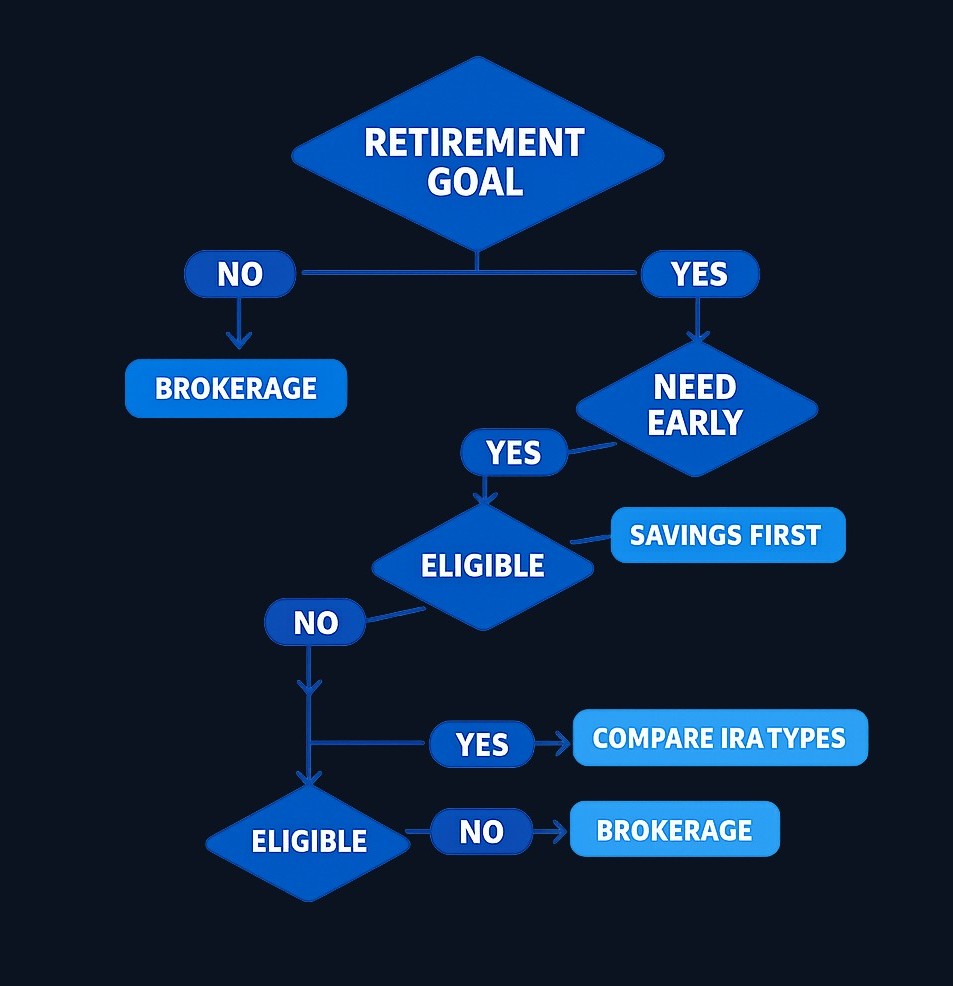
This framework does not choose investments or tax treatment for you. It prevents a common mistake: selecting a tax label before defining the goal and liquidity need.
Scenario 1: Retirement is the only goal
Jordan is investing for retirement and has separate emergency savings. An IRA may be the logical first account to evaluate because the goal and account purpose align. Jordan still needs to compare Traditional and Roth eligibility, tax treatment, fees, and investments.
Scenario 2: The goal has a flexible date
Casey may use the money for a home, business, education, or another goal before retirement. A brokerage account offers more flexibility. Casey should still match the portfolio’s risk to the earliest plausible withdrawal date.
Scenario 3: Retirement contributions continue beyond the IRA
Morgan uses an IRA for retirement but wants to invest additional money. A brokerage account can hold the additional portfolio. Morgan should review the combined asset allocation rather than managing the accounts as unrelated portfolios.
Scenario 4: Income changes from year to year
Riley’s income and tax situation vary. Instead of assuming one IRA type is always better, Riley reviews eligibility and the value of an upfront deduction each year. A brokerage account remains available for money that does not fit the chosen IRA approach.
Scenario 5: Access uncertainty
Taylor wants retirement growth but may need funds for a major transition. Committing every investable dollar to an IRA could create a future access problem. Taylor first separates emergency and near-term money, then chooses an IRA amount that can remain invested.
Using Both Accounts Without Creating a Mess
Having both accounts can solve different goals, but it can also create duplication and difficult recordkeeping.
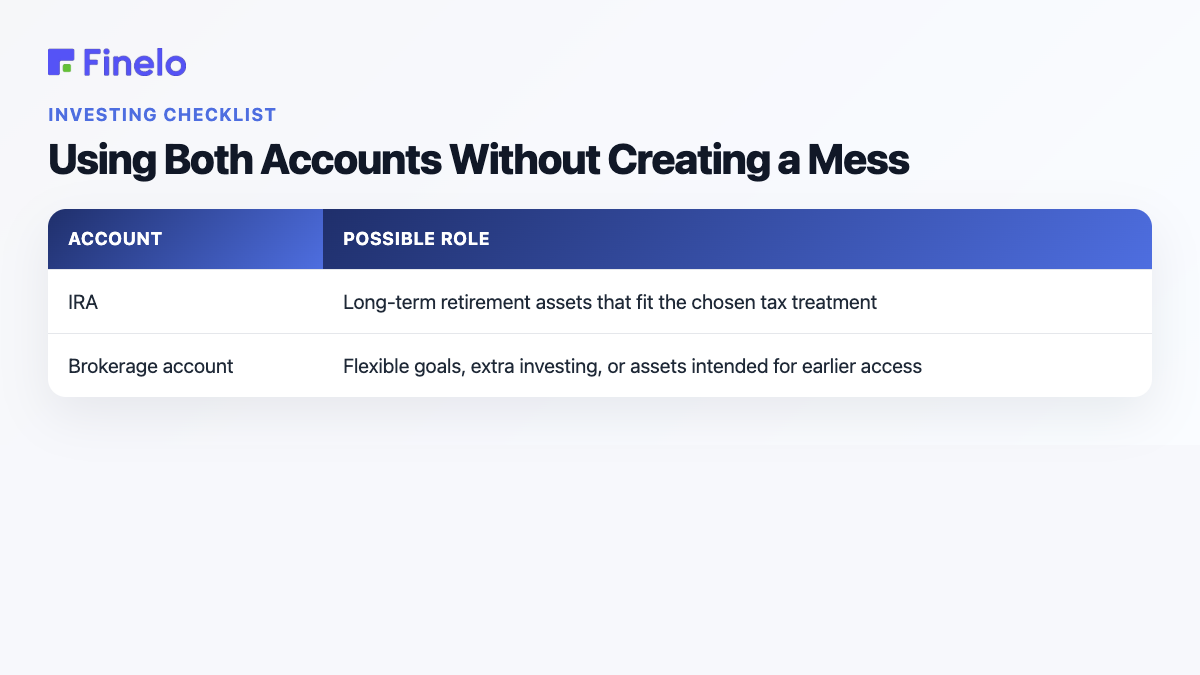
Assign each account a job:
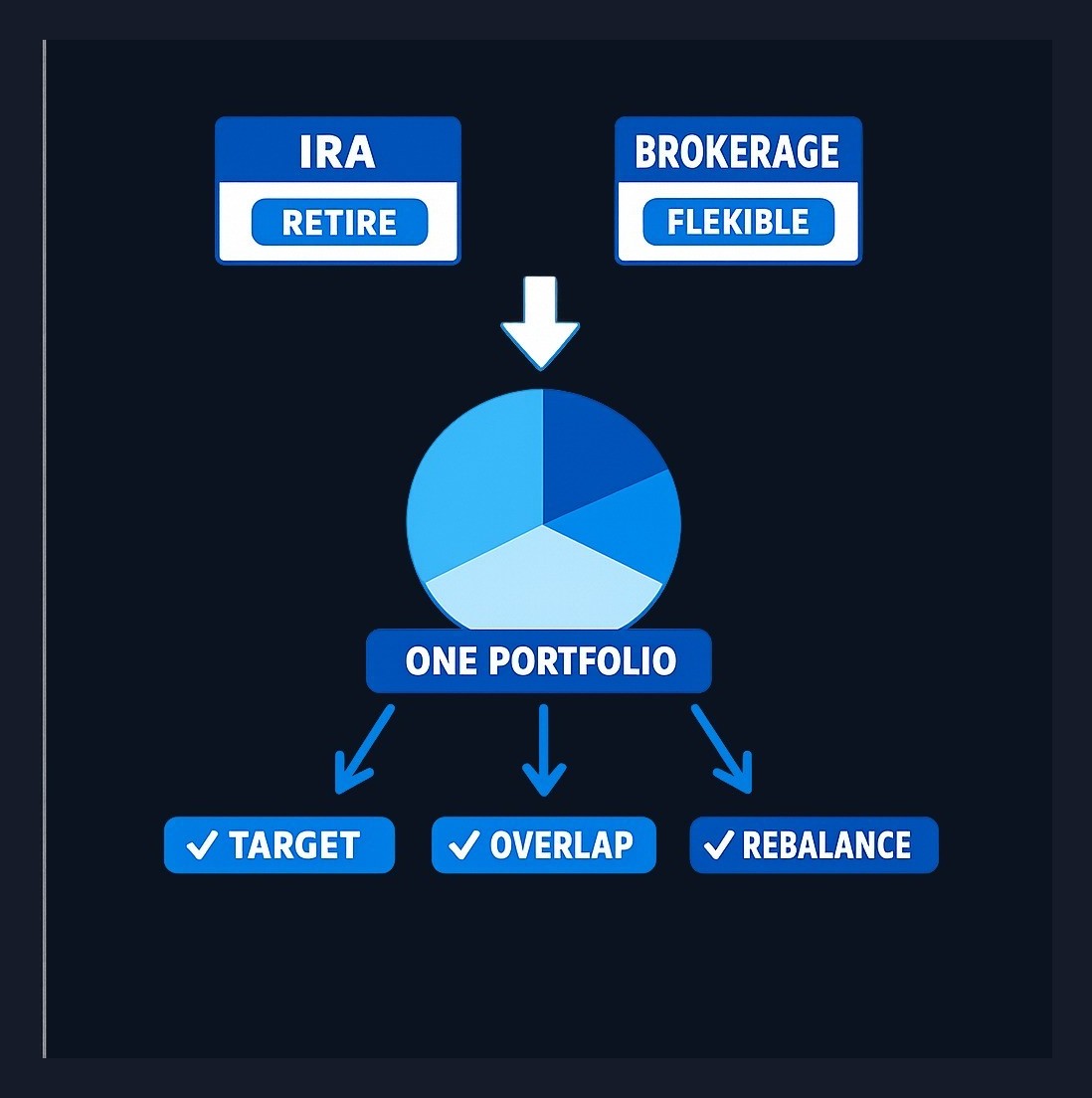
| Account | Possible role |
|---|---|
| IRA | Long-term retirement assets that fit the chosen tax treatment |
| Brokerage account | Flexible goals, extra investing, or assets intended for earlier access |
Then manage the accounts as one portfolio:
- Set a target allocation across all accounts.
- Decide which investments belong in each account.
- Check overlap between funds and individual holdings.
- Rebalance with new contributions when practical.
- Keep beneficiaries, contact information, and records current.
- Review fees and account restrictions annually.
Do not assume money can be moved freely between the accounts without consequences. A movement into an IRA may count as a contribution, rollover, or conversion depending on its source and method. A movement out may count as a distribution. The provider may require assets to be sold or transferred in a particular way.
Before moving money, ask the receiving and sending institutions to explain the transaction type, paperwork, investment handling, fees, and tax reporting. Confirm the treatment before authorizing the transfer.
Next Steps
Write down the goal, target date, and earliest date the money might be needed. Then compare:
- Brokerage, Traditional IRA, and Roth IRA eligibility
- Current contribution and withdrawal rules
- Tax treatment now and later
- Available investments
- Provider fees and restrictions
- The effect on emergency and near-term savings
Choose the account only after answering those questions. If retirement is the goal and the money can stay invested, an IRA may deserve priority. If flexibility or a nearer-term goal matters more, a brokerage account may fit better. If both goals matter, give each account a clear role.
Finelo’s role is educational: clarify the tradeoffs before money moves. Account selection cannot guarantee an investment result, and the tax value of either choice depends on individual circumstances. Confirm current rules and consider qualified financial or tax guidance for a high-impact decision.
Frequently asked questions
Can I withdraw money from a brokerage account at any time?
You can generally withdraw available cash, but invested money may need to be sold and settled first. Taxes, market losses, account holds, collateral requirements, or provider fees may affect the amount and timing.
What are the tax benefits of a Roth IRA?
A Roth IRA generally uses after-tax contributions and can provide favorable treatment for qualified withdrawals. Eligibility and qualification rules apply, so verify the current requirements before contributing or withdrawing.
Are there penalties for withdrawing from an IRA early?
Some early or nonqualified IRA withdrawals may trigger tax and an additional penalty unless an exception applies. The result depends on the IRA type, source of the funds, timing, purpose, and current rules.
Can I have both a brokerage account and an IRA?
Yes. The accounts can serve different goals. Treat them as parts of one financial plan so their investments, risks, fees, and access rules work together.
InvestingBeginnerRetirementGetting StartedMarkets
Practice investing with Finelo
Build practical investing skills with guided lessons, simulator practice, and structured challenges.
About the author
Finelo Team
The Finelo Team creates practical investing and trading education designed to help beginners learn faster with structured challenges, simulator practice, and bite-sized lessons.
Keep reading — Related articles

Investing
Yield to Call vs Yield to Maturity: Assumptions and Bond Risks
Yield to call (YTC) estimates a bond's yield if the issuer redeems it on an eligible call date; yield to maturity (YTM) estimates yield if it remains outstanding to final maturity.
Finelo Team

Investing
Will My Employer Know If I Take a 401(k) Loan?
Who this page is for: readers new to 401(k) loans who want a practical, privacy‑focused explanation — what your employer can see, how to limit visibility, and the financial tradeoffs to weigh.
Finelo Team

Investing
What Medical Expenses Qualify for a 401(k) Hardship Withdrawal?
Before you decide, confirm three things with your plan administrator:
Finelo Team