Dividend stocks are usually better for investors who want cash income, steadier business profiles, and a clearer payout discipline. Growth stocks are usually better for investors who want capital appreciation and can tolerate more uncertainty. Many portfolios can use both: dividend stocks for income and stability, growth stocks for long-term expansion potential.
Dividend Stocks vs Growth Stocks: A Comprehensive Comparison
Dividend stocks are usually better for investors who want cash income, steadier business profiles, and a clearer payout discipline. Growth stocks are usually better for investors who want capital appreciation and can…
8 min read
Practice investing with Finelo
Build practical investing skills with guided lessons, simulator practice, and structured challenges.
Want to learn more?
Build practical investing skills with guided lessons, simulator practice, and structured challenges.
Explore FineloExplore Finelo's 28-day challenges
Turn learning into a daily habit with guided challenge paths.
The real question is not which style is universally better. It is which role each stock plays in your portfolio. A dividend stock can still fall. A growth stock can still mature. A good comparison starts with your goal, time horizon, tax situation, and comfort with volatility.
What Are Dividend Stocks?
Dividend stocks are shares of companies that return part of their profits to shareholders through dividend payments. A dividend is usually paid in cash, though some companies may offer other forms of distribution. Investors often use dividend stocks when they want income from a portfolio rather than relying only on selling shares later.
Dividend stocks are often associated with mature businesses. A mature company may have fewer high-return expansion opportunities, so it may choose to share cash with shareholders. That does not make the company boring or risk-free. A dividend can be reduced, paused, or removed if the business weakens or management changes priorities.
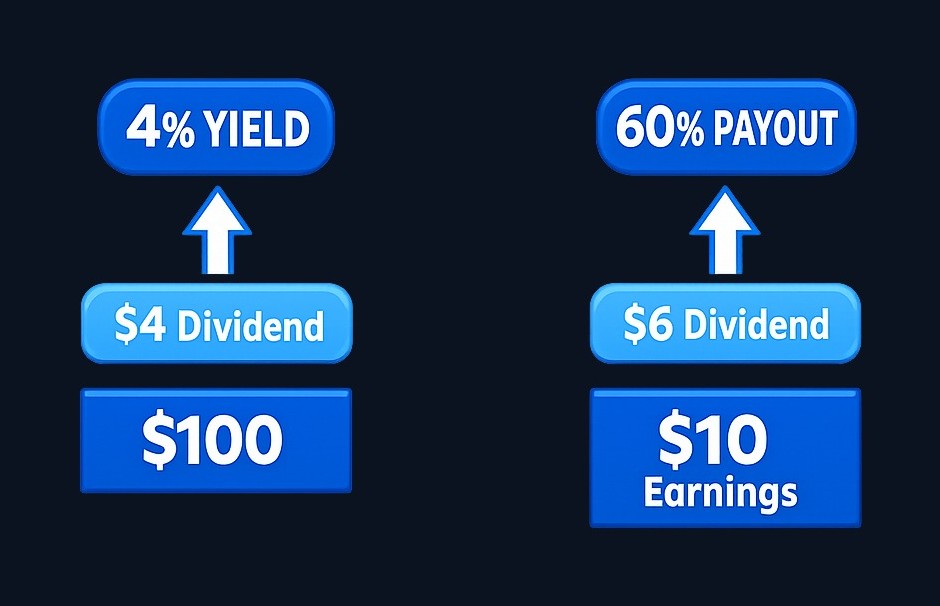
The key terms are dividend yield and payout ratio. Dividend yield compares the annual dividend with the stock price. Payout ratio compares dividends with company profits or cash flow. A very high yield can be tempting, but it can also signal market concern. Beginners should not chase yield without checking whether the payout looks sustainable.
What Are Growth Stocks?
Growth stocks are shares of companies expected to expand faster than the broader market or their industry. These companies often reinvest profits into product development, hiring, marketing, acquisitions, or new markets. Instead of paying meaningful dividends, they aim to increase business value over time.
Investors usually buy growth stocks for capital appreciation. Capital appreciation means the stock becomes more valuable and can be sold later at a higher price. That outcome is uncertain. Growth stocks can fall sharply if expectations are too high, revenue slows, margins weaken, or investors become less willing to pay premium prices.
Growth investing requires patience and emotional discipline. A growth company may look expensive by traditional measures because investors are pricing in future expansion. If that future does not arrive, the stock can be punished quickly. The investor has to understand both the business story and the valuation risk.
Key Differences Between Dividend and Growth Stocks
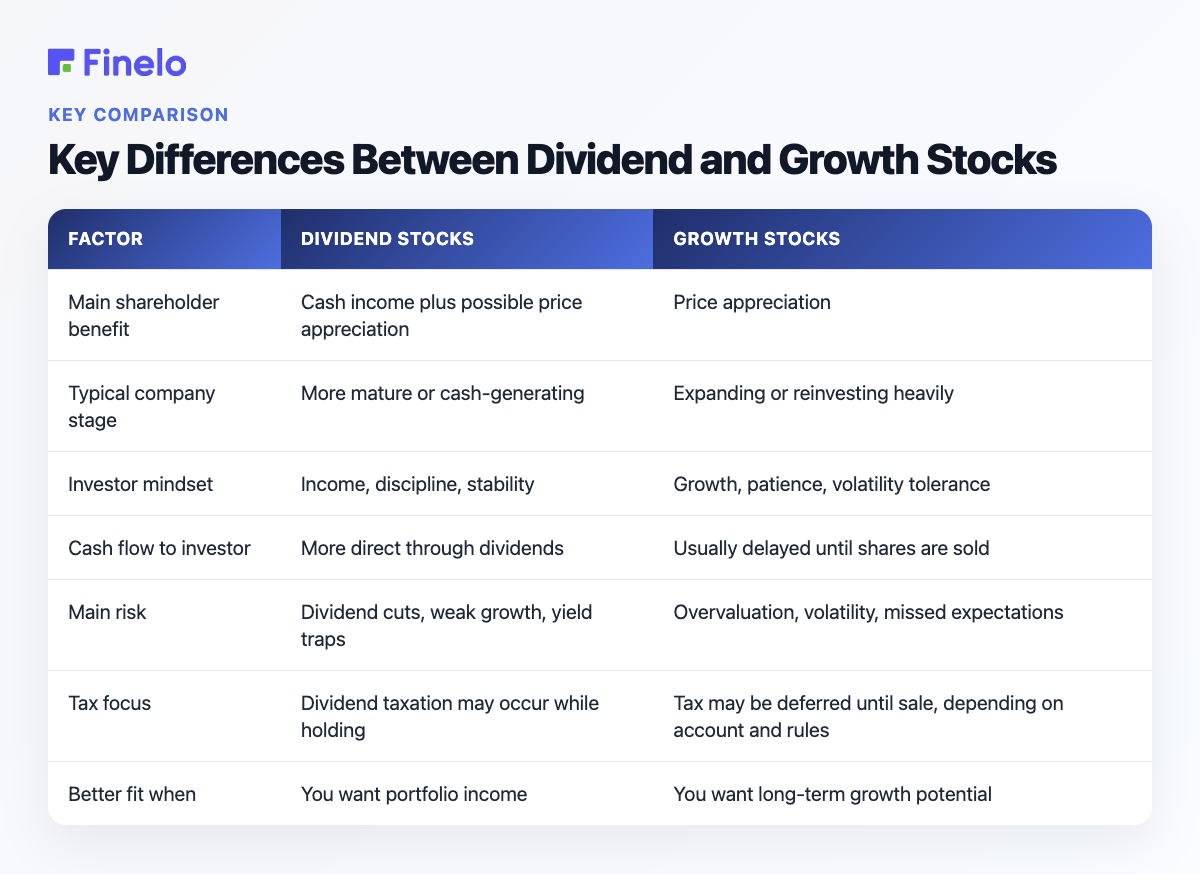
Dividend and growth stocks differ in how they aim to reward shareholders. Dividend stocks return cash along the way. Growth stocks usually keep more cash inside the business to pursue expansion.
| Factor | Dividend stocks | Growth stocks |
|---|---|---|
| Main shareholder benefit | Cash income plus possible price appreciation | Price appreciation |
| Typical company stage | More mature or cash-generating | Expanding or reinvesting heavily |
| Investor mindset | Income, discipline, stability | Growth, patience, volatility tolerance |
| Cash flow to investor | More direct through dividends | Usually delayed until shares are sold |
| Main risk | Dividend cuts, weak growth, yield traps | Overvaluation, volatility, missed expectations |
| Tax focus | Dividend taxation may occur while holding | Tax may be deferred until sale, depending on account and rules |
| Better fit when | You want portfolio income | You want long-term growth potential |
The comparison is not always clean. Some companies pay dividends and still grow. Some growth companies later become dividend payers. Some dividend stocks are risky. Some growth stocks are financially strong. The label is a starting point, not a final judgment.
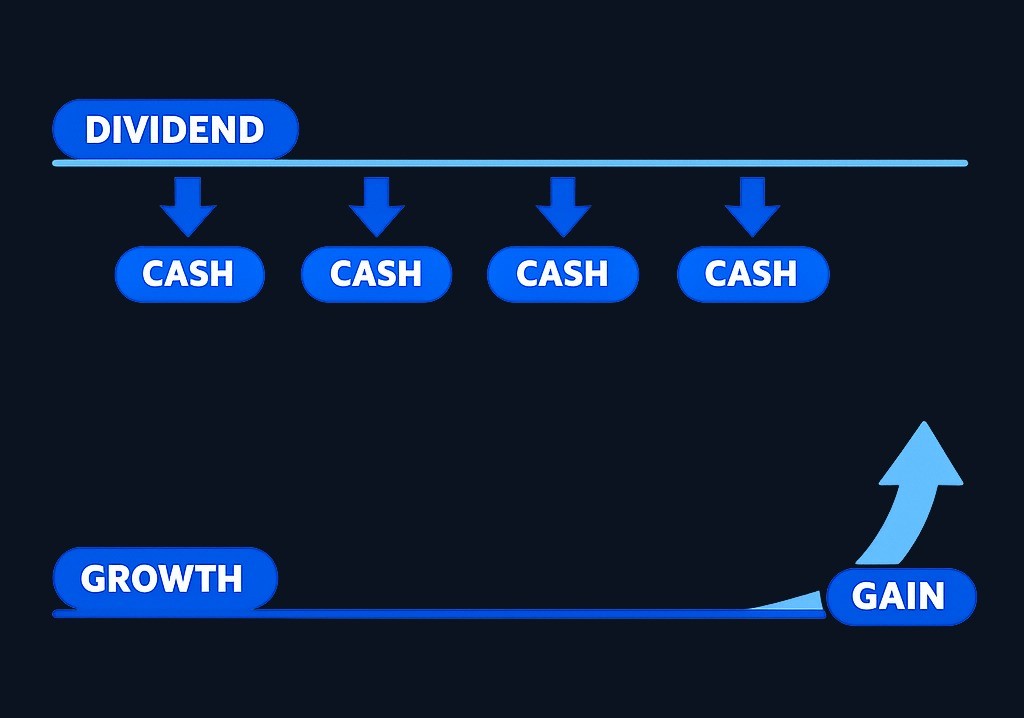
The strongest practical difference is cash timing. Dividend investors receive cash while they hold the stock. Growth investors usually wait for the market value to rise. That timing changes behavior. Dividend investors may feel steadier during sideways markets because cash still arrives. Growth investors may feel more pressure because the investment case depends more heavily on future price gains.
When to Choose Dividend Stocks or Growth Stocks
Choose dividend stocks when you want income, prefer a more tangible shareholder return, or are building a portfolio that needs to support spending. They can also fit investors who value business discipline. A company that pays dividends must decide how much cash to return and how much to keep.
Choose growth stocks when your goal is long-term appreciation and you can handle wider price swings. Growth stocks may fit investors with longer time horizons, higher risk tolerance, and a willingness to evaluate future business potential.
Use this decision framework:
| Your situation | Style that may fit better | Why |
|---|---|---|
| You need current portfolio income | Dividend stocks | Cash payments may support spending needs |
| You are early in wealth building | Growth stocks or a blend | Reinvestment and appreciation may matter more than income |
| You dislike sharp volatility | Dividend stocks or diversified funds | Mature cash-generating businesses may feel easier to hold |
| You can tolerate uncertainty for future upside | Growth stocks | The payoff depends more on future expansion |
| You want balance | Both | Income and growth can play different roles |
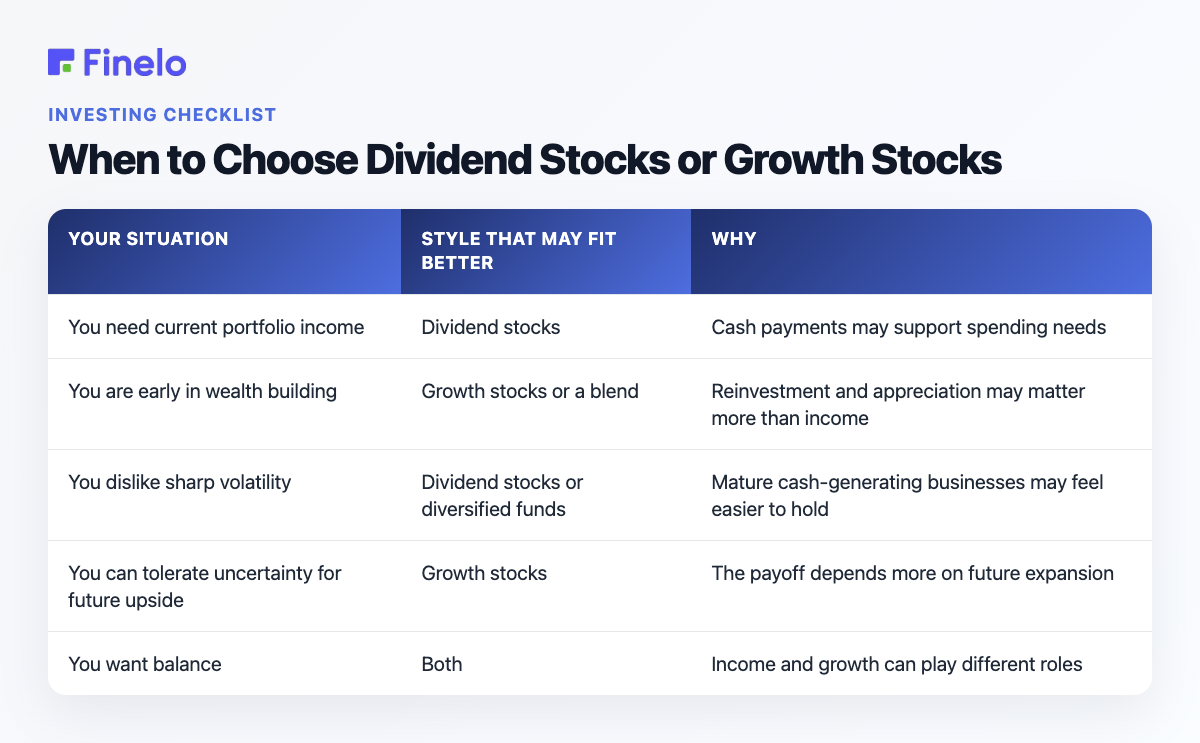
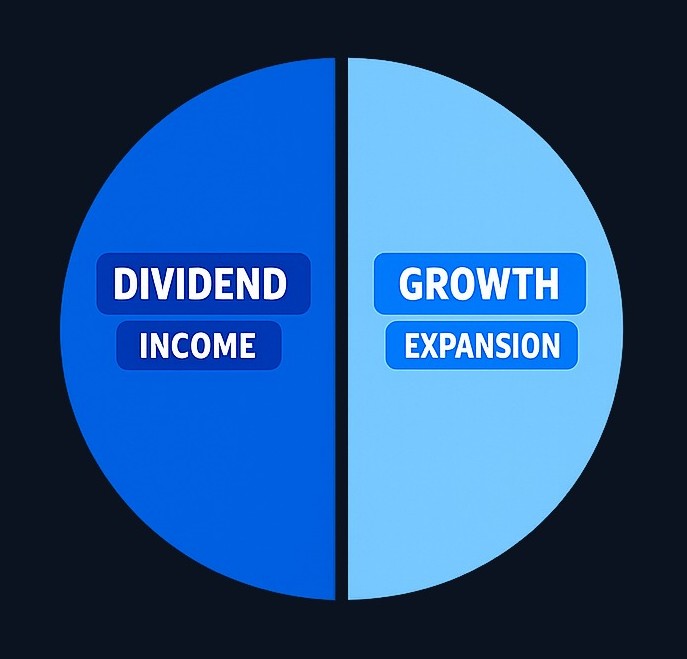
The best answer for many investors is a blend. A portfolio can hold dividend stocks for income and growth stocks for expansion. The mix depends on the job each holding is supposed to do. If you cannot explain that job, the problem is not the stock style. It is the plan.
Practice investing with Finelo
Build practical investing skills with guided lessons, simulator practice, and structured challenges.
Tax Implications of Dividend vs Growth Investing
Taxes can affect the comparison, especially in taxable accounts. Dividend stocks may create taxable income while you hold them. Growth stocks may create more of their taxable event when shares are sold, depending on the account, holding period, and local rules.
That timing matters. A dividend investor may owe tax even if the dividend is reinvested. A growth investor may have more control over when to sell, but selling can still create a taxable gain. Retirement accounts, tax-advantaged accounts, and local rules can change the result.
Do not choose a strategy only for tax reasons. Taxes are one layer. You still need to consider risk, valuation, income needs, diversification, and behavior. A tax-efficient investment can still be a poor fit if it makes the portfolio too volatile. A dividend stock can still be useful even if the income creates tax paperwork.
Before building a strategy, ask:
- Will I hold this in a taxable or tax-advantaged account?
- Do I need income now, or can I wait?
- Will dividends affect my yearly tax planning?
- How often do I expect to sell?
- Do I understand the rules in my country and account type?
For personal tax decisions, use qualified guidance. A general comparison cannot replace account-specific advice.
Real-World Style Examples
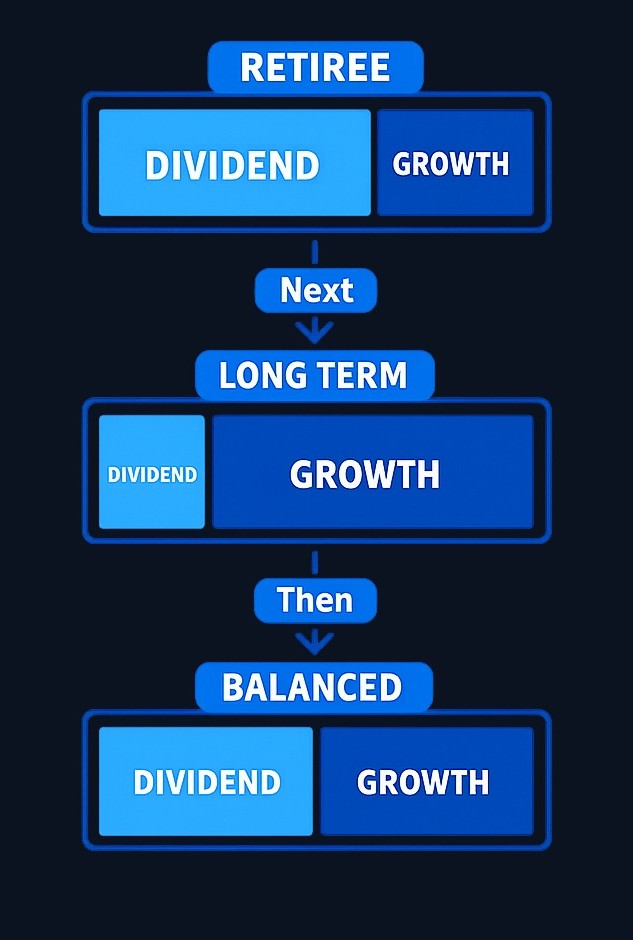
Consider an investor approaching retirement. They want to reduce the need to sell shares during normal market swings. Dividend stocks may help create a cash-flow sleeve, especially if the investor understands the businesses and avoids chasing unusually high yields. The risk is that dividend income is not fixed, and the stock price can still fall.
Now consider an investor with a long time horizon and no need for current income. Growth stocks may feel more appropriate because the investor can focus on business expansion and capital appreciation. The risk is psychological as much as financial. A growth stock can fall quickly when expectations change, and the investor must know whether the long-term thesis still holds.
Imagine a third investor who wants both. They place dividend stocks in the income sleeve and growth stocks in the expansion sleeve. The dividend sleeve is judged by payout quality, balance-sheet strength, and consistency of business cash generation. The growth sleeve is judged by revenue quality, reinvestment opportunities, competitive position, and valuation discipline.
These are not recommendations to buy any specific stock. They show how the same stock style can make sense or fail depending on the investor's goal.
Psychological Differences Investors Often Miss
Dividend investing can feel calmer because cash payments provide feedback. That feedback can help some investors stay patient. But it can also create a trap: the investor may ignore a weakening business because the dividend still arrives.
Growth investing can feel exciting because the story is about future expansion. That excitement can help investors tolerate slow compounding periods. It can also create overconfidence. A strong story does not mean the price is fair, and a fast-growing company can still disappoint.
The emotional question is simple: which mistake are you more likely to make?
If you are likely to chase yield, dividend stocks need extra caution. If you are likely to chase the latest fast-rising company, growth stocks need extra caution. If you panic during volatility, both styles need rules before money is involved.
A useful rule is to write a one-sentence reason for each holding. For a dividend stock: "I own this because the business can support income and still remain financially healthy." For a growth stock: "I own this because the business can reinvest at attractive rates and the valuation still makes sense." If you cannot write the sentence clearly, keep researching.
How to Build a Balanced Approach
You do not have to pick one style forever. A balanced portfolio may combine dividend stocks, growth stocks, funds, bonds, and cash depending on the goal.
Start by assigning roles:
- Income role: holdings meant to produce cash flow.
- Growth role: holdings meant to increase value over time.
- Stability role: holdings meant to reduce overall portfolio swings.
- Liquidity role: cash or near-cash for planned needs.
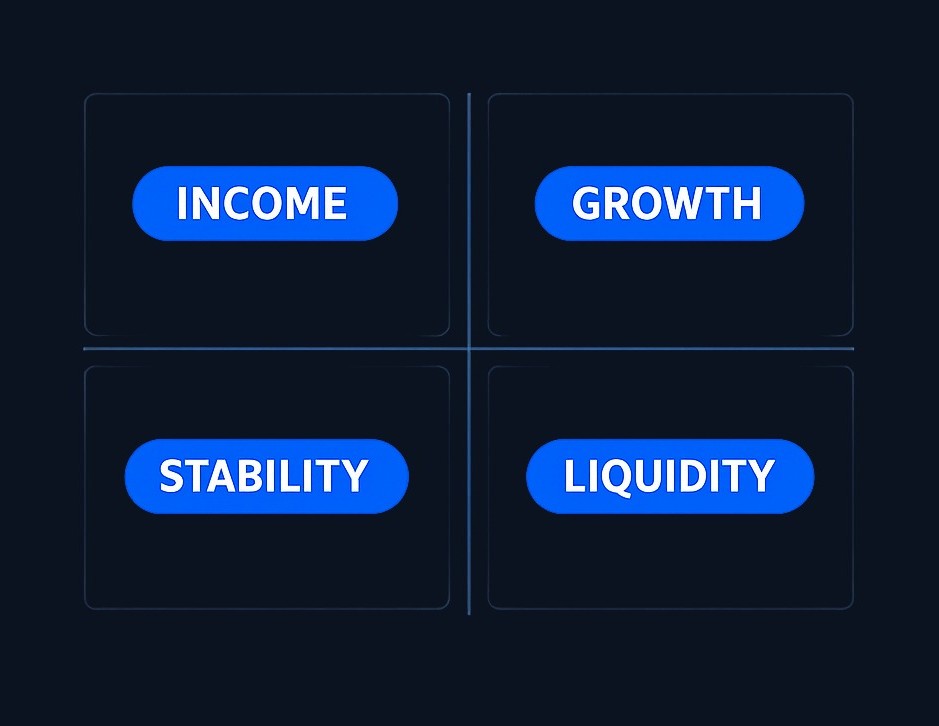
Then decide how much each role deserves. A younger investor may emphasize growth. A retiree may emphasize income and stability. Someone in the middle may want both.
Rebalance the mix when it drifts. Growth stocks can become a larger share after strong price gains. Dividend stocks can dominate if the investor keeps adding to yield. Rebalancing forces you to check whether the portfolio still matches the plan.
Finally, compare individual stocks with funds. Some investors prefer picking companies. Others prefer diversified funds that hold many dividend or growth stocks. Funds can reduce company-specific risk, though they still carry market risk and costs.
Conclusion
Dividend stocks and growth stocks solve different portfolio problems. Dividend stocks can provide income and help some investors stay disciplined. Growth stocks can provide expansion potential but often require more patience with volatility and valuation risk.
The best choice depends on your time horizon, income needs, taxes, risk tolerance, and behavior. Build the portfolio around roles rather than labels. If you want structured investing education before making real-money decisions, Finelo's AI Investing Challenge is positioned around long-term investing research, portfolio construction, diversification, patience, and AI-assisted thesis building. Use education as preparation, then verify risks, taxes, and suitability before investing.
Frequently asked questions
What are the main differences between dividend and growth stocks?
Dividend stocks focus more on cash payments to shareholders. Growth stocks focus more on reinvesting for expansion and potential price appreciation. Both can rise or fall in value.
Which type is better for long-term investing?
Neither is automatically better. Growth stocks may fit investors seeking appreciation over a long horizon, while dividend stocks may fit investors who want income and business maturity. Many long-term investors use both.
Can growth stocks pay dividends?
Yes. A company can start as a growth stock and later pay dividends as it matures. Some companies may also offer both growth potential and modest dividends.
How do I choose between dividend and growth stocks?
Start with your goal. If you need income, study dividend quality and payout sustainability. If you want appreciation, study growth durability and valuation. If both goals matter, consider a blended approach.
InvestingBeginnerDividendsMarkets
Practice investing with Finelo
Build practical investing skills with guided lessons, simulator practice, and structured challenges.
About the author
Finelo Team
The Finelo Team creates practical investing and trading education designed to help beginners learn faster with structured challenges, simulator practice, and bite-sized lessons.
Keep reading — Related articles

Investing
Yield to Call vs Yield to Maturity: Assumptions and Bond Risks
Yield to call (YTC) estimates a bond's yield if the issuer redeems it on an eligible call date; yield to maturity (YTM) estimates yield if it remains outstanding to final maturity.
Finelo Team

Investing
Will My Employer Know If I Take a 401(k) Loan?
Who this page is for: readers new to 401(k) loans who want a practical, privacy‑focused explanation — what your employer can see, how to limit visibility, and the financial tradeoffs to weigh.
Finelo Team

Investing
What Medical Expenses Qualify for a 401(k) Hardship Withdrawal?
Before you decide, confirm three things with your plan administrator:
Finelo Team


