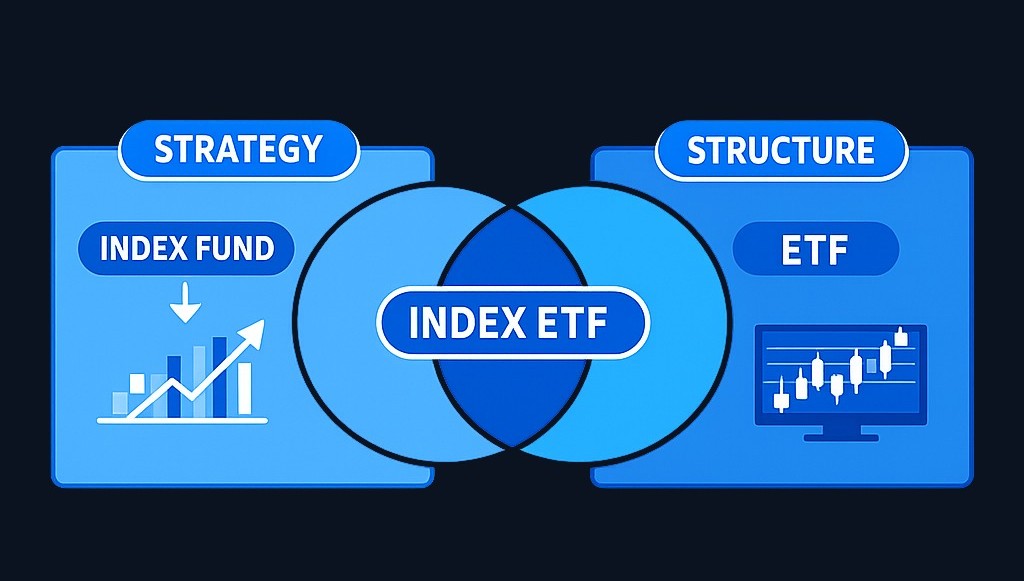
Here's the twist most comparisons bury: "ETF vs. index fund" isn't a battle between two products. An index fund is a strategy — passively tracking a market index. An ETF (exchange-traded fund) is a structure — a fund that trades on a stock exchange. Many ETFs are index funds. The real choice: an index fund in ETF form, or an index fund in mutual fund form.
ETFs vs. Index Funds: A Comprehensive Comparison
Here's the twist most comparisons bury: "ETF vs. index fund" isn't a battle between two products. An index fund is a strategy — passively tracking a market index. An ETF (exchange-traded fund) is a structure — a fund…
11 min read
Practice investing with Finelo
Build practical investing skills with guided lessons, simulator practice, and structured challenges.
Want to learn more?
Build practical investing skills with guided lessons, simulator practice, and structured challenges.
Explore FineloExplore Finelo's 28-day challenges
Turn learning into a daily habit with guided challenge paths.
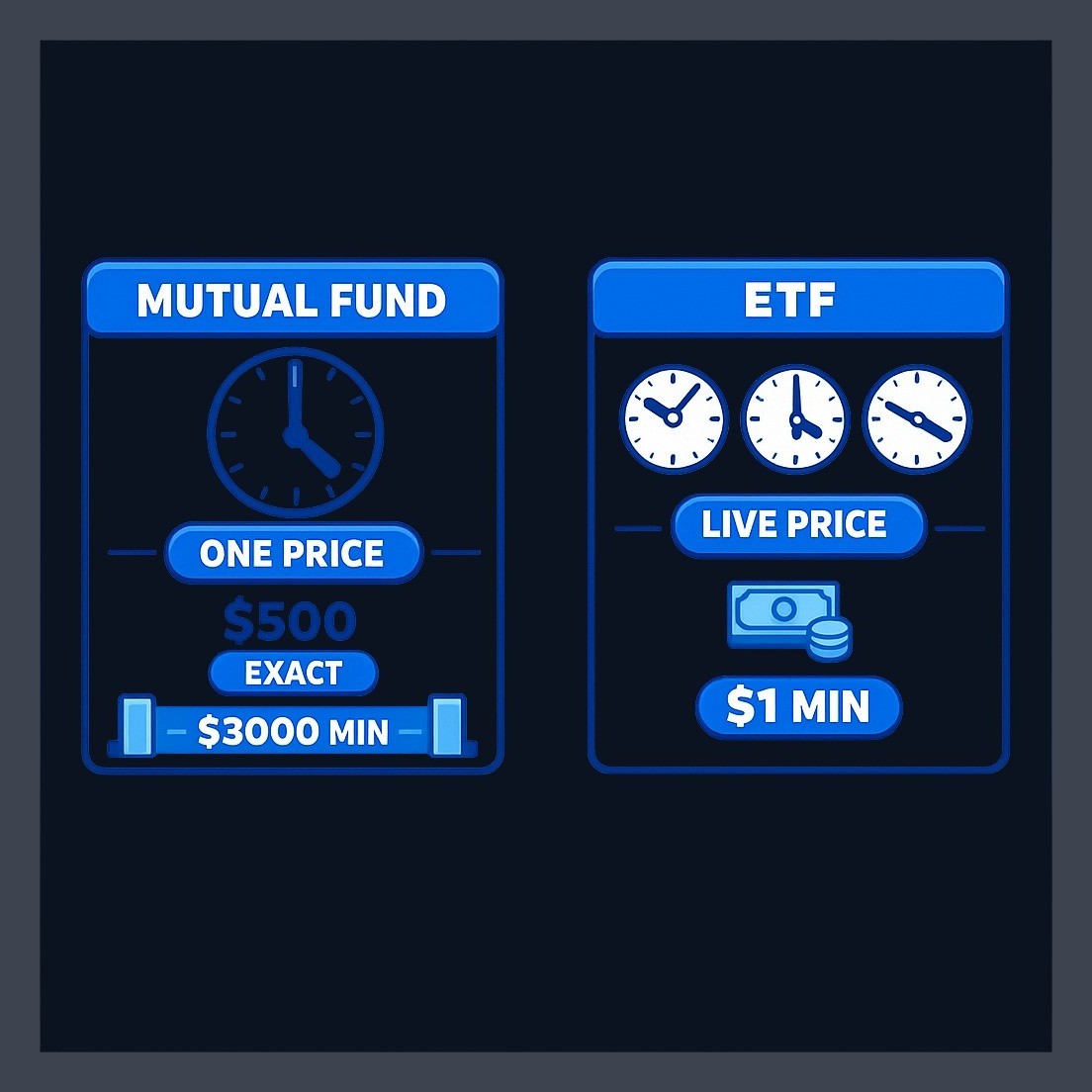
The practical differences come down to four things — trading, entry cost, taxes, and automation. ETFs trade all day at live market prices, while mutual fund orders execute once daily, with every investor getting the same price. This comparison walks through each difference, then hands you a decision table you can apply to your own situation.
What is an ETF?
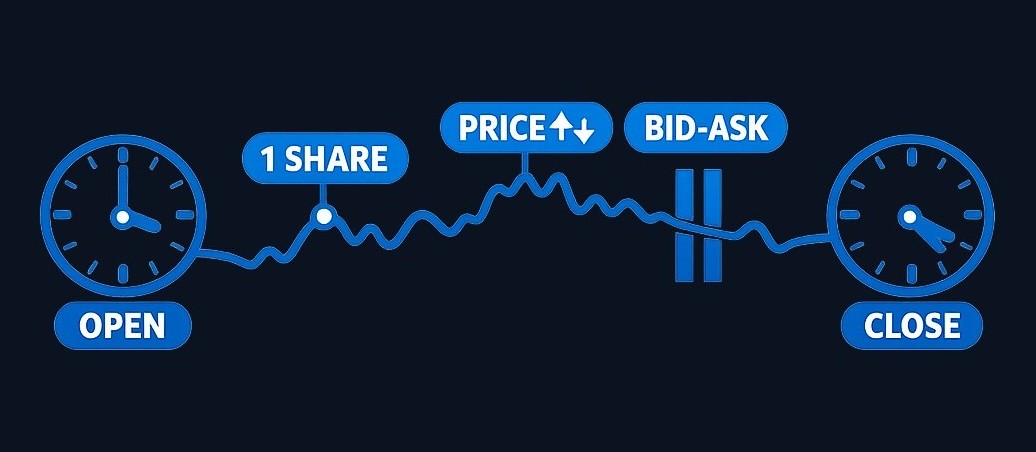
An ETF is a basket of securities — stocks, bonds, or other assets — that trades on a stock exchange like a stock, with its price changing throughout the day. You buy and sell shares through any brokerage account while the market is open.
Three features define the experience:
- Intraday trading. ETFs offer real-time pricing throughout the session. You see your price before you place the order.
- Low entry cost. ETFs generally require no minimum — you start with the price of one share. Some brokerages go lower: Vanguard sells its ETFs for as little as $1.
- Market-price mechanics. An ETF's market price can drift slightly from the value of its holdings — its net asset value, or NAV. You also pay a bid/ask spread: the small gap between buying and selling prices, which works as an implicit trading cost.
Most ETFs are passive. The U.S. market holds roughly 3,000 passively managed ETFs tracking various indexes. So when people say "ETF," they usually mean an index fund in an exchange-traded wrapper. A useful mental model: the ETF is a delivery mechanism, like a bottle. What matters most is what's inside — the index it tracks and the fee it charges.
What is an Index Fund?
An index fund is any fund built to mirror a market index — the S&P 500, a total market index, a bond index — rather than beat it. No manager picks stocks. The fund holds what the index holds. That keeps costs low.
In everyday usage, "index fund" means the mutual fund version. That's how this comparison uses the term. Index mutual funds differ from ETFs in three ways:
- One price per day. Orders execute once daily, and every investor that day gets the same price — the NAV, set after markets close. At Vanguard, pricing lands around 4 p.m. Eastern time. There's no bid/ask spread.
- Dollar-based investing. Mutual funds accept exact dollar amounts and fractional shares. Invest $500, and every cent goes to work.
- Higher entry bars. Minimums are normally a flat dollar amount. Example: most Vanguard mutual funds require $3,000 to start.
The selection is narrower than many expect: about 300 index mutual funds exist in the U.S., versus thousands of index ETFs. One caveat worth knowing: not every mutual fund is an index fund. The U.S. also has about 5,600 actively managed mutual funds, so check that a fund says "index" before assuming it's passive.
Key Differences Between ETFs and Index Funds
| Factor | ETF | Index mutual fund |
|---|---|---|
| Trading | All day, at live market prices | Once daily, at NAV |
| Pricing quirks | Market price may differ from NAV; bid/ask spread applies | Same daily price for everyone, no spread |
| Minimum to start | Price of one share; from $1 at Vanguard | Flat minimums — e.g., $3,000 at Vanguard |
| Buying in dollars | Typically whole shares | Fractional shares and exact dollar amounts |
| Automation | Recurring ETF purchases at Vanguard since January 2025 | Long-standing recurring investments and withdrawals |
| Tax behavior | May generate fewer capital gains — lower turnover and structure | Sales inside the fund can trigger gains for shareholders |
| Other fees | Spreads; commissions possible at some brokers | Possible sales loads or early redemption fees |
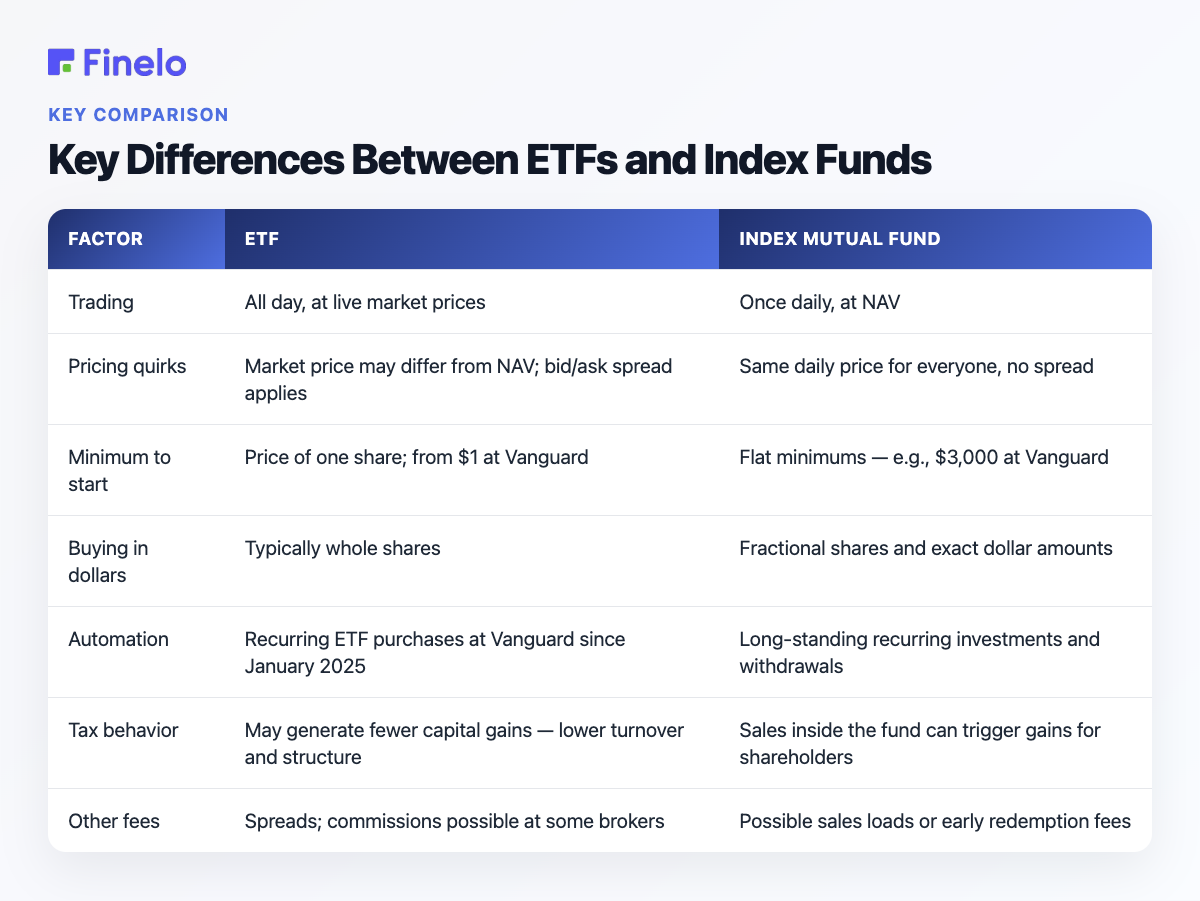
Read the table this way: the differences are operational, not philosophical. Both wrappers can hold the identical index. Your money tracks the same market either way. The wrapper changes how you buy, when your order fills, what frictions you pay, and when taxes arrive — not what you own.
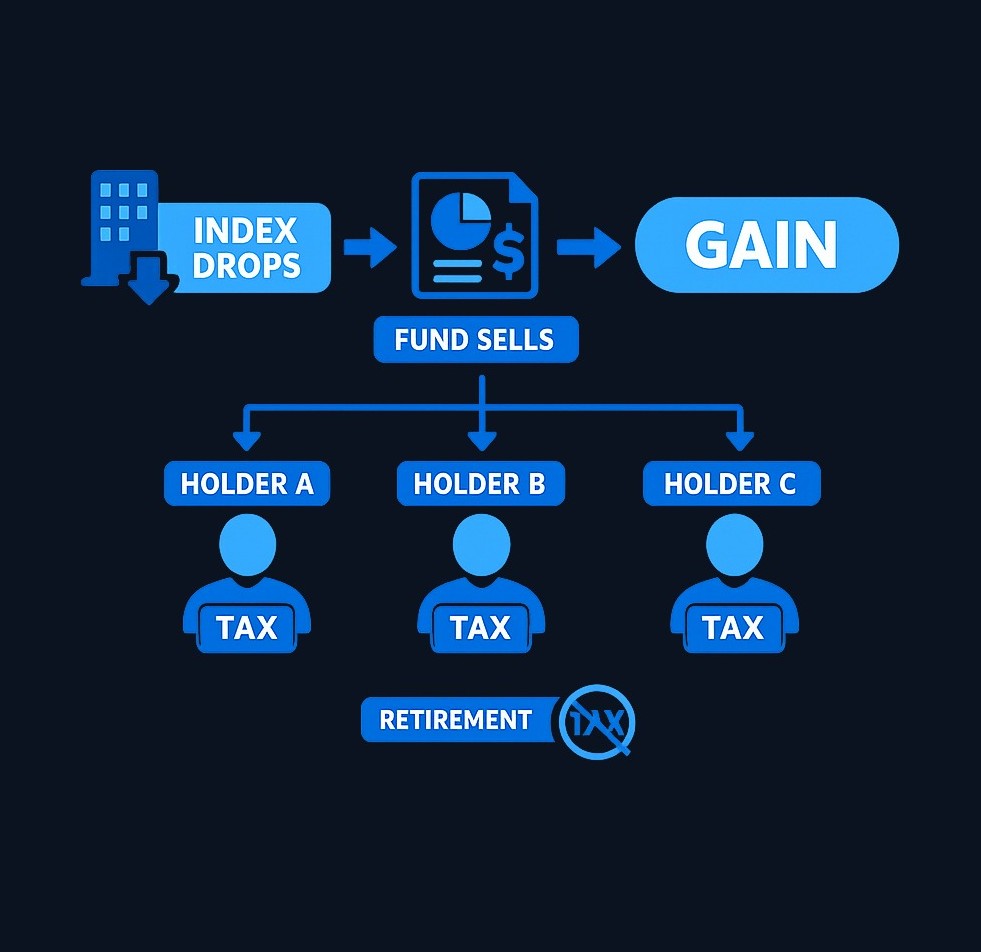
The tax row deserves a plain-language unpacking, because it's the least intuitive. When an index mutual fund sells holdings internally — say, when the index drops a company — that sale can create a taxable gain passed to every shareholder, even ones who bought last month and sold nothing. ETFs tend to produce fewer of these events because of lower turnover and the way they trade. In a taxable account, that difference quietly compounds in the ETF's favor. In a retirement account, neither event is taxed, so the row goes blank for you.
One cost note covers both: expense ratios vary more between providers than between wrappers. Vanguard reports an average expense ratio of 0.07%, versus a 0.44% industry average. Picking a cheap fund matters more than picking a wrapper. Fees change — verify current pricing on the official site.
Practice investing with Finelo
Build practical investing skills with guided lessons, simulator practice, and structured challenges.
Pros and Cons of ETFs
Advantages:
- Tiny entry point. One share — or $1 at Vanguard — gets you started. That removes the biggest barrier for new investors.
- Control over execution. Real-time pricing shows your price before you trade. You can also use limit orders — instructions to trade only at a price you set.
- Potential tax edge. In taxable accounts, ETFs can distribute fewer capital gains thanks to lower turnover. Vanguard notes the structure may add a tax benefit from the way ETFs trade.
- Huge selection. With around 3,000 passive ETFs in the U.S., nearly every index has an ETF tracking it.
Disadvantages:
- Trading frictions. The bid/ask spread is a real cost, and some brokerages charge commissions — though many, including Vanguard for online trades, have dropped them. Spreads run widest on thinly traded niche ETFs, so this cost grows as your fund choice gets more exotic.
- Price-watching temptation. All-day pricing invites all-day checking. Long-term investors rarely need to trade at 11:43 a.m. — but the option tempts people into timing the market.
- Whole-share awkwardness. Where fractional trading isn't offered, ETFs sell in whole shares. Odd amounts of cash can sit uninvested.
Pros and Cons of Index Funds
Advantages:
- Effortless dollar-based investing. Exact amounts and fractional shares mean a $500 monthly contribution invests fully, every time.
- Mature automation. Index mutual funds have long supported automatic recurring investments and withdrawals — the backbone of a set-and-forget plan.
- Simple, fair pricing. Everyone who orders that day gets the same NAV, no spread. Nothing to time. No execution skill needed.
Disadvantages:
- Higher entry bars. Flat minimums — like $3,000 at most Vanguard mutual funds — can lock out beginners who could have bought one ETF share instead.
- Tax drag in taxable accounts. When the fund sells securities internally, shareholders can owe capital gains — even shareholders who never sold anything.
- Possible extra fees. Some mutual funds carry sales loads or early redemption fees. Read the fee table first.
- No intraday exit. If markets swing at noon, your order still fills at the end-of-day price. Rarely a problem for long-term holders — but it's built in.
When to Choose ETFs vs. Index Funds
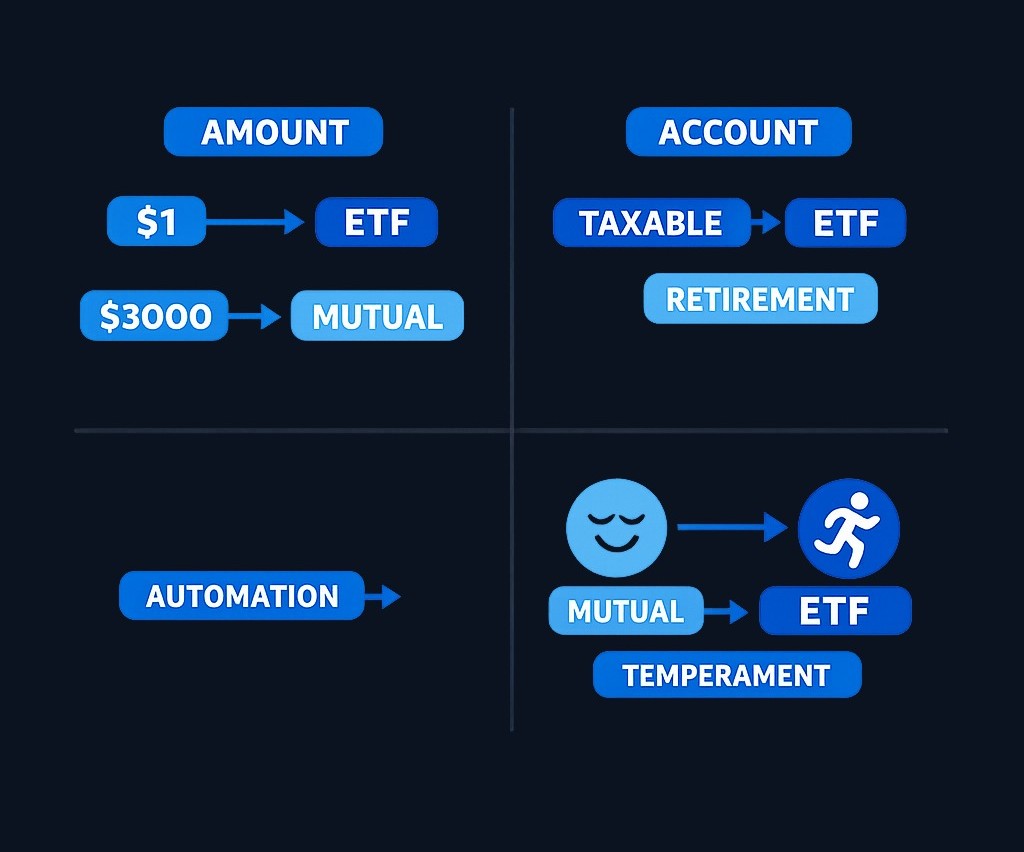
Start with the decision table, then read the reasoning behind your row:
| Your situation | Recommended next step |
|---|---|
| Starting with a small amount | Choose an ETF — entry from one share, or $1 at Vanguard |
| Investing in a taxable brokerage account | Lean ETF for fewer capital gains distributions |
| Investing inside a retirement account | Either — the ETF tax edge mostly disappears; decide on automation and minimums |
| Want fully automatic monthly investing | Lean index mutual fund for dollar-exact recurring investments; check your broker's ETF automation too |
| Want to control your exact execution price | Choose an ETF — only live market pricing allows limit orders |
| Want zero trading decisions | Choose an index mutual fund — one daily NAV, no spread |
| Need a niche market exposure | Search ETFs first — ~3,000 passive ETFs vs. ~300 index mutual funds |
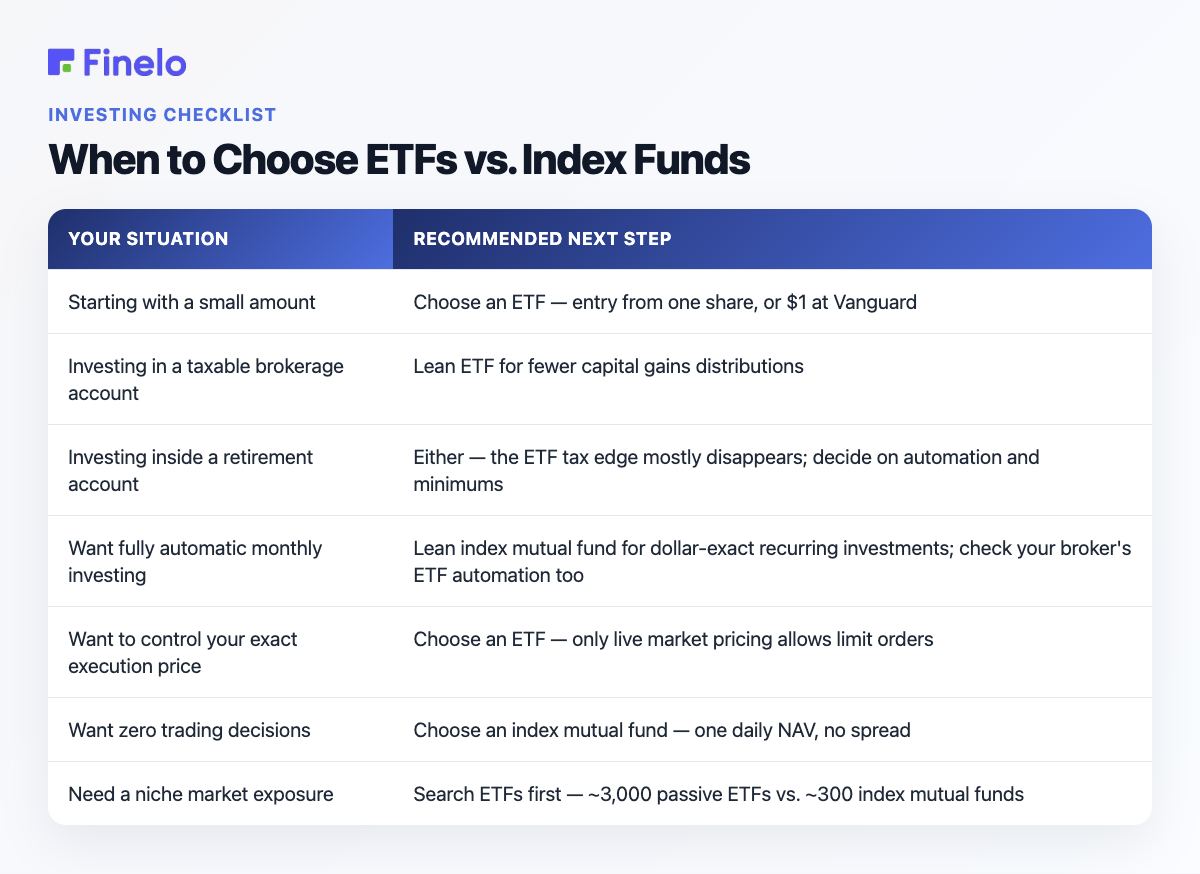
The reasoning, in brief. Amount: minimums decide for you at small balances — $1 versus $3,000 isn't a close call. Account type: retirement accounts shelter internal fund gains anyway, so the ETF's tax advantage matters mainly in taxable accounts. Automation: the gap is closing — Vanguard added recurring ETF purchases in January 2025 — but mutual funds still automate most cleanly. Temperament: if live prices will tempt you to tinker, the mutual fund's once-a-day pricing is a feature, not a limitation.
A realistic pair of scenarios. A 28-year-old opens a taxable account with $800: ETF — no minimum barrier, better tax behavior. A 45-year-old rolls $50,000 into a retirement account and automates monthly additions: index mutual fund — the tax edge is gone in that account, and automation is the priority. Same strategy, different wrapper, both sensible.
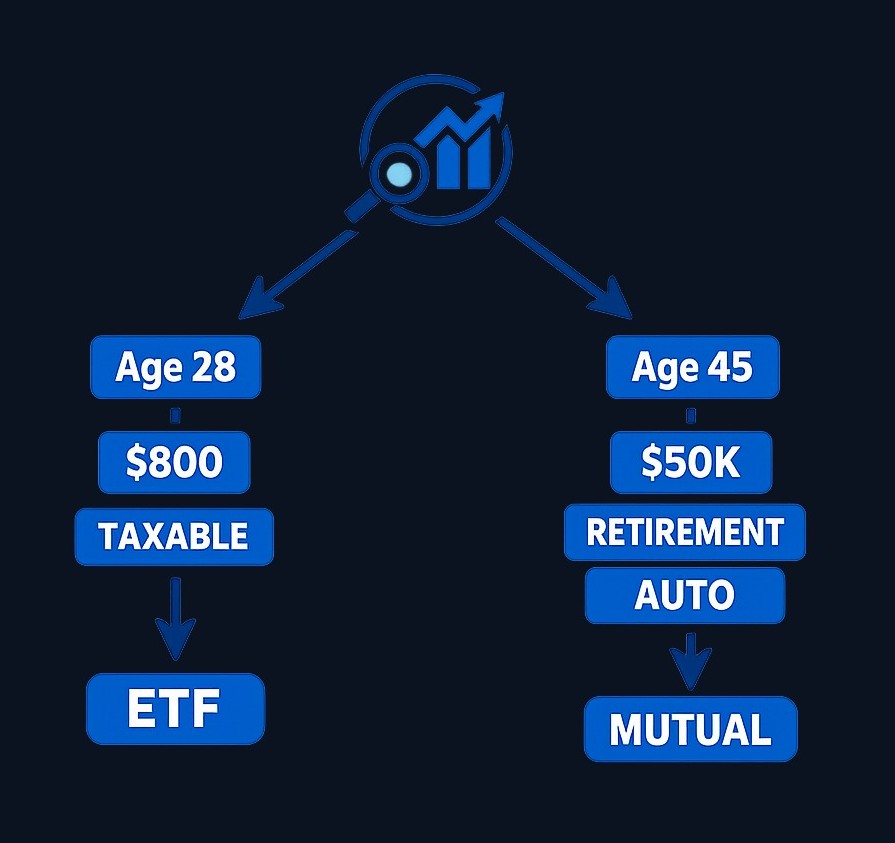
Whichever row fits you, the next steps are the same: pick the index you want to track, list the funds available in your account that track it, compare their expense ratios and minimums, and check what your brokerage supports for automation. The wrapper decision usually resolves itself by the end of that list.
Real-World Examples
The wrapper choice plays out visibly at major providers. Vanguard runs more than 80 index ETFs alongside more than 130 index mutual funds — often tracking the same benchmarks in both formats. The buyer's difference: the ETF version opens at as little as $1; the mutual fund version typically asks $3,000 upfront. Same benchmark, same strategy — the wrapper changes only the door you enter through. Verify current pricing and minimums on the official site.
Cost tells a similar story. Vanguard's 0.07% average expense ratio sits far below the 0.44% industry average. On $10,000, that's $7 a year versus $44. Repeat the gap for decades and it compounds into real money — and it comes from the provider you pick, not the wrapper.
Market structure shapes options too. With about 3,000 passive ETFs versus roughly 300 index mutual funds in the U.S., niche exposures — a single foreign market, a narrow sector — usually exist only in ETF form. For core holdings like a total market tracker, both wrappers are plentiful, and the decision table above settles it.
Frequently asked questions
Can an index fund be an ETF?
Yes — that's the heart of the confusion. "Index fund" names the passive strategy; "ETF" names the exchange-traded structure. Thousands of passive [ETFs](https://www.schwab.com/etfs/mutual-funds-vs-etfs) are index funds in ETF form.
Can I automate investments in ETFs?
Increasingly, yes. Mutual funds have offered recurring investments and [withdrawals](https://investor.vanguard.com/investor-resources-education/etfs/etf-vs-mutual-fund) for years, and Vanguard extended recurring purchases to ETFs in January [2025](https://investor.vanguard.com/investor-resources-education/etfs/etf-vs-mutual-fund). Support varies by brokerage — confirm before building your plan around it.
Are ETFs more tax-efficient than index mutual funds?
Often, in taxable accounts. ETFs tend to distribute fewer capital gains due to lower turnover and their trading [structure](https://www.schwab.com/etfs/mutual-funds-vs-etfs), while a mutual fund's internal sales can create taxable gains for its [shareholders](https://www.schwab.com/etfs/mutual-funds-vs-etfs). Inside retirement accounts, the difference largely disappears.
Which is better for beginners?
Depends on starting amount and temperament. Small balance? The ETF's [one-share entry](https://www.schwab.com/etfs/mutual-funds-vs-etfs) wins. Prefer automatic deposits you never touch? The mutual fund's [dollar-based automation](https://investor.vanguard.com/investor-resources-education/etfs/etf-vs-mutual-fund) fits that habit. Both wrappers carry full market risk — a downturn in the tracked index means a downturn in your balance, whichever structure holds it. This comparison is educational, not personalized financial advice. Verify costs, minimums, and suitability for your situation before investing. Want to build the investing foundations behind decisions like this one? Finelo's Wealth Growth [Quiz](https://finelo.com/) matches you with a learning path that fits your starting point.
InvestingBeginnerETFsIndex FundsMarkets
Practice investing with Finelo
Build practical investing skills with guided lessons, simulator practice, and structured challenges.
About the author
Finelo Team
The Finelo Team creates practical investing and trading education designed to help beginners learn faster with structured challenges, simulator practice, and bite-sized lessons.
Keep reading — Related articles
Investing
Yield to Call vs Yield to Maturity: Assumptions and Bond Risks
Yield to call (YTC) estimates a bond's yield if the issuer redeems it on an eligible call date; yield to maturity (YTM) estimates yield if it remains outstanding to final maturity.
Finelo Team
Investing
Will My Employer Know If I Take a 401(k) Loan?
Who this page is for: readers new to 401(k) loans who want a practical, privacy‑focused explanation — what your employer can see, how to limit visibility, and the financial tradeoffs to weigh.
Finelo Team

Investing
What Medical Expenses Qualify for a 401(k) Hardship Withdrawal?
Before you decide, confirm three things with your plan administrator:
Finelo Team


