Choose an ETF when you value intraday trading, price control, or potential tax efficiency in a taxable account. Choose a mutual fund when end-of-day pricing or the options in your retirement plan better fit your routine. Neither wrapper is automatically cheaper, safer, or better-performing. Compare the underlying strategy, total costs, account type, and the way you plan to invest.
ETFs vs. Mutual Funds: A Detailed Comparison
Choose an ETF when you value intraday trading, price control, or potential tax efficiency in a taxable account. Choose a mutual fund when end-of-day pricing or the options in your retirement plan better fit your…
13 min read
Practice investing with Finelo
Build practical investing skills with guided lessons, simulator practice, and structured challenges.
Want to learn more?
Build practical investing skills with guided lessons, simulator practice, and structured challenges.
Explore FineloExplore Finelo's 28-day challenges
Turn learning into a daily habit with guided challenge paths.
This guide is for readers who know the basics but want a practical decision process. Finelo compares the two wrappers against consistent criteria and links key claims directly to FINRA and Fidelity. This article is educational. It is not individualized investment or tax advice.
ETFs vs. Mutual Funds at a Glance
| Decision point | ETF | Mutual fund |
|---|---|---|
| What you own | A share of a pooled investment fund. | A share of a pooled investment fund. |
| How you trade | You generally buy and sell shares on an exchange at market prices during trading hours. | You buy or sell shares at the fund’s next calculated net asset value, or NAV. |
| Price experience | You can see the current market price, but it can be above or below NAV. | You receive the daily NAV, but you do not know it when you place an order earlier in the day. |
| Possible trading costs | Expense ratio, brokerage charges, and the bid-ask spread. | Expense ratio, possible sales charges, and other fund or brokerage fees. |
| Tax tendency | Often gives investors more control over when they realize gains in a taxable account. | The fund may distribute gains created by the manager’s portfolio sales. |
| Active or index strategy | Either is possible. | Either is possible. |
| Typical entry amount | Usually the price of a share or fractional share, if the broker supports fractions. | Some funds have a fixed minimum; others do not. |
| Main practical advantage | Intraday trading and more control over the execution price. | One end-of-day price and, on some platforms, convenient exact-dollar automation. |
| Main practical trap | Ignoring spreads, premiums, discounts, or thin trading. | Ignoring minimums, sales charges, or other account-level fees. |
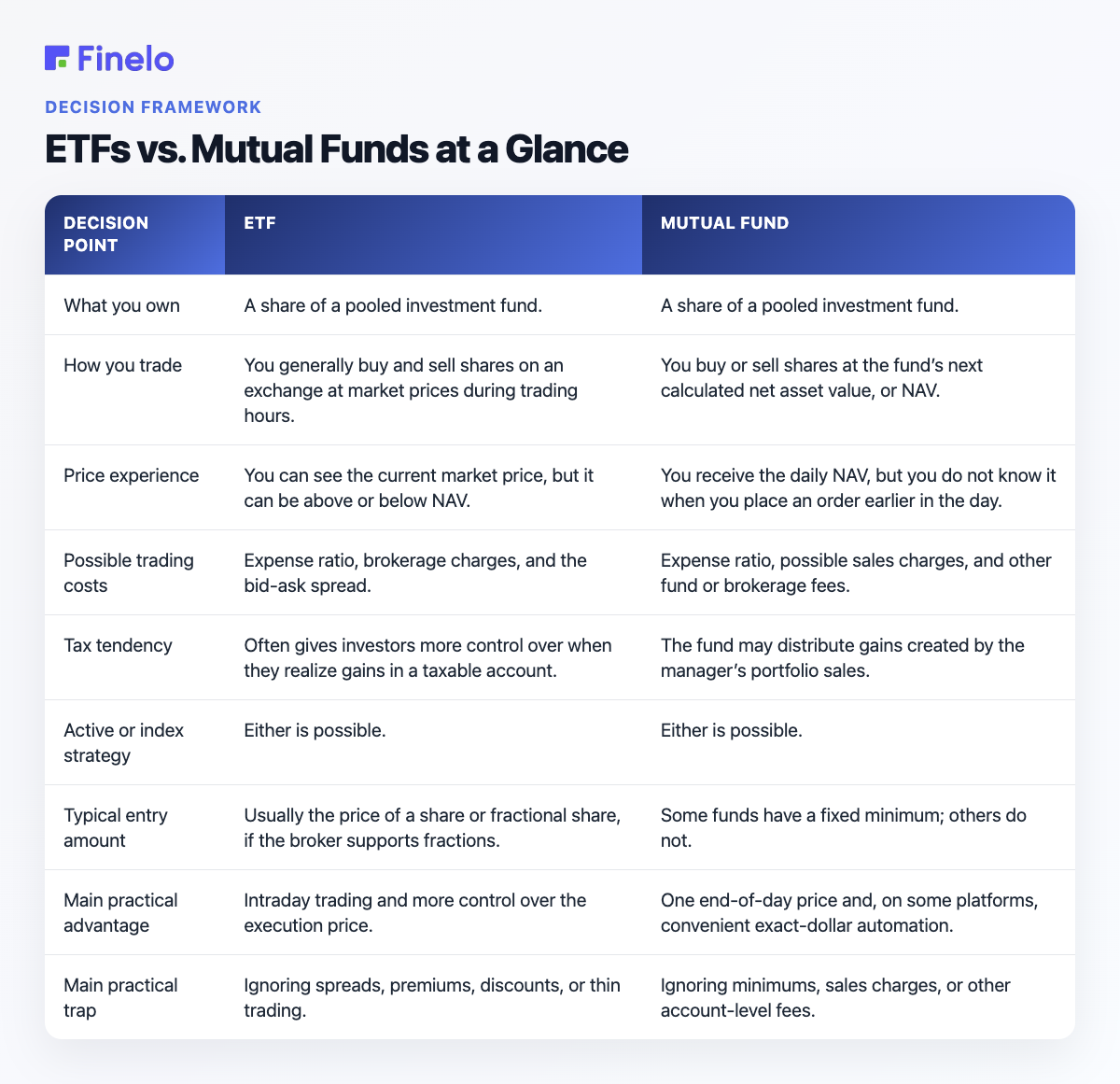
FINRA confirms the core differences in trading, pricing, minimums, expenses, taxes, and risk. The table compares fund wrappers, not investment quality. Start with the portfolio you need. Choose the wrapper second.
How ETFs and Mutual Funds Work
What is an ETF?
An exchange-traded fund, or ETF, pools money from investors and holds a portfolio under a stated strategy. Retail investors generally buy and sell ETF shares on an exchange.
An ETF calculates NAV, which is the value of its assets minus its liabilities on a per-share basis. Its exchange price changes during the trading day. If the market price is above NAV, the ETF trades at a premium. If it is below NAV, the ETF trades at a discount.
ETF investors also face a bid-ask spread. This is the gap between the highest price a buyer currently offers and the lowest price a seller will accept. A small spread reduces the cost of entering or leaving a position. A wide spread increases it.
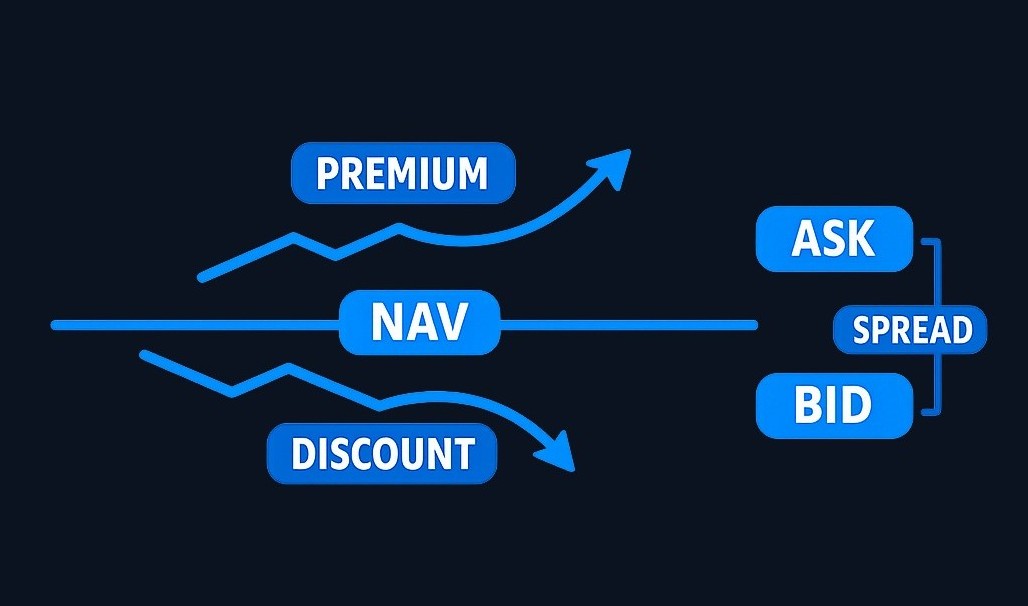
FINRA explains that ETF liquidity varies and that prices can move above or below NAV. This matters most when an ETF trades infrequently or the market is unsettled.
ETFs can follow an index or use active management. An index fund aims to track a benchmark, while an active fund gives a manager discretion within the fund’s mandate. “ETF” describes the wrapper and trading method, not a single strategy or risk level. Fidelity also notes that both active funds and active ETFs can seek to outperform an index.
What is a mutual fund?
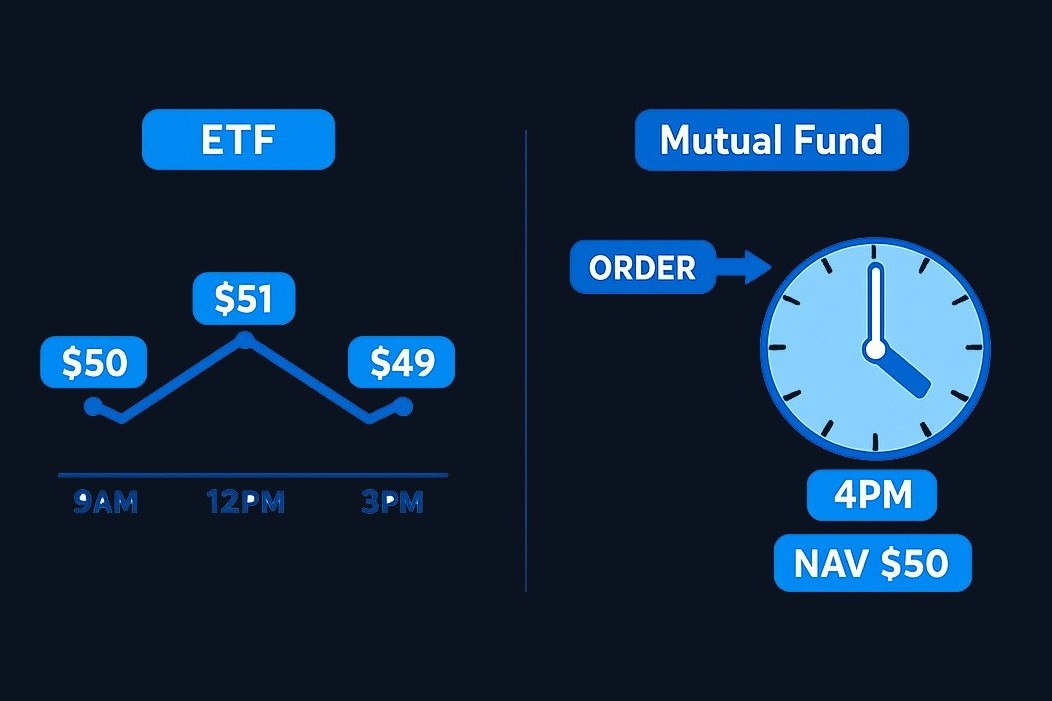
A mutual fund also pools investors’ money in a managed portfolio. Investors buy or sell shares through the fund company or an intermediary. Orders execute once per day at the fund’s NAV, usually calculated after major U.S. exchanges close.
Everyone whose eligible order receives that day’s price gets the same NAV. This removes the ETF’s intraday spread and premium-or-discount question. It creates a different uncertainty: you do not know the final execution price when you submit an order earlier in the day. FINRA describes this once-daily pricing process.
Mutual funds can also be active or passive. A passive mutual fund may track the same benchmark as an ETF. That is why “index fund” is not a third wrapper. It is a strategy that can appear inside either an ETF or a mutual fund.
Some mutual funds require a fixed initial investment, while others have no minimum or charge sales and account-related fees, depending on the fund and platform. Read the current fee information for the exact fund available in your account.
What the product label tells you
The label tells you how the fund trades. It does not tell you what the fund owns, how risky it is, or whether it is low-cost.
FINRA describes mutual funds and ETFs as pooled, registered investment funds that can provide exposure to many assets and strategies. The prospectus sets out the fund’s strategy. This comparison covers those funds. It does not assume every exchange-traded product works the same way. Check the legal structure and strategy in the prospectus before investing.
Key Differences That Affect the Choice
Trading and pricing
ETF shares trade throughout the day at changing market prices. This helps when you need control over timing or price. It also adds decisions. You must consider the spread, liquidity, and whether the ETF is trading at a premium or discount.
Mutual fund orders execute once daily at NAV. This can suit an investor who contributes on a schedule and does not need intraday control. It may not suit someone who wants to set an acceptable execution price.
Market conditions do not make one wrapper universally better. In fast or less-liquid markets, check an ETF’s spread and its market price relative to NAV. A mutual fund avoids those intraday trading questions, but its underlying holdings can still rise or fall.
Costs
Both wrappers charge operating expenses, usually stated as an expense ratio. This is the annual operating cost expressed as a percentage of fund assets. FINRA says mutual funds and ETFs both charge operating expenses.
The expense ratio is only the first line of the comparison:
- For an ETF, check brokerage charges and the bid-ask spread. A commission-free trade can still have a spread.
- For a mutual fund, check for sales charges and other fund or brokerage fees.
- For either wrapper, add any account or advisory fee that applies to you.
- If you invest small amounts often, check whether repeated transaction costs reduce the amount invested.
Fidelity also advises investors to consider management expenses and trading costs, including ETF spreads. Do not assume an ETF has the lowest total cost. Compare the two specific funds in the account you will use.
Taxes
In a taxable account, you generally decide when to sell your ETF or mutual-fund shares. That decision affects when you realize a gain or loss. Mutual-fund shareholders may also face a tax liability when the manager sells appreciated holdings inside the fund.
FINRA says ETFs generally give investors more control over their tax liability, while mutual-fund portfolio sales can create a liability for shareholders. This is a general tendency, not a promise that every ETF will avoid taxable distributions or that every mutual fund will be tax-inefficient.
Account type changes the comparison. Fidelity notes that an ETF’s potential tax advantage is not the deciding factor in a tax-deferred IRA or workplace savings account. In those accounts, focus on strategy, costs, available funds, and plan rules. Ask a tax professional how a sale or distribution would affect your situation.
Transparency, strategy, and risk
FINRA says ETF holdings are typically available more frequently than mutual-fund holdings. That can help investors monitor what a fund owns. Still, frequent disclosure does not make an ETF safer.
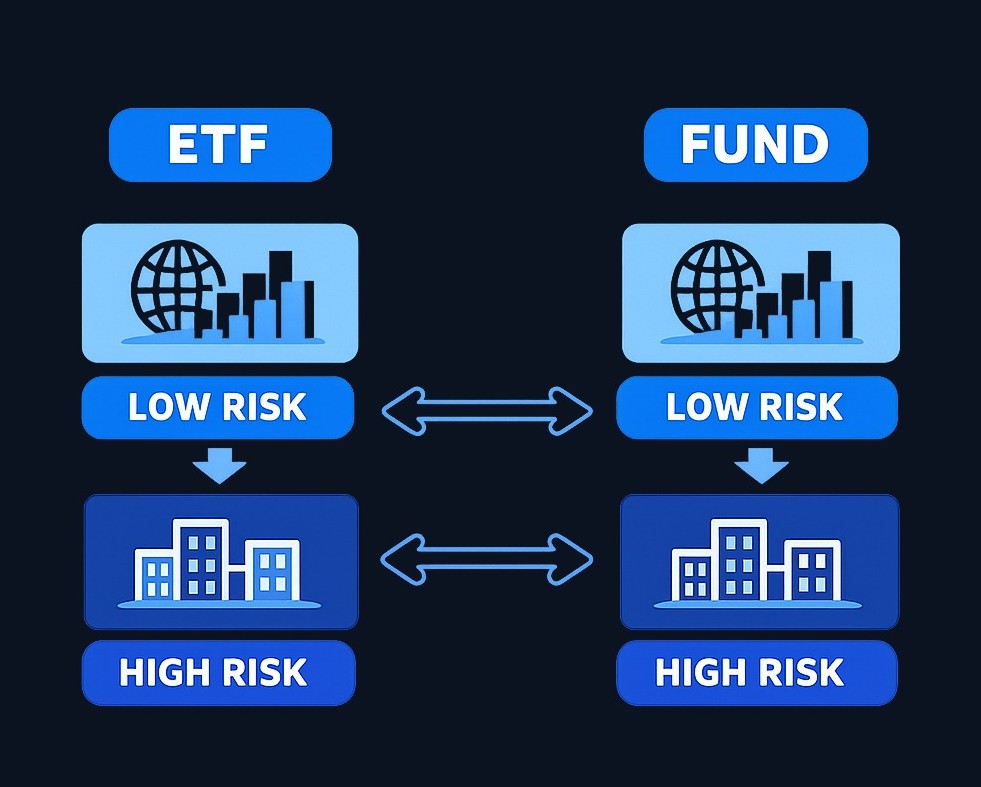
Both ETFs and mutual funds can lose money. The portfolio drives most of the risk. A broad bond mutual fund can behave very differently from a narrow stock ETF. A diversified stock ETF can behave very differently from a concentrated mutual fund.
Read the investment objective, principal strategy, holdings, and risks. Do not compare recent returns until you confirm that the funds pursue similar goals.
Practice investing with Finelo
Build practical investing skills with guided lessons, simulator practice, and structured challenges.
When Each Fund Type May Fit Better
When an ETF may fit better
An ETF may be the more practical wrapper when:
- You need intraday price control. You can see the market price and decide when to trade. Check the spread and price relative to NAV.
- The investment sits in a taxable account. The ETF structure may offer more control over when gains are realized. Your actual result depends on the fund and your transactions.
- Your broker supports your investing routine. Verify current rules for commissions, recurring purchases, and fractional shares. These are platform features, not universal ETF features.
- The comparable ETF has lower total costs. Include its expense ratio, spread, and any brokerage or advisory charge.
- The strategy you need is available in ETF form. Confirm that you understand the exposure and its risks.
Consider an investor building a long-term taxable portfolio. Two funds follow the same broad index. The broker supports recurring fractional ETF purchases. The ETF has a small spread and no added transaction fee. The mutual fund would carry an intermediary fee. The ETF may fit better because of account-specific costs and tax considerations, not because ETFs inherently earn more.
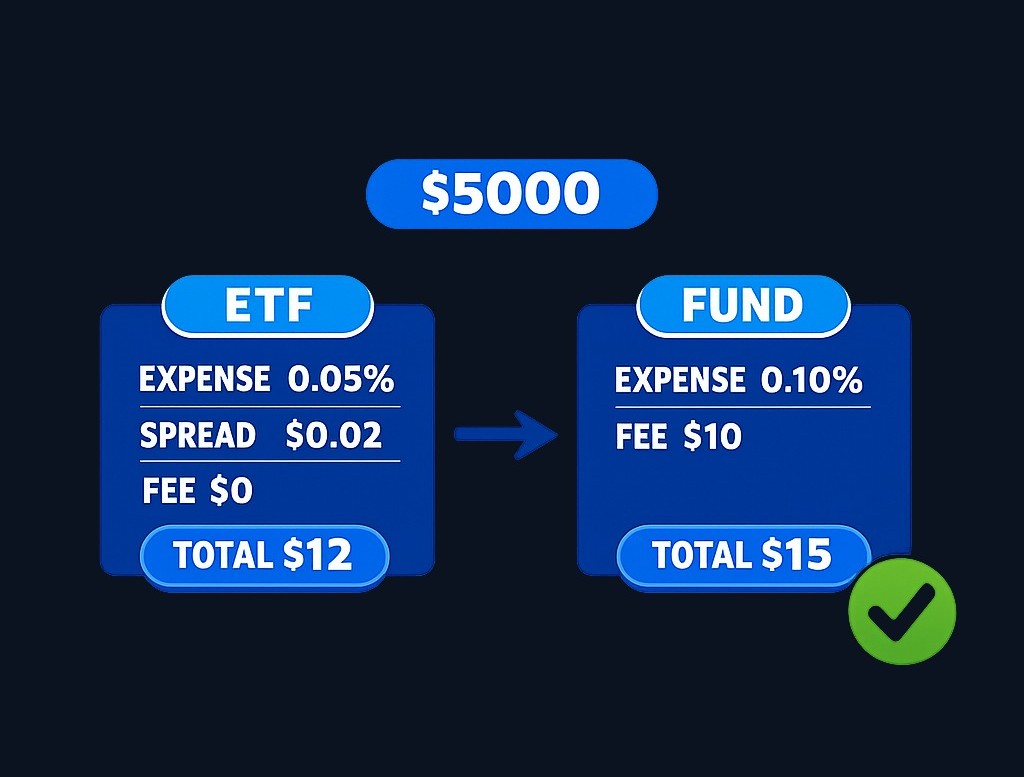
Common mistake: choosing a narrow ETF because it is easy to trade. Intraday liquidity does not make the underlying portfolio diversified or suitable.
When a mutual fund may fit better
A mutual fund may be the stronger choice when:
- It is the best option in a workplace plan. Compare it with the choices actually available in the plan.
- You value one end-of-day price. You avoid an ETF’s spread and premium-or-discount decision.
- The platform makes exact-dollar automation easy. Confirm the minimum and current recurring-investment rules. Do not assume either wrapper offers automation; verify the feature with your platform.
- The mutual fund has the lower total cost. A low-cost index mutual fund can compete directly with an index ETF.
- The desired active strategy is available only as a mutual fund. Compare the manager’s mandate, costs, and risks before relying on the active label.
Imagine an employee whose retirement plan offers a low-cost broad-market mutual fund through payroll contributions. The closest ETF is not available inside the plan. The mutual fund is the practical choice because it fits the account and savings process.
Common mistake: assuming NAV pricing removes market risk. It removes the ETF’s intraday trading variables. It does not stop the portfolio from losing value. FINRA warns that both fund types can lose money and that past performance does not predict future performance.
A Decision Framework for Comparing Specific Funds
Use the wrapper decision table only after choosing the exposure you need.
| Your situation | Likely starting point | Check before deciding |
|---|---|---|
| Taxable account; comparable portfolios | ETF | Distribution history, spread, premium or discount, and total trading costs |
| IRA or workplace plan | Best available fund in the account | Strategy, expense ratio, plan fees, and investment restrictions |
| Need to trade during the day | ETF | Liquidity, spread, market price versus NAV, and order approach |
| Prefer one daily price | Mutual fund | NAV pricing, minimum, automation, and transaction fees |
| Comparing an active ETF with an index mutual fund | Neither by default | Decide first whether you want active management or index tracking |
| Comparing funds that follow the same benchmark | Better all-in fit | Costs, portfolio tracking, taxes, service, and account rules |
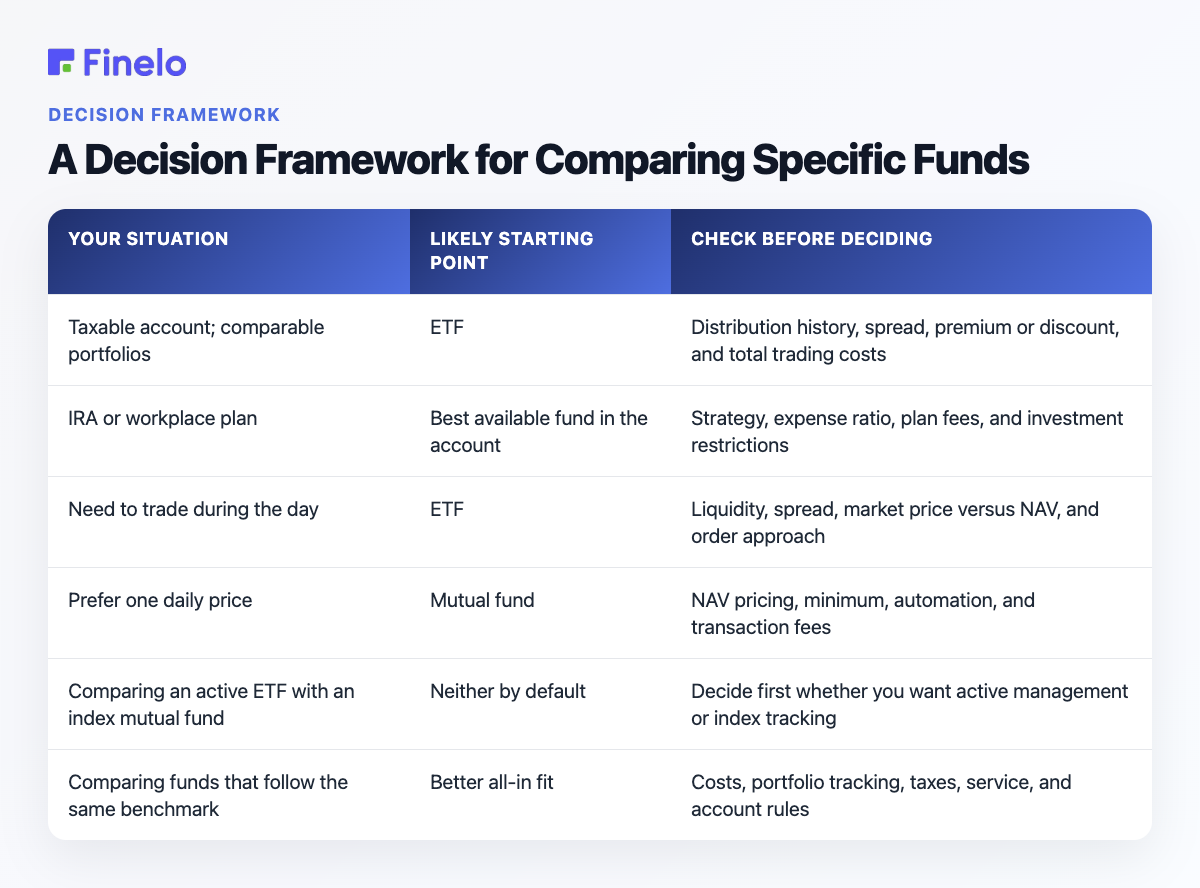
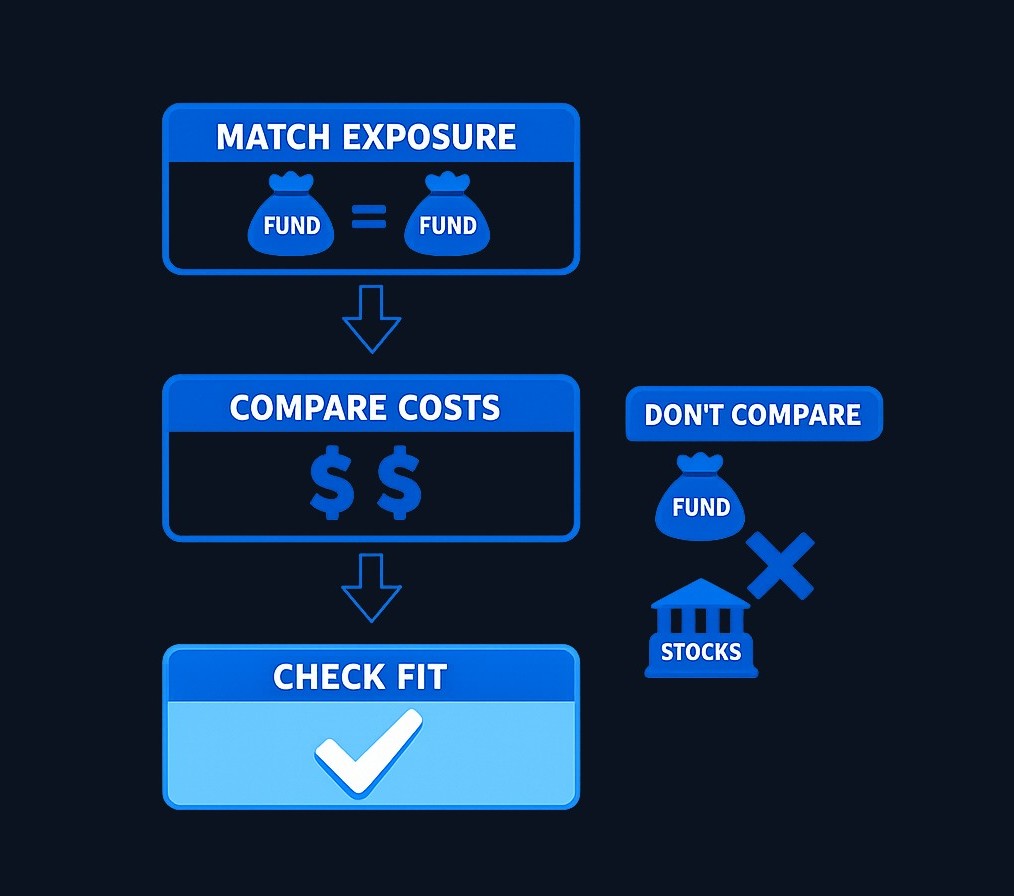
Use these five steps for an apples-to-apples comparison:
- Match the exposure. Confirm that both funds follow the same benchmark or pursue genuinely similar strategies. Similar names can hide different holdings.
- Match the period. Use the same start and end dates for performance. Do not compare a one-year result with a five-year average.
- Check the benchmark and portfolio. A fund can lag or lead because of expenses, cash holdings, sampling, or manager decisions. Do not credit the wrapper automatically.
- Add all costs. Use the current expense ratio for the exact fund. Add ETF spreads and brokerage charges or mutual-fund sales and transaction fees.
- Account for taxes and access. In a taxable account, review potential distributions and the effect of selling. In a retirement account, give more weight to strategy, cost, and plan rules.
For an ETF, review both NAV performance and market-price performance when available. NAV performance helps assess the portfolio. Market-price performance reflects the shareholder’s exchange-trading experience.
If one fund performed better, investigate why. A return gap may reflect different portfolios, costs, cash levels, trading, or distributions. A narrow historical result does not prove that one wrapper is better.
How to Switch Between ETFs and Mutual Funds
Switching usually means selling one fund and buying another. Do not switch only because the other wrapper looks more modern or cheaper at first glance.
- Match the destination fund. Compare exposure, risk, expense ratio, trading costs, and minimums.
- Check account rules. A workplace plan may restrict the menu. A broker may charge for a specific mutual fund or limit recurring ETF purchases.
- Review the tax effect. In a taxable account, selling shares can realize a gain or loss. FINRA notes that the timing of a sale affects when gains are realized. Ask a tax professional to review your circumstances.
- Plan the transactions. A mutual fund uses its next daily NAV, while an ETF uses its market price. Avoid assuming both sides will execute at the same time or price.
- Update your routine. Redirect recurring contributions and keep the records supplied by your broker or fund company.
If selling would create an unwanted tax cost, you could direct new contributions to the preferred fund while keeping the existing holding. Whether that approach suits you depends on your portfolio and tax situation.
Next Steps
Write down four things: your account type, desired exposure, contribution method, and expected holding behavior. Then shortlist one ETF and one mutual fund that serve the same role.
For each fund, review the current prospectus and fund information. Compare the strategy, risks, expense ratio, minimum, trading method, and performance over the same period. For an ETF, add the spread and market price relative to NAV. For a mutual fund, add any sales or transaction charge.
Finally, test the choice against your routine. Can you automate the amount you intend to invest? Is the fund available in your account? Will intraday pricing help you, or tempt you to trade unnecessarily? The better wrapper is the one that delivers the exposure you need at a reasonable total cost and that you can use consistently.
Frequently asked questions
Are ETFs safer than mutual funds?
No. Both can lose [money](https://www.finra.org/investors/insights/etf-vs-mutual-fund). The holdings, concentration, and strategy matter more than the wrapper. Compare the risks in each fund’s prospectus.
Which is better for long-term investing?
Either can work. A diversified fund with reasonable total costs that fits your account and routine matters more than the label. Fidelity concludes that both ETFs and open-ended mutual funds can suit long-term [investors](https://www.fidelity.com/viewpoints/investing-ideas/mutual-fund-or-etf).
How do ETF and mutual-fund taxes differ?
ETFs generally give investors more control over when they realize gains. Mutual-fund managers can sell appreciated holdings and create tax consequences for shareholders. FINRA explains this [distinction](https://www.finra.org/investors/insights/etf-vs-mutual-fund). Results vary by fund, account type, and investor, so get tax advice for your situation.
Can I buy ETFs in a retirement account?
That depends on the account and its investment menu. A brokerage IRA may offer ETFs, while a workplace plan may limit investors to selected funds. In a tax-deferred account, do not choose an ETF only for its taxable-account [reputation](https://www.fidelity.com/viewpoints/investing-ideas/mutual-fund-or-etf). Compare the available strategy, costs, and rules.
InvestingBeginnerETFsMutual FundsMarkets
Practice investing with Finelo
Build practical investing skills with guided lessons, simulator practice, and structured challenges.
About the author
Finelo Team
The Finelo Team creates practical investing and trading education designed to help beginners learn faster with structured challenges, simulator practice, and bite-sized lessons.
Keep reading — Related articles

Investing
Yield to Call vs Yield to Maturity: Assumptions and Bond Risks
Yield to call (YTC) estimates a bond's yield if the issuer redeems it on an eligible call date; yield to maturity (YTM) estimates yield if it remains outstanding to final maturity.
Finelo Team

Investing
Will My Employer Know If I Take a 401(k) Loan?
Who this page is for: readers new to 401(k) loans who want a practical, privacy‑focused explanation — what your employer can see, how to limit visibility, and the financial tradeoffs to weigh.
Finelo Team

Investing
What Medical Expenses Qualify for a 401(k) Hardship Withdrawal?
Before you decide, confirm three things with your plan administrator:
Finelo Team