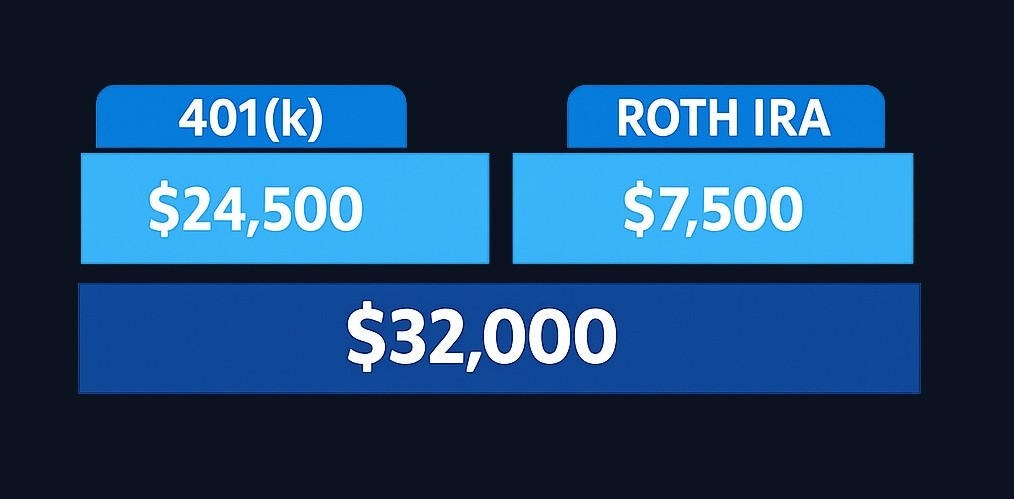
Yes — you can have both a 401(k) and a Roth IRA, and you can contribute to both in the same year. The annual limits are separate from each other, so you may contribute up to the maximum for each account type. For 2026, that means up to $24,500 in your 401(k) plus up to $7,500 in your Roth IRA.
Can I Have a 401(k) and a Roth IRA?
Yes — you can have both a 401(k) and a Roth IRA, and you can contribute to both in the same year. The annual limits are separate from each other, so you may contribute up to the maximum for each account type. For 2026…
7 min read
Practice trading with Finelo
Practice in a simulator, learn with bite-sized lessons, and build confidence before risking real money.
Want to learn more?
Practice in a simulator, learn with bite-sized lessons, and build confidence before risking real money.
Explore FineloExplore Finelo's 28-day challenges
Turn learning into a daily habit with guided challenge paths.
The only catch is Roth IRA income eligibility, covered below. For most savers, pairing the two isn't just allowed — it's one of the simplest ways to save more and build tax flexibility for retirement. Here's how the combination works and how to fund it in the right order.
Understanding 401(k) and Roth IRA
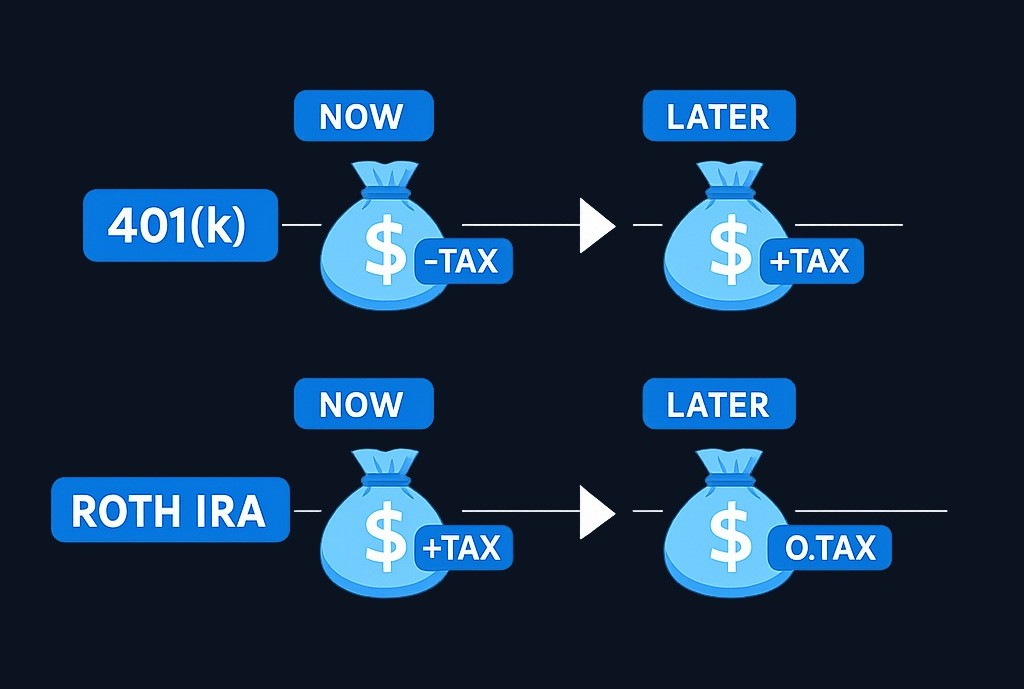
The two accounts are teammates with opposite tax personalities.
A 401(k) is a workplace retirement plan funded straight from your paycheck. Its classic form takes pre-tax contributions, often sweetened by employer matching, with required minimum distributions (RMDs) starting at age 73. Pre-tax means contributions reduce this year's taxable income — but withdrawals in retirement are taxed.
A Roth IRA is an account you open yourself at any brokerage. It runs on post-tax contributions, offers tax-free withdrawals after age 59½, and never requires minimum distributions. You get no deduction today; in exchange, qualified growth is never taxed.
Notice the mirror image: the 401(k) typically helps you now (lower taxes today, free match money), while the Roth IRA helps you later (tax-free income, no forced withdrawals). That's exactly why they combine so well — each covers the other's blind spot.
Can You Contribute to Both?
Yes, with two eligibility notes.
The 401(k) side is easy. If your employer offers a plan and you're eligible to participate, you can defer up to the annual limit. No income cap restricts your ability to contribute.
The Roth IRA side has income limits. For 2026, single filers can contribute in full with income below $153,000, with a phase-out up to $168,000; joint filers phase out between $242,000 and $252,000. Above those ranges, direct Roth IRA contributions close off. Contributing to a 401(k) does not affect your Roth IRA eligibility — only your income does.
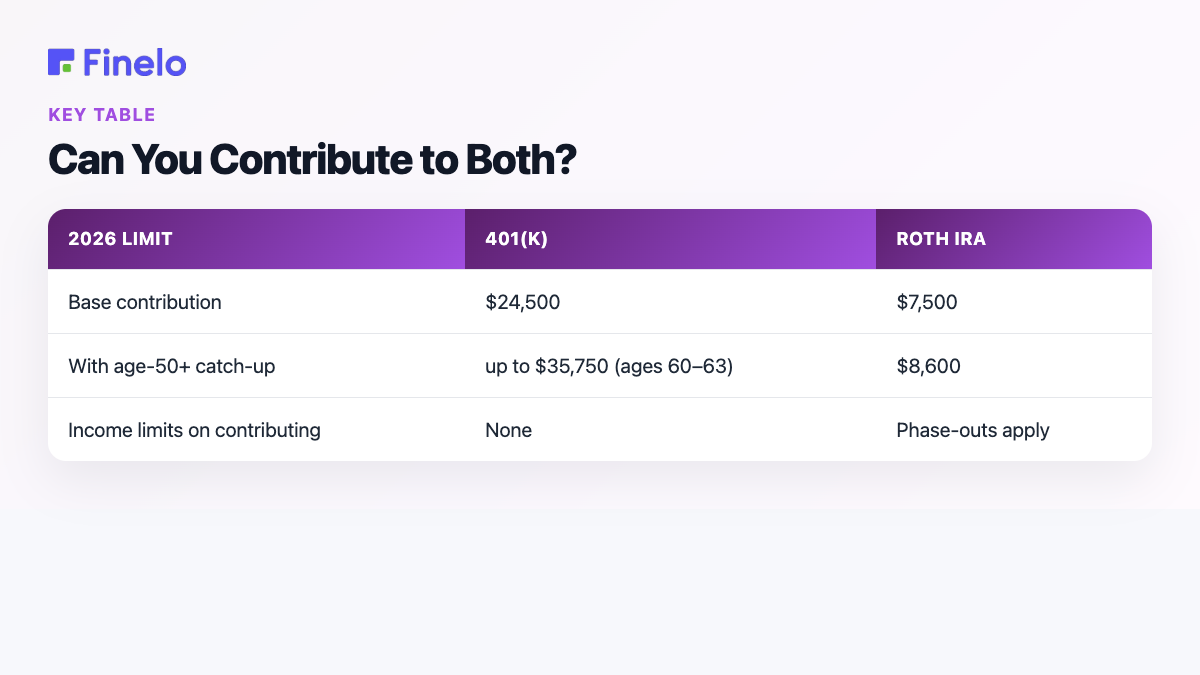
The key rule to internalize: the limits are independent — maxing one account takes nothing away from the other. The 2026 numbers side by side:
| 2026 limit | 401(k) | Roth IRA |
|---|---|---|
| Base contribution | $24,500 | $7,500 |
| With age-50+ catch-up | up to $35,750 (ages 60–63) | $8,600 |
| Income limits on contributing | None | Phase-outs apply |
A combined saver under 50 could set aside up to $32,000 across both accounts in 2026. Limits adjust over time — verify current figures before contributing.
Tax Implications of Each Account
Holding both accounts means holding two different tax deals — and that's the strategic point.
The 401(k) deal (traditional): contributions skip this year's taxes, growth compounds tax-deferred, and every withdrawal in retirement is taxed as income. Eventually the IRS insists: RMDs generally begin the year you turn 73.
The Roth IRA deal: you pay tax up front. After that, qualified withdrawals — tax-free after 59½ — never add to your taxable income, and no RMDs ever apply.
Why owning both beats owning either: nobody knows their retirement tax bracket decades in advance. With both buckets, each retirement year becomes a choice. Need income but want to stay under a tax threshold? Draw from the Roth. Sitting in a low-bracket year? Draw from the 401(k) while the rate is cheap. Tax professionals call this tax diversification — the retirement version of not putting all your eggs in one basket.
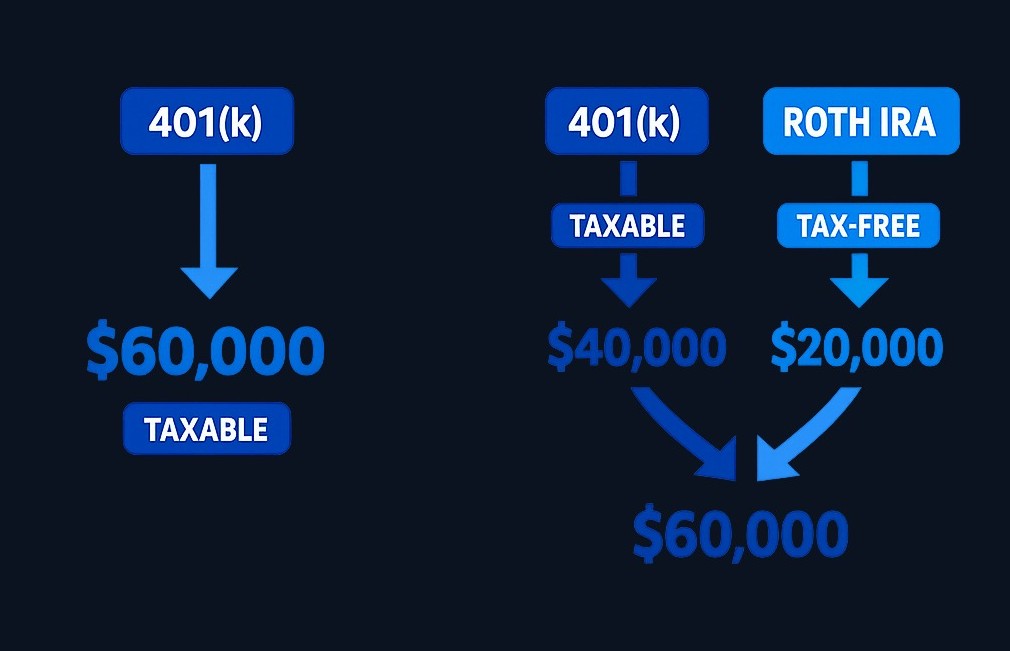
A worked illustration: a retiree needs $60,000 for the year. Pulling it all from a traditional 401(k) makes the full amount taxable. Pulling $40,000 from the 401(k) and $20,000 from the Roth IRA keeps taxable income lower — potentially holding the retiree in a smaller bracket. The mix is only possible because both accounts exist.
Practice trading with Finelo
Practice in a simulator, learn with bite-sized lessons, and build confidence before risking real money.
Strategies for Maximizing Contributions
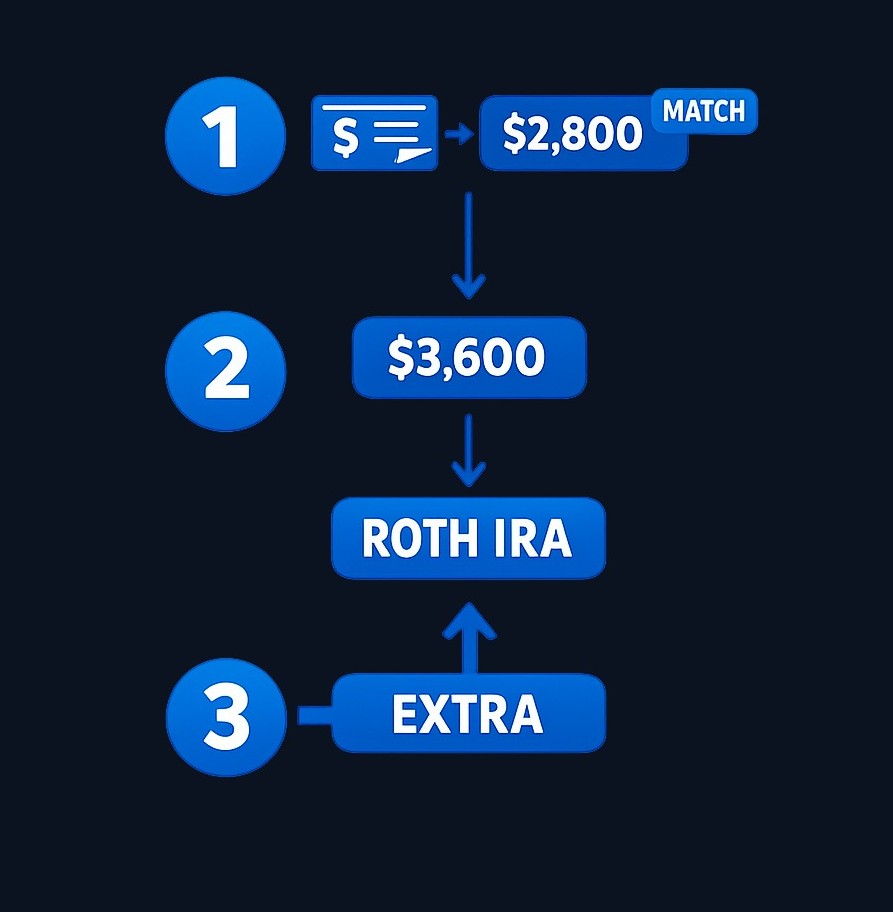
The widely used funding order comes down to grabbing the best deals first:
- Capture the full employer match. Prioritize 401(k) contributions until you receive the maximum match your employer offers. Match money is part of your compensation — skipping it is declining pay.
- Then fund the Roth IRA. Once you're getting the full match, contribute to a Roth IRA — building the tax-free bucket while your income still allows direct contributions.
- Then circle back to the 401(k). With the Roth IRA maxed at $7,500, push 401(k) deferrals toward the $24,500 cap as budget allows.
A concrete example: someone earning $70,000 whose employer matches up to 4% of salary. Step one: contribute $2,800 (4%) to the 401(k), collecting the full match. Step two: direct the next savings dollars — say $300 a month, $3,600 a year — to the Roth IRA. Step three: any further raises or bonuses increase the 401(k) percentage. Every dollar lands in the highest-value spot available.
Two practical tips: automate both contributions (payroll for the 401(k), a monthly bank transfer for the Roth IRA), and revisit the split each January when limits reset.
Withdrawal Rules and Penalties
The accounts also differ in how forgiving they are before retirement age.
- Roth IRA contributions are flexible. You can withdraw the money you contributed at any time, without taxes or penalties. The earnings are the protected part — touching them early can trigger income taxes plus a 10% penalty.
- 401(k) money is stricter. Early withdrawals generally face a 10% penalty plus income taxes, with limited exceptions.
- Timelines diverge at the back end too. The 401(k) forces withdrawals via RMDs from age 73; the Roth IRA never does.
Practical reading: treat the 401(k) as locked-until-retirement money, and the Roth IRA's contribution layer as a deep emergency reserve — available if life demands it, but best left compounding.
Key Takeaways
- You can hold and fund both accounts — the limits are fully separate.
- 2026 room: $24,500 in the 401(k) plus $7,500 in the Roth IRA, with catch-ups beyond that.
- Check Roth IRA income limits before assuming eligibility.
- Fund in order: match → Roth IRA → back to the 401(k).
- The real prize is tax flexibility in retirement: one taxable bucket, one tax-free bucket, and the freedom to choose between them year by year.
Frequently asked questions
What happens if I exceed the contribution limits?
Excess IRA contributions can trigger an annual penalty tax until corrected, so act quickly: contact your provider to withdraw the excess and any earnings on it before your tax deadline. For 401(k) over-contributions — possible after a mid-year job change — ask your plan administrator to distribute the excess.
Can I roll over my 401(k) into a Roth IRA?
Generally yes, typically after leaving a job. Moving pre-tax 401(k) money into a Roth IRA is a conversion, so the converted amount counts as taxable income that year. Many people convert gradually in lower-income years — check current IRS rules or a tax professional first.
Do employer matching contributions count against my limits?
Employer match dollars don't reduce your $24,500 employee deferral [limit](http://www.thriventfunds.com/insights/retirement-planning/pairing-roth-ira-with-your-401k-could-work-smarter-for-you-and-your-retirement.html) — they're counted under a separate overall plan cap. And they never affect your Roth IRA room, which is independent of the [401(k)](https://www.fidelity.com/learning-center/smart-money/roth-ira-vs-401k).
What's the difference between a Roth IRA and a Roth 401(k)?
Both take after-tax money and promise tax-free qualified withdrawals. The Roth 401(k) lives inside your workplace plan with the higher 401(k) [limits](http://www.thriventfunds.com/insights/retirement-planning/pairing-roth-ira-with-your-401k-could-work-smarter-for-you-and-your-retirement.html), while the Roth IRA is yours independently, has [income limits](https://www.fidelity.com/learning-center/smart-money/roth-ira-vs-401k), and [no RMDs](https://www.fidelity.com/learning-center/smart-money/roth-ira-vs-401k). If your plan offers a Roth 401(k), you can use it alongside a Roth IRA too. This article is educational, not personalized financial or tax advice. Limits and rules change — verify current figures and your eligibility before contributing. Building your retirement knowledge from the ground up? Finelo's Wealth Growth [Quiz](https://finelo.com/) matches you with a learning path that fits your starting point.
Financial LiteracyBeginnerRetirementPersonal Finance
Practice trading with Finelo
Practice in a simulator, learn with bite-sized lessons, and build confidence before risking real money.
About the author
Finelo Team
The Finelo Team creates practical investing and trading education designed to help beginners learn faster with structured challenges, simulator practice, and bite-sized lessons.
Keep reading — Related articles

Financial Literacy
Mercury Books Review 2026: Is It Worth It for Startups?
Mercury Books brings double-entry accounting into Mercury. Review its $35 pricing, reports, AI features, integrations, and migration limits.
Finelo Team

Financial Literacy
Why is My FICO Score Lower Than My Credit Score?
Example takeaway: seeing a higher score in a bank app doesn’t guarantee lenders will see the same FICO number at application time; lenders often pull a specific FICO version from a specific bureau.
Finelo Team

Financial Literacy
Why Is My FICO Score Higher Than My Credit Score?
Brief educational note: this article is educational, not financial or investment advice; investing and credit decisions involve risk and possible loss.
Finelo Team