A fixed annuity pays a guaranteed interest rate and protects your principal from market loss. A variable annuity invests your money in subaccounts tied to the stock market, so your balance rises and falls with investment performance. Fixed trades upside for safety. Variable trades safety for growth potential.
Fixed Annuity vs Variable Annuity: A Comprehensive Comparison

A fixed annuity pays a guaranteed interest rate and protects your principal from market loss. A variable annuity invests your money in subaccounts tied to the stock market, so your balance rises and falls with…
7 min read
Practice trading with Finelo
Practice in a simulator, learn with bite-sized lessons, and build confidence before risking real money.
Want to learn more?
Practice in a simulator, learn with bite-sized lessons, and build confidence before risking real money.
Explore FineloExplore Finelo's 28-day challenges
Turn learning into a daily habit with guided challenge paths.
This comparison is for anyone weighing guaranteed, predictable retirement income against growth potential with real market risk. Read the two definitions below, check the differences and fees, then use the decision framework near the end to see which fits your own risk tolerance and retirement timeline.
What is a Fixed Annuity?
A fixed annuity guarantees a specific interest rate for a contracted period. Your principal is protected from market loss, and your earnings are locked in at a set percentage regardless of what the stock market does. It's structurally closer to a CD than an investment: fixed annuities are contractual guarantees, not market participation.
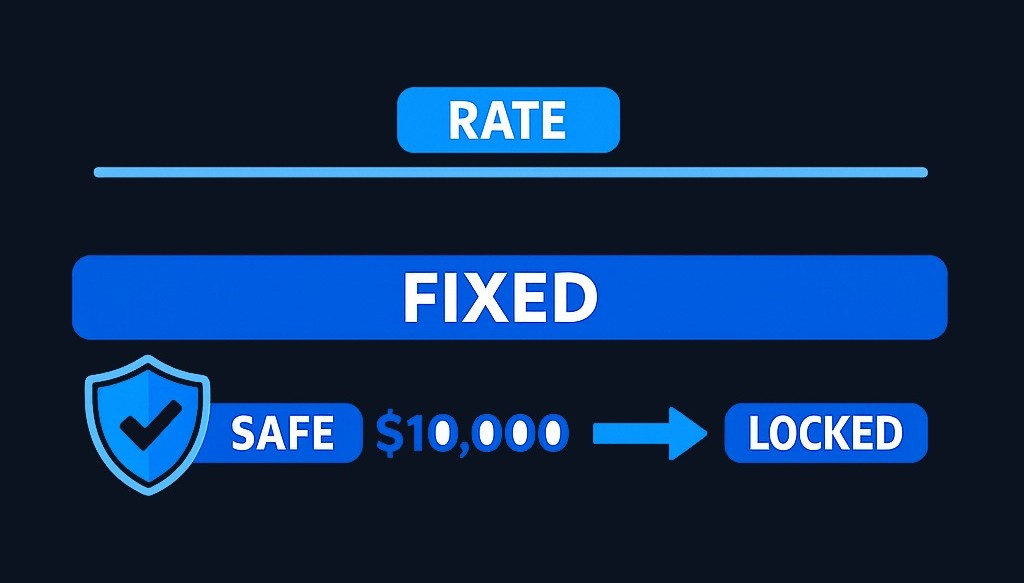
Like other annuities, growth is tax-deferred — you don't owe tax on gains until you withdraw them. You can also convert the balance into a guaranteed stream of lifetime income later on. The tradeoff for that safety is a lower ceiling: your return can't beat the guaranteed rate, even in a strong market.
What is a Variable Annuity?
A variable annuity puts your money into subaccounts you choose, similar to mutual funds, so your account value moves with the market. There's no guaranteed rate, and your principal is exposed to market fluctuations, including losses. In plain terms: a variable annuity is essentially a mutual fund wrapped in an insurance contract, built for growth exposure rather than a guarantee.
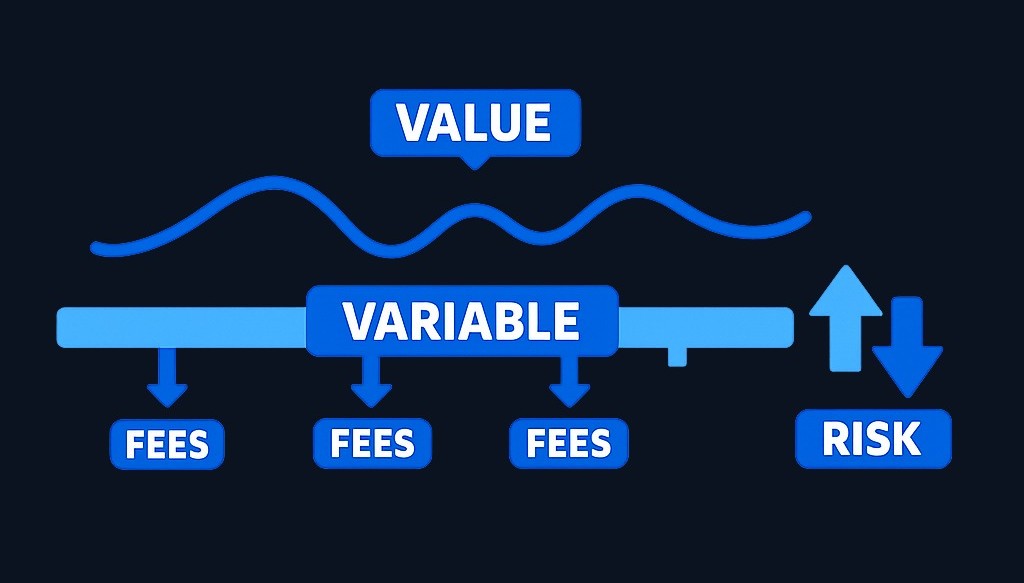
Growth is tax-deferred, same as a fixed annuity, and you can also annuitize the balance into guaranteed lifetime income later. The difference is cost: variable annuity fees can run from 1% to 4% annually, with 2% to 3% being more typical over the life of the contract — a real, ongoing drag that a fixed annuity doesn't carry.
Key Differences Between Fixed and Variable Annuities
| Factor | Fixed Annuity | Variable Annuity |
|---|---|---|
| Interest/return | Guaranteed, set rate | Tied to subaccount performance, no guarantee |
| Principal protection | Protected from market loss | Exposed to market losses |
| Fees | Generally lower — fewer administrative costs | 1%–4% annually, commonly 2%–3% |
| Investment control | None — set rate only | Choose conservative-to-aggressive subaccounts |
| Tax treatment | Tax-deferred growth, taxed on withdrawal | Same — tax-deferred, taxed on withdrawal |
| Early withdrawal | Surrender charges, plus a 10% IRS penalty before age 59½ with exceptions | Same surrender-charge and 10% early-withdrawal rules apply |
| Lifetime income option | Available by annuitizing | Available by annuitizing |
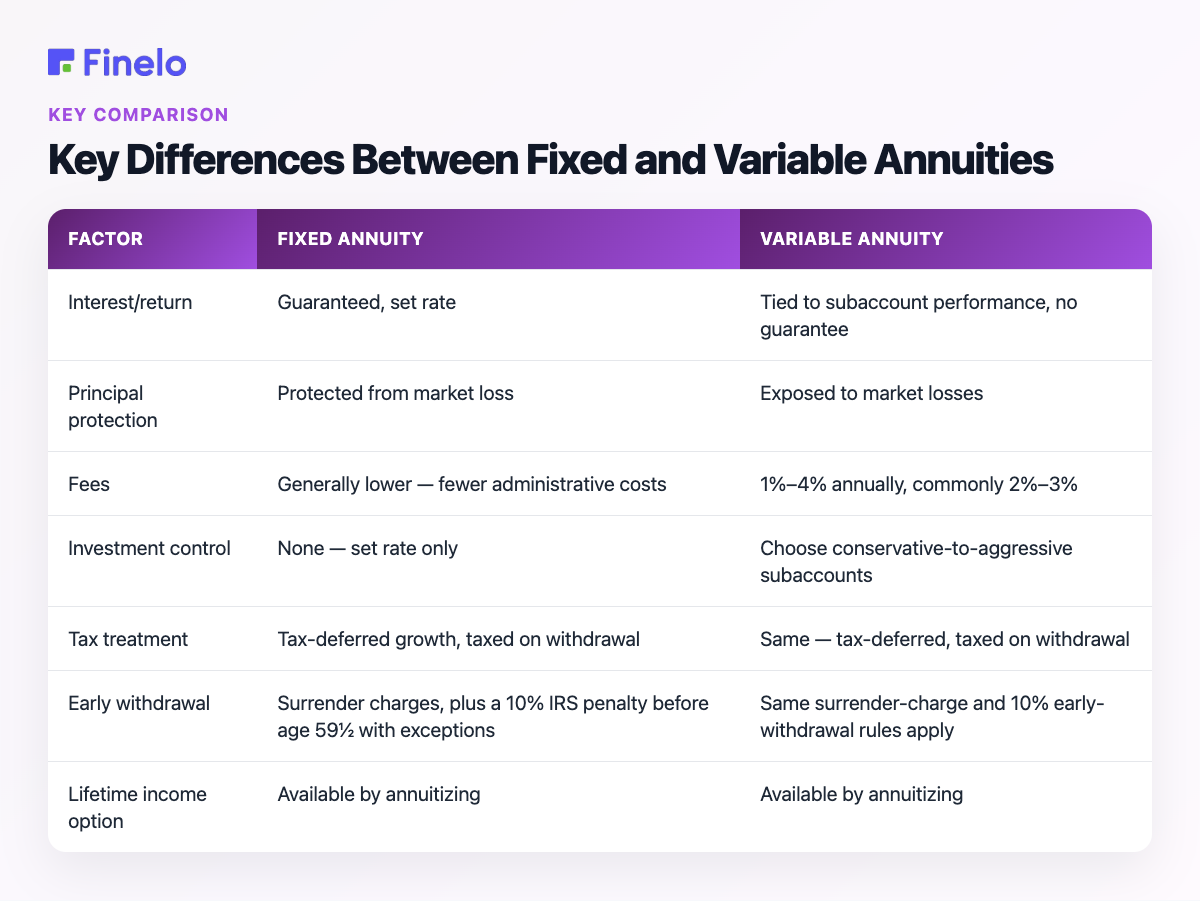
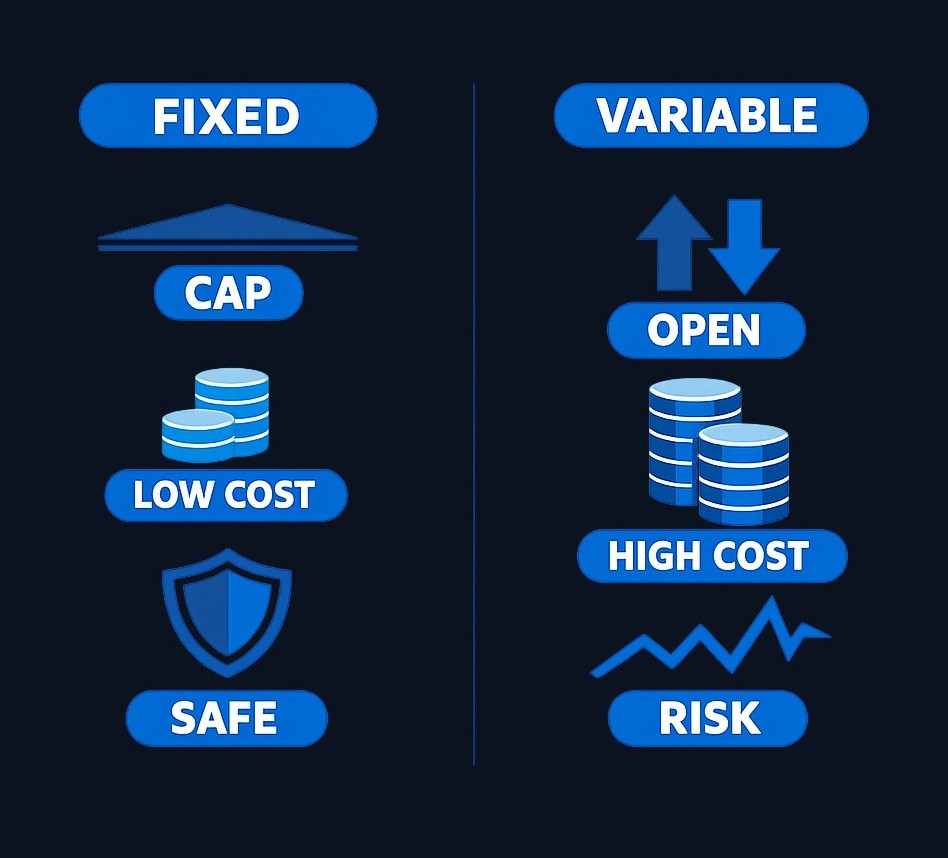
Both products share the same tax deferral and both can convert to guaranteed income. The real split is risk versus fees: a fixed annuity costs less and caps your upside; a variable annuity costs more and removes the cap, in either direction.
Pros and Cons of Fixed Annuities
Pros:
- Guaranteed interest rate, unaffected by market swings
- Principal protected from market loss
- Generally lower ongoing costs than a variable annuity
- Simple to understand — one rate, no fund choices to manage
Cons:
- Return is capped at the guaranteed rate, even in a strong market
- No ability to participate in market gains
- Surrender charges apply to early withdrawals, reducing liquidity in the early contract years
- A fixed rate can lose real purchasing power if inflation runs ahead of it
Practice trading with Finelo
Practice in a simulator, learn with bite-sized lessons, and build confidence before risking real money.
Pros and Cons of Variable Annuities
Pros:
- Choice of subaccounts to match your risk tolerance
- Real potential to outgrow inflation and beat a fixed rate over time
- Same tax-deferred growth as a fixed annuity
- Flexible income options at annuitization
Cons:
- No guaranteed rate — account value can decline with the market
- Fees run 1%–4% annually, quietly compounding against your returns every year
- More complex — you're actively choosing and monitoring subaccounts
- Same surrender charges and early-withdrawal penalty as a fixed annuity, on top of market risk
When to Choose a Fixed Annuity
A fixed annuity fits best if protecting principal matters more to you than growth potential — for example, money you're relying on for guaranteed income within the next few years, where a market downturn right before you need the cash would be genuinely damaging. It also suits anyone who wants a "set it and forget it" product: one rate, no ongoing fund decisions, and lower fees eating into the balance.
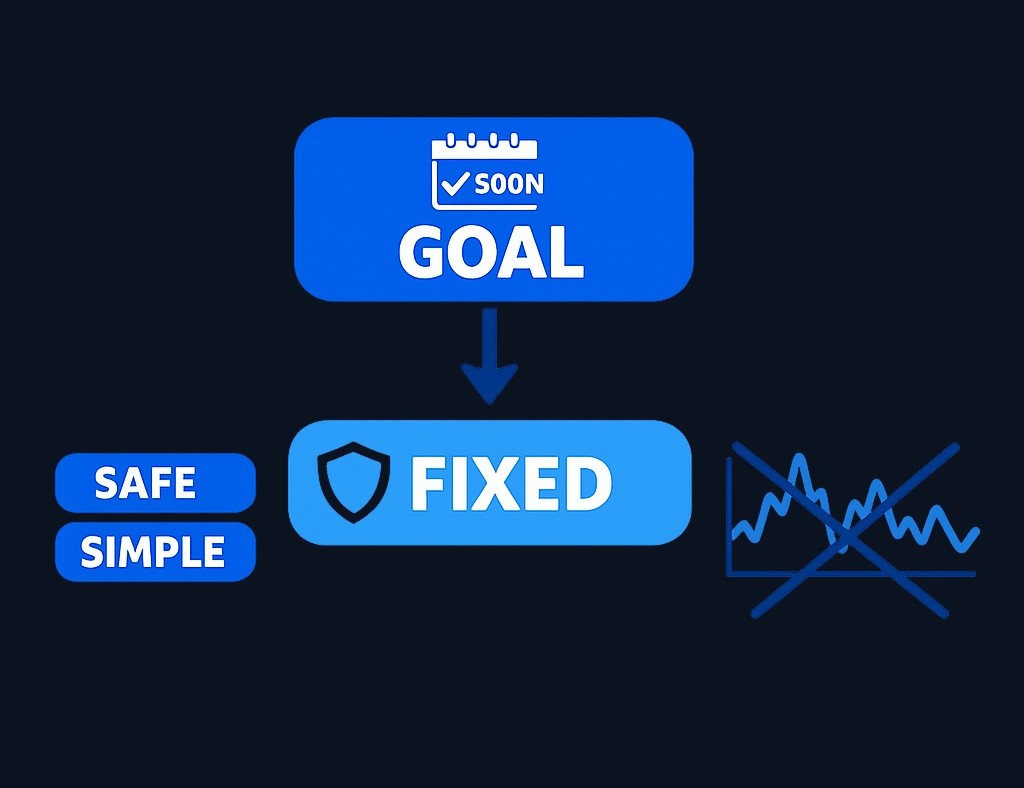
It's a weaker fit if you have a long time horizon and can tolerate short-term swings, since a fixed rate has no mechanism to grow beyond its guarantee — meaning years of strong market performance simply pass you by.
When to Choose a Variable Annuity
A variable annuity fits best if you have a longer time horizon, can tolerate market swings, and want a chance to outpace inflation rather than lock in a fixed rate. Choosing your own subaccounts lets you dial risk up or down as your goals change, something a fixed annuity can't offer.

It's a weaker fit if you can't afford to see your balance drop in a bad year, or if you're uncomfortable monitoring subaccount performance and absorbing fees that can run 1% to 4% annually regardless of how the market performs.
Decision Framework: Fixed vs Variable Annuity
Run your situation through these questions in order:
| Question | Fixed annuity fits better if... | Variable annuity fits better if... |
|---|---|---|
| How long until you need the income? | Within a few years | A decade or more away |
| How would a market drop affect your plans? | It would be genuinely damaging | You can wait it out |
| Do you want to manage investment choices? | No — you want one set rate | Yes — you want to pick subaccounts |
| How much do fees concern you? | You want the lower-cost option | You accept 1%–4% annual fees for growth potential |
| What's the priority: safety or growth? | Safety and predictability | Growth potential and inflation protection |
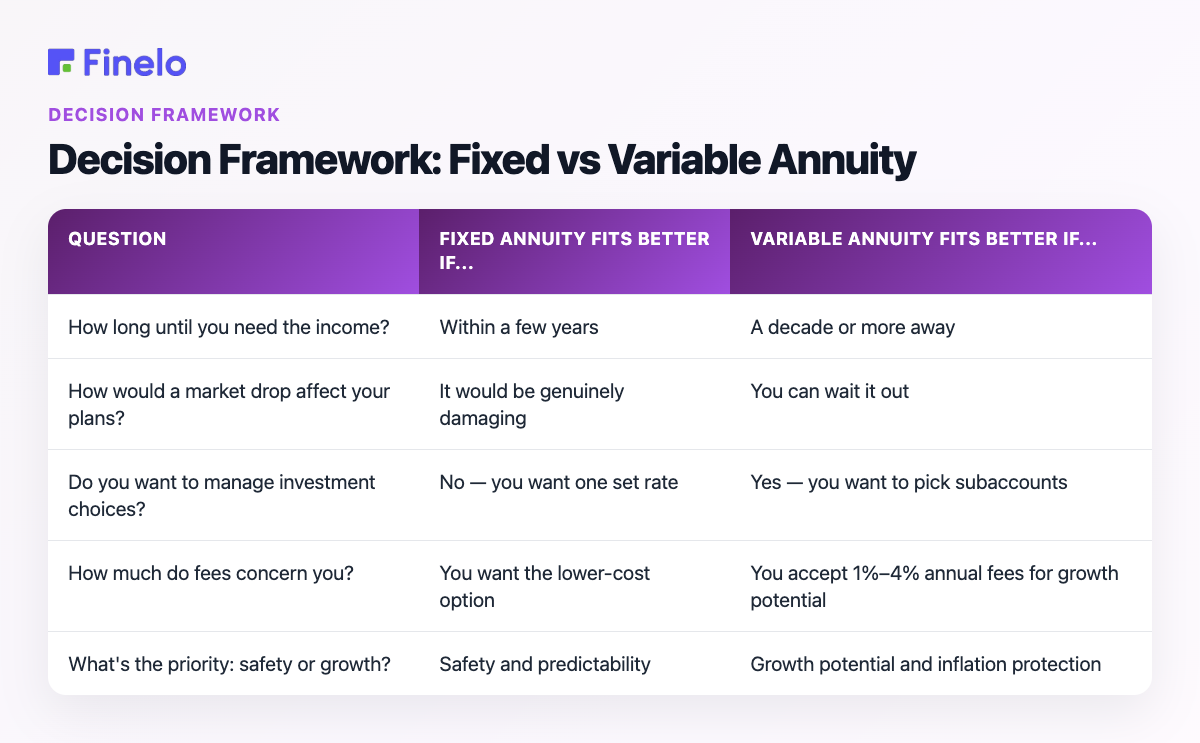
If your answers split between the two columns, that's common — many retirement plans use both, holding a fixed annuity for guaranteed near-term income and a variable annuity for longer-term growth. Whichever you choose, read the surrender charge schedule and fee disclosures in the actual contract before signing anything — the numbers vary by issuer and contract, and this comparison covers general patterns, not a specific product's terms.
Frequently asked questions
Can I switch from a fixed annuity to a variable annuity later?
Some contracts allow an exchange between annuity types, sometimes without triggering immediate tax, but the rules and any surrender charges depend entirely on your specific contract. Check your own annuity's terms, or ask the issuer directly, before assuming a switch is possible or free.
What are the tax implications of annuities?
Both types offer tax-deferred growth, meaning you don't owe tax on gains until you withdraw [them](https://www.thrivent.com/insights/annuities/fixed-annuity-vs-variable-annuity-pros-and-cons-to-consider). Withdrawals before age 59½ typically trigger a 10% IRS [penalty](https://www.thrivent.com/insights/annuities/fixed-annuity-vs-variable-annuity-pros-and-cons-to-consider) on top of ordinary income tax, unless an exception applies.
What happens if I need to withdraw money early?
Both fixed and variable annuities generally carry surrender charges for early [withdrawals](https://www.thrivent.com/insights/annuities/fixed-annuity-vs-variable-annuity-pros-and-cons-to-consider), which typically decline the longer you hold the contract, plus the 10% early-withdrawal tax penalty before 59½. Review your contract's surrender schedule before committing money you might need soon. This article is educational, not personalized financial advice. Annuity terms, fees, and surrender schedules vary by issuer and contract — verify the specific terms with the issuer and a qualified professional before purchasing. If you want to build a broader understanding of retirement and investing options first, Finelo's Wealth Growth [Quiz](https://finelo.com/) matches you with a learning path suited to your level.
Financial LiteracyBeginnerRetirementPersonal Finance
Practice trading with Finelo
Practice in a simulator, learn with bite-sized lessons, and build confidence before risking real money.
About the author
Finelo Team
The Finelo Team creates practical investing and trading education designed to help beginners learn faster with structured challenges, simulator practice, and bite-sized lessons.
Keep reading — Related articles

Financial Literacy
Mercury Books Review 2026: Is It Worth It for Startups?
Mercury Books brings double-entry accounting into Mercury. Review its $35 pricing, reports, AI features, integrations, and migration limits.
Finelo Team

Financial Literacy
Why is My FICO Score Lower Than My Credit Score?
Example takeaway: seeing a higher score in a bank app doesn’t guarantee lenders will see the same FICO number at application time; lenders often pull a specific FICO version from a specific bureau.
Finelo Team

Financial Literacy
Why Is My FICO Score Higher Than My Credit Score?
Brief educational note: this article is educational, not financial or investment advice; investing and credit decisions involve risk and possible loss.
Finelo Team


