If you want to know how to choose 401k investments, start with your retirement timeline, risk tolerance, and the investment menu inside your plan. Then choose a diversified mix, compare fees, decide whether you want an all-in-one option or a custom mix, and review it on a schedule instead of reacting to every market move.
How to Choose 401(k) Investments: A Step-by-Step Guide
If you want to know how to choose 401k investments, start with your retirement timeline, risk tolerance, and the investment menu inside your plan. Then choose a diversified mix, compare fees, decide whether you want an…
8 min read
Practice trading with Finelo
Practice in a simulator, learn with bite-sized lessons, and build confidence before risking real money.
Want to learn more?
Practice in a simulator, learn with bite-sized lessons, and build confidence before risking real money.
Explore FineloExplore Finelo's 28-day challenges
Turn learning into a daily habit with guided challenge paths.
A 401(k) is a workplace retirement account. The account is only the container. The investments inside the account determine how your money is exposed to stocks, bonds, cash-like options, or other plan choices. That is why choosing investments matters: the mix should fit your goals, time horizon, and comfort with volatility.
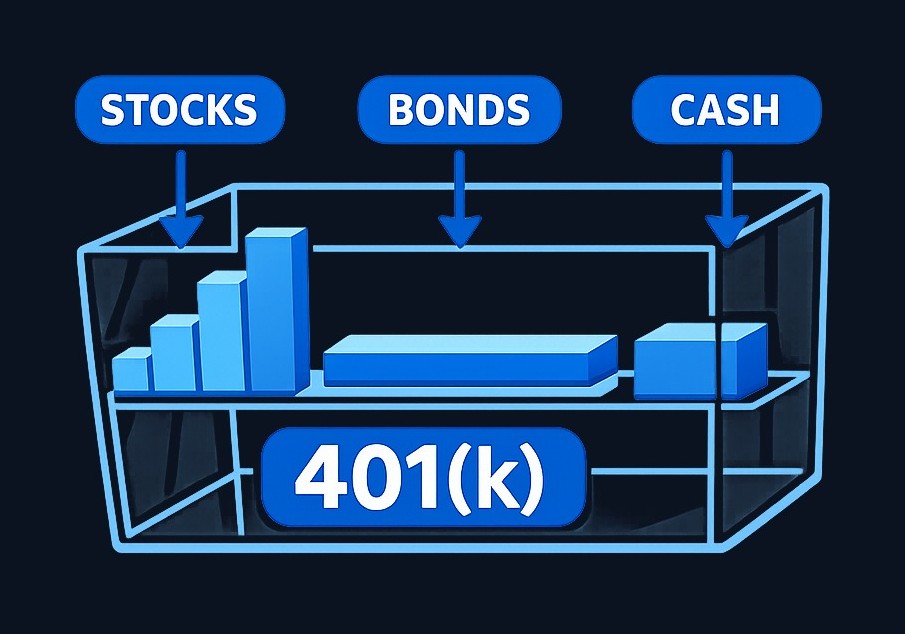
401(k) Investments at a Glance
Most 401(k) plans give you a menu rather than unlimited choices. You may see target-date funds, stock funds, bond funds, stable value or cash-like options, company stock, managed portfolios, or brokerage-window choices if the plan offers them.
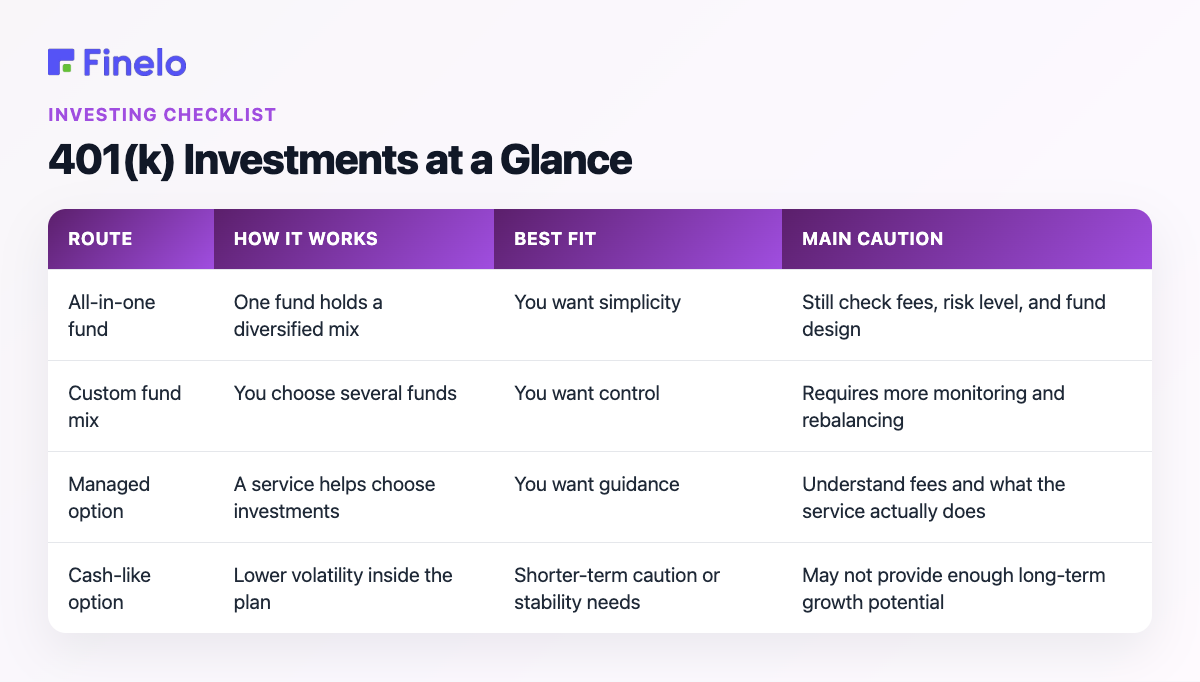
The first decision is whether you want a simple all-in-one route or a do-it-yourself mix. An all-in-one option, such as a target-date-style fund, usually combines different asset classes in one fund and adjusts the mix over time according to its design. A custom mix means you choose several funds yourself and manage the allocation.
Neither route is automatically better. The better choice is the one you understand and can maintain.
| Route | How it works | Best fit | Main caution |
|---|---|---|---|
| All-in-one fund | One fund holds a diversified mix | You want simplicity | Still check fees, risk level, and fund design |
| Custom fund mix | You choose several funds | You want control | Requires more monitoring and rebalancing |
| Managed option | A service helps choose investments | You want guidance | Understand fees and what the service actually does |
| Cash-like option | Lower volatility inside the plan | Shorter-term caution or stability needs | May not provide enough long-term growth potential |
Beginners often do best by reducing complexity first. A portfolio you can explain is easier to maintain than a complicated mix you picked because it sounded sophisticated.
Understand Your Investment Options
Start by reading the plan's investment menu. You are looking for what each option owns, how much it costs, how risky it is, and what role it could play.
Common choices include:
- Stock funds: These usually invest in company shares. They may focus on large companies, small companies, international markets, or specific styles.
- Bond funds: These usually invest in debt securities. They may help reduce portfolio swings, though they still carry risk.
- Target-date-style funds: These combine several asset types and are designed around an estimated retirement year.
- Stable value or cash-like options: These may be used for lower-volatility needs, depending on plan rules.
- Company stock: This can create concentration risk if too much of your retirement money depends on your employer.
- Brokerage window: Some plans may allow access to a wider menu, but more choice also means more responsibility.
If your plan offers both mutual funds and ETFs, compare the mechanics before choosing.
| Feature | Mutual funds in a 401(k) | ETFs in a 401(k) |
|---|---|---|
| Trading style | Usually processed through plan rules rather than intraday trading | May trade more like exchange-listed funds if available |
| Common use | Often the main menu in workplace plans | May appear in some plans or brokerage windows |
| Best beginner question | Does this fund fit my asset allocation? | Does this ETF fit my asset allocation and trade efficiently? |
| What to compare | Fees, holdings, risk, role in portfolio | Fees, holdings, risk, spread, role in portfolio |
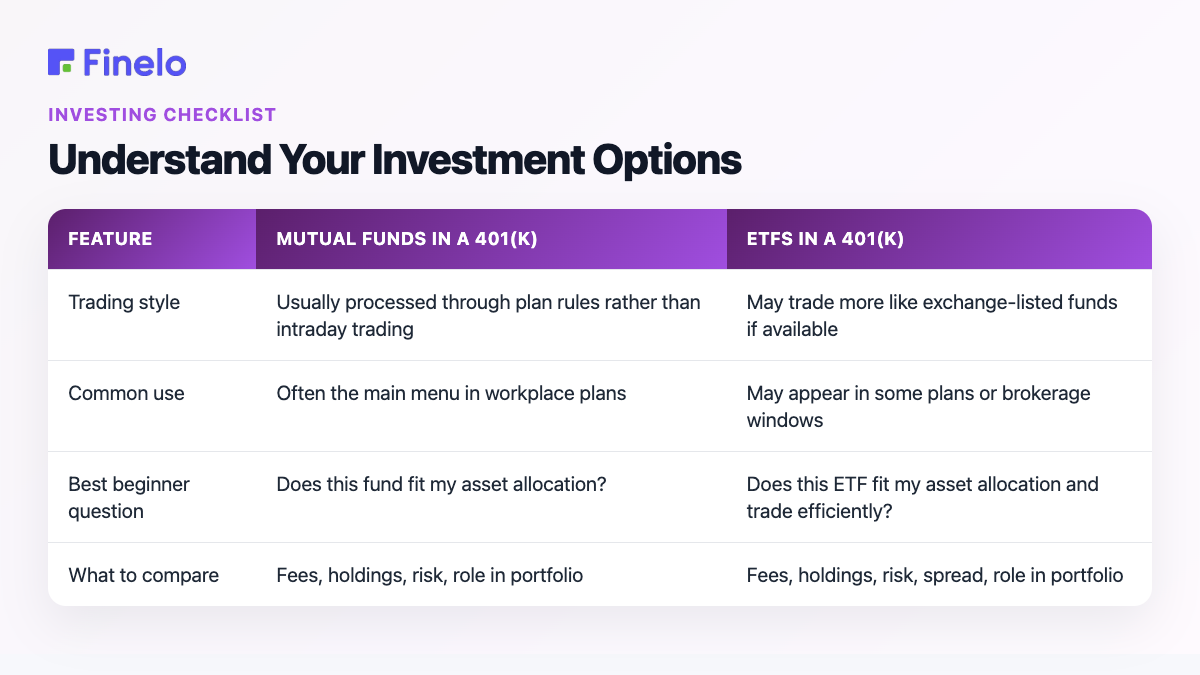
Do not choose based only on whether something is called a mutual fund or ETF. The wrapper matters less than the holdings, cost, risk, and fit.
Assess Your Risk Tolerance
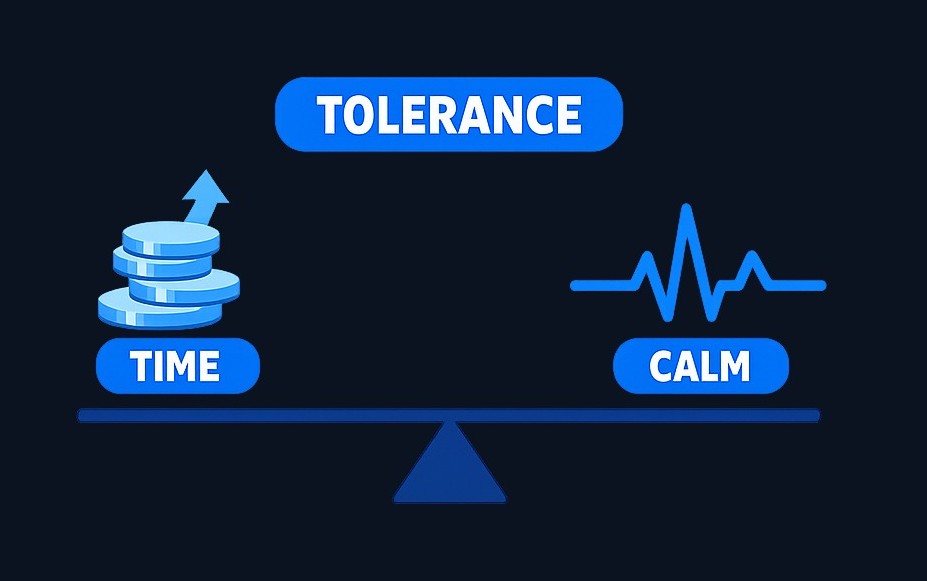
Risk tolerance means how much uncertainty you can handle without abandoning the plan. It has two sides: financial ability and emotional ability.
Financial ability is about your timeline, savings rate, job stability, debt, emergency savings, and years until retirement. Emotional ability is about how you react when account values fall. Both matter. A person with many years until retirement may have the financial ability to take more stock-market risk, but if every drop causes panic, the portfolio may still be too aggressive.
Use this checklist:
| Question | If your answer is yes | What it may suggest |
|---|---|---|
| Is retirement decades away? | You may have more time to ride out volatility | More growth exposure may be reasonable |
| Is retirement near? | Large losses may be harder to recover from | More balance and stability may matter |
| Would a market drop make you stop contributing? | Your emotional risk limit may be lower | Choose a mix you can stay with |
| Do you have emergency savings outside the 401(k)? | You may be less likely to raid retirement money | Long-term investing becomes easier |
| Do you understand the funds you selected? | You are more likely to stay disciplined | Keep the plan simple |
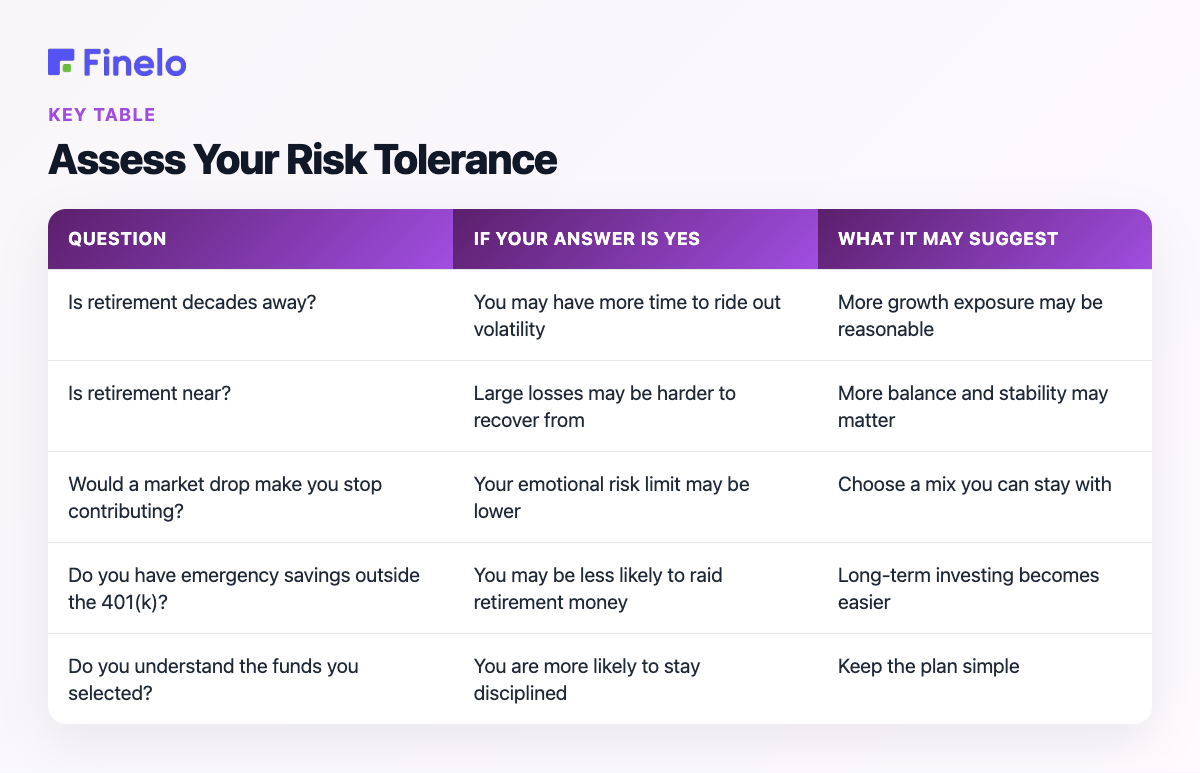
A useful test is the "bad year" question: if your account fell sharply, would you keep contributing, reduce risk slightly, or sell everything? If the honest answer is "sell everything," the mix may be too aggressive.
Diversification and Asset Allocation
Diversification means spreading money across different investments so one holding does not decide everything. Asset allocation means the overall mix of asset classes, such as stocks, bonds, and cash-like options.
Diversification does not remove risk. It helps manage concentration. If your entire 401(k) is in one company, one sector, or one aggressive fund, your result depends heavily on a narrow bet. A diversified mix spreads exposure across more sources of return and risk.
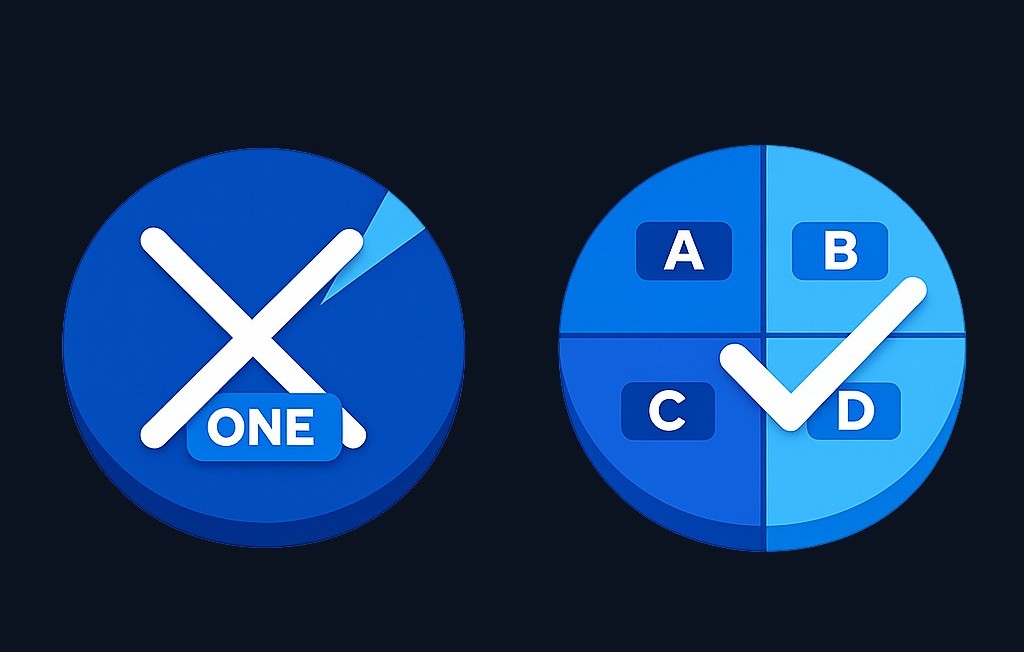
For beginners, the most important question is not "How many funds do I own?" It is "Do my funds overlap?" Owning five funds that all hold similar stocks may not diversify much. Owning one well-diversified all-in-one fund may be simpler than owning several overlapping funds.
Watch for these concentration traps:
- Too much company stock.
- Several funds with similar holdings.
- Too much exposure to one sector or trend.
- A mix that is too aggressive for your retirement timeline.
- A mix that is too conservative to support long-term goals.
The goal is not a perfect portfolio. It is a portfolio with a clear role for each piece.
Practice trading with Finelo
Practice in a simulator, learn with bite-sized lessons, and build confidence before risking real money.
Choose Based on Goals and Time Horizon
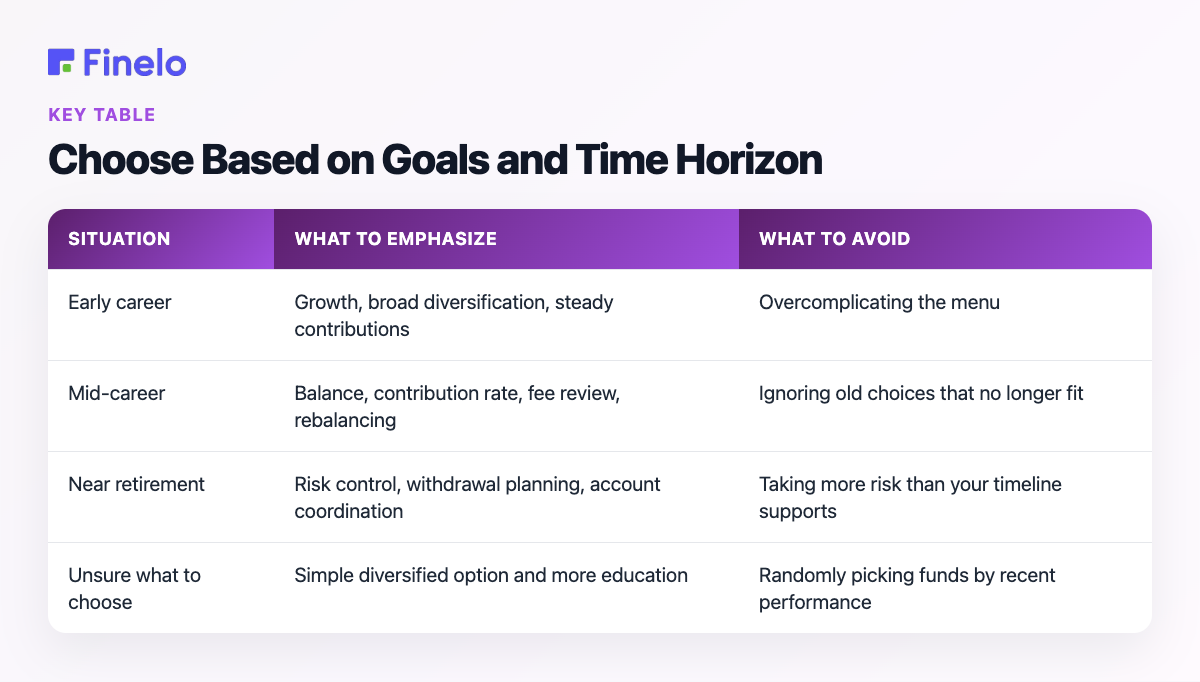
Your time horizon is the amount of time before you expect to use the money. A longer horizon may support more growth exposure because there is more time to recover from market downturns. A shorter horizon may call for more attention to stability.
Use this framework:
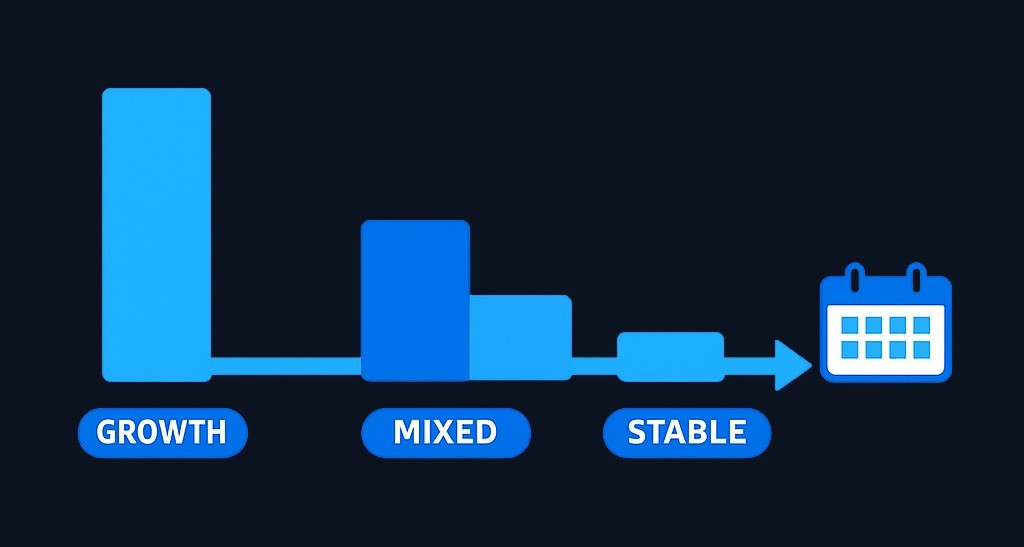
| Situation | What to emphasize | What to avoid |
|---|---|---|
| Early career | Growth, broad diversification, steady contributions | Overcomplicating the menu |
| Mid-career | Balance, contribution rate, fee review, rebalancing | Ignoring old choices that no longer fit |
| Near retirement | Risk control, withdrawal planning, account coordination | Taking more risk than your timeline supports |
| Unsure what to choose | Simple diversified option and more education | Randomly picking funds by recent performance |
Fees matter at every stage. Compare expense ratios, plan fees, and advisory charges if a managed option is involved. A lower-cost fund is not automatically best, but higher costs need a reason you understand.
Also decide whether you want to manage the mix yourself. If you choose a custom allocation, write it down. For example: "I want a diversified mix that leans toward growth but includes some stabilizing assets." Then connect each fund to that statement. If a fund does not have a role, it probably does not belong.
Common Mistakes to Avoid
The first mistake is choosing investments once and never reviewing them. Life changes. Retirement dates change. Plan menus change. Your risk tolerance can change too.
The second mistake is chasing the fund that recently performed best. Recent performance can be tempting, but it may reflect a market cycle that has already happened. Choose based on role, risk, cost, and fit.
The third mistake is ignoring fees. Fees are not the only factor, but they are part of the result you keep. Compare costs before selecting funds or managed services.
The fourth mistake is holding too much employer stock. Your paycheck already depends on your employer. Concentrating retirement savings in the same company can increase risk.
The fifth mistake is mixing several strategies without a plan. A target-date-style fund may already include a full asset mix. Adding several extra funds around it can accidentally change the risk level.
The sixth mistake is reacting emotionally during volatility. A 401(k) is usually a long-term account. Market movement should trigger review, not panic.
How Often to Review Your 401(k)
Reviewing does not mean changing everything. A practical review checks whether the account still matches your goals.
Consider reviewing when:
- You start a new job.
- Your plan changes its investment menu.
- Your income or contribution rate changes.
- You are approaching retirement.
- Your risk tolerance changes.
- Your portfolio drifts far from your intended mix.
- You have not looked at the account in a long time.
During review, check your contribution rate, investment allocation, fees, beneficiaries, account contact information, and whether your choices still make sense. If the plan offers automatic escalation, rebalancing, or advice tools, read the details before using them.
The review habit matters because small decisions can sit untouched for years. A few minutes of attention can keep the account from drifting away from the plan you meant to follow.
Conclusion and Next Steps
Choosing 401(k) investments is a process, not a one-time guess. Start with your retirement timeline, assess risk tolerance, compare available funds, build a diversified mix, check fees, and review the account on a schedule.
Your next step is to open your plan menu and write one sentence for each investment you own or are considering. If you cannot explain what it does, keep learning before adding it. Finelo's AI Investing Challenge is positioned around long-term investing research, portfolio construction, diversification, patience, and AI-assisted thesis building. Use education as preparation, then verify your plan's costs, tax rules, and account options before making changes.
Frequently asked questions
What types of investments can I choose for my 401(k)?
Your choices depend on your employer's plan. Common options may include stock funds, bond funds, target-date-style funds, stable value or cash-like options, company stock, managed portfolios, or a brokerage window.
How do I assess my risk tolerance?
Look at both your timeline and your behavior. If retirement is far away, you may have more time for volatility. If market drops make you want to stop contributing or sell everything, you may need a less aggressive mix.
What is diversification in a 401(k)?
Diversification means spreading money across different investments instead of relying on one holding, company, or sector. It does not remove risk, but it can reduce dependence on a single outcome.
Can I change my 401(k) investments later?
Many plans allow changes, but timing, available options, and account rules vary. Log in to your plan account or contact the plan provider to understand how changes work before making them.
Financial LiteracyBeginnerRetirementPersonal Finance
Practice trading with Finelo
Practice in a simulator, learn with bite-sized lessons, and build confidence before risking real money.
About the author
Finelo Team
The Finelo Team creates practical investing and trading education designed to help beginners learn faster with structured challenges, simulator practice, and bite-sized lessons.
Keep reading — Related articles

Financial Literacy
Mercury Books Review 2026: Is It Worth It for Startups?
Mercury Books brings double-entry accounting into Mercury. Review its $35 pricing, reports, AI features, integrations, and migration limits.
Finelo Team

Financial Literacy
Why is My FICO Score Lower Than My Credit Score?
Example takeaway: seeing a higher score in a bank app doesn’t guarantee lenders will see the same FICO number at application time; lenders often pull a specific FICO version from a specific bureau.
Finelo Team

Financial Literacy
Why Is My FICO Score Higher Than My Credit Score?
Brief educational note: this article is educational, not financial or investment advice; investing and credit decisions involve risk and possible loss.
Finelo Team