For U.S. readers: This article discusses U.S. rules and financial products. State rules and individual eligibility may differ.
Can I Pay Estimated Taxes All at Once?
Yes.
6 min read
Practice trading with Finelo
Practice in a simulator, learn with bite-sized lessons, and build confidence before risking real money.
Want to learn more?
Practice in a simulator, learn with bite-sized lessons, and build confidence before risking real money.
Explore FineloExplore Finelo's 28-day challenges
Turn learning into a daily habit with guided challenge paths.
Quick answer
Yes. The IRS instructions for estimated tax permit an individual to pay the year's estimated tax in one payment instead of four installments. To cover the full year without an earlier-period underpayment, the payment generally needs to be made by the first installment due date and be sufficient under the applicable rules. A payment made later cannot retroactively erase a penalty for an earlier required installment. Finelo provides general education, not tax, accounting, legal, or financial advice.
Use the current Form 1040-ES and instructions for the tax year and the IRS overview of estimated taxes.
Why timing matters
Federal income tax is generally paid as income is earned through withholding or estimated payments. Estimated-tax penalties are calculated by installment period, not only from the balance remaining when the return is filed.
This creates three different situations:
- Full payment by the first due date. A sufficiently large payment can cover all scheduled installments for the year.
- Full payment after one or more due dates. It can reduce or eliminate future shortfalls, but an earlier-period penalty may already have accrued.
- Income received unevenly. The annualized income installment method may better match required payments to when income was earned, but it requires additional calculation and records.
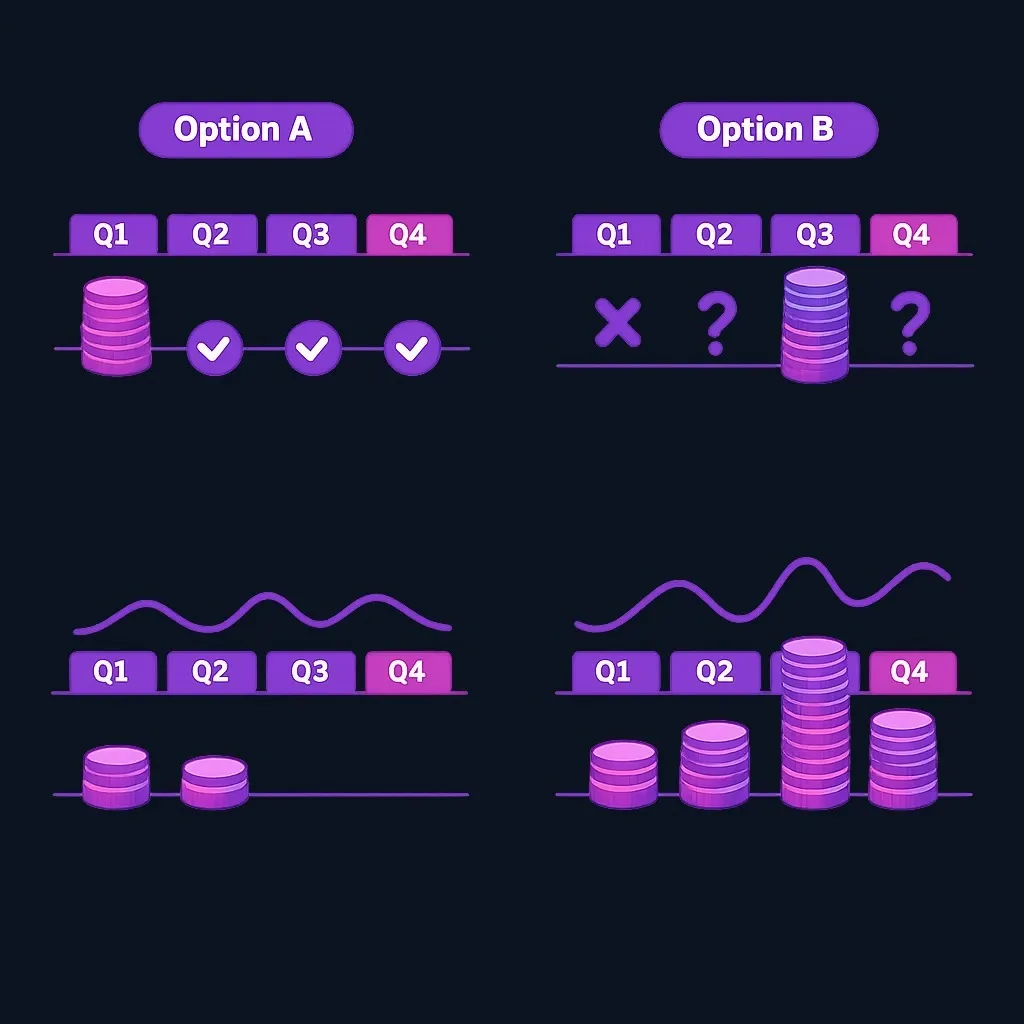
Paying “all at once” does not mean any amount paid on any date automatically eliminates penalty exposure.
How to estimate the amount
Form 1040-ES walks through projected adjusted gross income, taxable income, tax, credits, other taxes, and expected withholding. It also includes rules used to determine whether estimated payments are required and how required installments are calculated.
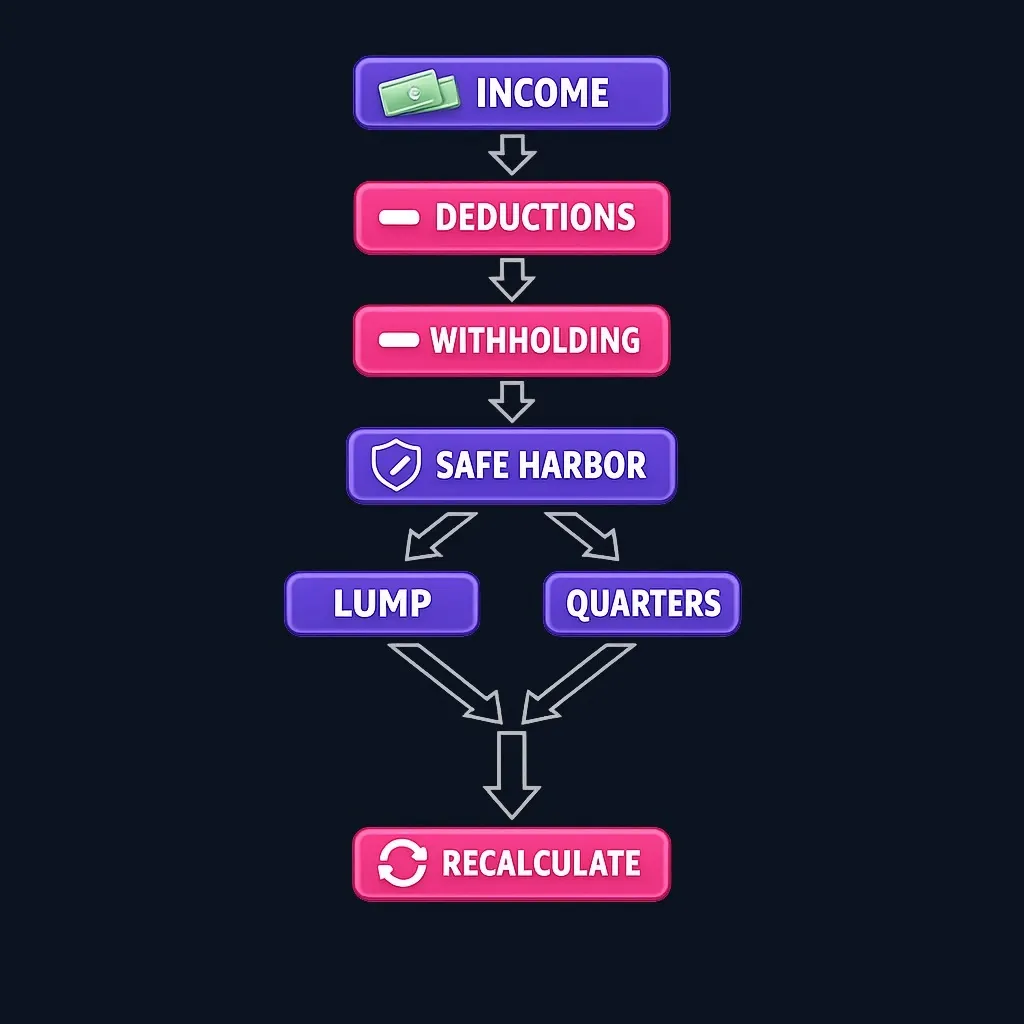
A careful process is:
- Project income from wages, business activity, interest, dividends, gains, rentals, retirement distributions, and other sources.
- Estimate adjustments, deductions, credits, and other taxes.
- Subtract expected withholding and eligible refundable credits.
- Apply the current Form 1040-ES rules, including any prior-year-tax safe-harbor calculation that applies.
- Decide whether to pay the calculated amount at once or by installments.
- Recalculate after a material change.
Do not simply multiply one month's income by twelve when income is seasonal or a large transaction is expected.
Lump sum versus installments
| Consideration | One early payment | Scheduled installments |
|---|---|---|
| Administration | One transaction and confirmation | Multiple dates to track |
| Liquidity | More cash leaves earlier | Cash remains available longer |
| Early-period coverage | Can cover the full schedule if timely and sufficient | Each payment must satisfy its period |
| Variable income | May overpay if projection falls | Easier to revise as facts change |
| Risk of missed dates | Lower after successful full payment | Requires calendar and payment controls |
The tax outcome depends on timing and sufficiency, not on which method feels simpler.
Income that changes during the year
If income rises after an early estimate, recompute. An original lump sum can become insufficient when a business earns more, a large capital gain occurs, or withholding decreases. Make an additional estimated payment when appropriate under the current instructions.
If income is concentrated late in the year, the annualized income installment method may reduce an apparent penalty by showing when the income was earned. This method is more complex and generally uses Form 2210 and supporting records. A qualified preparer can help when amounts are material.
Practice trading with Finelo
Practice in a simulator, learn with bite-sized lessons, and build confidence before risking real money.
Withholding is different
Income-tax withholding is generally treated differently from estimated payments for penalty calculations and can sometimes be adjusted later in the year through wages or eligible distributions. The exact treatment depends on the form and facts. Do not label a transfer as withholding unless it is actually withheld and reported by the payer.
Making and documenting the payment
Use an IRS-approved method and select the correct:
- taxpayer identification information;
- payment type;
- tax form;
- tax year; and
- amount.
Save the confirmation, bank record, and any voucher. A payment applied to the wrong tax year or form may require correction and can leave the intended installment unpaid.
Official payment options are linked from IRS.gov. Third-party card processors may charge fees; confirm the processor appears on the IRS list.
Hypothetical examples
Early full-year projection
A taxpayer projects the year using the current Form 1040-ES instructions and pays the calculated annual estimate by the first due date. If the projection and applicable safe-harbor calculation remain sufficient, no later estimated installment may be needed. The taxpayer still reviews the estimate after major changes.
Payment after the first deadline
A taxpayer makes no first installment and later pays the entire remaining annual estimate. The later payment can satisfy future requirements, but it generally does not change the fact that the first installment was late.
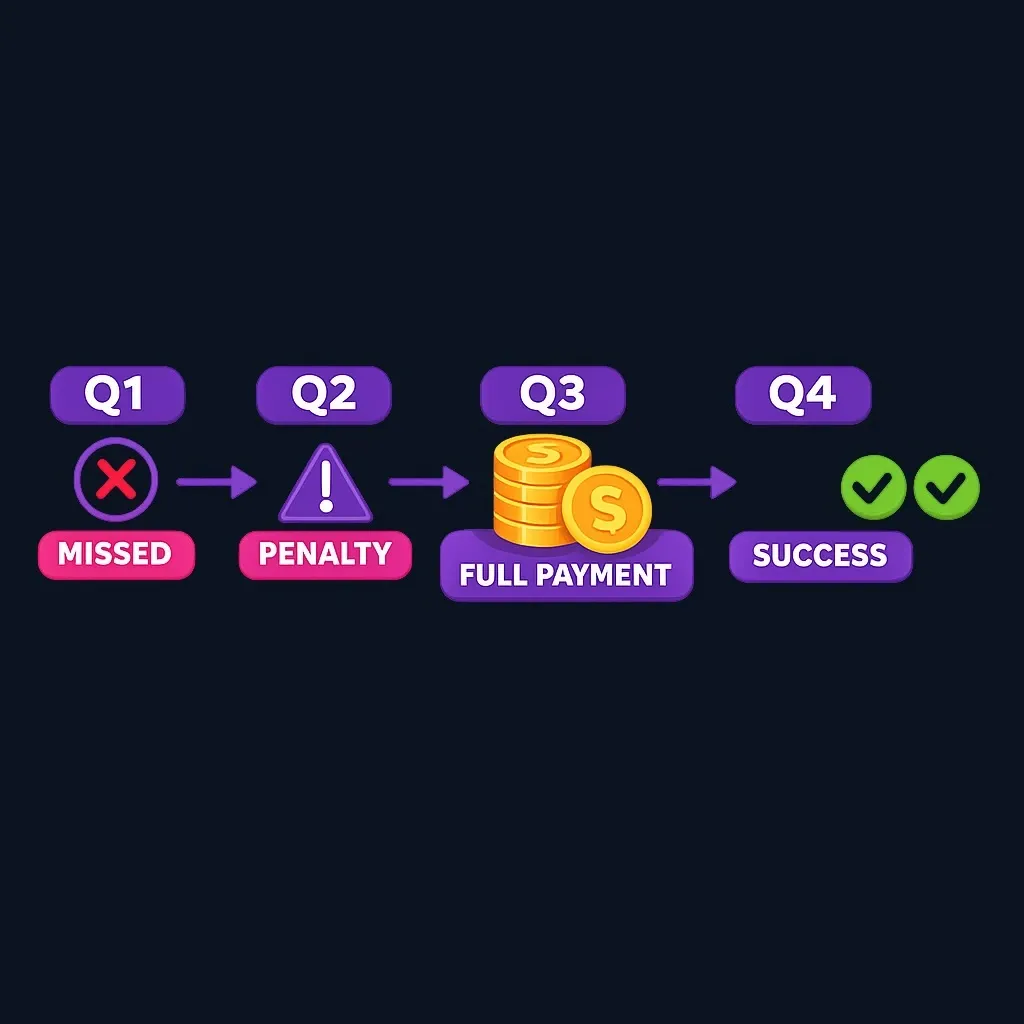
These are simplified illustrations, not calculations for a particular return.
Common mistakes
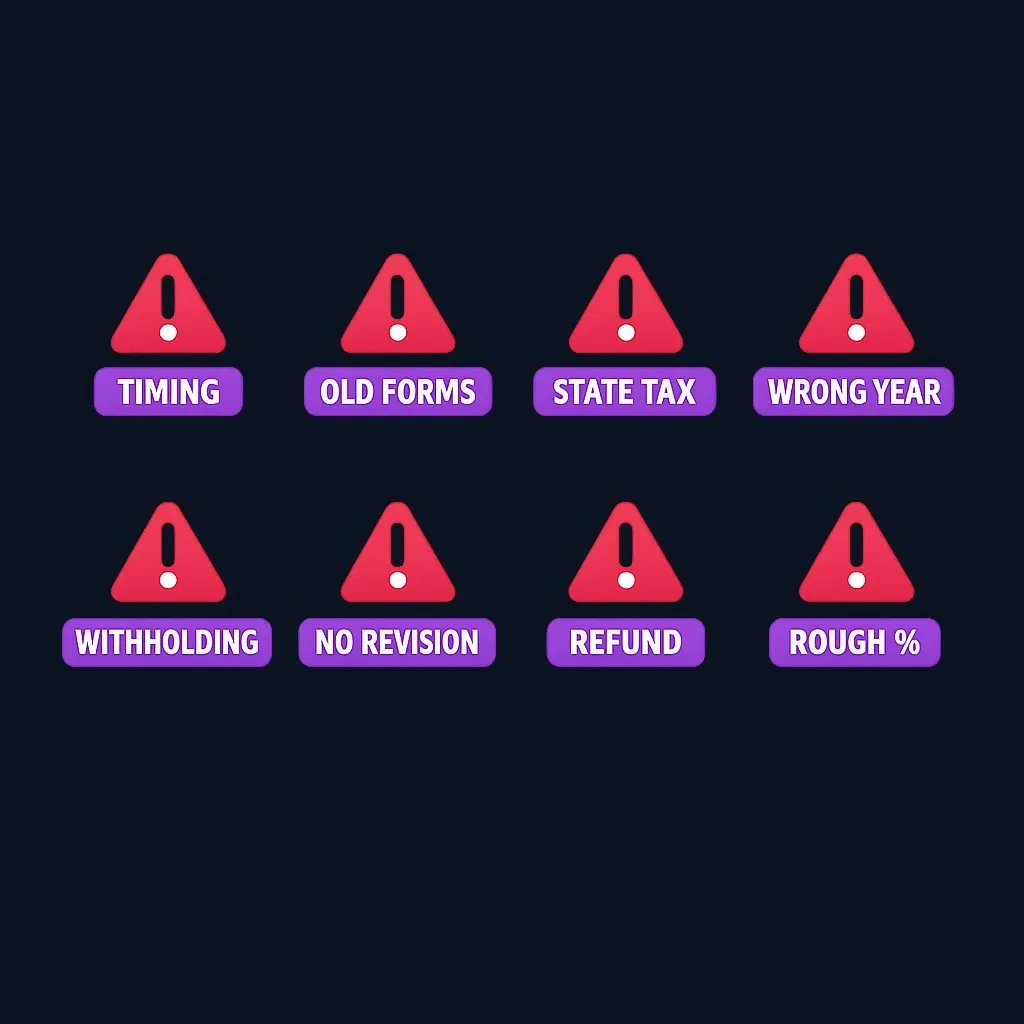
- Paying the full estimate after an early deadline and assuming no earlier penalty can apply.
- Using a prior year's due dates or worksheets.
- Ignoring state or local estimated-tax requirements.
- Applying a payment to the wrong year or form.
- Forgetting to subtract expected withholding.
- Failing to revise an estimate after a large gain or business-income change.
- Assuming an overpayment will be immediately available as cash.
- Treating a generic percentage of revenue as a completed tax calculation.
FAQ
Must estimated tax be paid quarterly?
Form 1040-ES generally provides four installment dates but also permits paying the entire estimated tax by the first due date. Timing and amount still determine whether a penalty applies.
Can all four payments be made at the end of the year?
A year-end payment can pay the tax, but it does not make earlier required installments timely. An underpayment penalty may apply for the periods the amounts were unpaid.
What happens if the early payment is too large?
Any overpayment is reconciled on the filed return and may be refunded or applied according to the return and IRS rules. Until then, the money is no longer available for ordinary cash needs.
What happens if income changes?
Recalculate using the current form. Additional payments, revised installments, more withholding, or the annualized income method may be relevant depending on the timing and facts.
Conclusion
Estimated tax can be paid all at once, but the safest version of that approach is a sufficient payment by the first applicable due date, followed by recalculation if the year changes. Use current IRS forms, preserve payment records, and obtain professional help for material or uneven income.
For more educational tax and personal-finance material, visit the Finelo Blog.
Financial LiteracyFinancial Education
Practice trading with Finelo
Practice in a simulator, learn with bite-sized lessons, and build confidence before risking real money.
About the author
Finelo Team
The Finelo Team creates practical investing and trading education designed to help beginners learn faster with structured challenges, simulator practice, and bite-sized lessons.
Keep reading — Related articles

Financial Literacy
Mercury Books Review 2026: Is It Worth It for Startups?
Mercury Books brings double-entry accounting into Mercury. Review its $35 pricing, reports, AI features, integrations, and migration limits.
Finelo Team

Financial Literacy
Why is My FICO Score Lower Than My Credit Score?
Example takeaway: seeing a higher score in a bank app doesn’t guarantee lenders will see the same FICO number at application time; lenders often pull a specific FICO version from a specific bureau.
Finelo Team

Financial Literacy
Why Is My FICO Score Higher Than My Credit Score?
Brief educational note: this article is educational, not financial or investment advice; investing and credit decisions involve risk and possible loss.
Finelo Team