For U.S. readers: This article discusses U.S. rules and financial products. State rules and individual eligibility may differ.
Can You Change an Irrevocable Trust to a Revocable Trust?

Usually not in the literal sense.
8 min read
Practice trading with Finelo
Practice in a simulator, learn with bite-sized lessons, and build confidence before risking real money.
Want to learn more?
Practice in a simulator, learn with bite-sized lessons, and build confidence before risking real money.
Explore FineloExplore Finelo's 28-day challenges
Turn learning into a daily habit with guided challenge paths.
Quick answer
Usually not in the literal sense. An irrevocable trust generally cannot be made freely revocable again by the person who created it. Depending on the trust document and the governing state's law, a court or another authorized process may permit a narrower modification, termination, reformation, nonjudicial settlement, or transfer of assets to a different irrevocable trust. Those outcomes are not the same as restoring the grantor's unrestricted right to take the property back.
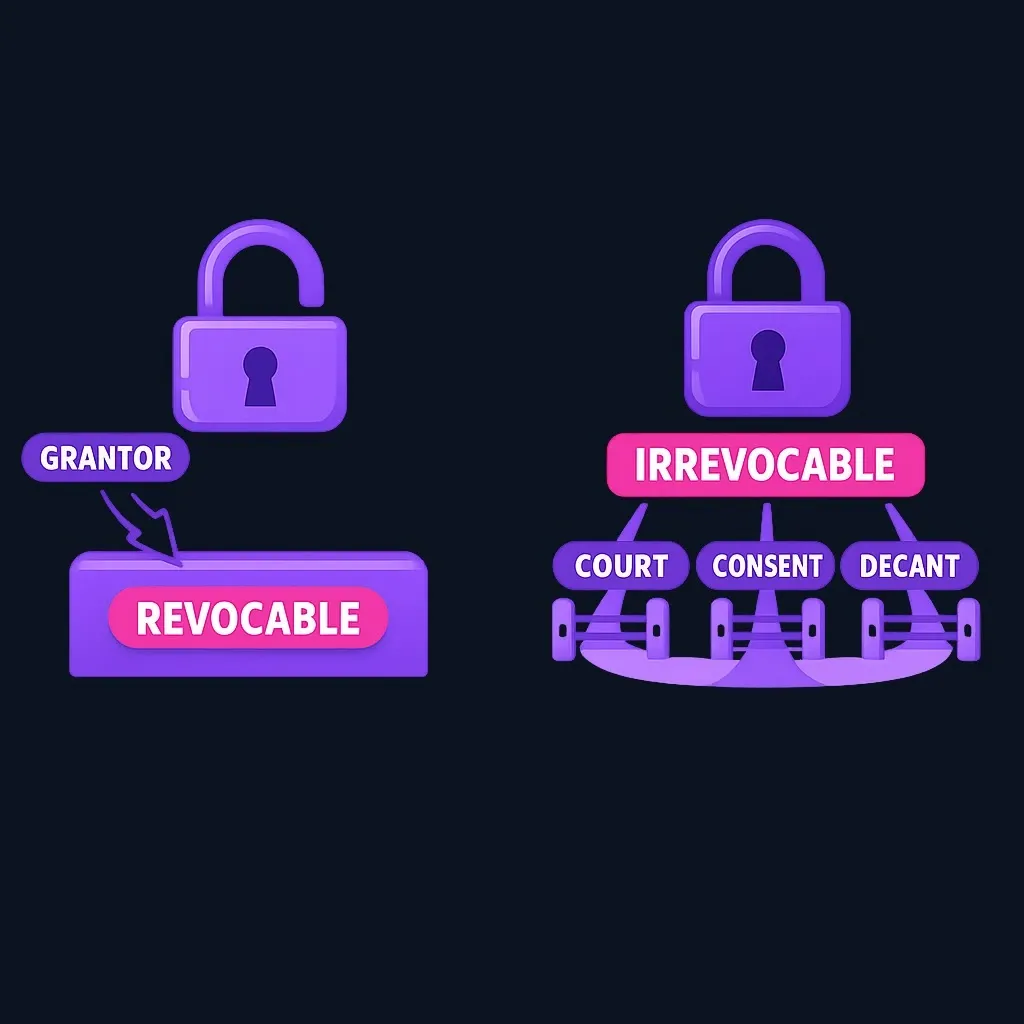
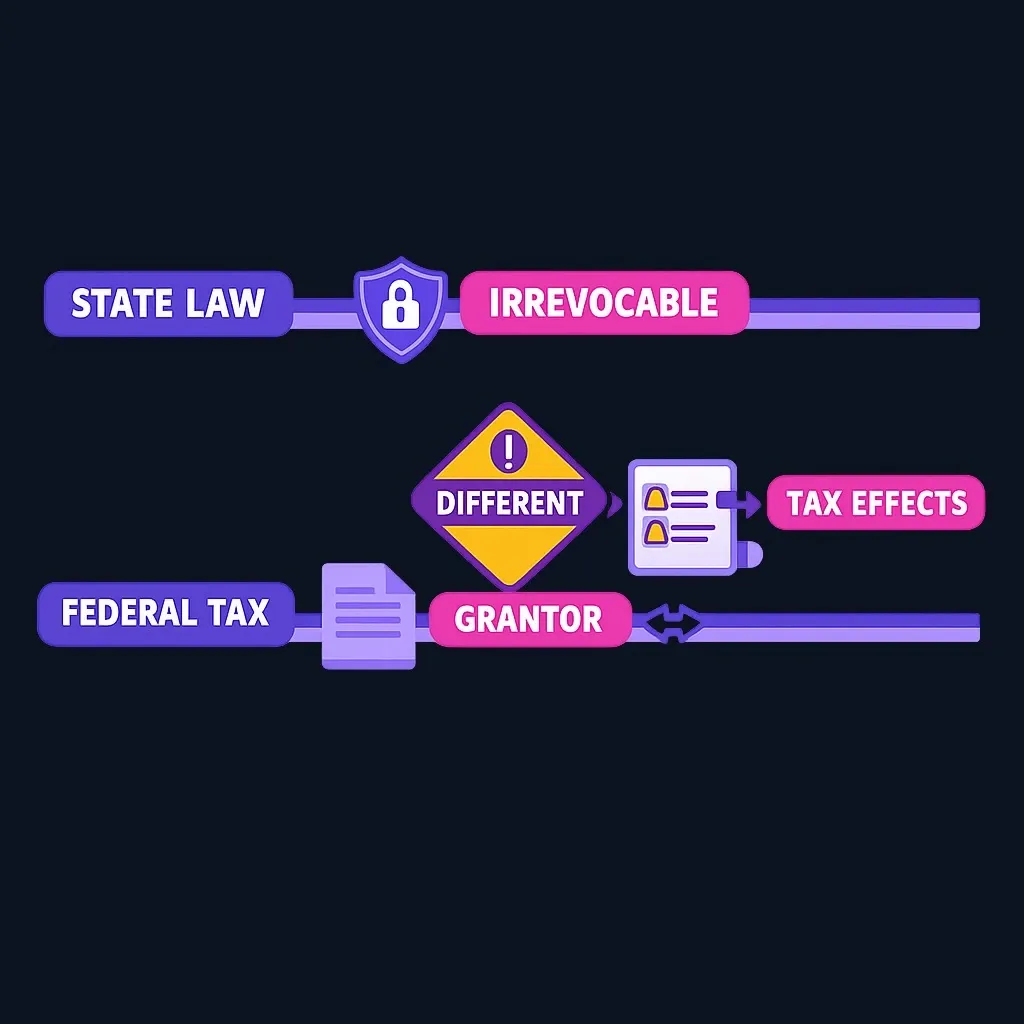
The Internal Revenue Service notes that state law and the trust instrument determine whether a trust is revocable or irrevocable. It also warns that a trust's legal label and its federal tax classification are separate questions (IRS trust overview).
Finelo provides financial education, not legal, tax, financial, or investment advice. Trust law is state-specific, and changing beneficial interests can have tax, creditor, benefits-eligibility, and fiduciary consequences. Have an attorney in the trust's governing state review the signed trust and all amendments before anyone consents to or transfers assets.
Why “irrevocable” does not always mean “unchangeable”
“Irrevocable” primarily means that the settlor, also called the grantor, did not retain a general unilateral power to revoke the trust. It does not necessarily mean that every administrative or distribution term is frozen forever.
Modern trust statutes may authorize changes in defined circumstances. The Uniform Trust Code, a model law that states may adopt with changes, includes provisions on modification or termination by consent, changed circumstances, uneconomic trusts, and reformation for mistakes. The Uniform Trust Decanting Act provides a separate model framework for certain trustees to move assets into a second trust with revised terms.
Neither model act is automatically the law in every state. A state may adopt, modify, or reject it, and the trust may select another state's law. The actual analysis therefore starts with the signed document and the current statute in the governing jurisdiction—not a generic online rule.
What outcome are you actually trying to achieve?
The phrase “make it revocable” often hides a more specific objective. Identifying that objective makes it easier to evaluate lawful options.
| Objective | A possible legal mechanism | Important limitation |
|---|---|---|
| Correct a drafting mistake | Judicial reformation | Usually requires evidence of the settlor's intent and a qualifying mistake |
| Adapt to an unforeseen circumstance | Judicial modification | The change must satisfy the state's statutory standard and may need to preserve the trust's purpose |
| Change an administrative term | Nonjudicial settlement or authorized amendment power | Cannot exceed the authority granted by the document or statute |
| Replace a trustee | Removal and appointment procedure | Changes the fiduciary, not ownership of the assets |
| Update an old trust structure | Decanting into another trust | Availability, notice, tax treatment, and permitted changes vary by state |
| End a small or obsolete trust | Statutory or court-approved termination | Beneficiary, tax, creditor, and protected-interest rules may apply |
| Return property to the settlor | Modification or termination, if legally permitted | Often the most difficult outcome and may defeat the original tax or asset-protection design |
The key distinction is control. A court-approved administrative change may leave the trust irrevocable, while a transfer back to the settlor may alter ownership and tax consequences substantially.

Main routes that may be available
Follow an express power in the trust
Some documents give a trustee, trust protector, distribution adviser, or another person a defined power to amend administrative provisions, change situs, replace a fiduciary, or respond to tax-law changes. The holder may use only the power the document and governing law actually provide. A title such as “trust protector” does not create unlimited amendment authority by itself.
Seek beneficiary consent and, when required, court approval
Some states permit modification or termination with the consent of specified parties. The required consents and judicial findings vary. Unborn, minor, unknown, or legally incapacitated beneficiaries may need representation, and a material purpose of the trust may prevent a proposed change even when current adult beneficiaries agree.
For that reason, “all beneficiaries agree” is not a universal shortcut. Counsel must identify every legally protected interest and the applicable representation rules.
Petition a court for modification or reformation
A court may be able to correct a mistake, respond to circumstances the settlor did not anticipate, or modify an administrative term that has become impracticable. The petition normally needs evidence tied to a statutory ground; dissatisfaction with the trust's economic result is not necessarily enough.
Use a nonjudicial settlement agreement
Where state law permits, interested persons may resolve certain trust-administration issues without a contested hearing. A nonjudicial agreement generally cannot accomplish something a court could not approve or violate a material purpose of the trust. The people who must sign and the subjects that may be settled vary by state.
Consider decanting
Decanting can allow a trustee with the required authority to distribute assets from one trust into another trust with revised terms. It does not ordinarily turn the assets into the settlor's freely revocable property. State decanting statutes differ on beneficiary changes, notice, trustee discretion, tax-sensitive provisions, and special-needs protections.

Practice trading with Finelo
Practice in a simulator, learn with bite-sized lessons, and build confidence before risking real money.
Tax and benefits issues to review before changing anything
A trust can be irrevocable under state law yet still be treated as a grantor trust for federal income-tax purposes. The IRS explicitly distinguishes legal revocability from grantor-trust tax status (IRS trust overview). A proposed change may affect:
- who reports trust income;
- whether a transfer is treated as a taxable gift;
- inclusion of assets in a settlor's or beneficiary's gross estate;
- income-tax basis at a later death or sale;
- generation-skipping transfer tax allocations;
- creditor or marital-property exposure; and
- eligibility for needs-based public benefits.
Do not assume that a state-court order automatically produces the intended federal tax result. Tax counsel should review the proposed transaction before documents are signed or assets are moved.
A safer review process
- Collect the controlling documents. Obtain the executed trust, amendments, schedules, court orders, tax returns, and records showing how each asset is titled.
- Identify the governing law. Read the governing-law, situs, amendment, protector, trustee-power, and dispute-resolution clauses.
- Define the exact objective. Separate an administrative problem from a request to change beneficiaries, distributions, or ownership.
- Map every affected interest. Include contingent, minor, unborn, charitable, and special-needs beneficiaries—not only current recipients.
- Compare available mechanisms. Counsel can evaluate document-based powers, consent, court modification, reformation, settlement, decanting, or termination under the current state statute.
- Run tax and benefits checks first. Obtain written analysis when gift, estate, generation-skipping, income-tax, creditor, or public-benefit consequences may be material.
- Document authority before acting. The trustee should not transfer assets merely because family members signed an informal agreement.
Common mistakes to avoid
- Treating “irrevocable” as a tax classification. State-law status and federal grantor-trust treatment are not interchangeable.
- Assuming unanimous adult consent settles everything. Other interests and a material trust purpose may still matter.
- Moving assets before authority is confirmed. An unauthorized transfer can expose a trustee to fiduciary-liability claims.
- Using decanting as a synonym for revocation. Decanting typically creates another trust; it does not necessarily return property to the settlor.
- Ignoring public-benefit rules. A change that expands a beneficiary's control can affect benefit eligibility.
- Relying on a model act without checking enactment. The Uniform Trust Code and Uniform Trust Decanting Act are starting points, not substitutes for the current law of the governing state.
FAQ
Can the grantor simply sign an amendment?
Usually not if the trust is truly irrevocable and contains no applicable reserved power. An attempted amendment without authority may be ineffective and can create title, tax, and fiduciary disputes.
Can every beneficiary agree to make the trust revocable?
Not necessarily. The answer depends on state law, the trust's material purposes, the identity and legal capacity of all interested beneficiaries, and whether the settlor's consent or a court order is required.
Does replacing the trustee make the trust revocable?
No. Replacing the fiduciary changes who administers the trust. It does not by itself give the settlor a right to revoke the trust or reclaim its assets.
Does decanting avoid court?
Sometimes, but only if the governing law and the trustee's authority permit it and required notices and procedures are followed. A court proceeding may still be appropriate when authority is disputed or protected interests are affected.
Is converting the trust always a taxable event?
No universal answer applies. Some changes may be primarily administrative; others may shift beneficial ownership or retained powers and create significant tax effects. The transaction must be analyzed before implementation.
Bottom line
An irrevocable trust may sometimes be modified, reformed, decanted, or terminated, but that does not mean it can simply be converted into a freely revocable trust. The legally available route depends on the document, the governing state's current law, the protected interests, and the tax and benefits consequences. Start with the signed trust and state-specific counsel, then choose the narrowest process that actually solves the identified problem.
Financial LiteracyFinancial Education
Practice trading with Finelo
Practice in a simulator, learn with bite-sized lessons, and build confidence before risking real money.
About the author
Finelo Team
The Finelo Team creates practical investing and trading education designed to help beginners learn faster with structured challenges, simulator practice, and bite-sized lessons.
Keep reading — Related articles

Financial Literacy
Mercury Books Review 2026: Is It Worth It for Startups?
Mercury Books brings double-entry accounting into Mercury. Review its $35 pricing, reports, AI features, integrations, and migration limits.
Finelo Team

Financial Literacy
Why is My FICO Score Lower Than My Credit Score?
Example takeaway: seeing a higher score in a bank app doesn’t guarantee lenders will see the same FICO number at application time; lenders often pull a specific FICO version from a specific bureau.
Finelo Team

Financial Literacy
Why Is My FICO Score Higher Than My Credit Score?
Brief educational note: this article is educational, not financial or investment advice; investing and credit decisions involve risk and possible loss.
Finelo Team