ChatGPT can be a useful assistant for learning about stocks and organizing your research. It can explain a concept, summarize a long filing or earnings call, gauge the tone of a batch of headlines, turn a fuzzy idea into screening criteria, and draft starter code for a backtest. What it cannot do is trade for you, predict where a price is going, or be trusted blindly on numbers. By default it has no real-time data, its knowledge stops at a training cutoff, it can state a wrong figure, a fake citation, or buggy code with total confidence, and it is not a licensed financial adviser. Used honestly, it is a research and study partner, not a signal generator or a crystal ball.
ChatGPT for Stock Trading: What It Can and Can't Do
ChatGPT can help you learn stocks, summarize filings, and draft research prompts — but it cannot trade for you, predict prices, or be trusted blindly on numbers. Here's an honest beginner guide to using it as a research assistant.
11 min read
Explore Finelo AI trading bots
See how AI bots scan market data, explain setups in plain language, and let you review each practice trade before approving it.
Want to learn more?
See how AI bots scan market data, explain setups in plain language, and let you review each practice trade before approving it.
Try AI botsExplore Finelo's 28-day challenges
Turn learning into a daily habit with guided challenge paths.
This guide is for beginners curious whether ChatGPT can pick stocks or run a portfolio. The short version: use it to learn faster and think more clearly, then verify everything that matters before it touches a real decision. This is education, not financial advice.
ChatGPT is a research assistant, not an oracle or an execution engine.
This article is for education only and is not financial advice.
Short answer: ChatGPT is a research assistant, not a stock picker
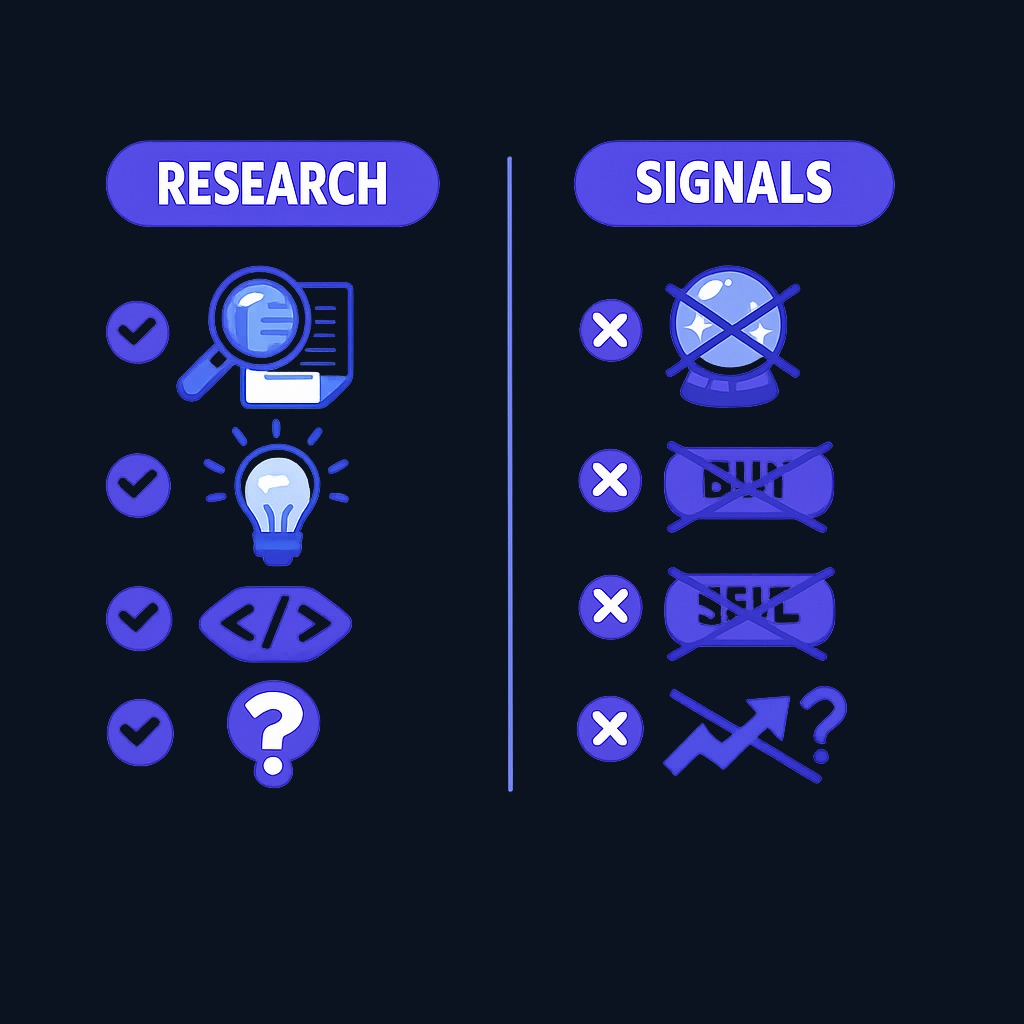
If you remember one thing, make it the line between research and signals. Using ChatGPT to understand a company, a concept, or a filing, or to draft code, is research, and that is where it helps. Asking it what to buy or when to sell is asking for a signal, and that is where it is weakest and where beginners get burned.
So how do you use ChatGPT for stock trading? Treat it as a large language model that acts like a fast, patient study partner. It shortens the time between not understanding something and understanding it, but not the distance to a sound decision. That distance is verification, and only you can close it.
The line that keeps beginners safe is research versus signals.
What ChatGPT can do for stocks
At its best, ChatGPT is a patient tutor for stock analysis. Ask it to explain free cash flow and how it differs from net income, and keep asking follow-ups until it clicks.
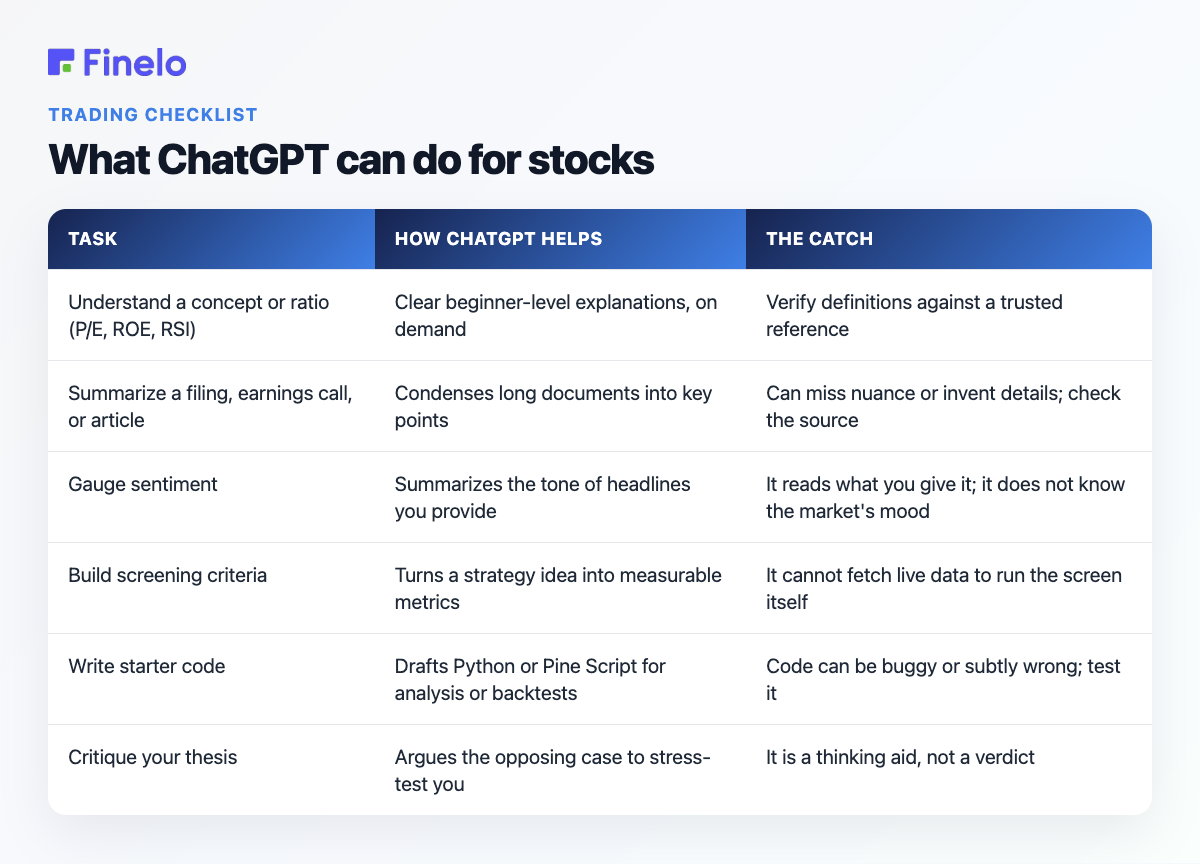
It also does light sentiment analysis on headlines you paste, helps with stock screening by turning a vague idea into measurable criteria, talks through a chart pattern in plain language, and writes starter code, Python or TradingView Pine Script, for a strategy or backtesting script. Generated code is a draft to test, not a finished system, and can contain subtle bugs. The capability matrix below sums up where it helps and the catch attached to each use.
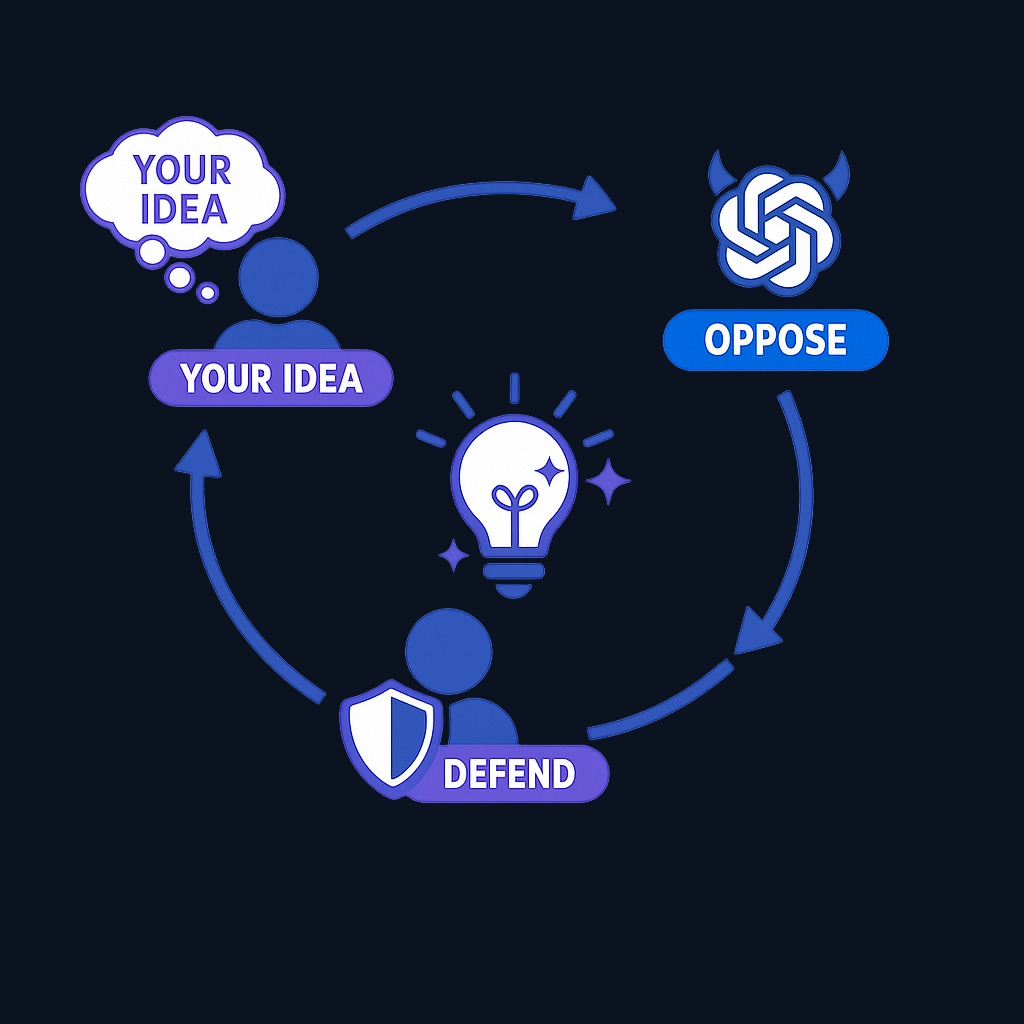
Where it becomes a reasoning partner is critique. Write out your own thinking, then ask it to argue the strongest opposing case: what a skeptic would say, what you are ignoring, what would make this a mistake. Turning it into an opponent rather than an oracle is the most useful shift a beginner can make.
| Task | How ChatGPT helps | The catch |
|---|---|---|
| Understand a concept or ratio (P/E, ROE, RSI) | Clear beginner-level explanations, on demand | Verify definitions against a trusted reference |
| Summarize a filing, earnings call, or article | Condenses long documents into key points | Can miss nuance or invent details; check the source |
| Gauge sentiment | Summarizes the tone of headlines you provide | It reads what you give it; it does not know the market's mood |
| Build screening criteria | Turns a strategy idea into measurable metrics | It cannot fetch live data to run the screen itself |
| Write starter code | Drafts Python or Pine Script for analysis or backtests | Code can be buggy or subtly wrong; test it |
| Critique your thesis | Argues the opposing case to stress-test you | It is a thinking aid, not a verdict |
What ChatGPT can't do
The first and biggest limitation is that, by default, ChatGPT has no live market data. It answers from training data with a knowledge cutoff, so it does not know today's price, this morning's news, or the latest earnings unless it is using a browsing or data tool. Ask a base model for the current price and whatever it returns is unreliable by construction.
Second, it hallucinates: it can produce a specific revenue figure, a ticker, a "study," or a block of code that looks authoritative and is simply wrong, so anything that could affect a decision has to be verified or tested. Third, it cannot execute trades, having no connection to your broker. Fourth, it misses market psychology, the fear and greed that move prices, because it generates plausible text rather than feeling a market. Fifth, it is not a financial adviser, and its output is general information, not personalized advice.
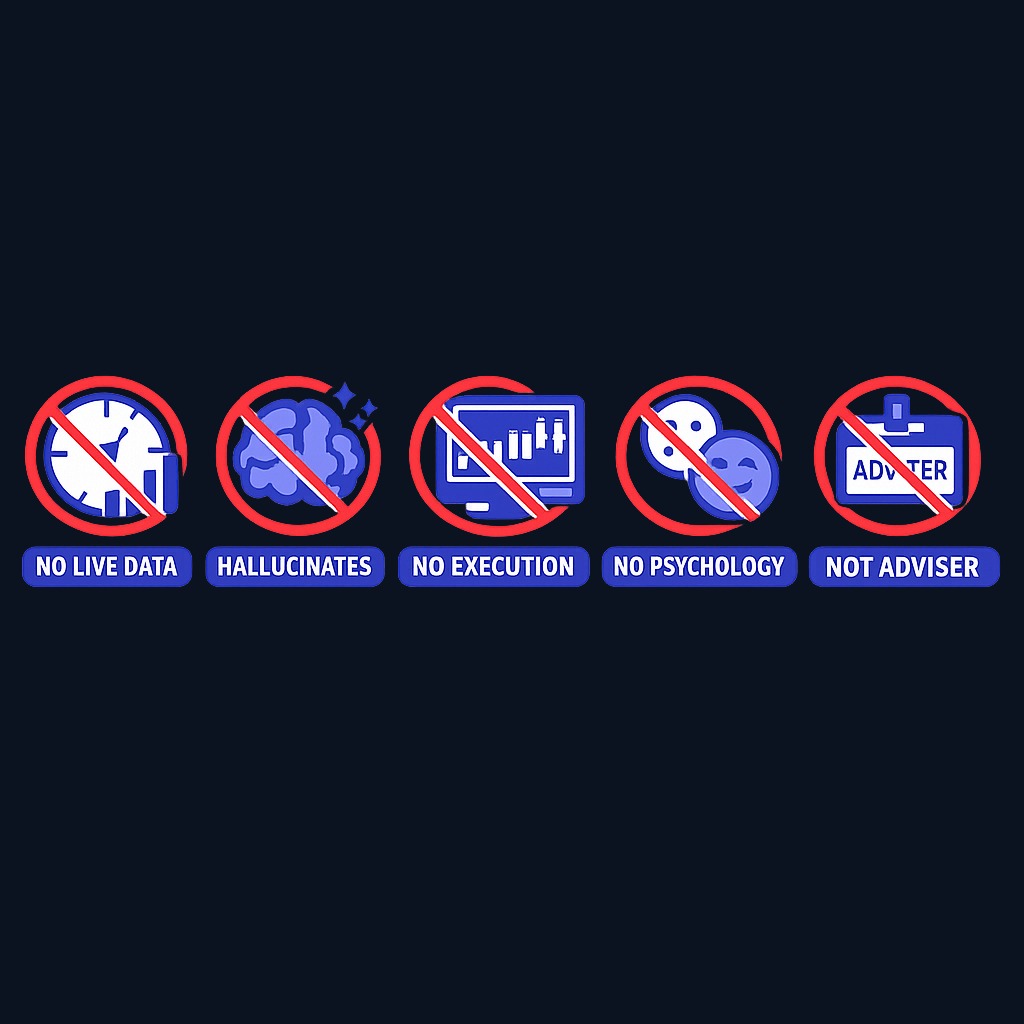
Treat every number, source, and line of code as a draft until you verify it.
How to use ChatGPT well: the research workflow
A good workflow puts verification between the model and any decision. Use it to learn or summarize, form your own view, ask it to challenge that view, then verify every fact that matters before it influences real money.
That last step is the one beginners skip, and it is the whole game: a model that is right most of the time is still wrong often enough that an unverified figure is a liability, not a shortcut.
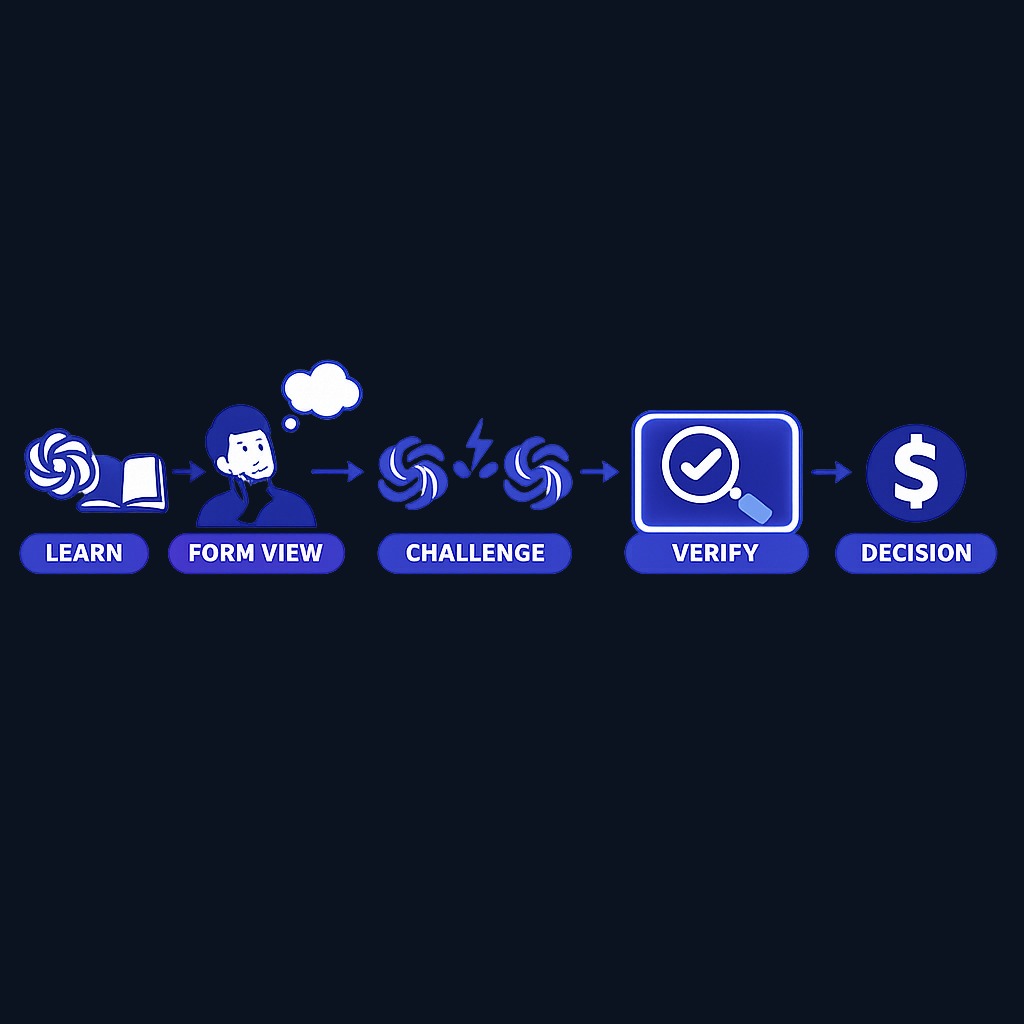
A copy-paste prompt library for stock research
These prompts are written for learning and research, not "give me stock picks." Treat any output, including code, as a draft to verify.
- Concept tutor: "Explain free cash flow to a beginner investor: why it matters, how it differs from net income, and one simple example."
- Filing summarizer (grounded): "Here is the risk-factors section of a 10-K. Summarize the main risks the company lists about itself, in plain language. Do not add risks that are not in the text, and quote the line that supports each point." (then paste the text)
- Screening criteria: "Turn this idea, 'stable, growing, reasonably priced companies,' into a short list of measurable screening criteria a beginner could use, and explain each one."
- Sentiment framing: "Here are ten headlines about a company. Summarize whether the overall tone is positive, negative, or mixed, and why. Judge only these headlines." (then paste them)
- Thesis critic: "Here is my reasoning for finding this company interesting. Argue the strongest opposing case and list what I might be overlooking." (then paste your notes)
- Code helper (verify and backtest): "Write commented Python to backtest a simple moving-average crossover on historical data I will provide. Explain each step so I can check it." (then test it yourself)
Explore Finelo AI trading bots
See how AI bots scan market data, explain setups in plain language, and let you review each practice trade before approving it.
The grounding technique that beginners skip
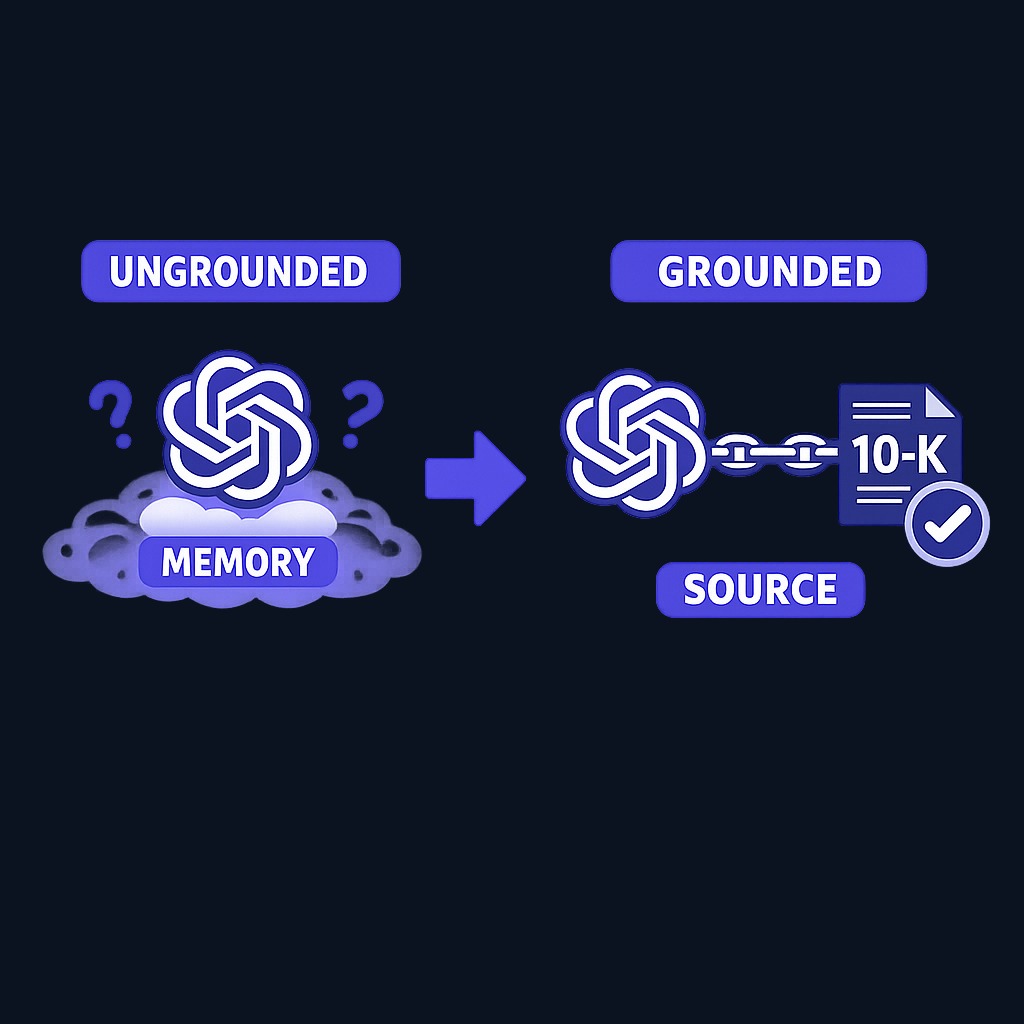
The most valuable upgrade to any prompt is grounding: instead of trusting the model's memory, hand it the source. Paste the exact SEC filing, a 10-K or 10-Q from EDGAR, upload your price data as an OHLCV CSV, or give it the earnings transcript. Then ask it to cite which part of the document supports each claim, and to list what it could not verify.
This one move changes what ChatGPT is. Ungrounded, it is a confident memory that may be out of date or invented. Grounded, it becomes an engine for working through sources you control, with the facts anchored to a document you can check. If a claim is not in the source you gave it, you want it to say so, and asking it to flag its own gaps makes that far more likely.
Does it actually work? What the evidence shows
The honest picture is mixed, and a single result is never proof. On the enthusiast side there are eye-catching experiments: one widely shared write-up handed ChatGPT a small sum to pick micro-cap stocks and reported roughly +29% over two months against about +4% for the S&P 500. That is a real logged result, but it is one short run on tiny, volatile companies that could as easily have gone the other way, and the same experiment's weekly figures swung around a lot.
The academic picture is more interesting than most guides admit. A peer-reviewed study in Finance Research Letters (Pelster and Val, 2024) found that ChatGPT-4, given internet access, produced company "attractiveness ratings" that positively correlated with future earnings news and short-horizon returns. The caveats matter: it used an internet-connected model on narrow tasks, output quality depended on the data and expertise fed in, and the authors do not call it a standalone stock picker. Against that sits a large, vocal group of experienced investors who argue people should stop using ChatGPT for investment research because it invents numbers and sources.
Both things are true at once: it is a powerful research aid and an unreliable oracle. The reasonable read is that it can help you work faster and understand more, that narrow, well-grounded tasks can show real signal, and that no experiment has shown a plain chatbot reliably beating the market for a beginner.
A single lucky experiment is a data point, not a strategy.
Can ChatGPT predict the market or pick stocks?
No, and the reason is in how the tool works.
ChatGPT is a language model: it predicts the next most plausible piece of text, it does not run a forecasting model of markets. When it answers where a stock is "going," it is generating text that sounds reasonable, not computing a probability from live data. Markets are also close to the hardest thing there is to forecast, since prices already reflect millions of participants reacting to news almost instantly. Even specialized quant models with real-time feeds struggle; a chatbot answering from older training data will not succeed where they fail.
It can generate ideas or opinions, and it can help you evaluate candidates you found elsewhere, but its "picks" are not grounded in live data or genuine forecasting.
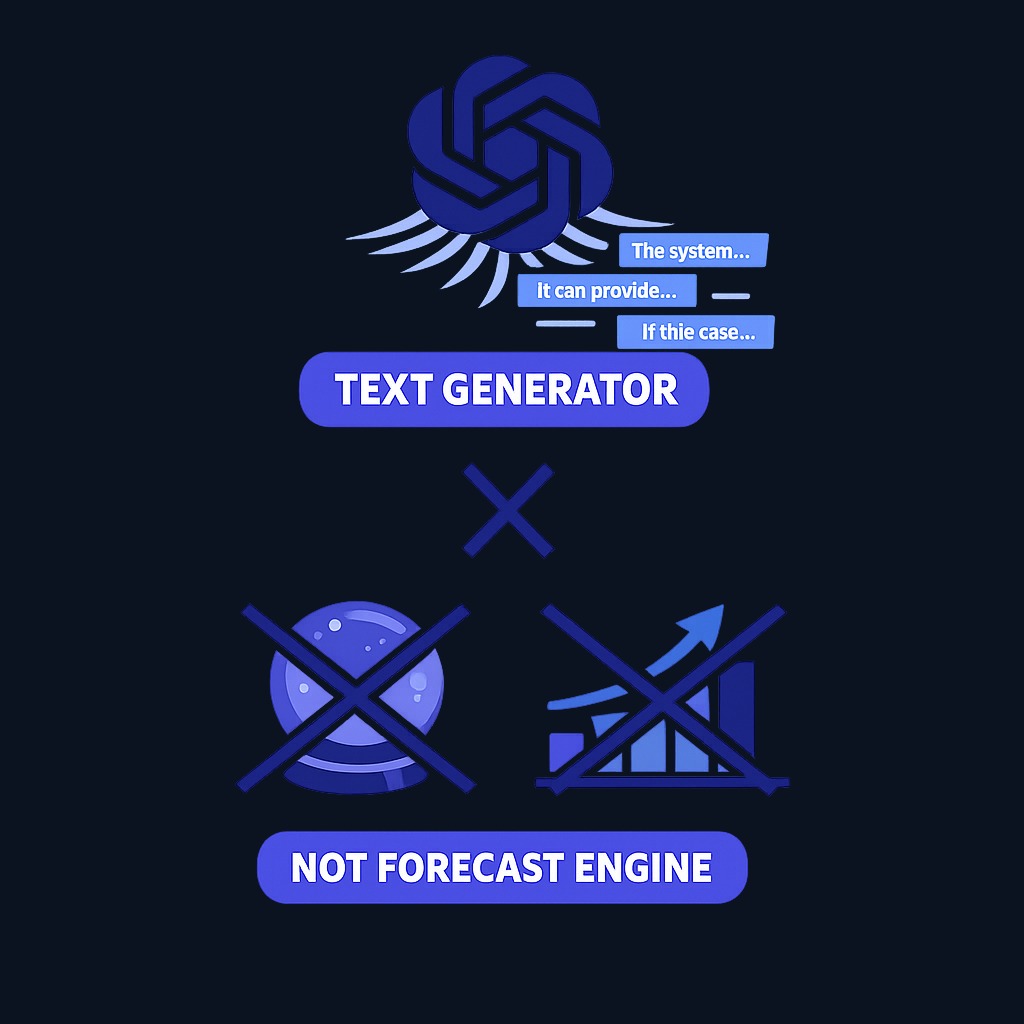
Use it to understand and stress-test, not to source trades you act on blindly.
Is it safe? Privacy, accuracy, and compliance
Safety here has three parts. On accuracy, verify anything that matters: because the model can hallucinate, treat every figure, source, or line of code as unconfirmed until you check or test it. On privacy, be careful what you paste. Never enter brokerage credentials, account numbers, or personal financial details, and assume anything you type could be retained to improve the service unless you have confirmed otherwise in the settings.
On compliance, ChatGPT's output is general information, not personalized advice, and it is not a registered financial adviser. Using it to learn is entirely appropriate; using it as a substitute for your own judgment, or for a professional when you genuinely need one, is not.
Common mistakes to avoid
The biggest mistake is trusting numbers or code blindly: a confident figure or a clean-looking script can be invention or subtly broken, so if it affects a decision, verify or test it. The second is asking for signals, since "should I buy this?" pushes the model into exactly the guessing it is worst at. The third is oversharing, since pasting account details into a chatbot is an avoidable privacy risk. The fourth is forgetting the clock, because plain ChatGPT ignores its training cutoff and dresses stale answers up as current. For a wider list, see Finelo's guide to common beginner investing mistakes.
How to get started
Use ChatGPT to learn, not to decide. Pick one concept you have been unsure about and have it tutor you; take one company, paste a section of its filing, and practice summarizing and then verifying; get into the habit of asking it to argue against you.
If your interest is automation rather than research, that is a different category: see Finelo's explainers on AI trading bots and whether AI trading actually works. For the visual side there is AI chart analysis, and for the bigger picture the AI trading for beginners overview. To build the fundamentals, start with how to start investing as a beginner, and explore Finelo for guided lessons and simulator practice, where a mistake costs a note in your journal, not real money.
Let ChatGPT help you think, not think for you.
Finelo is an educational product, not a brokerage. The simulator uses virtual funds and real market data, and final trading and investing decisions are yours, made through your own brokerage account when you choose to act. This article is for education and is not financial advice.
Frequently asked questions
Can ChatGPT trade stocks for me?
No. ChatGPT is a chat assistant, not a broker or trading system, and it has no connection to your accounts and cannot place orders. It can help you learn and research, but execution happens through a brokerage, and any automation would need separate, purpose-built software carrying its own significant risks.
Can ChatGPT pick winning stocks?
It can produce ideas and opinions, but it cannot pick winners with any consistency, because its output is not grounded in live data or real forecasting. A viral experiment or a lucky two-month run is one data point, not a repeatable edge. Use it to stress-test candidates, not to source picks you act on unchecked.
Can ChatGPT predict the stock market?
No. It is a language model that predicts plausible text, not a forecasting engine with live data. Markets are extremely hard to predict even for specialized models, and a general chatbot answering from older training data cannot do it reliably. Treat any "prediction" it offers as generated text, not analysis.
Does ChatGPT have real-time stock prices?
Not by default. Plain ChatGPT answers from training data with a knowledge cutoff and does not know current prices. Only a version using browsing or tools, or a coded workflow feeding it a live data source, can reach recent data, and even then you should verify whatever it reports.
Is it safe and legal to use ChatGPT for investing?
Using it as a learning and research tool is fine, provided you verify what matters and never paste sensitive data like account numbers or credentials. Its output is general information, not personalized or regulated advice, and it is not a registered adviser. Treat it as a study aid, not a substitute for professional guidance.
Is there a free way to use ChatGPT for stocks?
The standard free tier handles the research uses here: explaining concepts, summarizing text you paste in, drafting criteria or code, and critiquing your reasoning. The real limitation is not price. It is that plain ChatGPT lacks live data and can be confidently wrong, so verification still matters every time.
ChatGPTAI investingstock researchbeginnerAI trading
Explore Finelo AI trading bots
See how AI bots scan market data, explain setups in plain language, and let you review each practice trade before approving it.
About the author
Finelo Team
The Finelo Team creates practical investing and trading education designed to help beginners learn faster with structured challenges, simulator practice, and bite-sized lessons.
Keep reading — Related articles

AI Trading
New in Finelo: AI Trading Bots That Find Setups for You
Finelo's newest feature — AI bots that scan real market data around the clock, explain every setup in plain language, and wait for your approval. Here's what's new and how to try it.
Finelo Team
AI Trading
Does AI Trading Work? What Beginners Should Know Before Trusting a Bot
Two camps say bots either print money or scam everyone. The truth is boring and specific: it depends on the strategy, the data, and whether a human is still paying attention.
Finelo Team
AI Trading
AI Trading Bots for Beginners: How They Work, Risks, and Safer Ways to Learn
A trading bot promises hands-free profit while you sleep. Here's how bots actually make decisions, the risks and scam red flags to know, and a safer way to learn from bot logic without blindly trusting it.
Finelo Team


