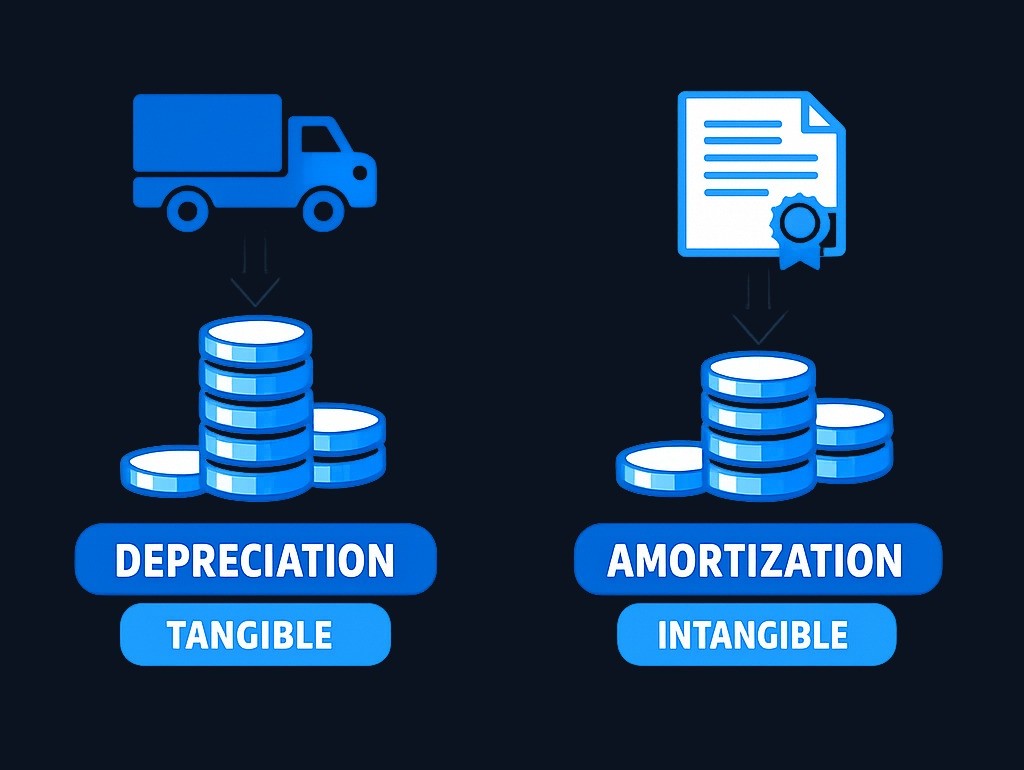
Depreciation and amortization both spread an asset’s cost across periods, but they generally apply to different assets. Depreciation is associated with tangible assets such as machinery, vehicles, and buildings. Amortization is associated with intangible assets such as certain licenses, patents, and software rights. Investors often see the two combined as “D&A,” yet their methods, useful-life assumptions, tax treatment, and economic meaning can differ.
Depreciation vs Amortization: An Investor’s Guide to D&A
Depreciation and amortization both spread an asset’s cost across periods, but they generally apply to different assets. Depreciation is associated with tangible assets such as machinery, vehicles, and buildings…
11 min read
Practice investing with Finelo
Build practical investing skills with guided lessons, simulator practice, and structured challenges.
Want to learn more?
Build practical investing skills with guided lessons, simulator practice, and structured challenges.
Explore FineloExplore Finelo's 28-day challenges
Turn learning into a daily habit with guided challenge paths.
This guide helps beginner investors read D&A in an income statement, cash-flow statement, and company notes. The practical goal is not merely to memorize two definitions. It is to understand how these non-cash expenses affect reported earnings, why asset-heavy businesses may need substantial replacement spending, and why adding D&A back to profit does not make the underlying asset cost disappear.
Depreciation vs Amortization at a Glance
| Comparison point | Depreciation | Amortization |
|---|---|---|
| Typical asset | Tangible, physical asset | Intangible, non-physical asset |
| Common examples | Equipment, vehicles, furniture, buildings | Patents, licenses, certain software, contractual rights |
| Basic purpose | Allocate depreciable cost over the asset’s useful or recovery period | Allocate amortizable cost over the asset’s useful or prescribed period |
| Common pattern | Straight-line or an accelerated/usage-based pattern when permitted | Often straight-line, though the applicable rules may require another pattern |
| Residual value | May be relevant to the calculation | Often assumed to be limited or zero, depending on the asset and rules |
| Income statement | Usually recorded as an expense | Usually recorded as an expense |
| Cash flow | Normally does not represent a current-period cash payment | Normally does not represent a current-period cash payment |
| Balance sheet | Accumulates against the related asset’s carrying amount | Accumulates against the related intangible asset’s carrying amount |
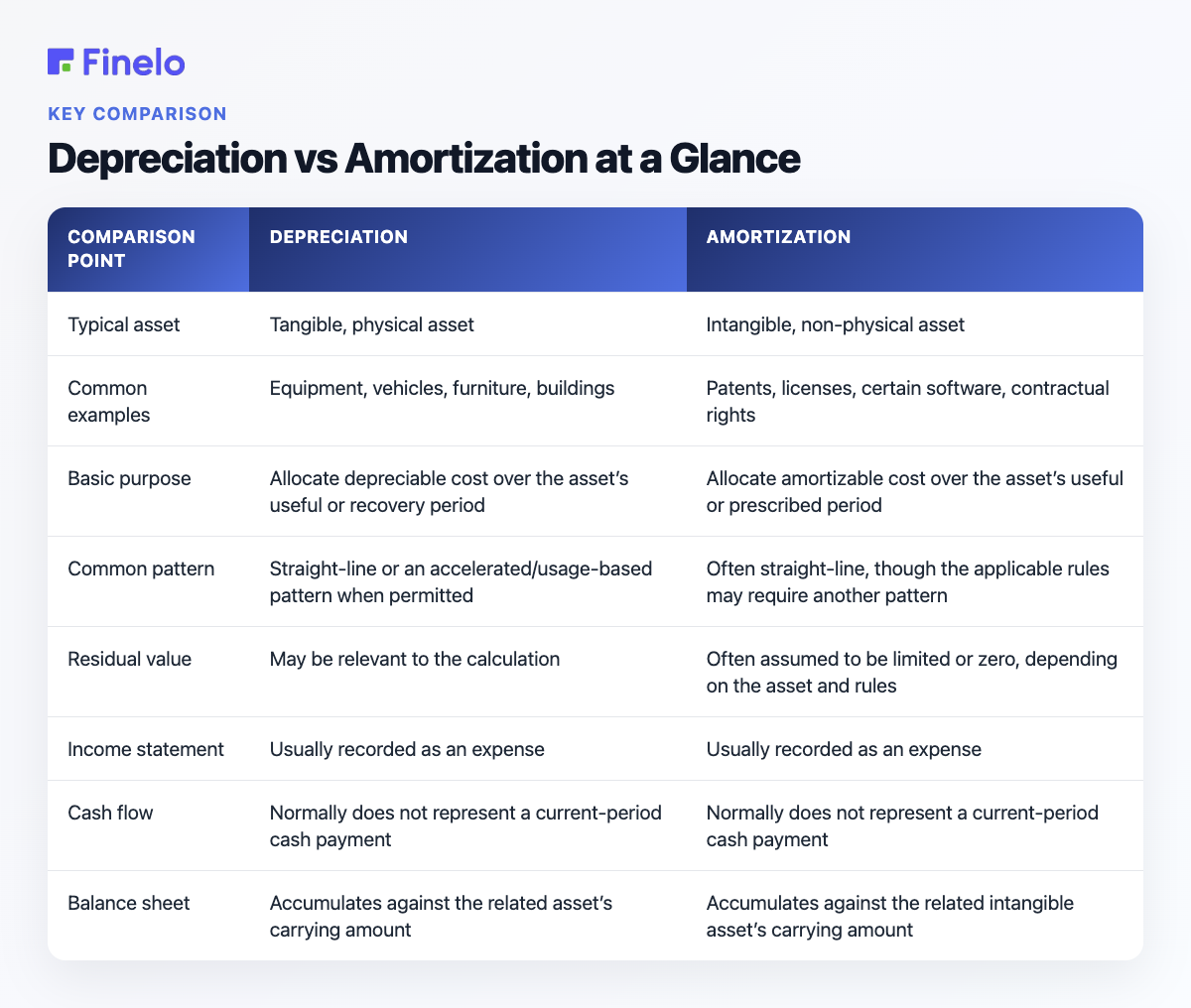
The table describes the usual distinction, not a universal rule. The IRS, for example, defines depreciation for U.S. tax purposes as an annual deduction that recovers the cost or other basis of certain property over the period it is used and links it to wear, deterioration, or obsolescence (IRS Publication 946). Exact treatment depends on the asset, jurisdiction, reporting framework, acquisition date, and use.
For an investor, three comparisons are especially useful: D&A versus capital expenditure, current assumptions versus earlier reporting periods, and one company’s asset intensity versus genuinely comparable peers. A rising D&A charge may reflect expansion, acquisitions, aging assets, or a change in estimates. The figure needs context before it supports any conclusion about business quality.
What Is Depreciation?
Depreciation is the systematic allocation of the depreciable amount of a physical long-lived asset over time. It recognizes that a business may receive value from equipment, vehicles, furniture, or a building for more than one reporting period.
Suppose a delivery company buys a van. Recording the entire purchase as an operating expense on day one would not reflect the fact that the van may help make deliveries over several periods. Depreciation assigns portions of the relevant cost to those periods instead.
For U.S. federal tax purposes, the concept has specific rules rather than being merely an accounting estimate. The IRS describes depreciation as cost or basis recovery over the time qualifying property is used (IRS Publication 946). That tax definition should not be assumed to produce the same timing as depreciation in a company’s financial statements.
What goes into a depreciation calculation?
A basic depreciation calculation usually starts with:
- The asset’s recognized cost or basis
- Any residual or salvage value considered under the applicable rules
- The useful life or tax recovery period
- The permitted allocation method
- The date the asset becomes available or is placed in service
These inputs matter because depreciation is not simply a decline in market price. An asset’s resale value can rise or fall for many reasons while its accounting depreciation continues according to the selected method and governing rules.
What Is Amortization?
Amortization performs a similar cost-allocation role for intangible assets. These assets do not have physical substance, but they can provide benefits through legal rights, technology, customer relationships, intellectual property, or other identifiable advantages.
Imagine a company purchases a time-limited software license. The license may support operations for several years, so its amortizable amount can be allocated across the period in which the right is expected to provide benefits. A straight-line approach would recognize an equal amount each period; another pattern may be appropriate only when supported and permitted.
Official GOV.UK guidance discussing earnings distinguishes the two terms by describing depreciation and amortization as non-cash transactions connected with tangible and intangible assets, respectively (HMRC International Manual). That distinction is useful when reading financial statements, although the detailed recognition and measurement rules still depend on the relevant framework.
Not every intangible asset is automatically amortized. Its classification, useful life, legal terms, acquisition method, and applicable accounting or tax rules must be assessed first. Goodwill also requires special care because its treatment can differ from that of a separately identifiable finite-life intangible asset.
The Key Differences That Matter
The asset’s physical form is the best starting point, but a sound comparison requires more than “physical versus non-physical.”
1. The underlying asset
Depreciation typically concerns tangible property that is used up, wears out, becomes obsolete, or otherwise provides benefits over time. Amortization typically concerns an intangible asset whose cost is allocated over a finite period.
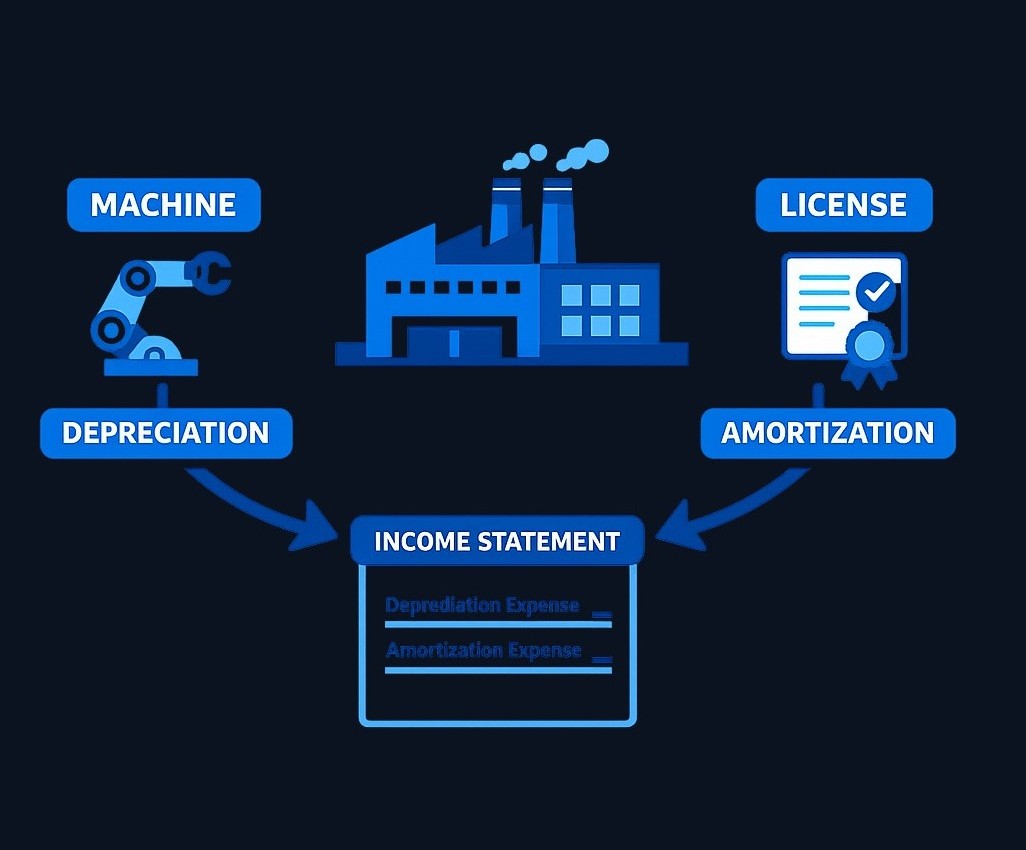
This is why a manufacturer may depreciate production machinery while amortizing a purchased finite-term license. The business is allocating cost in both cases, but the economic resource and governing rules are different.
2. The allocation method
Depreciation may use a straight-line, accelerated, or usage-based method when the applicable framework permits it. Amortization is frequently shown with a straight-line pattern because the consumption of an intangible asset’s benefits can be difficult to observe directly.
The method should not be chosen merely to produce a preferred profit figure. It should follow the relevant accounting standard or tax law. When judgment is allowed, it should also reflect how the asset’s benefits are expected to be consumed.
3. Useful life and recovery period
For financial reporting, useful life is generally an estimate connected to the period of expected benefit. For tax, a prescribed recovery period may control. Those are related ideas, but they are not necessarily the same number.
Intangible assets introduce another constraint: contractual or legal rights may limit the period over which benefits can be obtained. A license that expires cannot casually be assigned a longer amortization period without a supportable basis.
4. Residual value
A tangible asset may retain an expected residual value at the end of its useful life. If the applicable method uses that value, only the remaining depreciable amount is allocated.
For many finite-life intangible assets, a meaningful residual value is less common. Nevertheless, the correct assumption depends on the asset and reporting rules; “intangibles always have zero residual value” is too broad.
5. Tax treatment
Book depreciation or amortization and tax deductions can follow different schedules. A business can therefore report one expense amount in its financial statements and a different deduction in its tax calculation for the same period.
Tax outcomes are especially jurisdiction-specific. The IRS source cited here supports the U.S. federal-tax description of depreciation, while the GOV.UK source provides a U.K. governmental discussion of D&A in an earnings context. Neither should be treated as a substitute for the rules that govern a particular entity.
Practice investing with Finelo
Build practical investing skills with guided lessons, simulator practice, and structured challenges.
How the Main Calculation Methods Work
The formulas below are simplified educational models. Real calculations may require conventions, partial periods, impairment adjustments, re-estimated useful lives, or tax-specific schedules.
Straight-line method
Straight-line allocation recognizes an equal amount in each full period:
Annual expense = (recognized cost − residual value) ÷ useful life
Assume a business buys equipment for $50,000, expects a $5,000 residual value, and assigns it a five-year useful life. The depreciable amount is $45,000, producing $9,000 of straight-line depreciation per full year.
For a $24,000 finite-term license with no assumed residual value and a four-year amortization period, straight-line amortization would be $6,000 per full year.
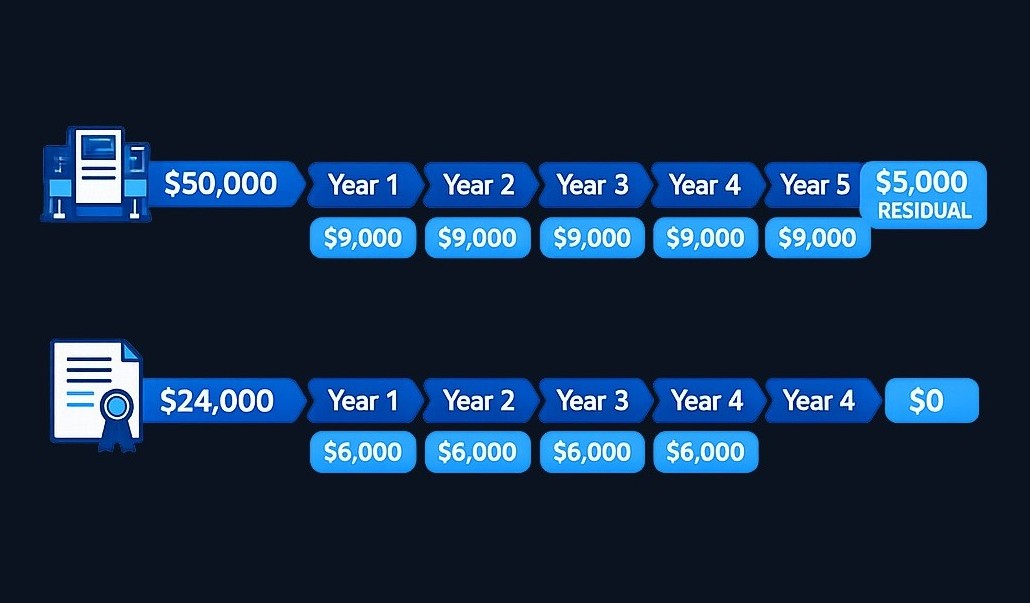
These examples illustrate the arithmetic only. They do not establish that a five- or four-year period is correct for any real asset.
Accelerated depreciation
An accelerated method records more depreciation in earlier periods and less later. It may fit an asset whose benefits or productivity are expected to be greater near the start of its life, or it may be required or allowed by a tax system.
The important analytical effect is timing: total allocable cost does not increase merely because more expense is recognized earlier. Earlier expense reduces early-period profit more and leaves less depreciation for later periods.
Usage-based methods
A units-of-production approach links expense to activity rather than the passage of time. A machine’s depreciation might be connected to units produced when output is a reasonable measure of consumption.
This method requires reliable activity estimates and records. It is not automatically suitable for an intangible asset merely because usage data exists; the relevant accounting or tax rules still control.
Choosing a method
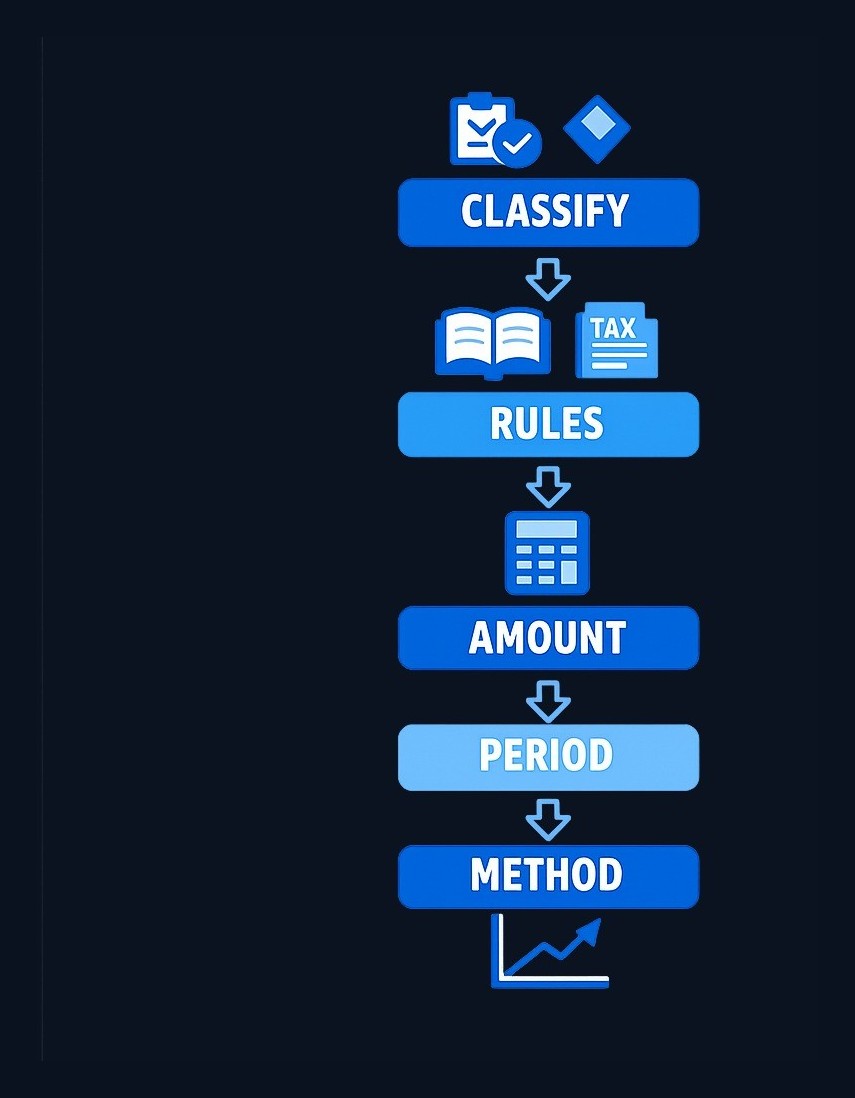
Use this short framework:
- Classify the asset. Is it tangible, a separately identifiable intangible, goodwill, or something else?
- Identify the rule set. Financial reporting and tax reporting may require separate calculations.
- Establish the allocable amount. Confirm cost or basis and any permitted residual value.
- Determine the period. Use a supportable useful life or the prescribed recovery period.
- Select a permitted pattern. Match expected consumption when judgment is allowed.
- Document assumptions. Retain the contract, placed-in-service date, estimates, and calculation.
- Review later changes. Disposal, impairment, revised estimates, or changes in use may affect subsequent accounting.
How D&A Affects Investor Analysis
Depreciation and amortization usually reduce reported profit through periodic expense recognition. At the same time, accumulated depreciation or amortization reduces the carrying amount associated with the asset on the balance sheet.
The cash-flow effect differs from the profit effect. Cash generally leaves when the asset is purchased. Depreciation or amortization is then recognized in later periods as a non-cash expense. GOV.UK’s HMRC manual discusses both as non-cash transactions in its EBITDA context (HMRC International Manual).
Consider a simplified sequence:
Asset purchased
↓
Cash leaves at acquisition
↓
Asset is recorded
↓
Depreciation or amortization is recognized over later periods
↓
Profit falls, but the periodic expense itself is not a new cash payment
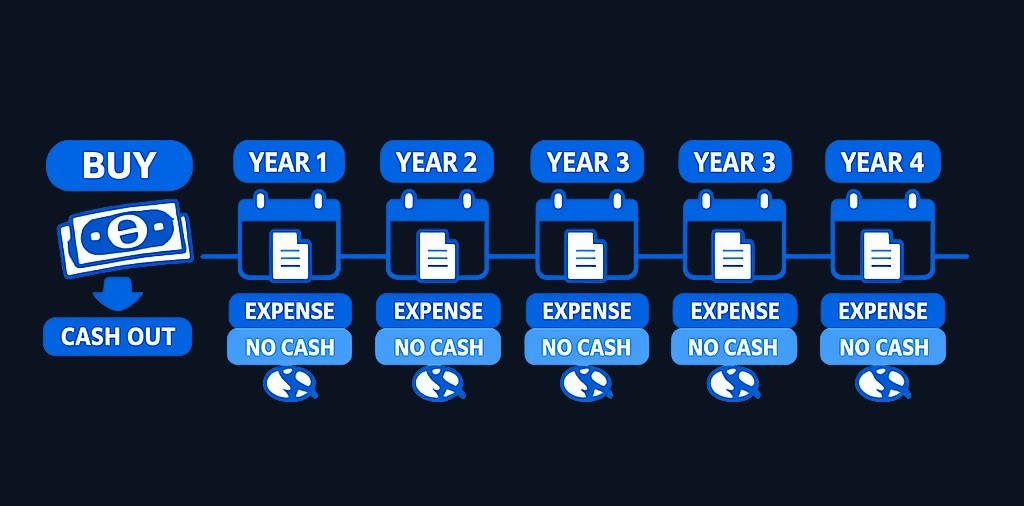
This explains why analysts often examine D&A when moving between profit-based measures and cash-flow measures. It does not mean the expense is economically meaningless. A tangible asset may eventually require replacement, and an intangible right may need renewal or replacement for the business to maintain its capabilities.
Different book and tax schedules can also create timing differences between accounting profit and taxable income. Because those effects depend on jurisdiction and entity circumstances, readers should verify the applicable tax rules rather than infer a deduction from the financial-statement expense.
Industry Examples
The following hypothetical cases show how asset type drives the choice.
Manufacturing
A manufacturer buys a production machine and acquires a finite-term technology license. The machine is a physical asset, so its allocated cost would generally appear as depreciation. The license is intangible, so its allocated cost would generally appear as amortization if it qualifies and has a finite life.
If the machine is used to produce inventory, some depreciation may become part of production cost rather than appearing immediately as a standalone period expense. The exact presentation depends on the reporting framework.
Transportation
A logistics company operates trucks and uses route-planning software under a capitalized qualifying arrangement. Trucks are tangible assets and are candidates for depreciation. A recognized finite-life software-related intangible may be amortized.
The company’s current cash spending could be high when it buys the fleet, even though only periodic depreciation appears in profit afterward. This timing difference is why profit and cash expenditure should not be confused.
Media and technology
A media business may own studio equipment while also holding acquired content rights or software-related intangibles. The equipment and intangible rights can generate expenses under different labels and possibly different useful lives, even when they support the same product.
Retail
A retailer may depreciate fixtures, shelving, and equipment. If it acquires a qualifying finite-life contractual right as part of a transaction, that right may require amortization. Routine advertising, repairs, or subscriptions should not be capitalized merely because management expects future benefits; recognition rules come before the depreciation-versus-amortization decision.
Common Misconceptions
“Depreciation measures an asset’s market value.”
Not necessarily. Depreciation is a cost-allocation process. Carrying amount and current resale value can differ.
“Amortization applies to every intangible cost.”
No. A cost must first qualify for recognition as an asset, and the asset’s classification and life matter.
“A non-cash expense has no economic importance.”
Non-cash means the expense is not itself a current-period cash payment. It can still signal consumption of an asset acquired with cash or another form of consideration.
“Tax depreciation and book depreciation are interchangeable.”
They may use different bases, periods, methods, and timing. The IRS description is specifically framed as an income-tax deduction (IRS Publication 946).
“The same asset can always be both depreciated and amortized.”
Usually, one recognized asset is classified and accounted for under the applicable model. A single purchase transaction can, however, contain multiple components—for example, physical equipment plus a separate license—that receive different treatment.
“Straight-line is always the safest choice.”
It is easy to calculate, but ease is not the deciding principle. The method must be permitted and appropriate for the relevant asset and rule set.
An Investor’s D&A Review
When you encounter depreciation or amortization in company accounts, begin with the note describing the asset class and accounting policy. Then compare the current-period expense with capital expenditure, asset additions, disposals, impairments, and changes in useful-life estimates. Review several periods and compare only with businesses that have similar asset needs. This gives more context than reading D&A as a single isolated number.
For a calculation, gather the purchase agreement, invoice, asset description, date available for use, useful-life support, residual-value assumption, and applicable financial-reporting and tax requirements. If the treatment could materially affect reports or tax filings, consult a qualified accounting or tax professional familiar with the relevant jurisdiction.
Finelo’s comparison is designed as an investor-education framework: classify the asset first, separate accounting expense from cash investment, and verify the method disclosed in the company’s filings. Its core distinction is anchored in official IRS and GOV.UK materials rather than treating depreciation and amortization as two spellings for the same expense. This article is educational and does not recommend a particular investment.
InvestingBeginnerFinancial StatementsMarkets
Practice investing with Finelo
Build practical investing skills with guided lessons, simulator practice, and structured challenges.
About the author
Finelo Team
The Finelo Team creates practical investing and trading education designed to help beginners learn faster with structured challenges, simulator practice, and bite-sized lessons.
Keep reading — Related articles

Investing
I Bonds vs EE Bonds in 2026: Rates, Rules, and Which to Buy for the Long Run
Series I and Series EE savings bonds are both U.S. Treasury retail savings bonds sold on TreasuryDirect. They share ownership, tax treatment, and redemption rules; the key difference is the…
Finelo Team
Investing
Coverdell ESA vs 529 Plan: Limits, Flexibility, and Which to Choose
Quick answer (one minute) Both a Coverdell Education Savings Account (Coverdell ESA) and a 529 plan let money grow tax‑free and be withdrawn tax‑free for qualified education expenses. The…
Finelo Team
Investing
CD vs High Yield Savings Account: Where to Park Your Cash in 2026
Hero answer — CD vs high yield savings account in one line A CD (certificate of deposit) and a high yield savings account are both low‑risk, federally insured homes for cash — the difference…
Finelo Team