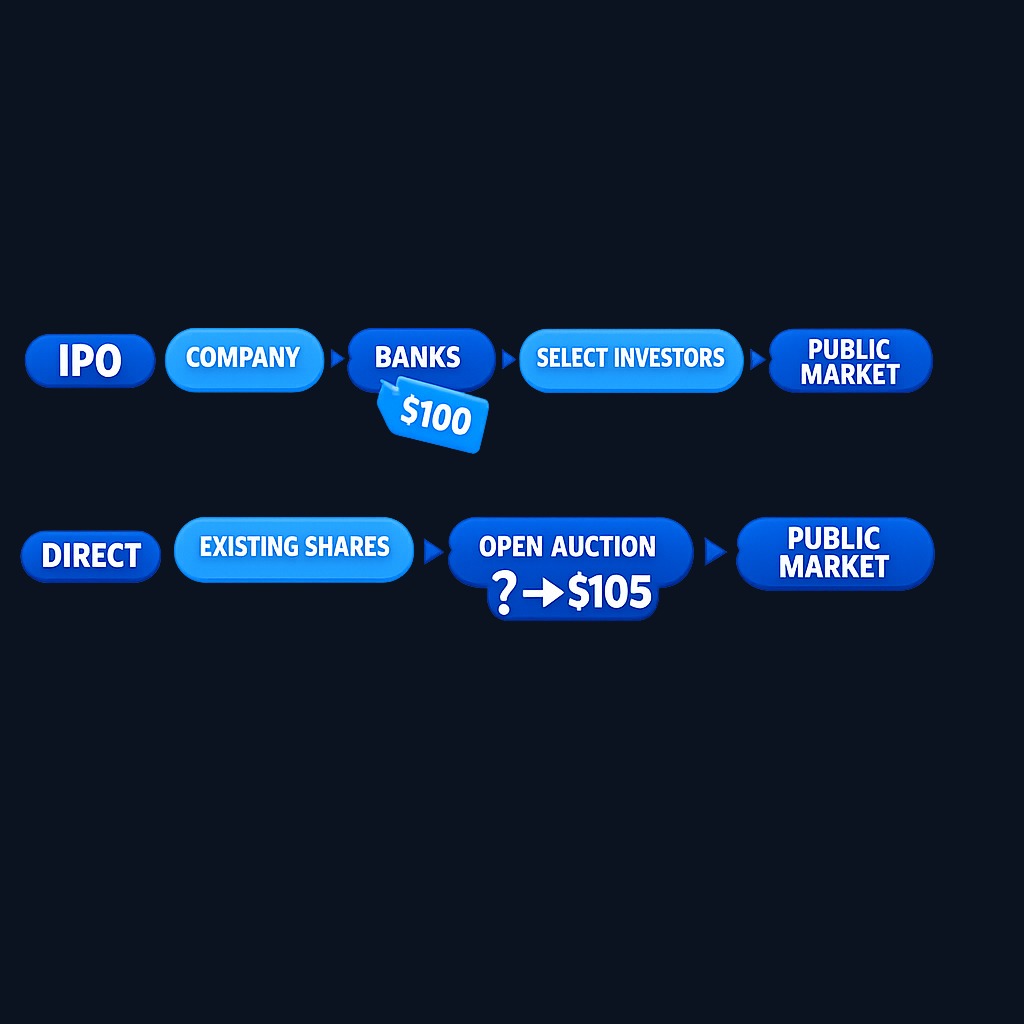
The core difference in the direct listing vs IPO choice is how the first public shares get priced and sold. An IPO sells newly issued shares to selected investors at a negotiated price the night before trading starts. A direct listing skips that step: existing shares simply begin trading in an exchange auction, and the market sets the opening price.
Direct Listing vs IPO: How Companies Go Public Two Different Ways
Compare direct listings and IPOs: pricing, underwriters, lockups, capital raising, and what each path means for everyday investors.
6 min read
Practice investing with Finelo
Build practical investing skills with guided lessons, simulator practice, and structured challenges.
Want to learn more?
Build practical investing skills with guided lessons, simulator practice, and structured challenges.
Explore FineloExplore Finelo's 28-day challenges
Turn learning into a daily habit with guided challenge paths.
This page is for investors who see headlines about companies "going public" both ways and want to know what actually differs, and what it means when they consider buying a newly listed stock. Read the mechanics of each path, then the comparison table and framework. This article is educational, not financial advice.
How a traditional IPO works
In an initial public offering, a company hires investment banks as underwriters. The banks help prepare the registration statement, market the deal to institutional investors in a roadshow, and gauge demand. The night before trading begins, the company and underwriters agree on an offering price, and the banks place the new shares with a group of investors they assemble, as described on the NYSE's direct listings page. Public trading starts the next morning through an opening auction.
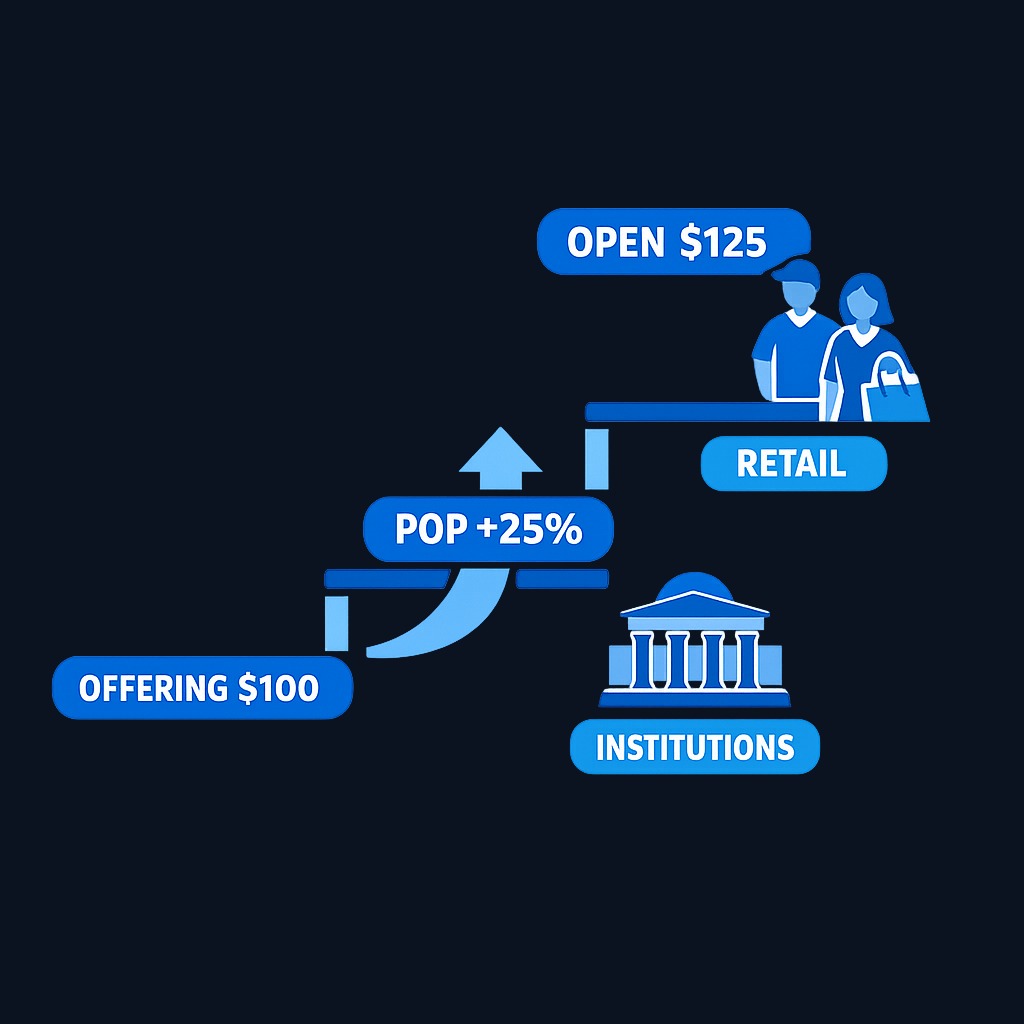
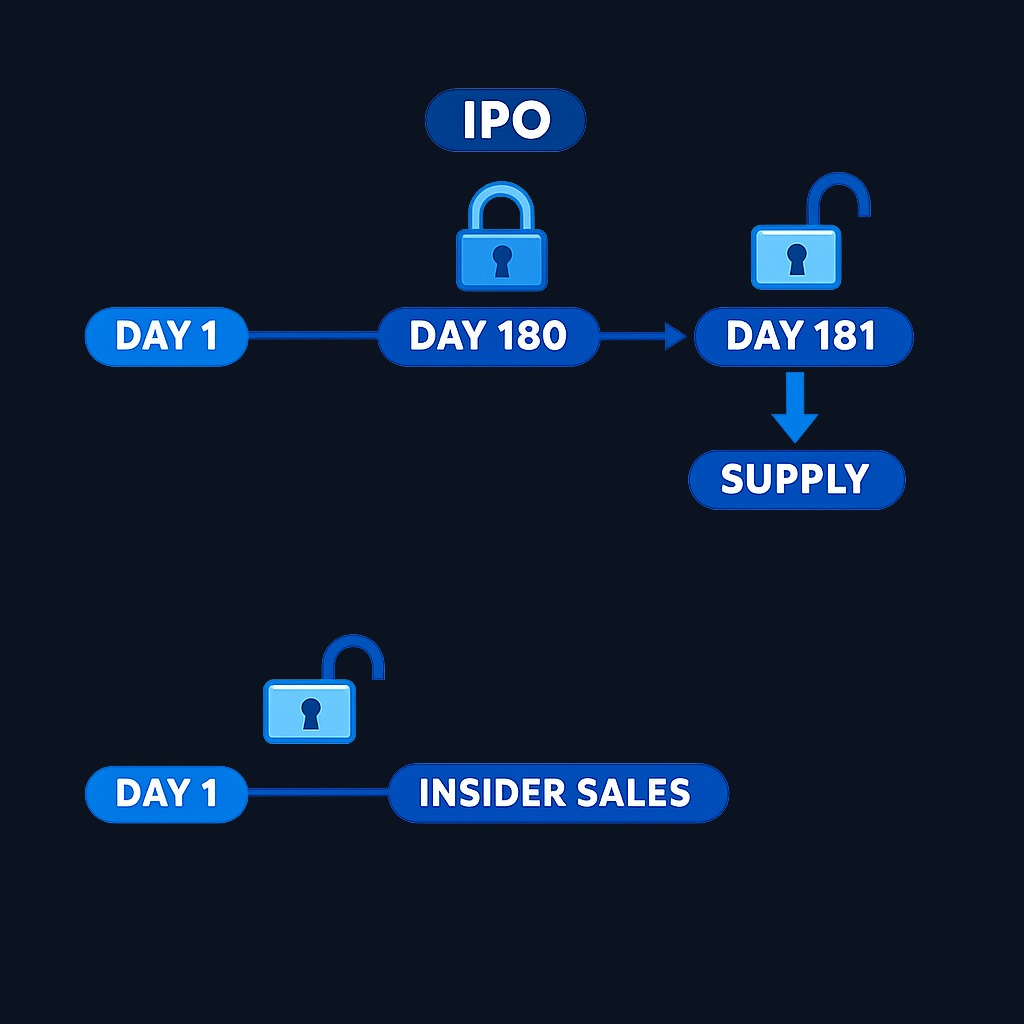
Along the way the company raises fresh capital by selling newly issued shares, pays underwriting fees, and typically accepts a lock-up period during which insiders agree not to sell, commonly about six months. Retail investors usually cannot buy at the offering price; they buy in the aftermarket, often after the well-known first-day "pop" when a deal was priced below what public demand would bear. The SEC's investor bulletin on IPOs walks through what to check before buying any newly public company.
How a direct listing works
In a direct listing, the company registers with the SEC and lists on an exchange, but no underwritten sale happens beforehand. Existing shareholders, such as employees and early investors, can sell starting on day one, and the opening price comes from supply and demand in the exchange's opening auction. Spotify in 2018 and Slack in 2019 pioneered the model on the NYSE.
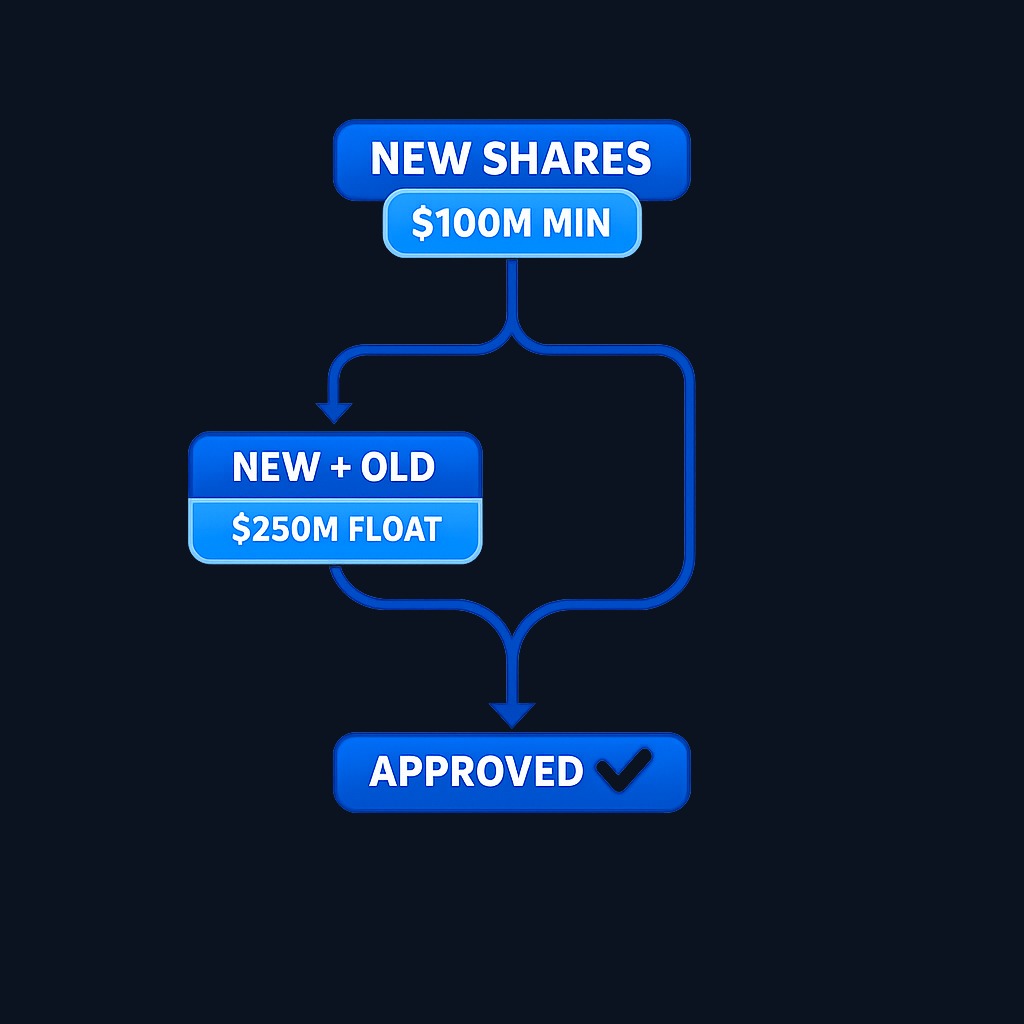
Two features stand out. First, there is typically no traditional lock-up, so insiders are free to sell immediately, a point the SEC commissioners' statement on primary direct listings highlights. Second, since a December 2020 SEC-approved NYSE rule, companies can also raise new capital in the process. In these primary direct listings, per the NYSE, a company must sell at least $100 million of newly issued shares in the opening auction, or have a combined public float of at least $250 million between new and existing shares. Disclosure obligations do not shrink: a prospectus is still required, and full ongoing public-company reporting follows.
Side-by-side comparison
| Feature | Traditional IPO | Direct listing |
|---|---|---|
| First-day pricing | Negotiated with underwriters the night before | Set by the opening auction |
| New capital raised | Yes, core purpose | Optional (primary direct listing) |
| Underwriter role | Firm commitment, allocation, price support | Advisory only |
| Lock-up on insiders | Common, often around 180 days | Typically none |
| Who can sell day one | Mostly the company's new shares | Existing shareholders |
| Typical cost profile | Higher underwriting fees | Lower fees, advisory only |
| Early volatility | Buffered by underwriter support | Set fully by market forces |
The table compresses the tradeoff: IPOs buy certainty and support with fees and dilution, while direct listings buy purity of price discovery at the cost of a safety net.
Practice investing with Finelo
Build practical investing skills with guided lessons, simulator practice, and structured challenges.
What it means for everyday investors
For retail investors, the differences show up in three practical ways.
Access. In an IPO, the offering price usually goes to institutional clients, and retail buyers enter after the price has moved. In a direct listing, everyone meets the stock at the same opening auction, so no group gets a pre-arranged better entry.
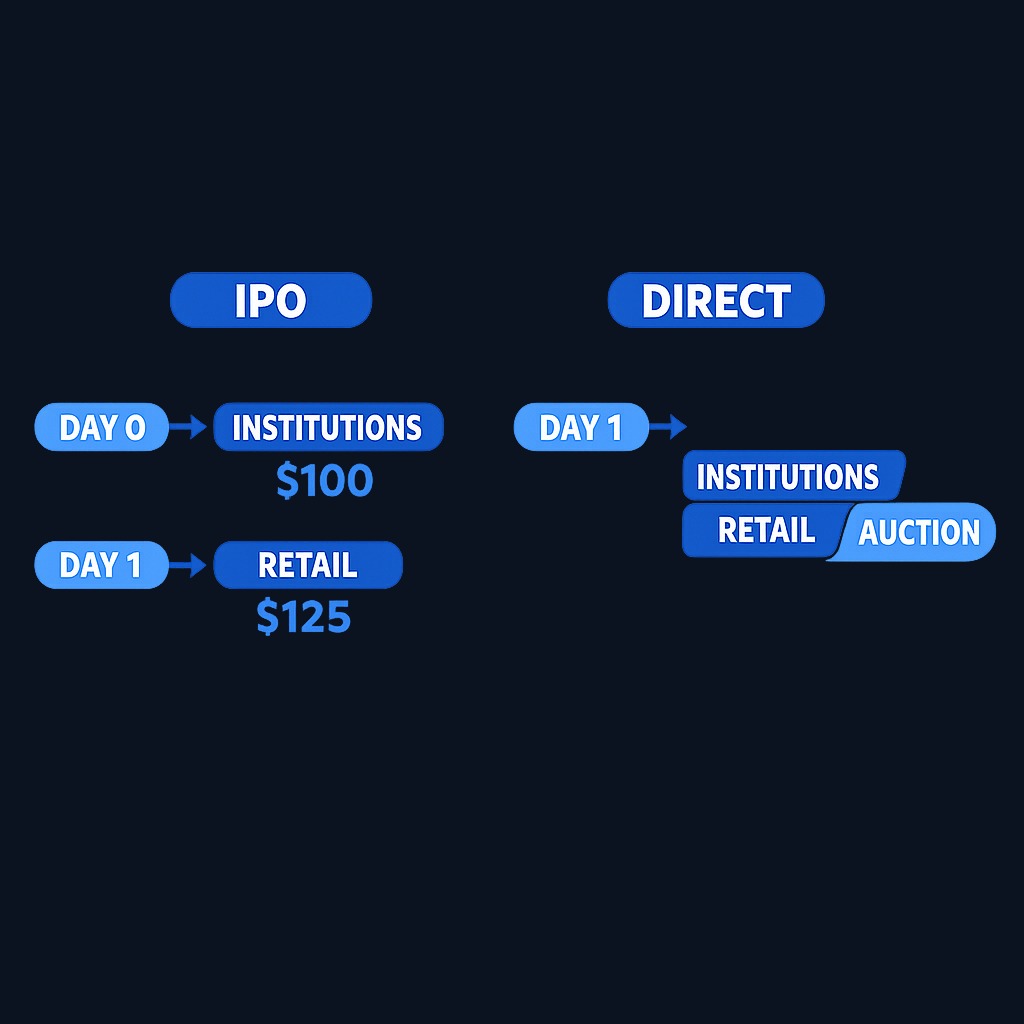
Volatility. Direct listings have no underwriter stabilizing the price in early trading, and early supply depends entirely on how many insiders choose to sell. Both factors can make the first days choppier, something the SEC commissioners flagged when approving primary direct listings.
Information and recourse. Both paths require a full prospectus and ongoing disclosures. The SEC statement notes, though, that without a firm-commitment underwriter, one layer of outside due-diligence pressure is reduced, and shareholders suing over faulty disclosures can face added difficulty tracing which shares were sold under the registration statement.
None of this makes either structure good or bad for buyers. It changes the shape of the first weeks of trading, and that is where retail decisions actually happen.
What to know before deciding
Before trading any newly public stock, from either path, do the same homework. Read the prospectus summary, risk factors, and financial statements. Check how many shares can actually trade on day one, since a small float can exaggerate moves in both directions. For IPOs, note when the lock-up expires, because a wave of insider selling becomes possible on that date. For direct listings, remember that insiders can sell from the start, so early prices already carry that supply. And treat first-day prices as noisy signals; neither an IPO pop nor a volatile direct-listing open tells you much about long-term value.
Decision framework: approaching a new listing as a retail investor
- Identify the path. IPO or direct listing changes what day-one supply and support look like.
- Read before you buy. Prospectus risk factors and financials first; headlines second.
- Check the float and the calendar. Small float or an approaching lock-up expiry are volatility events you can see coming.
- Decide your horizon. If you believe in the business for years, the difference between entering day one and month three is mostly noise and nerves.
- Size the position for turbulence. New listings lack trading history; assume wider swings than an established stock.
If a listing fails step 2, the structure it used to go public does not matter.
Conclusion and next steps
An IPO raises money through underwriters at a negotiated price with a lock-up; a direct listing opens existing shares straight to auction, with optional capital raising since the 2020 rule change. For companies the choice is about fees, dilution, and control over pricing. For you, it mostly changes the texture of early trading and the homework you should do before buying.
Next steps: pick a recent IPO and a recent direct listing, read the first pages of each prospectus, and compare their first month of trading against the framework above. To build this kind of analysis skill with guided practice, the Finelo app offers step-by-step investing education for beginners.
Frequently asked questions
Why would a company choose a direct listing over an IPO?
Common reasons include avoiding dilution from issuing new shares, skipping most underwriting fees, letting the market set the price without a negotiated discount, and giving existing shareholders immediate liquidity instead of a lock-up wait.
Can a company raise money in a direct listing?
Yes, since the SEC approved primary direct listings in December 2020. On the NYSE, the company must sell at least $100 million of new shares in the opening auction or meet a $250 million combined float threshold.
Is a direct listing riskier for investors than an IPO?
The disclosure requirements are the same, but early trading can be less cushioned: no underwriter price support, no lock-up limiting insider supply, and price discovery happening fully in the open. Expect more early volatility, not necessarily worse companies.
Do direct-listing companies file the same paperwork?
Yes. A registration statement and prospectus are required before listing, and full ongoing public-company reporting, such as annual reports and proxy filings, applies afterward, just as with an IPO.
directlistingipocompaniespublictwo
Practice investing with Finelo
Build practical investing skills with guided lessons, simulator practice, and structured challenges.
About the author
Finelo Team
The Finelo Team creates practical investing and trading education designed to help beginners learn faster with structured challenges, simulator practice, and bite-sized lessons.
Keep reading — Related articles
Investing
Tax-gain harvesting vs. tax-loss harvesting
Compare realizing investment gains with realizing losses, including holding periods, wash sales, offsets, and portfolio tradeoffs.
Finelo Team
Investing
Stable value fund vs. money market fund
Compare investment structure, contract protections, transfer restrictions, net yields, and access inside a retirement account.
Finelo Team
Investing
Single-life vs. joint-life annuity
Compare income for one lifetime with continued payments to a survivor, using equal premiums and matching guarantee terms.
Finelo Team