For U.S. readers: This article discusses U.S. rules and financial products. State rules and individual eligibility may differ.
Does a 401(k) Loan Show Up on Your Credit Report?
What you’ll learn here: whether 401(k) loans commonly appear on credit reports, how they can still affect your financial picture, practical decision tools, clear examples, and common mistakes to avoid.
11 min read
Practice investing with Finelo
Build practical investing skills with guided lessons, simulator practice, and structured challenges.
Want to learn more?
Build practical investing skills with guided lessons, simulator practice, and structured challenges.
Explore FineloExplore Finelo's 28-day challenges
Turn learning into a daily habit with guided challenge paths.
Quick answer
Short answer: most 401(k) loans are internal arrangements with your retirement plan and typically do not appear on consumer credit reports — but confirm with your plan documents or plan administrator before borrowing. Finelo provides financial education, not financial or investment advice. For general plan guidance, the IRS recommends reviewing your plan rules and talking with your plan administrator before taking a loan IRS guidance.
What you’ll learn here: whether 401(k) loans commonly appear on credit reports, how they can still affect your financial picture, practical decision tools, clear examples, and common mistakes to avoid.
What is a 401(k) Loan?
What is a 401(k) Loan?
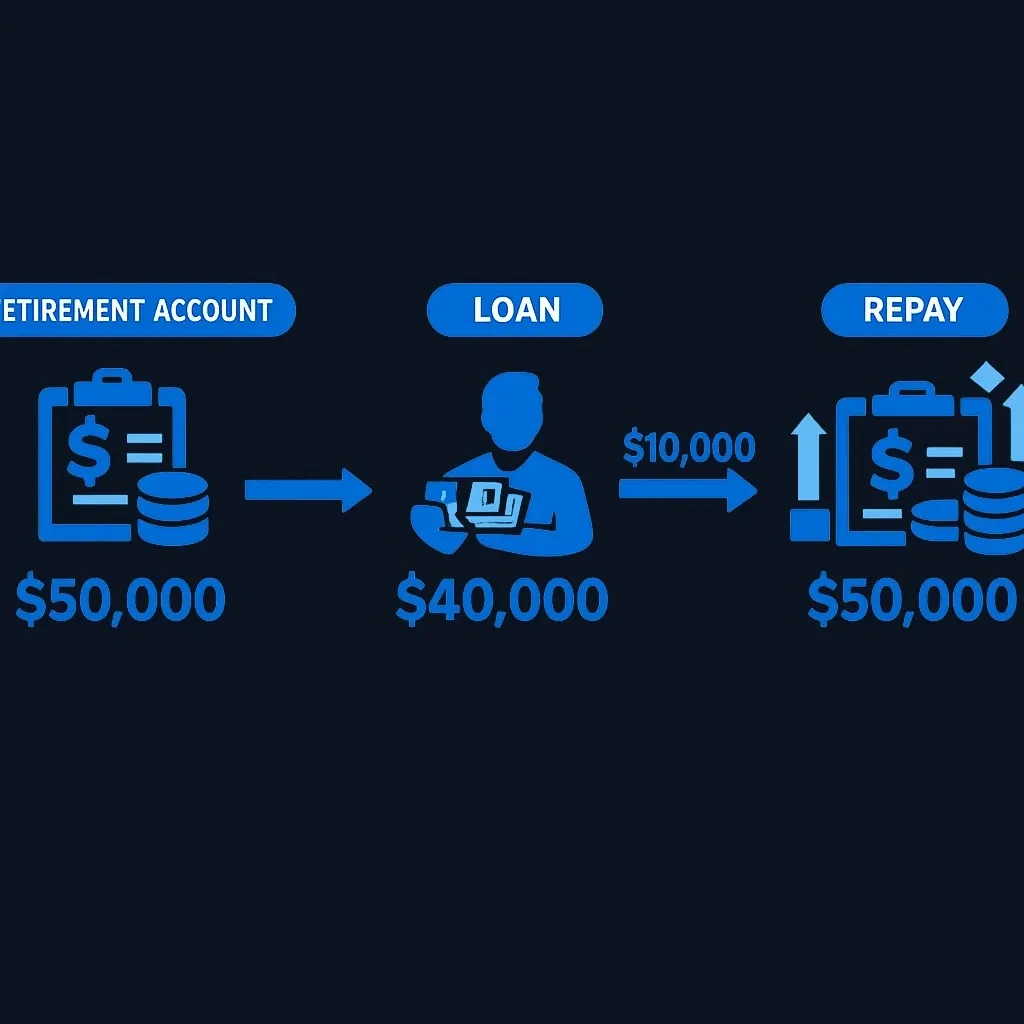
A 401(k) loan lets you borrow money from your own employer-sponsored retirement account and pay it back with interest into that same account. Unlike taking a distribution, a loan is intended to be repaid on a fixed schedule. Employers and plan administrators set whether loans are allowed and what terms apply; the IRS recommends checking plan rules and consulting the plan administrator before taking a loan.
Key mechanics (plain terms)
- Who lends: your plan, not an outside bank. The lender is effectively your plan administrator acting under plan rules.
- Repayment: you pay principal plus interest back into your 401(k) on a schedule set by the plan.
- Purpose: plans may permit loans for any reason or may restrict uses (for example, hardship or home purchase). Check your plan summary for details.
- Tax status: a properly repaid loan is not treated as a distribution. If you fail to repay it, plan rules and tax rules can treat a balance as a distribution, which has tax consequences; confirm details with your plan administrator and tax advisor.
Concrete example
- If your plan allows a loan and you borrow $10,000, your plan pays you that cash now and reduces your retirement account balance by that amount. You then make scheduled repayments (including interest) that restore funds to the plan over time. Exact loan size, term, and repayment timing depend on your plan rules.
Does a 401(k) Loan Appear on Your Credit Report?
Does a 401(k) Loan Appear on Your Credit Report?
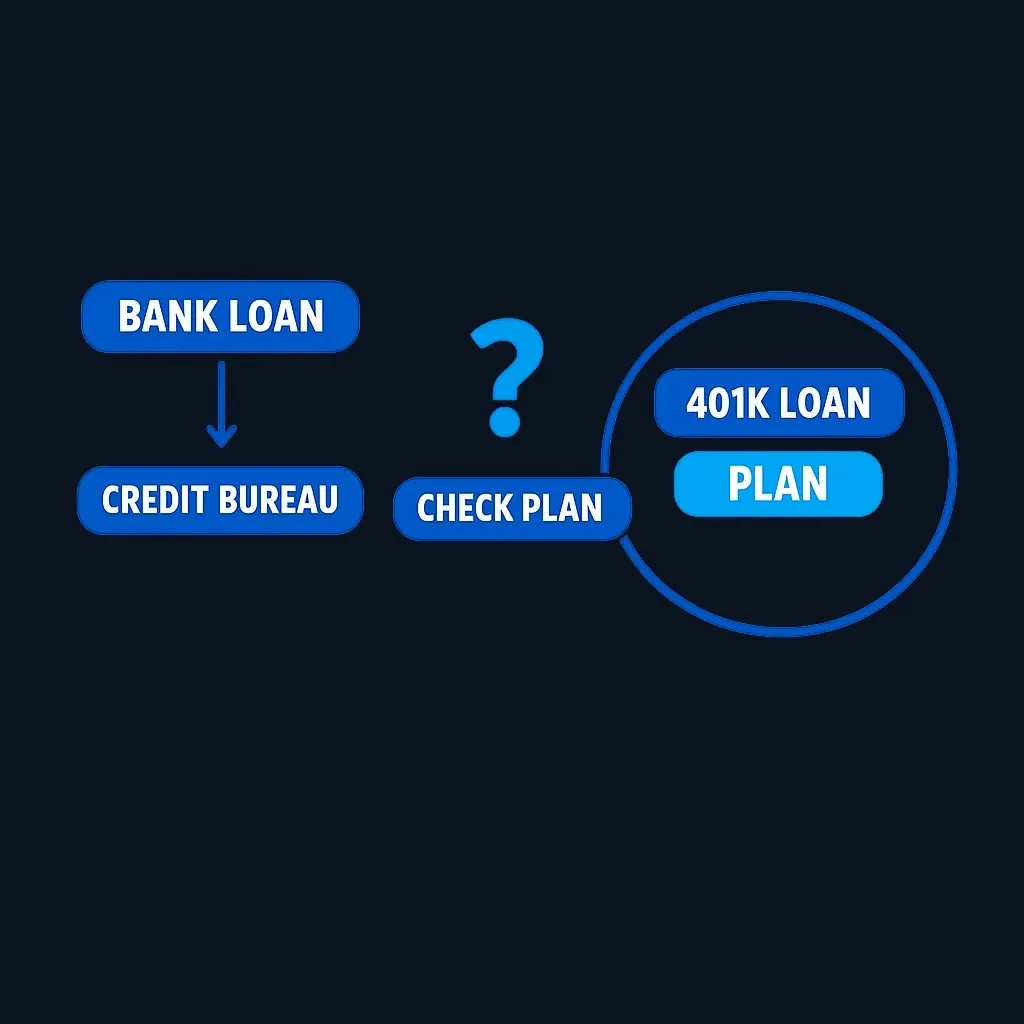
Direct answer: 401(k) loans are generally handled inside the retirement plan and are not reported to consumer credit bureaus in the same way a bank loan or credit card is. However, because plan rules vary, you should verify how your plan treats loans and confirm with the plan administrator before borrowing.
Why that matters
- Credit reporting is driven by third-party lenders and bureau reporting. Because a 401(k) loan is between you and your plan, it typically isn’t reported to credit bureaus.
- Even if the loan itself is not on your credit report, indirect consequences can affect your financial profile (see the next section).
Caveat and verification steps
- Ask your plan administrator whether loans are reported to any external entity.
- Read your Summary Plan Description (SPD) or loan policy; it will state whether loans are permitted and any reporting or default procedures.
- If you plan to apply for new credit (mortgage, auto loan) soon, tell your lender about the loan when asked; underwriters sometimes ask about recurring obligations even if not on a credit report.
Impact of 401(k) Loans on Credit Scores
Impact of 401(k) Loans on Credit Scores
A 401(k) loan generally does not directly change your credit score because it is usually not listed on consumer credit reports. But there are important indirect ways the loan can affect your finances and creditworthiness.
How a 401(k) loan can indirectly affect credit and borrowing capacity
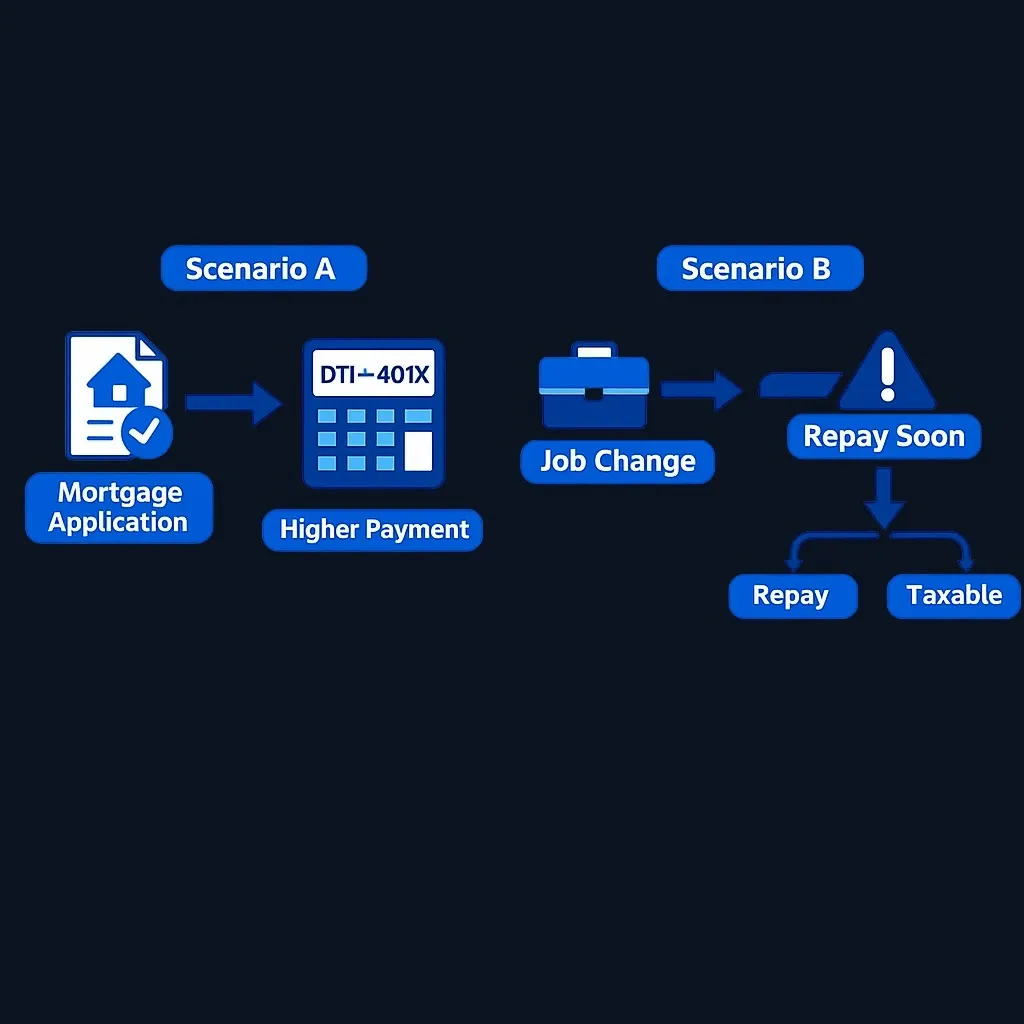
- Debt-to-income (DTI) and affordability: Lenders evaluating a mortgage or other loan commonly look at your monthly obligations. Even if a 401(k) loan doesn’t appear on your credit report, the repayment reduces your available monthly cash, which can lower how much new credit you qualify for.
- Payment stress and missed obligations: If the loan’s repayments strain your budget and cause you to miss payments on credit cards or loans that are reported, your credit score can suffer.
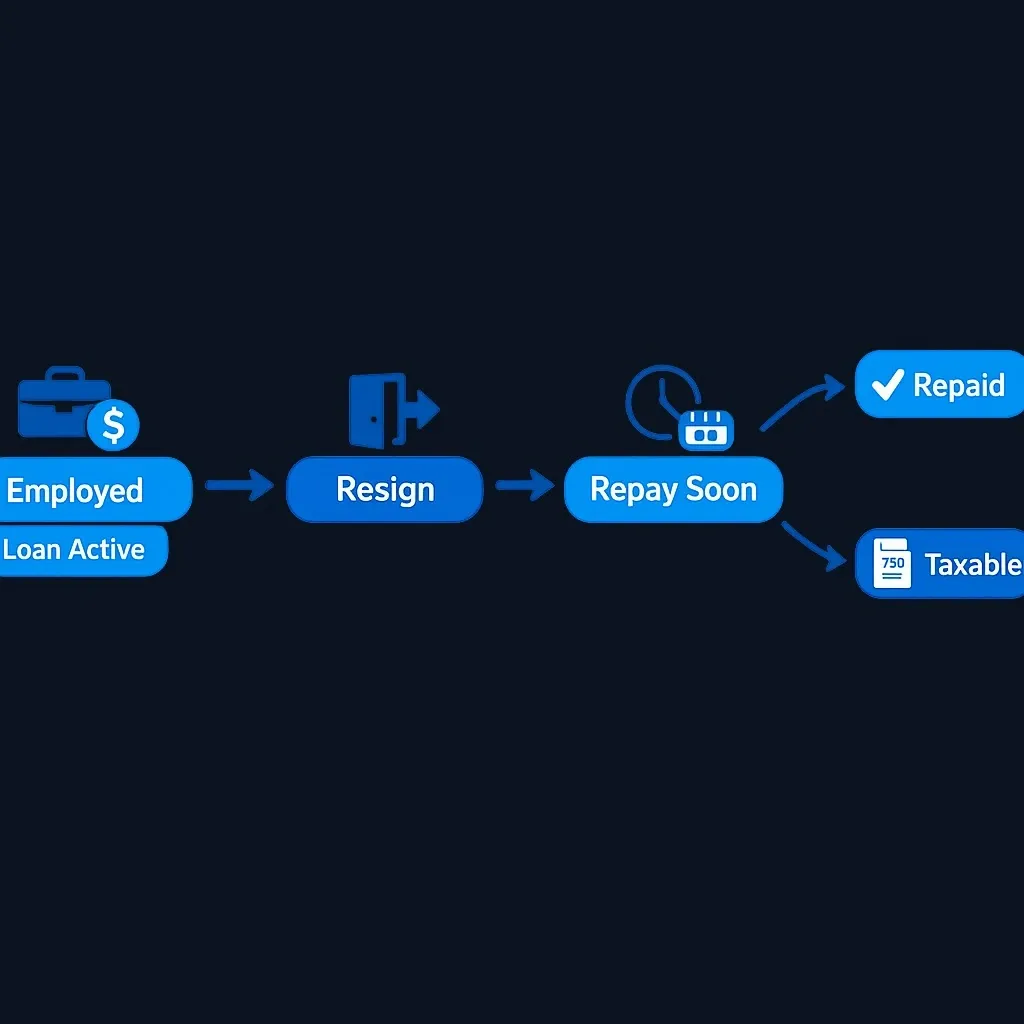
- Job loss and acceleration clauses: If you leave your employer (voluntarily or not), many plans require accelerated repayment; failure to repay may trigger taxes and possible loan default handling, which can create liquidity strains and lead to reported delinquencies on other debts.
Practical example
- Scenario A — Mortgage lender review: You have a stable income and plan to get a mortgage. Even though your 401(k) loan isn’t on your credit report, the lender may ask for documentation of monthly loan payments. Your underwriter will factor that payment into qualification calculations.
- Scenario B — Job change: You take a 401(k) loan and later leave your job. Your plan may require repayment sooner than expected. If you can’t repay and take a taxable distribution instead, that can reduce your savings and increase the risk of missing other bills.
Checklist to protect your credit score
- Confirm repayment schedule and monthly payment amount with your plan administrator.
- Add loan payments to your budget before borrowing.
- If you expect a job change, ask whether leaving will accelerate repayment and how much time you’d have to repay.
Pros and Cons of Taking a 401(k) Loan
Pros and Cons of Taking a 401(k) Loan
This section helps you weigh tradeoffs. Each item should be evaluated against your time horizon, emergency buffer, tax considerations, and risk tolerance. This is educational, not financial or investment advice.
Pros (when a 401(k) loan can help)
- Speed and convenience: If your plan allows loans, they can be quicker than applying for external credit because you’re borrowing from your account.
- No credit check: Because the loan is internal, the process often doesn't involve a credit bureau inquiry that would lower your credit score.
- Interest paid to yourself: The interest on the loan is repaid into your retirement account rather than to an external lender.
Cons and hidden costs
- Lost investment growth: Money taken from your retirement account is out of the market while it’s repaid; those missed returns can reduce long-term retirement savings.
- Double burden during contributions: Some borrowers stop contributing while repaying, which reduces both employer matching (if applicable) and compounded growth.
- Job-change risk: If you leave your employer, plans often demand quicker repayment; failure can trigger a taxable deemed distribution.
- Opportunity cost and behavioral risk: Borrowing from retirement can become a pattern that reduces long-term savings discipline.
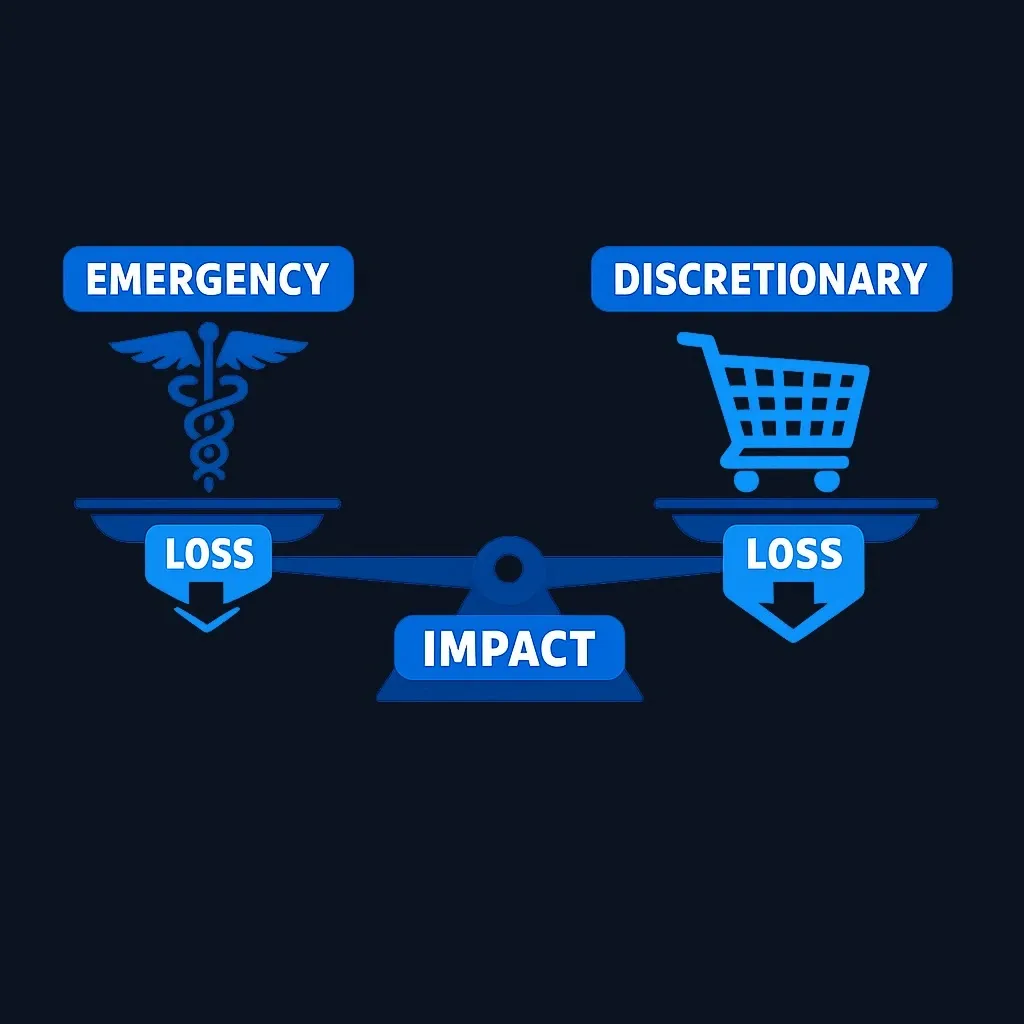
Example tradeoff: emergency vs. long-term impact
- Short-term emergency use: If you face an immediate medical bill and have no other low-cost options, a 401(k) loan may avoid high-interest debt but still reduces retirement compounding.
- Large nonessential purchase: Using retirement savings for discretionary expenses often produces larger long-term losses than using other credit options.
Decision checklist (quick)
- Does your plan allow loans and what are the terms? (Ask your plan administrator.)
- Is there an employer match that you’ll miss if you stop contributions?
- Can you afford the loan’s monthly repayments comfortably?
- What happens to the loan if you change or lose your job?
- Have you compared external loan rates and costs?
Alternatives to 401(k) Loans
Practice investing with Finelo
Build practical investing skills with guided lessons, simulator practice, and structured challenges.
Alternatives to 401(k) Loans
When you need cash, consider options that balance cost, speed, and risk to retirement savings. The right choice depends on your credit, need size, and urgency.
Comparison framework (qualitative)
| Option | Typical speed | Credit impact | Cost / risk to retirement |
|---|---|---|---|
| Personal loan from bank/credit union | Medium | May involve a credit check | Interest paid externally; keeps retirement intact |
| Home equity or HELOC | Medium–slow | May affect credit; uses collateral | Potentially lower rate, but house is at risk |
| Credit card or 0% APR offer | Immediate | May affect credit utilization | Expensive if not repaid; keeps retirement intact |
| Emergency savings | Immediate | No credit impact | Preserves credit and avoids debt |
| 401(k) loan | Immediate (if allowed) | Usually no direct credit report impact | Reduces retirement balance; repayment risk if job changes |
(Use this framework to compare costs and risks rather than relying on a single factor like “no credit check.”)
Practical decision rules
- If you have emergency savings, prefer using that to protect long-term retirement growth.
- If you can qualify for a low-rate personal loan without jeopardizing your credit, compare total cost vs. retirement opportunity loss.
- For short, bridgeable cash needs with a secure job and plan-friendly terms, a 401(k) loan may be reasonable; still, quantify the long-term retirement impact before choosing it.
Handling a 401(k) Loan if You Lose or Change Jobs
What to know before deciding
Plans often accelerate repayment if you separate from the employer; verify your plan’s rules. The IRS recommends reviewing plan documents and talking with your plan administrator before borrowing.
What can happen when employment ends (practical points)
- Many plans require you to repay the full remaining loan balance within a short timeframe after leaving.
- If you can’t repay, the outstanding amount may be treated as a distribution and could be taxable and subject to penalties if you are under the applicable age thresholds.
- To avoid forced default, plan for the possibility of accelerated repayment when you borrow.
Concrete example scenario
- You borrow money while employed and later resign. Your plan may demand full repayment within months. If you don’t have cash, the unpaid loan could convert to a taxable distribution. Factor that risk into your decision and keep an emergency buffer.
Decision framework
Use this step-based framework to decide whether to take a 401(k) loan. Work through each step and stop if a warning appears.
- Confirm plan eligibility and terms
- Action: Get your plan’s loan policy and ask the plan administrator about maximum loan amounts, repayment timelines, interest, and what happens on job separation. The IRS recommends reviewing plan rules and consulting the plan administrator.
- Calculate monthly payment and budget effect
- Action: Add the proposed loan payment to your monthly expenses. If the payment would cause you to miss other required payments, do not borrow.
- Compare total costs
- Action: Compare the loan’s effective cost (lost investment growth + opportunity cost) with external borrowing costs (interest and fees). If an external loan offers materially lower total cost and preserves retirement savings, prefer it.
- Stress-test job-change scenarios
- Action: Ask: “If I lose or leave this job in 12 months, can I repay the full balance?” If not, plan for the tax consequences and identify a fallback funding source.
- Decide and document
- Action: If you proceed, document terms, set up automatic repayments, and maintain an emergency fund to avoid default.
Common mistakes and fixes
- Mistake: Ignoring employer match contributions. Fix: Keep contributing at least to get matching funds where possible.
- Mistake: Using the loan for discretionary spending. Fix: Reserve loans for true emergencies or high-value investments.
- Mistake: Failing to account for job risk. Fix: Include accelerated repayment scenarios in your plan.
Frequently Asked Questions
FAQ
Does a 401(k) loan show up on my credit report?
Most 401(k) loans are internal to the retirement plan and typically are not reported to consumer credit bureaus; confirm with your plan administrator and read your plan’s loan policy before borrowing.
Will taking a 401(k) loan affect my credit score?
A 401(k) loan usually does not directly change your credit score because it is often not listed on credit reports. However, the loan’s monthly repayment can reduce your usable income and indirectly affect your ability to repay other debts, which could influence your credit over time.
What happens if I can't repay my 401(k) loan?
If you cannot repay under the plan’s terms and the unpaid balance is treated as a distribution, it can be taxable and possibly subject to early-distribution penalties. Confirm plan default rules with your plan administrator and consider tax consequences.
Can I use a 401(k) loan for any purpose?
Plan rules vary. Some plans permit loans for any reason; others restrict loans to specific uses such as home purchase or hardship. Always check your Summary Plan Description and ask your plan administrator.
Conclusion
Short recap: a 401(k) loan is usually an internal arrangement that typically does not appear on consumer credit reports, but plan rules and indirect financial effects matter. Before borrowing, confirm plan terms with your administrator, quantify the long-term cost to your retirement savings, and stress-test what happens if you change jobs. Finelo provides financial education, not financial or investment advice.
Next step (one action): If you’re considering a loan, request your plan’s loan policy and Summary Plan Description from your HR or plan administrator and compare the loan’s monthly impact with alternatives. For general context and related topics, visit Finelo: Finelo Blog.
InvestingFinancial Education
Practice investing with Finelo
Build practical investing skills with guided lessons, simulator practice, and structured challenges.
About the author
Finelo Team
The Finelo Team creates practical investing and trading education designed to help beginners learn faster with structured challenges, simulator practice, and bite-sized lessons.
Keep reading — Related articles

Investing
Yield to Call vs Yield to Maturity: Assumptions and Bond Risks
Yield to call (YTC) estimates a bond's yield if the issuer redeems it on an eligible call date; yield to maturity (YTM) estimates yield if it remains outstanding to final maturity.
Finelo Team
Investing
Will My Employer Know If I Take a 401(k) Loan?
Who this page is for: readers new to 401(k) loans who want a practical, privacy‑focused explanation — what your employer can see, how to limit visibility, and the financial tradeoffs to weigh.
Finelo Team

Investing
What Medical Expenses Qualify for a 401(k) Hardship Withdrawal?
Before you decide, confirm three things with your plan administrator:
Finelo Team


