For U.S. readers: This article discusses U.S. rules and financial products. State rules and individual eligibility may differ.
Does Net Worth Include 401(k)? A Comprehensive Guide

1.
6 min read
Practice investing with Finelo
Build practical investing skills with guided lessons, simulator practice, and structured challenges.
Want to learn more?
Build practical investing skills with guided lessons, simulator practice, and structured challenges.
Explore FineloExplore Finelo's 28-day challenges
Turn learning into a daily habit with guided challenge paths.
Quick answer
Yes — when you calculate your personal net worth, include the current balance of your 401(k) as an asset. Treat retirement accounts like other owned investments but note liquidity, tax rules, and withdrawal restrictions before relying on them for short‑term goals. Finelo provides financial education, not financial or investment advice. For background on 401(k) plan rules, see the IRS guidance on 401(k) plans (One Participant 401(k) Plans).
What to know before deciding
What is net worth?
Net worth equals the total value of what you own (assets) minus what you owe (liabilities). It’s a snapshot that helps you measure progress toward goals, compare scenarios, and spot risks or liquidity shortfalls.

Why retirement accounts (like a 401(k)) are usually included
A 401(k) is an owned retirement account with an account balance that represents value you control at retirement; therefore it is generally counted among assets in a net worth statement. For documentation about the nature of 401(k) plans, consult the IRS overview of 401(k) plans (One Participant 401(k) Plans).
Who this page is for
This guide is for people new to personal finance who want a practical, decision-focused explanation of whether to include retirement accounts when calculating net worth, plus clear steps, examples, and common pitfalls.
Decision framework
Use this short framework to decide how to treat a 401(k) in your own net worth calculation.
- Purpose — If you’re measuring long‑term wealth, include the full 401(k) balance as an asset.
- Liquidity needs — If you need cash in the next few years, show the 401(k) separately or discount it because of withdrawal penalties and tax consequences.
- Reporting rules — For external thresholds (mortgage underwriting, accredited investor tests, benefit eligibility), confirm whether the institution counts retirement accounts; rules vary by use case.
Note: This content is educational, not financial or investment advice. Investing can involve loss; evaluate tax, penalty, and liquidity implications before treating retirement assets as available wealth.
Comparison table: how common asset types affect net worth
| Asset type | Typical treatment in net worth | When to show separately |
|---|---|---|
| Cash & checking accounts | Full value (liquid) | Not needed |
| 401(k) / retirement accounts | Full balance as an asset | Show separately if liquidity or tax matters |
| Brokerage (taxable) | Full market value | Not usually separated |
| Home equity | Market value minus mortgage | Show separately for illiquidity and transaction costs |
| Vehicles, personal property | Estimated resale value | Often discounted for quick-sell value |
| Debts (student, credit card, mortgage) | Subtract full outstanding balance | Always listed as liabilities |
Use the table to decide whether to list retirement accounts with other assets or flag them for limited availability.
Worked example (simple)
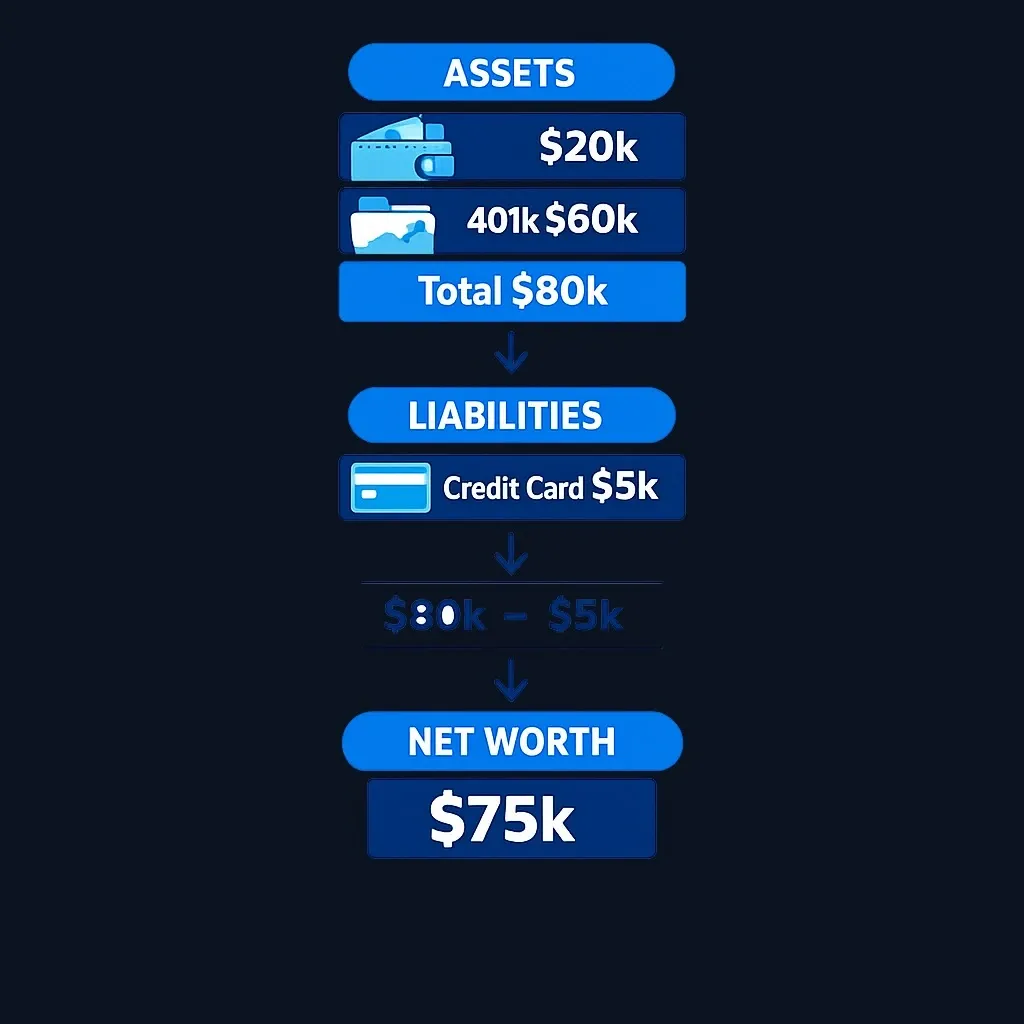
- Hypothetical: Pat has $20,000 cash, $5,000 in credit-card debt, and a $60,000 401(k).
- Calculation: Assets = $20,000 + $60,000 = $80,000. Liabilities = $5,000. Net worth = $75,000. If Pat needs cash within 2 years, show the $60,000 401(k) as an asset but annotate potential penalties/taxes or present an “available net worth” that excludes retirement balances.
Practice investing with Finelo
Build practical investing skills with guided lessons, simulator practice, and structured challenges.
Practical steps to calculate and improve your net worth
Step-by-step checklist to calculate net worth
- Gather balances: checking, savings, brokerage, retirement (401(k), IRAs), mortgage/HELOC statements, loans, credit cards, and estimate fair value for property and vehicles.
- Total assets: sum market values and account balances.
- Total liabilities: sum outstanding loan balances and other debts.
- Net worth = Total assets − Total liabilities.
- Record the date and any assumptions (e.g., market value estimates, whether retirement accounts are discounted).
Common pitfalls to avoid:
- Forgetting to include retirement accounts or pensions.
- Double-counting assets (e.g., including a home twice: mortgage and mortgage‑paid value).
- Using outdated account balances — pick a single date and update regularly.
Practical strategies to raise net worth (decision-oriented)
- Capture employer match first: at minimum, contribute enough to get any employer 401(k) match — it’s effectively immediate compensation.
- Reduce high‑interest debt: lowering credit card balances improves net worth directly and reduces interest drag.
- Build a liquid emergency fund: prevents forced retirement withdrawals and protects long‑term savings.
- Increase savings rate gradually: direct salary increases or windfalls into retirement and taxable investments.
- Rebalance and diversify: align asset allocation with goals and time horizon to manage risk (not a promise of returns).
- Track progress quarterly or semiannually: frequent updates reveal trends and let you course-correct.
Common misconceptions about net worth
Myth: Net worth equals your spending power today
Clarification: Net worth measures ownership minus obligations. Some assets (retirement accounts, home equity) are illiquid or come with tax/penalty constraints, so they don’t equal immediate spending cash.
Myth: Only liquid assets count
Clarification: Net worth typically includes liquid and illiquid assets. For planning, you can present two figures: “total net worth” (includes everything) and “liquid net worth” (liquid assets minus short-term liabilities).

Myth: Retirement accounts don’t matter until retirement
Clarification: Retirement account balances form a large part of long‑term wealth. Including them in net worth helps you measure retirement readiness, though you should separately track accessible assets for near-term needs.
FAQ
Does my 401(k) count toward my net worth?
Yes — most people include the current balance of a 401(k) as an asset when calculating net worth, while noting it may be illiquid or taxable if withdrawn early. See the IRS overview of 401(k) plans for plan details (One Participant 401(k) Plans).
Should I include pensions, IRAs, and other retirement accounts?
Treat pensions and IRAs similarly to 401(k)s: include their present value or account balance as assets. If a pension pays a future stream, you may note it separately and, for planning, estimate its present value with a conservative approach.
How often should I update my net worth?
Update it at a cadence that matches your goals — quarterly is common for investing progress, monthly if cash flow is volatile. Consistency (same valuation date and treatment) matters more than frequency.
What does a negative net worth mean?
A negative net worth means liabilities exceed assets. It’s a snapshot that signals a need to reduce debt, increase savings, or both. The path forward depends on goals, income stability, and time horizon.
Conclusion and next steps
Including your 401(k) in net worth gives a fuller picture of long‑term financial standing; just label or adjust it when judging short‑term liquidity. Practical next steps:
- Run the checklist above with current statements and record your net worth on a single date.
- If you want a simple worksheet, consider creating a two-line report: total net worth and liquid net worth (exclude retirement balances).
- Revisit your numbers quarterly and adjust savings or debt-reduction plans based on trends.
Finelo provides financial education, not financial or investment advice. The on-page table can be used as a manual worksheet and updated when account statements arrive; Finelo is not offering a separate downloadable calculator with this article.
InvestingFinancial Education
Practice investing with Finelo
Build practical investing skills with guided lessons, simulator practice, and structured challenges.
About the author
Finelo Team
The Finelo Team creates practical investing and trading education designed to help beginners learn faster with structured challenges, simulator practice, and bite-sized lessons.
Keep reading — Related articles

Investing
Yield to Call vs Yield to Maturity: Assumptions and Bond Risks
Yield to call (YTC) estimates a bond's yield if the issuer redeems it on an eligible call date; yield to maturity (YTM) estimates yield if it remains outstanding to final maturity.
Finelo Team

Investing
Will My Employer Know If I Take a 401(k) Loan?
Who this page is for: readers new to 401(k) loans who want a practical, privacy‑focused explanation — what your employer can see, how to limit visibility, and the financial tradeoffs to weigh.
Finelo Team

Investing
What Medical Expenses Qualify for a 401(k) Hardship Withdrawal?
Before you decide, confirm three things with your plan administrator:
Finelo Team