For U.S. readers: This article discusses U.S. rules and financial products. State rules and individual eligibility may differ.
How to Calculate the Value of a Pension for Net Worth

A defined-benefit pension does not usually have an account balance that belongs to the participant.
9 min read
Practice investing with Finelo
Build practical investing skills with guided lessons, simulator practice, and structured challenges.
Want to learn more?
Build practical investing skills with guided lessons, simulator practice, and structured challenges.
Explore FineloExplore Finelo's 28-day challenges
Turn learning into a daily habit with guided challenge paths.
Quick answer
A defined-benefit pension does not usually have an account balance that belongs to the participant. For a personal net-worth statement, use the plan's current lump-sum value if the plan actually offers one. If no lump sum is available, disclose a separate estimated present value of future payments rather than presenting it as cash or a transferable asset.
A reliable valuation is life-contingent: it reflects payment amount, start date, survival probabilities, survivor benefits, cost-of-living adjustments, and an appropriate discount-rate curve. A simple fixed-term annuity formula can be used for an educational sensitivity check, but it is not an actuarial valuation and can materially overstate or understate a pension.
Finelo provides general financial education, not actuarial, tax, legal, financial, or investment advice. Plan terms control benefits, and a valuation for divorce, estate, accounting, lending, or regulatory purposes may require a qualified actuary or another prescribed method.
First decide what “value” means
Different questions require different numbers.
| Purpose | Useful measure | Key limitation |
|---|---|---|
| Personal net-worth snapshot | Offered lump sum, or clearly labeled present-value estimate | Estimate is not necessarily accessible or transferable |
| Retirement cash-flow planning | Projected monthly benefit under selected start and survivor option | Income stream is not a current asset balance |
| Lump-sum versus annuity election | Plan's formal election package plus independent analysis | Tax, longevity, survivor, investment, and plan-credit risks matter |
| Divorce or legal proceeding | Method required by state law, court, or agreement | A personal spreadsheet may not be legally acceptable |
| Estate or tax filing | Value under applicable tax and valuation rules | May differ from a personal net-worth estimate |
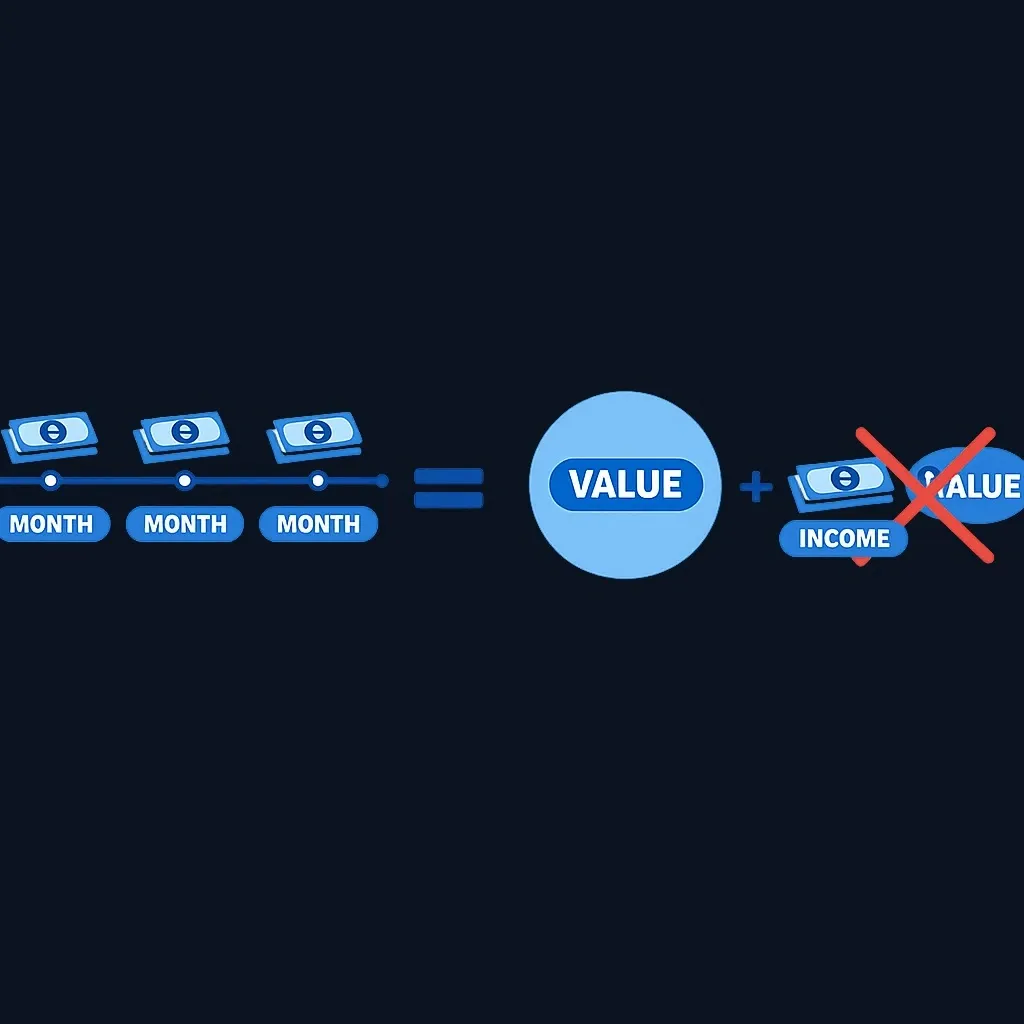
Keep pension income and a pension present value separate in your records. Adding both to net worth would double-count the same benefit.
Information to collect from the plan
Request the latest summary plan description and benefit estimate. Record:
- accrued monthly benefit at the normal retirement age;
- early- and late-retirement adjustment factors;
- vesting status;
- payment start date;
- single-life and joint-and-survivor options;
- period-certain or refund features;
- cost-of-living adjustment formula, cap, and timing;
- whether a lump sum is currently available;
- whether the benefit is covered by the Pension Benefit Guaranty Corporation; and
- whether plan amendments, funding status, or employment continuation can change the estimate.
The IRS explains the taxation of pension and annuity distributions in Publication 575. Tax treatment is relevant to cash-flow planning, but a tax publication does not provide a universal fair-value method.
Three useful valuation approaches
1. Use the plan's offered lump sum
If the plan currently offers a lump-sum distribution and the quote is valid for the measurement date, that is the most direct plan-provided value. Record the quote date, assumed start date, survivor election, and expiration date.
The quoted amount is not necessarily the economic value of keeping lifetime income, and it may change as interest rates, age, and plan assumptions change. It is also usually a pre-tax amount.
2. Report no pension asset and show future income separately
This is the most conservative and transparent personal approach when no lump sum is available. The net-worth statement lists owned assets and liabilities; the retirement plan lists the expected pension as an income source. This avoids implying liquidity that does not exist.
3. Calculate an estimated actuarial present value
An actuarial present value discounts each possible future payment and weights it by the probability that the covered person—or survivor, for a survivor benefit—is alive and eligible to receive it.
Conceptually:
Present value = sum of each future payment × probability it is payable × discount factor

This requires a mortality basis, payment timing, survivor contingencies, a discount curve, and COLA assumptions. A qualified actuary can document the assumptions and method when the result will be used for a consequential decision.
A simplified educational calculation
For a level payment made for a fixed number of periods, a basic annuity-immediate formula is:
PV = P × [1 − (1 + r)^−n] ÷ r
Where:
- P is the payment per period;
- r is the discount rate per period; and
- n is the assumed number of payments.
Hypothetical example: a $1,000 monthly payment for exactly 20 years, discounted at 4% annually with a monthly rate, has a simplified present value of approximately $165,000. That is a fixed-term example—not a value for a lifetime pension. A real pension may stop at death, continue partly to a survivor, increase under a COLA, or start at a different age.
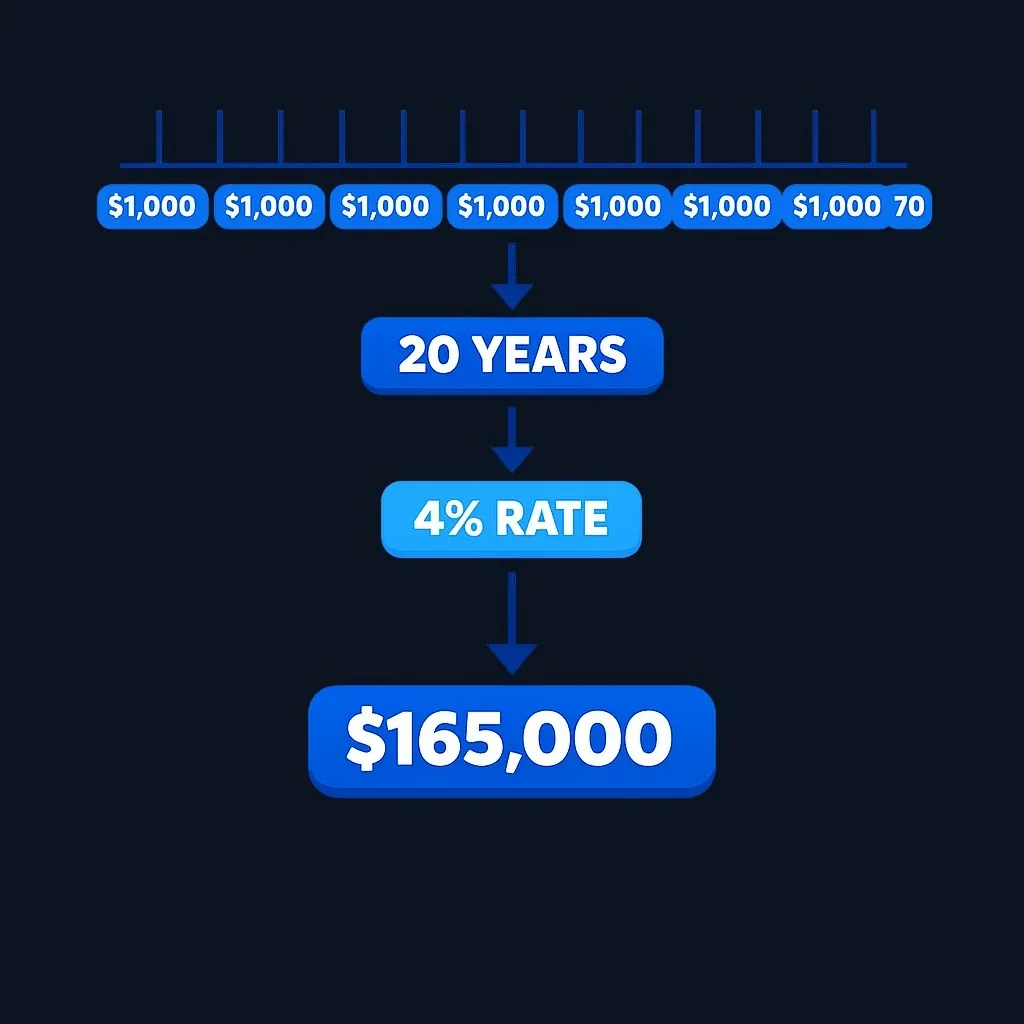
Use at least three sensitivity cases rather than one number. For a given fixed payment stream, a higher discount rate produces a lower present value, while a longer assumed payment period produces a higher value.
Why a fixed life-expectancy shortcut can mislead
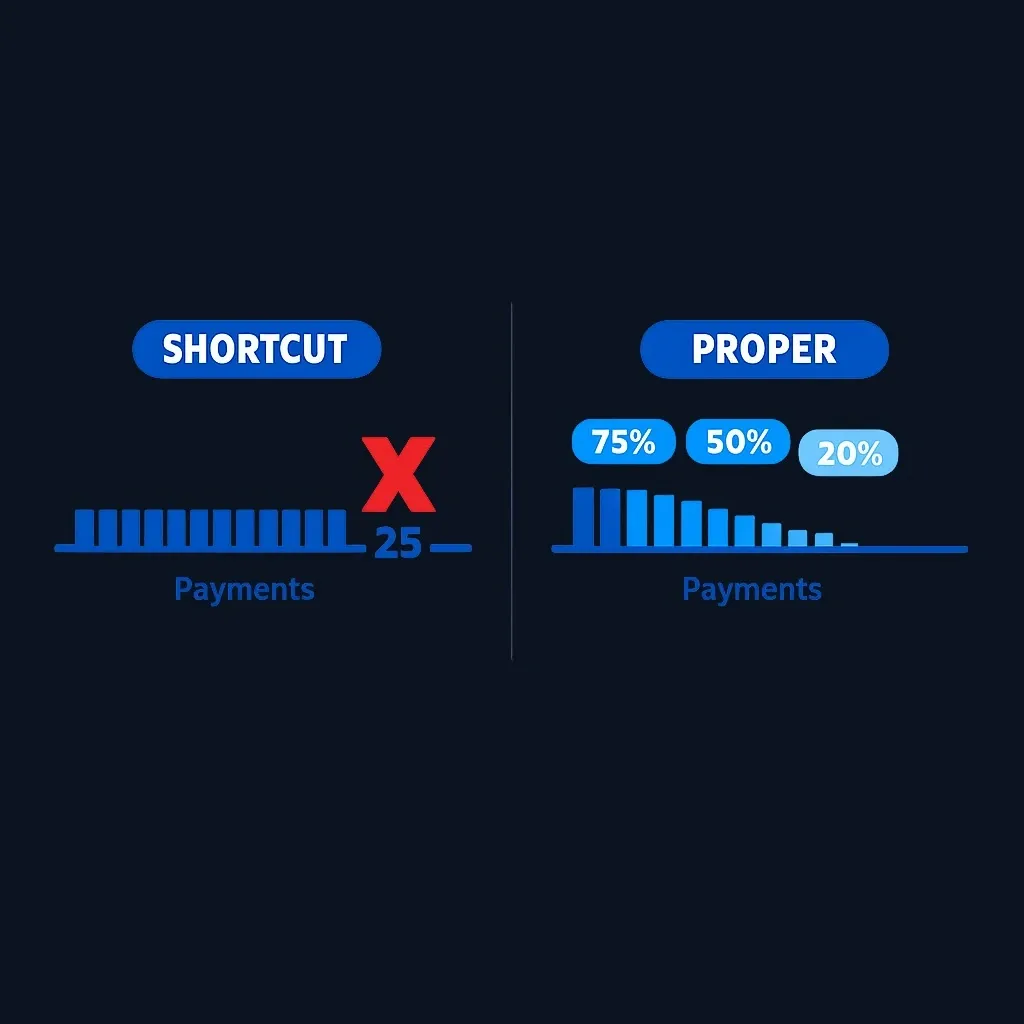
Selecting “25 years” based on average life expectancy treats death as occurring on one predetermined date. A life-contingent pension instead has probabilities attached to every payment date. Two people with the same expected lifetime can have different present values when survivor benefits, commencement dates, or mortality assumptions differ.
Health and family history may matter for an individual's election analysis, but replacing an actuarial table with a personal guess is not a neutral valuation method. Show any personal-longevity scenario separately from a standardized present value.
Practice investing with Finelo
Build practical investing skills with guided lessons, simulator practice, and structured challenges.
How COLAs and survivor options change value
Cost-of-living adjustments
A fixed COLA can be modeled by increasing each projected payment. A CPI-linked COLA with caps, floors, delays, or discretionary provisions requires scenarios. Do not apply a simple growing-annuity formula unless its assumptions match the plan.
Joint-and-survivor benefit
A joint-and-survivor option normally reduces the initial participant payment in exchange for continued payments after the participant's death. Its value depends on both lives, the survivor percentage, and the plan's reduction factor. It cannot be valued accurately by multiplying one life expectancy by the monthly benefit.
Period-certain feature
A ten-year certain-and-life form may continue payments to a beneficiary if the participant dies during the guaranteed period. Separate the guaranteed component from the later life-contingent component.

Taxes, inflation, and liquidity
- Taxes: pension values are often quoted pre-tax. A post-tax estimate requires assumptions about future tax law and household income.
- Inflation: a nominal fixed pension loses purchasing power over time. A nominal valuation uses nominal payments and discount rates; a real valuation uses inflation-adjusted payments and real rates. Do not mix them.
- Liquidity: a present value is not money that can necessarily be withdrawn, pledged, transferred, or inherited.
- Credit risk: federal law and PBGC coverage may protect qualifying private pensions within limits, but not every plan has identical protections.
- Fees and investment risk: a lump sum transferred to an individual account exposes the holder to investment, longevity, and withdrawal decisions that the pension may have pooled.
A transparent net-worth presentation
Consider showing pension information in a separate section:
Defined-benefit pension: projected $X per month beginning at age Y under the single-life option. No current lump sum is available. For planning only, an estimated present-value range of $A–$B was calculated as of [date] using documented mortality and discount assumptions. This amount is illiquid and is not added again to projected retirement income.
If the plan provides a current lump sum, replace the estimated range with the formal quote and its expiration date.
Common mistakes
Treating monthly benefit times life expectancy as value
This ignores discounting, survival probability at each payment date, survivor benefits, and COLAs.
Calling a high or low discount rate automatically “conservative”
A higher rate lowers present value; a lower rate raises it. Conservatism depends on the purpose of the estimate and must be explained, not asserted.
Double-counting pension value and income
Do not add a present value to net worth and also treat every future payment as a separate asset.
Ignoring the measurement date
Interest rates, age, plan factors, and benefit elections change. Date every quote and estimate.
Using a personal estimate for a legal proceeding
Courts, state law, plan rules, or professional standards may prescribe the valuation date and method.
FAQ
Should a pension be included in net worth?
There is no single personal-finance convention. You may exclude it from owned assets and disclose projected income, or include a clearly labeled present value. Consistency and avoiding double-counting matter more than forcing one number.
Is the plan's lump-sum quote the same as the value of lifetime income?
It is the plan's offered cash-equivalent benefit for the quoted date and assumptions. Whether taking it is preferable depends on taxes, survivor needs, health, plan protections, risk tolerance, and the ability to manage withdrawals.
Which discount rate should I use?
Use a rate or curve appropriate to the valuation purpose and payment timing, and disclose it. For legal or actuarial work, use the method required by the applicable standard rather than selecting a convenient return assumption.
Can I use a growing-annuity formula for a COLA pension?
Only when the COLA is fixed and the formula's timing assumptions match the plan. CPI-linked, capped, conditional, or delayed COLAs are better modeled payment by payment.
Is the present value taxable now?
A planning estimate does not itself create a distribution. Tax generally depends on an actual benefit payment, rollover, or other taxable event and the plan's tax characteristics. Verify the transaction under current law.
Bottom line
Use a current plan lump-sum quote when one exists. Otherwise, either disclose the pension as future income or use a clearly labeled actuarial present-value range with documented assumptions. A fixed-term annuity formula is useful for sensitivity analysis, but it should not be presented as the definitive value of a life-contingent pension.
InvestingFinancial Education
Practice investing with Finelo
Build practical investing skills with guided lessons, simulator practice, and structured challenges.
About the author
Finelo Team
The Finelo Team creates practical investing and trading education designed to help beginners learn faster with structured challenges, simulator practice, and bite-sized lessons.
Keep reading — Related articles

Investing
Yield to Call vs Yield to Maturity: Assumptions and Bond Risks
Yield to call (YTC) estimates a bond's yield if the issuer redeems it on an eligible call date; yield to maturity (YTM) estimates yield if it remains outstanding to final maturity.
Finelo Team

Investing
Will My Employer Know If I Take a 401(k) Loan?
Who this page is for: readers new to 401(k) loans who want a practical, privacy‑focused explanation — what your employer can see, how to limit visibility, and the financial tradeoffs to weigh.
Finelo Team

Investing
What Medical Expenses Qualify for a 401(k) Hardship Withdrawal?
Before you decide, confirm three things with your plan administrator:
Finelo Team


