An ETF premium or discount is the gap between the fund's market price and the value of what it owns. When the share price sits above the fund's net asset value (NAV) per share, the ETF trades at a premium. When the price sits below NAV, it trades at a discount. Small gaps are normal; large or persistent ones are a warning worth understanding.
ETF Premiums and Discounts: What They Mean for Your Trades

An ETF premium or discount is the gap between the fund's market price and the value of what it owns. When the share price sits above the fund's net asset value (NAV) per share, the ETF trades at a premium. When the…
7 min read
Practice investing with Finelo
Build practical investing skills with guided lessons, simulator practice, and structured challenges.
Want to learn more?
Build practical investing skills with guided lessons, simulator practice, and structured challenges.
Explore FineloExplore Finelo's 28-day challenges
Turn learning into a daily habit with guided challenge paths.
This page is for ETF investors who want to avoid quietly overpaying at purchase or accepting too little at sale. You will learn why gaps appear, what usually closes them, and when they should change your behavior. This article is educational, not financial advice.
What a premium or discount is
Every ETF has two prices. The NAV is the per-share value of everything the fund holds, calculated once a day from the closing prices of the underlying securities minus liabilities. The market price is whatever buyers and sellers agree on during the trading day.
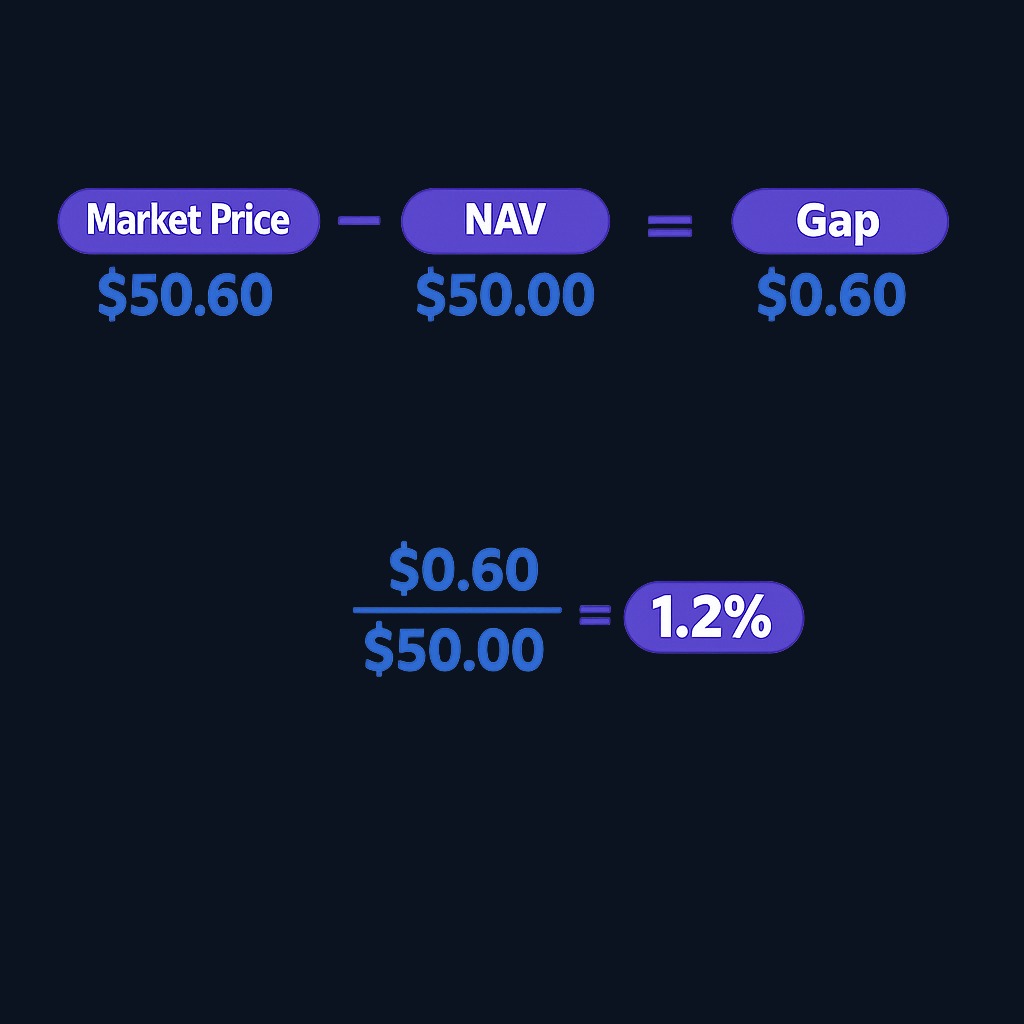
Because the market price floats with supply and demand, it can drift from NAV. The SEC's ETF investor bulletin defines the terms plainly: shares selling above NAV are at a premium, shares selling below NAV are at a discount, and the size of these gaps varies over time. The premium or discount is usually expressed as a percentage: market price minus NAV, divided by NAV.
Why price and NAV diverge
Three forces open the gap:
- Supply and demand pressure. Heavy buying pushes the market price above fair value; heavy selling pushes it below. The imbalance persists until arbitrage restores the link.
- Timing differences. NAV uses closing prices, and for international ETFs the underlying markets may have closed hours before US trading ends. The ETF price then reflects newer information than the stale NAV, so a measured "premium" or "discount" can be partly an illusion of timing.
- Hard-to-price holdings. Bonds trade over the counter without a single closing price, so bond-fund NAVs rely on pricing estimates. In fast markets the live ETF price and the estimated NAV can disagree meaningfully.
The key insight: a measured gap mixes real mispricing with measurement noise. Which one dominates depends on what the fund holds.
The arbitrage that narrows the gap
ETFs have a built-in correction mechanism. Authorized participants, large trading firms with agreements with the fund, can create new ETF shares by delivering the underlying basket of securities, or redeem ETF shares in exchange for that basket.
If an ETF trades at a meaningful premium, an authorized participant can buy the cheaper underlying basket, deliver it to the fund for new ETF shares, and sell those shares at the elevated market price. That selling pushes the premium back down. A discount invites the reverse trade. Because this arbitrage is profitable whenever the gap exceeds transaction costs, competition keeps most large equity ETFs trading within a narrow band around fair value in normal markets.
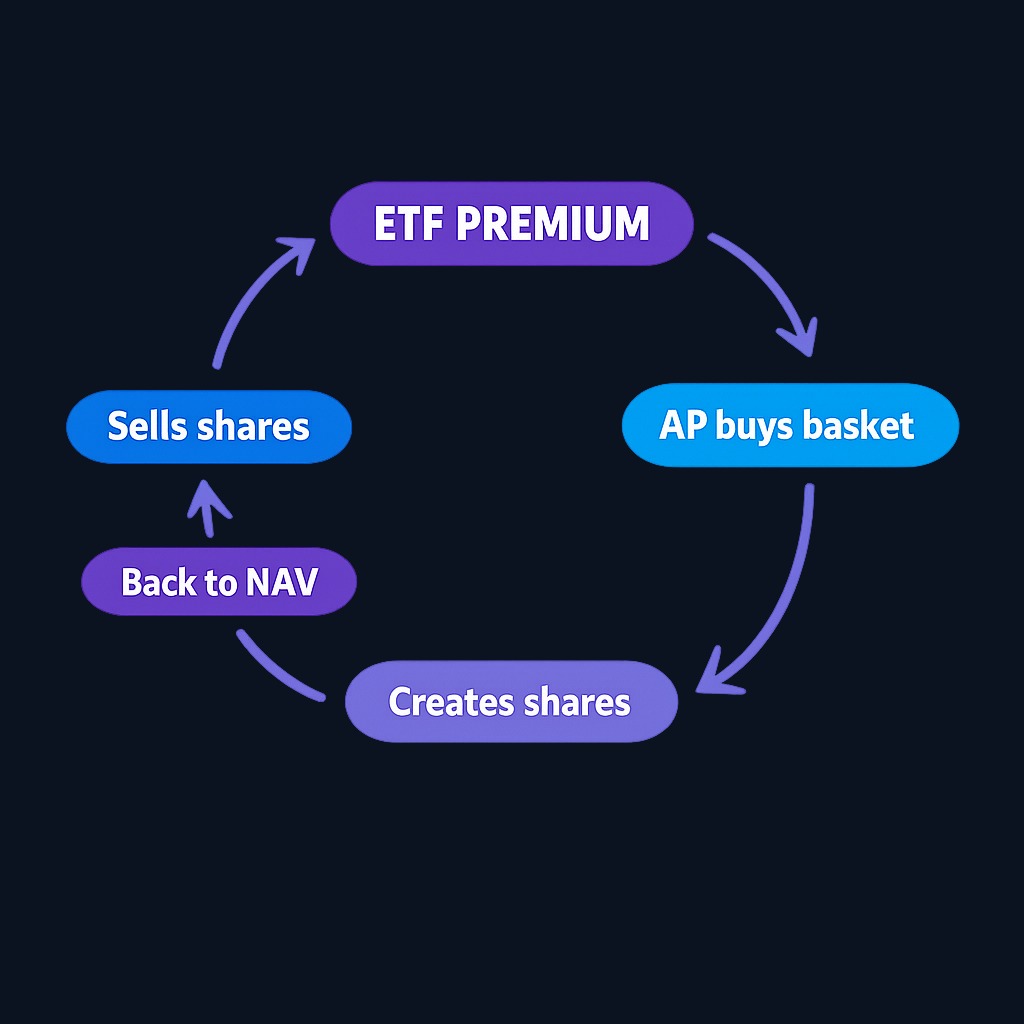
The mechanism has limits. Arbitrage only happens when the profit beats the cost of trading the basket. Illiquid or hard-to-hedge holdings raise those costs, so their ETFs can sustain wider gaps before anyone steps in.
A worked example
Take an ETF with a NAV of $50.00 per share:
| Scenario | Market price | Gap | Premium/discount |
|---|---|---|---|
| Calm market | $50.05 | +$0.05 | +0.10% premium |
| Strong demand | $50.60 | +$0.60 | +1.20% premium |
| Selling pressure | $49.40 | -$0.60 | -1.20% discount |
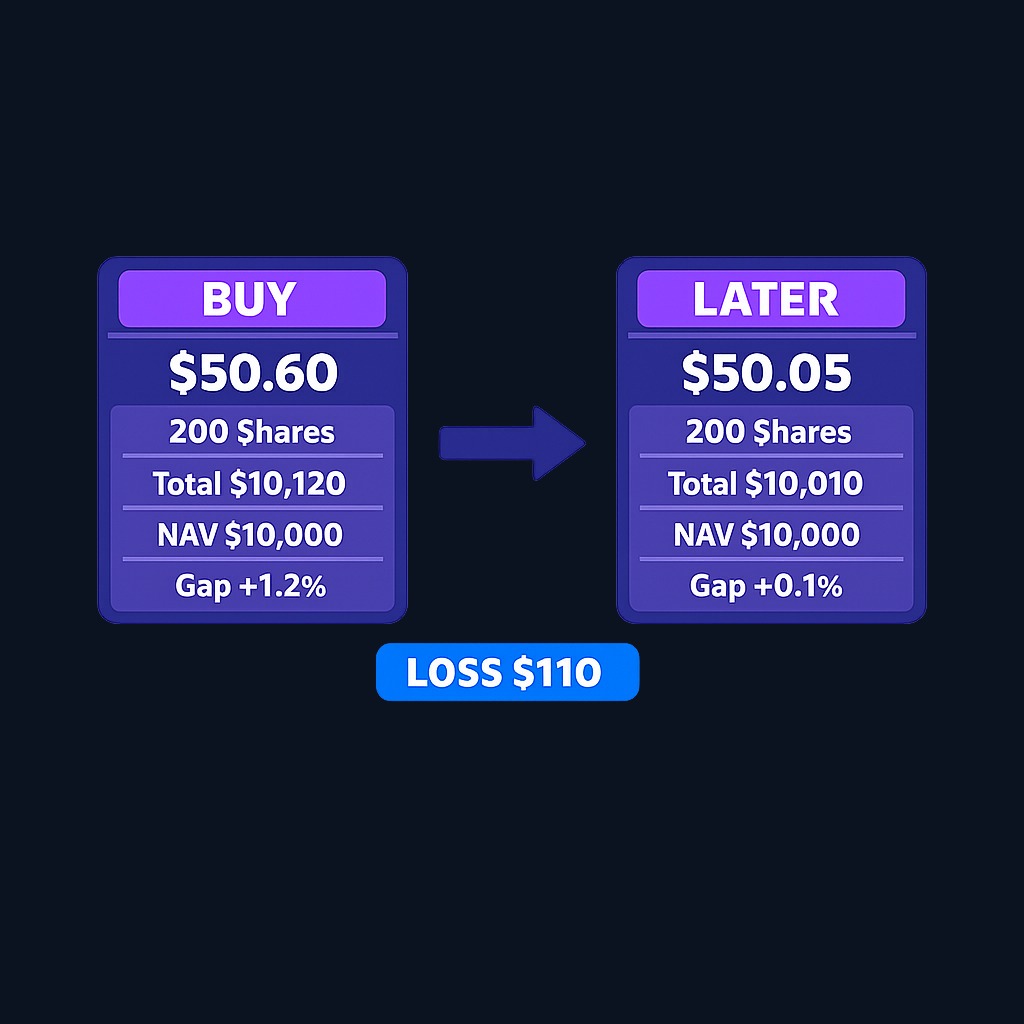
Buying 200 shares during the +1.20% premium costs $10,120 for assets worth $10,000 at the stated NAV. If the premium closes to 0.10% while you hold, that is roughly $110 of drag unrelated to how the investments performed. The same math works in your favor if you buy at a discount that later narrows. These moves are small per trade but real, and for frequent traders they compound.
Practice investing with Finelo
Build practical investing skills with guided lessons, simulator practice, and structured challenges.
When gaps get large
Premiums and discounts are not evenly distributed across fund types. Broad US large-cap equity ETFs usually track NAV tightly, because their baskets are cheap to arbitrage. Wider and more persistent gaps show up in three places. International equity ETFs measure NAV against closed foreign markets, so their end-of-day gaps partly reflect time-zone math. Bond ETFs rely on estimated bond prices, and during stressed markets their discounts can widen sharply, with the live ETF price arguably acting as the truer signal of what the bonds would fetch. And niche or thinly supported funds, with few competing market makers, simply have less arbitrage pressure keeping them honest.
Stress is the common thread. When volatility spikes and liquidity thins, arbitrage costs rise, gaps widen everywhere, and sellers in a panic accept discounts that patient holders never experience.
How to check a fund's history
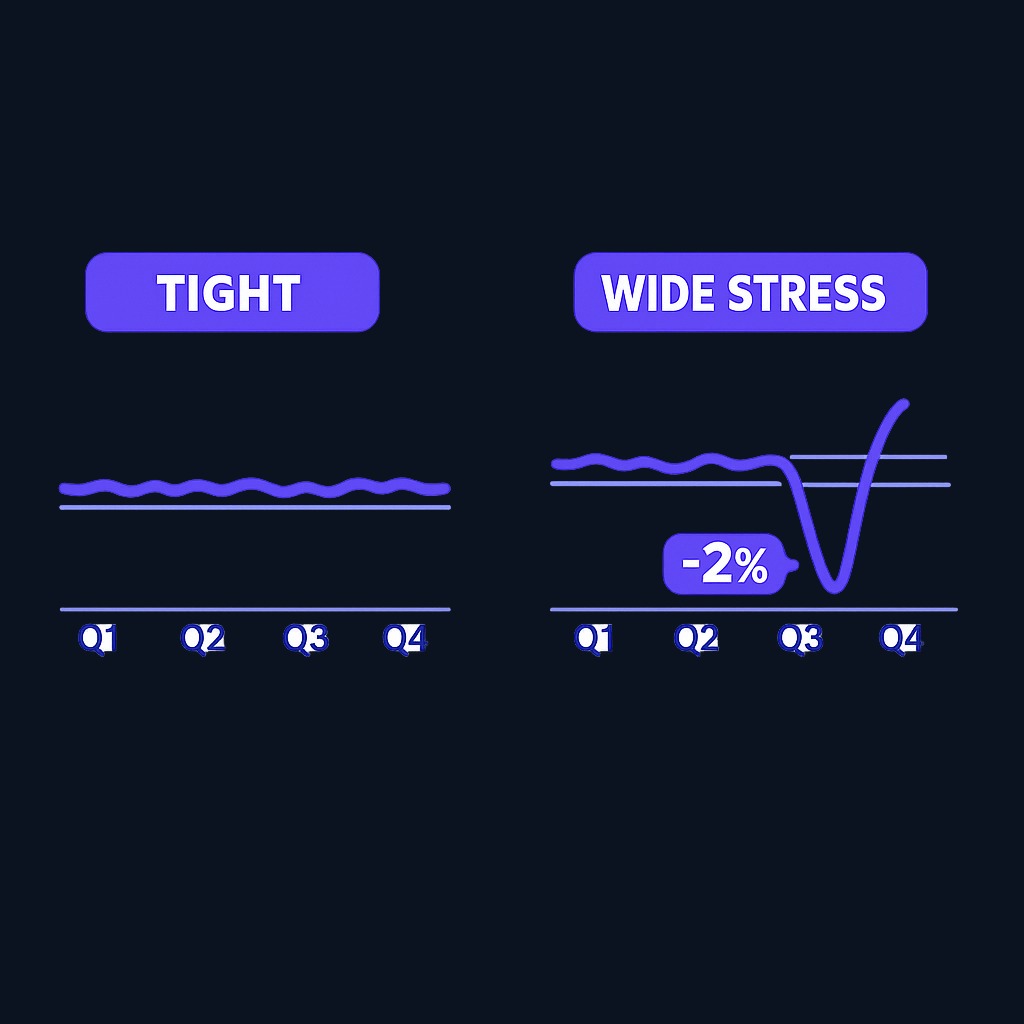
You do not have to guess. Per the SEC's investor bulletin, historical premium and discount information is available in a fund's full prospectus and, more typically, on the ETF's own website. Issuers publish tables and charts showing how many days the fund closed at a premium or a discount, and how large the gaps were, quarter by quarter.
Before buying, spend two minutes there. Look for the typical gap size, how often the fund swings between premium and discount, and what happened during the most recent volatile quarter. A fund that stayed within a few basis points through stress has a robust arbitrage ecosystem. One that gapped by percent-level amounts tells you what to expect next time markets get rough.
What to know before deciding
A discount is not automatically a bargain, and a premium is not automatically a rip-off. For international funds, part of the gap is timing noise. For bond funds in stress, the discount may reflect the real cost of instant liquidity. The questions that matter: is today's gap unusual relative to the fund's own history, and do you need to trade right now? Also compare the gap to the bid-ask spread; for most long-term investors in mainstream ETFs, the spread is the bigger cost. Verify current figures on the fund issuer's official site before acting.
Decision framework: should the gap change your trade?
- Measure it. Compare the live price to the issuer's iNAV or latest NAV, and express the gap as a percentage.
- Contextualize it. Check the fund's published premium/discount history. Is today typical or an outlier?
- Diagnose it. Foreign holdings or bonds? Assume part of the gap is measurement timing. Domestic liquid equities? Take the gap at face value.
- Time it. If you are buying at an unusual premium or selling into an unusual discount and you can wait, waiting often pays.
- Protect it. Use limit orders so a temporary gap cannot fill you at an extreme price.
Conclusion and next steps
An ETF premium discount gap is the market's price disagreeing with the fund's measured value. Arbitrage through creation and redemption keeps the gap small for liquid funds, timing and pricing quirks explain much of the rest, and stress is when the numbers get interesting. Check the gap before large trades, read the fund's own history, and use limit orders.
Next steps: pick one ETF you own, find its premium/discount chart on the issuer's site, and note its worst quarter. To practice fund mechanics like NAV, spreads, and arbitrage with structured lessons, try the Finelo app, built to teach investing fundamentals from zero.
Frequently asked questions
Is buying an ETF at a discount free money?
No. The discount can persist, widen, or reflect stale NAV pricing rather than genuine cheapness. It is only an edge when the gap is unusual for that fund and likely to close after you buy.
How big is a normal ETF premium or discount?
Large, liquid equity ETFs typically stay within a few hundredths of a percent of NAV in calm markets. Bond, international, and niche ETFs routinely run wider. Judge each fund against its own published history rather than one universal number.
What is iNAV?
It is an intraday estimate of the fund's per-share value, updated during the trading day. It helps you compare the live market price to an up-to-date value estimate instead of yesterday's closing NAV.
Do premiums and discounts matter for long-term investors?
Mostly at entry and exit. Buying at an unusual premium or selling at an unusual discount is a one-time cost, so checking the gap before large trades is a cheap habit even for buy-and-hold investors.
etfpremiumsdiscountstheymeantrades
Practice investing with Finelo
Build practical investing skills with guided lessons, simulator practice, and structured challenges.
About the author
Finelo Team
The Finelo Team creates practical investing and trading education designed to help beginners learn faster with structured challenges, simulator practice, and bite-sized lessons.
Keep reading — Related articles
Investing
Tax-gain harvesting vs. tax-loss harvesting
Compare realizing investment gains with realizing losses, including holding periods, wash sales, offsets, and portfolio tradeoffs.
Finelo Team
Investing
Stable value fund vs. money market fund
Compare investment structure, contract protections, transfer restrictions, net yields, and access inside a retirement account.
Finelo Team

Investing
Single-life vs. joint-life annuity
Compare income for one lifetime with continued payments to a survivor, using equal premiums and matching guarantee terms.
Finelo Team