ETF tax efficiency comes down to structure. Exchange-traded funds rarely pass capital gains distributions to shareholders. In a taxable account, you mostly pay tax only when you sell your own shares, at your own time. Mutual funds work differently: they can hand you a taxable gains bill even in years you bought nothing and sold nothing.
ETF Tax Efficiency: What Investors Need to Know
ETF tax efficiency comes down to structure. Exchange-traded funds rarely pass capital gains distributions to shareholders. In a taxable account, you mostly pay tax only when you sell your own shares, at your own time…
6 min read
Practice investing with Finelo
Build practical investing skills with guided lessons, simulator practice, and structured challenges.
Want to learn more?
Build practical investing skills with guided lessons, simulator practice, and structured challenges.
Explore FineloExplore Finelo's 28-day challenges
Turn learning into a daily habit with guided challenge paths.
This page is for investors choosing funds for a taxable brokerage account. It explains why the wrapper matters, how the mechanics work, and what to do about it. Tax rules are general here and change over time; this is education, not tax advice.
How ETFs compare to mutual funds
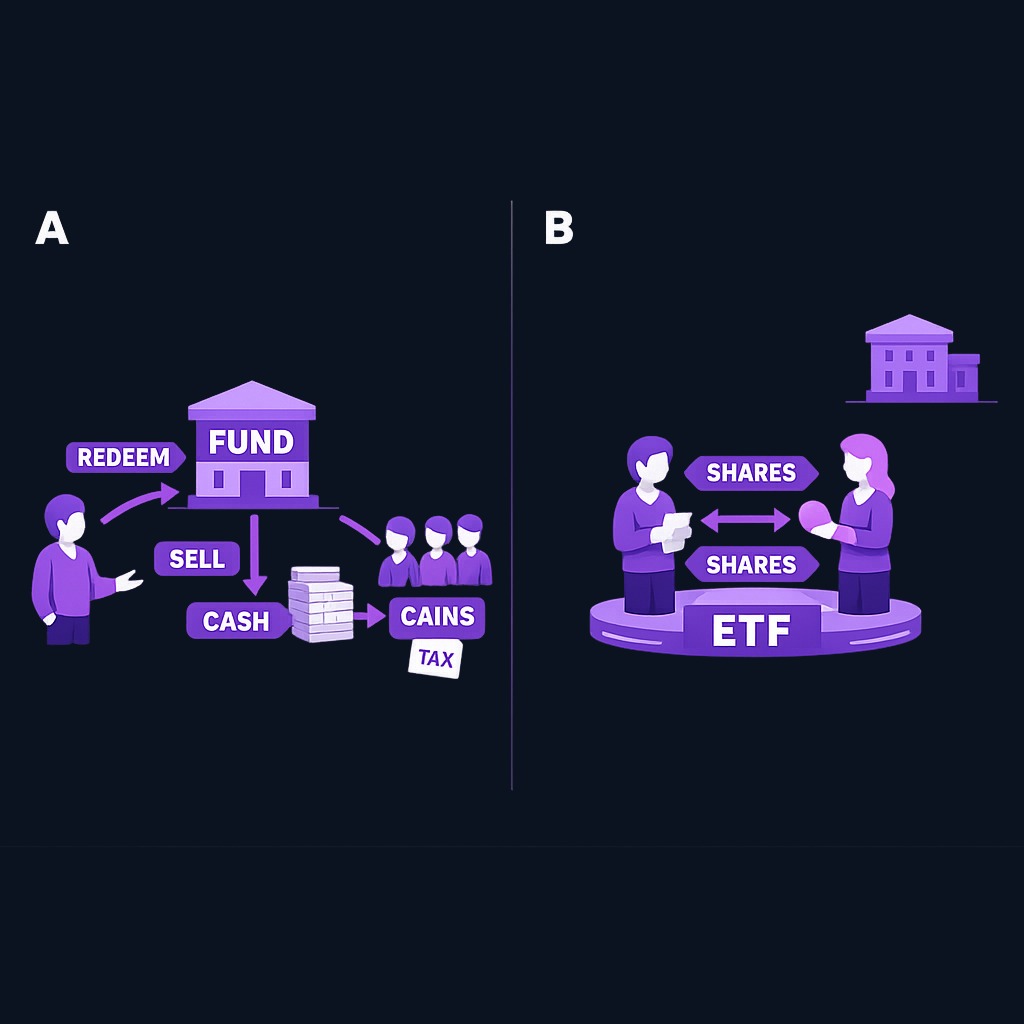
Both vehicles pool money into a portfolio of securities, and both pass through dividends. The tax difference appears in how investors enter and exit. Mutual fund investors buy and redeem directly with the fund. When many holders redeem, the manager may sell holdings for cash. Those sales can create capital gains that get distributed to every remaining shareholder at year-end. ETF investors trade shares with each other on an exchange, so ordinary buying and selling never forces the fund itself to sell anything.
| Feature | ETF | Mutual fund |
|---|---|---|
| How you trade | On-exchange, with other investors | Directly with the fund |
| Redemption mechanics | Largely in-kind, via authorized participants | Often cash, forcing portfolio sales |
| Year-end capital gains distributions | Rare for passive equity funds | Common, even for holders who did not sell |
| Control over the taxable event | Mostly yours, when you sell | Partly the fund's and other investors' |
| Dividend pass-through | Yes, taxable in taxable accounts | Yes, taxable in taxable accounts |
The gap is a structural feature, not manager skill. As Schwab's ETF tax guide explains, the reputation rests primarily on passively managed equity ETFs. Their managers can sidestep realizing gains by redeeming shares in-kind through large institutional trading partners.
The in-kind redemption process
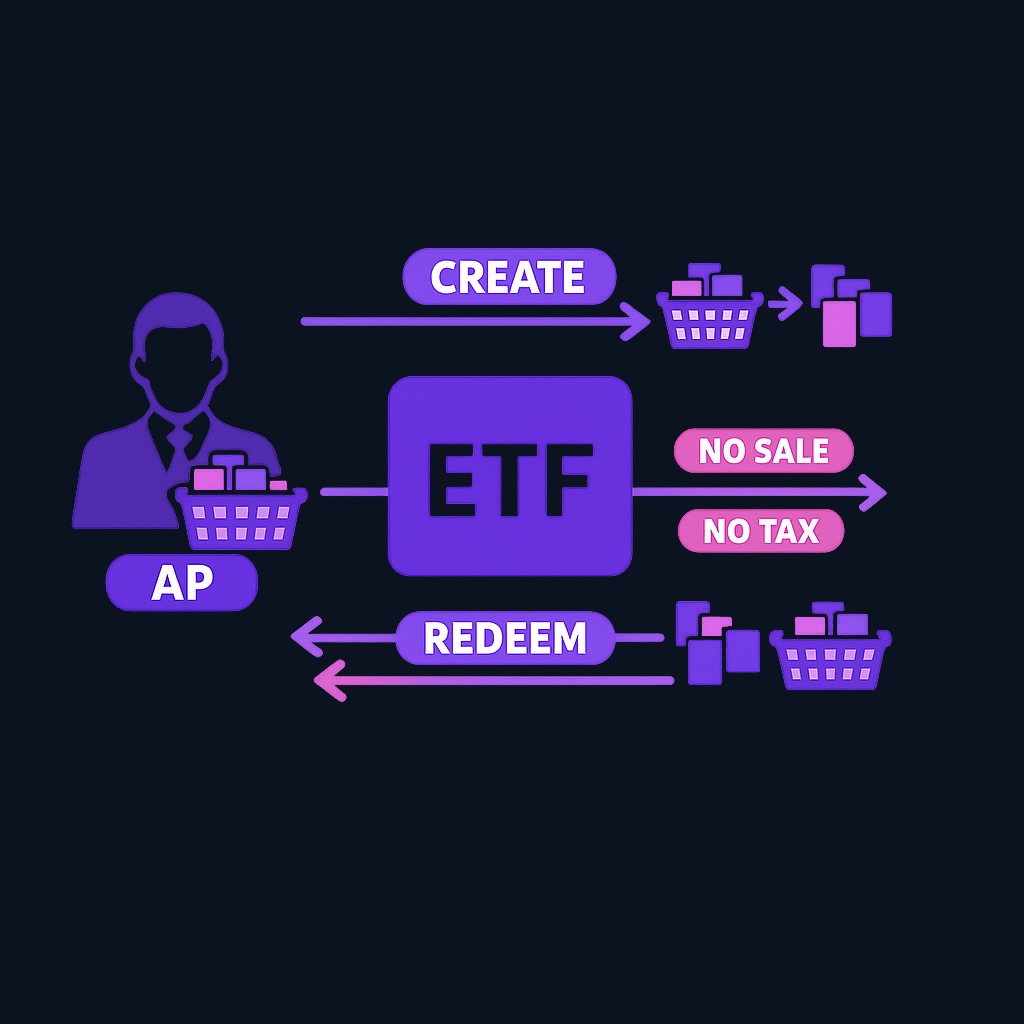
The engine behind the efficiency is the creation and redemption mechanism. Large institutions called authorized participants (APs) assemble baskets of the underlying securities. They exchange these baskets with the ETF for new ETF shares, or hand ETF shares back and receive securities in return. Because these swaps are in-kind, securities for shares rather than sales for cash, the fund does not realize taxable gains in the process.
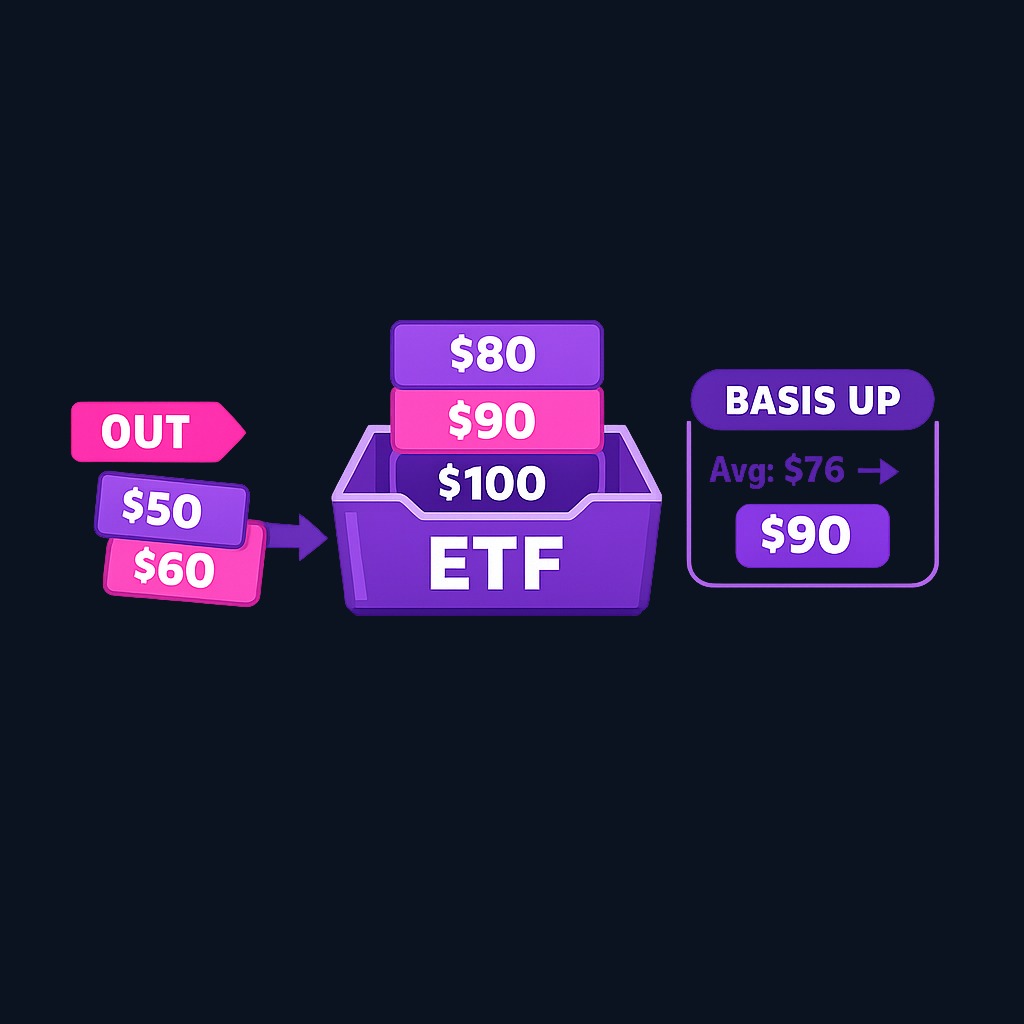
The mechanism has a second, quieter benefit. When the fund delivers securities out in a redemption, it can hand over its lowest-cost-basis lots. That steadily raises the average basis of what remains inside the portfolio. Over years, that pruning leaves fewer embedded gains waiting to surprise shareholders. The process runs constantly in liquid ETFs, invisible to the end investor. That is exactly the point: ordinary turnover gets absorbed by structure instead of becoming everyone's tax bill.
Capital gains distributions: what you should know
A capital gains distribution is the fund pushing its own realized profits out to shareholders. Holders in taxable accounts owe tax on them regardless of whether they sold anything. For mutual funds, heavy redemptions or portfolio changes in a volatile year can generate significant distributions. They occasionally land on investors who bought in just weeks earlier, even when the position is down since purchase.
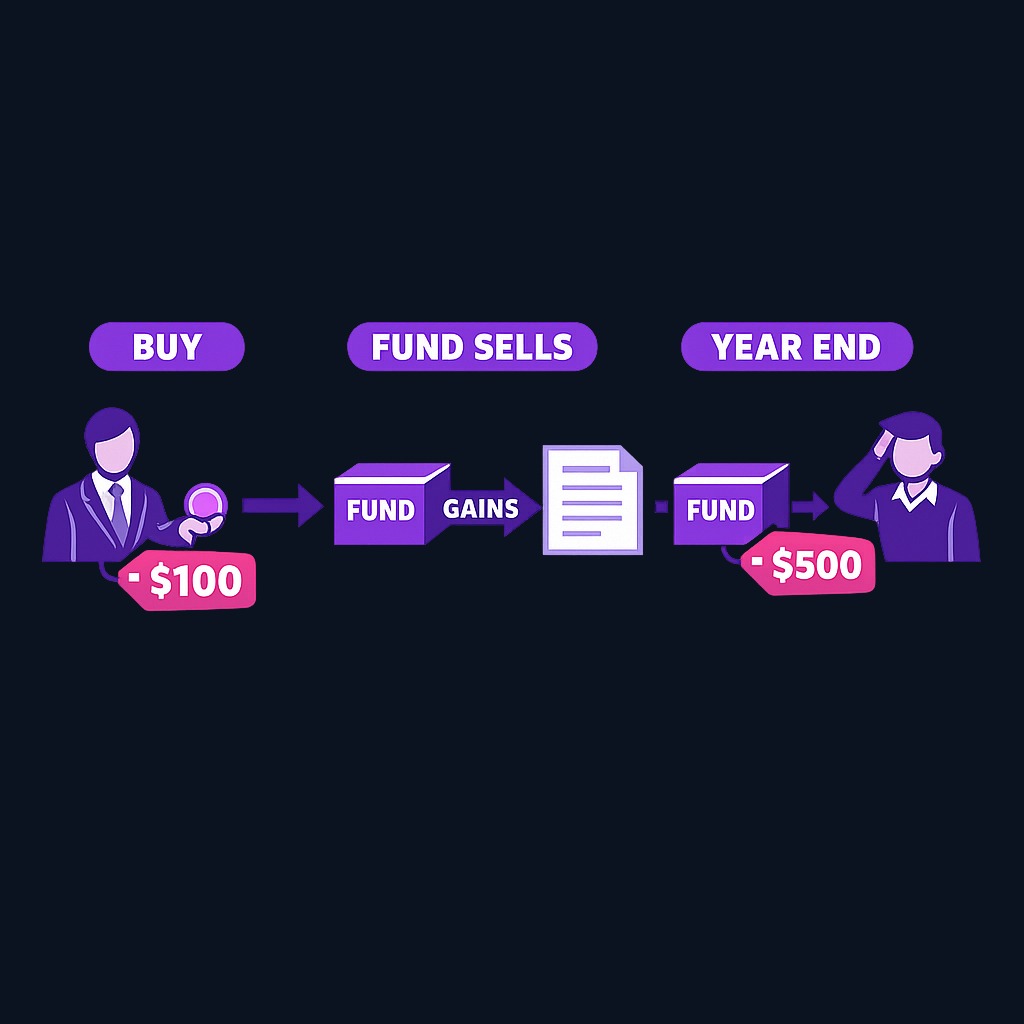
Passive equity ETFs mostly avoid this, but "mostly" deserves respect. Distributions can still occur when an index rebalances heavily, when a fund holds assets that cannot move in-kind, or in niche and actively managed products with high turnover. Bond, commodity, and derivatives-based ETFs each carry their own tax quirks. Before buying any fund for a taxable account, check its distribution history on the issuer's site. A long record of zero or near-zero capital gains distributions is the pattern you want.
Practice investing with Finelo
Build practical investing skills with guided lessons, simulator practice, and structured challenges.
Tax treatment of ETF dividends
Structure does not shelter dividends: they flow through to you and are taxable in the year received. What varies is the rate. According to Fidelity's overview of ETF tax efficiency, a dividend counts as "qualified" once you have held the fund past the 60-day requirement around the payout. Qualified dividends are taxed between 0% and 20%, depending on income. Otherwise, the payment is taxed as ordinary income. Holding period, in other words, decides the rate on the same cash payment.
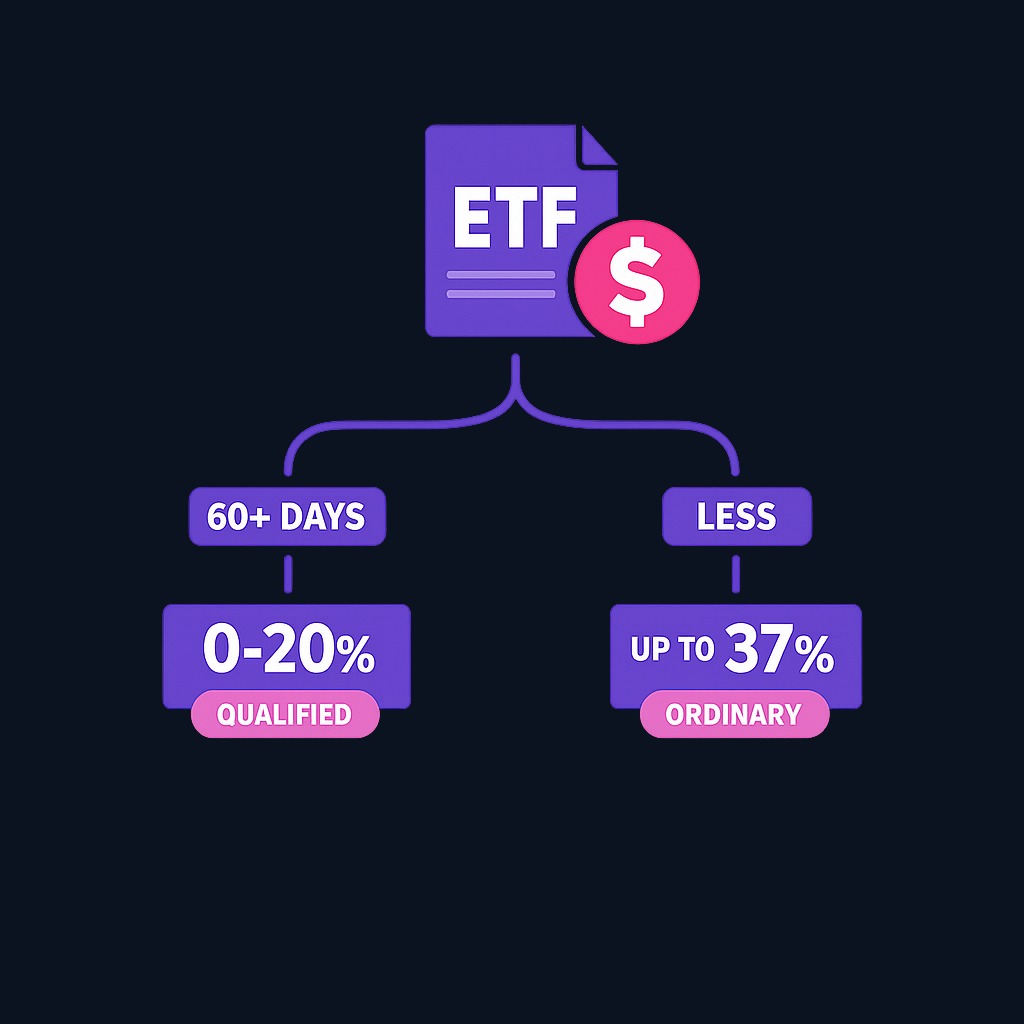
Two practical implications follow. Rapid trading around distribution dates can silently convert favorable rates into ordinary-income rates. And dividend-heavy funds surrender part of their tax advantage no matter the wrapper, because the payout itself is the taxable event. Investors prioritizing after-tax compounding often tilt toward lower-yield, growth-oriented funds in taxable accounts.
What to know before deciding
Account type comes first. Inside retirement accounts, the ETF tax advantage is largely irrelevant, because gains and distributions are not taxed year to year anyway. The efficiency argument belongs to taxable accounts. Next, the advantage scales with tax bracket. Investors facing the top rates on income and gains save the most from deferring realization. That is why high-net-worth portfolios lean so heavily on the structure. Finally, remember that rules evolve. The in-kind mechanism's treatment and dividend rates are set by law, and both have been debated in past legislative proposals. Review any strategy built on one tax provision against current rules with a tax professional.
Decision framework and practical strategies
- Match wrapper to account. Favor tax-efficient ETFs in taxable accounts; hold tax-noisy assets, like high-turnover funds or income-heavy products, in tax-advantaged accounts where distributions do not sting.
- Check the distribution record. Before buying, read the fund's capital gains distribution history; structure helps, but the record proves it.
- Mind holding periods. Meeting the qualified-dividend window and holding shares past one year keeps you in the lower rate tiers on both dividends and your own eventual sale.
- Harvest losses with care. Selling a losing ETF to capture the loss, then rotating into similar but not substantially identical exposure, can offset gains elsewhere. Wash-sale rules police how close the replacement can be.
- Let winners defer. The core of the advantage is unrealized gains compounding untaxed until you choose to sell, so avoid unnecessary turnover of appreciated positions.
- Re-check annually. Fund launches, mergers, index changes, and tax-law changes can all alter the calculus; a yearly review keeps the plan current.
Conclusion and next steps
ETF tax efficiency is a structural feature. On-exchange trading plus in-kind redemption lets the fund absorb investor turnover without manufacturing taxable events. You stay in control of when gains are realized. Dividends stay taxable, niche products vary, and account type decides whether any of it matters.
Next steps: for each fund in your taxable account, look up last year's capital gains distributions and your unrealized gain. Then decide whether your current mix puts tax-noisy assets in the wrong place. Confirm specifics with a tax professional. If you want structured practice with fund mechanics, Finelo teaches investing concepts step by step.
Frequently asked questions
Why are ETFs more tax-efficient than mutual funds?
Because ETF investors trade with each other on an exchange and institutional redemptions happen in-kind, the fund itself rarely sells holdings and rarely realizes taxable gains. Mutual funds meeting cash redemptions must sell securities, and the resulting gains are distributed to all remaining shareholders.
Do I pay taxes on an ETF if I never sell it?
In a taxable account you still owe tax on dividends and on any capital gains distributions the fund makes, though for passive equity ETFs distributions are rare. The large embedded gain in your shares stays untaxed until you sell.
Are all ETFs equally tax-efficient?
No. Passive equity ETFs are the strongest case. Actively managed, bond, commodity, currency-hedged, and derivatives-based ETFs can distribute more income or gains, and some hold assets that cannot be redeemed in-kind. Check each fund's structure and distribution history.
Does ETF tax efficiency matter in a 401(k) or IRA?
Very little. Tax-advantaged accounts already shield interim distributions from annual taxation, so the wrapper's deferral benefit adds nothing there. The advantage is specific to taxable brokerage accounts.
etftaxefficiencyinvestors
Practice investing with Finelo
Build practical investing skills with guided lessons, simulator practice, and structured challenges.
About the author
Finelo Team
The Finelo Team creates practical investing and trading education designed to help beginners learn faster with structured challenges, simulator practice, and bite-sized lessons.
Keep reading — Related articles
Investing
Tax-gain harvesting vs. tax-loss harvesting
Compare realizing investment gains with realizing losses, including holding periods, wash sales, offsets, and portfolio tradeoffs.
Finelo Team
Investing
Stable value fund vs. money market fund
Compare investment structure, contract protections, transfer restrictions, net yields, and access inside a retirement account.
Finelo Team

Investing
Single-life vs. joint-life annuity
Compare income for one lifetime with continued payments to a survivor, using equal premiums and matching guarantee terms.
Finelo Team