Shares outstanding is the total number of shares a company has issued to all holders, including insiders and institutions. Float is the smaller subset actually available for public trading, after locked-up and insider-held shares are excluded. In short: shares outstanding measures ownership, while float measures tradable supply.
Float vs Shares Outstanding: Understanding the Key Differences

Shares outstanding is the total number of shares a company has issued to all holders, including insiders and institutions. Float is the smaller subset actually available for public trading, after locked-up and…
6 min read
Practice trading with Finelo
Practice in a simulator, learn with bite-sized lessons, and build confidence before risking real money.
Want to learn more?
Practice in a simulator, learn with bite-sized lessons, and build confidence before risking real money.
Explore FineloExplore Finelo's 28-day challenges
Turn learning into a daily habit with guided challenge paths.
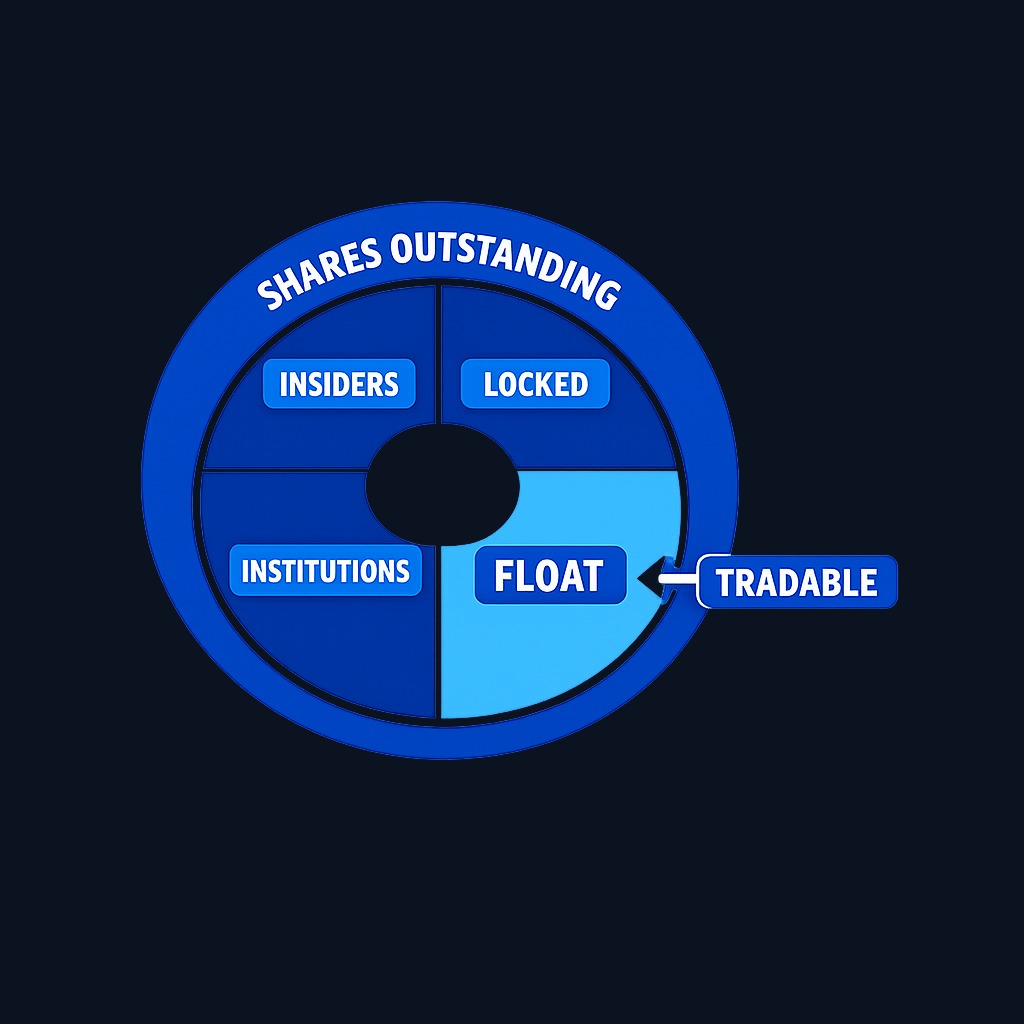
If you have compared the two numbers on a stock screener and wondered why they differ, this page walks through the float vs shares outstanding distinction with examples, the reasons float changes over time, and a practical framework for using both figures. It is educational content, not financial advice.
What shares outstanding means
Shares outstanding counts every share currently issued and held by someone: founders, executives, employees, institutional funds, and everyday retail investors. It excludes treasury stock, meaning shares the company has bought back and holds in its own vault.
The figure anchors several core calculations. Market capitalization is share price times shares outstanding. Earnings per share divides profit by shares outstanding. Ownership percentages, dilution math, and voting power all rest on this number. Companies report it in every quarterly and annual filing, and you can verify the current count for any US public company in the SEC's EDGAR database rather than trusting a screener's cached figure.
What stock float means
Float, sometimes called free float or public float, is the portion of shares outstanding that can actually change hands in the open market. To estimate it, analysts start with shares outstanding and subtract closely held stock: insider stakes, founder blocks, shares held by controlling investors, restricted stock that cannot yet be sold, and shares locked up after an IPO.
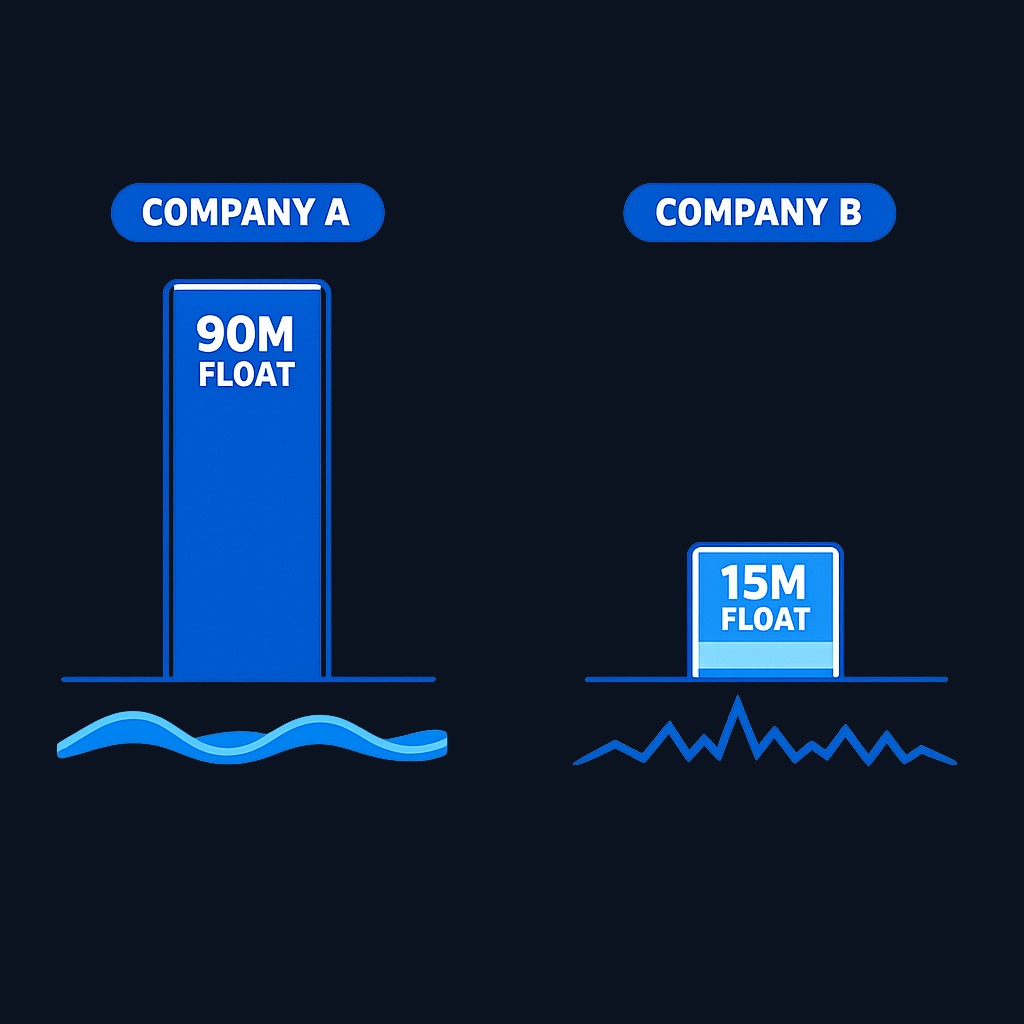
Float is the market's working inventory. When you place a buy order, you are competing for shares within the float, not the full outstanding count. That is why two companies with identical shares outstanding can trade completely differently if one has 90% of its stock floating and the other only 15%.
Key differences between float and shares outstanding
| Dimension | Shares outstanding | Float |
|---|---|---|
| Definition | All issued shares held by investors | Shares freely available for public trading |
| Size | The larger figure | Equal or smaller, sometimes much smaller |
| Used for | Market cap, EPS, ownership math | Liquidity, volatility, and supply analysis |
| Changes when | Shares are issued or bought back | Lockups expire, insiders buy or sell, restrictions lift |
| Stability | Changes with corporate actions | Can shift without any new shares being issued |
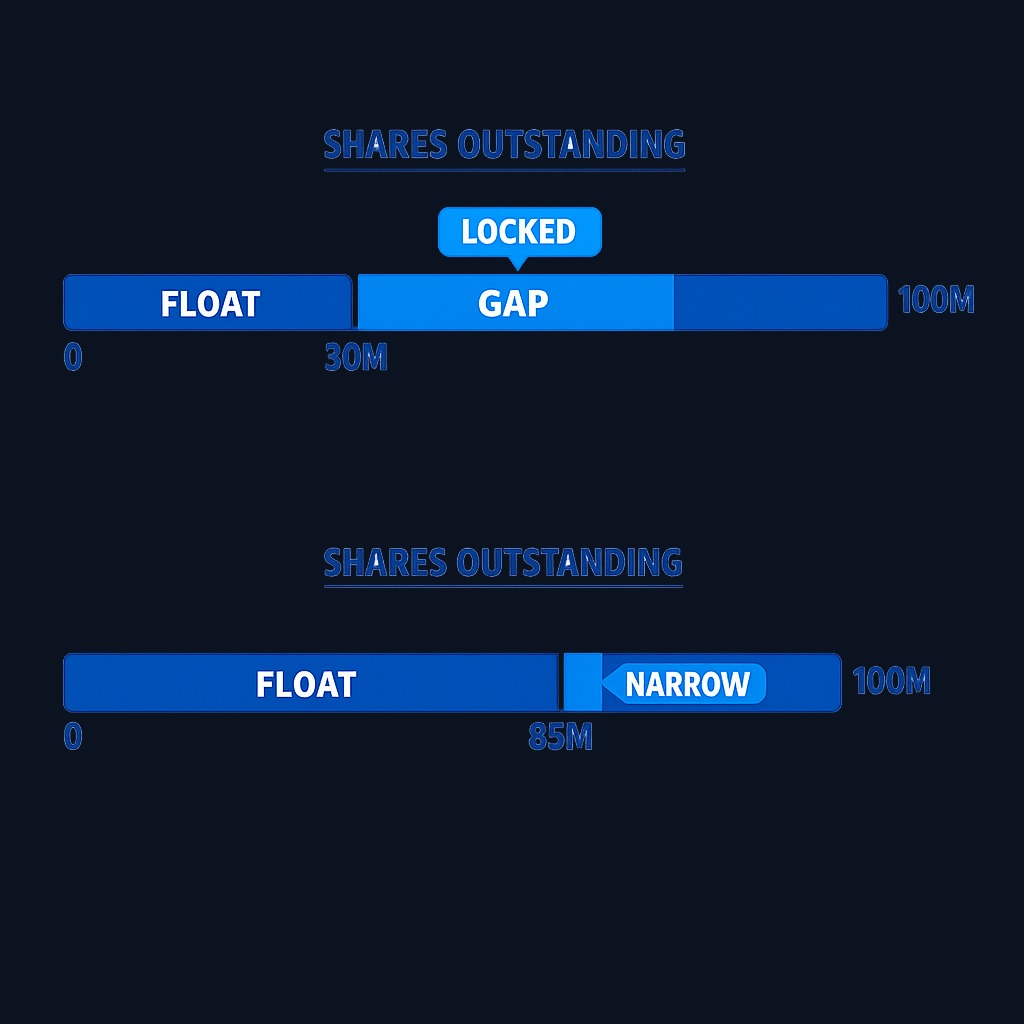
The relationship is one-directional: float can never exceed shares outstanding. The gap between them tells its own story. A wide gap means ownership is concentrated in hands that rarely trade, leaving thin public supply. A narrow gap means most of the company is in play on the open market.
Why float matters for investors
Float drives trading behavior in ways the headline share count does not:
- Volatility. Low-float stocks move more violently because modest order flow meets scarce supply. The same buying pressure that nudges a large-float stock can send a low-float stock sharply higher, and vice versa.
- Liquidity. A small float often means wide bid-ask spreads and difficulty entering or exiting positions at expected prices.
- Squeeze potential. When traders hold large short positions in a low-float stock, forced buying can collide with scarce supply, producing sudden spikes. These episodes are dramatic but hard to predict, and treating them as an investment strategy is speculation.
- Index and fund treatment. Many major indexes weight companies by float-adjusted market cap, so float size influences how much index-tracking money flows into a stock.
For long-term investors, float mostly matters as a risk descriptor: it tells you how bumpy the ride between your entry and exit might be.
Practice trading with Finelo
Practice in a simulator, learn with bite-sized lessons, and build confidence before risking real money.
Factors that change a stock's float
Float is not static, and its movements often matter more than its level:
- IPO lockup expirations release insider shares into the tradable pool, sometimes expanding float substantially in one event.
- Secondary offerings add newly issued shares, raising both outstanding count and float.
- Buybacks shrink both figures as repurchased shares move into treasury.
- Insider transactions shift shares between the closely held and floating buckets without changing the outstanding total.
- Restricted stock vesting gradually converts employee equity into potentially tradable shares.
- Stock splits multiply both numbers proportionally, leaving their ratio unchanged.
Watching float changes is essentially watching supply. An expanding float without matching demand tends to weigh on price; a shrinking float with steady demand supports it.
A worked example
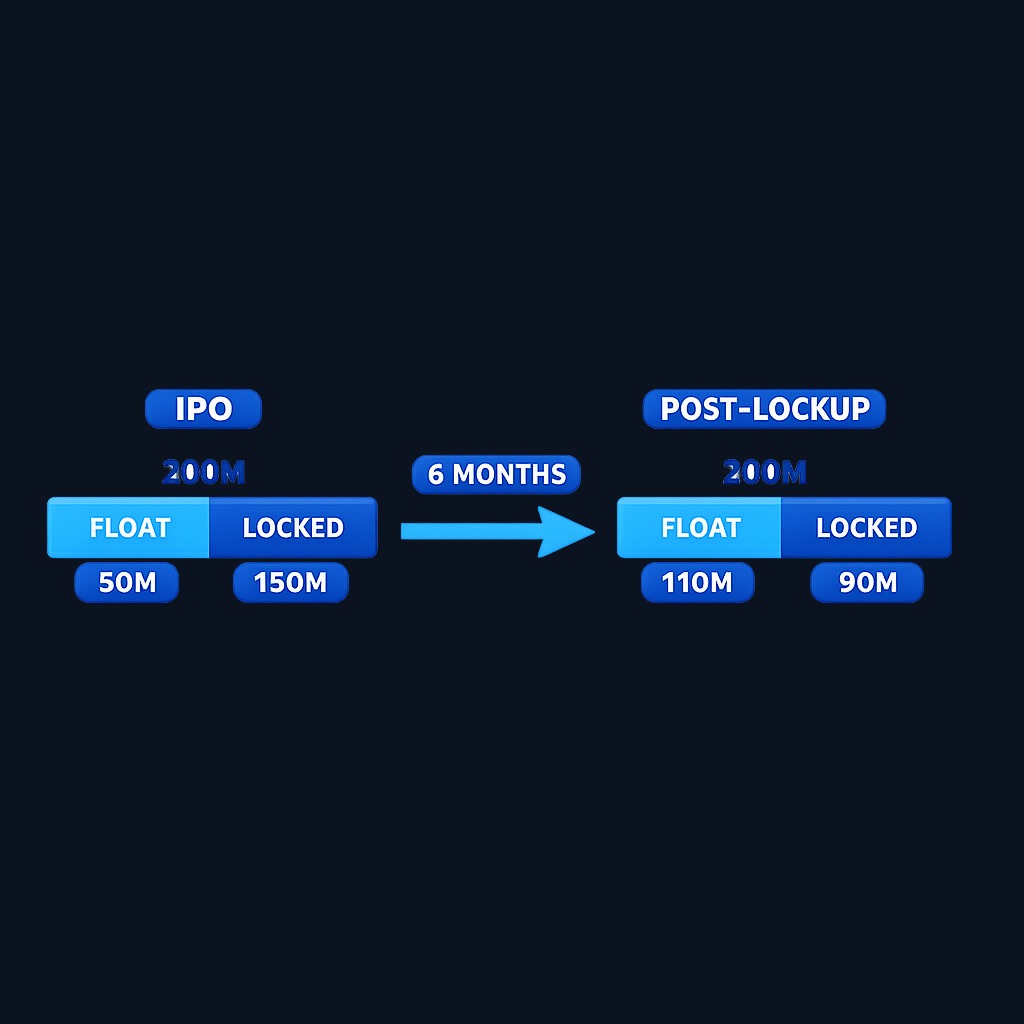
Consider a newly public company with 200 million shares outstanding. Insiders and early funds hold 150 million under lockup, so the float at listing is only 50 million shares. Early trading is jumpy: with only a quarter of the company tradable, each burst of enthusiasm or fear moves the price fast. Six months later the lockup expires, and suppose 60 million insider shares become sellable. Shares outstanding has not changed, but the float has potentially tripled. Whether the price absorbs that shift depends on demand, yet the structure of the market for this stock has permanently changed: deeper supply, likely calmer trading, and less scarcity premium.
What to know before deciding
Before you use either number in a decision, verify both from filings rather than a single data provider, since float estimates differ across sources depending on who counts as an insider. Check the float ratio, meaning float divided by shares outstanding, to judge concentration. Review the calendar for events that will change float, especially lockup expirations and announced offerings. And match the numbers to your intent: ownership and valuation questions need shares outstanding, while execution and volatility questions need float.
Decision framework: using float and shares outstanding together
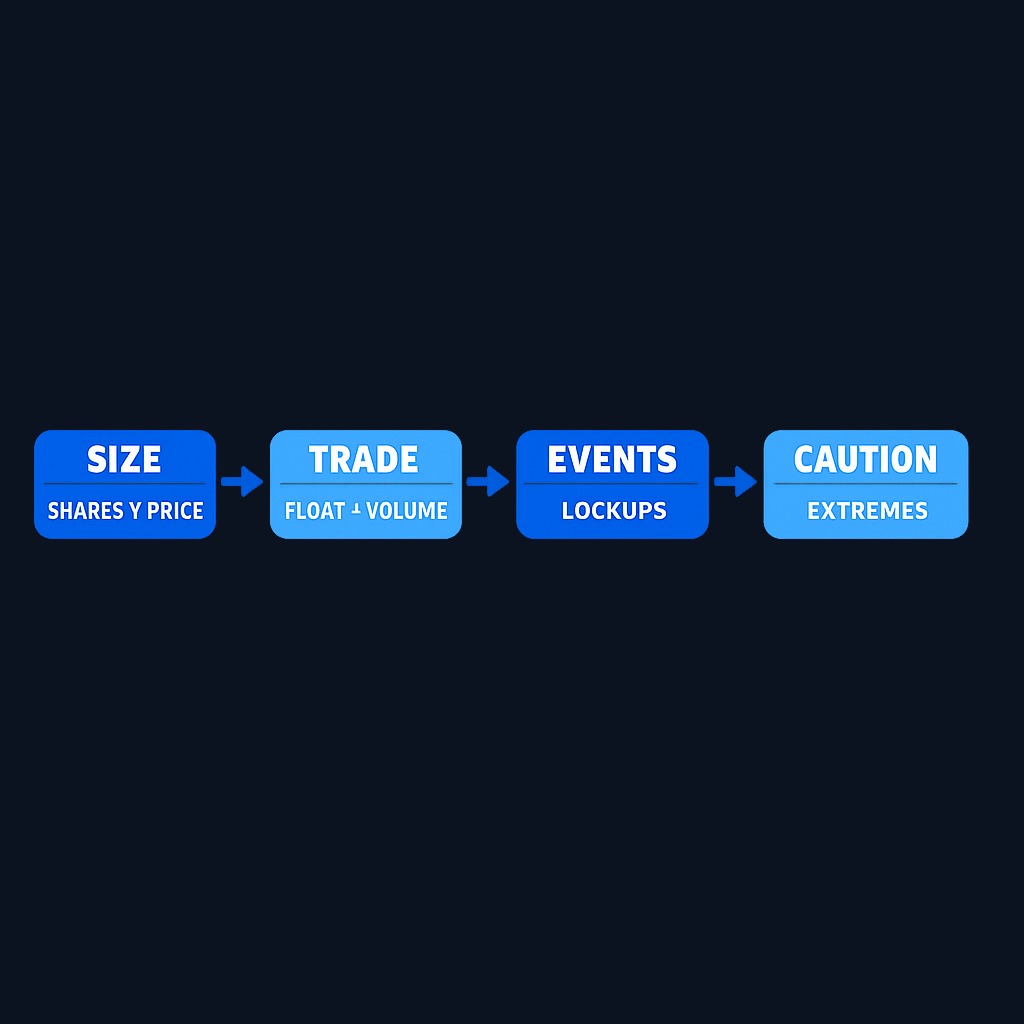
Run four checks in sequence. First, size the company with shares outstanding times price to get market cap, which frames what kind of investment this is. Second, gauge tradability with float and average daily volume; if your intended position is large relative to daily trading, plan entries and exits carefully. Third, scan for supply events: upcoming unlocks, offerings, or buyback programs that will move float. Fourth, treat extreme float situations with extra caution; very low float amplifies both gains and losses, and it attracts short-term traders whose behavior can overwhelm fundamentals. Investors who complete these checks know both what they own and how it trades, which is the entire point of comparing the two figures.
Conclusion and next steps
Shares outstanding tells you how a company is owned; float tells you how it trades. The gap between them explains why some stocks glide while others lurch, and changes in float are supply events worth tracking. Next step: pick one stock you follow, find its shares outstanding in the latest filing, compare it with the float shown on your screener, and compute the float ratio. That five-minute exercise turns two abstract numbers into a concrete read on the stock's trading structure.
Frequently asked questions
Can float ever equal shares outstanding?
Nearly, yes. In companies with no meaningful insider ownership or restricted stock, almost all shares circulate publicly. A float ratio near 100% is common for mature, widely held companies, while founder-led and recently public firms sit much lower.
Why do different websites show different float numbers?
Float is an estimate, not an official filing line. Providers classify insiders, institutions, and restricted shares differently, so their subtractions differ. For decisions that depend on the figure, cross-check against ownership data in company filings.
Is a low float good or bad for a stock?
Neither by itself. Low float means scarce supply, which produces sharper moves in both directions and thinner liquidity. Traders may seek that volatility; long-term investors usually prefer the steadier behavior of larger floats. Context and your goals decide.
Does a stock split change the float?
A split multiplies shares outstanding and float by the same factor, so both grow but their ratio stays the same. Liquidity can improve because the per-share price drops, yet the underlying supply structure is unchanged.
floatsharesoutstanding
Practice trading with Finelo
Practice in a simulator, learn with bite-sized lessons, and build confidence before risking real money.
About the author
Finelo Team
The Finelo Team creates practical investing and trading education designed to help beginners learn faster with structured challenges, simulator practice, and bite-sized lessons.
Keep reading — Related articles

Trading
Understanding Walk Forward Analysis in Trading
Brief educational note: this article is educational — not investment advice — and trading involves the risk of loss.
Finelo Team
Trading
VWAP vs Moving Average: Formulas, Uses, and Limits
VWAP weights price by recorded volume over a defined period, while a moving average summarizes a sequence of prices over a rolling lookback.
Finelo Team
Trading
Volume Profile vs Market Profile: What Each Chart Measures
Volume Profile groups traded volume by price level.
Finelo Team