A diagonal spread is an options strategy built from two options of the same type, either two calls or two puts, on the same underlying. What makes it a diagonal is that the two options differ: they have different strike prices and different expiration dates. That is why it is a hybrid. Different strikes are what define a vertical spread, different expirations are what define a calendar spread, and a diagonal borrows from both.
Diagonal Spread: How the Strategy Works (with Example)
A diagonal spread buys a longer-dated option and sells a nearer-dated option at a different strike. Learn how call and put diagonals are built, why max profit is undefined, and how they compare to vertical and calendar spreads.
12 min read
Practice trading with Finelo
Practice in a simulator, learn with bite-sized lessons, and build confidence before risking real money.
Want to learn more?
Practice in a simulator, learn with bite-sized lessons, and build confidence before risking real money.
Explore FineloExplore Finelo's 28-day challenges
Turn learning into a daily habit with guided challenge paths.
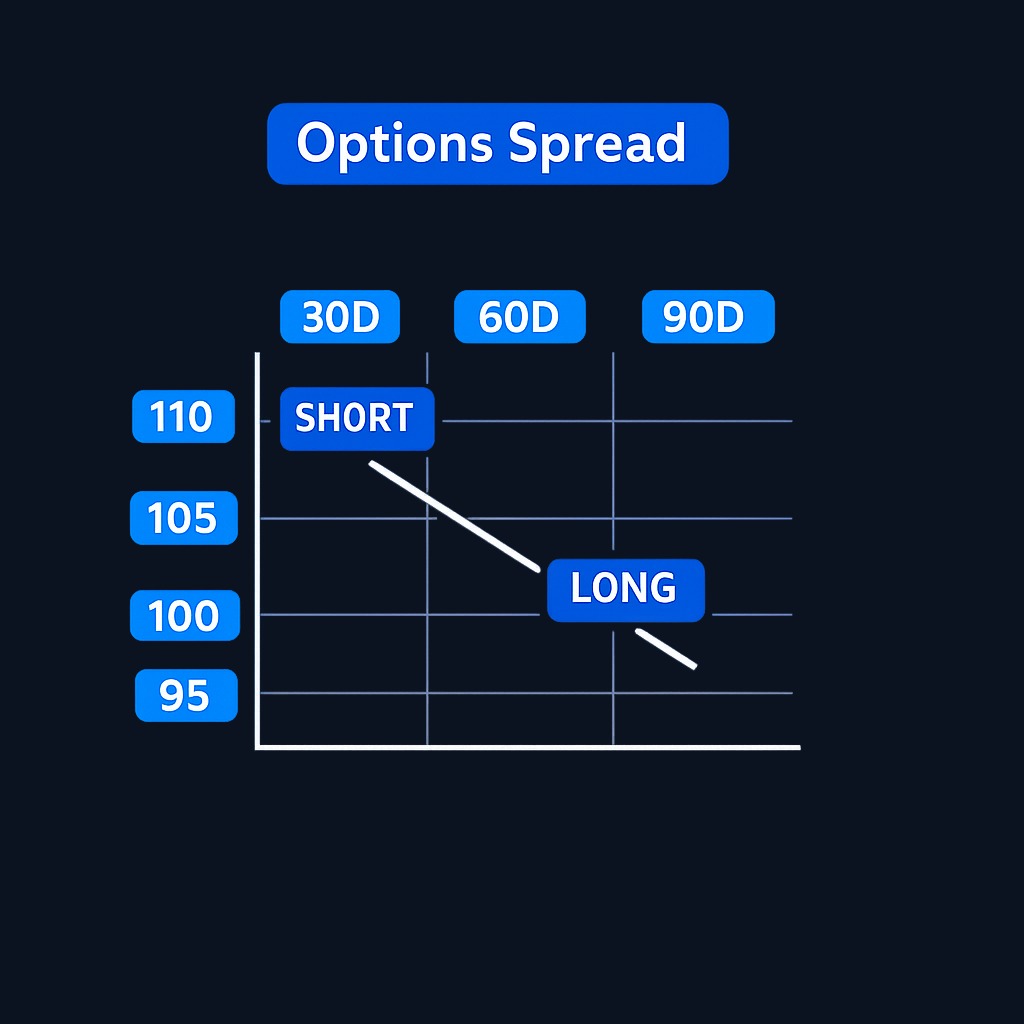
In its common form, a trader buys a longer-dated option and sells a nearer-dated option at a different strike against it, paying a net debit. The short leg decays faster, which reduces the cost of the long leg, while the long leg carries the directional view.
One feature sets diagonal spread options apart from the simpler spreads. Because the two legs expire at different times, the maximum profit and breakeven cannot be calculated exactly in advance, and any article handing you a precise formula is simplifying.
This page is for readers who already understand basic calls and puts, and ideally vertical spreads. If those are still fuzzy, read the options trading for beginners guide first, then come back. It explains the structure and mechanics; it does not tell you to trade it, or which strikes, expirations, or deltas to pick.
This page is for learning purposes only and is not financial advice. Options trading carries significant risk and is not suitable for everyone.
Who this guide is for
The diagonal spread strategy is worth understanding once single-expiration positions feel comfortable.
Use it as a learning path if you are:
- Comfortable with calls, puts, and ideally vertical spreads, and curious how a two-expiration position behaves.
- Trying to understand why a diagonal's maximum profit is described as undefined.
- Comparing diagonal, vertical, and calendar spreads before ever risking real money.
Why it's called "diagonal"
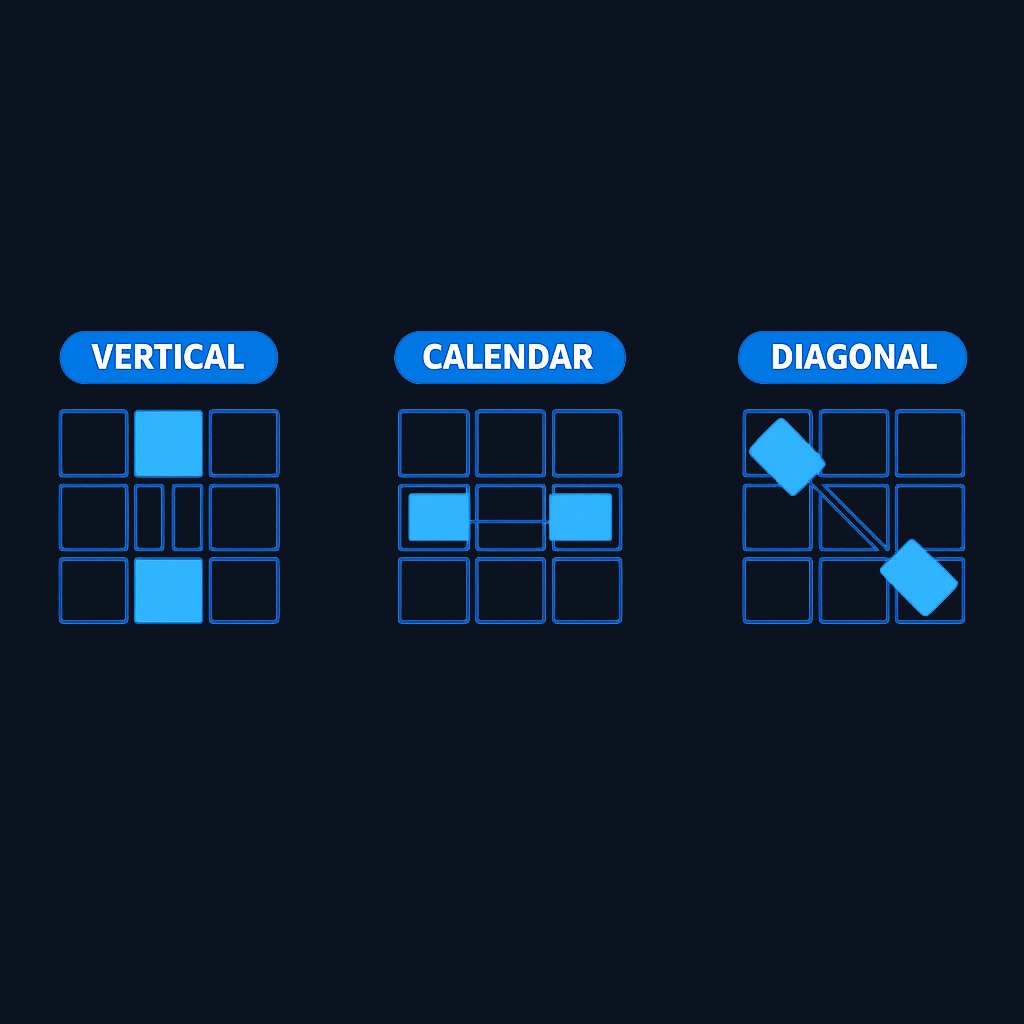
Knowing where the name comes from makes the whole family easier to keep straight. When options prices were printed in newspapers, they appeared in a grid: strike prices ran vertically down the rows, expirations horizontally across the columns.
From there the names write themselves. Two options in the same column share an expiration and differ by strike, sitting vertically on the page, giving the vertical spread. Two in the same row share a strike and differ by expiration, sitting horizontally, giving the horizontal spread, known today as a calendar or time spread. A position whose options differ in both strike and expiration sits in a different row and a different column, cutting diagonally across the grid. You will sometimes see it called a diagonal calendar spread, which is the same idea.
How it's built: two legs, two expirations
The common form is the long diagonal spread, and it has exactly two legs of the same option type:
- Buy the longer-dated option. This is the anchor, carrying the position's directional exposure. Options educators typically describe an at-the-money or slightly in-the-money strike here, so the option holds real value rather than pure time premium.
- Sell a nearer-dated option at a different strike. This leg is usually out of the money. The premium collected reduces the net cost of the long leg, and because shorter-dated options shed time value faster, its time decay (theta) works in the position's favor while it stays out of the money.
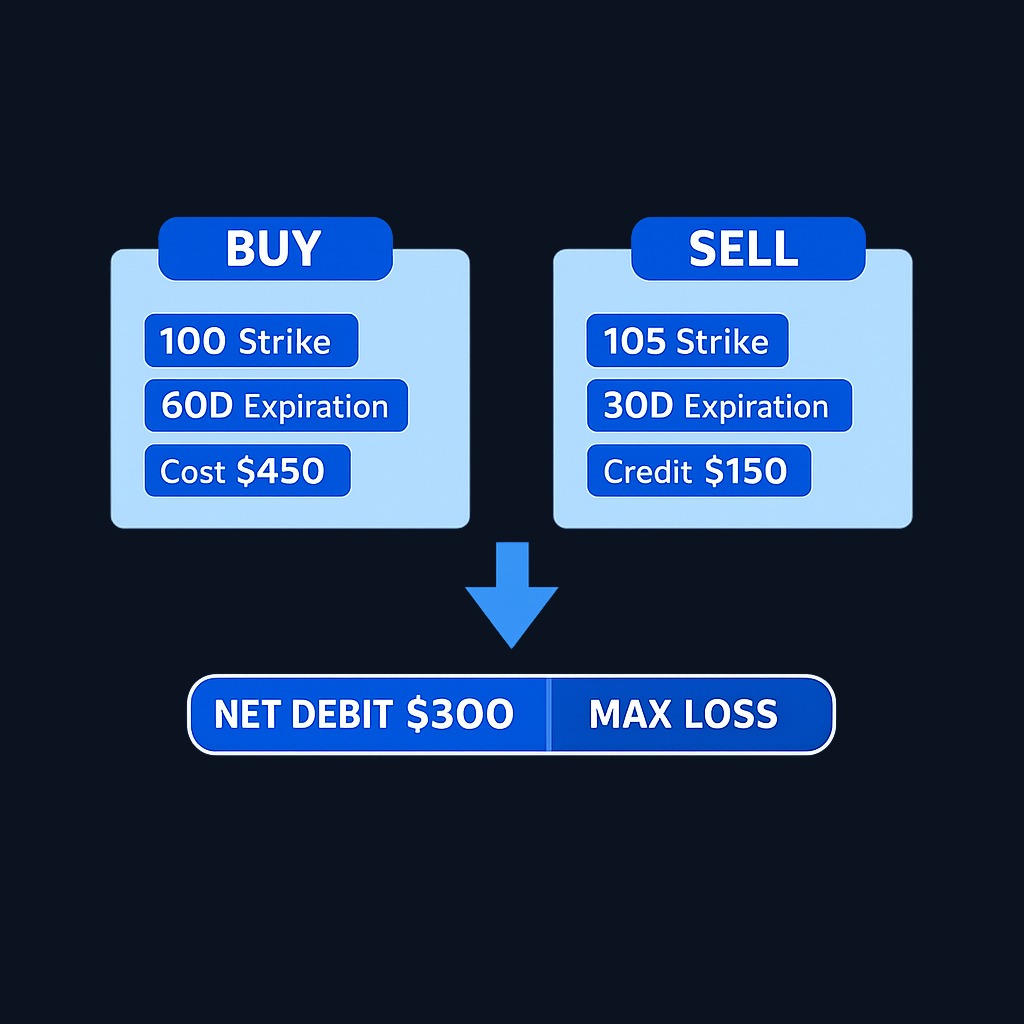
Because the longer-dated option costs more than the near-term option brings in, you pay to open the position. That amount is the net debit. It is both what the position costs and, with one caveat about assignment, the most you can lose. Option prices are quoted per share and one standard contract covers 100 shares, so dollar figures are the per-share numbers multiplied by 100.
A short diagonal, which sells the longer-dated option and buys the nearer one, also exists. It is generally entered for a credit and carries a different risk profile. Other strike and expiration combinations exist too, which is why a diagonal option spread is better understood as a family of positions than as one fixed trade. This page covers the long version, which is what most educational material means by the term.
Call diagonal vs put diagonal
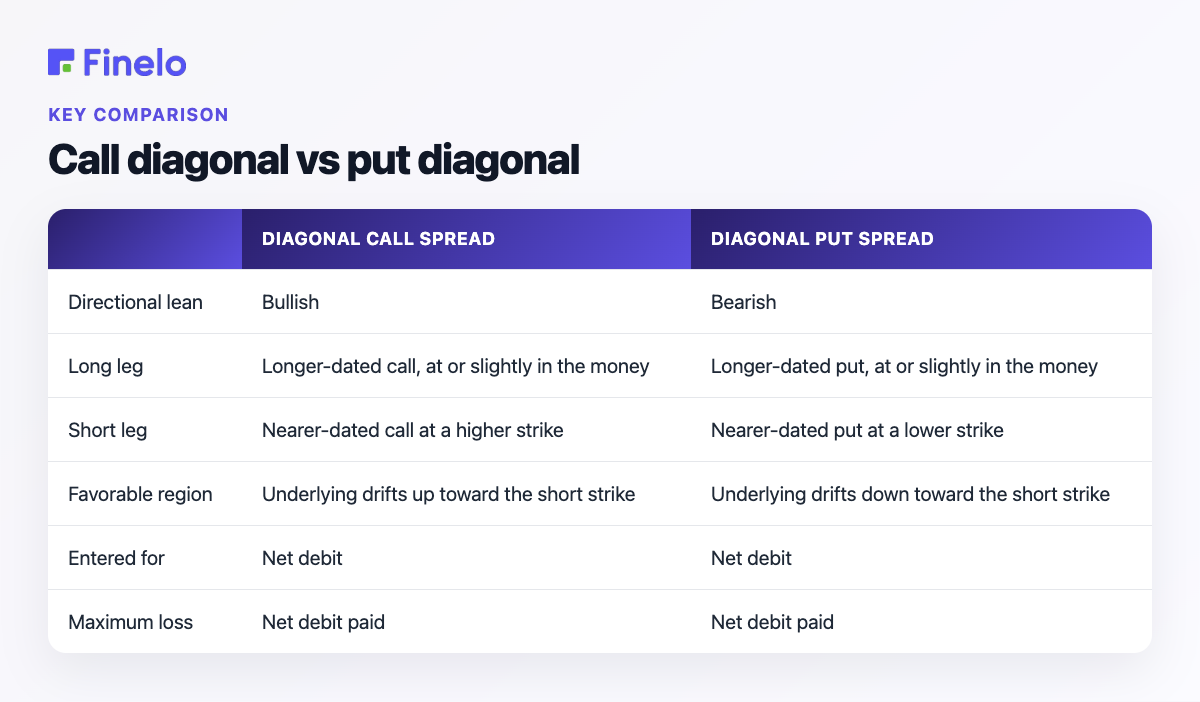
The mechanics do not change between calls and puts. Only the direction of the lean does.
| Diagonal call spread | Diagonal put spread | |
|---|---|---|
| Directional lean | Bullish | Bearish |
| Long leg | Longer-dated call, at or slightly in the money | Longer-dated put, at or slightly in the money |
| Short leg | Nearer-dated call at a higher strike | Nearer-dated put at a lower strike |
| Favorable region | Underlying drifts up toward the short strike | Underlying drifts down toward the short strike |
| Entered for | Net debit | Net debit |
| Maximum loss | Net debit paid | Net debit paid |
Max loss, max profit, and breakeven
Maximum loss is defined: the net debit paid. If the underlying moves sharply against the position, past the long strike, the long option can lose most or all of its value. The one caveat is early assignment on the short leg, covered in the risks section.
Maximum profit cannot be calculated precisely in advance. In a vertical spread both options expire together, so the payoff is fixed arithmetic. A diagonal is different because the short leg expires first. At that moment the long leg is still alive, and it holds two kinds of value: intrinsic value, and extrinsic value, which is the time value left in the option. How much extrinsic value it holds depends on how much time remains and on implied volatility at that future date. Neither of those can be known when the position is opened, which is precisely why the maximum profit cannot be either.
What can be said is where the best case sits: the underlying finishing at the short strike on the short leg's expiration date, where the short option expires worthless while the long option keeps the most value relative to it.
Breakeven is an estimate, not a formula. For the same reason, it depends on what the long option is worth at that moment. A pricing model can approximate it, but a single exact number quoted in advance is a simplification.
One guideline circulates among options educators: keep the net debit meaningfully below the distance between the two strikes, some suggesting under roughly 75 percent of the strike width. That is a guideline some traders describe using, not an instruction.
A diagonal's payoff depends on a future price nobody can know today.
Practice trading with Finelo
Practice in a simulator, learn with bite-sized lessons, and build confidence before risking real money.
A worked example
Here is one hypothetical:
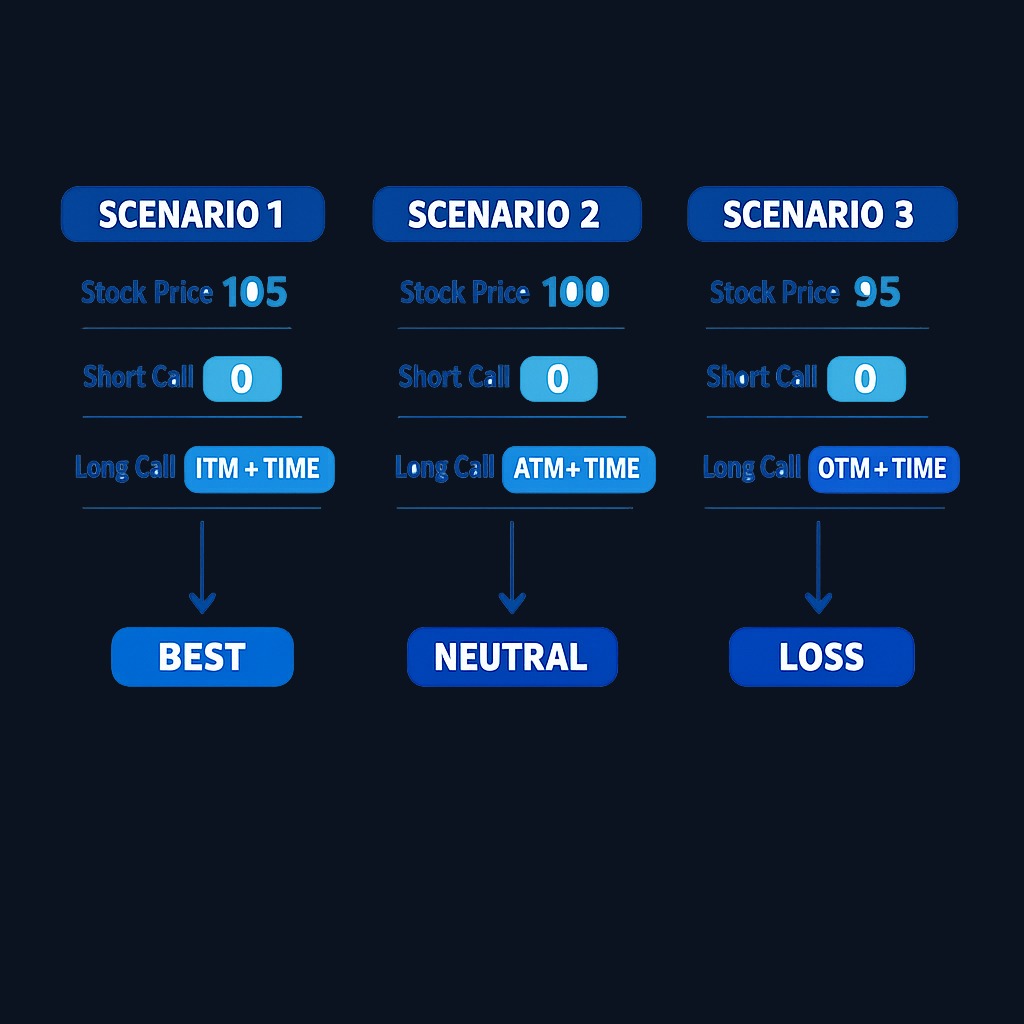
Suppose a stock trades near $100 and someone is studying a diagonal call spread: buying a 60-day $100 call for $4.50 and selling a 30-day $105 call for $1.50. The net debit is $3.00 per share, or $300 for one spread. Consider three scenarios at the short leg's expiration, 30 days in, when the long call still has 30 days to run.
- The stock drifts up to around $105. The short $105 call expires at or near worthless, so its premium is kept, and the long $100 call is about $5 in the money with 30 days of time value left. This is the most favorable region, though the exact profit depends on the long call's remaining extrinsic value.
- The stock stays flat at $100. The short call expires worthless and its $1.50 is kept, while the long call has given up a month of time value. These effects work against each other, so the outcome is close to a wash. Whether it lands slightly up or down depends on the extrinsic value the long call retains, exactly the quantity that cannot be known in advance.
- The stock falls to $92. Both options lose most of their value. The short leg expiring worthless helps only marginally, and the position shows a significant loss, bounded by the $300 debit if the long call is left to expire worthless.
The payoff picture
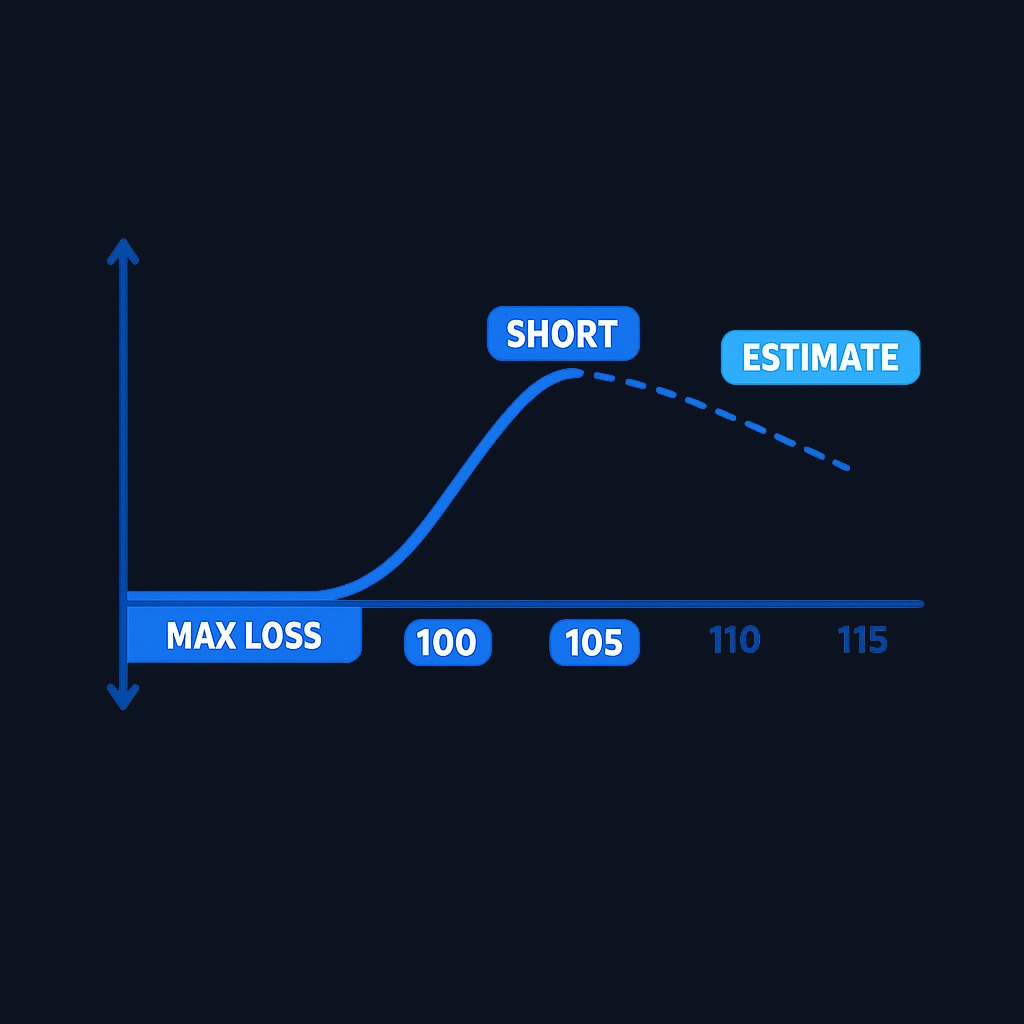
Plotted at the short leg's expiration, a long call diagonal has a recognizable shape. There is a flat floor at the maximum loss well below the long strike, a rising slope as the underlying approaches the short strike, a peak right around the short strike, and a gentle taper beyond it. That taper is worth understanding. When the underlying runs far past the short strike, the long call goes deep in the money and sheds the extrinsic value that gives the position its edge. The result settles toward the strike width plus whatever time value remains, so the position stays profitable there, just below its peak.
The best case is the underlying finishing near the short strike, not as far above it as possible.
Past the peak, the curve is drawn as an estimate rather than a firm line. That is the visual version of the point above: a vertical spread's payoff has a fixed ceiling, and a diagonal's does not.
Rolling the short leg
Because the long option outlives the short one, a diagonal is not necessarily a one-shot position. Traders commonly describe rolling the short leg. Once the near-term option expires or has lost most of its value, another short option is sold against the same long option, reducing its cost basis again. Repeated over the long option's life, this turns the position into an ongoing structure rather than a single trade, and each roll is a new decision carrying its own risk.
One well-known application is the poor man's covered call, which buys a long-dated in-the-money call as a stock substitute and repeatedly sells shorter-dated calls against it. Structurally it is a call diagonal spread.
Diagonal vs vertical vs calendar spread
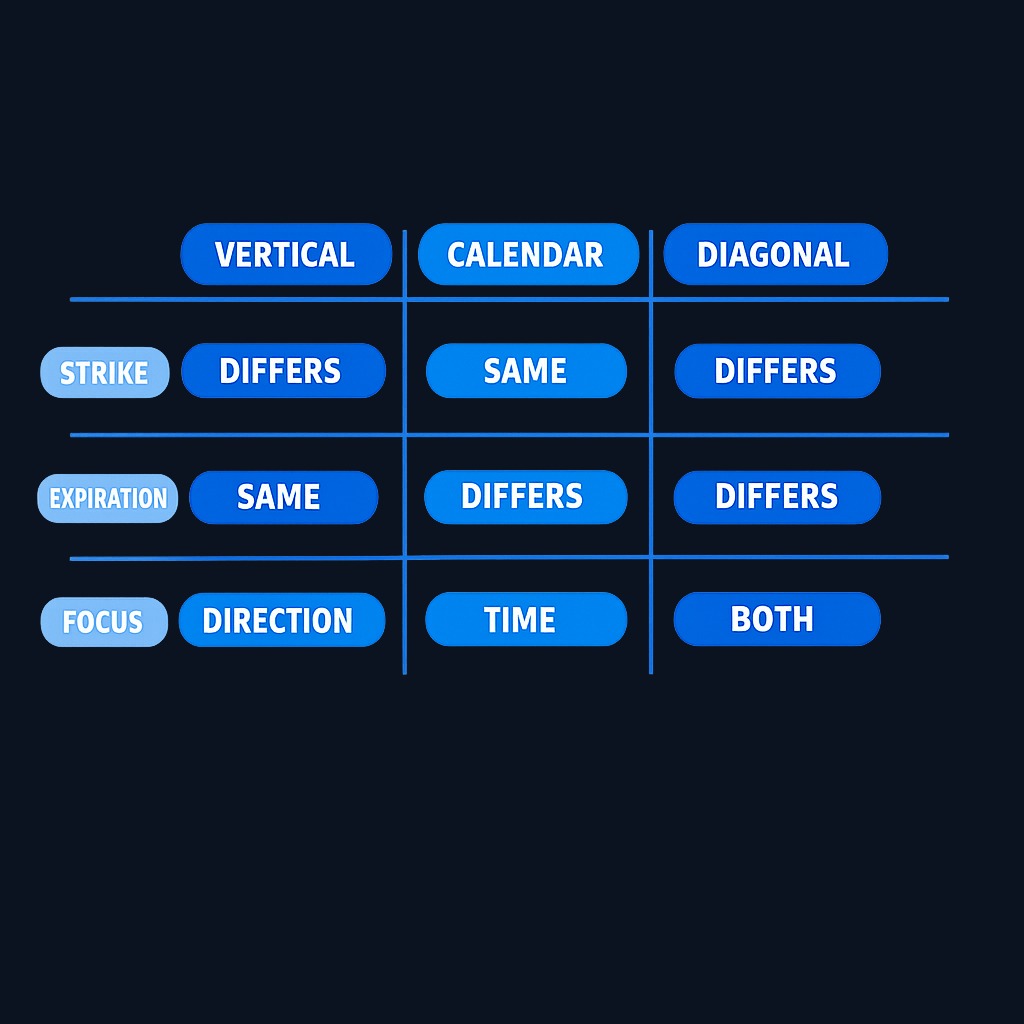
Two options can differ in two ways: strike and expiration. Which of those two differ is exactly what separates the three spread types. This is a high-level comparison, not a recommendation of one over another.
| | Vertical spread | Calendar spread | Diagonal spread | | --- | --- | --- | | Strikes | Different | Same | Different | | Expirations | Same | Different | Different | | Character | Directional, fixed payoff math | Time and volatility focused, near-neutral | Directional and time-based, a hybrid | | Entered for (long form) | Net debit | Net debit | Net debit | | Maximum loss | Net debit | Net debit | Net debit | | Maximum profit | Fixed: strike width minus debit | Not fixed, depends on the long leg's future value | Not fixed, depends on the long leg's future value |
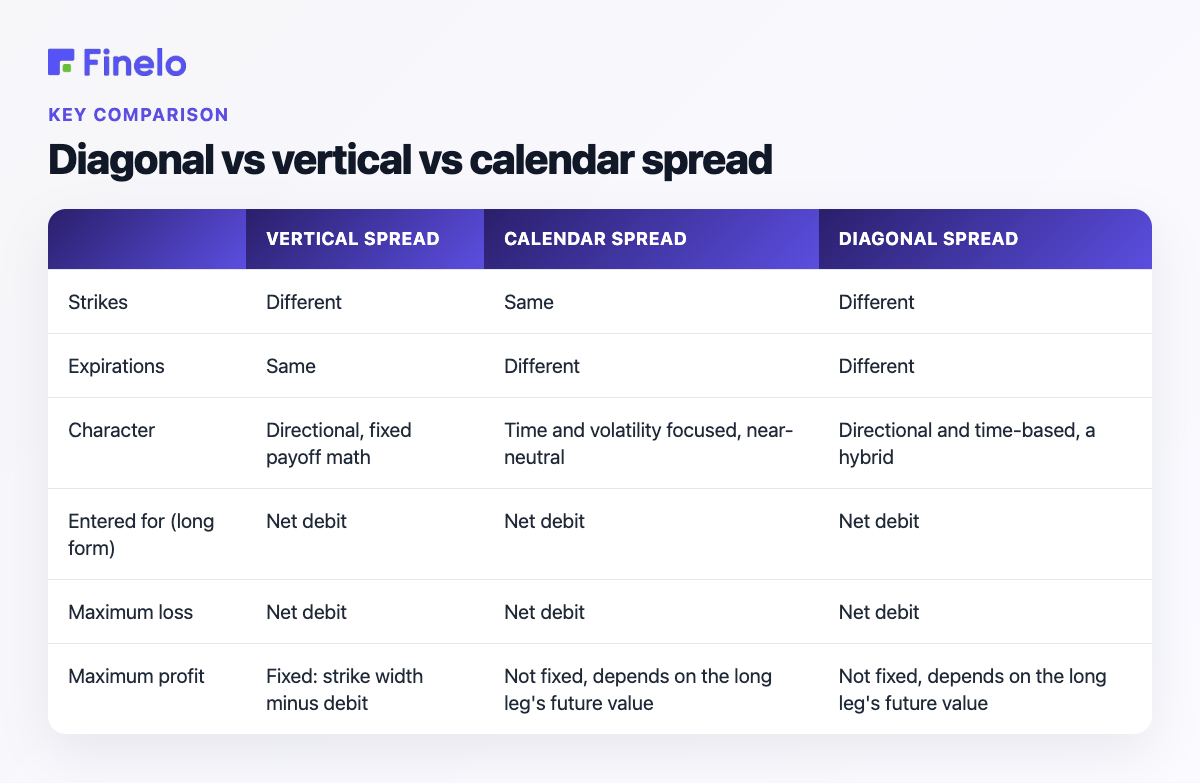
A useful intuition follows from the table. A diagonal with strikes far apart but expirations close together behaves more like a vertical spread. One with strikes close together but expirations far apart behaves more like a calendar spread. The combination chosen determines the position's character, which is another reason the strategy resists a single tidy formula.
Risks and things to watch
Defined risk does not mean low risk, and the second expiration adds complications single-expiration spreads do not have.
- You can lose the entire net debit. If the underlying moves firmly against the position, the long option can expire worthless and the whole amount paid is gone.
- The short leg can be assigned early. American-style short options can be assigned before expiration, most commonly around ex-dividend dates for calls. That converts the position into stock plus a long option and can trigger margin requirements, which is why the maximum loss figure carries a caveat.
- Pin risk at the short expiration. If the underlying finishes very close to the short strike, whether assignment happens may not be known until after the close.
- Two expirations mean ongoing decisions. When the short leg expires the position does not end. The long option has to be managed, closed, or covered again, and it keeps losing time value.
- The outcome depends on future implied volatility. The long option's value at the short leg's expiration is the heart of the payoff, so a drop in implied volatility can hurt even when the directional view was right. The implied volatility guide covers this in depth.
- Costs matter. Two legs, potential rolls, and possible assignment mean more commissions and bid-ask spread than a single option.
Whether this strategy suits anyone depends on their knowledge, options approval level, and risk tolerance, and it is exactly the kind of structure to study thoroughly and practice before risking real money.
Understanding a strategy and being ready to trade it are not the same thing.
Next steps
A diagonal spread shows how the two dimensions of an option, strike and time, combine into a single position. It offers a vertical spread's direction alongside a calendar spread's time component, at the cost of a payoff that can only be estimated in advance.
Understanding what a payoff cannot tell you is as valuable as the payoff itself.
Read the implied volatility guide next, since it drives a diagonal's uncertain payoff, and see the bull call spread for the fixed-payoff contrast. A simulator lets you watch how a two-expiration position behaves over time without risking money. Inside the Finelo app, you can study positions like this on real market data with virtual funds. There are no deposits, no withdrawals, and no broker connection — it is a closed practice loop, so the only cost of a wrong read is the lesson. To weigh up other users' experiences, read Finelo reviews, and for account questions, use the Finelo support center. Finelo is an educational product, not a brokerage, so verify current features through Finelo.
Finelo is an educational product, not a brokerage. The simulator uses virtual funds and real market data, and final trading and investing decisions are yours, made through your own brokerage account when you choose to act. This article is for education and is not financial advice. Options trading carries significant risk and is not suitable for everyone.
Frequently asked questions
Is a diagonal spread bullish or bearish?
Either, depending on construction. A diagonal built with calls — long a further-dated call and short a nearer-dated higher-strike call — leans bullish. A put diagonal — long a further-dated put and short a nearer-dated lower-strike put — leans bearish. The structure is identical; the option type sets the direction.
Is a diagonal spread a debit or a credit?
The common long diagonal, buying the longer-dated option and selling the shorter-dated one, is entered for a net debit, because the longer-dated option costs more than the near-term one brings in. Short diagonals reverse the legs, are generally entered for a credit, and carry a different, less defined risk profile.
Why can't you calculate a diagonal spread's max profit in advance?
Because the short leg expires before the long leg. At the short option's expiration the long option still holds extrinsic value, and that value depends on implied volatility and remaining time at that future date — neither of which is knowable at the outset. Vertical spreads avoid this because both legs expire together.
What is the difference between a diagonal spread and a calendar spread?
A calendar spread's two options share the same strike and differ only in expiration, making it a near-neutral position focused on time decay and volatility. A diagonal spread's options differ in both strike and expiration, which layers a directional lean on top of that time component.
What is a double diagonal spread?
A more advanced, market-neutral structure combining a call diagonal and a put diagonal on the same underlying, typically a longer-dated straddle bought against a nearer-dated strangle sold. It involves four legs, is generally treated as an advanced strategy, and is a separate topic from the standard diagonal covered here.
diagonal spreadoptions tradingcalendar spreadvertical spreadtrading education
Practice trading with Finelo
Practice in a simulator, learn with bite-sized lessons, and build confidence before risking real money.
About the author
Finelo Team
The Finelo Team creates practical investing and trading education designed to help beginners learn faster with structured challenges, simulator practice, and bite-sized lessons.
Keep reading — Related articles

Trading
Understanding Walk Forward Analysis in Trading
Brief educational note: this article is educational — not investment advice — and trading involves the risk of loss.
Finelo Team
Trading
VWAP vs Moving Average: Formulas, Uses, and Limits
VWAP weights price by recorded volume over a defined period, while a moving average summarizes a sequence of prices over a rolling lookback.
Finelo Team

Trading
Volume Profile vs Market Profile: What Each Chart Measures
Volume Profile groups traded volume by price level.
Finelo Team


