A beginner stock trading course should teach market mechanics, order types, analysis, risk limits, trading plans, and practice before real-money trades. The best course is not one advertised as a shortcut to financial success. It explains losses, includes realistic exercises, and helps you build a repeatable decision process.
Stock Trading Course for Beginners: Everything You Need to Know
A beginner stock trading course should teach market mechanics, order types, analysis, risk limits, trading plans, and practice before real-money trades. The best course is not one advertised as a shortcut to financial…
8 min read
Practice trading with Finelo
Practice in a simulator, learn with bite-sized lessons, and build confidence before risking real money.
Want to learn more?
Practice in a simulator, learn with bite-sized lessons, and build confidence before risking real money.
Explore FineloExplore Finelo's 28-day challenges
Turn learning into a daily habit with guided challenge paths.
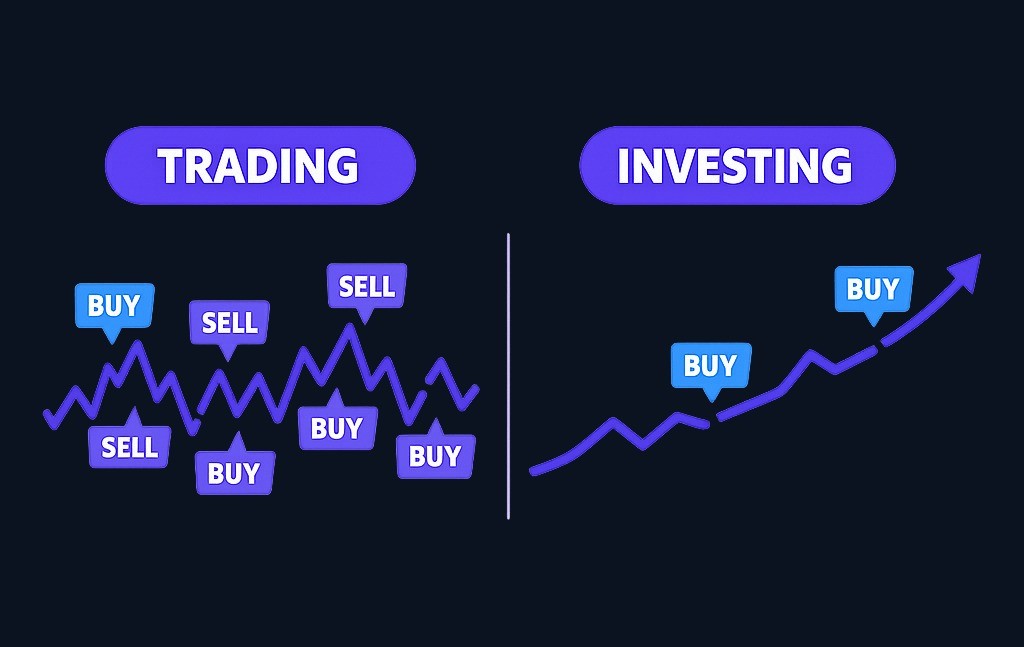
Stock trading means buying and selling shares with the aim of benefiting from price movements. Unlike long-term investing, trading usually puts more weight on entries, exits, timing, and short-term risk. Both approaches can lose money. A course should help you understand the difference before you choose either path.
What Should a Beginner Stock Trading Course Teach?
A useful course begins with how the market works. It should not jump straight to chart patterns or trade ideas.
Look for a curriculum that covers:
- What a share represents
- How exchanges and brokers connect buyers with sellers
- Bid prices, ask prices, and spreads
- Market, limit, and stop orders
- Trading hours and liquidity
- Fundamental and technical analysis
- Position sizing and risk limits
- Trading plans and journals
- Fees, taxes, and account rules
- Simulated or paper-trading practice
- Trading psychology and emotional control
The order matters. A learner who recognises a chart pattern but does not understand order execution may still enter at an unexpected price. A learner who can find a promising setup but has no position limit may allow one mistake to damage the entire account.
A strong learning sequence
- Learn the vocabulary and mechanics.
- Observe how prices and orders behave.
- Study one simple analysis method.
- Write rules for entries, exits, and risk.
- Practise those rules in a simulator.
- Review mistakes in a trading journal.
- Decide whether real-money trading suits your goals and finances.
Avoid courses that treat the last step as automatic. Completing lessons does not mean you are ready to risk cash.
Key Stock Trading Concepts to Understand
Fundamental and technical analysis
Fundamental analysis examines the business behind a stock. A trader may review revenue, profitability, cash flow, debt, competition, and events that could change expectations.
Technical analysis studies price, volume, and patterns in market data. It can help define a possible setup, but it cannot reliably predict where the price will move next.
A course should explain what each method can and cannot do. It should also show how traders can reach different conclusions from the same information.
Orders and execution
A market order generally prioritises execution over a specific price. A limit order sets a price boundary but may not execute. A stop order is designed to activate after a specified trigger, although the eventual execution price may differ from that trigger.
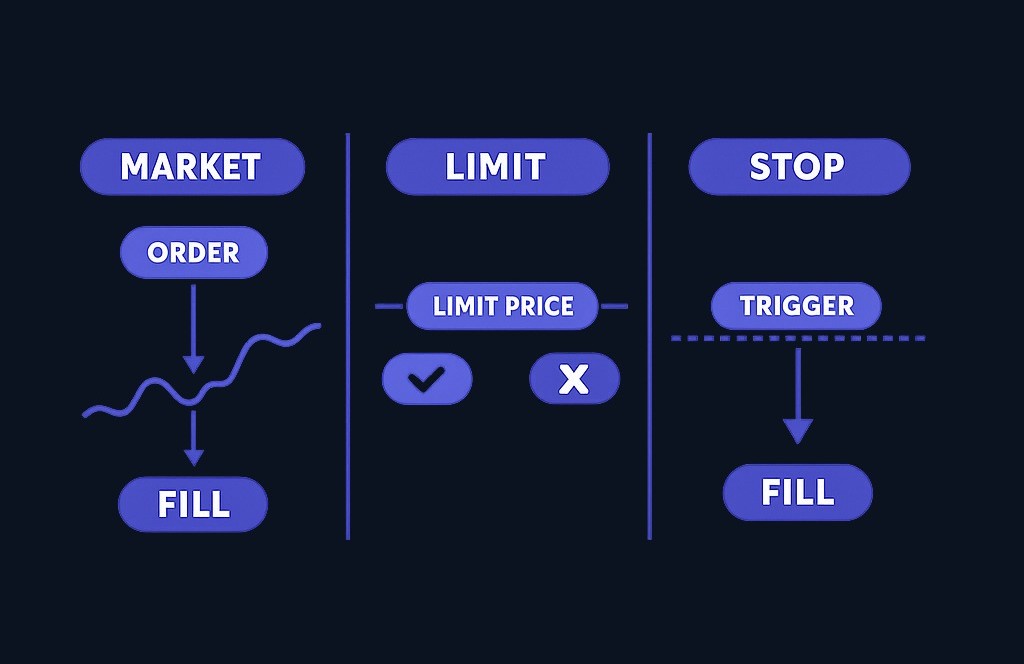
The right order depends on the security, liquidity, market conditions, and your plan. A course should use worked examples rather than presenting one order type as universally best.
Position sizing
Position sizing connects a trade idea to an amount of risk. One educational worksheet is:
Planned risk amount = account value × chosen risk fraction
Risk per share = absolute value of entry price − planned exit price
Maximum shares = planned risk amount ÷ risk per share
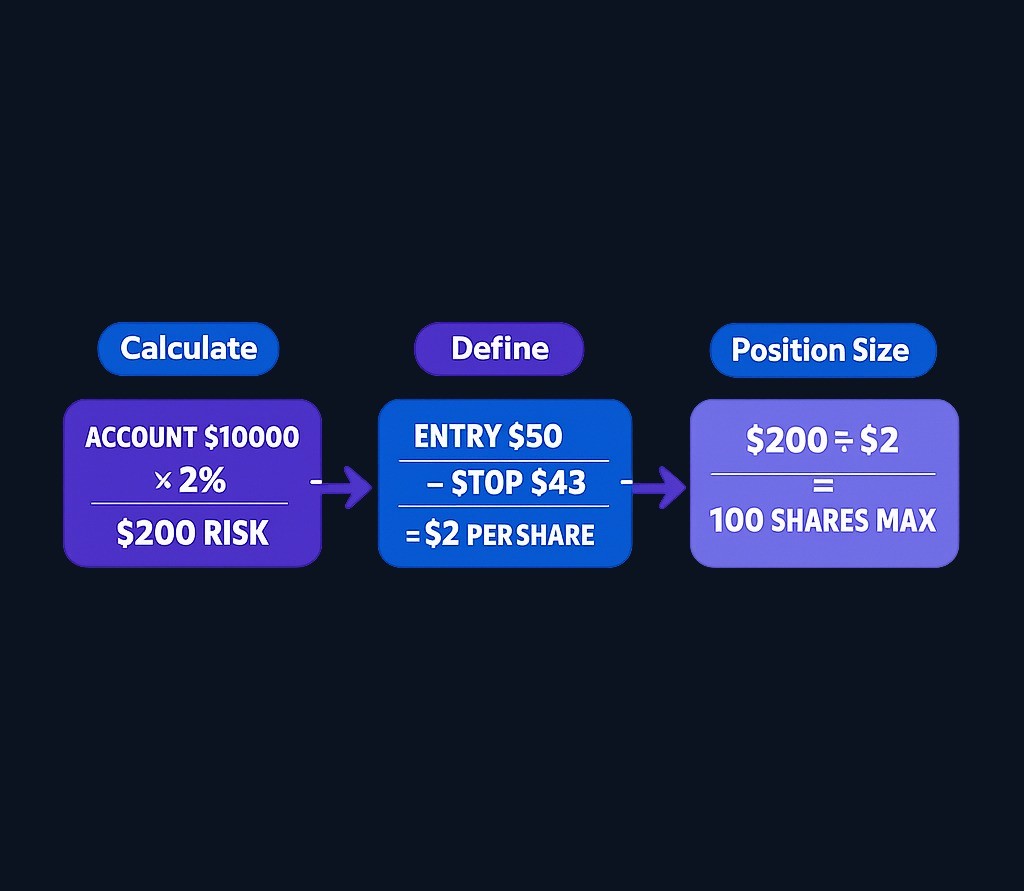
This is a practice framework, not a recommendation for how much to risk. Real losses can exceed a planned amount because prices may gap, orders may fill poorly, and markets may become difficult to exit.
Trading psychology
Fear can make a trader exit without following the plan. Excitement can lead to larger positions or rushed decisions. Losses can trigger “revenge trading”—placing another trade mainly to recover money quickly.
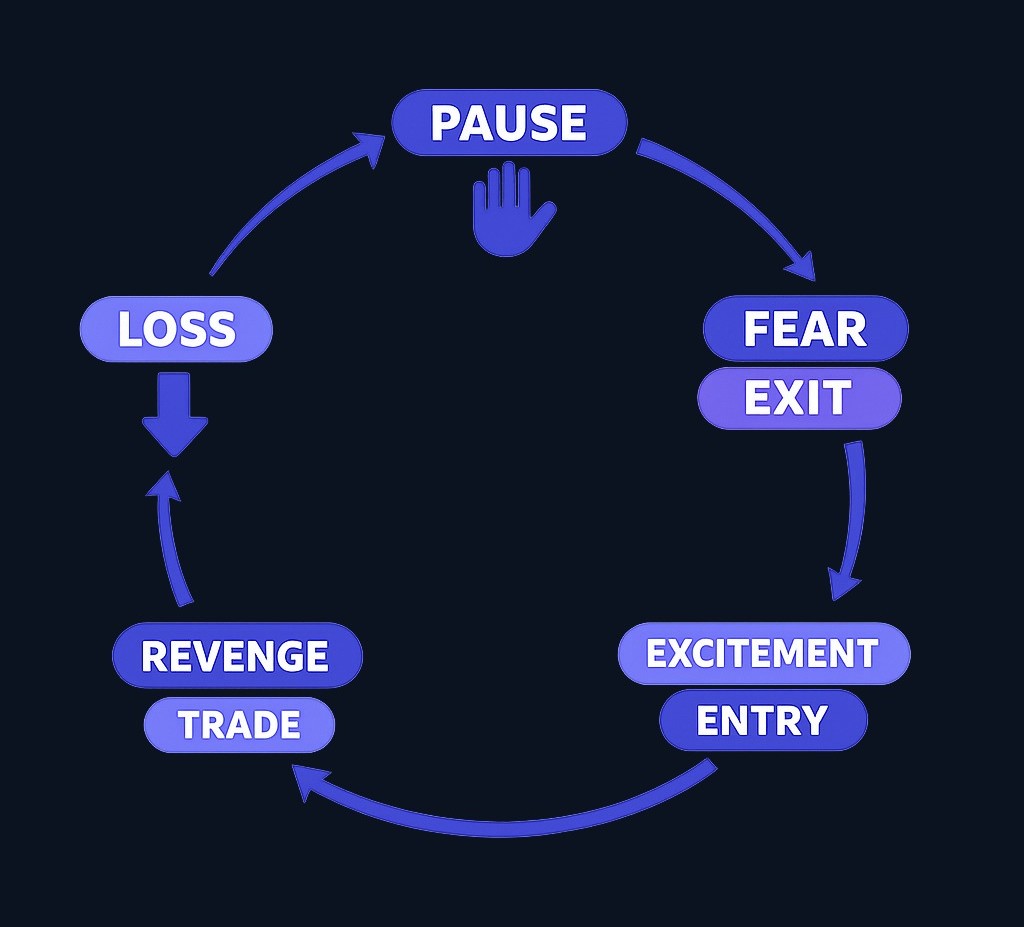
A good course treats psychology as a process problem. It should help you create rules, recognise emotional triggers, and pause when your behaviour stops matching the plan.
How to Choose the Right Trading Course
The best course for a beginner matches the skill you want to build, the way you learn, and the amount of support you need. Start by defining the outcome.
Do you want to:
- Understand market mechanics?
- Learn one trading style?
- Practise using charts and orders?
- Build a risk-management routine?
- Decide whether active trading suits you?
A course called “beginner-friendly” may still assume you know the platform, terminology, or risks. Review the syllabus rather than relying on the title.
Compare course and platform types
| Course or platform type | Best suited to | What to examine | Cost questions |
|---|---|---|---|
| Self-paced video course | Learners who prefer flexible study | Lesson order, exercises, updates, instructor access | One-time or recurring payment, expiry, add-ons |
| Broker education library | Learning tools tied to a trading interface | Account requirement, neutrality, platform-specific focus | Account charges, data fees, trading and product costs |
| Live class or coaching | Learners who need feedback | Instructor background, class size, recordings, cancellation terms | Tuition, recurring membership, software, data, community access |
| App-based guided course | Short lessons and structured progress | Curriculum depth, practice, risk coverage, subscription terms | Trial conversion, recurring charge, premium modules |
| Simulator-led program | Practising orders and a written process | Data timing, simulated fills, journal tools, reset options | Subscription, market-data access, feature limits |
| Community or chat-room program | Observation and peer discussion | Moderation, conflicts, trade-call culture, pressure to copy others | Membership, tools, mentorship, renewal terms |
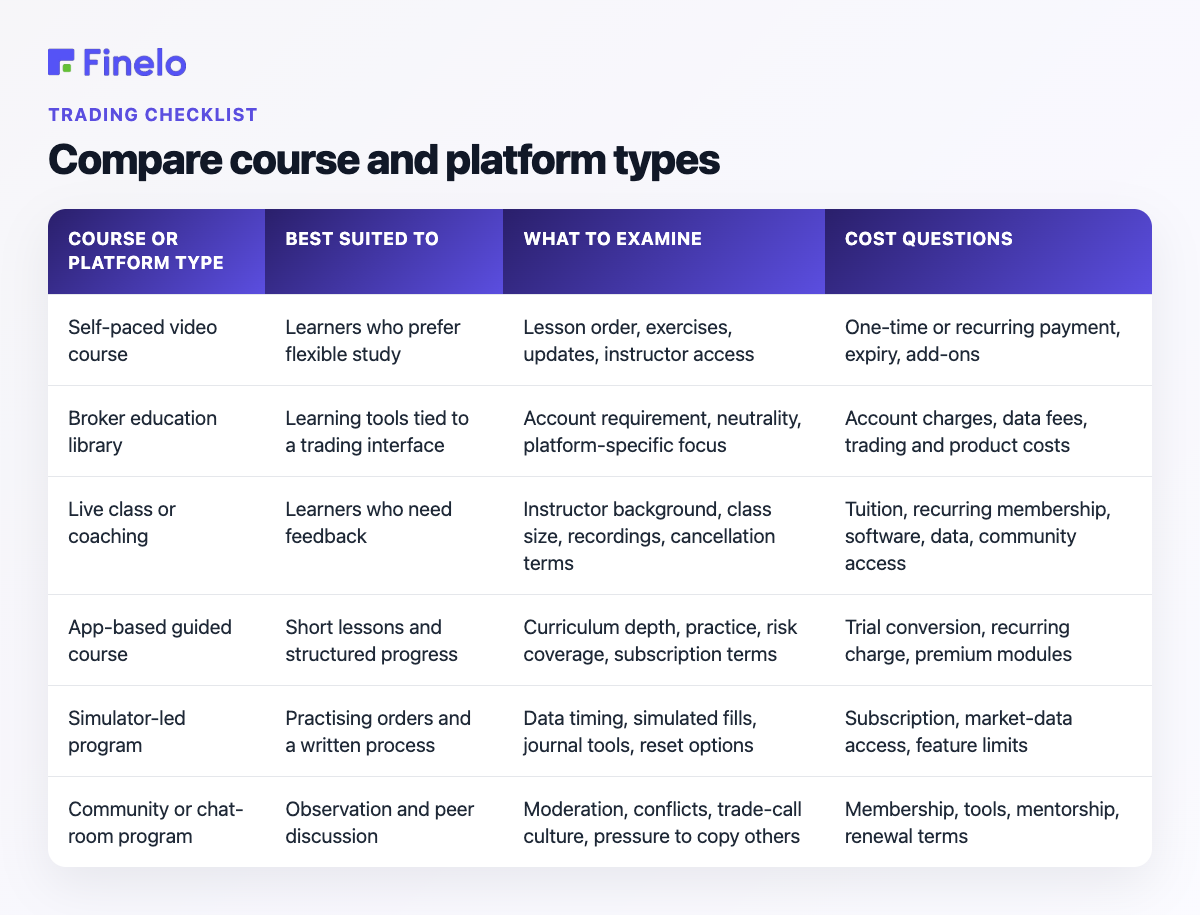
Do not compare only the advertised course price. The full learning cost may include subscriptions, charting software, live data, simulator access, community membership, account charges, or separate advanced modules. Check current terms on the provider’s official pages before paying.
Course evaluation checklist
Before enrolling, confirm that the course:
- States the expected skill level
- Publishes a clear syllabus
- Defines trading and investing separately
- Gives risk management meaningful attention
- Uses examples that include losing trades
- Explains fees, taxes, and regional account rules without pretending they are universal
- Includes exercises, quizzes, or practice tasks
- Shows how to build and review a trading plan
- Identifies instructor and provider conflicts
- States clearly that favourable trading outcomes are uncertain
- Explains cancellation, renewal, and content-access terms
- Provides a way to test whether you understood the material
Red flags
Walk away from a course that claims training will produce regular income, advertises a secret strategy, uses exceptional results as if they were typical, or pressures you to fund an account quickly. Be cautious when the course earns money from referrals but does not disclose how those relationships may influence recommendations.
A certificate can show that you completed a course. It does not prove trading skill, professional status, or favourable future outcomes.
Practice trading with Finelo
Practice in a simulator, learn with bite-sized lessons, and build confidence before risking real money.
Product, Course, App, and Platform Experience
Course content is only part of the learning experience. The product should make it easy to move from an explanation to an exercise, then review what happened.
Before paying or creating a trading account, test the available preview or demo. Check:
- Whether lessons have a clear sequence
- Whether key terms are defined when they first appear
- How charts, order tickets, and risk examples display on your device
- Whether the app separates education, simulation, and real-money actions
- Whether simulated prices and fills are labelled clearly
- Whether progress syncs across the devices you plan to use
- Whether exercises explain incorrect answers
- Whether you can review past decisions and notes
- Whether accessibility, language, and caption options meet your needs
- How support, billing, cancellation, and account deletion work
A polished app can still contain a weak curriculum. A strong curriculum can also become frustrating if navigation hides lessons or practice tools. Evaluate both layers.
Use one practical test: choose a lesson on limit orders, complete its exercise, place a simulated order, and then find the record of that decision. If the experience makes any step unclear—or pushes you toward real-money trading before you understand the exercise—the platform may not suit a beginner.
What Progress After a Course Really Looks Like
Without verified student evidence, dramatic success stories are not a sound way to judge a course. A more useful test is whether the learner’s process improves.
Consider this illustrative scenario:
Maya begins by entering trades after seeing fast-moving stocks online. She has no written entry rule and changes her exit whenever the price moves against her. During a structured course, she narrows her practice to one setup, records the reason for every entry, sets a planned exit, and reviews each decision after the market closes.
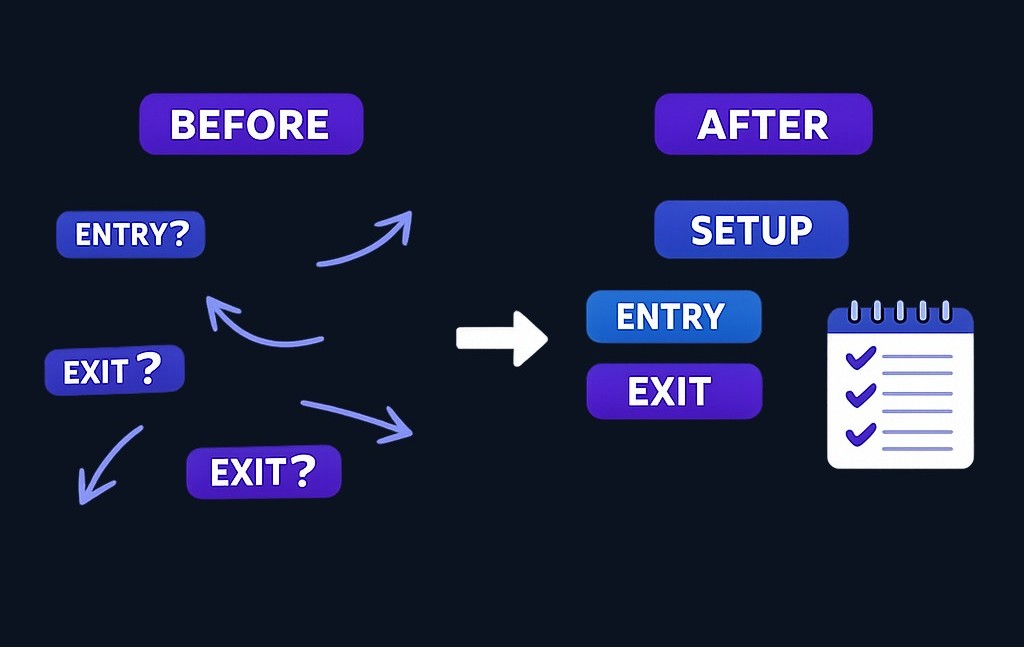
This example does not claim that Maya begins earning money consistently. Her progress is that her decisions become observable and reviewable.
Use a simple learning scorecard:
| Skill | Evidence of progress |
|---|---|
| Market mechanics | Can explain what happens after submitting an order |
| Strategy | Can state the setup and conditions in plain language |
| Risk | Chooses the position limit before entering |
| Discipline | Follows the written exit rule or documents why it changed |
| Review | Separates a good decision from a lucky outcome |
| Psychology | Notices emotional triggers before placing another trade |
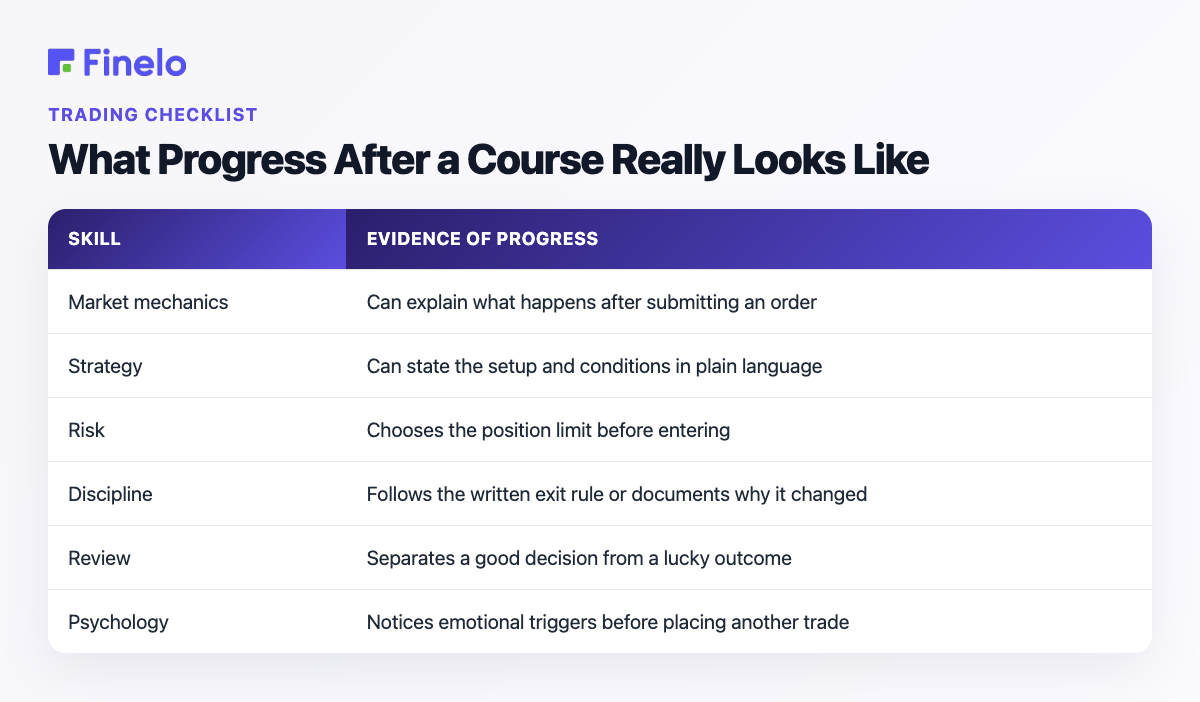
Judge a course by whether it helps you produce this evidence. Testimonials may describe another person’s experience, but they cannot show how you will perform.
Common Beginner Mistakes
Starting with a strategy instead of mechanics
Patterns and indicators are hard to use responsibly when you do not understand spreads, liquidity, and order behaviour.
Better approach: Learn how a trade is placed and filled before evaluating setups.
Treating simulated gains as proof
Paper trading may simplify execution and removes the emotional effect of losing cash.
Better approach: Score rule-following, position sizing, and review quality—not only the virtual balance.
Changing strategies after every loss
No method produces only winning trades. Constantly switching makes it difficult to learn whether a process is coherent.
Better approach: Define the strategy, test it consistently, and decide in advance what evidence would justify a change.
Ignoring total costs
A course fee may be only one part of the expense. Trading itself may involve spreads, account charges, market-data costs, taxes, and poor execution.
Better approach: Create separate budgets for education, tools, and trading capital. Do not use money needed for essential expenses.
Copying instructors or communities
A trade that fits an instructor’s account, timing, and risk tolerance may not fit yours. Delays can also change the available price.
Better approach: Use examples to study a process. Do not place a trade you cannot explain independently.
Skipping regional checks
Broker rules, available products, taxes, and regulatory protections vary by location.
Better approach: Verify current requirements through the relevant provider and local authorities. Use a qualified tax or legal professional when the decision requires personal guidance.
Next Steps: Start With Practice
Choose one course objective, compare curricula with the checklist above, and practise a single setup before considering real-money trading. Keep a journal that records your plan, execution, result, and emotional state.
For a structured educational next step, explore the Finelo AI Trader Challenge. Its official page describes lessons in chart reading, short- to medium-term analysis, preset strategy logic, and simulator practice, while stating that the product is educational rather than a brokerage or personalised signal service.
Trading involves substantial risk, including the possible loss of capital. A course can improve knowledge and process, but trading outcomes remain uncertain and market risk remains.
Frequently asked questions
Can I learn stock trading without experience?
Yes. Start with market mechanics, terminology, orders, and risk before studying strategies. A beginner course should not assume you already know how a brokerage platform or trade setup works.
How much money do I need to start?
Course costs and broker requirements vary. You can learn concepts and practise in a simulator before deciding whether to fund an account. Never treat the money needed for essential expenses as trading capital.
Are free trading courses useful?
They can be useful if the syllabus is structured, current, and serious about risk. A zero-price course is not automatically high quality, and it may lead to paid tools, brokerage promotions, or advanced modules. Check incentives and total costs.
How long does it take to learn stock trading?
There is no universal completion time. Finishing course content is different from applying a process consistently under changing conditions. Measure progress through exercises, journals, and rule-following rather than a promised timetable.
TradingBeginnerEducationMarkets
Practice trading with Finelo
Practice in a simulator, learn with bite-sized lessons, and build confidence before risking real money.
About the author
Finelo Team
The Finelo Team creates practical investing and trading education designed to help beginners learn faster with structured challenges, simulator practice, and bite-sized lessons.
Keep reading — Related articles

Trading
Understanding Walk Forward Analysis in Trading
Brief educational note: this article is educational — not investment advice — and trading involves the risk of loss.
Finelo Team
Trading
VWAP vs Moving Average: Formulas, Uses, and Limits
VWAP weights price by recorded volume over a defined period, while a moving average summarizes a sequence of prices over a rolling lookback.
Finelo Team

Trading
Volume Profile vs Market Profile: What Each Chart Measures
Volume Profile groups traded volume by price level.
Finelo Team