The main difference between investing and trading is the time horizon. Investing usually means buying assets with the aim of holding them for years, while trading means buying and selling more often to respond to shorter-term price moves. Both involve risk. The better choice depends on your goals, patience, time, skill, and comfort with uncertainty.
What is the Difference Between Investing and Trading?
The main difference between investing and trading is the time horizon. Investing usually means buying assets with the aim of holding them for years, while trading means buying and selling more often to respond to…
10 min read
Practice trading with Finelo
Practice in a simulator, learn with bite-sized lessons, and build confidence before risking real money.
Want to learn more?
Practice in a simulator, learn with bite-sized lessons, and build confidence before risking real money.
Explore FineloExplore Finelo's 28-day challenges
Turn learning into a daily habit with guided challenge paths.
That simple answer matters because people often use "investing" and "trading" as if they mean the same thing. They do not. A person building a long-term portfolio needs a different plan from someone studying chart patterns and managing active positions. This guide explains the difference in plain English, shows where the two overlap, and gives you a practical way to decide which approach fits your current life.
Defining Investing and Trading
Investing is the practice of buying an asset because you believe it can become more valuable over a longer period. The asset might be a stock, fund, bond, or another financial instrument. The key idea is ownership plus patience. An investor usually asks: "Is this worth owning for a long time, and does it fit my broader plan?"
That broader plan is often called a portfolio. A portfolio is simply the mix of assets you own. A long-term investor may build a portfolio around diversification, which means spreading money across different holdings so one bad outcome does not decide everything. Diversification does not remove risk, but it can make a plan less dependent on a single company, sector, or market moment.
Trading is more active. A trader buys and sells assets to respond to shorter-term price movement. The trader may care less about owning the asset for years and more about whether the price may move over a shorter window. That window can vary widely. Some traders watch very short periods. Others hold positions for days, weeks, or months.
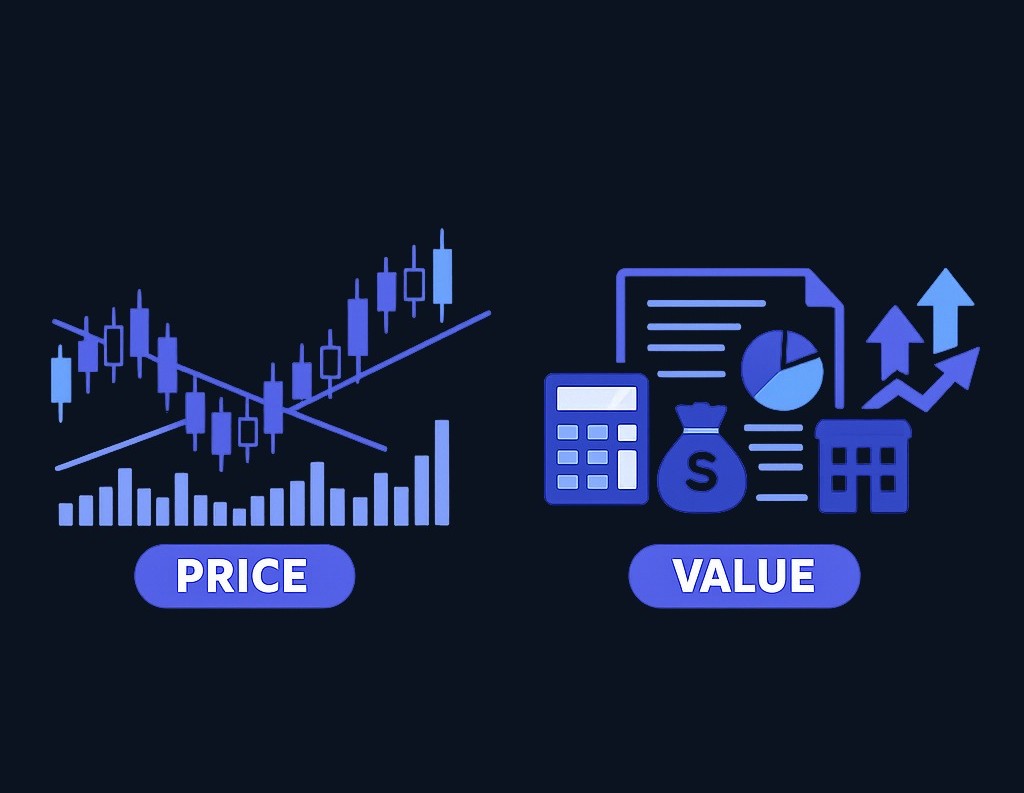
Trading often uses technical analysis. That means studying price charts, volume, trends, and patterns to make decisions. Investing often uses fundamental analysis. That means studying the business, asset quality, earnings, valuation, balance sheet strength, competition, and long-term prospects. The two methods can overlap, but they answer different questions. Technical analysis asks, "What is price doing now?" Fundamental analysis asks, "What is this asset likely worth over time?"
Neither approach is automatically smart or reckless. A patient investor can still make a poor decision. A trader can still be disciplined. The real difference is the job each person is trying to do.
Key Differences Between Investing and Trading
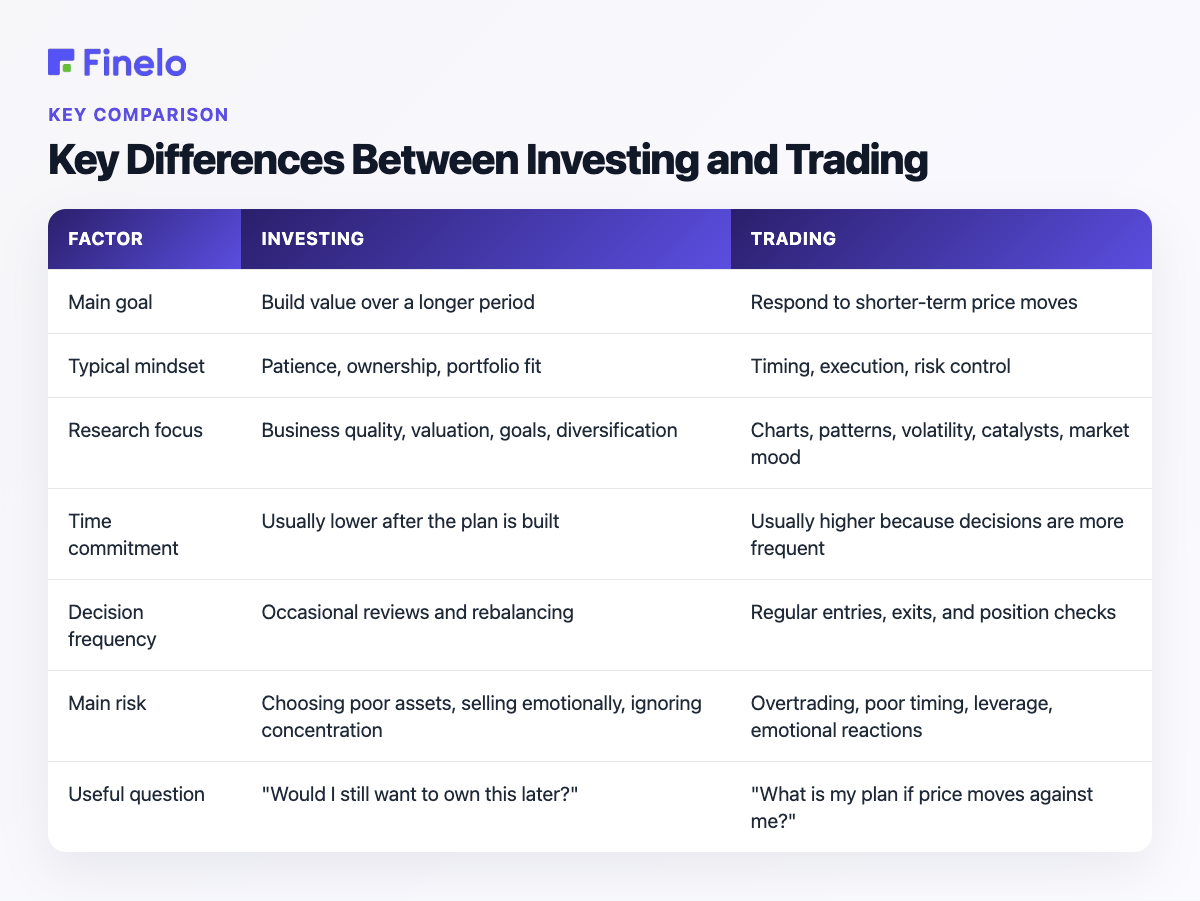
The biggest difference is not the button you click. Both investors and traders buy and sell. The difference is the reason behind the action. Investors usually seek long-term growth from assets they are willing to hold. Traders usually seek shorter-term opportunity from price movement.
| Factor | Investing | Trading |
|---|---|---|
| Main goal | Build value over a longer period | Respond to shorter-term price moves |
| Typical mindset | Patience, ownership, portfolio fit | Timing, execution, risk control |
| Research focus | Business quality, valuation, goals, diversification | Charts, patterns, volatility, catalysts, market mood |
| Time commitment | Usually lower after the plan is built | Usually higher because decisions are more frequent |
| Decision frequency | Occasional reviews and rebalancing | Regular entries, exits, and position checks |
| Main risk | Choosing poor assets, selling emotionally, ignoring concentration | Overtrading, poor timing, leverage, emotional reactions |
| Useful question | "Would I still want to own this later?" | "What is my plan if price moves against me?" |
Risk looks different in each approach. Investors face market declines, weak asset selection, concentration, and the temptation to abandon a plan during volatility. Traders face those risks too, plus the added pressure of faster decisions. When decisions come faster, small mistakes can stack up. A trade with no exit plan can become an accidental investment. An investment with no thesis can become a hope-based position.
Time commitment also changes the experience. A long-term investor may spend more effort upfront: choosing an approach, deciding how much risk is appropriate, and setting review habits. After that, the plan may need periodic attention rather than constant monitoring. A trader often needs a tighter process. Before entering a trade, the trader should know the setup, position size, invalidation point, exit plan, and reason for taking the trade.
Costs and taxes can also affect the result, especially when buying and selling is frequent. The exact effect depends on the account, country, broker, asset, and holding period, so it is worth checking current rules with a qualified tax professional before building an active strategy. The practical point is simple: a strategy should be judged after all real-world frictions, not only by the attractive part of the idea.
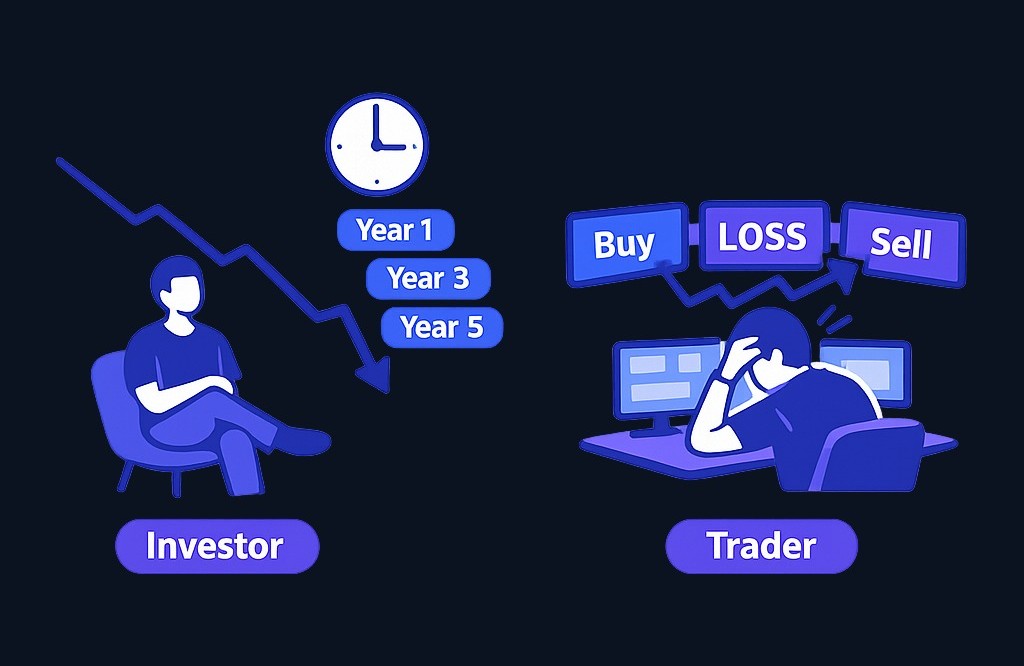
The psychological load is different too. Investing tests patience. Trading tests speed, discipline, and emotional control. Investors may struggle when a portfolio falls and the news feels loud. Traders may struggle when a quick loss tempts them to revenge trade, which means taking a new trade mainly to win back the last loss. In both cases, the market punishes vague plans.
Similarities Between Investing and Trading
Investing and trading share more than beginners expect. Both involve uncertainty. Both require capital that you can afford to put at risk. Both benefit from education, a written plan, and a clear rule for what you will not do.
Both also require risk management. Risk management means deciding how much you are willing to lose before the outcome is known. For an investor, that may mean limiting concentration in one asset, keeping enough cash for near-term needs, and choosing a portfolio that will not be abandoned at the first sign of stress. For a trader, it may mean using position sizing, stop levels, and limits on how many trades can be taken in a day or week.
Both approaches also need a feedback loop. Investors can review whether their portfolio still matches their goals. Traders can review a trade journal to see whether they followed the plan or acted impulsively. A journal does not need to be complicated. It can record the reason for the decision, the risk taken, the outcome, and one lesson. Over time, that record helps separate process from luck.
Finally, both investing and trading work better when the person understands the tool they are using. A beginner does not need to master every market term at once. But they should know what they own, what could go wrong, what would make them change the plan, and how the decision fits their life. If those answers are missing, the next step is not a bigger position. It is more learning.
Practice trading with Finelo
Practice in a simulator, learn with bite-sized lessons, and build confidence before risking real money.
Who Should Invest and Who Should Trade?
Investing is usually the better starting point for someone with long-term goals, limited time, and a preference for a calmer process. That person may want to build knowledge slowly, avoid frequent decisions, and focus on consistency. Investing may also fit someone who dislikes watching prices all day and does not want their schedule tied to market movement.
Trading may fit someone who has the time and temperament for active decisions. That person should be comfortable studying price behavior, practicing with a defined process, accepting losses without spiraling, and tracking results honestly. Trading is not just "being more involved." It is a skill-based activity where the process matters as much as the idea.
Use this quick framework:
| If this sounds like you | The better starting point may be |
|---|---|
| "I have a long goal and want a plan I can review periodically." | Investing |
| "I enjoy research but do not want to watch markets constantly." | Investing |
| "I want to learn chart behavior and can practice without rushing." | Trading education before real trades |
| "I react emotionally to losses and want fast wins." | Neither yet; start with education and simulated practice |
| "I want both long-term growth and a small active learning sleeve." | A separated investing plan plus a limited practice framework |
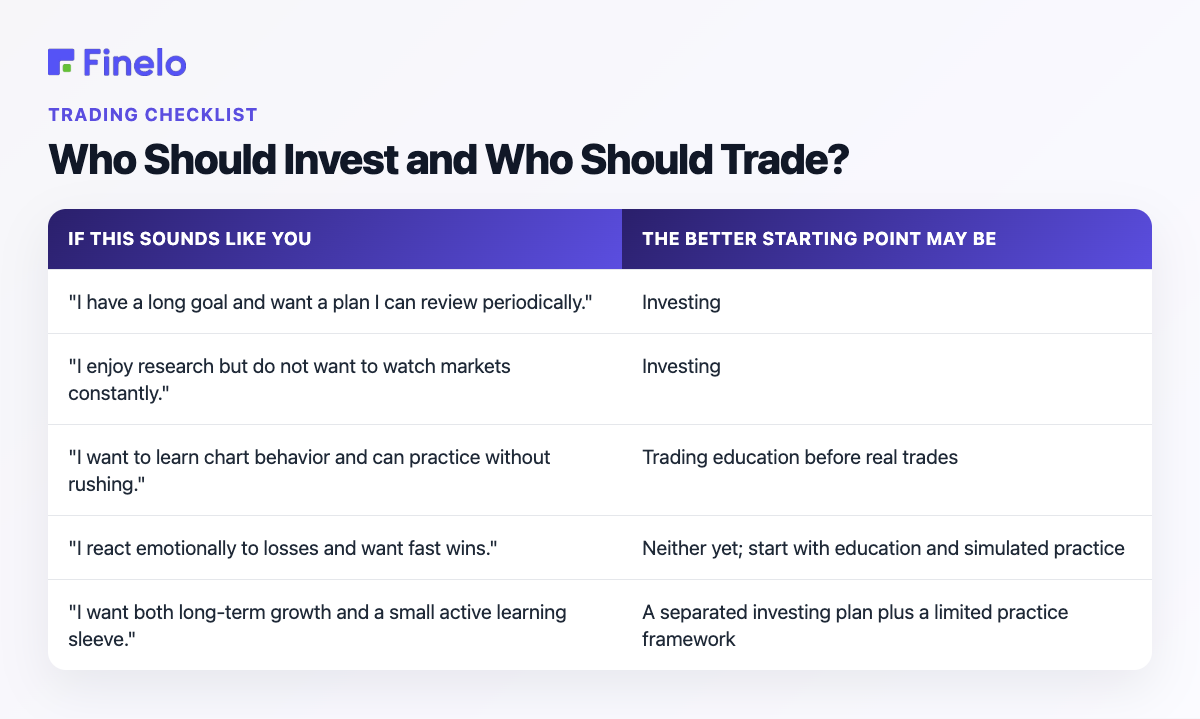
The last row is important. You do not have to turn this into a personality test. Some people invest for long-term goals and also study trading with a small, clearly separated practice budget. The separation matters. Do not let a short-term trade become part of your retirement plan because it moved against you. Do not let a long-term investment become a trade because the price moved for one week.
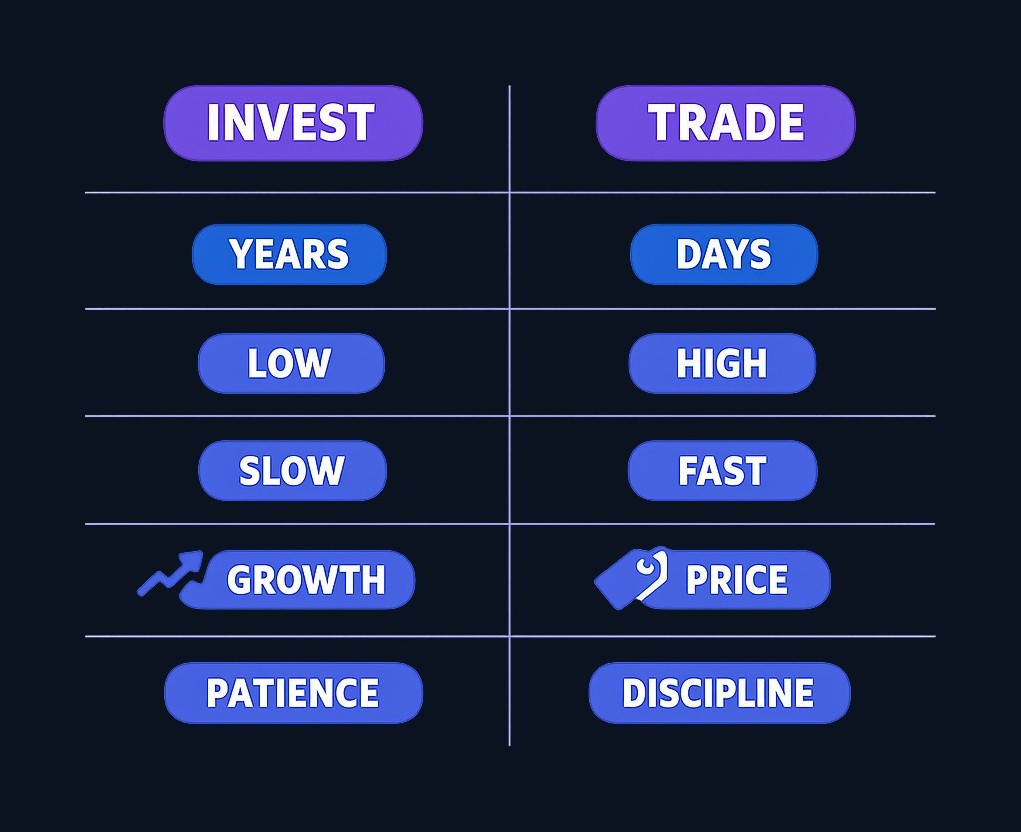
A useful rule is to name the decision before you make it. If it is an investment, write the long-term reason for owning it. If it is a trade, write the setup, risk, and exit plan. If you cannot name it, you probably do not have a plan yet.
Practical Examples of Investing and Trading
Consider two beginners with different goals.
Maya wants to build knowledge and make calmer long-term decisions. She is not trying to watch prices during the workday. Her first task is to understand asset types, diversification, risk tolerance, and how to evaluate a long-term thesis. A thesis is the reason an asset belongs in a plan. For Maya, a good process might include writing down why she wants exposure to an asset, what could weaken that reason, and when she will review it.
Now consider Leo. Leo is interested in short-term market movement. He enjoys charts, but he also knows that excitement is not a strategy. Before risking real money, his useful tasks are different from Maya's. He needs to learn how support and resistance work, how to size positions, how to define a stop, how to avoid overtrading, and how to review results. A simulated environment can help him practice the mechanics without treating early practice as proof of skill.
Here is how the same market drop might affect each person:
| Situation | Investor response | Trader response |
|---|---|---|
| A strong asset falls after broad market weakness | Review whether the long-term thesis changed | Check whether the trade setup is invalid |
| Price moves quickly against the position | Avoid panic if the position still fits the plan | Follow the prewritten exit rule |
| News creates volatility | Ask whether the news affects long-term value | Decide whether volatility fits the setup or increases risk |
| The position rises fast | Consider whether allocation still fits the portfolio | Take profit, trail risk, or exit based on the plan |
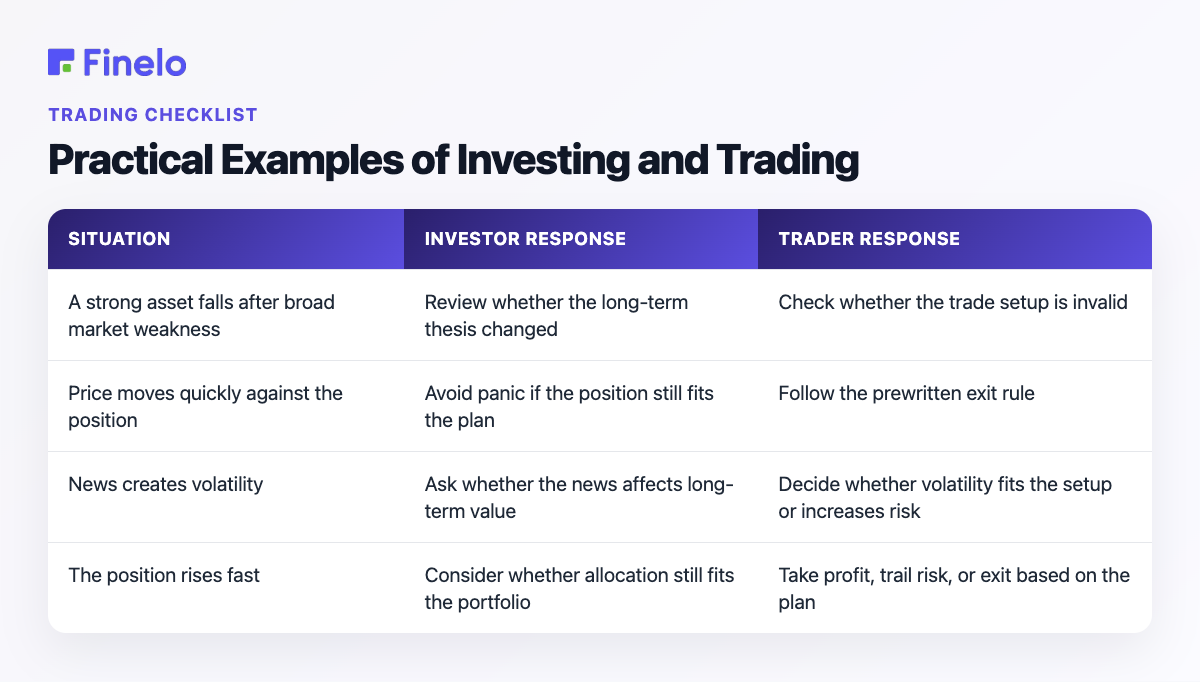
These examples show why the labels matter. The investor is not ignoring risk. The trader is not ignoring research. They are solving different problems.
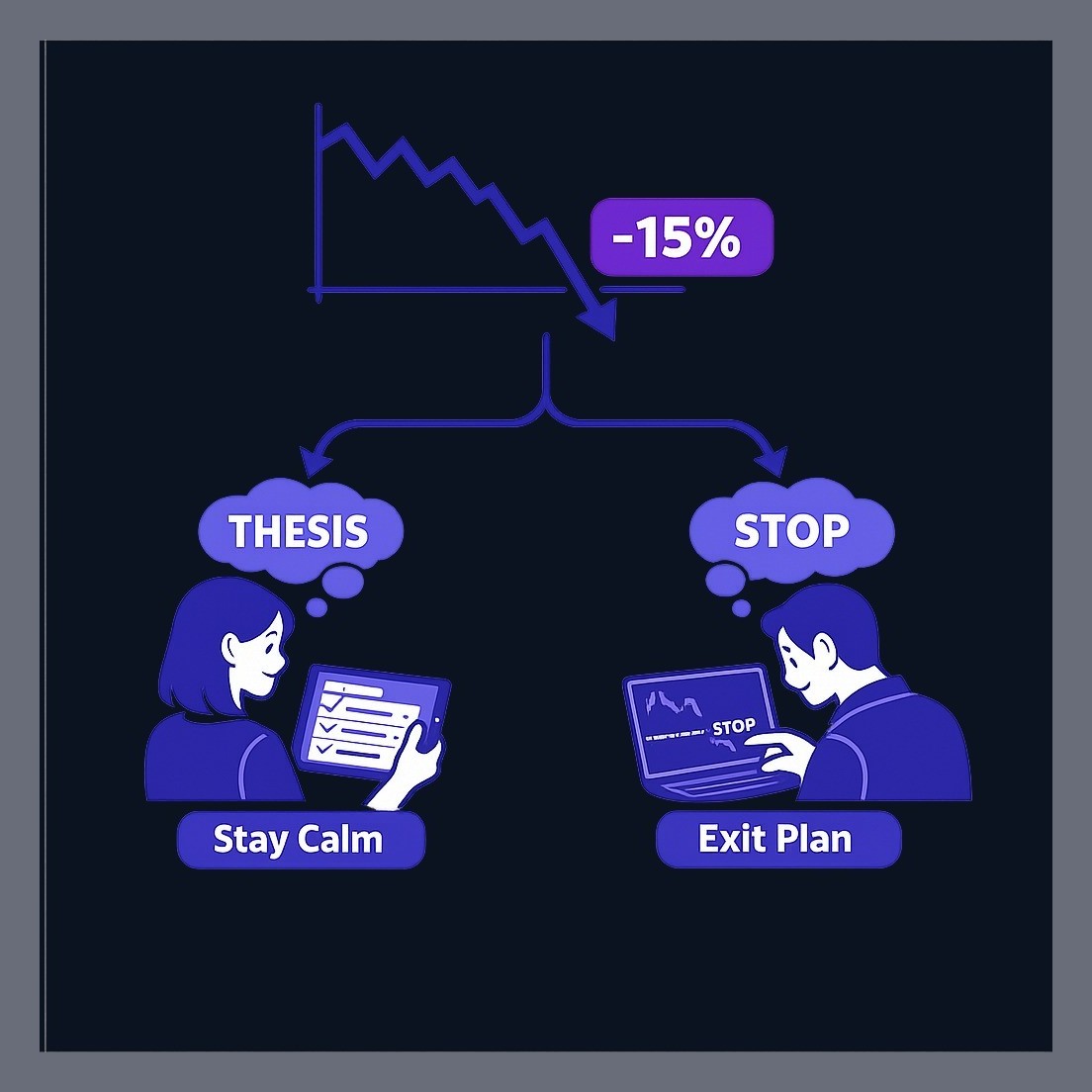
Psychology is often the hidden divider. Investors can get hurt by impatience, performance chasing, or checking prices so often that a long-term plan starts to feel like a daily scorecard. Traders can get hurt by FOMO, overconfidence after a win, and the urge to increase size after a loss. FOMO means fear of missing out. It is the feeling that you must act now because everyone else seems to be making money. In markets, that feeling can turn a weak idea into an expensive lesson.
The fix is boring in the best way: rules before action. Decide the purpose, risk, review schedule, and exit conditions before money is involved. A plan written after the price moves is usually just an emotional explanation.
How to Learn the Right Skills Before You Choose
If you are new, do not start by asking which approach is more exciting. Start by asking which skill set you need first.
For investing, the core skills are:
- Understanding asset classes and how they behave differently.
- Building a portfolio that matches your goals and risk tolerance.
- Reading basic financial information without drowning in jargon.
- Staying patient when short-term news is noisy.
- Reviewing your plan without constantly rewriting it.
For trading, the core skills are:
- Reading charts and price levels.
- Defining a setup before entering a position.
- Managing position size and downside risk.
- Keeping a trade journal.
- Controlling emotional decisions under pressure.
Finelo's AI Investing Challenge is positioned around long-term investing research, portfolio construction, diversification, patience, and AI-assisted thesis building. Its AI Trader Challenge focuses on active trading concepts, chart reading, market analysis, risk management, emotional discipline, and simulator practice.
That distinction is useful even if you are only comparing approaches. Investing education should help you think in years and portfolios. Trading education should help you think in setups, risk, and execution. Mixing the two too early can create confusion. Learn the language of each path, then choose the one that matches your real goal.
One practical next step: choose one sample asset and analyze it twice. First, write an investor's note: why might someone own it for a long time, what risks matter, and how would it fit a portfolio? Then write a trader's note: what is price doing now, where would the setup be wrong, and what would the exit plan be? This exercise makes the difference concrete.
Conclusion
Investing and trading both involve markets, risk, and the possibility of loss. The difference is the job you are asking your money, attention, and decision-making process to do. Investing is usually about long-term ownership and portfolio building. Trading is usually about shorter-term setups and active execution.
If you are still unsure, do not rush the label. Learn the basics, practice the decision process, and write down your rules before you act. Finelo describes itself as an educational platform only, not a provider of trading or financial advice, so use education as preparation, not as a substitute for your own judgment. The best next step is not choosing the flashier path. It is choosing the path you can follow clearly, calmly, and responsibly.
Frequently asked questions
What is the main difference between investing and trading?
The main difference is time horizon and intent. Investing focuses on owning assets for longer-term growth. Trading focuses on buying and selling more actively to respond to shorter-term price movement.
Can I combine investing and trading?
Yes, but keep the plans separate. A long-term portfolio should not be disrupted by every short-term price move. A trading plan should not become a long-term holding just because the trade went wrong.
Is trading riskier than investing?
Trading often adds risks that come from frequent decisions, timing pressure, leverage, and emotional reactions. Investing still involves risk, including market declines and poor asset selection. The risk level depends on the strategy, asset, position size, and the person's discipline.
How do I choose between investing and trading?
Start with your goal, available time, and temperament. If you want a longer-term plan with fewer decisions, investing may fit better. If you want to study short-term price movement and can practice with strict rules, trading education may be worth exploring before real-money decisions.
TradingBeginnerMarkets
Practice trading with Finelo
Practice in a simulator, learn with bite-sized lessons, and build confidence before risking real money.
About the author
Finelo Team
The Finelo Team creates practical investing and trading education designed to help beginners learn faster with structured challenges, simulator practice, and bite-sized lessons.
Keep reading — Related articles
Trading
Understanding Walk Forward Analysis in Trading
Brief educational note: this article is educational — not investment advice — and trading involves the risk of loss.
Finelo Team
Trading
VWAP vs Moving Average: Formulas, Uses, and Limits
VWAP weights price by recorded volume over a defined period, while a moving average summarizes a sequence of prices over a rolling lookback.
Finelo Team
Trading
Volume Profile vs Market Profile: What Each Chart Measures
Volume Profile groups traded volume by price level.
Finelo Team