Futures create a two-sided commitment tied to a future price, while an option gives the buyer a right they may choose to use. Futures usually fit direct, linear exposure or firm hedging needs. Long options can fit one-sided protection or a directional idea with a defined upfront premium. Neither is automatically safer: contract size, leverage, time, volatility, and whether you buy or sell the contract all shape the risk.
Futures vs Options: Understanding the Key Differences
Futures create a two-sided commitment tied to a future price, while an option gives the buyer a right they may choose to use. Futures usually fit direct, linear exposure or firm hedging needs. Long options can fit…
11 min read
Practice trading with Finelo
Practice in a simulator, learn with bite-sized lessons, and build confidence before risking real money.
Want to learn more?
Practice in a simulator, learn with bite-sized lessons, and build confidence before risking real money.
Explore FineloExplore Finelo's 28-day challenges
Turn learning into a daily habit with guided challenge paths.
This Finelo educational comparison is for readers who know basic market terms but need a practical way to choose between these derivatives.
What Are Futures?
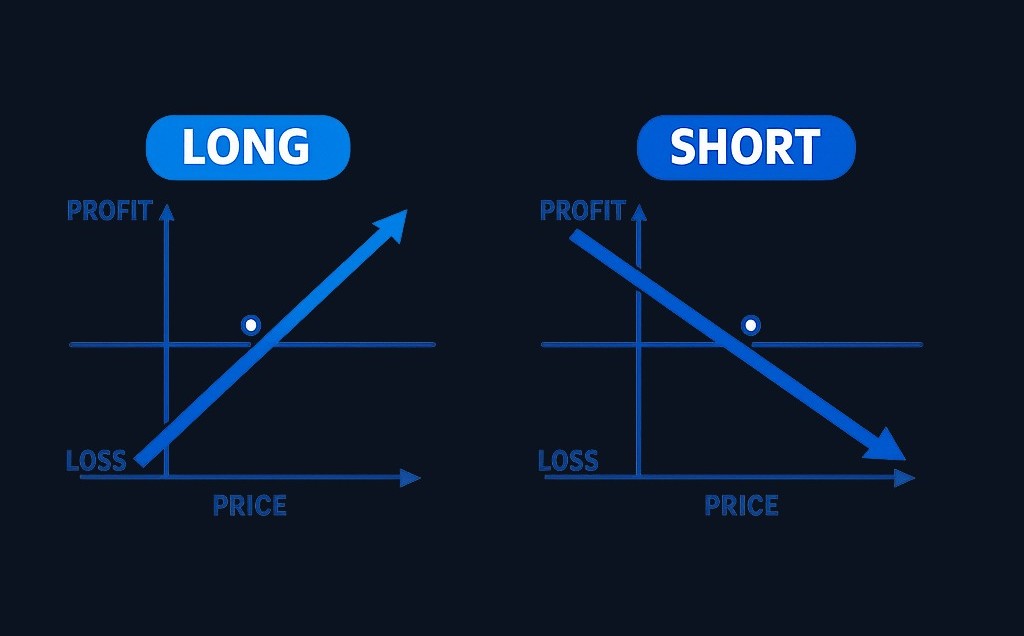
A futures contract sets terms for buying or selling a specified underlying exposure at a future date. For comparison purposes, think of a long futures position as gaining when the quoted futures price rises and losing when it falls. A short position behaves in the opposite direction.
The contract specification matters as much as the market view. Before trading, identify:
- The underlying asset or reference rate
- The contract size and minimum price movement
- The expiration month
- Whether settlement is in cash or can involve delivery
- The initial and ongoing margin requirements
- The final trading and settlement procedures
Margin is collateral rather than the full value represented by the contract. It can make futures capital-efficient, but it also magnifies the effect of a market move on the cash committed to the position. CME Group describes futures as controlling a large contract value with a relatively small margin amount and presents futures and options on futures as tools used to manage risk (CME Group).
Futures are often useful when the desired payoff is straightforward. If the market moves one unit in your favor, the position gains roughly that unit multiplied by the contract’s value per unit. If it moves against you, the loss changes in the same direct way. Actual account results also reflect fees, daily account adjustments, contract rules, and any offsetting positions.
This linear exposure is easy to visualize but not necessarily easy to manage. A trader must know how much one adverse move would cost, when more margin might be required, and what happens if the position remains open near expiration.
What Are Options?
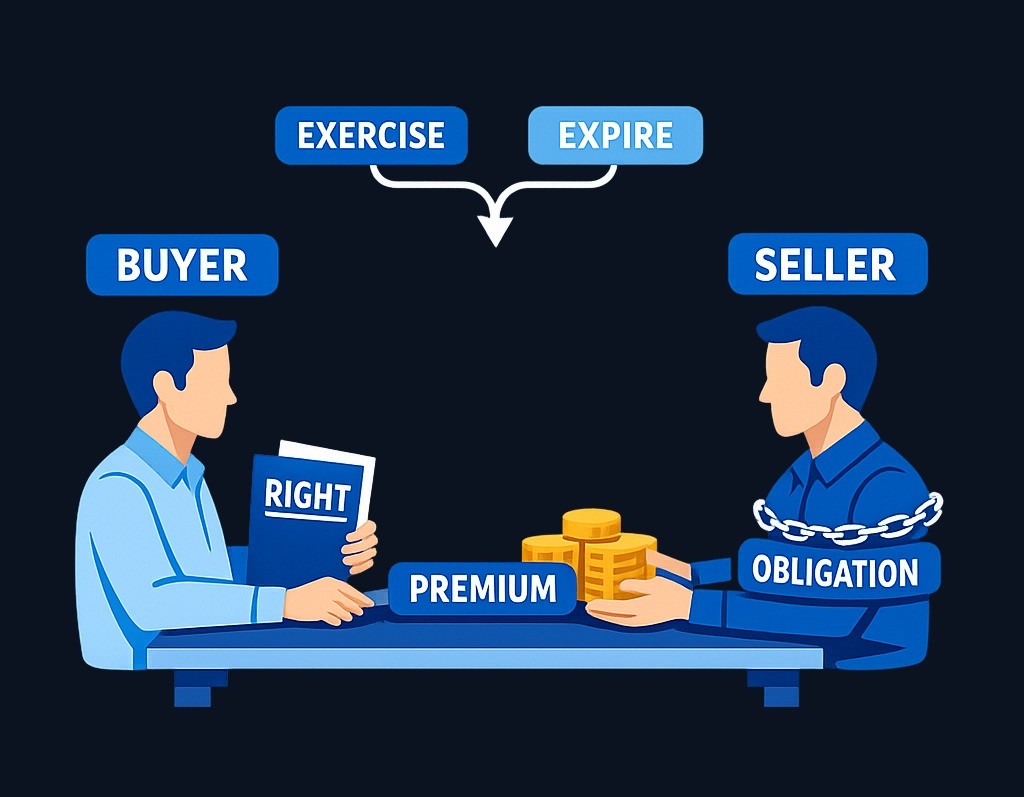
An option separates the buyer’s right from the seller’s obligation. A call gives its buyer the right to buy or receive positive exposure under the contract terms. A put gives its buyer the right to sell or receive negative exposure. The price paid for that right is the premium.
Four terms drive the basic option decision:
- Underlying: The asset, futures contract, index, or other reference
- Strike price: The level used to determine the option’s exercise value
- Expiration: The point when the option ends
- Premium: The price of the option
A long option can expire without being used. In that standalone position, the buyer’s loss is limited to the premium and related trading costs. The seller receives the premium but accepts an obligation if the contract is exercised or assigned. That obligation can create losses much larger than the premium received, depending on the option and any offsetting position.
An option’s value depends on more than direction. The underlying price can move the way the buyer expected, yet the trade can still disappoint if the move is too small, happens too late, or is offset by a change in expected volatility. This is why options traders refer to time decay: as expiration approaches, the remaining time for a favorable move shrinks.
Options can express many payoff shapes. Buying a call or put creates a different risk profile from selling one. Combining options can cap gains, cap losses, create a trading range, or target volatility. Treat “options” as a family of strategies rather than one product with one risk level.
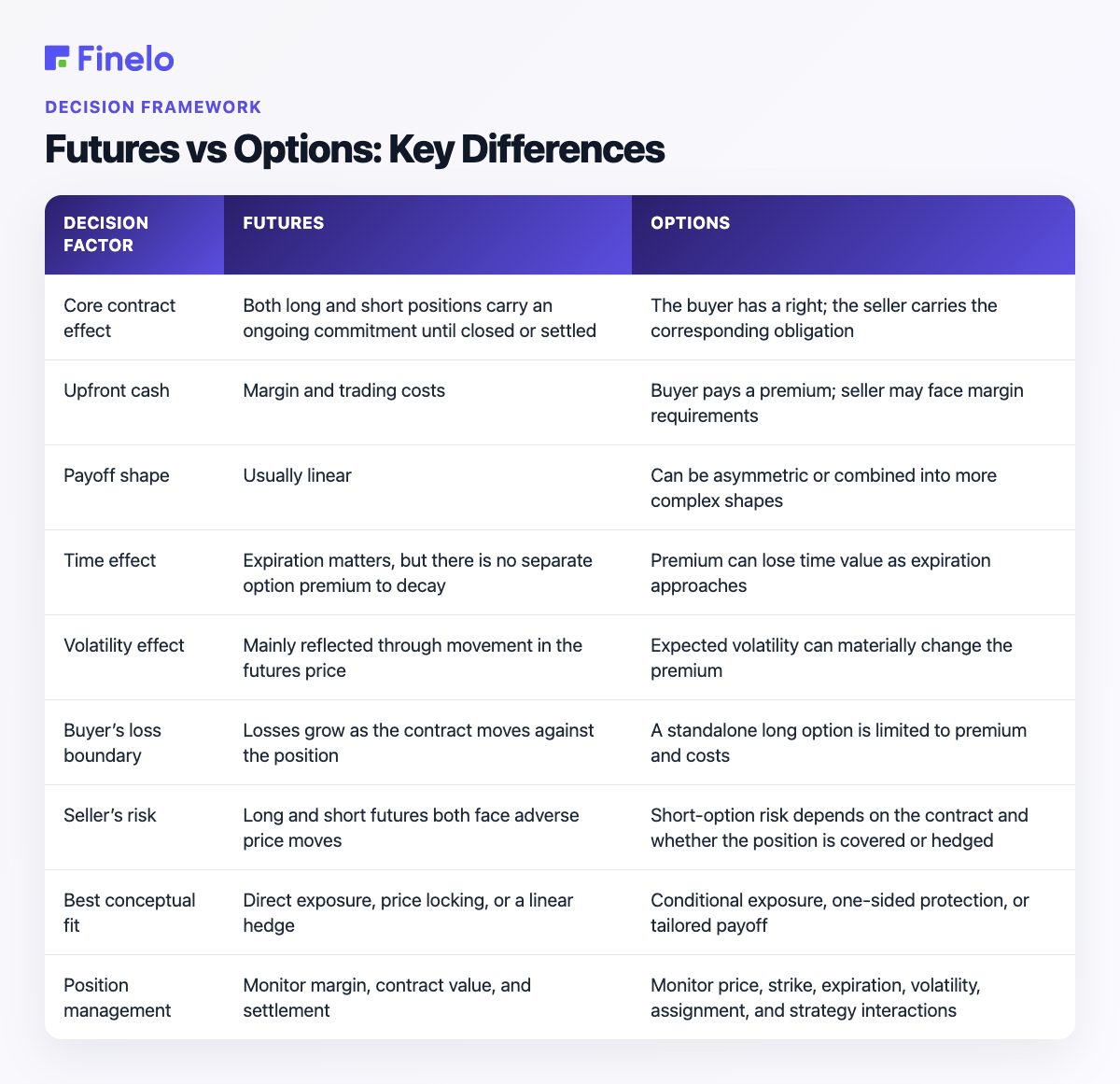
Futures vs Options: Key Differences
| Decision factor | Futures | Options |
|---|---|---|
| Core contract effect | Both long and short positions carry an ongoing commitment until closed or settled | The buyer has a right; the seller carries the corresponding obligation |
| Upfront cash | Margin and trading costs | Buyer pays a premium; seller may face margin requirements |
| Payoff shape | Usually linear | Can be asymmetric or combined into more complex shapes |
| Time effect | Expiration matters, but there is no separate option premium to decay | Premium can lose time value as expiration approaches |
| Volatility effect | Mainly reflected through movement in the futures price | Expected volatility can materially change the premium |
| Buyer’s loss boundary | Losses grow as the contract moves against the position | A standalone long option is limited to premium and costs |
| Seller’s risk | Long and short futures both face adverse price moves | Short-option risk depends on the contract and whether the position is covered or hedged |
| Best conceptual fit | Direct exposure, price locking, or a linear hedge | Conditional exposure, one-sided protection, or tailored payoff |
| Position management | Monitor margin, contract value, and settlement | Monitor price, strike, expiration, volatility, assignment, and strategy interactions |
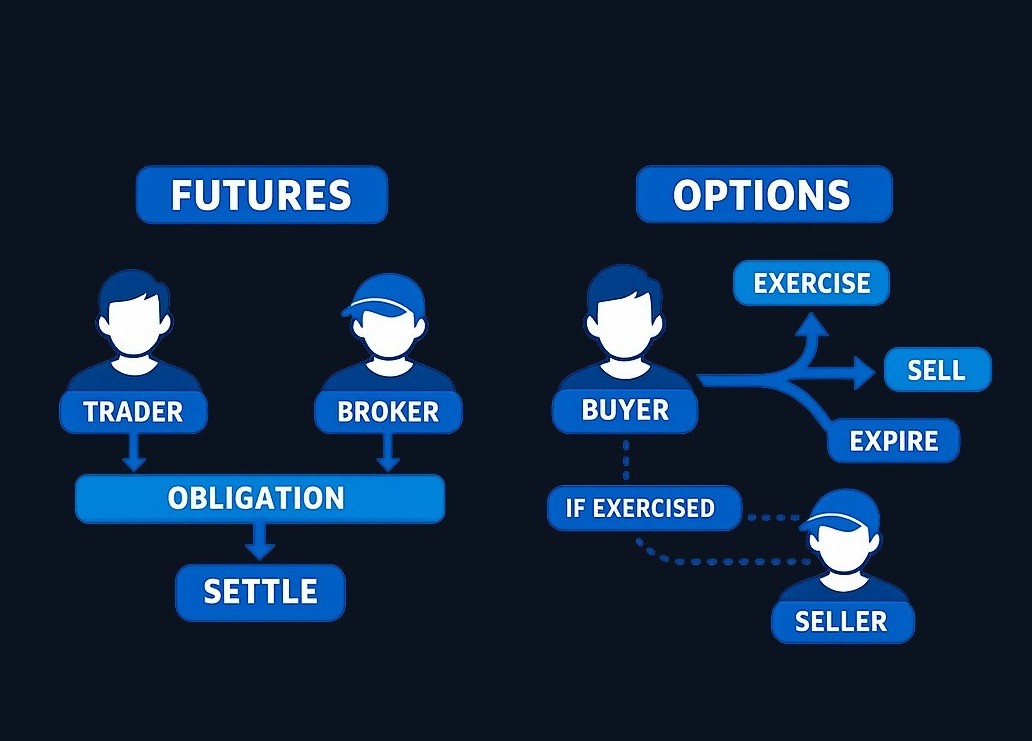
The main difference is obligation versus choice. Futures keep both sides exposed to price changes unless the position is closed or settled. An option buyer pays for the choice to exercise, sell, or let the option expire under its terms.
Cost also works differently. Futures traders should review commissions, exchange and clearing charges, bid-ask spread, data fees, and the cash required for margin. Options traders should review those items plus the premium and possible exercise or assignment costs. Broker and exchange schedules vary, so compare the current charges for the exact contract and account.
Neither product has a universal performance advantage. A futures position may be more efficient for a move that happens as expected. An option may be more suitable when limiting the buyer’s loss matters more than obtaining one-for-one exposure. The correct comparison is the payoff after premiums, fees, slippage, margin needs, and taxes—not the raw market move.
When to Use Futures vs Options
Use the objective first and the instrument second.
Consider futures when:
- You want direct exposure that rises and falls with the underlying reference.
- You need to offset a known price exposure with a similarly sized hedge.
- You can monitor margin and respond to adverse price changes.
- You understand the contract’s expiration and settlement process.
- The option premium would undermine the purpose of the position.
Consider buying options when:
- You want protection against one direction while keeping the benefit of a favorable move.
- You want to cap the cash at risk in a standalone directional position at the premium and costs.
- The timing of a possible move is defined well enough to choose an expiration.
- You need a payoff that starts only beyond a chosen strike.
- You understand that an option can lose value even when the market moves somewhat in the expected direction.
Use extra caution before selling options when:
- The maximum loss is unclear.
- The position is described as “income” without showing the adverse scenario.
- Assignment would create an exposure you cannot fund or manage.
- Several legs depend on one another and you do not understand what happens if one leg is closed.
- The account cannot absorb a sudden increase in margin requirements.
A useful decision shortcut is to write one sentence before choosing:
I need this position to ______ if the market ______ by ______ before ______.
If the blank requires direct exposure from the first price move, futures may be easier to map. If it requires protection beyond a threshold or a fixed loss budget for the buyer, an option may map better. If you cannot complete the sentence with a size, condition, and time horizon, the trade is not yet defined.
Practice trading with Finelo
Practice in a simulator, learn with bite-sized lessons, and build confidence before risking real money.
Risk Analysis
Futures and options are leveraged derivatives. A small underlying move can produce a much larger percentage change relative to the cash placed in the account. CME Group lists futures and options on futures across markets such as interest rates and describes their use in managing risk, but a risk-management tool can also create risk when the contract is too large or the direction is wrong (CME Group).
Futures risk checklist
- Contract-size risk: One contract may represent more exposure than the trader intended.
- Margin risk: An adverse move may require additional cash or force the position to close.
- Gap risk: The market may move past the intended exit level before an order fills.
- Basis risk: A hedge may not move exactly like the exposure it is meant to offset.
- Expiration risk: Settlement or delivery rules may create an unwanted obligation.
- Liquidity risk: Exiting at the expected price may be difficult in a thin contract or stressed market.
Options risk checklist
- Premium risk: A long option can lose the entire premium and costs.
- Time risk: The expected move may happen after the option expires.
- Volatility risk: A change in expected volatility may reduce the option’s value.
- Strike risk: A move can be directionally correct but insufficient for the chosen strike.
- Assignment risk: A short option may create an underlying position or settlement obligation.
- Complexity risk: Multiple legs can behave differently as price, time, and volatility change.
Avoid comparing only the “maximum loss” shown for one leg. A covered, spread, or portfolio position must be evaluated as a whole. Also test what happens if liquidity worsens, the market gaps, margin rises, or the hedge and the original exposure stop moving together.
Before placing either trade, calculate the position’s response to at least three conditions: the expected move, a meaningful adverse move, and no move at all. Then repeat the test shortly before expiration. This catches strategies that look attractive only under one narrow path.
Worked Scenarios
These examples are simplified and use invented numbers to explain payoff logic. They exclude fees, taxes, slippage, margin changes, and contract-specific settlement rules.
Scenario 1: A business expects to buy a commodity
A manufacturer expects to buy a commodity in three months and worries that its price will rise.
- Futures approach: A long futures hedge offsets part of the effect of a price increase. If the commodity price falls instead, the futures position loses while the physical purchase becomes cheaper.
- Options approach: Buying a call creates a ceiling-like protection above the strike while preserving the benefit of a lower cash-market price. The tradeoff is the premium, which is paid even if the protection is never needed.
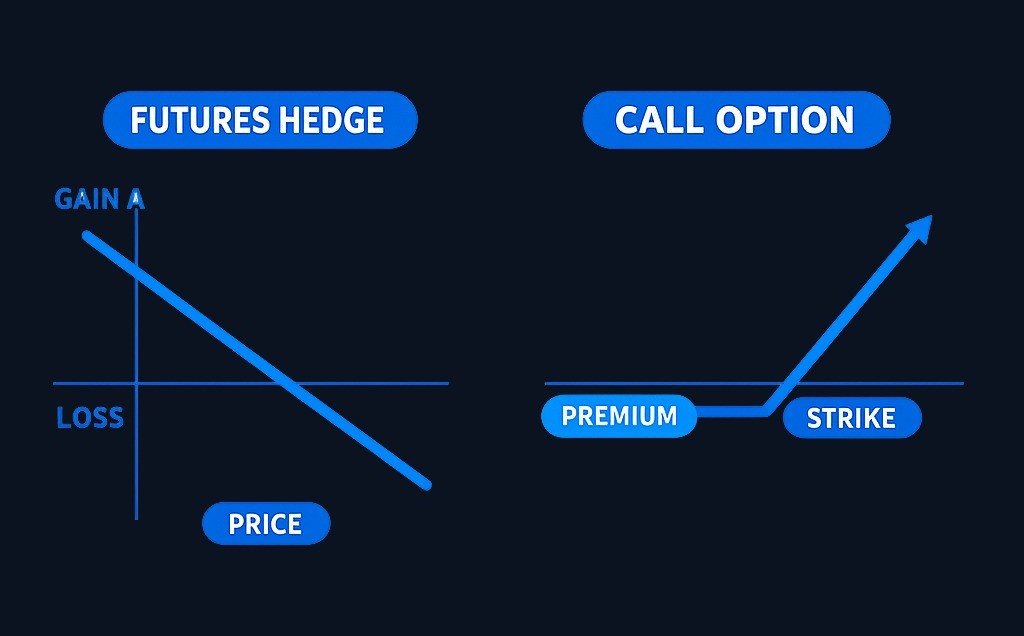
Futures may fit when reducing price uncertainty is the main goal. A call may fit when the business wants protection but still values the benefit of a price decline.
Scenario 2: An investor wants temporary downside protection
An investor plans to keep a diversified portfolio but worries about a short-term decline.
- Futures approach: Selling an equity-index futures contract can offset market losses more directly. It can also offset gains if the market rises.
- Options approach: Buying a put can add protection below a chosen strike while allowing the portfolio to participate in gains. The premium reduces the portfolio’s result whether or not the put is used.
The better fit depends on whether the priority is a strong linear hedge or one-sided insurance with a known premium.
Scenario 3: A trader expects a fast price increase
Assume a market is quoted at 100. A trader expects it to rise soon.
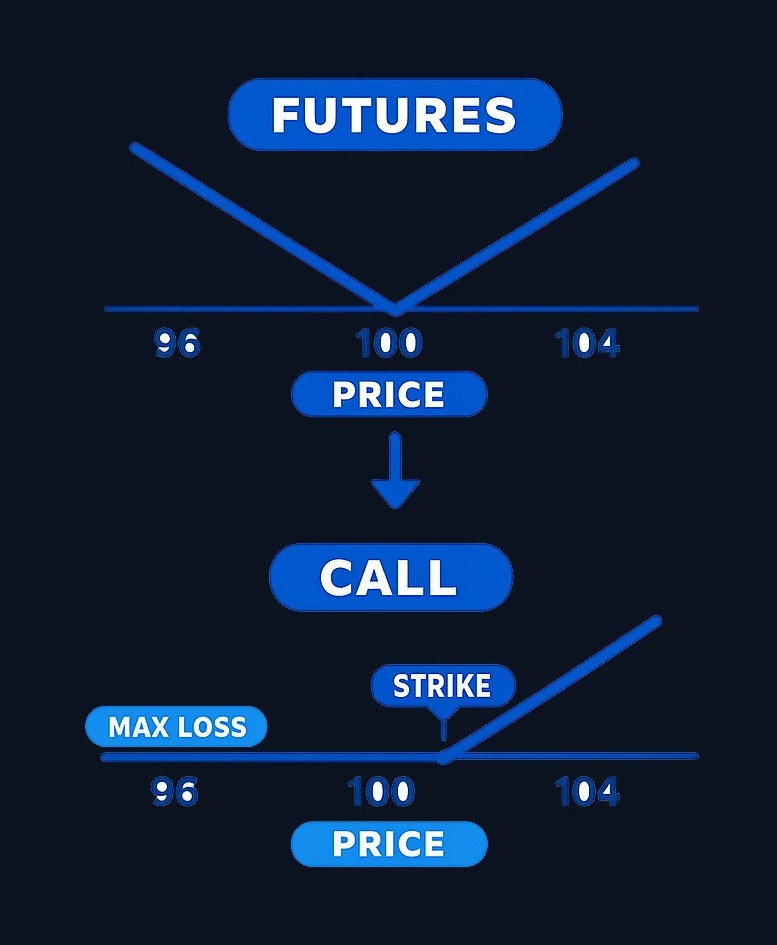
- Futures approach: A long futures position gains or loses directly as the quoted price changes. A move from 100 to 104 is favorable; a move to 96 is adverse. The cash impact depends on the contract multiplier.
- Options approach: A call with a strike near 100 needs enough price movement, soon enough, to offset the premium and any loss of time value.
The futures position provides cleaner directional exposure but can create open-ended losses as the market falls. The call buyer gives up the premium if the thesis fails, but does not receive one-for-one exposure in every market condition.
Scenario 4: A trader expects volatility but is unsure of direction
A futures position requires a directional choice. Options can combine a call and put to express a view that the market will move substantially, although the combined premiums create a higher hurdle. This strategy can still lose if the move is too small or arrives too late.
This is a case where the instrument follows the forecast. Futures fit a directional view. Options can express a view about direction, magnitude, timing, or volatility—but each extra dimension adds complexity.
Costs and Tax Questions
Do not assume futures are cheap because margin is small, or options are cheap because one contract’s premium looks modest. Compare the full position.
For futures, check:
- Round-trip commissions and exchange charges
- Bid-ask spread and likely slippage
- Contract multiplier
- Initial and maintenance margin
- Data or platform charges
- Rollover costs if the position spans expirations
For options, check:
- Total premium for all contracts and legs
- Commissions and exchange charges
- Bid-ask spread
- Exercise and assignment charges
- Margin for short options
- Cost of closing or adjusting the position
Tax treatment can vary with the jurisdiction, account, underlying asset, contract type, holding period, and trading activity. The label “futures” or “options” is not enough to determine the result. Review the current contract documentation and applicable tax guidance, and consult a qualified tax professional when the amount is material.
Use after-cost and after-tax scenarios rather than comparing gross payoffs. A trade that looks efficient before fees, spread, and tax may be the weaker choice afterward.
Next Steps
Choose a market, then compare one real futures contract with one relevant option. Record the contract size, payoff, maximum tolerable loss, margin or premium, expiration, settlement, fees, and tax questions. Model an expected move, an adverse move, and no move.
Finelo’s role is educational: build the vocabulary and decision process before risking capital. Futures and options can both support hedging or market exposure, but neither guarantees a favorable outcome. Use only instruments whose worst realistic scenario you can explain and afford.
Frequently asked questions
What is the main difference between futures and options?
Futures keep both sides exposed to the contract’s price movement unless the position is closed or settled. An option buyer pays a premium for a right they may choose to use, while the option seller accepts the corresponding obligation.
How do I start trading futures?
Start by learning one contract’s size, price increment, margin, expiration, and settlement rules. Use simulated trading to practise calculating gains, losses, and margin changes before considering real capital. Confirm that your broker permits the product and review every current fee and risk disclosure.
What are the advantages of buying options?
Buying an option can create one-sided exposure with the standalone buyer’s loss limited to the premium and costs. It can also preserve favorable upside or downside while protecting beyond a chosen strike. The tradeoff is that timing, strike, and volatility affect the option’s value.
Can I trade futures and options simultaneously?
Yes, the two can be combined in one risk-management or trading plan. For example, an option may limit part of the risk created by a futures position. Evaluate the combined payoff, margin, expiration, and settlement rather than reviewing each leg separately.
TradingBeginnerDerivativesMarkets
Practice trading with Finelo
Practice in a simulator, learn with bite-sized lessons, and build confidence before risking real money.
About the author
Finelo Team
The Finelo Team creates practical investing and trading education designed to help beginners learn faster with structured challenges, simulator practice, and bite-sized lessons.
Keep reading — Related articles
Trading
Understanding Walk Forward Analysis in Trading
Brief educational note: this article is educational — not investment advice — and trading involves the risk of loss.
Finelo Team
Trading
VWAP vs Moving Average: Formulas, Uses, and Limits
VWAP weights price by recorded volume over a defined period, while a moving average summarizes a sequence of prices over a rolling lookback.
Finelo Team
Trading
Volume Profile vs Market Profile: What Each Chart Measures
Volume Profile groups traded volume by price level.
Finelo Team