The stock market connects companies that want to raise money with investors who want to own part of a business. Investors place buy or sell orders through brokers, those orders are routed to trading venues, and a transaction occurs when compatible buyers and sellers meet. Prices continually adjust as market participants react to company prospects, economic conditions, risk, and one another’s decisions.
How Does the Stock Market Work?

The stock market connects companies that want to raise money with investors who want to own part of a business. Investors place buy or sell orders through brokers, those orders are routed to trading venues, and a…
8 min read
Practice investing with Finelo
Build practical investing skills with guided lessons, simulator practice, and structured challenges.
Want to learn more?
Build practical investing skills with guided lessons, simulator practice, and structured challenges.
Explore FineloExplore Finelo's 28-day challenges
Turn learning into a daily habit with guided challenge paths.
For a beginner, the essential point is simple: buying a stock means accepting an uncertain future price in exchange for potential participation in a company’s success. Understanding how orders, prices, diversification, and risk fit together is more useful than trying to predict every market move.
What Is the Stock Market?
A stock represents a unit of ownership in a company. The stock market is the broader system through which those ownership units are issued and traded. It includes exchanges, other trading venues, brokerage firms, market makers, companies, and individual or institutional investors.
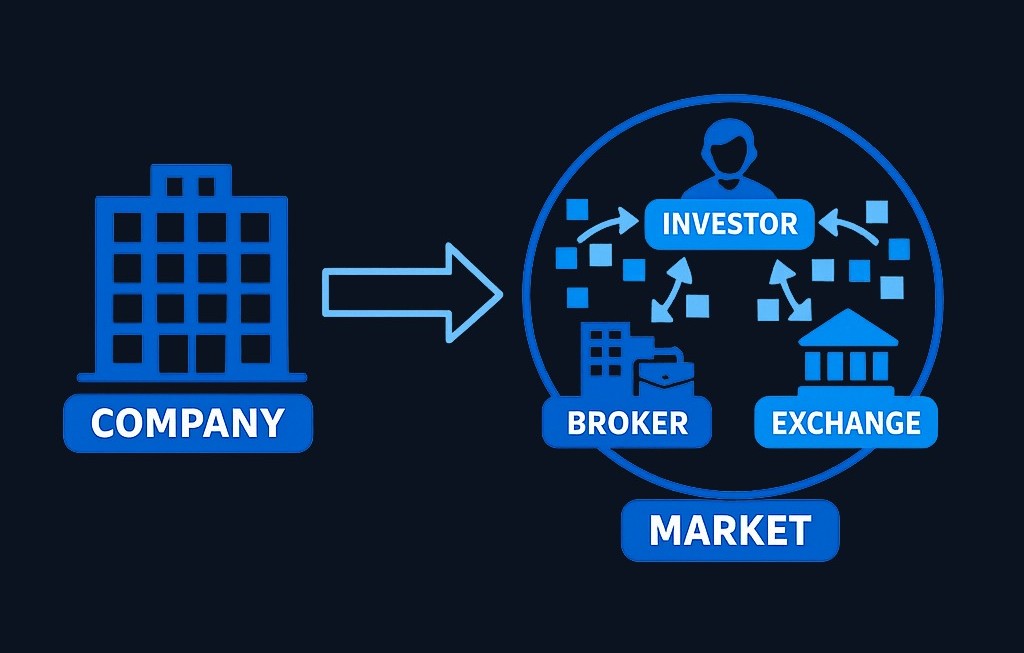
The market serves two related purposes:
- It gives companies a way to seek capital from investors.
- It gives investors a way to buy and sell ownership interests.
“The market” is therefore not one physical location or a single organization. It is a network of participants and systems. A market index may be used as a shorthand for the performance of a selected group of stocks, but an index and the stock market are not the same thing.
How a Stock Trade Works
Suppose an investor decides to buy shares. The investor enters an order through a brokerage account, stating what to buy, how much, and—depending on the order type—the acceptable price. The broker then routes the order for execution. As the SEC explains, placing an order is only the beginning: the broker’s firm must send it to a market center, where the order can be executed.
A simplified trade looks like this:
- The investor submits an order. A buy order expresses demand; a sell order expresses supply.
- The broker routes it. The order is sent to a venue or firm capable of handling it.
- The order meets available interest. A trade can occur when the terms of a buyer and seller are compatible.
- The execution is reported. The investor sees whether the order filled and at what price.
- The transaction is completed. Cash and the ownership position are processed through the market’s post-trade systems.
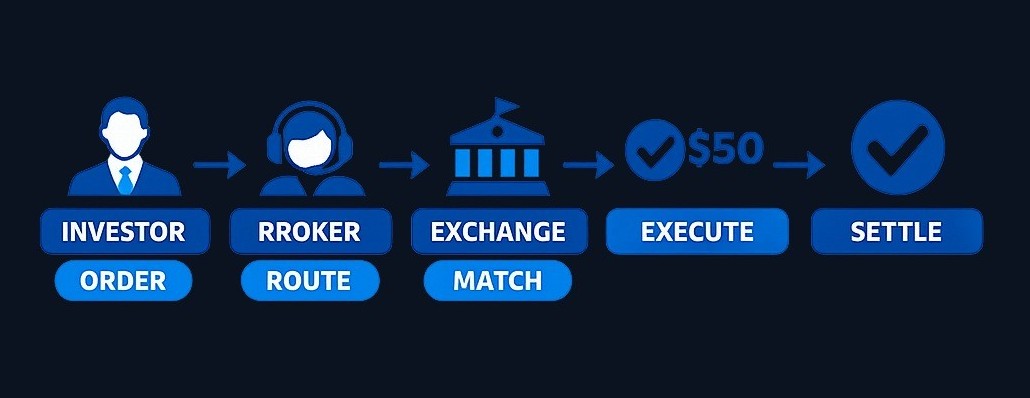
An exchange provides an organized venue for trading. A broker acts for the customer in accessing the market. A market maker stands ready to transact at publicly quoted prices, helping connect buying and selling interest. These roles overlap within a larger system, but they are not interchangeable.
Market orders and limit orders
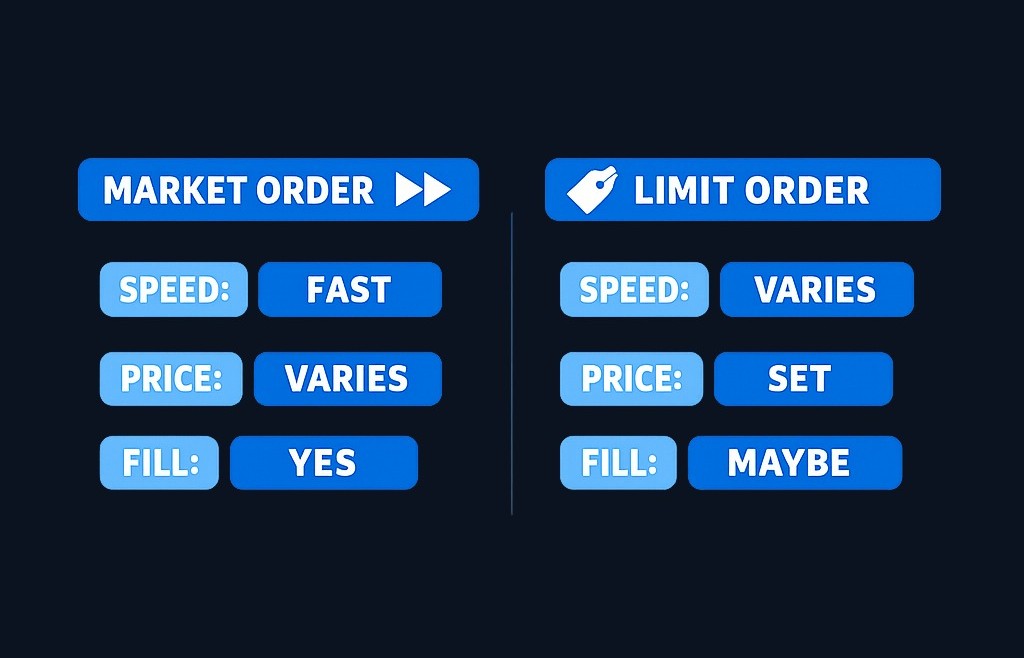
Two basic order instructions illustrate an important tradeoff:
| Order type | Main priority | Main uncertainty |
|---|---|---|
| Market order | Seeking prompt execution at available prices | The final execution price |
| Limit order | Setting a maximum buy price or minimum sell price | Whether the order executes |
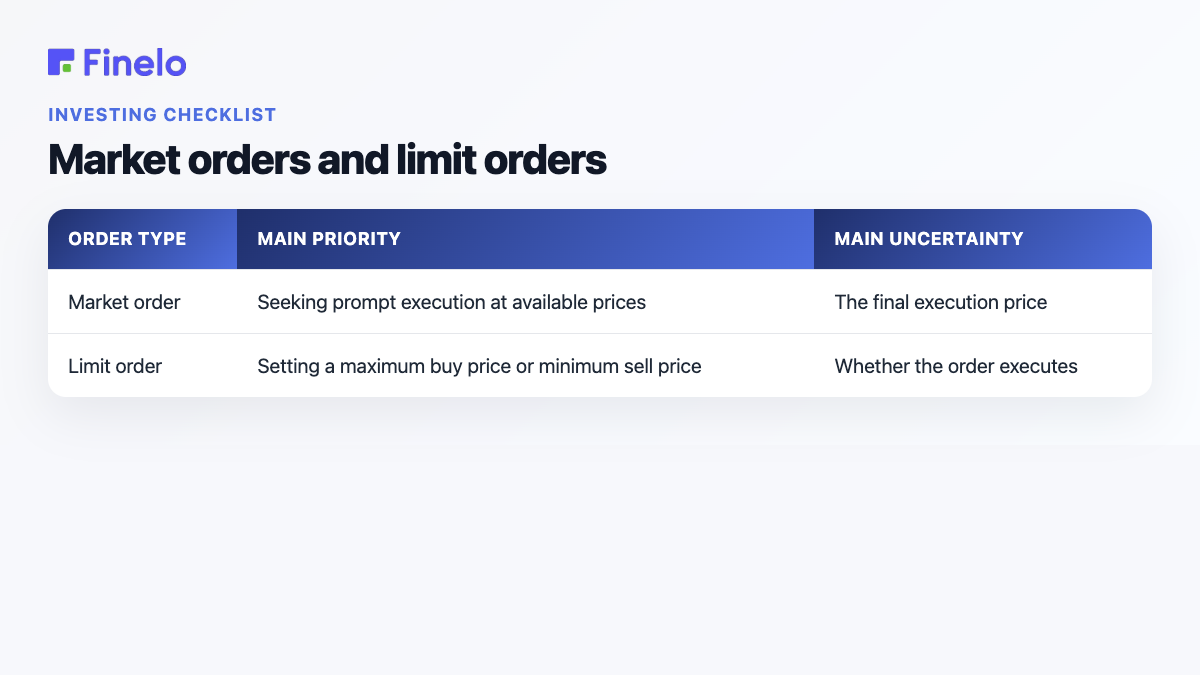
A market order emphasizes getting the trade done, while a limit order emphasizes price control. Neither is automatically better. The appropriate choice depends on whether execution or a price boundary matters more to the investor.
Primary Market vs. Secondary Market
The distinction between primary and secondary markets explains where the money goes.
In the primary market, newly issued shares move from a company to investors. The company receives the capital, subject to the structure and costs of the offering.
In the secondary market, investors trade existing shares with other investors. The company does not receive the purchase price from each later trade. Instead, ownership changes hands among market participants.
Think of a concert ticket as a rough analogy. Its first sale comes from the issuer; a later resale occurs between holders. Stocks are regulated financial instruments rather than tickets, but the analogy captures the difference between initial issuance and subsequent trading.
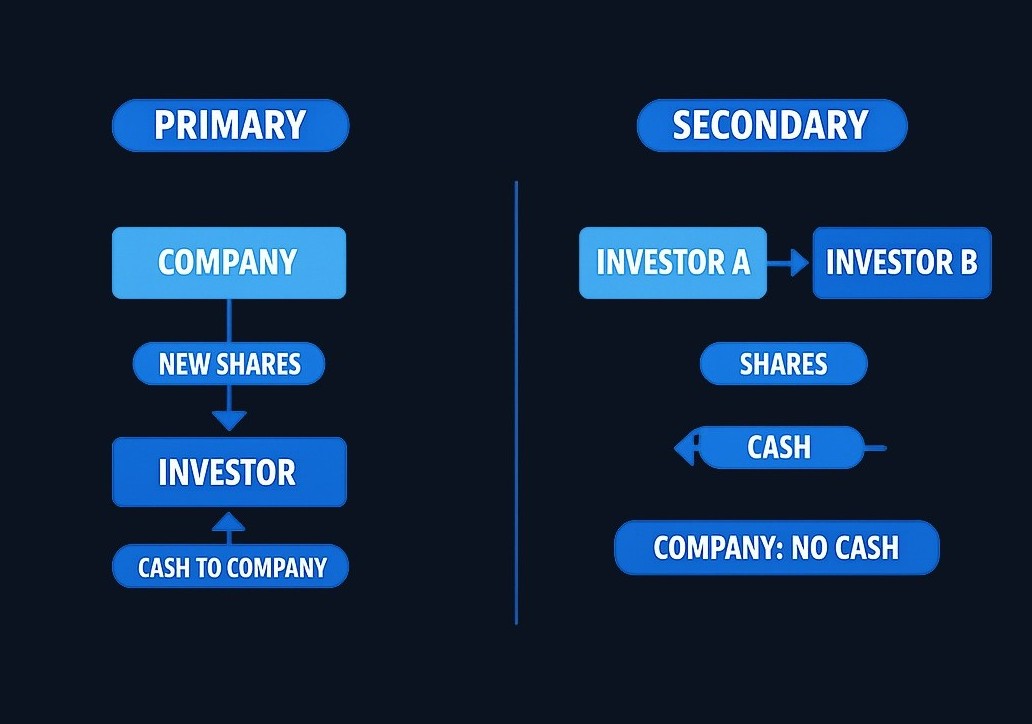
The secondary market matters because the possibility of reselling shares can make ownership more practical. However, the ability to place a sell order does not guarantee a particular price. A seller still needs compatible demand.
How Stock Prices Change
A quoted stock price reflects where trading interest currently meets—not a permanent statement of what a company is “really worth.” If buyers become willing to pay more than before, trades may occur at higher prices. If sellers accept less, prices may fall.
Several inputs can shift that willingness:
- Business expectations: Changes in anticipated sales, costs, competition, or management decisions can alter how investors view a company.
- New information: Company announcements and broader news may cause participants to reassess possible outcomes.
- Economic conditions: Expectations about growth, borrowing costs, inflation, currencies, or employment can affect different businesses in different ways.
- Industry developments: Regulation, technology, input costs, and changes in consumer behavior may help some companies while hurting others.
- Market sentiment: Fear, optimism, crowd behavior, and the desire to avoid losses can amplify short-term moves.
- Liquidity: When relatively little buying or selling interest is available, an order may have a larger effect on the traded price.
Price and value should not be treated as synonyms. Price is observable in the market. Value is an estimate based on assumptions about a company’s future and the risks around it. Two informed investors can examine the same company and reach different estimates, which is one reason they may be willing to trade with each other.
What market capitalization means
Market capitalization, often shortened to “market cap,” is calculated as:
Share price × shares outstanding
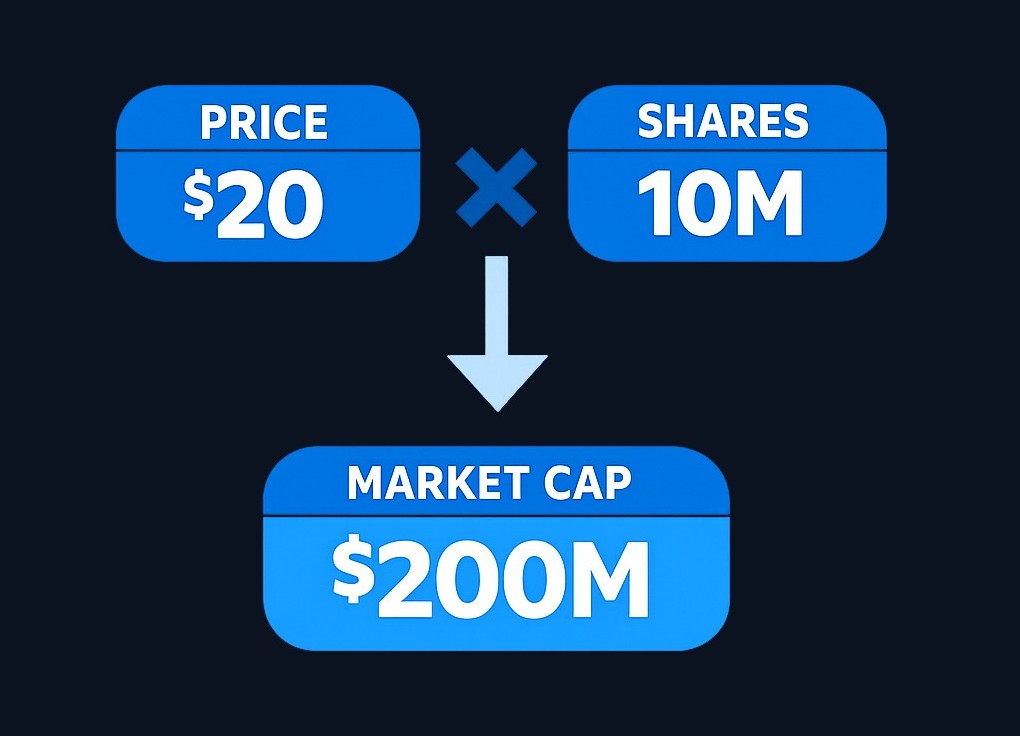
For a hypothetical company with 10 million shares outstanding and a share price of $20, the market cap would be $200 million. This is an illustrative calculation, not a valuation of any real company.
Market cap helps describe the market’s current equity valuation of a company. It does not represent cash sitting in a corporate account, and it does not tell an investor whether the stock is cheap or expensive. A low share price also does not necessarily mean a smaller or better-value company, because the number of shares matters.
Practice investing with Finelo
Build practical investing skills with guided lessons, simulator practice, and structured challenges.
Strategies Investors Use
An investment strategy is a set of rules for choosing, buying, holding, and selling investments. Its value lies partly in creating consistency before emotions take over.
Common approaches include:
- Long-term ownership: Selecting investments with the intention of holding through ordinary market fluctuations.
- Growth investing: Focusing on businesses expected to expand, while recognizing that optimistic expectations may already be reflected in the price.
- Value investing: Looking for a gap between market price and an investor’s estimate of underlying value, with the risk that the estimate may be wrong.
- Income investing: Prioritizing investments expected to distribute cash, without assuming that distributions or prices are guaranteed.
- Diversified fund investing: Using a fund to spread exposure across multiple holdings instead of relying on a small number of individual companies.
These approaches can overlap. A company may appear attractive to both growth and value investors for different reasons. More importantly, a strategy should match the investor’s time horizon, need for accessible cash, ability to tolerate losses, and willingness to research and monitor holdings.
Individual stocks or diversified exposure?
Owning an individual stock concentrates the outcome in one company. That can make the investment easier to understand in isolation, but it also makes company-specific setbacks more important. Diversification spreads exposure, although it cannot remove the possibility of market losses.
A useful decision framework is:
- What is the money for?
- When might it be needed?
- How much loss could be tolerated without abandoning the plan?
- How concentrated would the resulting portfolio be?
- What costs, taxes, and account rules need to be checked?
- What evidence would justify buying—and what would justify selling?
If those questions do not yet have clear answers, learning and observation may be more appropriate than rushing into a trade.
Risks and Potential Rewards
Stocks offer the possibility of benefiting when a business grows in value or distributes money to shareholders. The tradeoff is uncertainty: neither the company’s future nor the market’s future price is guaranteed.
Key risks include:
- Company risk: A business can lose customers, face higher costs, make poor decisions, or fail.
- Market risk: Broad declines can pull down many stocks at once, including financially sound companies.
- Concentration risk: A portfolio dependent on one company, sector, or country has fewer independent sources of return.
- Liquidity and execution risk: The price received may differ from the price expected, particularly when markets move quickly or trading interest is limited.
- Behavioral risk: Chasing recent gains, panic-selling after losses, overconfidence, and excessive trading can undermine a plan.
- Time-horizon risk: Money needed soon may have to be withdrawn during an unfavorable market period.
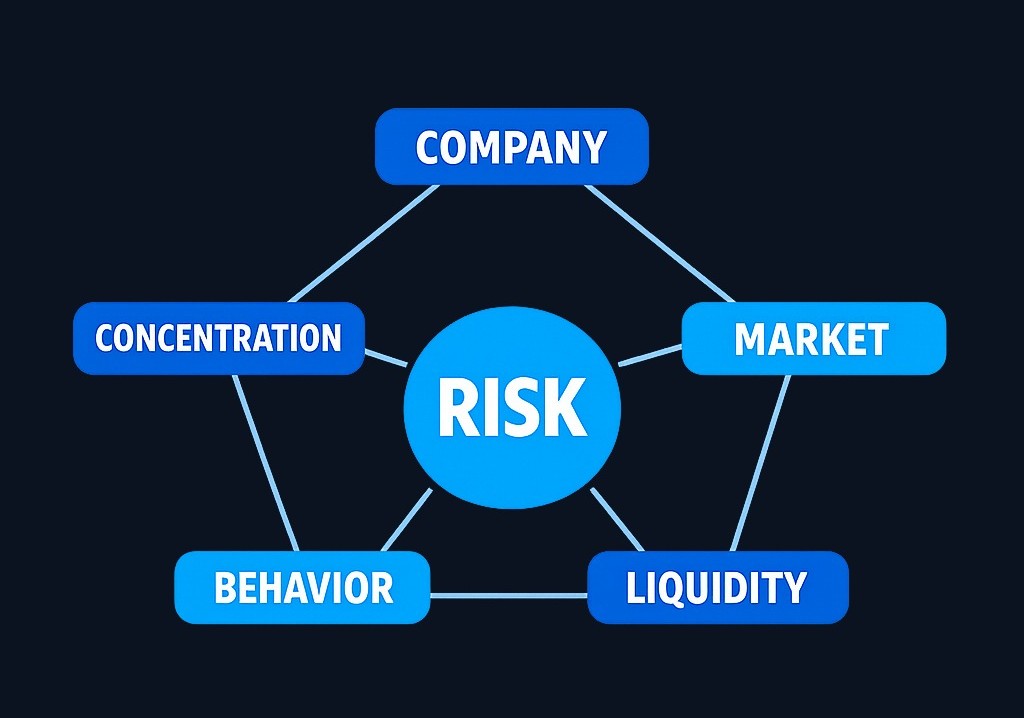
Risk management begins before purchase. Position size, diversification, an emergency reserve, and a realistic time horizon can matter as much as the choice of stock. No checklist eliminates loss, and “high potential return” should always be read together with “high uncertainty.”
How to Start Learning About Investing
For someone new to the stock market, the first step does not have to be buying a stock. A measured process can separate education from commitment:
- Clarify the goal. Define what the money is intended to accomplish and when.
- Build a financial buffer. Consider whether near-term expenses and emergencies could force an untimely sale.
- Learn the basic vocabulary. Understand shares, funds, diversification, orders, fees, and risk.
- Compare account providers carefully. Review available investments, costs, service, protections, and applicable terms.
- Practice evaluating an investment. Write down the reason for considering it, the major risks, and the assumptions behind the decision.
- Start at a tolerable scale if you proceed. The amount should be small enough that a loss would not disrupt essential plans.
- Review the process, not just the price. A profitable outcome can follow a poor decision, and a thoughtful decision can still lose money.
Finelo is positioned as an investment-learning and financial-education product. Readers who want a structured starting point can explore the Finelo learning experience while independently checking whether any investing decision, cost, and risk suits their circumstances.
The Bottom Line
The stock market is a system for issuing and trading ownership in companies. Brokers connect investors to trading venues, orders interact with available buyers and sellers, and prices move as expectations change. For beginners, the practical lesson is not to predict every movement. It is to understand what is being bought, why it fits a goal, how much can be lost, and how concentration, costs, and emotions may affect the result.
This article is educational and does not provide personalized financial advice. Before investing, verify the product, account terms, costs, risks, and suitability for your situation.
Frequently asked questions
Can a stock price fall even when a company reports good news?
Yes. A price reflects expectations as well as the new information itself. If investors expected even stronger results, apparently positive news may disappoint. Broader market conditions or selling pressure can also affect the reaction.
Do companies receive money whenever their shares trade?
Not in an ordinary secondary-market trade. The buyer’s money goes through the transaction process to the seller. A company receives capital when it issues securities in the primary market, subject to the terms of that issuance.
Is the stock market the same as the economy?
No. They influence one another, but they measure different things. Stock prices reflect market expectations about listed companies, while the economy includes households, private businesses, governments, labor, production, and consumption.
What is the simplest answer to “How does the stock market work?”
Companies issue ownership shares, investors trade those shares through brokers and market venues, and prices change as supply, demand, information, expectations, and risk preferences change. The mechanics enable trading; uncertainty creates both the opportunity and the risk.
InvestingBeginnerMarket BasicsMarkets
Practice investing with Finelo
Build practical investing skills with guided lessons, simulator practice, and structured challenges.
About the author
Finelo Team
The Finelo Team creates practical investing and trading education designed to help beginners learn faster with structured challenges, simulator practice, and bite-sized lessons.
Keep reading — Related articles

Investing
I Bonds vs EE Bonds in 2026: Rates, Rules, and Which to Buy for the Long Run
Series I and Series EE savings bonds are both U.S. Treasury retail savings bonds sold on TreasuryDirect. They share ownership, tax treatment, and redemption rules; the key difference is the…
Finelo Team
Investing
Coverdell ESA vs 529 Plan: Limits, Flexibility, and Which to Choose
Quick answer (one minute) Both a Coverdell Education Savings Account (Coverdell ESA) and a 529 plan let money grow tax‑free and be withdrawn tax‑free for qualified education expenses. The…
Finelo Team
Investing
CD vs High Yield Savings Account: Where to Park Your Cash in 2026
Hero answer — CD vs high yield savings account in one line A CD (certificate of deposit) and a high yield savings account are both low‑risk, federally insured homes for cash — the difference…
Finelo Team