Building a diversified portfolio means spreading your money across investments that don't all rise and fall together — so no single failure can sink you. The recipe has five steps: define your goals, assess your risk tolerance, choose a mix of asset classes, diversify within each class, and rebalance periodically. In a typical structure, stocks drive long-term growth, bonds steady the ride, and holdings tied to physical value — property funds, commodities — help defend purchasing power when inflation rises.
How to Build a Diversified Portfolio
Building a diversified portfolio means spreading your money across investments that don't all rise and fall together — so no single failure can sink you. The recipe has five steps: define your goals, assess your risk…
8 min read
Practice investing with Finelo
Build practical investing skills with guided lessons, simulator practice, and structured challenges.
Want to learn more?
Build practical investing skills with guided lessons, simulator practice, and structured challenges.
Explore FineloExplore Finelo's 28-day challenges
Turn learning into a daily habit with guided challenge paths.
Diversification matters because the future is unknowable. Any single company, sector, or country can disappoint; a spread portfolio makes sure being wrong somewhere doesn't mean losing everywhere. This guide is for beginners building a first portfolio — walk through the steps in order, use the decision framework to pick your mix, then borrow from the example portfolios near the end.
Understanding Your Investment Goals
Diversification without a goal is decoration. Sound portfolio-building starts with your financial objectives — long-term growth, nearer-term income, or a blend — because the goal dictates the mix.
Three questions define your goal:
- What is the money for? Retirement, a home purchase, a child's education, general wealth — each carries a different timeline and a different tolerance for interruption.
- When will you need it? Time horizon is the single most powerful input. Money needed in 3 years cannot ride out a deep market decline; money needed in 30 years can — and probably should — accept short-term swings in exchange for growth.
- Will you add money regularly? A portfolio receiving monthly contributions can recover from downturns by buying at lower prices. A one-time lump sum has no such refueling.
Write the answers down before touching any investment list. A concrete pair of examples shows why: a 30-year-old investing for retirement in 2060 and a 58-year-old retiring in four years might both call themselves "long-term investors," yet the right mix for one would be wrong — even risky — for the other. Goals first, portfolio second. Every decision that follows inherits from this step.
Assessing Your Risk Tolerance
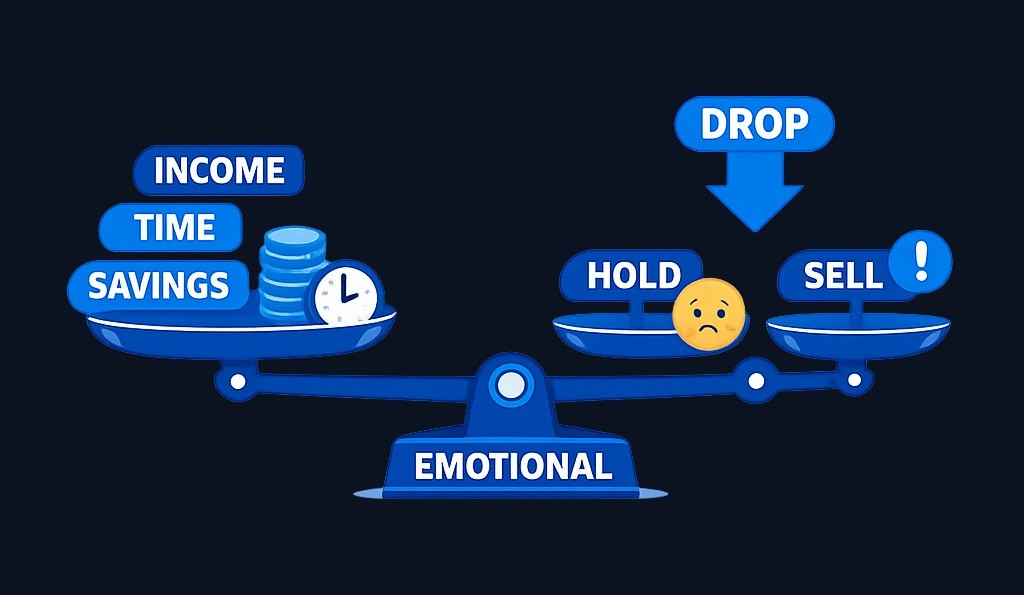
Risk tolerance is your honest capacity to watch your portfolio fall without abandoning the plan. It sets how much of your money belongs in swingier assets like stocks — and it has two components people often confuse.
Financial capacity for risk is objective: your income stability, emergency savings, debts, and time horizon. A secure job, a cash cushion, and decades of runway equal high capacity. An uncertain income or a near-term goal equals low capacity — regardless of personality.
Emotional tolerance is subjective: what you'll actually do when your balance drops. The honest test isn't "am I comfortable with risk?" — everyone says yes in a rising market. It's "if my $50,000 became $35,000 this year, would I hold, buy more, or sell in fear?" Your answer at 2 a.m. matters more than your answer in a questionnaire.
A quick self-assessment checklist:
- I have an emergency fund outside my investments
- I won't need this money for at least five years
- My income is stable enough to keep contributing in a downturn
- I've seen my investments fall before and didn't panic-sell (or I honestly believe I wouldn't)
- A temporary 30% drop would not change my plans
The more boxes you check, the more equity-heavy risk you can reasonably carry. Fewer checks argue for a gentler mix — cautious investors typically tilt further toward bonds. And one crucial note: taking less risk than a questionnaire allows is never a mistake if it keeps you invested through the bad years. The best allocation is the one you'll stick with.
Types of Asset Classes to Consider
An asset class is a category of investments that behaves similarly. The main building blocks:
- Stocks (equities). Ownership stakes in companies — the growth engine. Highest long-term potential, sharpest short-term swings.
- Bonds. Loans to governments and companies that pay interest — the stabilizer. Lower expected returns, gentler ride, and a cushion when stocks fall.
- Real assets. Property and commodities carry physical value that doesn't move in lockstep with financial markets, which is why investors use them as a buffer when inflation climbs. Real estate investment trusts (REITs) make property investable without buying buildings.
- Cash and equivalents. Savings and money market holdings — zero growth power, maximum availability. The right home for near-term needs, not long-term wealth.
The practical shortcut for beginners: broad, low-cost funds. A single total-market stock fund holds thousands of companies; a bond fund holds hundreds of loans. Two or three funds can deliver more diversification than a hand-picked basket of twenty stocks ever could. Alternatives like cryptocurrencies exist, but their high volatility argues for treating them — if at all — as a small satellite, never a core holding.
Practice investing with Finelo
Build practical investing skills with guided lessons, simulator practice, and structured challenges.
Creating a Balanced Portfolio
Asset allocation — the percentage split across classes — is the decision that shapes most of your portfolio's behavior. Three illustrative mixes show the spectrum (educational examples, not recommendations):
| Profile | Stocks | Bonds | Real assets / other | Typical fit |
|---|---|---|---|---|
| Growth | 80% | 15% | 5% | Long horizon, high risk capacity |
| Balanced | 60% | 30% | 10% | Medium horizon, moderate tolerance |
| Conservative | 35% | 50% | 15% | Short horizon or low tolerance |
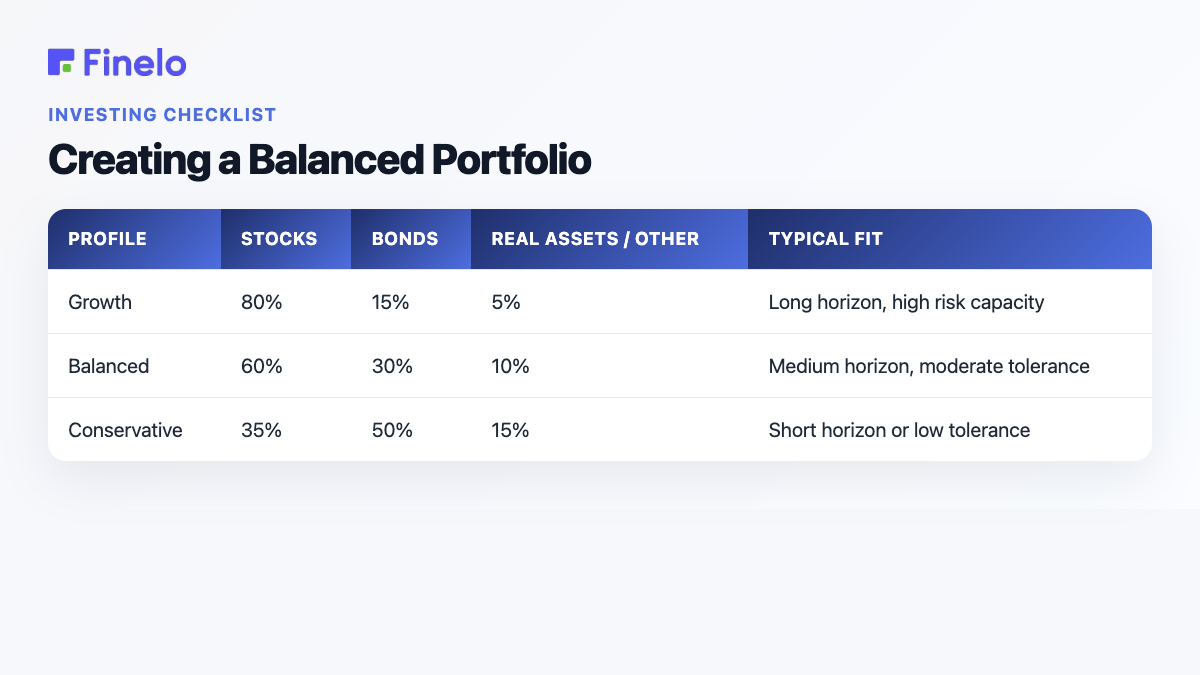
The percentages matter less than the logic: more stocks = more growth and more turbulence; more bonds = smoother ride and slower growth.
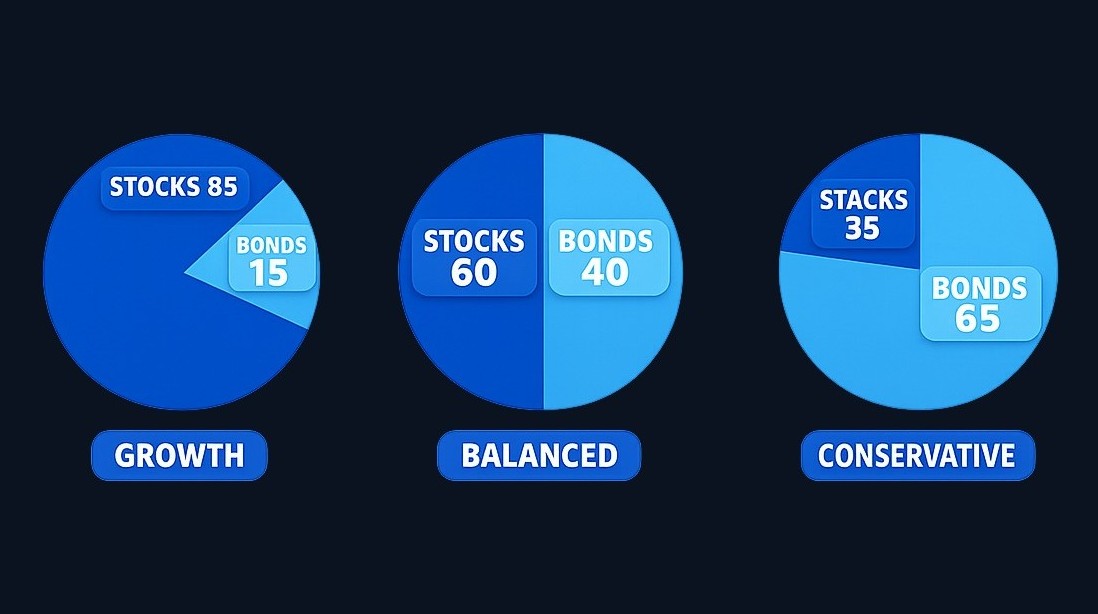
Decision framework: picking your mix
Run your answers from the first two sections through these rules:
- Horizon over 15 years and all checklist boxes ticked? Start from the Growth row.
- Horizon of 5–15 years, or a couple of unticked boxes? Start from Balanced.
- Horizon under 5 years, or an honest fear of large drops? Start from Conservative — or keep truly short-term money out of markets entirely.
- Torn between two rows? Take the more cautious one. Staying invested beats squeezing out the theoretically optimal mix.
- Multiple goals with different timelines? Split them into separate allocations rather than averaging into one compromise.
Allocation is only half the job. The other half is diversifying within each class, because variety inside each bucket prevents hidden concentration:
- Within stocks: spread across sectors — technology, healthcare, consumer staples — and across company sizes and regions. Ten tech stocks is concentration wearing a diversification costume.
- Within bonds: blend government and corporate issuers and mix shorter with longer maturities, softening the impact of rate moves and credit trouble.
- Across geographies: pairing home-market stocks with international ones taps different economic cycles, so one region's slump doesn't set your whole return.
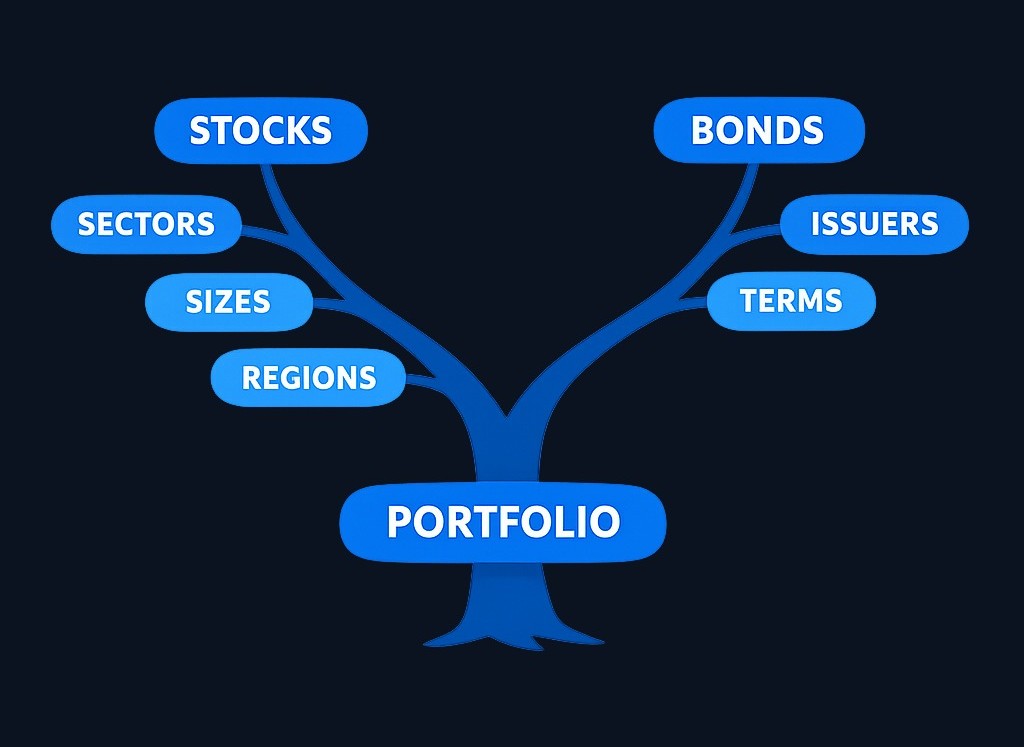
Broad index funds handle most of this automatically — a total world stock fund covers sectors and geographies in one purchase, which is exactly why beginners gravitate to them.
The Importance of Rebalancing
Markets move, and your carefully chosen allocation drifts. After a powerful stock rally, equities can swell into a larger share of your portfolio than you ever chose — quietly raising your risk. Rebalancing restores the plan: trim what grew beyond target, add to what fell behind.
A worked example: you set a 60/40 stock-bond mix on $10,000 — $6,000 stocks, $4,000 bonds. After a great year for stocks, you hold $8,000 in stocks and $4,100 in bonds: now a 66/34 portfolio. Nothing you decided changed, but your risk did. Rebalancing sells roughly $740 of stocks and buys bonds to restore 60/40.
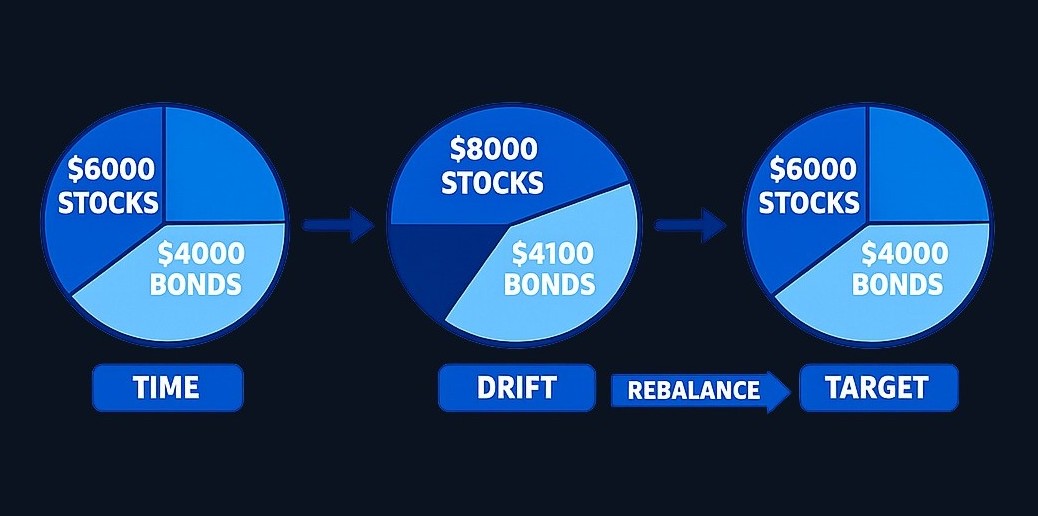
Notice the quiet discipline hiding in the mechanics: rebalancing forces you to sell what recently rose and buy what recently lagged — the opposite of what emotions suggest, and precisely the behavior that keeps risk constant.
Practical approaches, pick one:
- Calendar-based: review once or twice a year on fixed dates. Simple, sufficient for most people.
- Threshold-based: rebalance whenever an allocation drifts more than about 5 percentage points from target.
- Contribution-based: direct new monthly money toward whatever is underweight — rebalancing without selling anything, which also avoids taxable sales in a regular account.
What to avoid: rebalancing monthly or after every piece of market news. Over-tinkering adds transaction costs and stress while achieving nothing a yearly review wouldn't.
Real-World Examples of Diversified Portfolios
Three illustrative investors — composites for education, not advice — show how the same principles produce different portfolios:
Aisha, 27 — the long-horizon builder. Retirement is 40 years away, income is stable, and she contributes monthly. Her mix: 85% stocks (split across U.S., international developed, and emerging markets funds), 10% bonds, 5% REITs. Downturns barely concern her — her monthly contributions buy more shares when prices fall. Her main risk isn't volatility; it's abandoning the plan.
Marcus, 45 — the mid-career balancer. Two goals share his portfolio: retirement in 20 years and college tuition in 6. He runs two allocations — an aggressive 75/25 mix for the retirement account, and a conservative 35/65 mix for the tuition money. Same person, different horizons, different portfolios. Splitting by goal beats averaging into one compromise mix that suits neither.
Elena, 61 — the pre-retiree. Four years from retirement, she's shifted to 40% stocks, 45% bonds, 15% real assets and cash. She keeps some stocks deliberately — retirement may last 30 years, and abandoning growth entirely creates its own risk: inflation slowly eroding a too-cautious portfolio. Her rebalancing is strict, because a major loss now has little time to heal.
The common thread: none of the three own exotic products. Broad funds, sensible splits, and discipline — diversification is boring by design, and that's the point.
Conclusion and Next Steps
The build order: goal → horizon → risk tolerance → asset allocation → diversify within each class → automate contributions → rebalance on schedule. Tools that help: your brokerage's allocation and screening features, target-date funds that manage the mix automatically, and free online allocation calculators for a starting point — verify any tool's assumptions before relying on it.
Diversification manages risk; it doesn't eliminate it. A diversified portfolio still falls in broad downturns — it's designed to fall survivably and recover with the market. This guide is educational, not personalized financial advice; verify costs, risks, and suitability for your own situation before investing.
Want to build the knowledge behind each of these steps? Finelo's Wealth Growth Quiz matches you with an investing learning path that fits your starting point.
Frequently asked questions
How do I know if my portfolio is diversified enough?
Check three layers: multiple asset classes (not just stocks), variety within each class — sectors, regions, issuer types — and no single position big enough to hurt you badly alone. If one company or one theme dominates your balance, you're concentrated, whatever the account statement's length suggests.
What percentage should be in stocks versus bonds?
There's no universal number — it follows from your horizon and risk tolerance. Longer horizons and stronger tolerance support more stocks; shorter horizons and shakier nerves argue for a heavier bond weighting. The decision framework above turns those inputs into a starting row.
How often should I rebalance?
Once or twice a year is enough for most investors, or whenever market moves push an asset class meaningfully past your target. Directing new contributions to underweight assets rebalances continuously without selling.
Do index funds make diversification easier?
Substantially. One broad index fund holds hundreds or thousands of securities across sectors — instant within-class diversification at low cost. Many simple portfolios are built entirely from two to four such funds.
InvestingBeginnerPortfolio ManagementMarkets
Practice investing with Finelo
Build practical investing skills with guided lessons, simulator practice, and structured challenges.
About the author
Finelo Team
The Finelo Team creates practical investing and trading education designed to help beginners learn faster with structured challenges, simulator practice, and bite-sized lessons.
Keep reading — Related articles

Investing
Yield to Call vs Yield to Maturity: Assumptions and Bond Risks
Yield to call (YTC) estimates a bond's yield if the issuer redeems it on an eligible call date; yield to maturity (YTM) estimates yield if it remains outstanding to final maturity.
Finelo Team

Investing
Will My Employer Know If I Take a 401(k) Loan?
Who this page is for: readers new to 401(k) loans who want a practical, privacy‑focused explanation — what your employer can see, how to limit visibility, and the financial tradeoffs to weigh.
Finelo Team

Investing
What Medical Expenses Qualify for a 401(k) Hardship Withdrawal?
Before you decide, confirm three things with your plan administrator:
Finelo Team


