A cash flow statement is a financial statement that shows the cash going in and out of a business over a set period. To read one, check three sections in order: operating activities (cash from running the business), investing activities (cash from buying or selling long-term assets), and financing activities (cash from debt, stock, and dividends). Add them up, and you get net cash flow — the real change in the company's cash for the period.
How to Read a Cash Flow Statement: A Complete Guide

A cash flow statement is a financial statement that shows the cash going in and out of a business over a set period. To read one, check three sections in order: operating activities (cash from running the business)…
9 min read
Practice investing with Finelo
Build practical investing skills with guided lessons, simulator practice, and structured challenges.
Want to learn more?
Build practical investing skills with guided lessons, simulator practice, and structured challenges.
Explore FineloExplore Finelo's 28-day challenges
Turn learning into a daily habit with guided challenge paths.
This page is for anyone who needs to judge a company's financial health from its public filings: investors, employees weighing a job offer, or small business owners checking their own numbers. It's not written for accountants building the statement from scratch. Read the definitions first if the vocabulary is new, then use the step-by-step section to build your own reading habit.
What is a Cash Flow Statement?
A cash flow statement is one of the core financial statements a company reports, alongside the income statement and balance sheet. Where those two show profit and net worth, the cash flow statement tracks cash going in and out of a business over a set period — actual money, not accounting figures.
That distinction matters more than it sounds. A company's profit and its cash inflows can look completely different. Picture a sale made on credit: it counts as revenue on the income statement right away, but the cash might not arrive until a later period. A business can look profitable on paper while running low on actual cash — which is exactly the gap this statement exists to close.
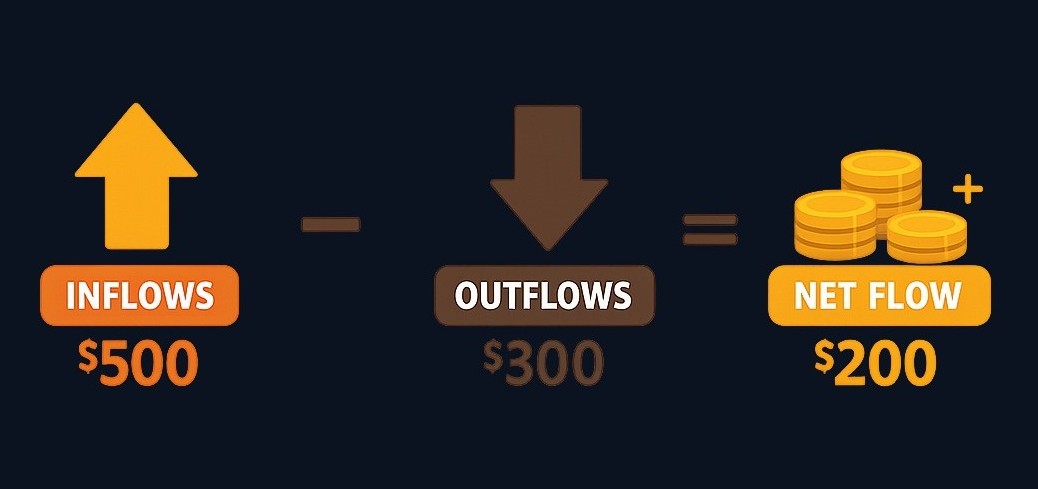
Cash flow is simple arithmetic once you strip away the jargon: add every cash inflow for the period, then subtract every outflow. The result is net cash flow. Positive means more cash came in than went out. Negative means the reverse. Neither number tells the whole story by itself — you have to know where that cash came from, which is what the three sections below are for.
Components of a Cash Flow Statement
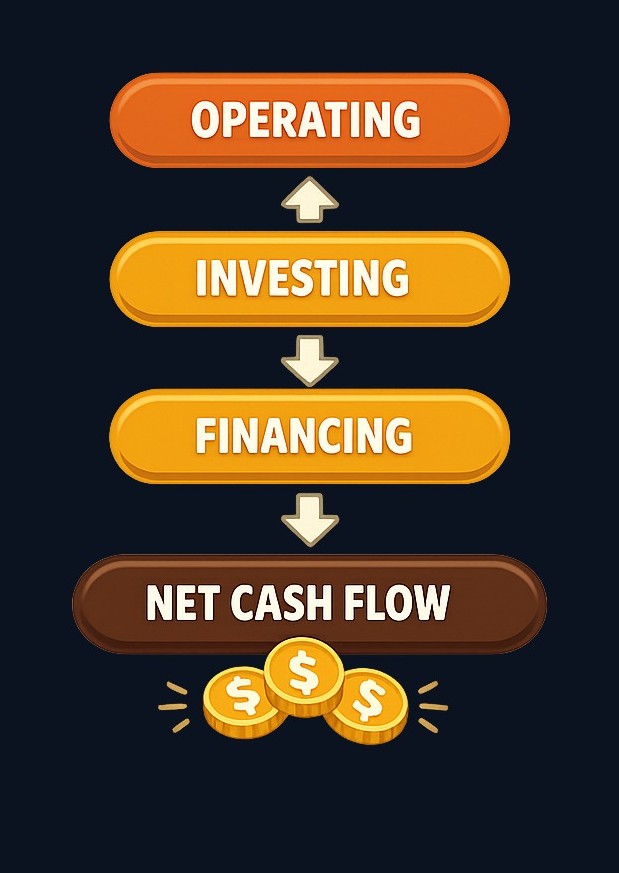
Every cash flow statement splits into the same three sections, in the same order.
Operating Activities
This section covers cash from the core business — the day-to-day work of selling a product or service. Inflows include cash received from customers; outflows include cash paid to suppliers and employees. For most healthy companies, this is the section that should stay reliably positive. It's the closest thing to "did the actual business make money this period?"
Investing Activities
This section tracks money spent on or raised from long-term assets. If a company buys a building, that's an outflow. If it sells land or a bond investment matures, the proceeds show up as an inflow. A negative number here isn't automatically bad — a growing company often spends cash to buy equipment or expand, which shows as a negative investing figure even while the business is thriving.
Financing Activities
This section shows cash moving between the company and its investors or lenders. Issuing stock or bonds is an inflow. Buying back stock or repaying bonds that matured is an outflow. This section tells you how a company funds itself: by raising money, paying it back, or returning cash to shareholders.
How to Read a Cash Flow Statement: Step-by-Step
Follow this order every time, rather than jumping straight to the bottom-line number.
- Start with operating cash flow. This is the number that matters most. It should be positive and, ideally, growing across several periods.
- Check investing activities next. A negative number here can be healthy growth spending. Look at what's driving it before judging it.
- Review financing activities. Is the company raising cash by issuing debt or stock, or returning cash through buybacks and dividends? Neither is automatically good or bad — context decides.
- Add the three sections together. That total is net cash flow for the period.
- Compare net cash flow to net income. If they diverge sharply and repeatedly, dig into why — it's often the first sign something in the business has changed.
A quick worked example, using a hypothetical company for illustration:
| Section | Amount |
|---|---|
| Operating activities | +$220,000 |
| Investing activities | −$40,000 |
| Financing activities | −$30,000 |
| Net cash flow | +$150,000 |
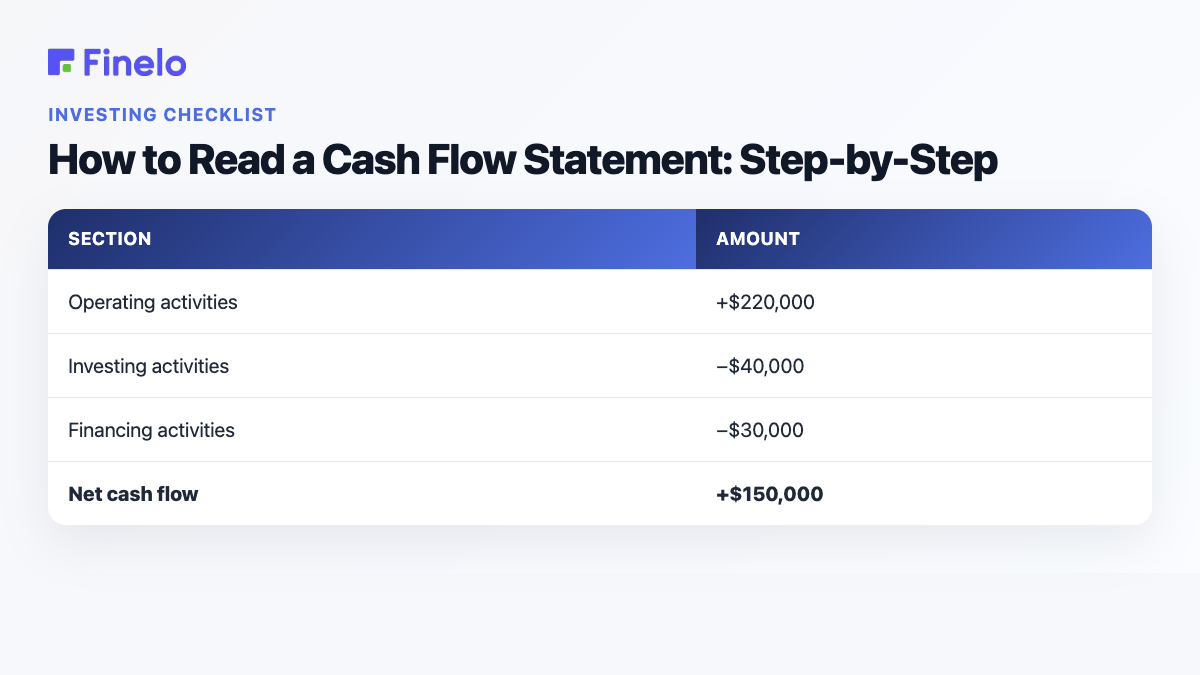
This kind of breakdown shows a company generating solid cash from its core business, spending some of it on long-term investments, and using the rest to pay down financing obligations — a pattern that, read section by section, tells a much clearer story than the single net number alone.

Practice investing with Finelo
Build practical investing skills with guided lessons, simulator practice, and structured challenges.
Common Mistakes to Avoid
- Reading only the bottom line. A positive net cash flow can hide a negative operating section propped up by new debt. A rising cash balance can be a concern if the inflow came from issuing debt while operating cash flow was negative — always check where the cash actually came from.
- Confusing cash flow with profit. They measure different things. Revenue can show up on the income statement before the matching cash ever arrives, so a profitable quarter and a cash-positive quarter aren't automatically the same quarter.
- Treating negative investing cash flow as automatically bad. It's often the opposite — heavy investment usually means the company is expanding, not struggling.
- Ignoring the trend across periods. One quarter tells you little. Look at three to five periods to separate a real shift from ordinary noise.
- Assuming every company's statement looks identical. Line items vary by business and industry. That variation is normal, not a red flag by itself.
- Skipping the comparison to net income. If operating cash flow and net income tell very different stories for several periods running, that gap deserves investigation before you trust either number alone.
Real-World Examples Across Industries
The same three sections tell very different stories depending on the business. These composites are illustrative, not real companies, but the patterns are representative of how each type of business typically shows up on a cash flow statement.
A Retail Business
A growing retailer often shows strong operating cash flow from steady customer sales, a meaningfully negative investing section from opening new stores, and a financing section reflecting a loan taken out to fund that expansion. Read together, that's a business investing in growth using a mix of its own cash and borrowed money — a common and often healthy pattern for retail expansion.
A Software or Subscription Business
A software company with recurring subscription revenue frequently shows very strong, stable operating cash flow relative to its size, since it collects cash upfront with low ongoing delivery costs. Investing activity might be modest — some equipment or a small acquisition — while financing activity may show stock-based fundraising if the company is still scaling. The operating section is usually the one to watch closest here.
A Manufacturing Business
A manufacturer often shows more volatile operating cash flow, since it ties up cash in inventory and receivables before customers pay. Investing activities are typically a large, recurring outflow for machinery and facilities. Financing activity often includes both debt to fund equipment purchases and dividends if the business is mature. The size of the investing outflow relative to operating cash flow is the figure worth tracking over time.
Using Cash Flow Statements for Financial Analysis
Free Cash Flow: The Number Serious Investors Track
Free cash flow is whatever cash is left after a company covers its costs and its capital investments. The formula: free cash flow equals cash flow from operations minus capital expenditures. It matters because it can reveal downward trends in a company's finances before they show up in earnings and revenue — a business can report solid profit while its free cash flow is quietly shrinking.

This isn't just a theoretical concern. Between 1990 and 2017, S&P 500 companies in the top quintile of free cash flow delivered annualized returns of 15.7%, versus 12.2% for the index as a whole — a reminder that this figure has tracked real differences in company performance, historically, though past results never guarantee future ones.
Free cash flow projections can also swing hard on new information. Analysts initially projected one large company's 2026 free cash flow at $76–105 billion, before revising the consensus estimate to negative $11 billion once major new capital spending plans became clear — a reminder that even this "cleaner" number is an estimate, not a guarantee, and can move sharply as a company's spending plans change.
Forecasting and Budgeting with Cash Flow Data
Multiple periods of cash flow statements let you build a simple forecast: average the last four quarters of operating cash flow, adjust for any known upcoming change (a new loan, a planned equipment purchase), and you have a rough budget baseline. Businesses use the same logic internally to plan payroll, inventory purchases, and debt payments around when cash actually arrives, not just when revenue is booked.
A Quick Decision Framework for Cash Flow Health
Run any company's statement through these checks, in order:
- Is operating cash flow positive and stable or growing? If not, treat everything else as secondary until you understand why.
- Does net income roughly track operating cash flow over time? A persistent, growing gap is worth investigating before it's worth ignoring.
- Is investing cash flow negative because of growth, or because assets are being sold off to stay afloat? The direction of asset activity tells you which.
- Is financing cash flow funding real growth, or masking a weak operating section with new debt? Check operating cash flow first, then read financing in that light.

Conclusion and Next Steps
Reading a cash flow statement comes down to a short routine: check operating cash flow first, read investing and financing in context rather than in isolation, add the three together for net cash flow, and compare that trend to net income over several periods. The three-section structure — operating, investing, financing — turns a single confusing number into a readable story about where a company's cash actually came from and went.
Your next step: pull up a company's most recent cash flow statement and run it through the decision framework above. Practice on one you already understand before applying the same routine to a company you're actually evaluating.
This guide is educational, not personalized financial advice. Every figure and formula here is a general framework, not a guarantee of any outcome — verify current numbers and consult a qualified professional before making financial decisions. If you want a structured way to build this kind of analysis skill further, Finelo's Wealth Growth Quiz matches you with a learning path suited to your level.
Frequently asked questions
What does a negative cash flow indicate?
Negative net cash flow means more cash left the business than came in in during that period. It isn't automatically a warning sign — a growing company investing heavily in equipment can show negative cash flow overall while its core operating cash flow stays healthy. The section causing the negative number matters more than the total.
What is the difference between cash flow and profit?
Profit is an accounting figure that can include revenue not yet collected in cash. A sale made on credit counts as profit immediately but may not become cash until [later](https://www.fidelity.com/learning-center/trading-investing/what-is-a-cash-flow-statement). Cash flow only counts money that has actually moved, which is why the two numbers can tell different stories in the same period.
How do I calculate free cash flow?
Free cash flow equals cash flow from operations minus capital [expenditures](https://www.schwab.com/learn/story/whats-free-cash-flow-and-why-it-matters). Both figures come straight from the cash flow statement: operating cash flow from the first section, and capital expenditures from the investing section.
How often is a cash flow statement prepared?
Public companies prepare one alongside their other financial statements on a regular reporting schedule — typically each quarter and once a year. Private businesses often prepare theirs monthly for internal planning, even though they aren't required to publish it externally.
InvestingBeginnerFinancial StatementsMarkets
Practice investing with Finelo
Build practical investing skills with guided lessons, simulator practice, and structured challenges.
About the author
Finelo Team
The Finelo Team creates practical investing and trading education designed to help beginners learn faster with structured challenges, simulator practice, and bite-sized lessons.
Keep reading — Related articles

Investing
Yield to Call vs Yield to Maturity: Assumptions and Bond Risks
Yield to call (YTC) estimates a bond's yield if the issuer redeems it on an eligible call date; yield to maturity (YTM) estimates yield if it remains outstanding to final maturity.
Finelo Team

Investing
Will My Employer Know If I Take a 401(k) Loan?
Who this page is for: readers new to 401(k) loans who want a practical, privacy‑focused explanation — what your employer can see, how to limit visibility, and the financial tradeoffs to weigh.
Finelo Team

Investing
What Medical Expenses Qualify for a 401(k) Hardship Withdrawal?
Before you decide, confirm three things with your plan administrator:
Finelo Team