You don't need thousands of dollars to begin — you can start investing for the price of a donut. Micro-investing apps accept as little as a few dollars a month. Many online brokerage accounts have no investment minimums at all.
How to Start Investing with Little Money: A Comprehensive Guide
You don't need thousands of dollars to begin — you can start investing for the price of a donut. Micro-investing apps accept as little as a few dollars a month. Many online brokerage accounts have no investment…
6 min read
Practice investing with Finelo
Build practical investing skills with guided lessons, simulator practice, and structured challenges.
Want to learn more?
Build practical investing skills with guided lessons, simulator practice, and structured challenges.
Explore FineloExplore Finelo's 28-day challenges
Turn learning into a daily habit with guided challenge paths.
Starting small works because time, not the starting amount, does most of the heavy lifting. Money invested early has decades to compound — to earn returns on top of returns. That's why a modest monthly habit started now can outgrow a much larger one started years later. This guide covers the basics, the accounts that accept small deposits, simple strategies, and the mistakes that trip up new investors.
Understanding Investment Basics
Three concepts carry most of the weight in investing. Get these, and the rest is detail.
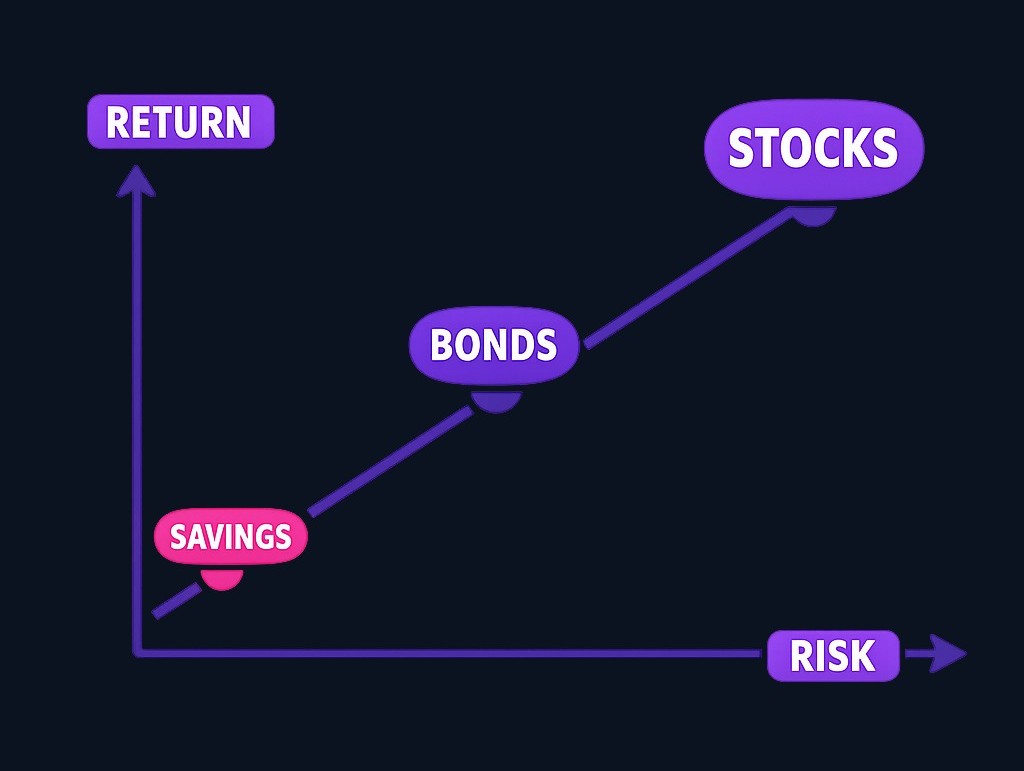
Risk and return travel together. Investments that can grow faster can also fall harder. Stocks swing more than bonds. Bonds swing more than savings accounts. There's no high-return, no-risk option — anyone offering one is selling something.
Diversification spreads the blows. Don't concentrate your money in one company or one bet. Spread it across many holdings, so a loss in one spot can be offset by gains elsewhere. For a small investor, one broad, diversified fund achieves this in a single purchase.
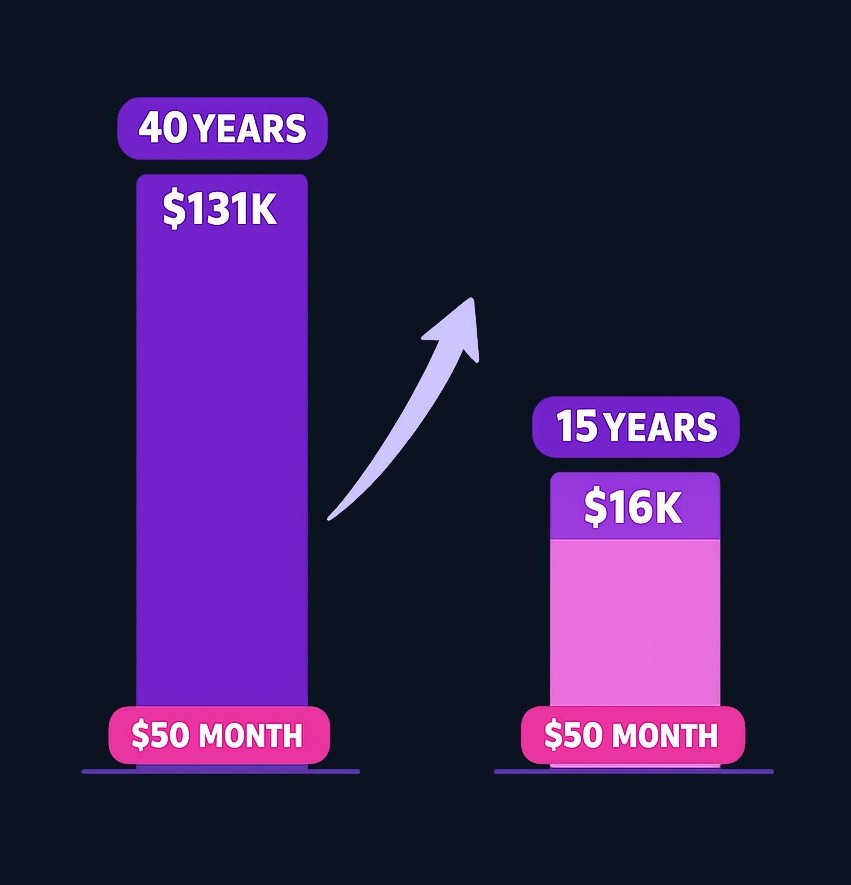
Compounding rewards the early. Your returns start earning returns of their own, and the effect snowballs. A hypothetical illustration: $50 a month growing at an assumed 7% average annual return reaches roughly $131,000 after 40 years. The same $50 a month over 15 years reaches only about $16,000. Real markets won't deliver smooth returns — some years will be negative — but the direction of the lesson holds: months invested matter more than dollars per month.
Before the first dollar goes in, get the foundation right: know your budget, pay down high-interest debt, and set aside an emergency cushion. Credit card interest often costs more than investments plausibly earn — clearing it is the best "return" available.
Micro-Investing: What Is It and How to Get Started
Micro-investing means putting very small amounts — spare change, a few dollars a week — into diversified investments automatically. It removes the two classic beginner barriers: no lump sum, and no idea what to pick. And the entry bar is genuinely low: a few dollars a month is enough.
The category comes in two familiar shapes:
- Round-up investing. The app links to your card and invests the spare change from purchases. Buy a coffee for $3.60, and 40 cents goes into your portfolio.
- Automated portfolios. Robo-advisor services build and manage a diversified portfolio for you, based on your goals and risk comfort.
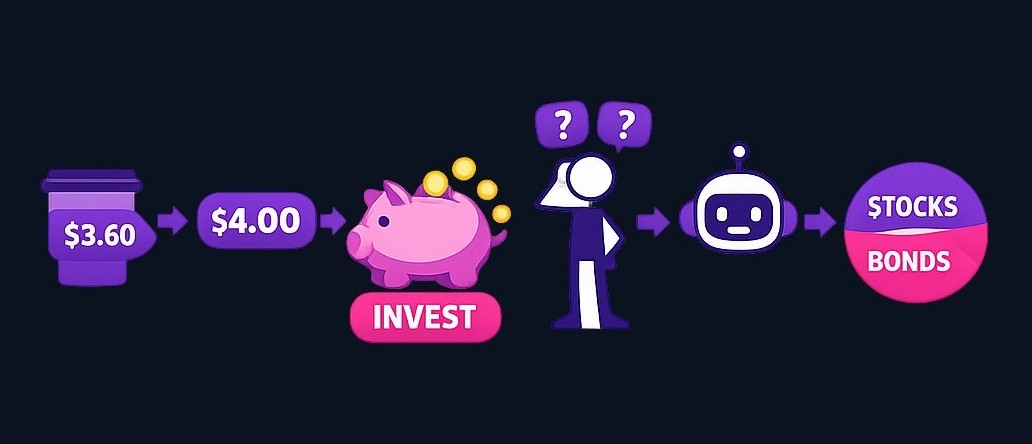
Getting started takes four moves: pick a platform, connect a funding source, set an automatic contribution — even $5 a week — and leave it alone. The amounts feel trivial at first. That's fine. Micro-investing's real product isn't the first $100; it's the habit and comfort that make larger investing possible later.
One cost caution: on tiny balances, even small flat fees bite. Research management fees, sales commissions, and other costs before choosing a provider. A $3 monthly fee on a $100 balance works out to a 36% annual drag.
Choosing the Right Investment Account
Different doors suit different starting points. The main options, per U.S. Bank's breakdown:
| Account type | Typical minimum | Best for |
|---|---|---|
| Micro-investing app | A few dollars a month | Building the habit from pocket change |
| Robo-advisor | Generally around $500 | Hands-off automated portfolios |
| Online brokerage | Typically no minimum | Choosing your own funds and stocks |
| Workplace retirement plan | Varies by employer — 401(k), 403(b), SIMPLE and SEP IRAs | Long-term saving straight from your paycheck |
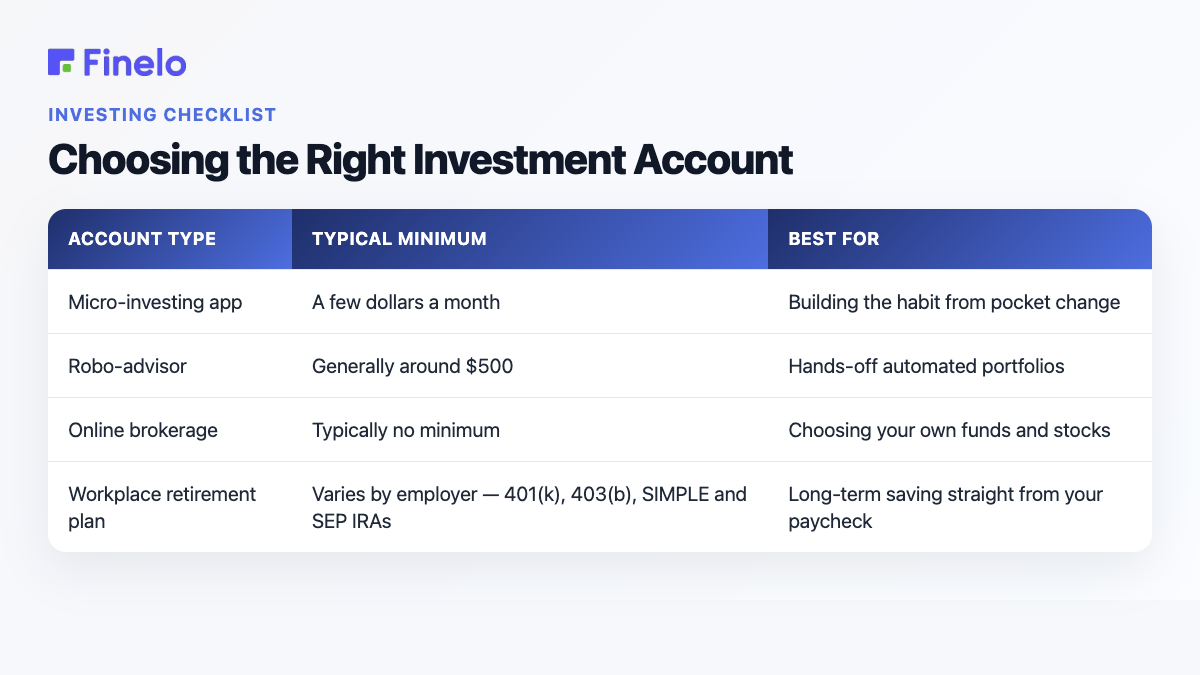
Verify current minimums and fees on each provider's official site — they change.
How to choose:
- Have a 401(k) with an employer match? Start there. Contributions leave your paycheck automatically, and matching money is part of your pay. Even a small starting percentage builds the foundation — raise it over time.
- No workplace plan, want zero decisions? A robo-advisor or automated app fits. Answer questions about goals and risk; it builds the portfolio.
- Want to learn by doing? A no-minimum brokerage lets you buy broad, low-cost funds yourself and grow into more control.
- Money you might need within a year or two? Keep it out of the market. Savings vehicles like high-yield savings accounts, money market accounts, and CDs fit short-term cash.
The checklist: match the account to (1) whether an employer match exists, (2) how much decision-making you want, and (3) when you'll need the money.
Practice investing with Finelo
Build practical investing skills with guided lessons, simulator practice, and structured challenges.
Investment Strategies for Beginners
Dollar-cost averaging: invest on a schedule, not on a feeling. Commit a fixed amount at fixed intervals — say $50 every payday. You automatically buy more shares when prices are low and fewer when they're high. Better still, it kills the paralyzing question "is now a good time?" The schedule decides, not your nerves.
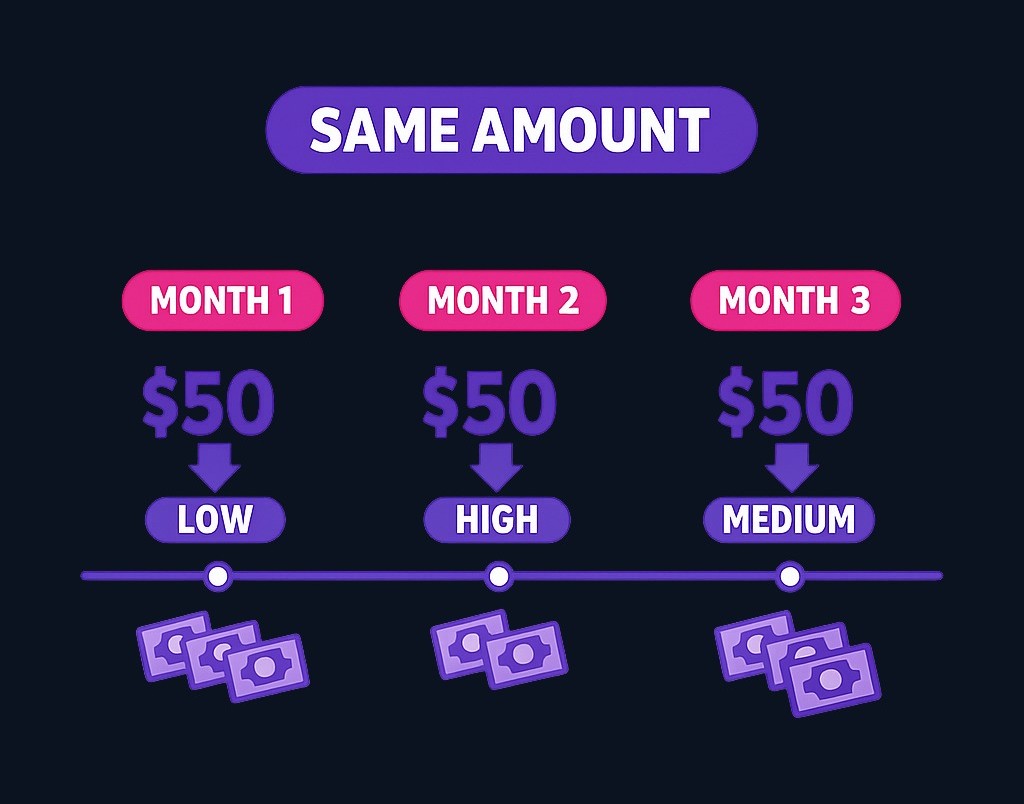
Automate everything. A transfer that happens without you survives busy months, scary market news, and fading motivation. The beginner sequence: set a goal, pick an account, start small, automate the contribution, and adjust as income grows.
Scale with your income, not your mood. A practical ladder: start with whatever is painless — say 2% of income. Then raise it one percentage point with every raise. You'll never feel the increase. Within a few years, the contribution is substantial.
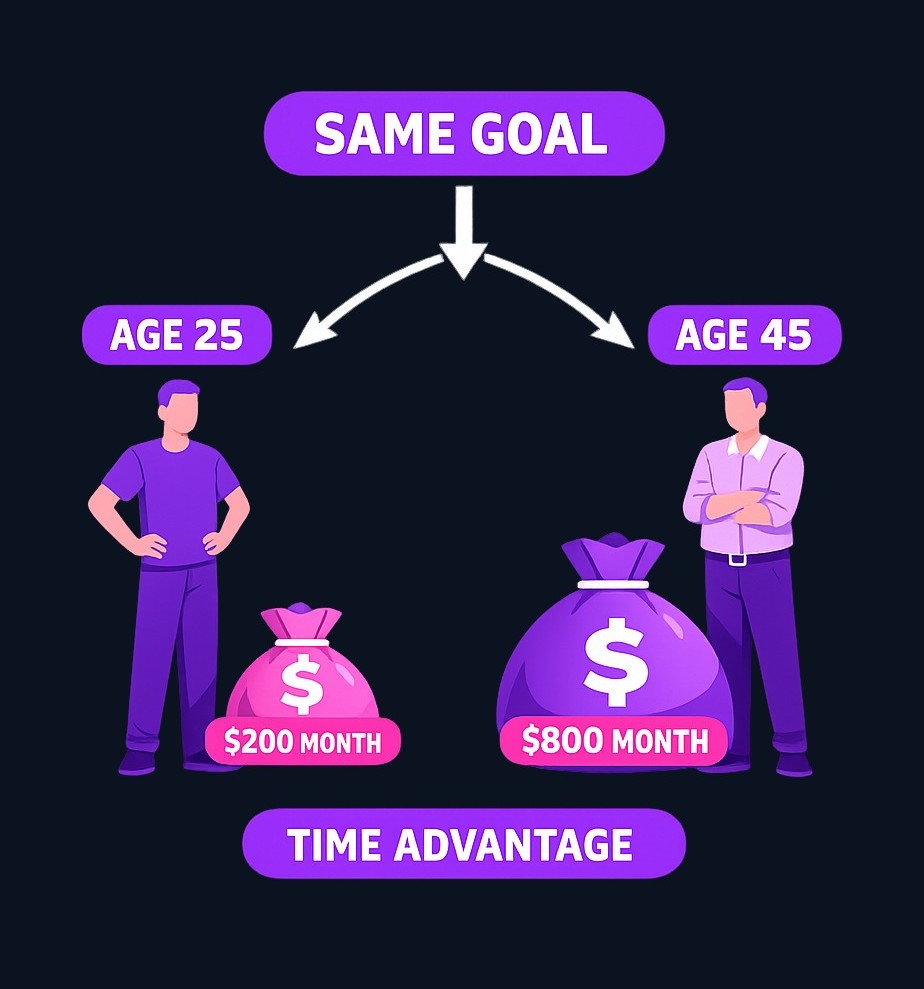
Respect the math of starting now. Run the compounding illustration on your own numbers with any online calculator. At the same assumed return, someone who starts at 25 typically needs to invest far less per month than someone starting at 45 to reach the same goal. Waiting is the expensive choice.
Review yearly, not daily. Once or twice a year, check that your contributions still match your goals. Daily checking invites tinkering — and tinkering is where beginner returns go to die.
Common Mistakes to Avoid When Investing
- Waiting until you have "real money." Small and early beats big and late — compounding needs time more than it needs dollars.
- Investing while carrying high-interest debt. If a card charges more than investments plausibly earn, pay it down first. That's a guaranteed win.
- Skipping the emergency fund. Without accessible savings, your first car repair forces you to sell investments — possibly at the worst moment.
- Betting on one stock. Concentration is the opposite of diversification. One broad fund beats one exciting stock for a beginner.
- Ignoring fees on small balances. Management fees and commissions hit hardest when balances are tiny. Compare costs before committing.
- Panic-selling the first dip. Markets fall regularly. Selling into a drop locks in the loss. Your automatic schedule is the defense — let it keep buying.
Conclusion: Taking the First Step
Starting small isn't a compromise — it's the strategy. The sequence: clear high-interest debt, build a small emergency cushion, grab any employer match, then automate a contribution you won't miss into a diversified investment. Even a few dollars a month starts the compounding clock. The clock is what builds wealth.
This guide is educational, not personalized financial advice. Returns aren't guaranteed, and the right choices depend on your situation — verify costs, risks, and suitability before investing.
Ready to build your knowledge alongside your first dollars? Finelo's Wealth Growth Quiz matches you with an investing learning path that fits exactly where you're starting from.
Frequently asked questions
How much money do I really need to start investing?
Almost none. Micro-investing starts at a few dollars a month, and many online brokerages have no [minimum](https://www.usbank.com/investing/financial-perspectives/investing-insights/how-to-start-investing.html). The habit matters more than the amount at the start.
How does compound interest work in simple terms?
Your money earns returns. Those returns then earn returns of their own — a snowball. The longer it rolls, the faster it grows, which is why starting years earlier beats contributing more later.
What are the risks of investing?
Investments can lose value, and no return is guaranteed — any growth figure is an assumption, not a promise. You manage risk by diversifying, investing only money you won't need soon, and keeping an emergency fund outside the market.
What if I can't afford to invest regularly?
Invest irregularly rather than not at all — a $20 deposit whenever you can still compounds. Meanwhile, fix the foundation: budget, high-interest debt, emergency cushion. Regular investing gets much easier once those are handled.
InvestingBeginnerMarkets
Practice investing with Finelo
Build practical investing skills with guided lessons, simulator practice, and structured challenges.
About the author
Finelo Team
The Finelo Team creates practical investing and trading education designed to help beginners learn faster with structured challenges, simulator practice, and bite-sized lessons.
Keep reading — Related articles

Investing
Yield to Call vs Yield to Maturity: Assumptions and Bond Risks
Yield to call (YTC) estimates a bond's yield if the issuer redeems it on an eligible call date; yield to maturity (YTM) estimates yield if it remains outstanding to final maturity.
Finelo Team
Investing
Will My Employer Know If I Take a 401(k) Loan?
Who this page is for: readers new to 401(k) loans who want a practical, privacy‑focused explanation — what your employer can see, how to limit visibility, and the financial tradeoffs to weigh.
Finelo Team
Investing
What Medical Expenses Qualify for a 401(k) Hardship Withdrawal?
Before you decide, confirm three things with your plan administrator:
Finelo Team