An index fund is usually the stronger fit for an investor who wants a rules-based strategy, broad market exposure, and close control over costs. An actively managed mutual fund may fit someone who values a manager’s specific strategy and accepts the extra cost and uncertainty. The important catch is that these labels can overlap: “index fund” describes a strategy, while “mutual fund” describes a fund structure. This Finelo educational comparison focuses on the strategy, structure, fees, taxes, holdings, and risk—not just the name.
Index Funds vs Mutual Funds: A Comprehensive Comparison
An index fund is usually the stronger fit for an investor who wants a rules-based strategy, broad market exposure, and close control over costs. An actively managed mutual fund may fit someone who values a manager’s…
8 min read
Practice investing with Finelo
Build practical investing skills with guided lessons, simulator practice, and structured challenges.
Want to learn more?
Build practical investing skills with guided lessons, simulator practice, and structured challenges.
Explore FineloExplore Finelo's 28-day challenges
Turn learning into a daily habit with guided challenge paths.
What Is an Index Fund?
For this comparison, an index fund is a fund designed to follow a selected market benchmark. It may hold the full group represented by that benchmark or use a sample. Its portfolio follows preset rules instead of relying mainly on a manager to select investments in an attempt to beat the benchmark.
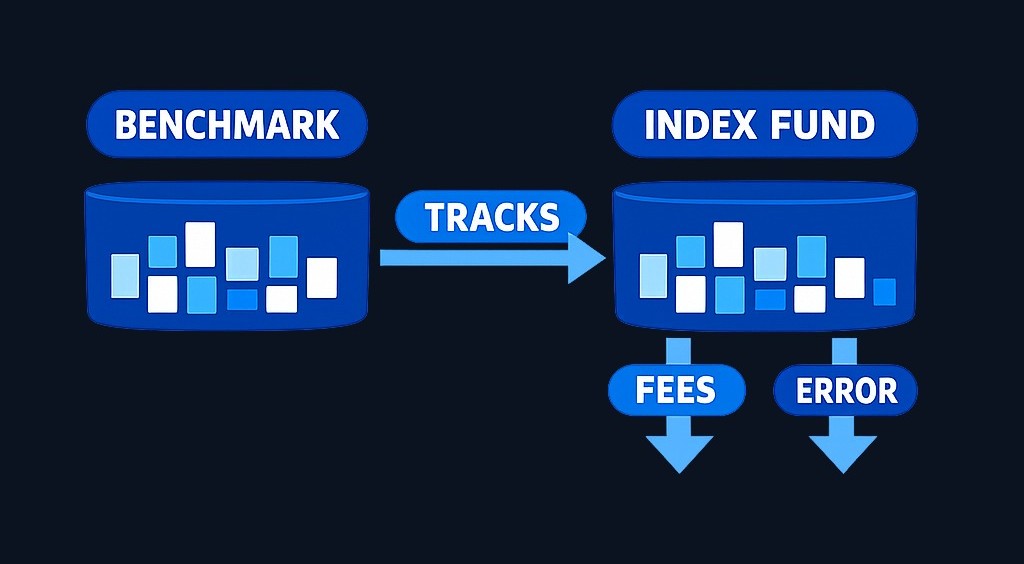
“Passive” does not mean risk-free or maintenance-free. An index fund carries the risks of the securities it tracks. It can also lag its benchmark because of fees, trading costs, or tracking error—the gap between the fund’s results and the index’s results. A narrowly focused index may also be far less diversified than a broad-market index.
The label describes an investment strategy, not a single trading format. Before comparing products, confirm whether the index fund uses a mutual-fund, ETF, or another available structure and check how orders work on your platform.
What Is a Mutual Fund?
A mutual fund combines investors’ money in one portfolio. Investors buy shares of that portfolio rather than selecting every underlying holding themselves.
In this article, “actively managed mutual fund” means a mutual fund whose manager can select and trade investments within a stated objective. A mutual fund can also use an index strategy, which is why the comparison must separate structure from management style.
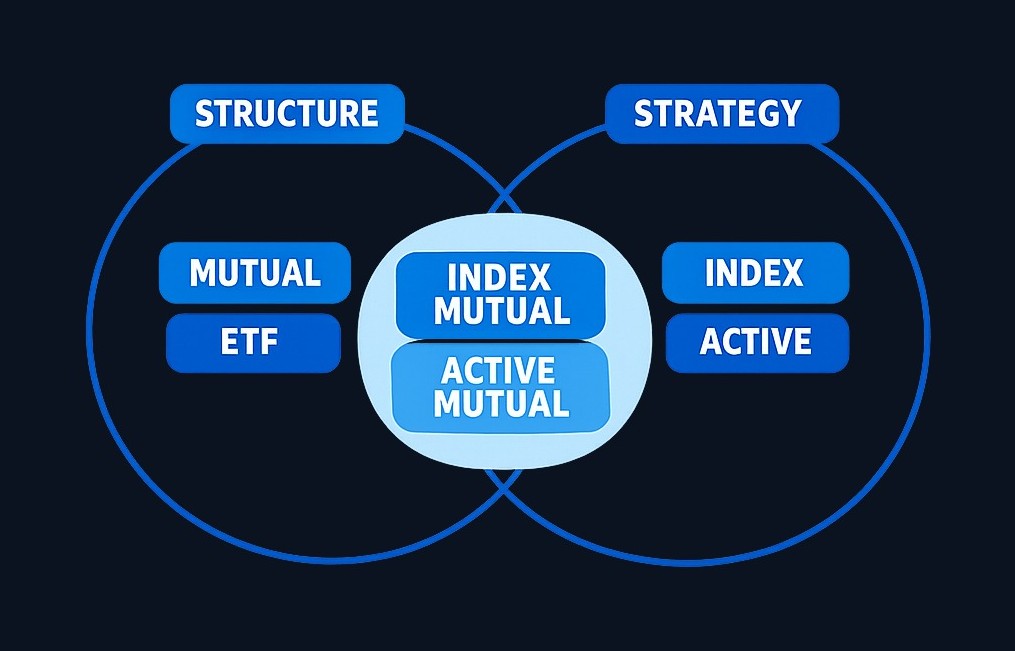
This distinction matters. “Index fund versus mutual fund” is not a perfect either-or comparison. In everyday use, people usually mean index fund versus actively managed mutual fund. That is the comparison used below unless the fund structure itself affects pricing, fees, or taxes.
Index Fund vs Mutual Fund: Key Differences
| Factor | Typical index fund | Actively managed mutual fund |
|---|---|---|
| Portfolio decisions | Follows the rules of a selected index | Manager chooses holdings within the fund’s mandate |
| Main objective | Track a benchmark before costs | Pursue a stated objective, often relative to a benchmark |
| Management risk | Results depend mainly on the index design and tracking | Results also depend on the manager’s decisions and process |
| Trading activity | Usually lower | Varies and may be higher |
| Costs | Often lower, but not always | Often higher because research and active management cost money |
| Market declines | Generally stays invested according to index rules | Manager may adjust holdings, but protection is not guaranteed |
| Tax profile | Depends on turnover, distributions, and whether it is a mutual fund or ETF | Depends on turnover, realized gains, distributions, and account type |
| Buying and selling | Depends on the fund structure and platform | Depends on the fund’s dealing rules and platform |
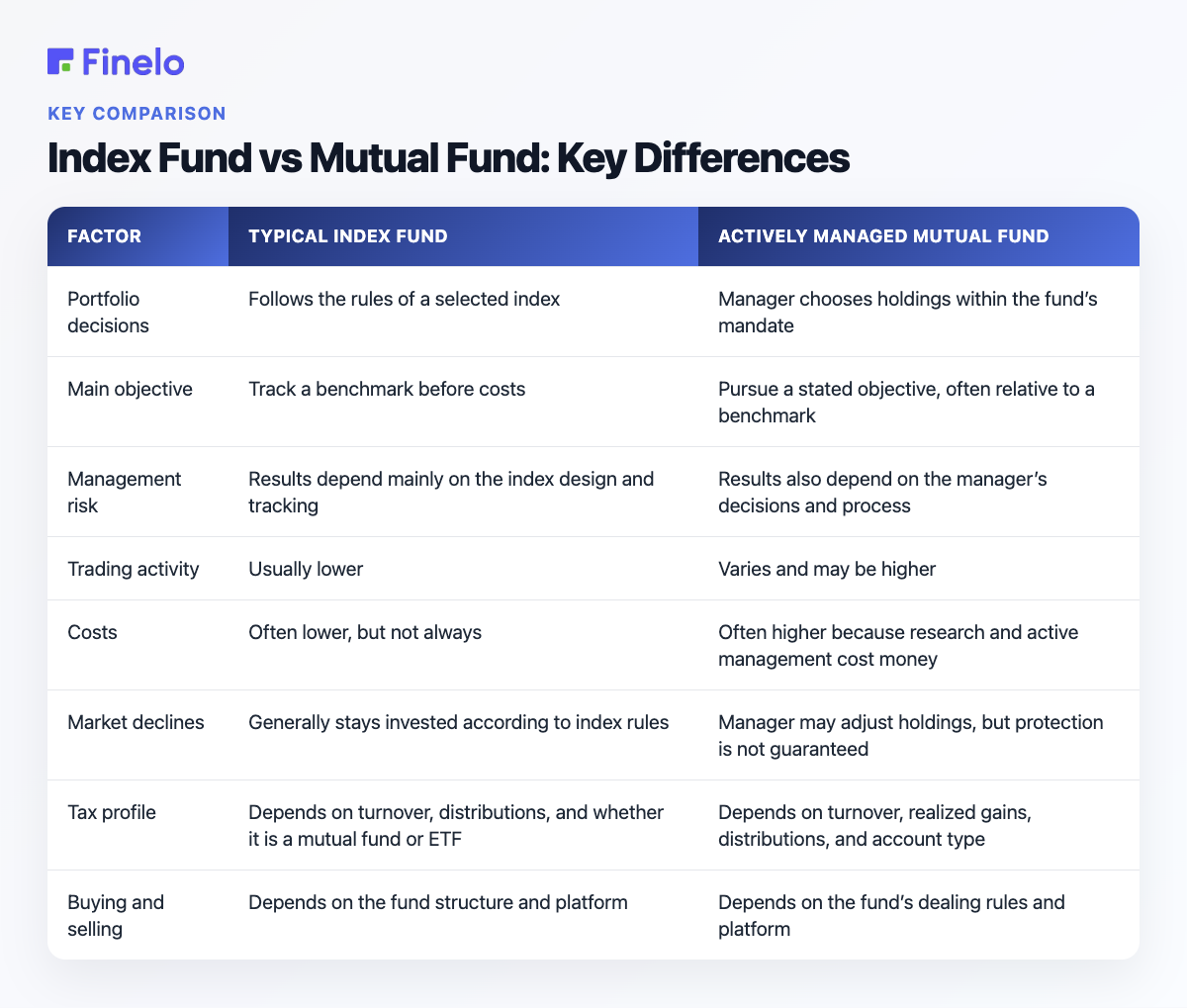
An index strategy may involve less portfolio trading and lower operating costs, but those outcomes are not guaranteed. Check the actual fund rather than assuming its category tells you the price.
Fund structure can also change the buying experience. Check when orders execute, how the price is calculated, whether a minimum applies, and which transaction charges your platform adds.
Advantages and Tradeoffs
Why choose an index fund?
An index fund can make the investment process easier to evaluate. You can inspect the benchmark, understand its selection rules, and measure how closely the fund follows it. Passive management may also reduce research and trading costs. When two options otherwise produce the same result, the lower-cost option leaves more of that result with the investor.
The tradeoff is limited flexibility. The fund follows its index through favorable and unfavorable markets. It does not avoid a company merely because a manager considers it overvalued, and it may become concentrated when the underlying index becomes concentrated. Choosing an index still requires judgment: a broad stock-market index, a sector index, and a bond index solve different problems.
Why choose an actively managed mutual fund?
An active fund can pursue an objective that a basic index does not address. Its manager may research securities, adjust position sizes, hold cash when permitted, or focus on a particular income, risk, or valuation approach. This flexibility can be useful when the strategy has a clear role in a wider portfolio.
It also introduces more variables. You must assess the manager, process, benchmark, portfolio, trading behavior, and cost. A good story is not enough. Historical results can help you examine consistency and volatility, but they cannot tell you what the fund will return next.
An active fund is therefore not automatically better during a market decline, and an index fund is not automatically diversified. Examine what the fund owns and how those holdings behave together.
Practice investing with Finelo
Build practical investing skills with guided lessons, simulator practice, and structured challenges.
Fees and Expenses: Compare the Whole Cost
The expense ratio is only the starting point. When reviewing current fund documents, look for management and operating expenses as well as any distribution, purchase, sale, redemption, exchange, account, platform, or advisory charges. A label that excludes one type of charge does not prove the fund has no other costs.
Use an all-in cost check:
- Confirm the correct fund and share class.
- Read the prospectus fee table.
- Note the expense ratio and any temporary fee waiver.
- Add transaction, sales, account, and advisory charges that apply to you.
- Check whether the fund invests in other funds, which can add indirect underlying expenses.
- Compare costs over your expected holding period.
Here is a simple illustration. Assume Fund A charges an annual expense ratio of 0.10% and Fund B charges 0.75%. On a constant $25,000 balance, those rates represent about $25 and $187.50 for one year—a $162.50 difference. This simplified example ignores market movements, compounding, transaction costs, taxes, and fee changes. Use each fund’s current prospectus for a real comparison.
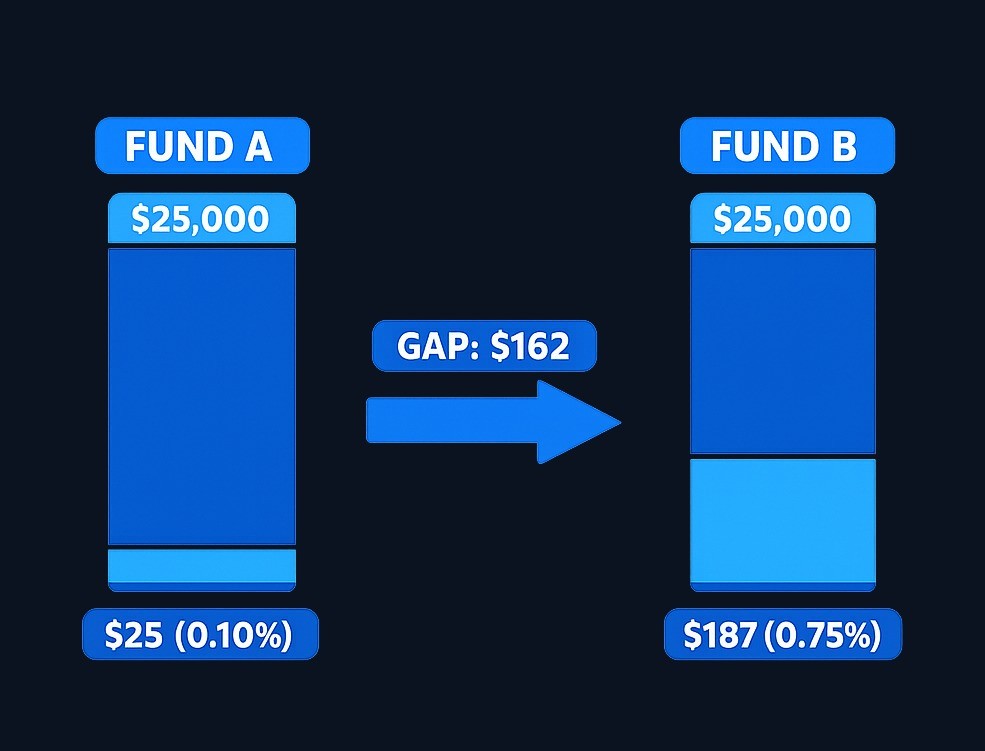
Fees do not prove which fund will perform better. They set the hurdle. A higher-cost fund must earn more before fees to leave the investor with the same result as a lower-cost alternative.
Investment Strategy and Performance
Do not compare two funds by placing their latest returns side by side. First ask whether they pursue the same exposure and risk.
Use this five-part review:
- Objective: What is the fund trying to achieve?
- Benchmark: Is the comparison index appropriate for the fund’s holdings and strategy?
- After-fee results: How did the fund perform after operating expenses?
- Consistency: Did the process and portfolio remain recognizable through different market conditions?
- Risk: How volatile were the results, and how severe were the declines?
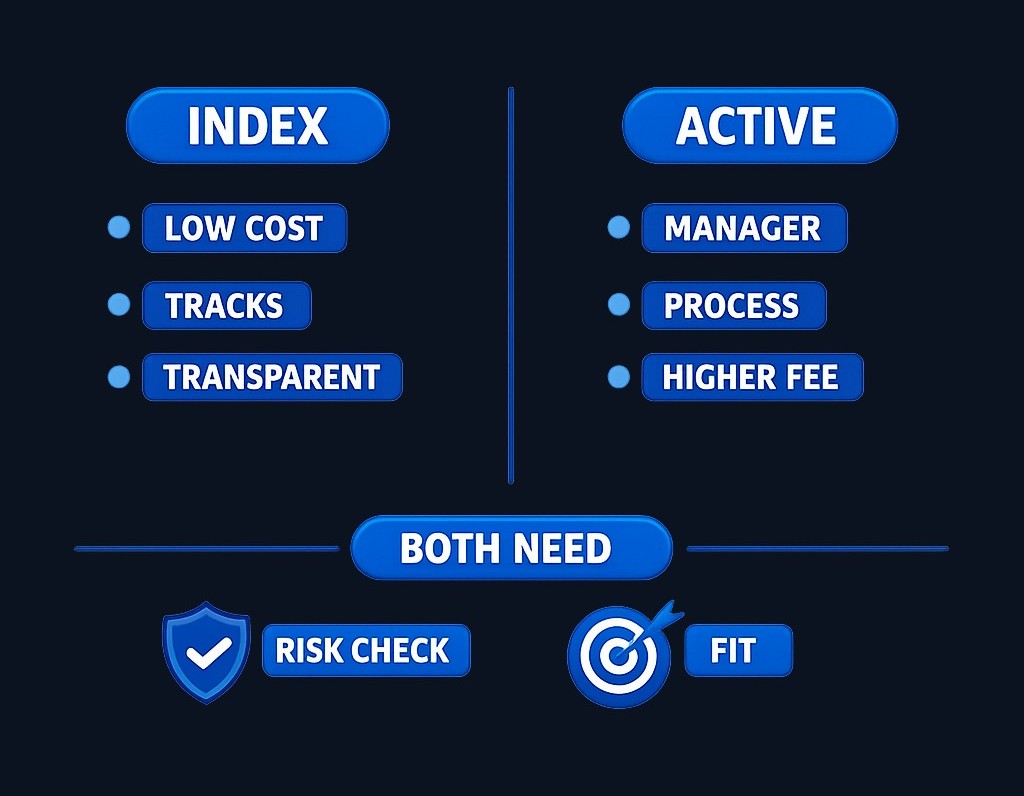
For an index fund, examine index construction, concentration, tracking difference, and cost. Two funds with similar names may follow different benchmarks. For an active fund, examine the investment process, manager tenure, portfolio turnover, holdings, and performance relative to an appropriate benchmark.
Consider an illustrative choice. A reader wants broad stock exposure for a long-term goal. One option tracks a broad index at low cost. Another holds a smaller portfolio chosen by a manager and charges more. The active fund should not win merely because it recently performed better. It needs a clear role, a repeatable process, acceptable risk, and a reason to believe the strategy justifies its cost. The index fund still needs scrutiny for concentration, tracking, and fit.
Tax Implications
Tax treatment can depend on the account, jurisdiction, fund structure, portfolio activity, distributions, and sale of shares. The word “index” alone does not answer the tax question.
Before investing, resolve five points:
- Is the account taxable or tax-advantaged under the rules that apply to you?
- What kinds of distributions can the fund make?
- How does the fund structure handle portfolio transactions and investor withdrawals?
- How are reinvested amounts recorded?
- What records will you need when you sell?
An index strategy may trade less than an active strategy, but that does not guarantee a lower tax bill. Benchmark changes, rebalancing, investor activity, and the fund’s structure may all affect the outcome. Two funds with similar holdings can also produce different after-tax results.
Review the fund’s current tax disclosures and distribution history. Then check them against guidance from the tax authority in your jurisdiction. Keep purchase, reinvestment, and sale records, and consult a qualified tax professional when the consequences could be material.
How to Choose
Use the following decision sequence:
- Define the exposure. Decide which stocks, bonds, markets, or strategy the fund should cover.
- Identify the strategy. Confirm whether the fund tracks an index or gives a manager discretion.
- Identify the wrapper. Check whether it is a mutual fund or ETF; this affects trading and may affect taxes.
- Compare all costs. Review the correct share class and every relevant fee.
- Check the account. Consider taxable versus tax-advantaged placement.
- Inspect risk and overlap. Look through the fund to its holdings rather than assuming the name guarantees diversification.
- Read the documents. Review the current prospectus or equivalent disclosure, fee information, and latest fund report before investing.
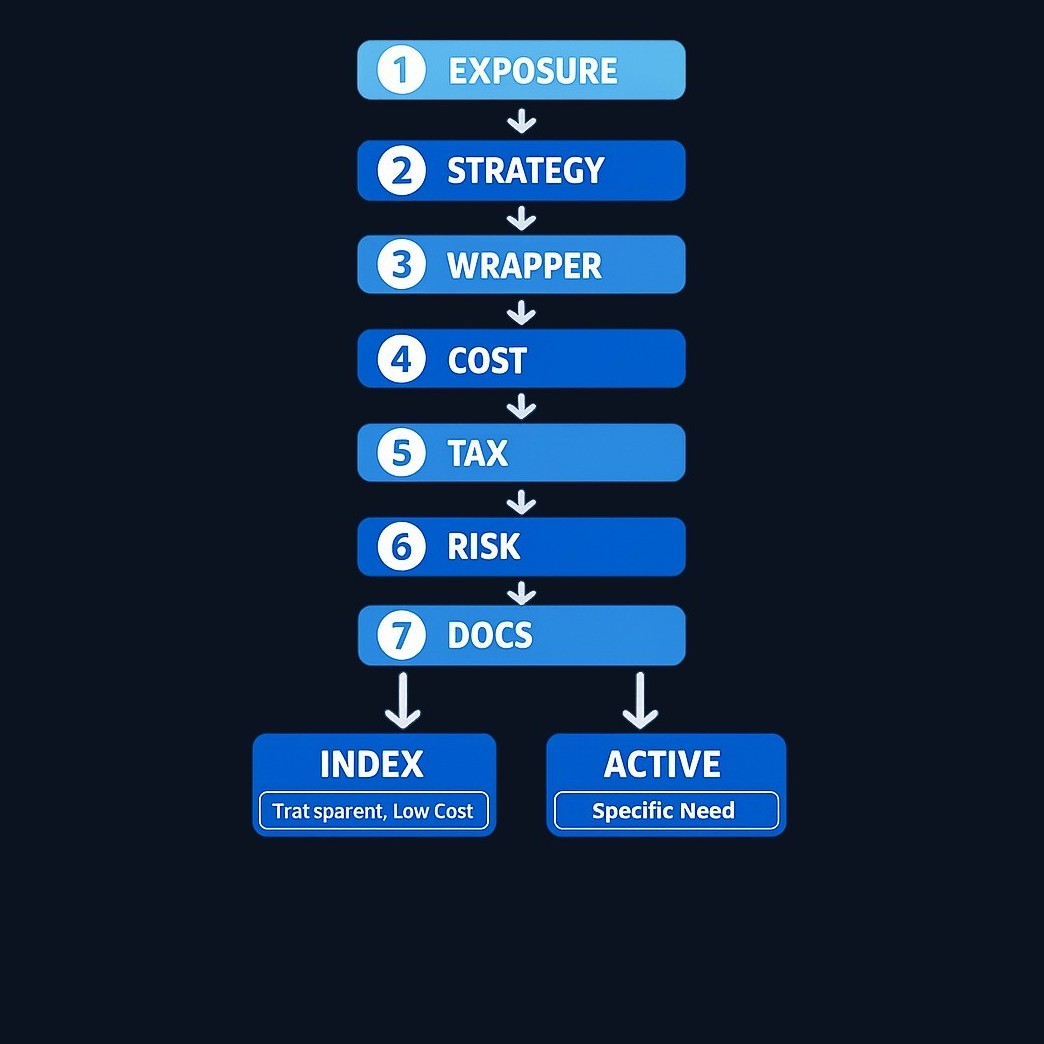
Favor a typical index fund when you want a transparent benchmark, rules-based exposure, and low implementation cost. Consider an actively managed mutual fund when its mandate fills a specific need and you can evaluate its process, risks, and total cost. Holding both can also be reasonable if each serves a distinct role and their holdings do not create unwanted duplication.
Next Steps
Start with the investment exposure you need, then compare funds that pursue that same job. Record each candidate’s benchmark, structure, expense ratio, other fees, tax considerations, major holdings, risks, and role in the portfolio. Eliminate any option you cannot explain in plain language.
Finelo’s educational approach is to separate labels from decisions: understand what the fund owns, how it operates, what it costs, and what could go wrong. That process cannot guarantee an outcome, but it can help you make a more informed comparison. This article is educational and does not provide personalized investment or tax advice.
Frequently asked questions
Are index funds safer than mutual funds?
Not as a category. Risk comes mainly from the underlying holdings, concentration, strategy, and market exposure. An index fund that tracks a narrow or volatile segment can carry more risk than a broadly diversified active mutual fund.
Can an index fund also be a mutual fund?
Yes. Indexing describes the strategy, while “mutual fund” describes a fund structure. An index fund can therefore also be a mutual fund.
Can I own index funds and actively managed mutual funds?
Yes. The practical question is whether each fund has a separate purpose. Compare their holdings to avoid paying for two funds that provide nearly the same exposure.
InvestingBeginnerIndex FundsMutual FundsMarkets
Practice investing with Finelo
Build practical investing skills with guided lessons, simulator practice, and structured challenges.
About the author
Finelo Team
The Finelo Team creates practical investing and trading education designed to help beginners learn faster with structured challenges, simulator practice, and bite-sized lessons.
Keep reading — Related articles
Investing
Yield to Call vs Yield to Maturity: Assumptions and Bond Risks
Yield to call (YTC) estimates a bond's yield if the issuer redeems it on an eligible call date; yield to maturity (YTM) estimates yield if it remains outstanding to final maturity.
Finelo Team

Investing
Will My Employer Know If I Take a 401(k) Loan?
Who this page is for: readers new to 401(k) loans who want a practical, privacy‑focused explanation — what your employer can see, how to limit visibility, and the financial tradeoffs to weigh.
Finelo Team

Investing
What Medical Expenses Qualify for a 401(k) Hardship Withdrawal?
Before you decide, confirm three things with your plan administrator:
Finelo Team