
To understand the stock market as a beginner, learn what a share represents, how orders reach the market, why prices move, and how risk changes with diversification and time. Then practise reading one company, compare account types and costs, and build a written plan before investing real money.
How to Understand the Stock Market for Beginners
To understand the stock market as a beginner, learn what a share represents, how orders reach the market, why prices move, and how risk changes with diversification and time. Then practise reading one company, compare…
13 min read
Practice investing with Finelo
Build practical investing skills with guided lessons, simulator practice, and structured challenges.
Want to learn more?
Build practical investing skills with guided lessons, simulator practice, and structured challenges.
Explore FineloExplore Finelo's 28-day challenges
Turn learning into a daily habit with guided challenge paths.
This guide is for readers starting from zero. It explains the basic mechanics, the main types of stock, a practical research process, and the risks that easy-to-use investing apps can hide. You do not need to memorise every market term. You need a framework that helps you ask better questions and avoid decisions you do not understand.
What Is the Stock Market?
The stock market is a system where investors buy and sell ownership interests in publicly traded companies. Each unit of ownership is called a share. If a company has issued shares and you own one, you own a small part of that company. Your economic result depends on what happens to the value of the shares and whether the company makes distributions to shareholders.
The phrase stock market does not describe one physical room. It covers exchanges, trading venues, brokers, market makers, clearing systems, and the rules that connect buyers with sellers.
The market in one simple flow
- A company makes shares available to public investors.
- Investors place buy or sell orders through brokerage accounts.
- Trading systems match compatible orders.
- A trade occurs when a buyer and seller agree on a price.
- The quoted market price changes as new orders and information arrive.
When investors trade already-issued shares with one another, the transaction is generally between market participants rather than a new purchase from the company. A separate share issuance may raise capital for the company, but it may also reduce the ownership percentage represented by each existing share.
Exchanges, brokers, and indexes are different
An exchange is a marketplace with rules for listing and trading securities. A broker is the firm that accepts a customer’s order and routes or executes it. A market index tracks a selected group of investments to show how that segment is performing.
An index is a measurement, not automatically an investment. A fund can be designed to follow an index, but the fund is a separate product with its own holdings, fees, and risks.
Think of an index as a scoreboard. It can show whether a defined group rose or fell, but it does not explain why every company moved. One stock may fall on disappointing business news while the broader index rises.
Types of Stocks Beginners Should Understand
The most important distinction is between common and preferred stock. Companies can create different share classes, so the exact rights always depend on the terms attached to the security.
| Feature | Common stock | Preferred stock |
|---|---|---|
| Basic role | Represents an ownership interest in a company | Represents an ownership interest with specially defined economic rights |
| Voting | May include voting rights | Often has limited or no ordinary voting rights |
| Distributions | Dividends may change or stop | Dividends may follow stated terms, but payment is not guaranteed |
| Priority | Usually ranks behind creditors and preferred shareholders | May rank ahead of common stock for dividends or liquidation proceeds |
| Price behaviour | Often responds strongly to expectations about company growth | May react to company risk and changes in interest-rate expectations |
| Best use for a beginner | Learning how business performance affects ownership value | Studying how security terms can change risk and income characteristics |
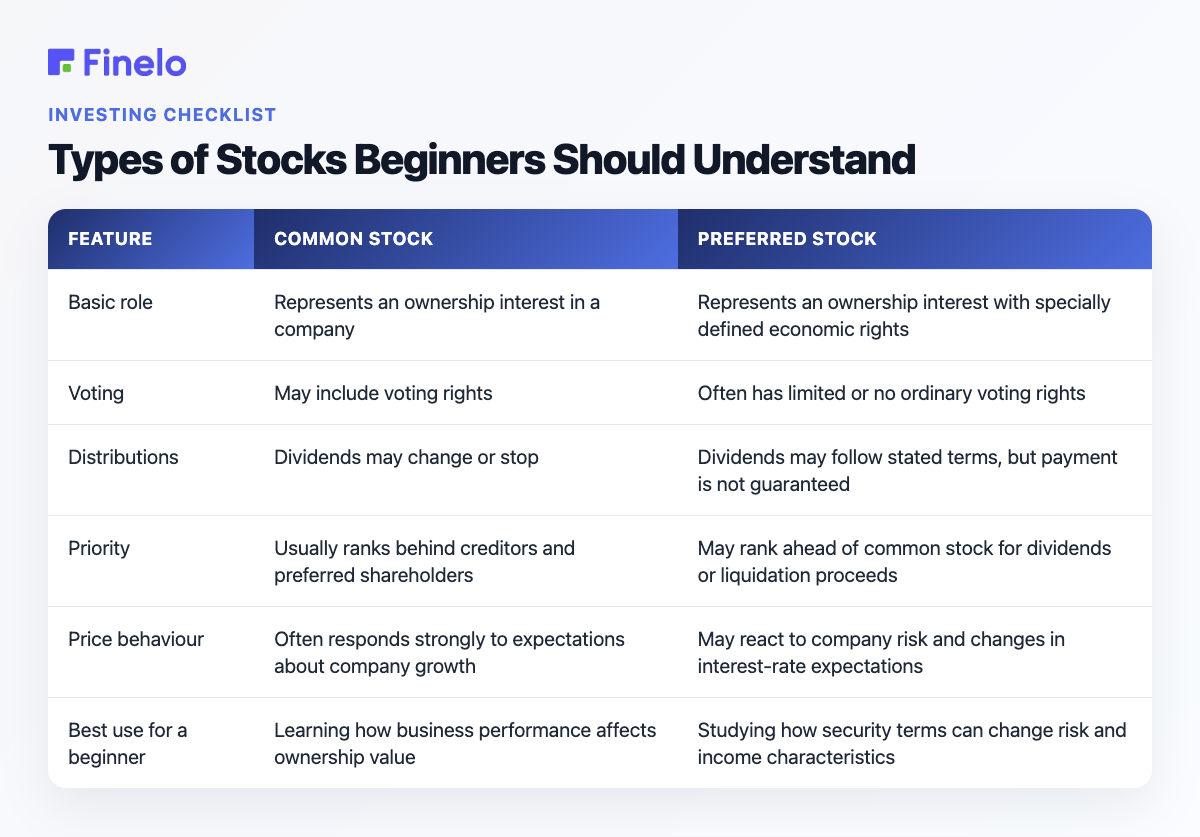
“Preferred” does not mean safer in every situation. It describes contractual priority over common stock in specified areas. A preferred share can still lose value, stop paying dividends, or become difficult to sell.
Other labels describe behaviour, not a separate legal category
You may also see stocks described as:
- Growth stocks: Companies whose value depends heavily on expectations of future expansion.
- Value stocks: Companies that appear inexpensive relative to selected business or valuation measures.
- Income stocks: Companies investors may consider for dividend income.
- Cyclical stocks: Businesses whose results may be sensitive to economic cycles.
- Defensive stocks: Businesses whose products or services may face steadier demand.
- Large-, mid-, or small-cap stocks: Companies grouped by market capitalisation, which is the share price multiplied by the number of shares.
These labels overlap. A company can be both large-cap and growth-oriented, or both cyclical and dividend-paying. Treat labels as a starting point for research, not as a complete risk assessment.
Individual stocks, ETFs, and mutual funds
Buying one company’s stock gives you concentrated exposure to that business. A fund may hold many investments in one product. ETFs are generally designed to trade during the market day, while mutual funds follow dealing rules set by their structure and provider.
The right comparison is not “Which product always performs better?” Instead, ask:
- Do I want to analyse individual businesses?
- How much concentration can I tolerate?
- What does the fund hold?
- How does the product choose and weight its investments?
- What fees, trading costs, and tax considerations apply?
- Can I explain why this investment belongs in my plan?
Diversification can reduce the damage caused by one company performing badly, but it cannot prevent a diversified portfolio from losing value when a broad market falls.
How to Start Investing in Stocks
Start with your financial position, not with a stock symbol. Investing is easier to understand when every decision has a purpose, a time horizon, and a limit.
1. Define the job of the money
Write down:
- What the money is for
- When you may need it
- What loss would make the plan unworkable
- Whether you need regular access to the funds
- Which decisions you will make yourself
Money needed for near-term essentials has a different job from money intended for a distant goal. A volatile investment may fall just when you need to sell it.
2. Compare brokerage account types
Account labels, tax treatment, eligibility, and investor protections vary by provider and jurisdiction. Use this table as a question guide, then check the provider’s official fee schedule and account documents.
| Account type | What it is generally used for | Fee questions to ask | Other points to check |
|---|---|---|---|
| Self-directed taxable brokerage account | Buying and selling investments directly | Trading commissions, account fees, transfer fees, currency costs, and product expenses | Tax reporting, available investments, order types, and cash protection |
| Tax-advantaged retirement account | Investing for retirement under special tax rules | Account fees, product expenses, advice fees, and transfer or closure charges | Eligibility, contribution rules, withdrawal restrictions, and tax treatment |
| Managed or advisory account | Paying a provider to manage or recommend a portfolio | Advisory fee, product expenses, trading costs, and service fees | Investment mandate, conflicts, rebalancing method, and withdrawal access |
| Automated portfolio service | A model-driven portfolio with limited customisation | Management fee, fund expenses, cash allocation, and transfer fees | Risk questionnaire, portfolio changes, human support, and tax features |
| Education or simulation account | Practising without placing real-money trades | Subscription or feature-access costs | Whether prices are live or delayed and how simulated orders are filled |
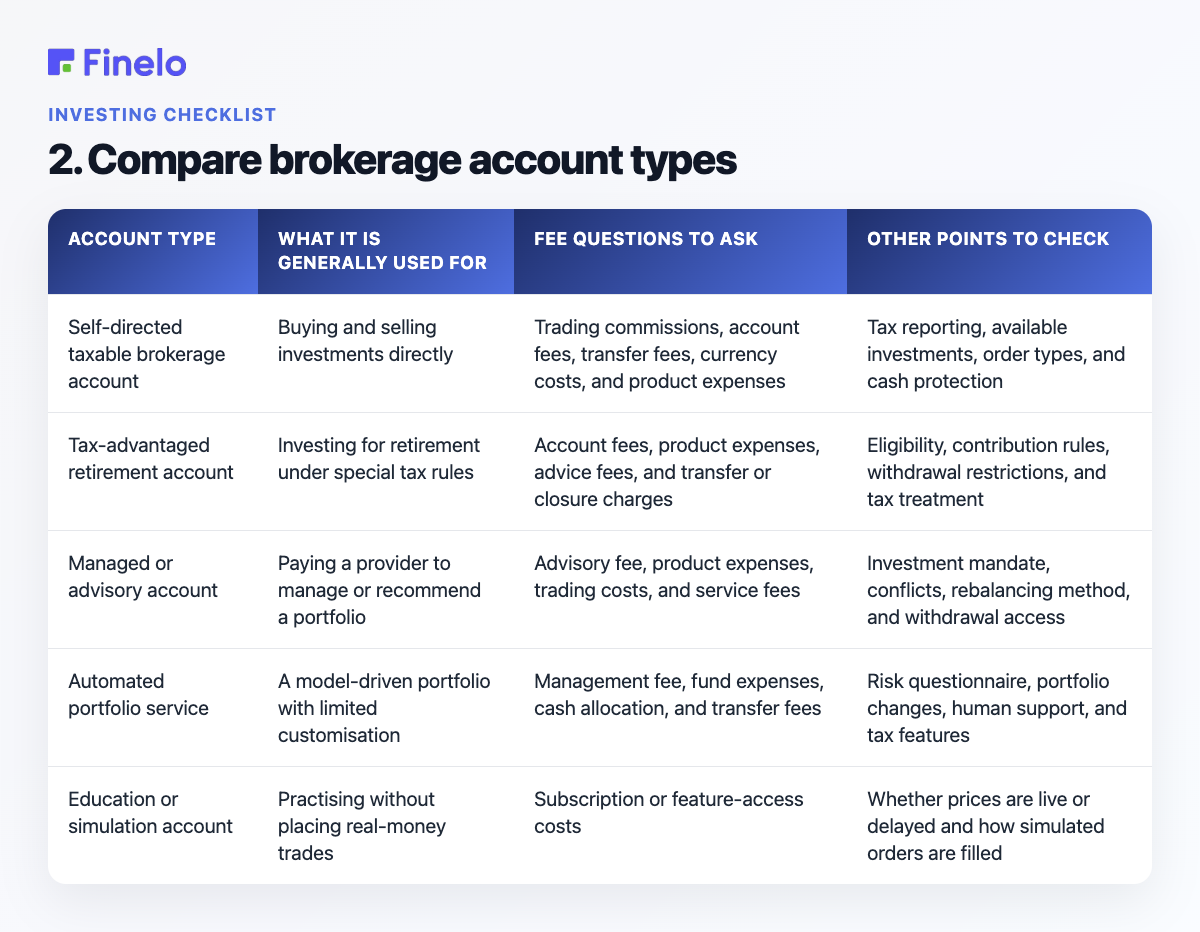
A “zero commission” trade does not necessarily make the full investment journey cost-free. Depending on the account and product, costs may include bid–ask spreads, fund expenses, account charges, taxes, currency conversion, or a less favourable execution price. Compare the full journey: deposit, purchase, holding, sale, and withdrawal.
3. Evaluate the brokerage before funding it
Check the provider’s official documents for:
- Which investments and account types it offers
- How cash and securities are held
- Every applicable fee
- Minimum purchase or balance requirements
- Order types and execution practices
- Access to statements and tax records
- Withdrawal and transfer procedures
- Customer support and complaint handling
- Which regulator or legal entity is responsible in your location
Do not rely on an app-store description or influencer summary for these details. Read the current documents tied to the exact legal entity that would hold your account.
4. Build a research note before buying
Use a one-page investment note:
- Business: How does the company make money?
- Customers: Who pays it, and why?
- Advantage: What might help it keep customers or compete?
- Financial condition: Are sales, profits, cash flow, and debt moving in a direction you understand?
- Valuation: What expectations seem built into the share price?
- Risks: What could make the original idea wrong?
- Exit rule: What evidence—not emotion—would make you reconsider?
If you cannot explain the business in plain language, keep researching. Complexity is not proof of quality.
5. Practise the process
A simulator can help you learn order entry and review decisions before using cash. Finelo describes its learning platform as combining lessons, quizzes, and risk-free market simulations (see how the Finelo learning platform works).
Simulation does not reproduce every real-world cost, order fill, or emotion. Treat it as practice for a process, not evidence that future trades will be profitable.
Practice investing with Finelo
Build practical investing skills with guided lessons, simulator practice, and structured challenges.
Why Stock Prices Rise and Fall
The price shown as the most recent trade records where a buyer and seller completed a transaction. New trades may occur at different prices as market participants update what they are willing to pay or accept.
The key idea is expectations. A company can report growing profits and still see its share price fall if investors expected even stronger results. A struggling company’s price can rise if the news is less negative than expected.
What can change expectations?
- Revenue, costs, profit margins, and cash flow
- New products or lost customers
- Leadership decisions
- Competition and regulation
- Debt and financing conditions
- Interest-rate and inflation expectations
- Economic growth or contraction
- Industry-specific events
- Changes in market sentiment
Not every price move has one clear cause. Market commentary often creates a neat explanation after the event, but many buyers and sellers act for different reasons.
Bid, ask, spread, and liquidity
In a displayed market quote, the bid generally represents the highest shown buying price, while the ask generally represents the lowest shown selling price. The difference is the spread.
Liquidity describes how easily an investment may be bought or sold without causing a large price change. A security with limited trading activity may have a wider spread or less predictable execution.
Consider a hypothetical share with buyers near 49 and sellers near 50. A market order generally prioritises execution over a particular price. A limit order sets a price boundary, but execution is not guaranteed. This example is illustrative; order handling and available prices depend on the market, broker, security, and current conditions.
How to evaluate stock performance
Price alone tells you very little. A low-priced share is not automatically cheap, and a high-priced share is not automatically expensive.
Use a layered review:
| Layer | Questions |
|---|---|
| Business progress | Are customers, revenue, and the company’s competitive position improving? |
| Profitability | Are margins and earnings sustainable, volatile, or dependent on unusual items? |
| Cash flow | Does the business generate cash, and what does it spend that cash on? |
| Balance sheet | How much debt, cash, and near-term financial pressure does it have? |
| Share count | Is the company issuing shares in a way that dilutes existing owners? |
| Valuation | What growth, profitability, or recovery does the current price appear to assume? |
| Total return | How have price changes and any distributions affected the investment result? |
| Benchmark | Did the stock reward its additional risk compared with a relevant alternative? |
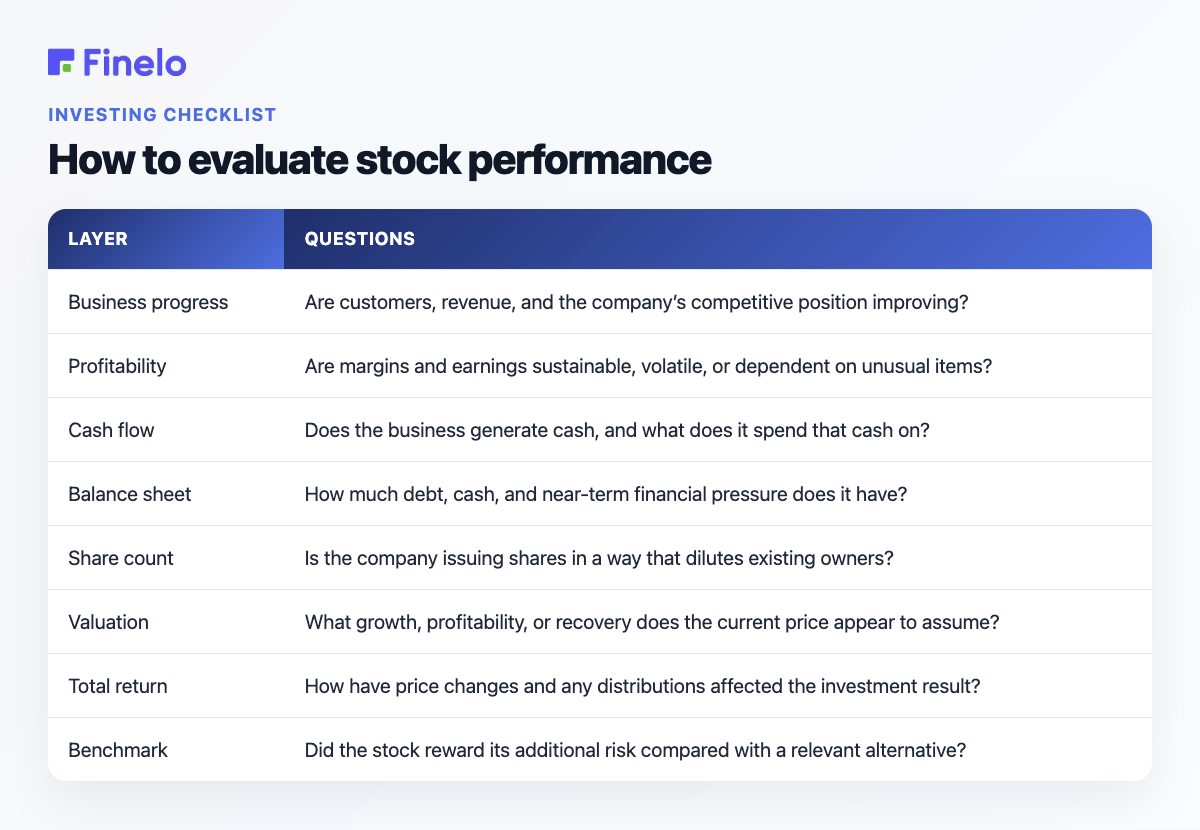
No single metric gives a complete answer. Ratios need context from the company’s industry, accounting, capital needs, and stage of development.
Beginner Investment Strategies
A strategy is a repeatable set of rules. It should state what you will buy, why you will buy it, how much you will allocate, when you will review it, and what would make you change course.
Diversified long-term investing
This approach spreads money across multiple investments and focuses on a long horizon. It reduces dependence on one company, but it does not remove market risk.
Before choosing a fund, examine:
- The index or strategy it follows
- Its largest holdings
- Sector and geographic concentration
- Ongoing expenses and trading costs
- How often the portfolio changes
- Whether the product matches your goal and account
Two funds with similar labels can hold different investments. Read the portfolio information rather than relying on the fund name.
Regular investing
Regular investing means contributing according to a schedule instead of waiting for a perfect forecast. It can create discipline, but it does not guarantee a favourable average price or protect against losses.
The useful question is whether the contribution fits your cash flow and plan. Do not automate an investment you have not reviewed.
Individual-stock investing
This strategy gives you direct exposure to selected companies. It demands more research and creates more company-specific risk than a broadly diversified portfolio.
Use a position limit decided before purchase. A compelling story is not a reason to let one holding dominate money assigned to an important goal.
A beginner decision framework
| If your priority is… | A starting approach to research | Main danger |
|---|---|---|
| Broad market exposure | Compare diversified funds and their holdings | Assuming all broad funds are identical |
| Learning company analysis | Research a small watchlist before investing | Confusing familiarity with a strong business |
| Practising mechanics | Use a simulator and decision journal | Treating virtual gains as proof of skill |
| Building a routine | Create a contribution and review schedule | Automating without monitoring costs or suitability |
| Seeking dividend income | Review cash flow, payout resilience, and total return | Chasing a high yield without studying the business |
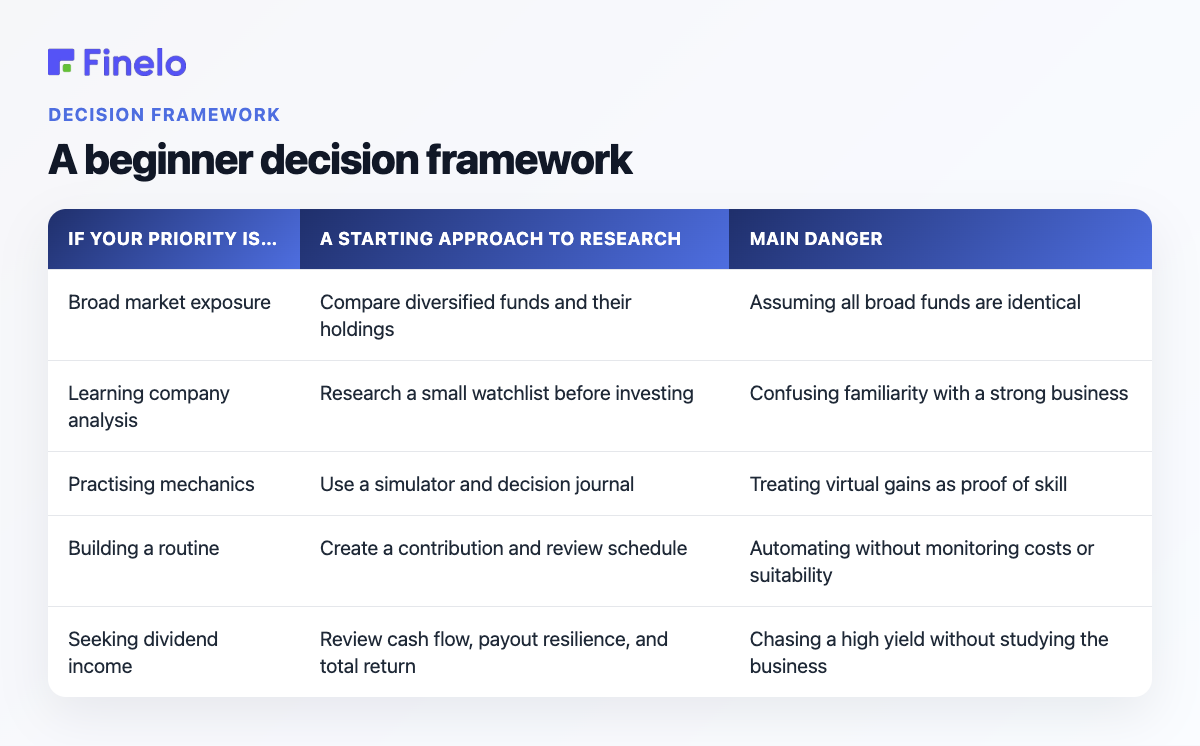
The framework narrows the research task. It does not select an investment for you.
Risks of Investing in Stocks
Stock investing involves the risk of losing money. Good research can improve a decision process, but it cannot remove uncertainty.
The main risks
- Market risk: Broad prices can fall together.
- Company risk: A business can lose customers, face higher costs, take on excessive debt, or fail.
- Valuation risk: A strong company can still be a poor investment if the price assumes unrealistic results.
- Concentration risk: One position, sector, or country can dominate the outcome.
- Liquidity risk: You may be unable to sell quickly at the price you expect.
- Currency risk: Returns can change when the investment and your spending currency differ.
- Behaviour risk: Fear, excitement, and social pressure can override a written plan.
- Tax and account risk: The account type, transaction, and jurisdiction can change the tax or reporting result.
- Fraud and security risk: Impersonation, account theft, or misleading promotions can cause losses outside normal market movements.
A practical risk-control system
Use five guardrails:
- Separate essential cash from investment money. Avoid depending on a stock sale to cover a near-term obligation.
- Limit concentration. Decide how much one company, theme, or sector may represent before buying.
- Define the thesis and failure conditions. Write what must remain true and what evidence would invalidate the idea.
- Review costs and taxes before trading. Frequent activity can create friction even when the decisions appear profitable before costs.
- Secure the account. Use unique credentials, stronger authentication where available, and official contact channels.
An illustrative risk scenario
Imagine two beginners who both like the same company. One puts nearly all available investment money into it after seeing enthusiastic posts. The other writes a research note, limits the position, and keeps exposure to other businesses.
If the company disappoints, both positions may lose value. The second beginner has not eliminated risk, but one mistaken idea is less likely to control the entire result. The lesson is about portfolio construction, not predicting which company will win.
Common Beginner Mistakes and Better Alternatives
Buying a story without checking the business
A popular product or charismatic leader does not automatically make a sound investment.
Better approach: Trace the story to revenue, costs, cash flow, debt, competition, and valuation. Ask what the current price already assumes.
Treating a falling price as a bargain
A stock can become cheaper because the business outlook has weakened. A percentage decline does not reveal fair value.
Better approach: Rebuild the investment case using current information. Do not anchor on the previous high.
Chasing performance
Recent winners attract attention, but past movement does not explain future risk.
Better approach: Write why the investment should earn a return from today’s price and what could prove that view wrong.
Trading too often
Activity feels productive. It can also increase costs, tax complexity, and opportunities for emotional mistakes.
Better approach: Set review dates and trade only when the decision follows your written rules.
Ignoring fees because one charge is zero
Commission is only one possible cost.
Better approach: Review spreads, product expenses, advice fees, currency conversion, account charges, taxes, and transfer costs.
Copying an influencer or AI output
A confident explanation can still be incomplete, outdated, or unsuitable for your situation.
Better approach: Use outside ideas as research prompts. Check company documents, assumptions, conflicts, and risks yourself.
Confusing simulation with real investing
Virtual trading can simplify fills and remove the emotional effect of losses.
Better approach: Score the quality of the decision, not only the virtual return. Record whether you followed your process and included realistic costs.
Your practical next step
Choose one company or diversified fund for research without buying it. Write down how it works, what it owns, its costs, three risks, and what evidence would change your view. Then practise monitoring that thesis rather than reacting to every price move.
For a structured educational option, the Finelo AI Investing Challenge covers portfolio construction, research, diversification, and simulator practice with virtual funds. The official page states that it is an educational product rather than a brokerage or investment adviser.
Frequently asked questions
How much money do I need to start investing?
The practical amount depends on the broker’s rules, the investment’s purchase requirements, and your finances. Start only after deciding what the money is for, when you may need it, and what loss you could tolerate without affecting essential expenses.
What is the difference between stocks and bonds?
A stock represents an ownership interest in a company. A bond represents a debt obligation under defined terms. Both can lose value, and the relevant risks depend on the issuer, price, maturity, contractual terms, and market conditions.
How can I track my investments?
Track holdings, allocation, costs, cash flows, and the reason you bought each investment. Review whether the original thesis remains valid. Separate investment performance from deposits and withdrawals so new contributions do not look like gains.
Should a beginner buy individual stocks or funds?
Individual stocks provide direct exposure to selected businesses but create more company-specific risk. Diversified funds spread exposure, yet their holdings, costs, and strategies still need review. Choose based on your goal, research capacity, concentration tolerance, and understanding of the product. Investing involves risk, including the possible loss of principal. This article is educational and does not provide personalised financial advice or promise investment results.
InvestingBeginnerMarket BasicsMarkets
Practice investing with Finelo
Build practical investing skills with guided lessons, simulator practice, and structured challenges.
About the author
Finelo Team
The Finelo Team creates practical investing and trading education designed to help beginners learn faster with structured challenges, simulator practice, and bite-sized lessons.
Keep reading — Related articles
Investing
What is an Index Fund?
An index fund is a mutual fund or exchange-traded fund (ETF) that holds the same investments as a market index — such as the S&P 500 — instead of relying on a manager to pick stocks. Its goal is simple: match the…
Finelo Team
Investing
What Happens to Bonds When Interest Rates Rise?
When interest rates rise, existing bond prices typically fall. The reason is competition: newly issued bonds pay the higher current rates, which makes older bonds with lower payments less attractive — and less valuable…
Finelo Team
Investing
Essential Stock Market Terms for Beginners
The most important stock market terms for beginners explain five things: what you own, where it trades, how you place an order, what changes its value, and which risks you accept. Start with stock, share, exchange…
Finelo Team