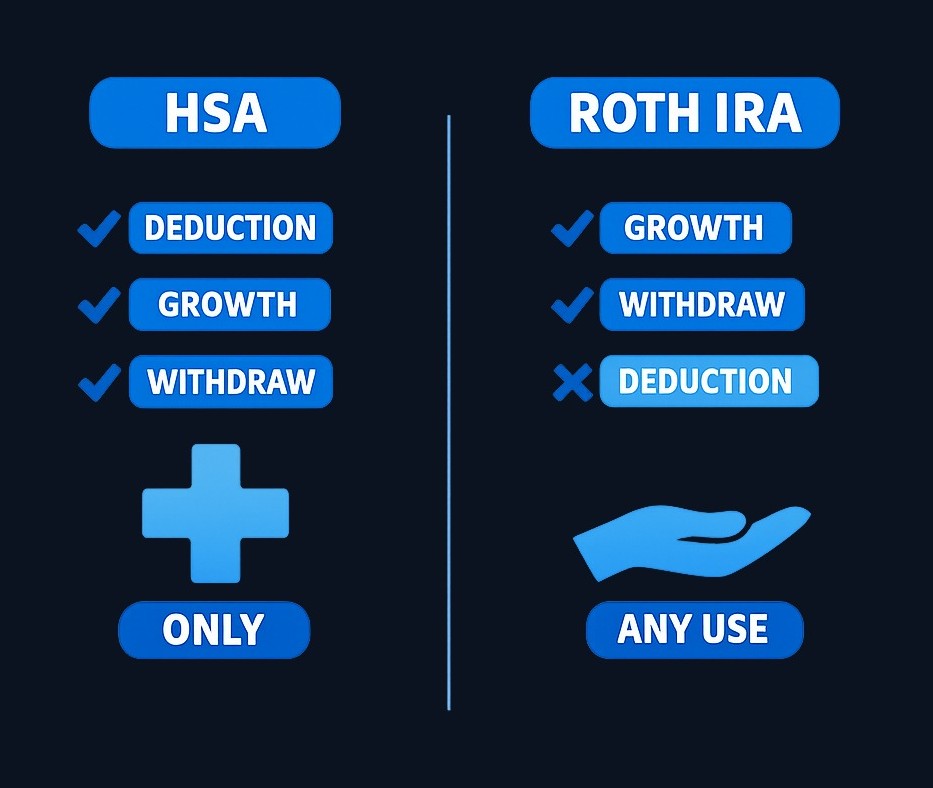
An HSA and a Roth IRA both grow your money tax-free, but they exist for different jobs. An HSA is built around a triple tax advantage: contributions cut your taxable income, growth is tax-free, and qualified medical withdrawals are never taxed. A Roth IRA uses after-tax contributions in exchange for tax-free qualified withdrawals in retirement, for any expense, not just medical ones.
HSA vs Roth IRA: A Detailed Comparison
An HSA and a Roth IRA both grow your money tax-free, but they exist for different jobs. An HSA is built around a triple tax advantage: contributions cut your taxable income, growth is tax-free, and qualified medical…
6 min read
Practice trading with Finelo
Practice in a simulator, learn with bite-sized lessons, and build confidence before risking real money.
Want to learn more?
Practice in a simulator, learn with bite-sized lessons, and build confidence before risking real money.
Explore FineloExplore Finelo's 28-day challenges
Turn learning into a daily habit with guided challenge paths.
This comparison is for anyone deciding where their next dollar of savings should go, especially if they're eligible for both accounts. Read the two definitions below, check the differences table, then use the decision sections to see which one — or both — fits your situation.
What is an HSA?
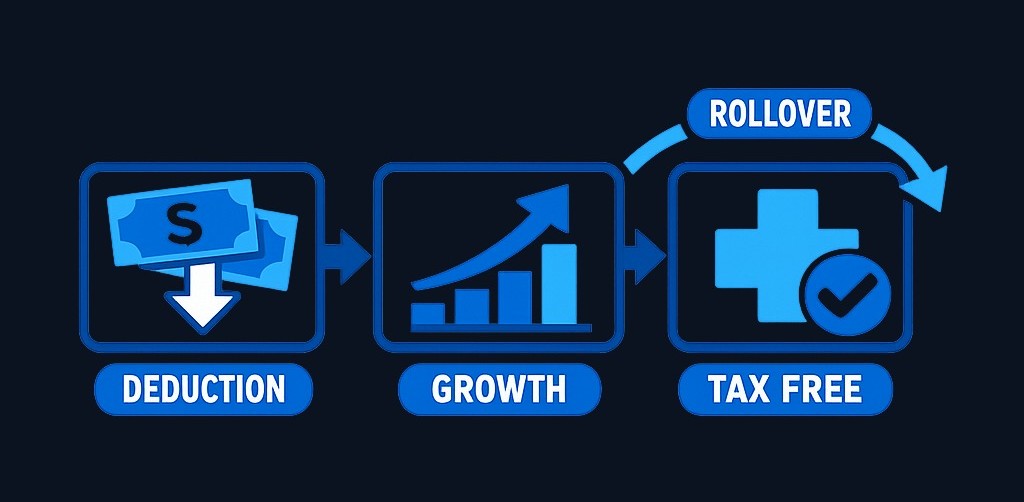
A health savings account (HSA) is a tax-advantaged account used to pay for qualified medical expenses, including copays, prescriptions, dental, and vision costs. To open one, you must be enrolled in a high-deductible health plan, not covered by a non-HSA-eligible plan, not enrolled in Medicare, and not claimed as someone else's dependent.
The 2026 contribution limit is $4,400 for self-only coverage and $8,750 for family coverage, plus a $1,000 catch-up contribution if you're 55 or older. Unused money carries forward every year — there's no use-it-or-lose-it deadline, so an HSA can double as a long-term investment account, not just a spending account.
What is a Roth IRA?
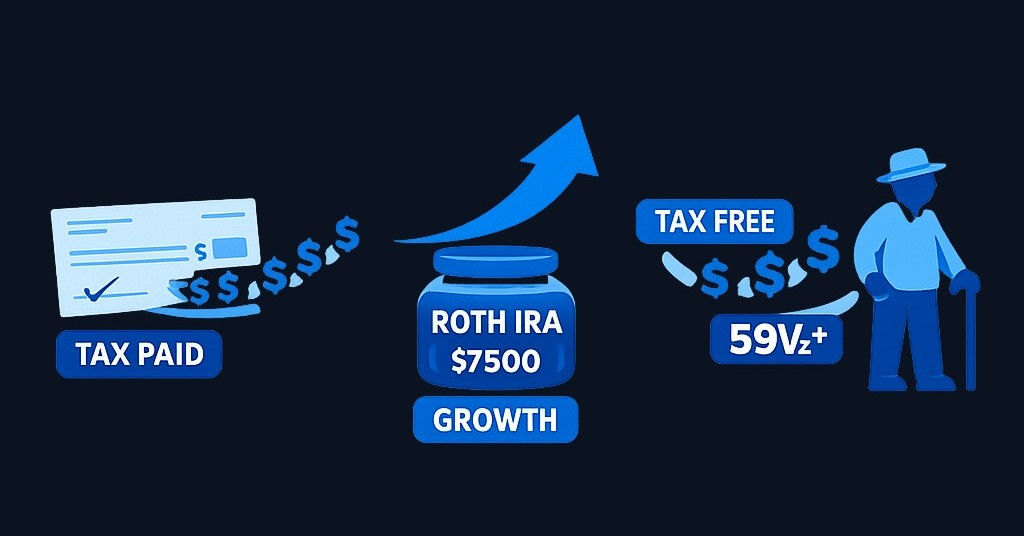
A Roth IRA is an individual retirement account funded with after-tax dollars. You don't get a tax deduction going in, but qualified withdrawals in retirement are completely tax-free — on contributions and on decades of growth alike.
The 2026 contribution limit is $7,500 for those under 50, and $8,600 for those 50 and older, including a $1,100 catch-up contribution. Eligibility phases out at higher incomes: full contributions are available under $153,000 for single filers and under $242,000 for married couples filing jointly, with contributions phasing out completely above $168,000 and $252,000 respectively.
Key Differences Between HSA and Roth IRA
| Factor | HSA | Roth IRA |
|---|---|---|
| Tax on contributions | Deductible — reduces taxable income now | After-tax — no deduction now |
| Tax on withdrawals | Tax-free for qualified medical expenses | Tax-free for any qualified withdrawal in retirement |
| Eligibility | Requires an HDHP; barred once on Medicare | Requires income under the phase-out thresholds |
| 2026 contribution limit | $4,400 self-only / $8,750 family | $7,500 under 50 / $8,600 at 50+ |
| Non-medical/early access | Taxed as ordinary income after 65, no penalty | Taxes plus a 10% penalty before the 5-year mark and age 59½ |
| Required minimum distributions | None | None during the owner's lifetime |
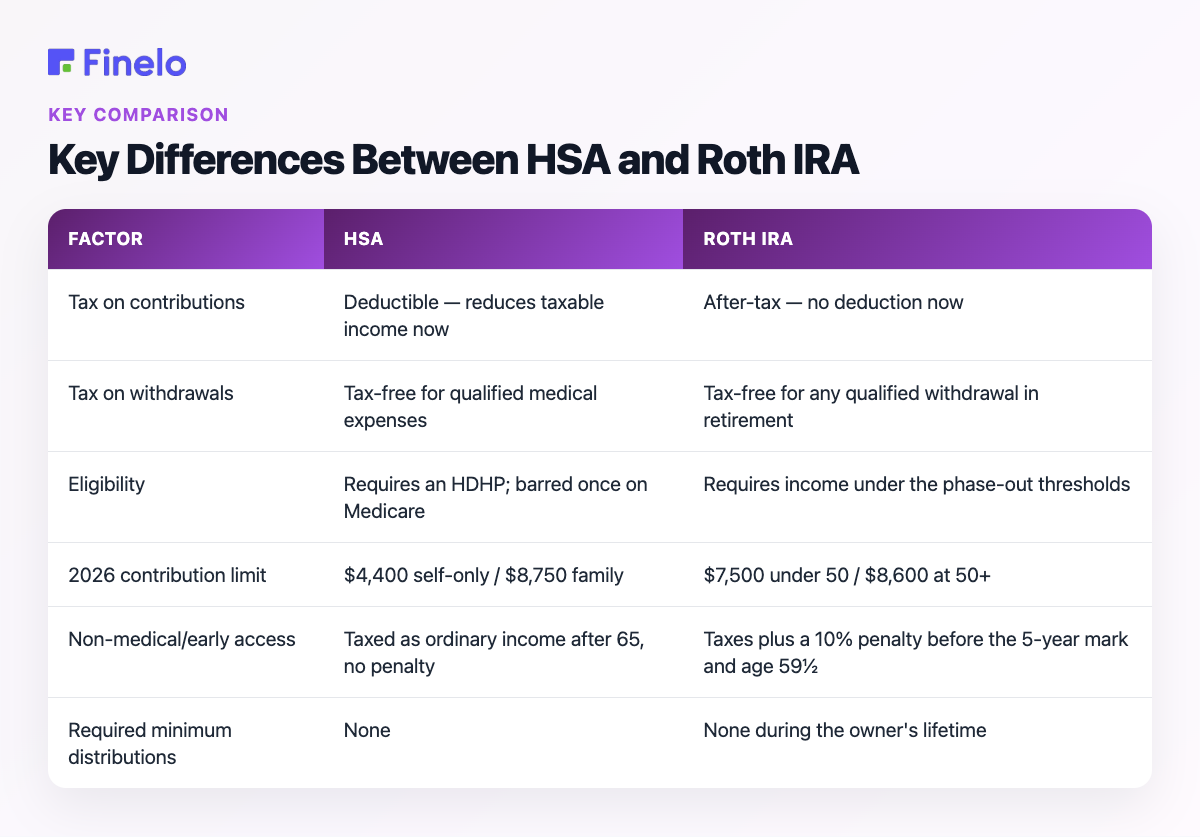
The HSA is the only account here with a true triple tax break, but only for medical spending. The Roth IRA trades that medical restriction for total flexibility once you clear the 5-year and age-59½ rules.
Practice trading with Finelo
Practice in a simulator, learn with bite-sized lessons, and build confidence before risking real money.
When to Choose an HSA
An HSA makes the most sense when you're already enrolled in a high-deductible health plan and want to reduce today's tax bill while building a fund for future medical costs. Because funds carry forward indefinitely and can be invested rather than left as cash, a well-funded HSA can effectively become a second retirement account — one that happens to cover healthcare, historically one of the largest expenses retirees face.
It's also the stronger choice if you expect meaningful medical costs before traditional retirement age. Unlike a Roth IRA, an HSA lets you withdraw for qualified medical expenses tax-free at any age, with no 59½ threshold to clear first. The tradeoff: you need an HDHP to contribute in the first place, which isn't the right health plan for everyone.
When to Choose a Roth IRA
A Roth IRA fits best when you don't have — or don't want — a high-deductible health plan, or when you've already maxed out HSA contributions and want another tax-advantaged bucket. Its biggest advantage is flexibility: qualified withdrawals cover any expense in retirement, not just medical ones.
It's also the better fit if your income is under the eligibility thresholds and you expect to be in a higher tax bracket later. Since contributions are already taxed, locking in today's rate can pay off if rates or your income rise. Just remember the 5-year and age-59½ rules for penalty-free earnings withdrawals — this isn't a short-term savings account.
Can You Use Both?
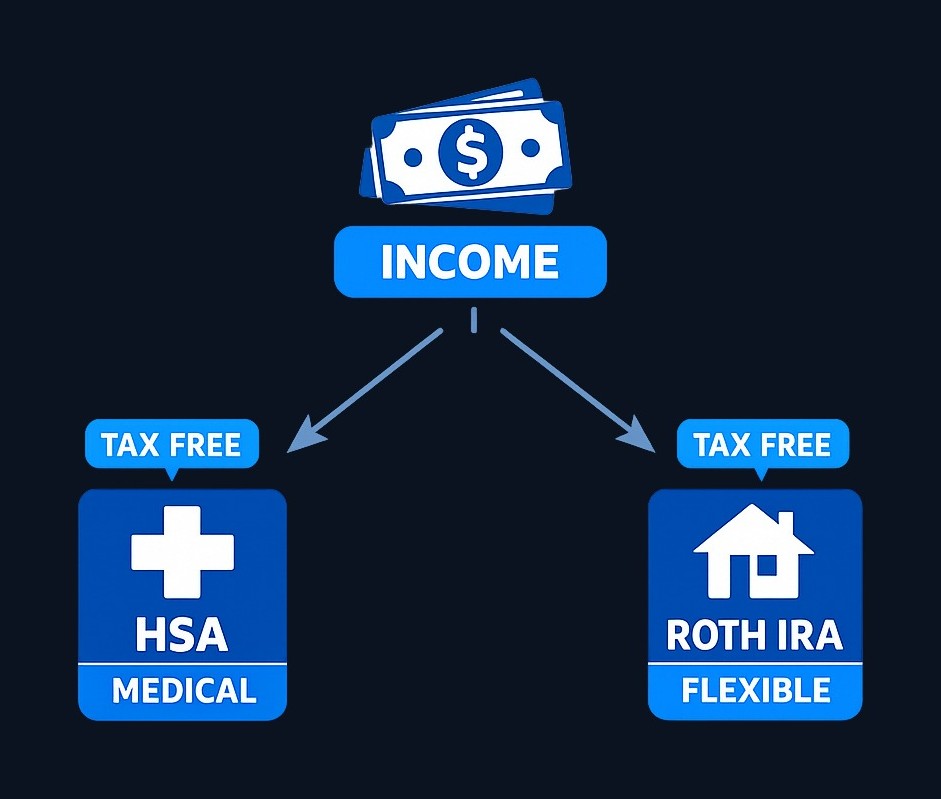
Yes. The two accounts have separate eligibility rules — an HDHP for the HSA, an income limit for the Roth IRA — and nothing prevents contributing to both in the same year, provided you qualify for each on its own terms. A common approach: contribute enough to the HSA to cover expected near-term medical costs and capture the tax break, then direct additional retirement savings to a Roth IRA for its broader spending flexibility later on.
Conclusion
Neither account beats the other outright. An HSA offers the strongest tax break available for money earmarked for healthcare, but only if you have an HDHP. A Roth IRA offers unmatched flexibility for retirement dollars, with no restriction on what you spend them on. If you qualify for both, funding each for its specific strength — medical costs through the HSA, general retirement flexibility through the Roth IRA — is a reasonable way to use both rather than choosing one.
This article is educational, not personalized financial advice. Contribution limits, income thresholds, and tax rules change and should be verified before you contribute. If you want a structured way to build your broader investing knowledge, Finelo's Wealth Growth Quiz matches you with a learning path suited to your level.
Frequently asked questions
What is the difference between an HSA and a Roth IRA?
An HSA is funded with pre-tax or deductible dollars and reserved for medical [expenses](https://www.fidelity.com/learning-center/smart-money/what-is-an-hsa) to get the tax-free withdrawal. A Roth IRA is funded with after-tax dollars and can be withdrawn tax-free for anything in [retirement](https://www.schwab.com/ira/roth-vs-traditional-ira).
Can I have both an HSA and a Roth IRA?
Yes — eligibility for each is independent. You need an HDHP for the HSA and an income under the phase-out range for the Roth IRA, but qualifying for one doesn't affect the other.
Are there penalties for withdrawing from an HSA for non-medical expenses?
Before age 65, non-medical withdrawals are taxed and [penalized](https://www.fidelity.com/learning-center/smart-money/what-is-an-hsa). After 65, the penalty disappears, but non-medical withdrawals are still taxed as ordinary [income](https://www.fidelity.com/learning-center/smart-money/what-is-an-hsa) — similar to a traditional IRA.
Do either of these accounts have required minimum distributions?
No. Roth IRAs have no RMDs during the owner's [lifetime](https://www.schwab.com/ira/roth-vs-traditional-ira), and an HSA has no RMDs at all — unused funds simply carry forward.
Financial LiteracyBeginnerRetirementPersonal Finance
Practice trading with Finelo
Practice in a simulator, learn with bite-sized lessons, and build confidence before risking real money.
About the author
Finelo Team
The Finelo Team creates practical investing and trading education designed to help beginners learn faster with structured challenges, simulator practice, and bite-sized lessons.
Keep reading — Related articles

Financial Literacy
Mercury Books Review 2026: Is It Worth It for Startups?
Mercury Books brings double-entry accounting into Mercury. Review its $35 pricing, reports, AI features, integrations, and migration limits.
Finelo Team

Financial Literacy
Why is My FICO Score Lower Than My Credit Score?
Example takeaway: seeing a higher score in a bank app doesn’t guarantee lenders will see the same FICO number at application time; lenders often pull a specific FICO version from a specific bureau.
Finelo Team

Financial Literacy
Why Is My FICO Score Higher Than My Credit Score?
Brief educational note: this article is educational, not financial or investment advice; investing and credit decisions involve risk and possible loss.
Finelo Team