The core difference: a 401(k) is a retirement plan you get through an employer. An IRA is an account you open yourself. The 401(k) wins on contribution room — $24,500 in 2026 versus $7,500 for an IRA — and may add free employer matching money. The IRA wins on control and typically offers more investment options.
IRA vs 401(k): Understanding Your Retirement Options
The core difference: a 401(k) is a retirement plan you get through an employer. An IRA is an account you open yourself. The 401(k) wins on contribution room — $24,500 in 2026 versus $7,500 for an IRA — and may add free…
8 min read
Practice trading with Finelo
Practice in a simulator, learn with bite-sized lessons, and build confidence before risking real money.
Want to learn more?
Practice in a simulator, learn with bite-sized lessons, and build confidence before risking real money.
Explore FineloExplore Finelo's 28-day challenges
Turn learning into a daily habit with guided challenge paths.
Good news if you're stuck choosing: you can have both, and many investors pair an IRA with their 401(k). The real question isn't which one. It's which one to fund first, and with how much. The comparison below gives you a working decision framework.
What is an IRA?
An IRA (individual retirement account) is a tax-advantaged account you open on your own at a brokerage or bank. No employer is involved. You control the account completely: you pick the provider, and the menu typically includes more investment options than a 401(k) — stocks, bonds, funds, and more.
IRAs come in two main flavors. The difference is when you pay tax:
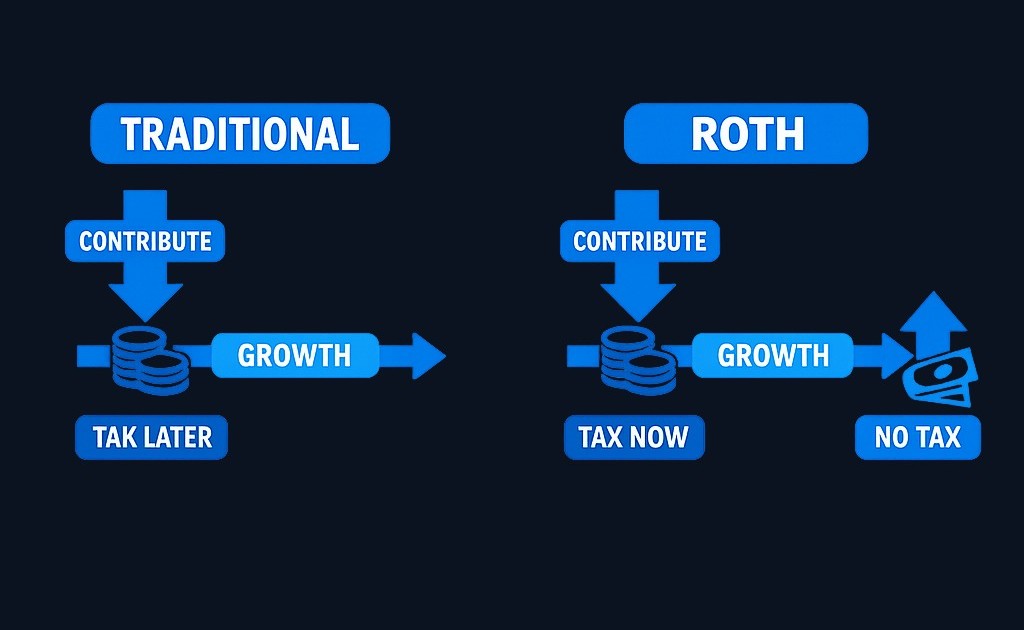
- Traditional IRA: contributions may cut your taxable income now. Withdrawals in retirement are taxed as income.
- Roth IRA: you contribute after-tax money. Qualified withdrawals in retirement come out tax-free.
For 2026, you can contribute up to $7,500 — or $8,600 if you're 50 or older, thanks to a catch-up allowance. One caveat: your earned income can limit which IRA contributions you qualify for. Higher earners face limits on Roth contributions and on deducting traditional ones. Check the current IRS thresholds for your situation.
What is a 401(k)?
A 401(k) is a workplace retirement plan that employers set up for their eligible staff. You fund it through payroll: money flows from each paycheck into the account, pre-tax or after-tax. Like IRAs, 401(k)s come in traditional (pre-tax) and Roth (after-tax) versions — when the employer offers both.
Two features set the 401(k) apart. First, scale. The 2026 employee limit is $24,500 — rising to $32,500 with the $8,000 catch-up at 50-plus, and up to $35,750 for ages 60 to 63, who get a larger $11,250 catch-up. That's more than triple the IRA's room.
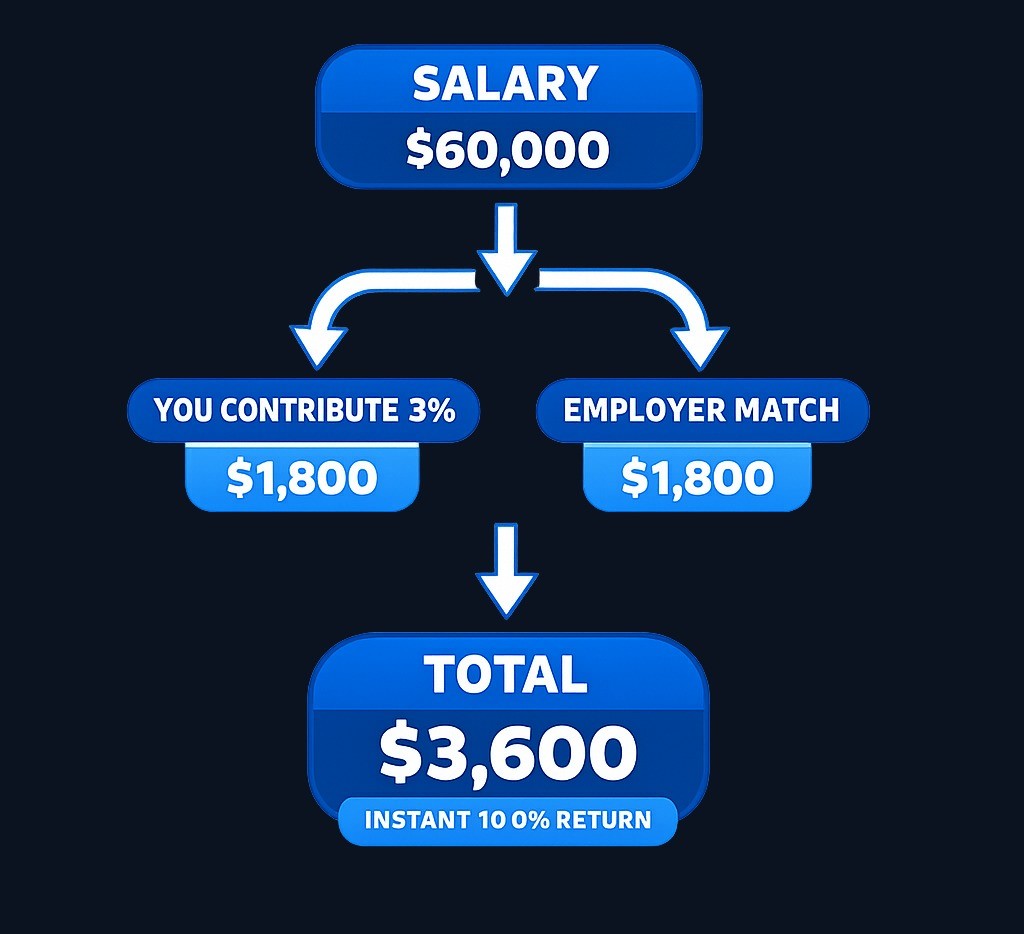
Second, employer money. Your employer can pay into your 401(k) and may match your contributions. A common formula: a dollar for each dollar you contribute, up to 3% of your salary. On a $60,000 salary, contributing 3% ($1,800) earns another $1,800 from your employer. That's an instant 100% return on those dollars. No investment reliably beats it.
The trade-off: your employer picks the fund menu. Your choices are narrower than an IRA's open universe.
Key Similarities Between IRA and 401(k)
The overlap between these accounts is the reason either one works.
Both defer or eliminate taxes on growth. Traditional versions take pre-tax contributions now, and tax the money when you withdraw it. Roth versions flip it: pay tax up front, withdraw tax-free later. Inside both wrappers, investments grow with no annual tax on dividends or gains. That's the engine of compounding.
Both punish early exits. Pull money from an IRA before age 59½ and you may owe income taxes plus a 10% penalty. The 401(k) applies the same 10% penalty before 59½, though some plans allow access at 55 after you leave the job. Exceptions exist for both, including birth and adoption costs up to $5,000, medical expenses above 7.5% of adjusted gross income, domestic abuse distributions, and permanent disability.
Both eventually force withdrawals. Traditional IRAs and pre-tax 401(k)s trigger required minimum distributions (RMDs) — mandatory annual withdrawals — at age 73, rising to 75 starting in 2033.
Both travel with you. Leave your job and you can roll your 401(k) into another 401(k) or an IRA, keeping the tax shelter intact.
Practice trading with Finelo
Practice in a simulator, learn with bite-sized lessons, and build confidence before risking real money.
Key Differences Between IRA and 401(k)
| Factor | 401(k) | IRA |
|---|---|---|
| How you get it | Through an employer | You open it yourself |
| 2026 contribution limit | $24,500; $32,500 at 50+; up to $35,750 at 60–63 | $7,500; $8,600 at 50+ |
| Employer match | Possible — e.g., dollar-for-dollar up to 3% of salary | None |
| Investment choice | Limited to the plan's menu | Typically wider |
| Income restrictions | None on employee deferrals | Earned-income limits can apply |
| Borrowing | Loans up to 50% of the balance, capped at $50,000, repaid within about 5 years | No loans |
| Funding method | Automatic payroll deduction | Manual or scheduled transfers |
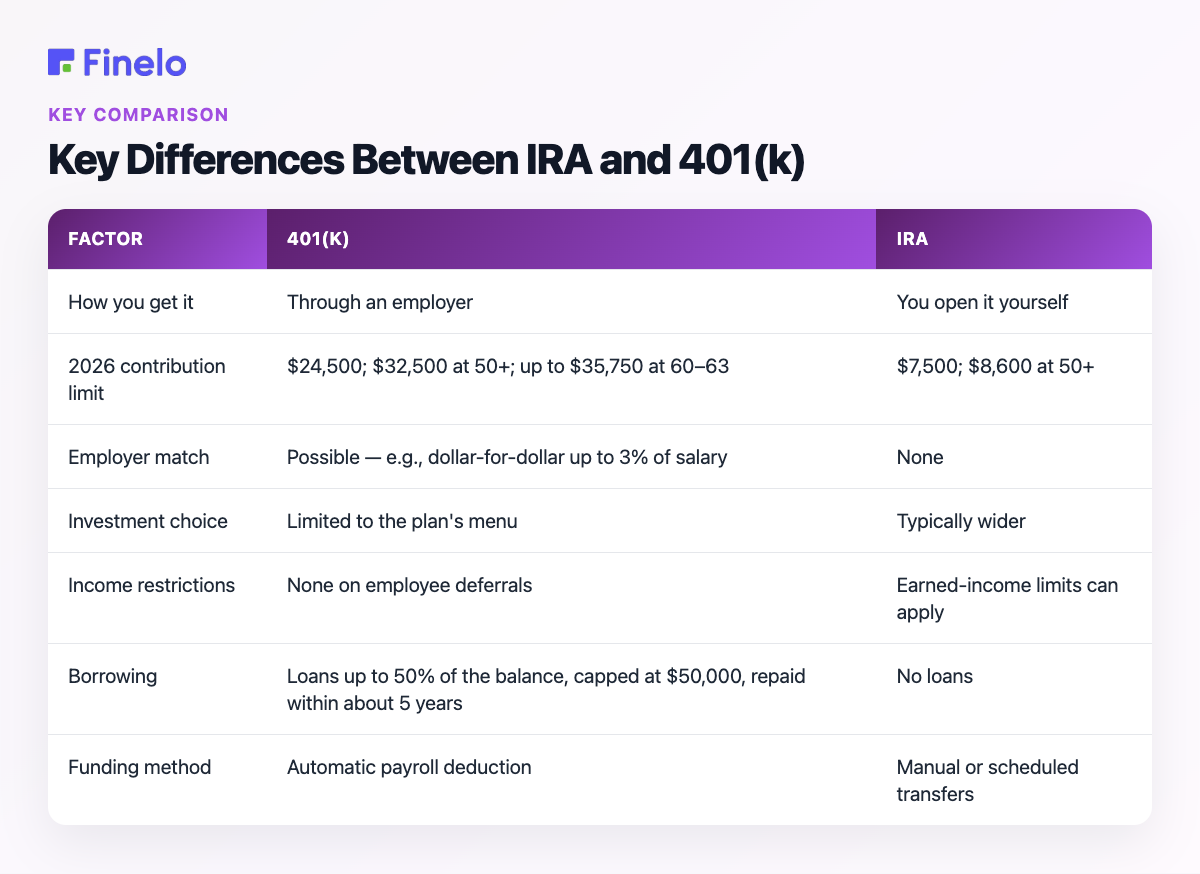
How to read this table: the 401(k) is built for volume. High limits, employer money, and forced consistency through payroll. The IRA is built for flexibility. You control the provider and the investments, and a Roth adds a bucket of future tax-free income. Neither wins every row — which is exactly why the funding-order strategy below exists.
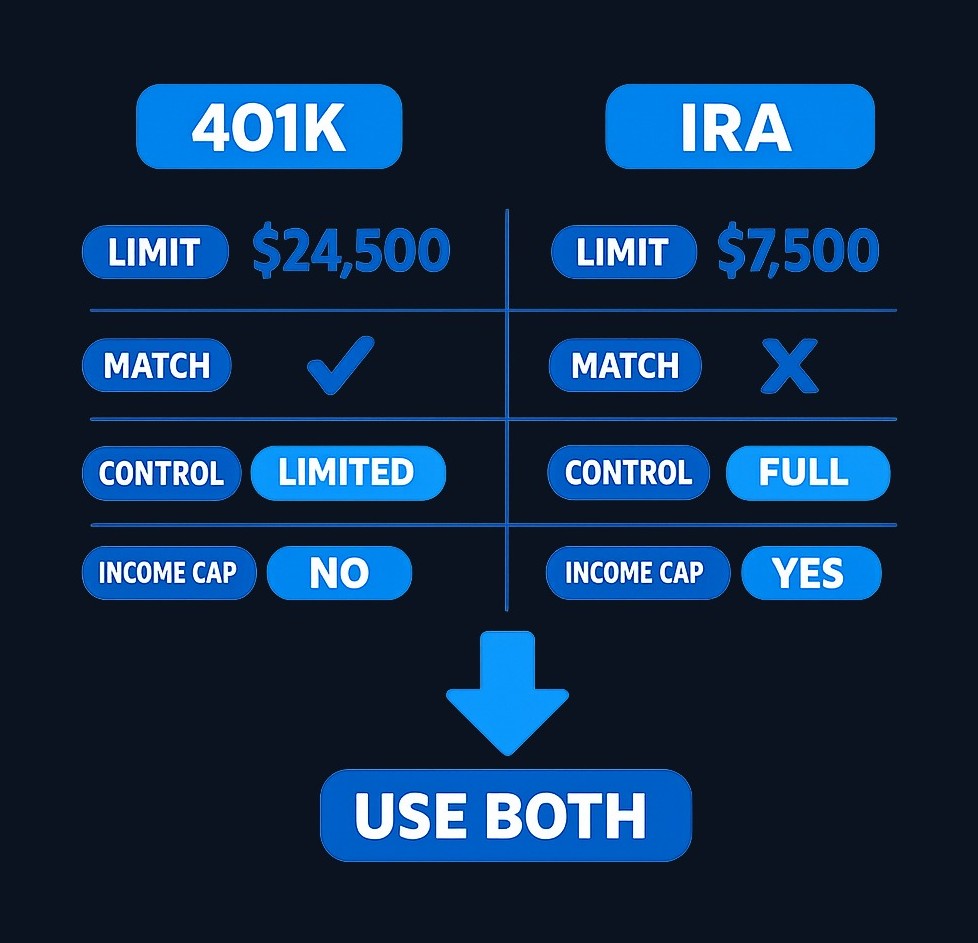
Pros and Cons of Each Account Type
401(k) advantages: the match is free compensation — skip it and you forfeit pay. Limits are more than triple an IRA's. Payroll deduction automates discipline. And no income cap blocks your salary deferrals.
401(k) drawbacks: you're stuck with your employer's fund menu and its fees. Features vary by plan — confirm yours offers a Roth option before assuming.
IRA advantages: full control and a broader investment universe let you cut fund costs and customize your portfolio. A Roth IRA adds tax diversification.
IRA drawbacks: the $7,500 limit alone rarely funds a retirement. There's no match. And income-based restrictions can shrink or block direct contributions.
On the traditional-vs-Roth layer inside both accounts: expect a lower tax bracket in retirement? Pre-tax (traditional) tends to win. Expect a higher bracket — common early in a career? Paying tax now via Roth looks better. Your bracket today is knowable; your future one is a guess. That's a fair argument for holding some of each.
When to Choose an IRA vs a 401(k)
Match your situation to a next step:
| Your situation | Recommended next step |
|---|---|
| Employer offers a match | Fund the 401(k) to the full match first — it's the highest-priority retirement dollar you'll invest |
| Match captured, want cheaper or wider investments | Open and fund an IRA for its broader menu |
| IRA maxed at $7,500 | Return to the 401(k) and climb toward $24,500 |
| No workplace plan | Start with an IRA — you can open one yourself |
| No match offered | Weigh funding the IRA earlier for its flexibility |
| High earner facing IRA income limits | Lean on the 401(k)'s unrestricted deferrals |
| Age 50+ | Use both catch-ups: $8,600 IRA plus up to $32,500 401(k) |
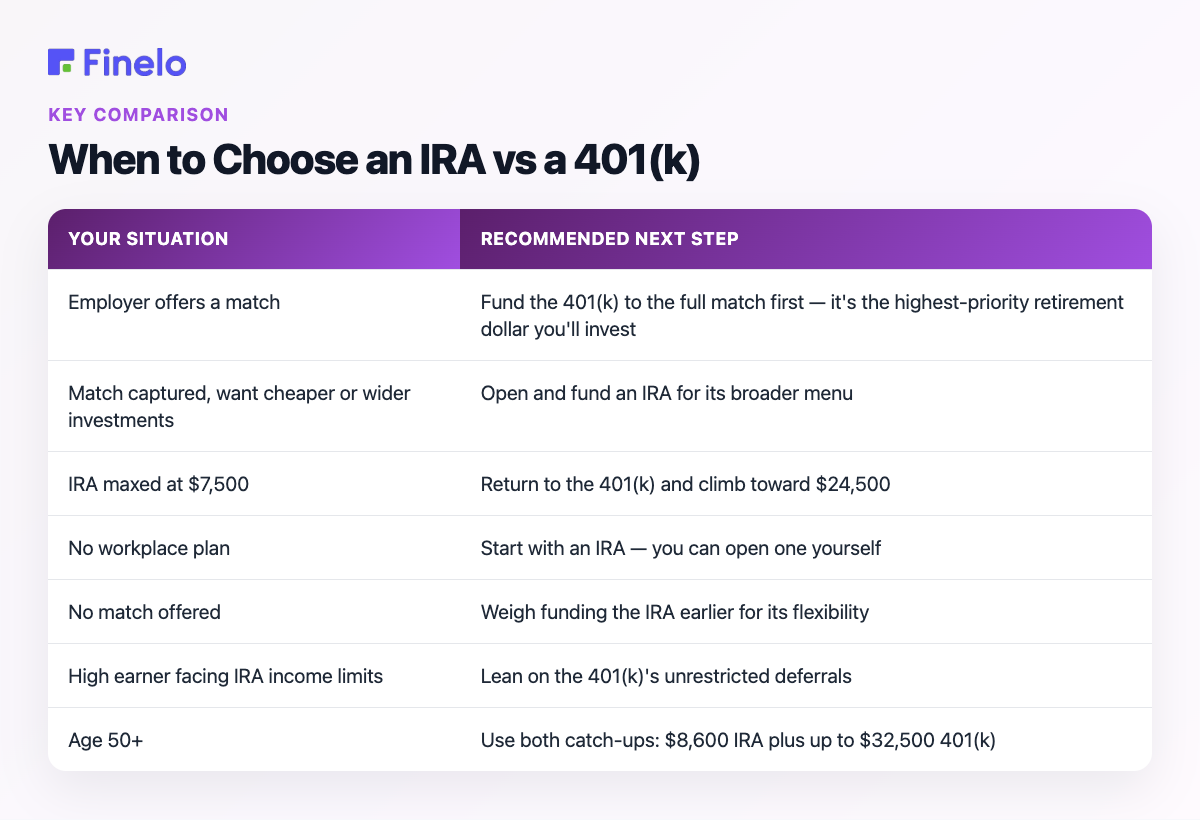
The pattern behind the table: capture free money first, buy flexibility second, then add volume. Most savers touch all three steps as income grows.
Conclusion
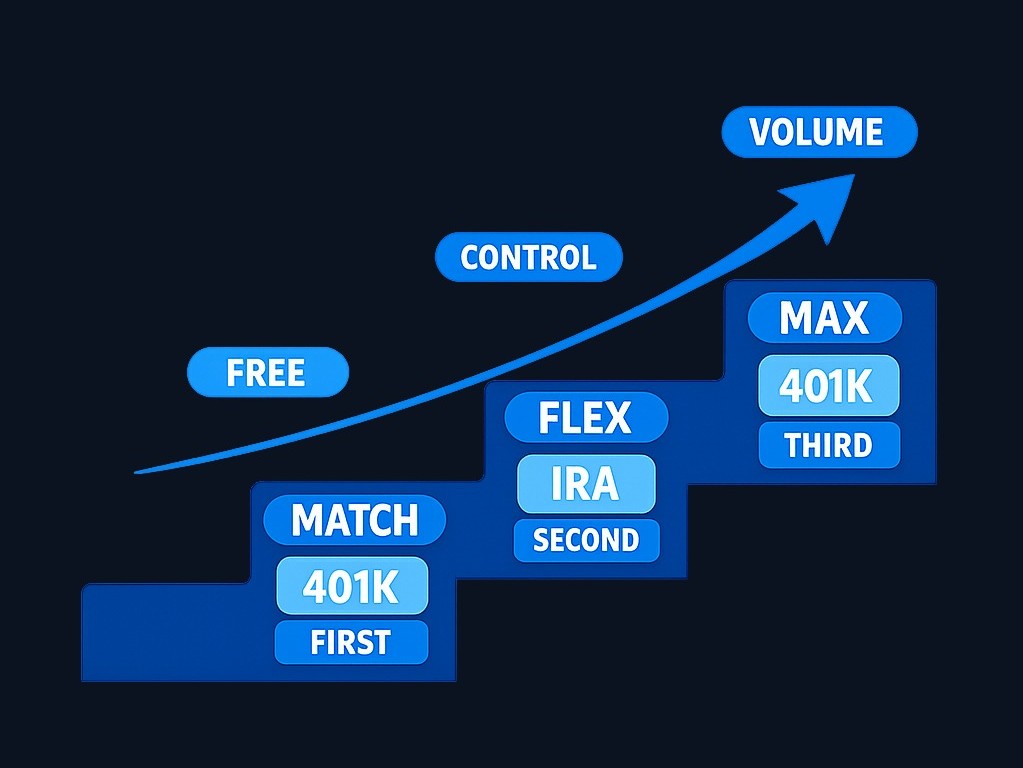
The IRA vs 401(k) question usually resolves into "both, in the right order." Capture every dollar of employer match first. Use an IRA for investment flexibility. Then push the 401(k) toward its much higher limit as income allows. Limits and tax rules change yearly and depend on your situation — this comparison is educational, not personalized financial advice. Verify current figures and suitability before acting.
Want to strengthen the investing fundamentals behind these decisions? Finelo's Wealth Growth Quiz can match you with a learning path suited to your starting point.
Frequently asked questions
Can I contribute to both an IRA and a 401(k) in the same year?
Yes — many investors pair an IRA with their workplace [401(k)](https://www.greatbasin.org/401k-vs-ira-what-you-should-know/). Each account has its own separate limit. Note that income can affect whether traditional IRA contributions stay deductible when you also have a workplace plan.
Can I roll over my 401(k) into an IRA?
Yes. After leaving a job, you can move your 401(k) into another 401(k) or an [IRA](https://www.greatbasin.org/401k-vs-ira-what-you-should-know/). A direct rollover keeps the tax shelter intact. Many savers pick an IRA for the wider investment menu.
What happens if I withdraw money early?
Before age 59½, withdrawals from either account generally cost income tax plus a 10% [penalty](https://www.greatbasin.org/401k-vs-ira-what-you-should-know/). Exceptions include disability, qualifying medical expenses, and birth or adoption costs up to [$5,000](https://www.fidelity.com/learning-center/smart-money/ira-vs-401k). Some 401(k) plans also allow penalty-free access at [55](https://www.greatbasin.org/401k-vs-ira-what-you-should-know/) after separation.
Can I borrow from these accounts?
Only from a 401(k), and only if your plan allows it — up to 50% of your balance, capped at $50,000, typically repaid within 5 [years](https://www.fidelity.com/learning-center/smart-money/ira-vs-401k). IRAs don't offer loans.
Financial LiteracyBeginnerRetirementPersonal Finance
Practice trading with Finelo
Practice in a simulator, learn with bite-sized lessons, and build confidence before risking real money.
About the author
Finelo Team
The Finelo Team creates practical investing and trading education designed to help beginners learn faster with structured challenges, simulator practice, and bite-sized lessons.
Keep reading — Related articles
Financial Literacy
Mercury Books Review 2026: Is It Worth It for Startups?
Mercury Books brings double-entry accounting into Mercury. Review its $35 pricing, reports, AI features, integrations, and migration limits.
Finelo Team

Financial Literacy
Why is My FICO Score Lower Than My Credit Score?
Example takeaway: seeing a higher score in a bank app doesn’t guarantee lenders will see the same FICO number at application time; lenders often pull a specific FICO version from a specific bureau.
Finelo Team
Financial Literacy
Why Is My FICO Score Higher Than My Credit Score?
Brief educational note: this article is educational, not financial or investment advice; investing and credit decisions involve risk and possible loss.
Finelo Team