This is not a second basic definition of intrinsic value. It shows how to turn a discounted-cash-flow point estimate into a range and identify which assumptions dominate the result. Intrinsic value is an estimate conditional on forecasts, capital structure, dilution, terminal value, and discount rate—not an observable fact.
Intrinsic Value Sensitivity Analysis: Building a Defensible DCF Range
This is not a second basic definition of intrinsic value. It shows how to turn a discounted-cash-flow point estimate into a range and identify which assumptions dominate the result. Intrinsic value is an estimate…
9 min read
Practice investing with Finelo
Build practical investing skills with guided lessons, simulator practice, and structured challenges.
Want to learn more?
Build practical investing skills with guided lessons, simulator practice, and structured challenges.
Explore FineloExplore Finelo's 28-day challenges
Turn learning into a daily habit with guided challenge paths.
Build the sensitivity table before choosing a target
Use at least three operating cases and a two-dimensional terminal-value table. One axis varies WACC or the required equity return; the other varies terminal growth or an exit multiple. Keep nominal cash flows with nominal discount rates, match currency, and require terminal growth to remain below a defensible long-run constraint. Then test revenue growth, operating margin, reinvestment, working capital, taxes, net debt, options, and diluted shares.
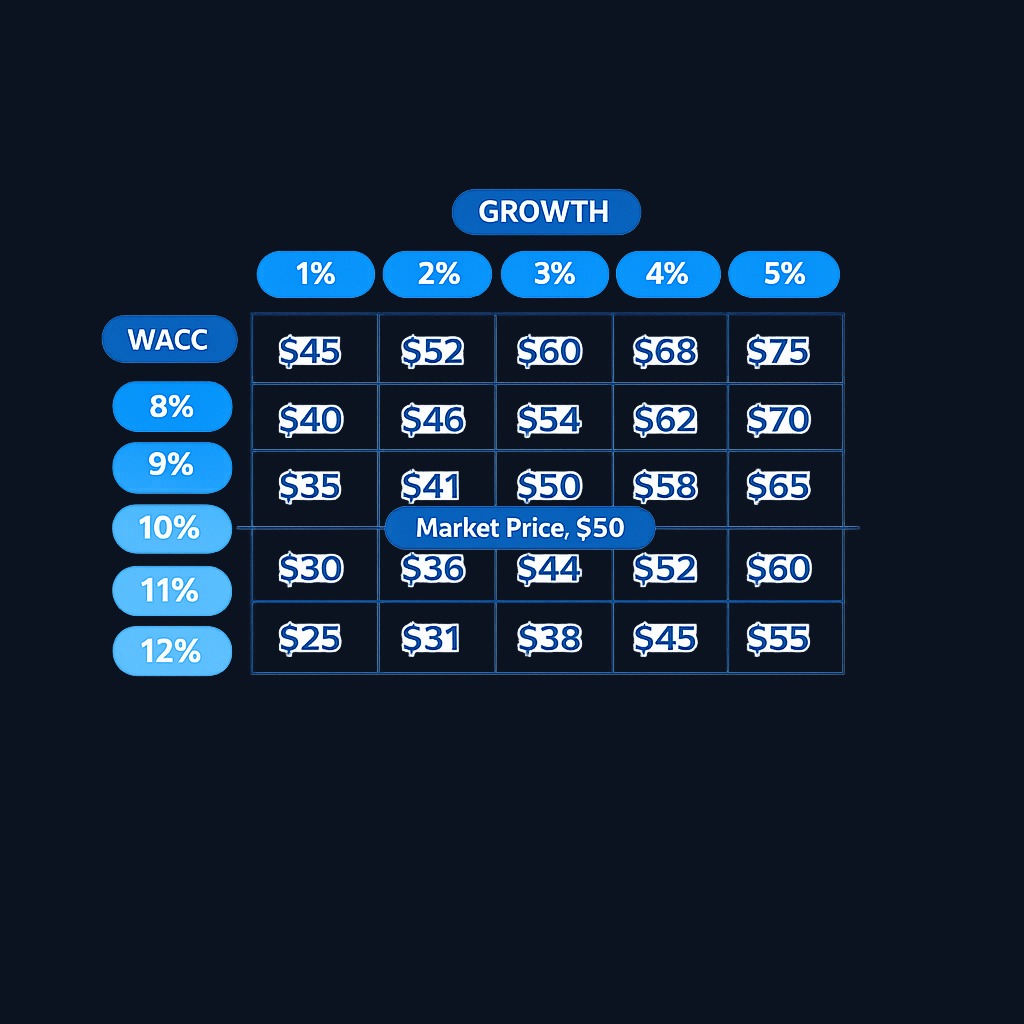
Report the percentage of enterprise value produced by the terminal value. If a small change in WACC or terminal growth changes the conclusion from undervalued to overvalued, the honest output is a wide range and low decision confidence. A margin of safety is not a fixed percentage; it should reflect forecast uncertainty, balance-sheet risk, cyclicality, and model sensitivity.
The intrinsic value of a stock is an estimate of what a share is actually worth based on the cash the business can generate over time, independent of its current market price. Investors compare that estimate with the quoted price: when intrinsic value sits well above the market price, the stock may be undervalued; when it sits below, the stock may be overpriced. This page is for beginners and self-directed investors who want a working definition, the main calculation methods, and a practical way to use them. Read the methods below, then practice the math on a real company's filings before you risk any money.
What is the intrinsic value of a stock?
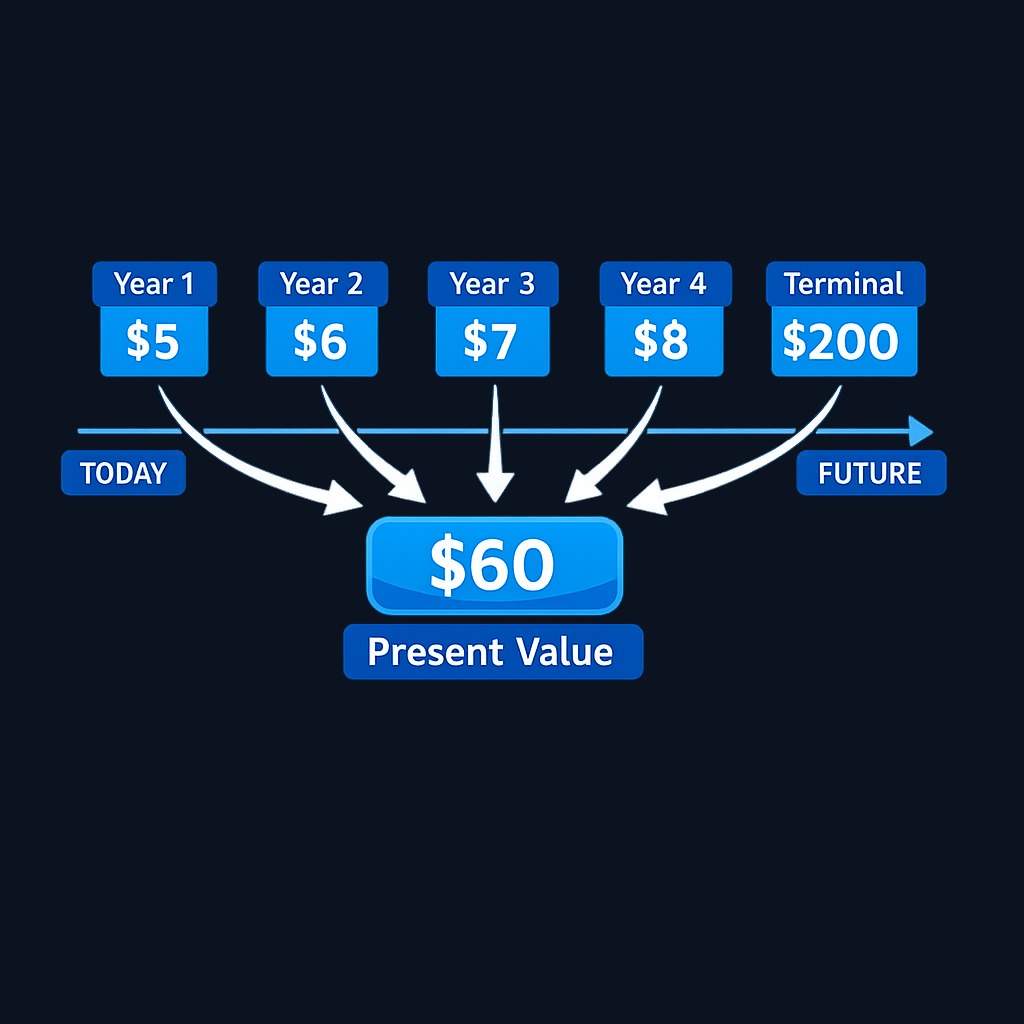
Intrinsic value is the present worth of all the cash flows a company is expected to produce for its owners in the future. Instead of asking "what are people paying for this share today?", it asks "what is this business fundamentally worth per share?".
The idea comes from value investing. A share of stock is a claim on a real company: its earnings, its assets, and its future growth. The market price moves every second with supply and demand, news, and sentiment. Intrinsic value moves far more slowly, because it reflects the underlying business rather than the mood around it.
Three inputs drive almost every intrinsic value estimate:
- Expected cash flows. How much cash the company can generate, usually projected from revenue, margins, and reinvestment needs.
- Growth assumptions. How fast those cash flows can grow, and for how long.
- A discount rate. The rate used to translate future cash into today's dollars, reflecting risk and the return you could earn elsewhere.
Because each input is an assumption, intrinsic value is always an estimate with a range, never a precise number.
Why intrinsic value matters
Valuation gives your decisions an anchor. Without an independent estimate of worth, the only reference point is the current price, and price alone tells you nothing about whether a stock is cheap or expensive.
A few practical uses:
- Spotting a margin of safety. Value investors look to buy when the market price is meaningfully below their intrinsic value estimate, so ordinary estimation errors do not wipe out the investment case.
- Staying calm in volatility. When prices swing, an investor with a valuation anchor can judge whether the business changed or just the sentiment around it.
- Comparing opportunities. Two companies at the same share price can have very different underlying worth. Intrinsic value puts them on a common footing.
- Avoiding hype. A stock rising fast is not automatically a good investment. Checking the price against fundamentals is a discipline against buying stories instead of businesses.
How to calculate intrinsic value
There are several established methods. Each fits different company types, and serious analysis often runs more than one to build a range.
Discounted cash flow (DCF)
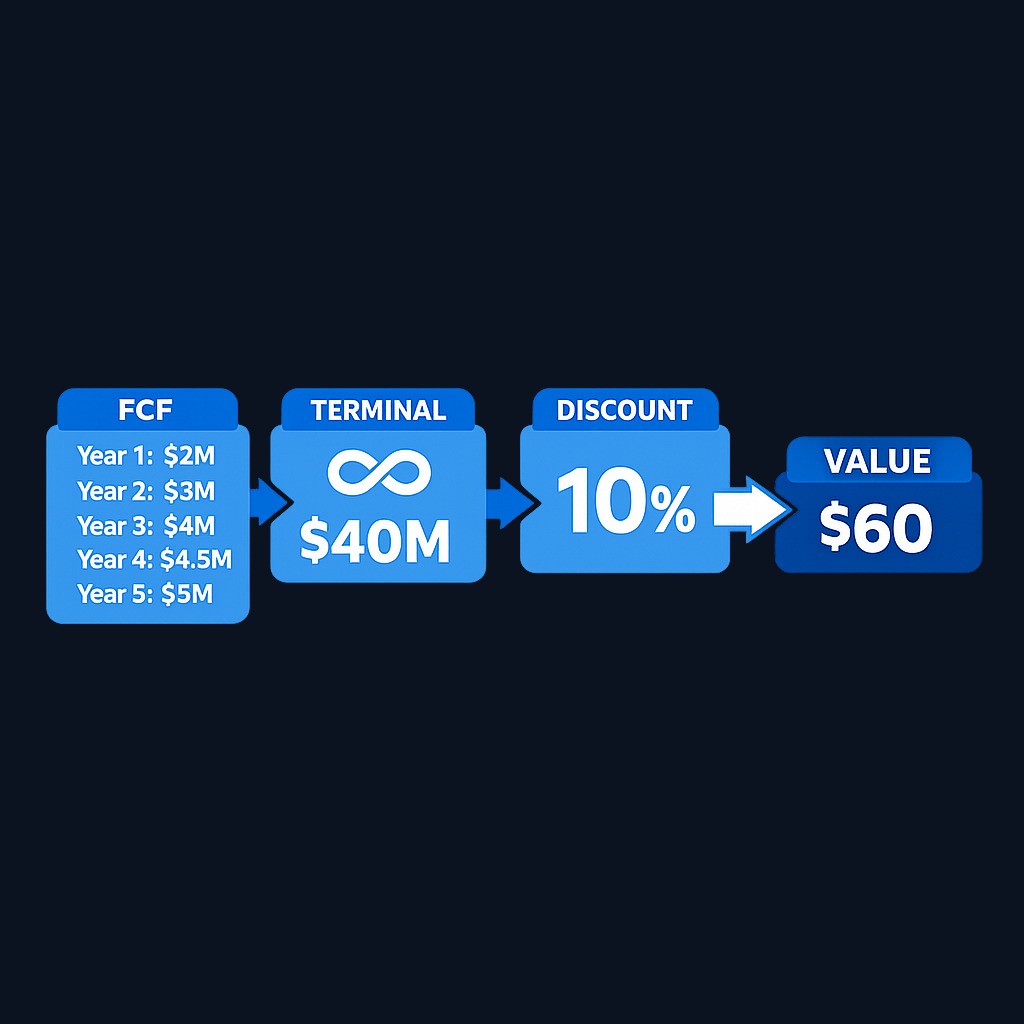
The DCF model projects the company's free cash flow for a number of years, adds a terminal value for the years beyond the forecast, and discounts everything back to the present using a chosen discount rate. The sum, divided by shares outstanding, is intrinsic value per share. DCF is the most flexible and most widely taught method, and also the most sensitive to assumptions: a one-point change in the discount rate or the long-term growth rate can move the result substantially.
Dividend discount model (DDM)
For companies that pay steady dividends, the DDM values a share as the present value of all expected future dividends. The simplest version, the Gordon growth model, divides next year's dividend by the difference between the discount rate and the dividend growth rate. It works best for mature, stable payers such as utilities, and poorly for firms that pay little or no dividend.
Asset-based and residual income approaches
An asset-based valuation totals what the company owns, subtracts what it owes, and treats the remainder as the floor value of the equity. Residual income models start from book value and add the value created above the cost of equity. These approaches suit banks, holding companies, and asset-heavy businesses.
A short worked example
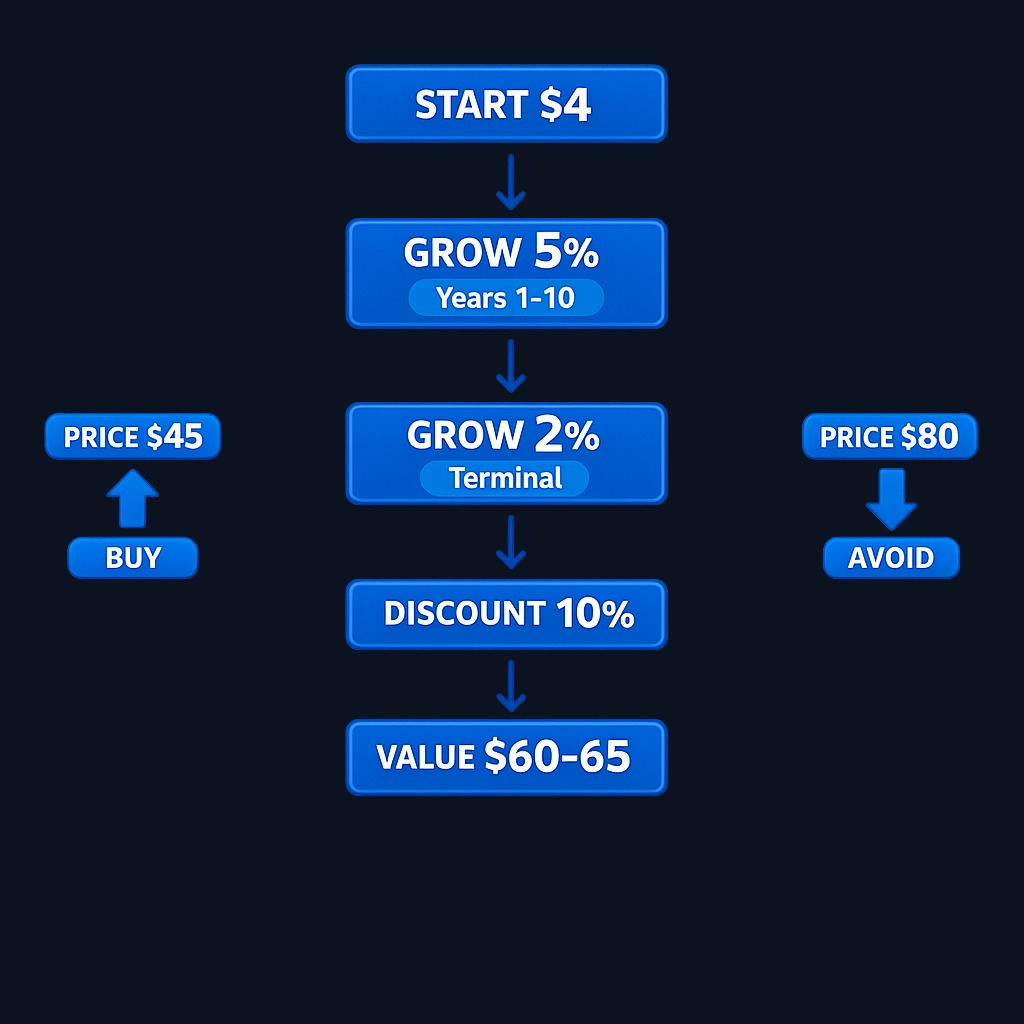
Suppose a company generates about $4 of free cash flow per share, and you expect that figure to grow 5% a year for a decade, then 2% after that. Using a 10% discount rate, the present value of that stream works out to roughly $60-65 per share. If the stock trades at $45, your estimate implies a meaningful discount; at $80, the market is paying more than the business fundamentals support under your assumptions. Public-company inputs for this math come from annual and quarterly reports, which you can pull for free from the SEC's EDGAR filing system.
Practice investing with Finelo
Build practical investing skills with guided lessons, simulator practice, and structured challenges.
Intrinsic value vs market value
| Aspect | Intrinsic value | Market value |
|---|---|---|
| What it measures | Estimated worth of the underlying business | Price buyers and sellers agree on right now |
| How it moves | Slowly, with business fundamentals | Constantly, with news, sentiment, and flows |
| How it is set | Analysis of cash flows, growth, and risk | Live trading on an exchange |
| Objectivity | Depends on the analyst's assumptions | Observable fact at any moment |
| Main use | Judging whether a price is attractive | Executing trades and tracking positions |
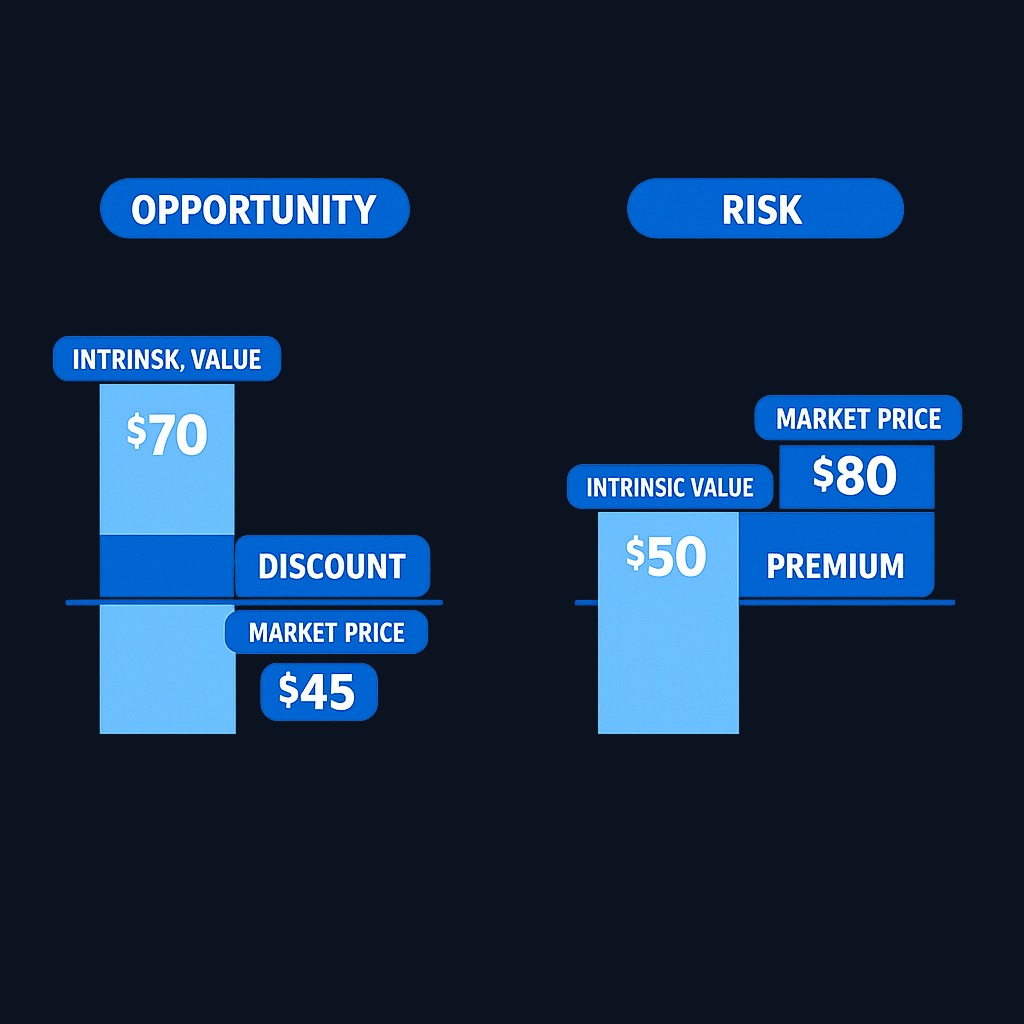
The gap between the two is where investment decisions live. A market price far below a well-built intrinsic value estimate suggests opportunity; a price far above it suggests risk. Neither signal is a guarantee, because the estimate itself can be wrong, and markets can stay disconnected from fundamentals for long stretches of time.
What to know before deciding
- Every model is only as good as its inputs. Optimistic growth or a low discount rate can make almost any stock look cheap. Test your valuation with conservative assumptions before trusting it.
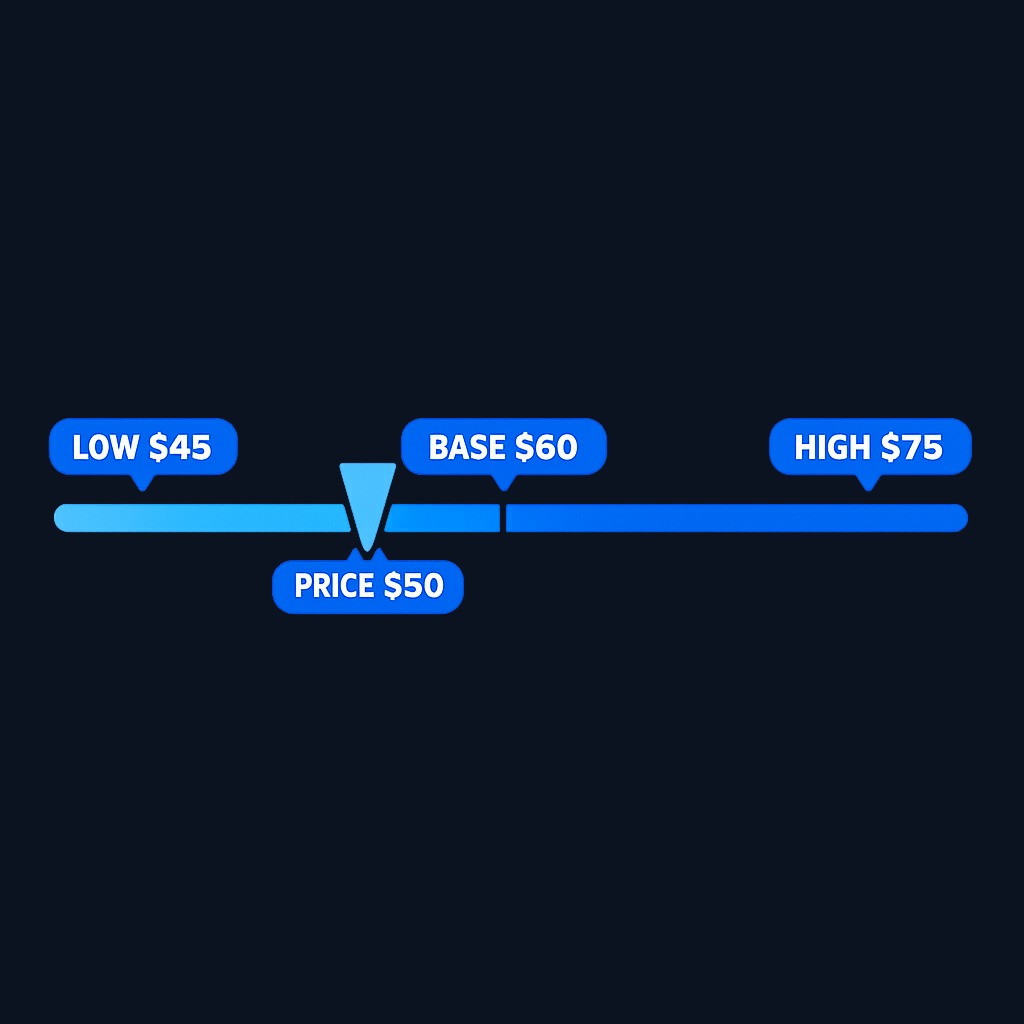
- Ranges beat point estimates. Professionals produce a valuation range across scenarios. If the current price is attractive even in your pessimistic case, the idea is stronger.
- Some businesses resist valuation. Early-stage companies with negative cash flow, or firms in fast-changing industries, produce highly uncertain estimates. Recognizing "too hard" is part of the skill.
- Intrinsic value is not a timing tool. An undervalued stock can stay undervalued for years. Valuation tells you what something is worth, not when the market will agree.
- Education compounds. The math is simple; the judgment takes practice. Working through real filings on a few familiar companies builds the skill faster than reading formulas alone.
Decision framework: putting intrinsic value to work
- Start with a business you understand. Predictable revenue and a clear model make cash flows easier to project.
- Pull the numbers from primary sources. Use the company's own filings for revenue, cash flow, debt, and share count.
- Run two methods. Pair a DCF with a dividend or asset-based check where the business allows it. Agreement between methods raises confidence.
- Apply a margin of safety. Many practitioners only act when price sits well below estimated value, commonly by a third or more.
- Re-check the thesis periodically. Update the valuation when results, debt, or the competitive picture change, not when the price wiggles.
If the process feels heavy at first, that is normal. Each pass through a real company's numbers makes the next one faster.
FAQ
What is the intrinsic value of a stock in simple terms?
It is an estimate of what a share is really worth based on the cash the business can generate over its life, discounted to today's dollars. It answers "what would a rational buyer pay for the whole business, per share?" rather than "what is the ticker showing right now?".
How is intrinsic value calculated?
The most common route is a discounted cash flow model: project free cash flows, add a terminal value, and discount everything at a rate that reflects risk. Dividend discount and asset-based models are common alternatives for dividend payers and asset-heavy firms.
Is intrinsic value the same as book value?
No. Book value is the accounting net worth on the balance sheet. Intrinsic value is forward-looking and includes the profits the company has not earned yet, so it usually differs from book value substantially.
Can intrinsic value be wrong?
Yes, routinely. It rests on assumptions about growth, margins, and risk. That is why investors build ranges, stress-test assumptions, and demand a margin of safety before acting on any single estimate.
Conclusion and next steps
The intrinsic value of a stock is the bridge between owning a ticker and owning a business. Estimate what the company is worth from its cash-generating power, compare that estimate with the market price, and let the gap, not the headlines, guide your decisions. Start small: pick one company you know, pull its latest annual report, and build a simple DCF with conservative numbers. Repeating that exercise a handful of times teaches more than any formula sheet. If you want structured practice, the Finelo app breaks valuation concepts like these into short interactive lessons for beginners.
InvestingFundamental AnalysisBeginner
Practice investing with Finelo
Build practical investing skills with guided lessons, simulator practice, and structured challenges.
About the author
Finelo Team
The Finelo Team creates practical investing and trading education designed to help beginners learn faster with structured challenges, simulator practice, and bite-sized lessons.
Keep reading — Related articles

Investing
Tax-gain harvesting vs. tax-loss harvesting
Compare realizing investment gains with realizing losses, including holding periods, wash sales, offsets, and portfolio tradeoffs.
Finelo Team

Investing
Stable value fund vs. money market fund
Compare investment structure, contract protections, transfer restrictions, net yields, and access inside a retirement account.
Finelo Team

Investing
Single-life vs. joint-life annuity
Compare income for one lifetime with continued payments to a survivor, using equal premiums and matching guarantee terms.
Finelo Team


