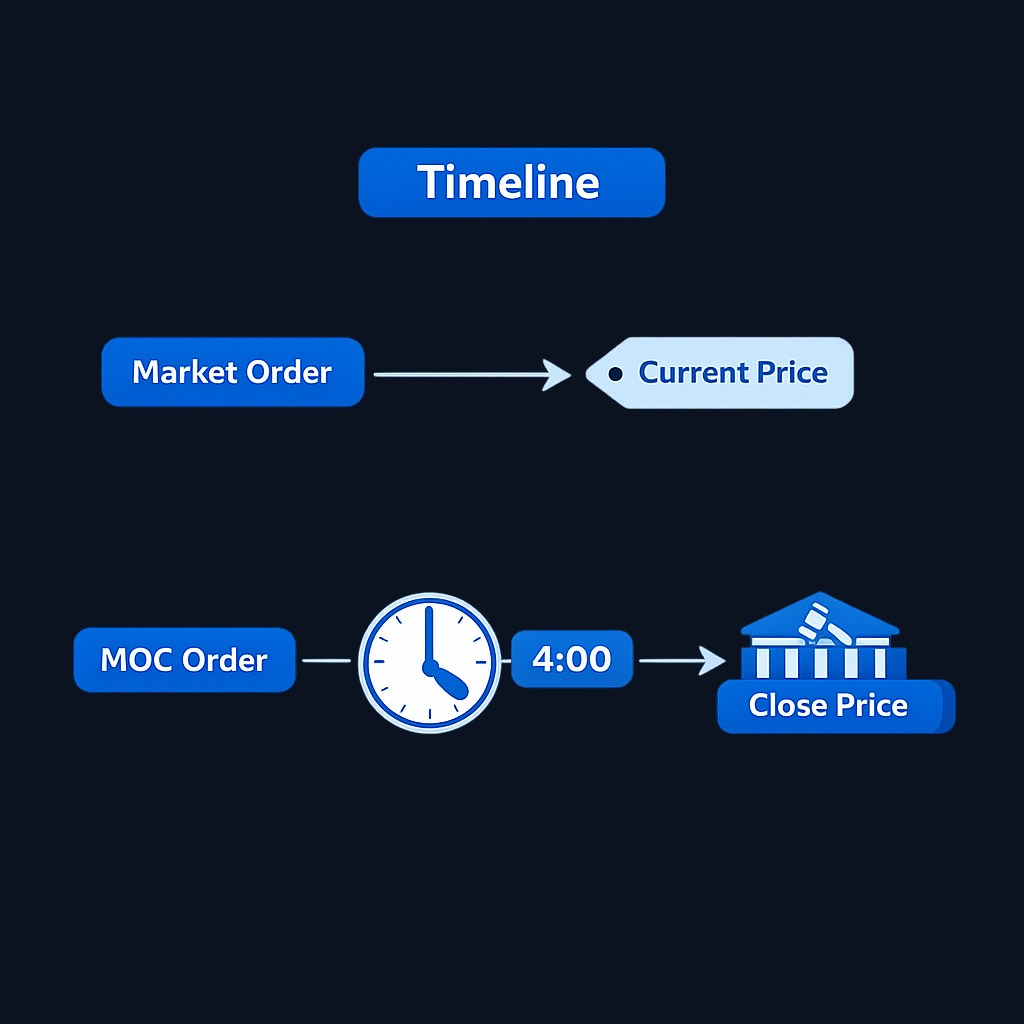
A market on close order, or MOC order, tells your broker to buy or sell shares at the official closing price of the trading day. You do not set a price. The order joins the exchange's closing auction and fills at whatever single price that auction produces at 4:00 p.m. Eastern time.
Market on Close Order: How MOC Orders Work at the Closing Bell
Learn what a market on close (MOC) order is, exchange cutoff times, how the closing auction sets the price, and when MOC orders help or hurt.
7 min read
Practice trading with Finelo
Practice in a simulator, learn with bite-sized lessons, and build confidence before risking real money.
Want to learn more?
Practice in a simulator, learn with bite-sized lessons, and build confidence before risking real money.
Explore FineloExplore Finelo's 28-day challenges
Turn learning into a daily habit with guided challenge paths.
This page is for investors and active traders who want the closing price on purpose, whether to match a benchmark, exit before an earnings report, or rebalance at day's end. It explains the auction behind the fill, the exact cutoff times on NYSE and Nasdaq, and a simple framework for choosing between MOC, limit on close, and ordinary orders. It is educational content, not financial advice.
What a market on close order does
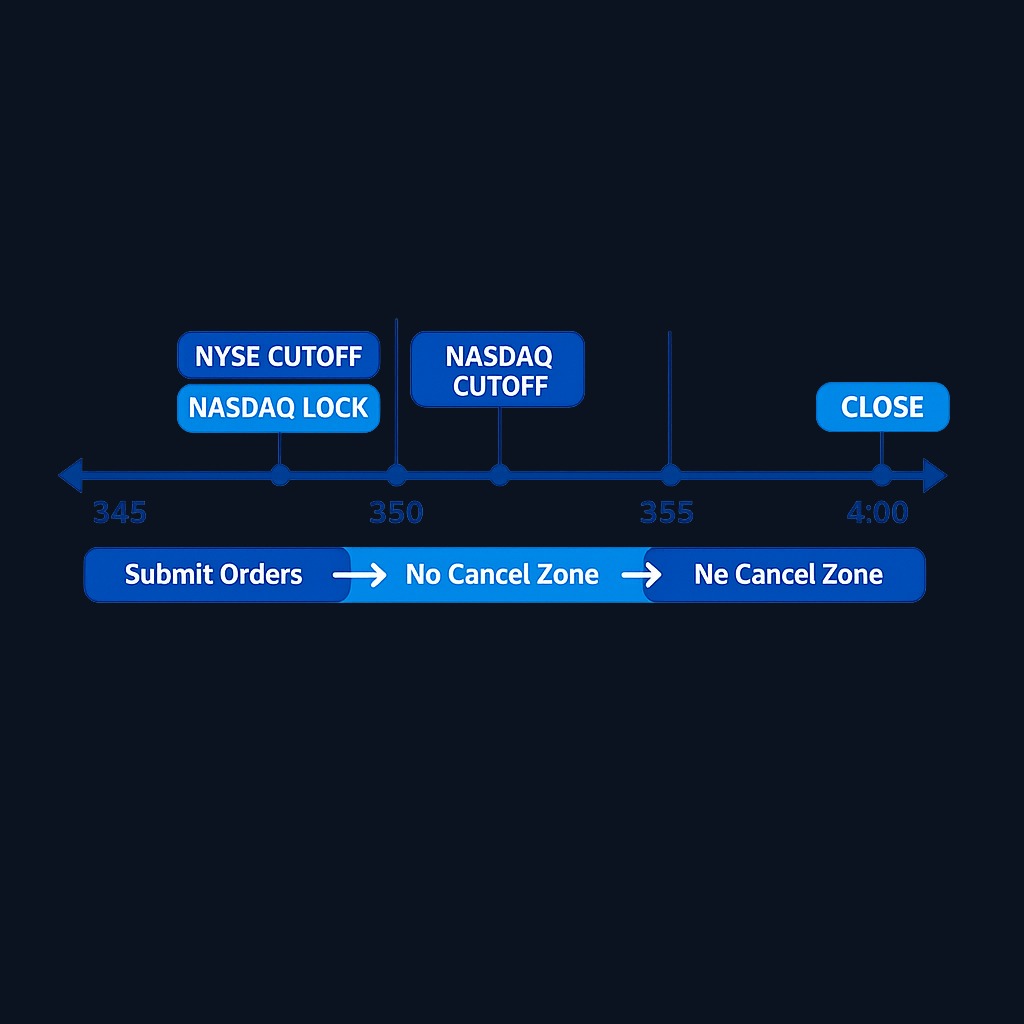
A regular market order executes immediately at the best available price. An MOC order waits. It sits with the exchange until the end of the session, then executes in the closing auction alongside every other on-close order. Per FINRA's overview of order time qualifiers, an MOC order seeks execution as close as possible to the 4 p.m. ET close, generally must be placed at least two minutes before the close, and typically cannot be modified or canceled after that point.
The appeal is precision of timing, not precision of price. You are guaranteed to participate in the close if the order is accepted, but you will not know your fill price until the auction prints.
The closing auction: where MOC orders execute
Exchanges end the day with a single giant matching event, often called the closing auction or closing cross. All accumulated on-close interest, MOC orders, limit-on-close (LOC) orders, and eligible open-market orders are matched at one price. On Nasdaq, that price is calculated at 4:00 p.m. as the level that maximizes the number of shares matched, producing the Nasdaq Official Closing Price.
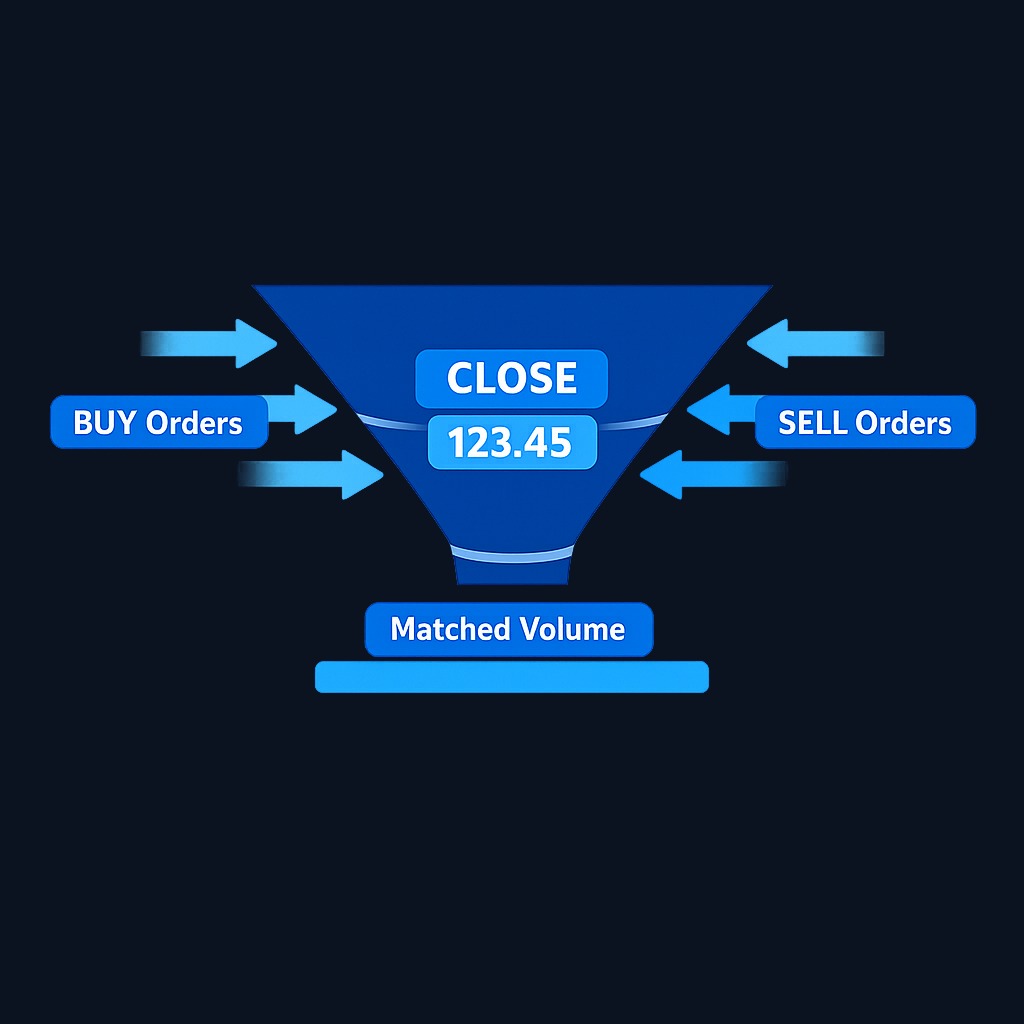
This closing price matters far beyond the auction itself. It is the benchmark print used for index funds, mutual fund NAVs, and countless performance calculations. That is why volume concentrates there: per Nasdaq's own closing cross FAQ, nearly 10% of its average daily volume occurs in the closing auction. In the minutes before the close, exchanges broadcast imbalance data showing whether buy or sell interest dominates, which lets offsetting orders step in and stabilize the final price.
MOC cutoff times on NYSE and Nasdaq
The deadlines are earlier than most beginners expect, and they differ by exchange:
| Rule | NYSE | Nasdaq |
|---|---|---|
| Last time to enter an MOC order | 3:50 p.m. ET | 3:55 p.m. ET |
| Cancel/modify restriction | Cancels rejected after 3:50 p.m. | No cancel or modify after 3:50 p.m. |
| LOC order entry | Until 3:50 p.m. | Until 3:58 p.m. |
| Auction executes | 4:00 p.m. | 4:00 p.m. |
Sources: the NYSE auctions page and the Nasdaq closing cross FAQ. After the cutoff, NYSE accepts only orders that offset a published imbalance. Brokers often impose their own earlier deadlines, so check your platform; when in doubt, submit MOC orders with comfortable margin rather than at 3:49.
Why traders use MOC orders
Three motives cover most real usage:
- Benchmark matching. Index funds and anyone measured against a closing benchmark want fills at the same price the benchmark uses. The closing auction is the only place that price exists.
- Event timing. Suppose a company reports earnings tonight and you want out before the news. An MOC order guarantees you exit at the day's final print rather than risking an overnight gap. The same logic works for entering ahead of an expected positive catalyst, with the same uncertainty attached.
- Discipline and convenience. An investor who cannot watch the screen can commit to the close in advance. The auction's concentrated liquidity also tends to handle size better than a random intraday minute in many large stocks.
Practice trading with Finelo
Practice in a simulator, learn with bite-sized lessons, and build confidence before risking real money.
Risks and limitations
The price you get is the price you get. That is the core tradeoff, and it has sharp edges:
- No price control. News in the final minutes can move the close dramatically, and your order rides through it. A stop or limit logic does not apply.
- Locked in after the cutoff. Since cancels are rejected after the deadlines above, you cannot change your mind at 3:57 on NYSE.
- Imbalance swings. Large one-sided on-close interest can push the closing price away from the last intraday trades, especially on rebalancing days and index events.
- Thin names behave worse. In a lightly traded stock, the closing auction may be small, and one sizable order, possibly yours, can move the print.
- Not universal. Some brokers restrict MOC availability or apply their own earlier cutoffs and eligibility rules.
MOC vs LOC vs regular market order
| Feature | MOC | LOC | Regular market order |
|---|---|---|---|
| Execution time | Closing auction only | Closing auction only | Immediately |
| Price control | None | Fills only at limit or better | None |
| Fill certainty | Very high if accepted | May not fill | Very high |
| Best for | Guaranteed participation in the close | Close participation with a price floor/ceiling | Speed right now |
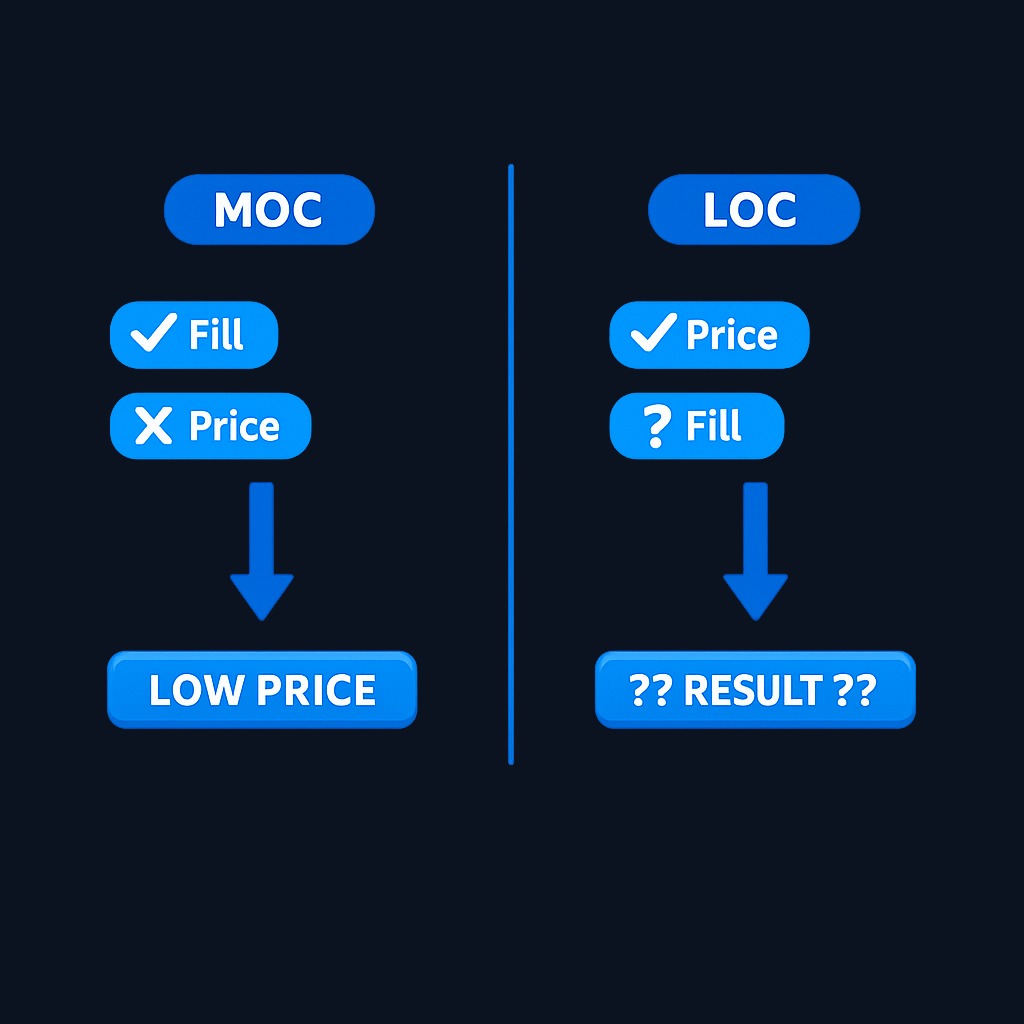
The practical difference between MOC and LOC is what you are willing to sacrifice. MOC sacrifices price control for certainty. LOC keeps a price boundary but accepts that the auction may leave the order unfilled if the close lands outside the limit.
What to know before deciding
Run through this checklist before submitting a market on close order:
- Know your exchange's cutoff and your broker's possibly earlier one.
- Check recent closing behavior. Has this stock been swinging in the final minutes?
- Size against auction volume. If your order is large relative to typical closing volume in that name, expect impact.
- Have a reason for the close specifically. If any afternoon price would do, an intraday limit order may serve you better.
- Remember the lock-in. Treat the cutoff as a commitment point, not a suggestion.
Decision framework: choosing your end-of-day order
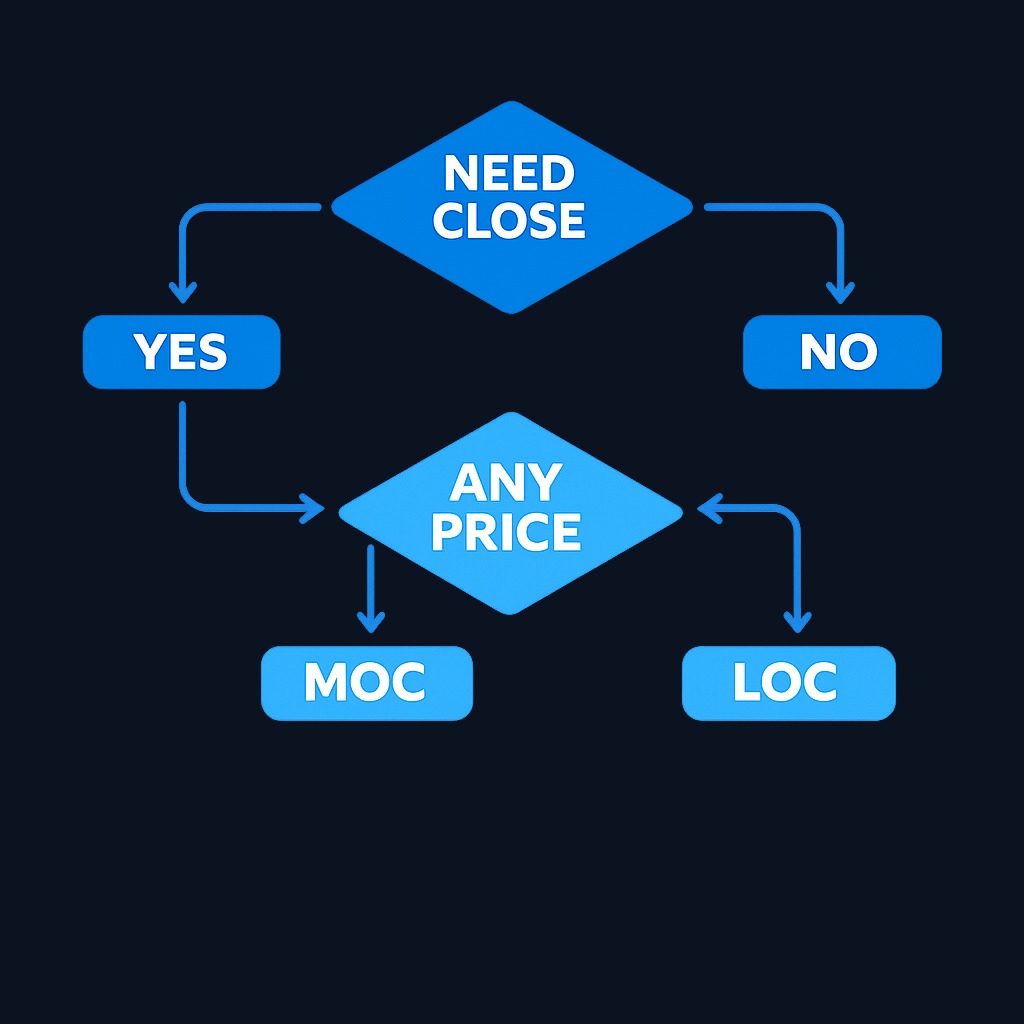
- Do you need the official closing price? If your goal is benchmark matching or a deliberate pre-event exit, yes; continue. If not, use a normal order during liquid hours.
- Can you tolerate any closing price? If yes, use MOC. If a bad print would genuinely hurt, use LOC with a limit at the worst price you accept.
- Is the stock liquid at the close? For thin names, prefer LOC or split the order, since a market on close order in an illiquid auction can move the price against you.
- Submit early. Enter the order well before the 3:50/3:55 p.m. ET cutoffs so a platform hiccup does not strand you.
- Review the fill. Compare your print to the official close; a mismatch means your broker handled the order outside the auction and deserves a question.
Conclusion and next steps
A market on close order is a timing instrument: it trades price control for guaranteed participation in the day's most important print. It shines when the closing price itself is the goal and stings when late-day news or imbalances move the auction. Know the 3:50 and 3:55 p.m. ET cutoffs, respect the no-cancel window, and choose LOC instead when a worst-case price would matter.
Next steps: watch the last ten minutes of trading in a large stock and a small one, and compare their closing prints to the 3:45 price. To build order-type fluency step by step, Finelo offers structured lessons on market mechanics for beginners.
Frequently asked questions
What time do I have to submit a market on close order?
On NYSE, MOC orders must be entered by 3:50 p.m. ET; Nasdaq accepts them until 3:55 p.m. ET, though they cannot be changed after 3:50. Brokers may cut off earlier, so submit with time to spare.
Can I cancel an MOC order after the cutoff?
Generally no. NYSE rejects cancel requests after 3:50 p.m. except for documented errors, and Nasdaq blocks cancels and modifications after 3:50 p.m. Treat submission near the deadline as final.
Is the closing price guaranteed to be near the last intraday price?
No. The closing auction sets its own price from all on-close interest. Large imbalances, news, and index rebalancing can move the official close away from where the stock traded minutes earlier.
Do MOC orders work for every stock and every broker?
No. On-close order types depend on the listing exchange's auction and on your broker supporting them. Some platforms limit MOC availability, order size, or eligible securities, so check your broker's order-type documentation first.
marketcloseordermocordersclosing
Practice trading with Finelo
Practice in a simulator, learn with bite-sized lessons, and build confidence before risking real money.
About the author
Finelo Team
The Finelo Team creates practical investing and trading education designed to help beginners learn faster with structured challenges, simulator practice, and bite-sized lessons.
Keep reading — Related articles
Trading
Understanding Walk Forward Analysis in Trading
Brief educational note: this article is educational — not investment advice — and trading involves the risk of loss.
Finelo Team

Trading
VWAP vs Moving Average: Formulas, Uses, and Limits
VWAP weights price by recorded volume over a defined period, while a moving average summarizes a sequence of prices over a rolling lookback.
Finelo Team
Trading
Volume Profile vs Market Profile: What Each Chart Measures
Volume Profile groups traded volume by price level.
Finelo Team


