For U.S. readers: This article discusses U.S. rules and financial products. State rules and individual eligibility may differ.
Married Filing Separately With Student Loans: How to Compare the 2026 Tradeoffs

Married filing separately can cause a federal income-driven repayment plan to use only the borrower’s income instead of joint income, but the result depends on the repayment plan, loan dates, and current federal rules.
8 min read
Practice trading with Finelo
Practice in a simulator, learn with bite-sized lessons, and build confidence before risking real money.
Want to learn more?
Practice in a simulator, learn with bite-sized lessons, and build confidence before risking real money.
Explore FineloExplore Finelo's 28-day challenges
Turn learning into a daily habit with guided challenge paths.
Quick answer
Married filing separately can cause a federal income-driven repayment plan to use only the borrower’s income instead of joint income, but the result depends on the repayment plan, loan dates, and current federal rules. Filing separately can also increase a couple’s combined tax bill and eliminate benefits such as the student loan interest deduction.
This is a comparison problem, not a universal tax-saving strategy. Compare the couple’s projected federal and state taxes with the projected federal student-loan payments under each filing status before choosing.
Finelo provides financial education, not tax, legal, investment, or individualized financial advice. Federal repayment rules and tax amounts can change, and state community-property rules may materially affect the calculation.
Why filing status can affect an IDR payment
Federal income-driven repayment, or IDR, plans calculate required payments using income and family information. According to Federal Student Aid’s July 2026 guidance, most current IDR plans generally use:
- joint income when spouses file a joint federal return; and
- individual income when spouses file separate federal returns.
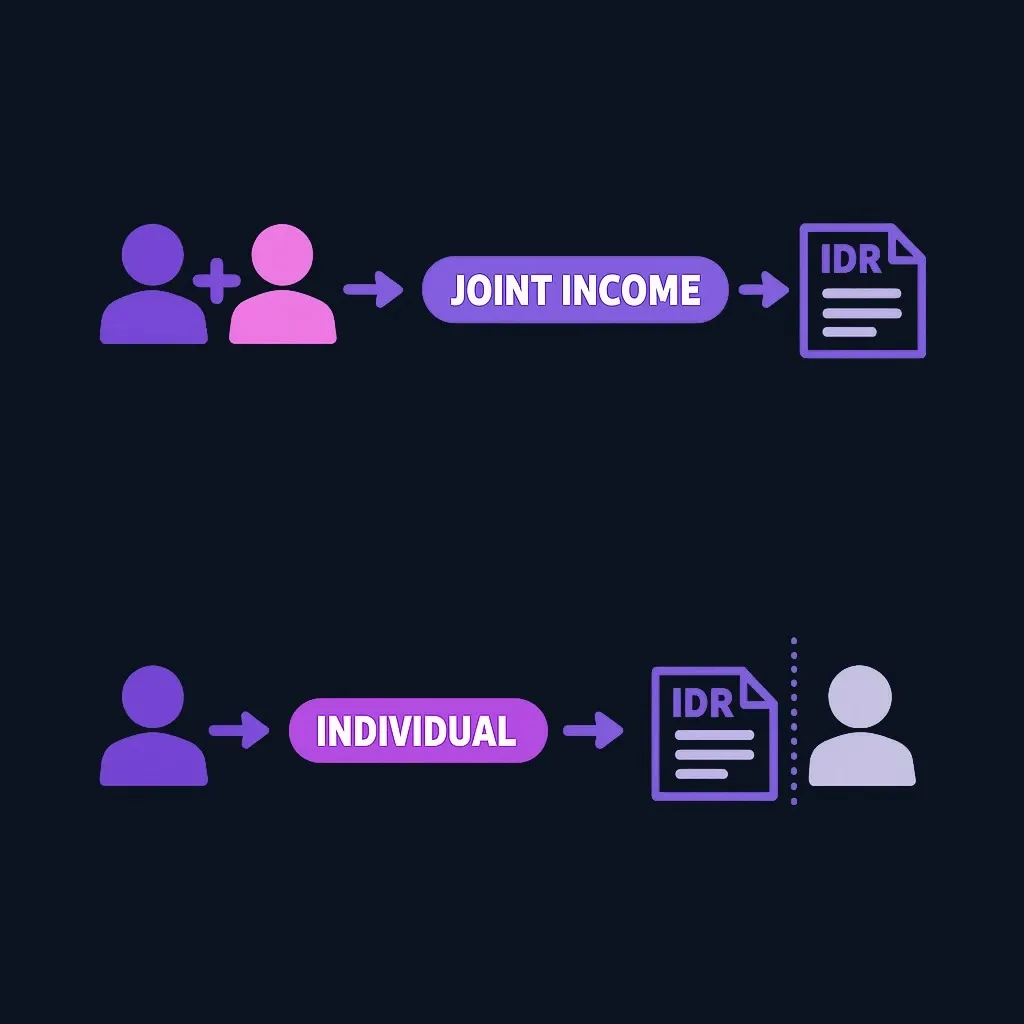
There are plan-specific exceptions. For example, Income-Contingent Repayment may use joint income when both spouses choose to repay eligible loans jointly under that plan. Loan eligibility also depends on when the loans were disbursed.
The federal plan landscape is changing. Federal Student Aid says the Repayment Assistance Plan, or RAP, is available for eligible Direct Loans, while IBR, PAYE, and ICR generally remain limited to loans disbursed before July 1, 2026. PAYE and ICR borrowers are expected to select another plan by July 1, 2028. Verify the current rules for each loan rather than relying on an older comparison article.
Official references:
- How Marriage Affects Your Student Loan Payments — Federal Student Aid
- Federal Student Aid Loan Simulator
- Income-Driven Repayment Plans — Federal Student Aid
Married filing jointly versus separately
| Question | Married filing jointly | Married filing separately |
|---|---|---|
| Which income may an IDR plan use? | Usually joint income | Usually the borrower’s individual income, subject to plan rules |
| Is a spouse’s federal student debt considered? | It may be used to prorate the payment when joint income is used | Usually not relevant to an individual-income calculation |
| Student loan interest deduction | May be available if all requirements are met | Not available |
| Tax return preparation | One federal return | Two federal returns |
| Community-property complications | Usually less significant for allocating income between spouses | May require special income-allocation rules |
| Best result | Depends on taxes, payments, loan eligibility, and household facts | Depends on taxes, payments, loan eligibility, and household facts |
The table describes general federal treatment. It does not predict a specific household’s result.
The tax cost of married filing separately
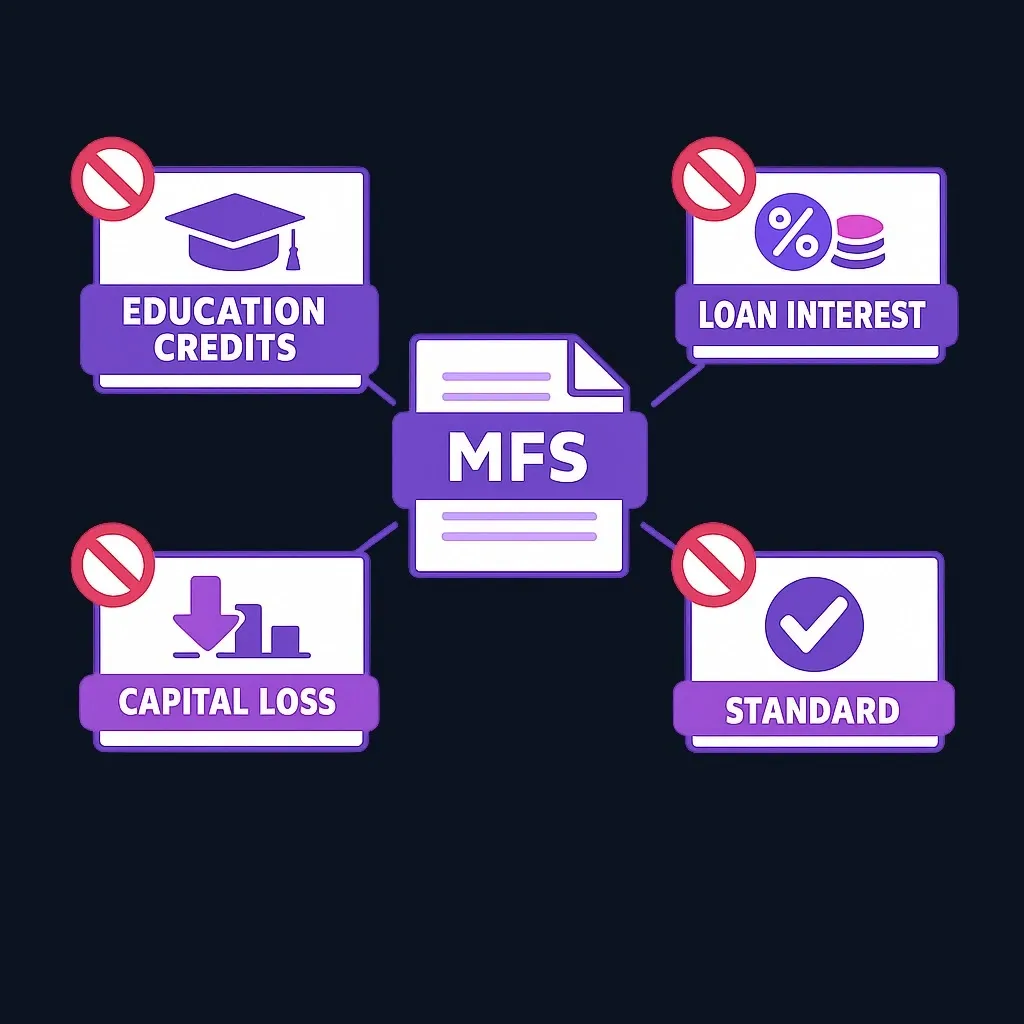
Married filing separately can restrict more than the student loan interest deduction. The IRS explains that separate filers may lose education credits, face narrower eligibility for other credits, and receive a lower capital-loss deduction limit. If one spouse itemizes deductions, the other generally cannot claim the standard deduction.
The exact cost is household-specific. Relevant factors may include:
- each spouse’s income;
- dependents and childcare expenses;
- itemized deductions;
- education expenses;
- retirement contributions;
- capital gains and losses;
- state income taxes; and
- whether community-property rules apply.
The IRS confirms that a taxpayer using married filing separately cannot claim the student loan interest deduction. See IRS Topic No. 456 and IRS Publication 504.
Community-property states require a separate check
In a community-property state, filing separate returns does not necessarily mean each spouse reports only the wages shown under that spouse’s name. Federal tax rules may require spouses to allocate community income and deductions between their separate returns.
That allocation can change adjusted gross income and therefore affect the apparent IDR benefit of filing separately. The applicable rules vary with domicile, the source of the income, marital agreements, and state law.
Use IRS Publication 555 as a starting point, then obtain state-specific tax guidance when community-property rules may apply.
Practice trading with Finelo
Practice in a simulator, learn with bite-sized lessons, and build confidence before risking real money.
A neutral way to compare both filing statuses
Step 1: inventory the loans
For each spouse, record:
- loan type;
- disbursement date;
- current repayment plan;
- principal and accrued interest;
- current payment;
- repayment status; and
- whether the loan may qualify for forgiveness or discharge.
Loan type and disbursement date matter because not every borrower can use every IDR plan.
Step 2: estimate payments under current federal rules
Use the official Loan Simulator while signed in, if possible. Compare the available plans under both filing assumptions. Treat the output as an estimate, not a guarantee; income certification, family size, loan status, and later rule changes can affect the actual payment.
Record both the estimated monthly payment and the estimated total paid. A lower monthly payment does not automatically mean a lower long-term cost, particularly if unpaid interest accumulates or repayment lasts longer.
Step 3: prepare two tax projections
Model:
- one married-filing-jointly return; and
- two married-filing-separately returns.
Include federal and state tax. Do not compare only the refund amounts; compare total tax liability, withholding, estimated payments, and any credits or deductions lost.
Step 4: compare annual cash flow
A simple first-pass comparison is:
annual IDR payment difference − additional annual tax from filing separately
Example: if separate filing is projected to reduce combined federal loan payments by $2,400 for the year but increase combined federal and state tax by $3,100, the first-year cash-flow difference is negative $700 before preparation fees or other effects. This example is hypothetical and does not represent a recommendation.

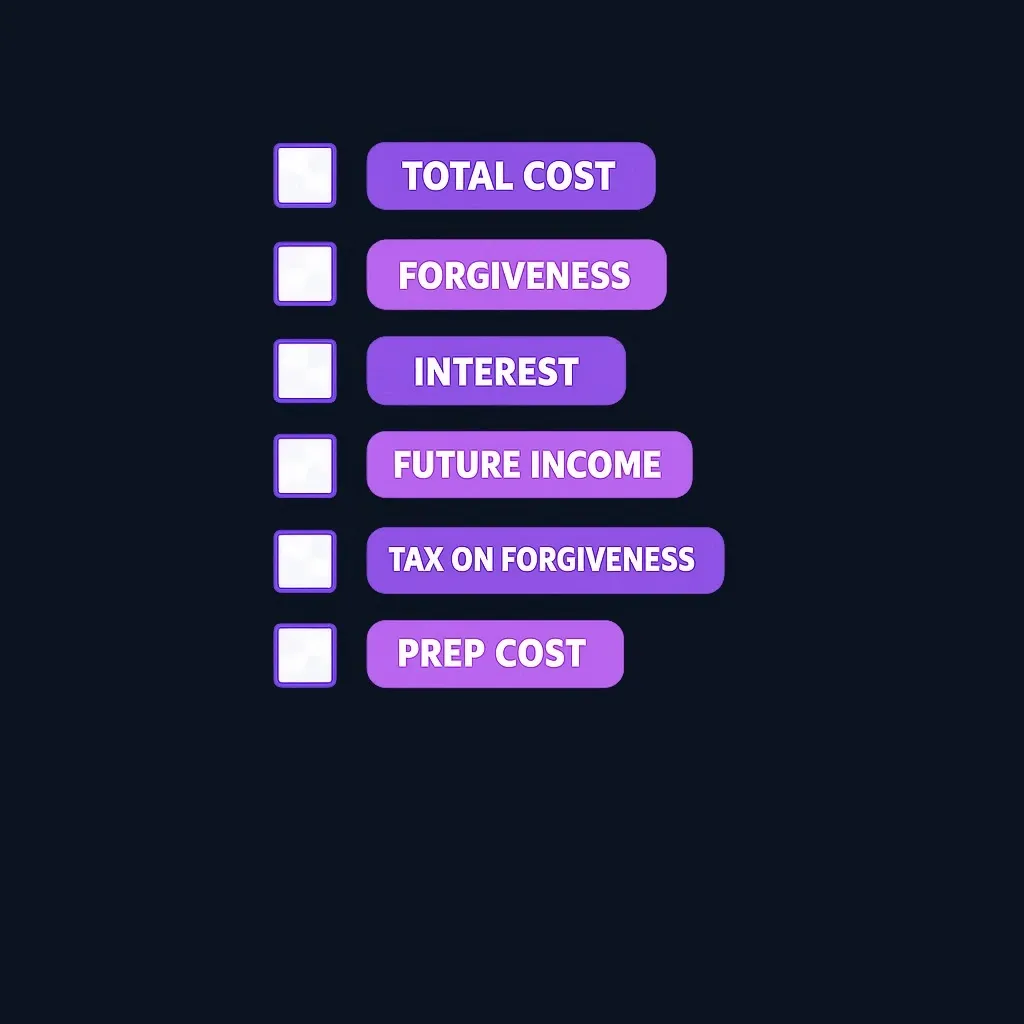
Step 5: check long-term effects
Also compare:
- total projected repayment, not only the next payment;
- progress toward any forgiveness program;
- interest accumulation;
- the possibility that income or filing status changes next year;
- tax consequences of any future forgiveness under then-current law; and
- the administrative cost of filing two returns.
Common mistakes
Assuming every IDR plan uses the same spousal-income rule
Plan rules and loan eligibility differ. Confirm the plan name and loan dates in the borrower’s StudentAid.gov account.
Comparing a monthly payment with an annual tax number
Convert both sides to the same period. Compare annual student-loan payments with annual federal and state tax, then separately review long-term repayment.
Treating a simulator estimate as a binding quote
The official simulator is useful for planning, but the servicer’s calculation based on certified information controls the billed amount.
Ignoring community-property allocation
Separate filing may not isolate income as expected in a community-property state. Review IRS Publication 555 and state rules before using an MFS estimate.
Using old SAVE-plan explanations
Repayment programs have changed substantially. Use current Federal Student Aid pages and application materials rather than archived articles or social-media summaries.
Questions to bring to a tax professional or loan servicer
For a tax professional:
- What is our combined federal and state tax under each filing status?
- Which credits and deductions would we lose by filing separately?
- Do community-property rules change either spouse’s reported income?
- Are there state-specific filing consequences?
For the loan servicer or Federal Student Aid:
- Which IDR plans are available for each loan?
- Which income will the selected plan use under each filing status?
- How will a spouse’s eligible federal student debt affect a joint-income calculation?
- When must income and family size be recertified?
- Could switching plans affect qualifying-payment progress or interest treatment?
Frequently asked questions
Does married filing separately always lower student-loan payments?
No. It may lower an IDR payment when the plan uses individual rather than joint income, but the amount depends on income, family information, loan type, disbursement date, and plan rules. It does not reduce a standard payment solely because the tax return is separate.
Can married filing separately cost more in taxes?
Yes. Separate filing can remove or restrict deductions and credits and may produce a higher combined federal or state tax bill. The only reliable comparison uses two current-year tax projections.
Can a married-filing-separately taxpayer deduct student-loan interest?
No. The IRS lists married filing separately as ineligible for the student loan interest deduction.
Do both spouses need the same repayment plan?
Generally, no. Federal Student Aid states that a spouse does not need to use the same IDR plan. Plan-specific rules still apply to each borrower and loan.
Should a couple file separately only to lower an IDR payment?
That cannot be answered from the loan payment alone. The comparison should include taxes, payment estimates, long-term repayment, state law, and the household’s objectives. A tax professional can evaluate the filing consequences; Federal Student Aid or the servicer can confirm loan-plan administration.
Bottom line
Married filing separately can reduce the income used for some federal IDR calculations, but it can also raise taxes and remove valuable tax benefits. Current plan eligibility is especially important in 2026 because federal repayment options are changing.
Use official Federal Student Aid tools for the loan side, current IRS guidance for the federal tax side, and a state-specific tax review when needed. Recalculate the comparison each tax year rather than assuming last year’s result will repeat.
For more plain-language financial education, visit the Finelo Blog.
Financial LiteracyFinancial Education
Practice trading with Finelo
Practice in a simulator, learn with bite-sized lessons, and build confidence before risking real money.
About the author
Finelo Team
The Finelo Team creates practical investing and trading education designed to help beginners learn faster with structured challenges, simulator practice, and bite-sized lessons.
Keep reading — Related articles

Financial Literacy
Mercury Books Review 2026: Is It Worth It for Startups?
Mercury Books brings double-entry accounting into Mercury. Review its $35 pricing, reports, AI features, integrations, and migration limits.
Finelo Team

Financial Literacy
Why is My FICO Score Lower Than My Credit Score?
Example takeaway: seeing a higher score in a bank app doesn’t guarantee lenders will see the same FICO number at application time; lenders often pull a specific FICO version from a specific bureau.
Finelo Team

Financial Literacy
Why Is My FICO Score Higher Than My Credit Score?
Brief educational note: this article is educational, not financial or investment advice; investing and credit decisions involve risk and possible loss.
Finelo Team