For U.S. readers: This article discusses U.S. rules and financial products. State rules and individual eligibility may differ.
Median 401(k) Balance by Age: How to Read Benchmark Data
If you compare a balance with a published median, first confirm the dataset, age band, and participant definition.
13 min read
Practice investing with Finelo
Build practical investing skills with guided lessons, simulator practice, and structured challenges.
Want to learn more?
Build practical investing skills with guided lessons, simulator practice, and structured challenges.
Explore FineloExplore Finelo's 28-day challenges
Turn learning into a daily habit with guided challenge paths.
Quick answer
Median 401(k) balances generally rise with age because pay, tenure, and compound returns accumulate over a working life. Use the median—the midpoint of balances in an age band—as a realistic benchmark rather than the mean, which high balances can skew. Finelo provides financial education, not financial or investment advice.
If you compare a balance with a published median, first confirm the dataset, age band, and participant definition. Then review the account in the context of personal spending needs, Social Security or pension income, plan match and vesting terms, fees, taxes, and risk tolerance. A peer median is not a savings target.
Introduction
This article explains what “median 401(k) balance by age” means, why the median matters, the main drivers that shape balances, and practical steps you can take at each life stage. It includes a decision framework (Assess → Prioritize → Act), a checklist, hypothetical examples, and an FAQ. Use the guidance to interpret published medians rather than treating a peer benchmark as a personal target.
Near-term note: when plan rules or distribution mechanics matter, official guidance may apply; for example, certain distribution-consent rules are described by the IRS here. This content is educational, not personal financial or investment advice. Investing involves risk, including loss of principal.
What is the Median 401(k) Balance by Age?
Definition and why it’s used
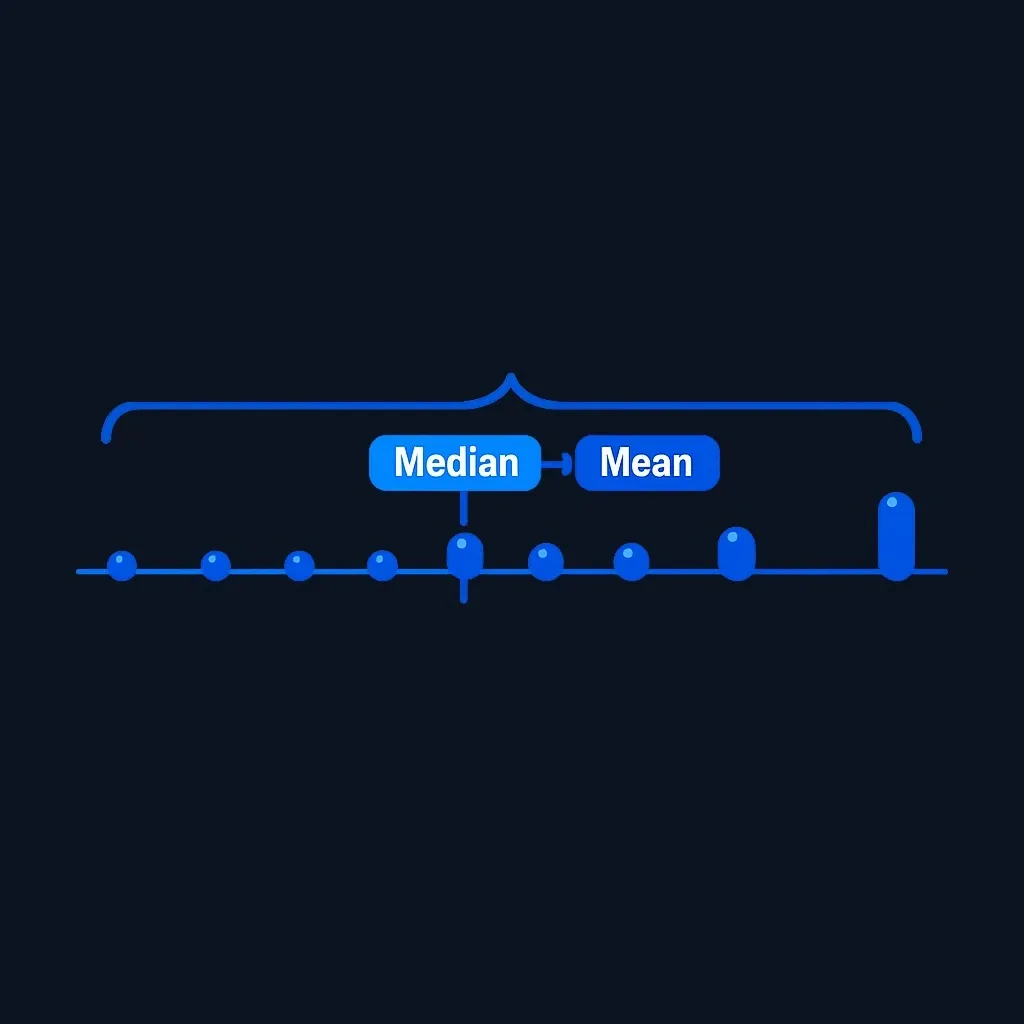
The median 401(k) balance for an age band is the middle value when you sort all account balances for that band from smallest to largest. Half of accounts lie below the median and half above it. Because retirement-account balances are typically skewed—many small accounts and a few very large ones—the median gives a better sense of the “typical” saver than the average (mean).
How to interpret a published median
- Check the sample frame. Some medians are calculated only for actively contributing participants; others include inactive or rolled-over accounts. These choices materially change the number.
- Match age bands. Sources use different brackets (for example, 25–34 vs. 30–39). Compare only like-for-like bands.
- Look for methodology notes. Confirm whether rollovers, IRA roll-ins, and small-balance distributions were included or excluded.
Why median matters for planning
- Descriptive benchmark: A median shows the midpoint of the selected sample; it does not show what most people need.
- Diagnostic prompt: A large difference from a peer sample can prompt a review of contributions, fees, employment history, and personal goals, but it does not prescribe an action.
Practical example
If a published median applies only to “active participants” at large firms, it will likely be higher than a population-wide median that counts many inactive or small accounts. Before adjusting your plan, confirm which population the headline number represents.
Median 401(k) Balances by Age Group
Below is a practical, sourced-free table that summarizes the typical life-stage drivers behind medians. Because published numeric medians vary by source and sample method, this table focuses on interpretation and use.
| Age band | Typical life stage and balance drivers | What the median reflects (how to interpret it) |
|---|---|---|
| 20s | Early career, establishing saving habits, student debt or low starting salary | Median often reflects only a few years of saving; many are still building the habit. |
| 30s | Career progression, family formation, higher recurring expenses | Median rises as wages and deferral rates increase; interruptions like parental leave widen the spread. |
| 40s | Longer tenure, compounding gains, larger balances among steady savers | Median reflects a decade or more of consistent saving and market returns. |
| 50s | Peak earnings for many; catch-up opportunities available in many plans | Median often shows long-term savers with higher balances and those who increased deferrals later. |
| 60s+ | Approaching/entering retirement; withdrawals and rollovers reshape account sizes | Median can plateau or fall as people begin distributions and consolidate accounts. |
How to use this table
- Translate any numeric median into life-stage expectations: medians tell you what is typical, not what is sufficient for your retirement goals.
- Pair the median with percentiles where possible. If available, review 25th and 75th percentiles to see distribution spread and whether you’re near the lower, middle, or upper third of savers.
Short illustrative scenarios
- Saver A (late 20s): Just enrolled at work and contributes enough to get the match; steady small contributions will compound over decades.
- Saver B (late 30s): Took parental leave and paused contributions for a period; later resumed with higher deferral rate and consolidated old accounts.
- Saver C (early 50s): Increased deferrals after a career bump and focused on lower-cost funds while preserving an emergency cushion.
These examples are illustrative and do not reference a specific study or dataset.
Understanding the Difference: Average vs. Median 401(k) Balances
What each measure tells you
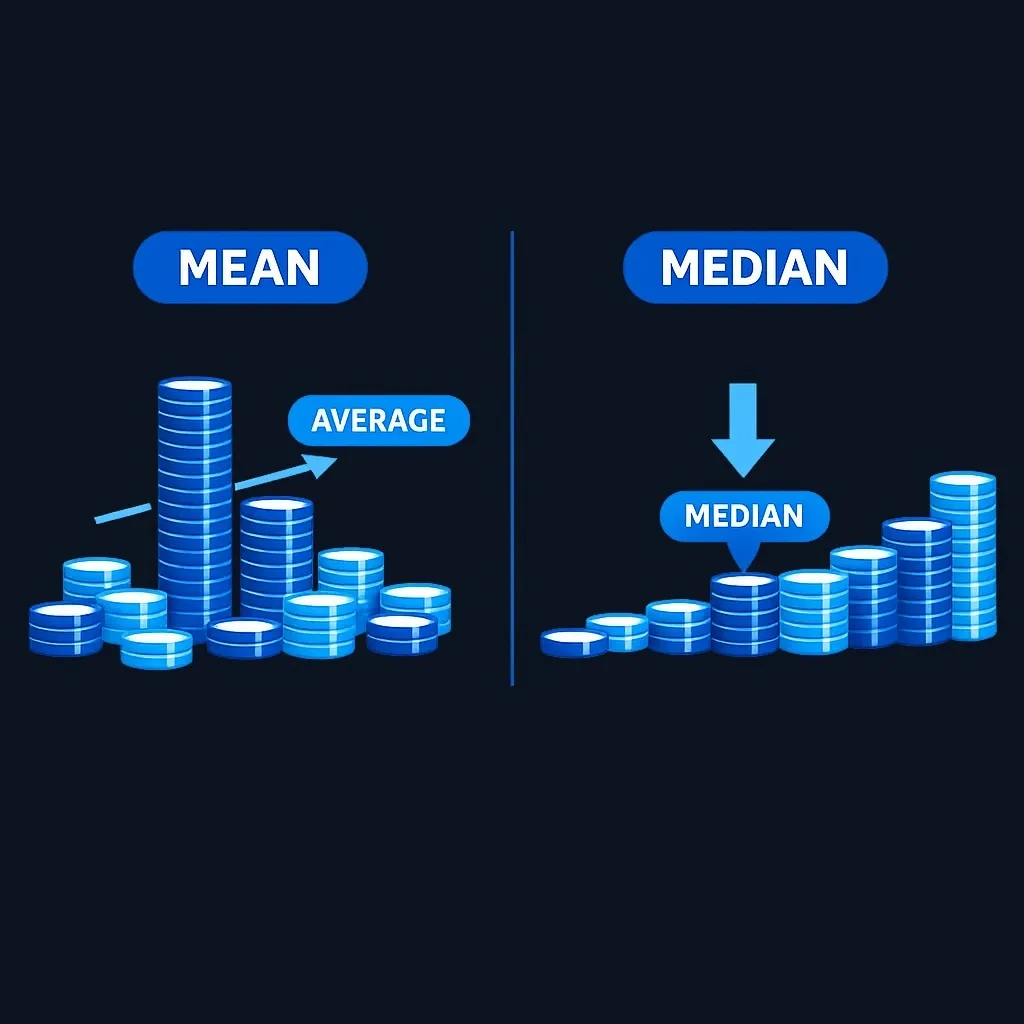
- Mean (average): Sum of all balances divided by the number of accounts. Because a few very large accounts raise the sum, the mean can overstate what most people hold.
- Median: The midpoint balance. Because medians resist outliers, they often represent a more accurate “typical” position for most savers.
Why headlines can mislead
News stories quoting the “average” may imply that most people have more saved than they actually do. Always look for the median or percentile breakdown (25th, 50th, 75th) for an honest snapshot.
Practical takeaway
When assessing your position, use median and percentiles to see where you stand relative to peers. Use the mean when you need a sense of total assets per account but interpret it alongside medians and percentiles.
Factors Influencing 401(k) Balances
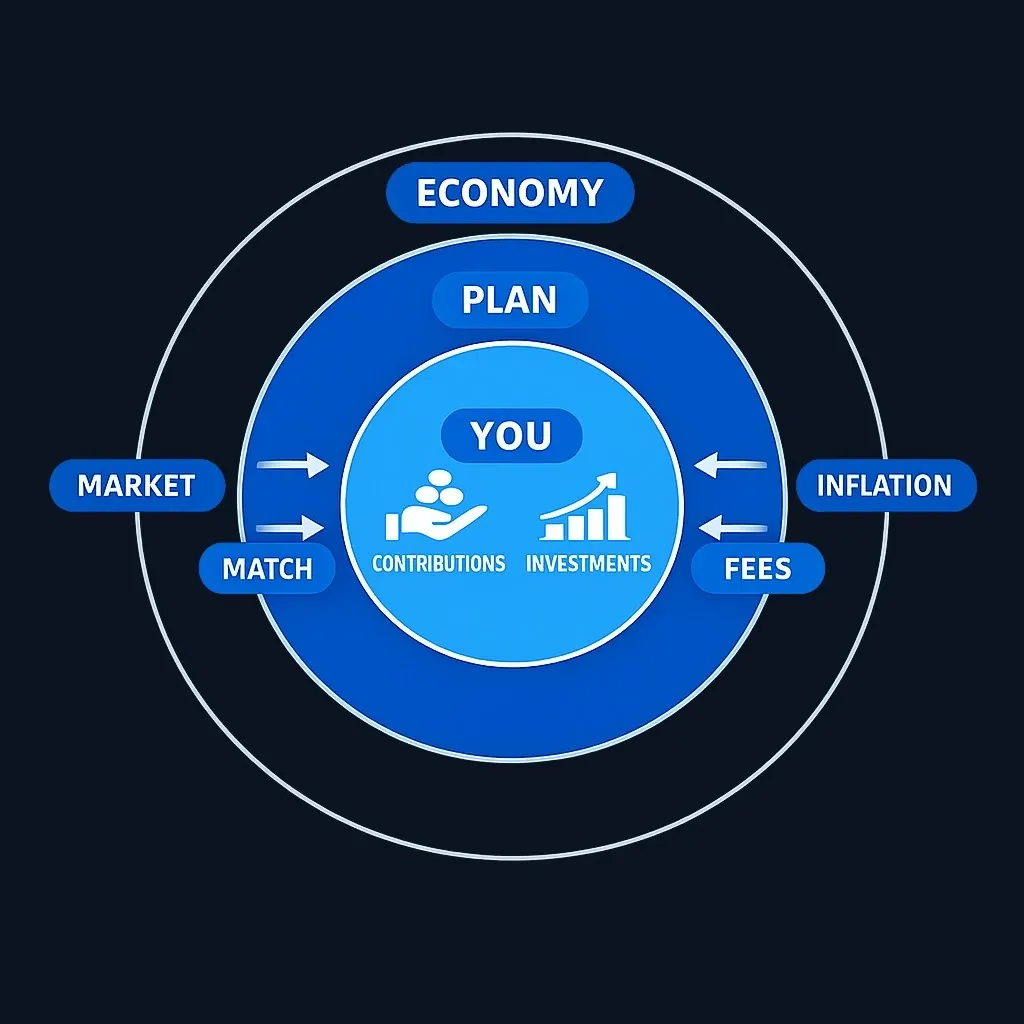
401(k) balances result from a mix of individual behavior, plan design, employer actions, and macroeconomic forces. Below are the common drivers and practical ways they influence medians.
Individual-level drivers
- Contribution rate and consistency: The percent of pay you save and whether you keep saving through life events are the largest determinants.
- Tenure and account structure: Longer contribution histories can raise balances. Consolidating old accounts may simplify administration, but it can raise or lower fees and change investment choices, legal protections, and withdrawal features.
- Investment choices and fees: Higher-cost funds and poor diversification erode long-term returns.
- Life events and liquidity needs: Job changes, layoffs, caregiving, or medical costs can interrupt contributions and reduce balances.
Plan- and employer-level drivers
- Employer match and vesting: Employer contributions can increase balances; vesting schedules determine how much employer money a participant keeps after leaving.
- Automatic plan features: Auto-enrollment and auto-escalation raise participation and saving rates without active choices.
- Fund menu and fee structure: A broad, low-cost fund lineup supports higher net returns for participants.
Macro and economic drivers
- Market returns and volatility: Strong market runs raise balances across cohorts; downturns compress medians temporarily.
- Inflation and cost-of-living pressures: Higher prices reduce the share of pay available to save unless compensation keeps pace.
- Labor market trends: Frequent job churn or long unemployment spells fragment accounts and reduce plan-based balances.
Administrative and regulatory example
Plan distribution and small-balance handling affect reported balances. For instance, plan administrators must obtain participant consent before distributing an account that exceeds a specified threshold, a rule described by the IRS.
Common mistakes tied to these factors
- Comparing medians without matching methodology.
- Chasing short-term performance instead of fixing contribution behavior.
- Overlooking plan fees or default investments that lower net growth.
Practice investing with Finelo
Build practical investing skills with guided lessons, simulator practice, and structured challenges.
Strategies to Optimize Your 401(k) Savings
Actionable strategies you can apply now, organized by age and priority. Each subsection includes practical steps and one realistic tip you can implement quickly.
Universal first priorities (applies at any age)
- Review the employer match. A match can be valuable, but it is not literally risk-free: vesting, plan restrictions, investment performance, taxes, and household liquidity can affect its value.
- Minimize avoidable fees. Review your plan’s fee disclosures and prefer low-cost, broad-market funds when appropriate.
- Automate increases. Enable auto-escalation or commit to raising deferrals when you get raises to increase savings without decision friction.
Practical quick tip: Set a calendar reminder to review contribution and fund choices at least annually or after a major life event.
Age-based tactics
20s — Habit formation and match capture
- Enroll in the plan and set up automatic contributions.
- Keep an emergency fund (so you avoid early withdrawals).
- Favor a growth-oriented allocation appropriate to a long time horizon.
Illustrative step: If your plan offers automatic enrollment, review and confirm your investment default but prioritize saving enough to get the match.
30s — Scale contributions and limit interruptions
- Increase deferrals as income rises and after promotions.
- Compare rollover and retention options for old accounts; consolidation may simplify management, but verify fees, investments, protections, and access before moving assets.
- Revisit beneficiary designations after major life events.
Illustrative step: Automate a 0.5–1% deferral increase when you receive a raise to let saving rise with income.
40s — Catch-up planning and fee focus
- Reassess asset allocation for risk management and fee efficiency.
- If you’re behind, prioritize increasing the deferral rate and consolidating accounts.
- Use tax-aware coordination with IRAs or other accounts when appropriate.
Illustrative step: Replace overlapping funds or high-cost active options with broad, low-cost funds where available.
50s+ — Maximize opportunities and plan distributions
- Review any plan catch-up options that allow higher contributions if available in your plan.
- Plan for sequence-of-returns risk as retirement nears and consider liquid reserve levels.
- Coordinate withdrawal planning across accounts as retirement approaches.
Illustrative step: Prepare a withdrawal sequence plan (which account to tap first) and test its tax and cash-flow implications with hypothetical scenarios.
Common tactical mistakes and fixes
- Mistake: Ignoring employer match. Fix: Confirm and contribute at least to the match formula.
- Mistake: Letting small, old accounts languish. Fix: Consolidate accounts to reduce fees and simplify rebalancing.
- Mistake: Chasing recent top-performing funds. Fix: Stick to a diversified, low-cost mix and rebalance periodically.
Decision framework
Use this compact framework—Assess → Prioritize → Act—to convert a median comparison into a practical plan you can implement within weeks.
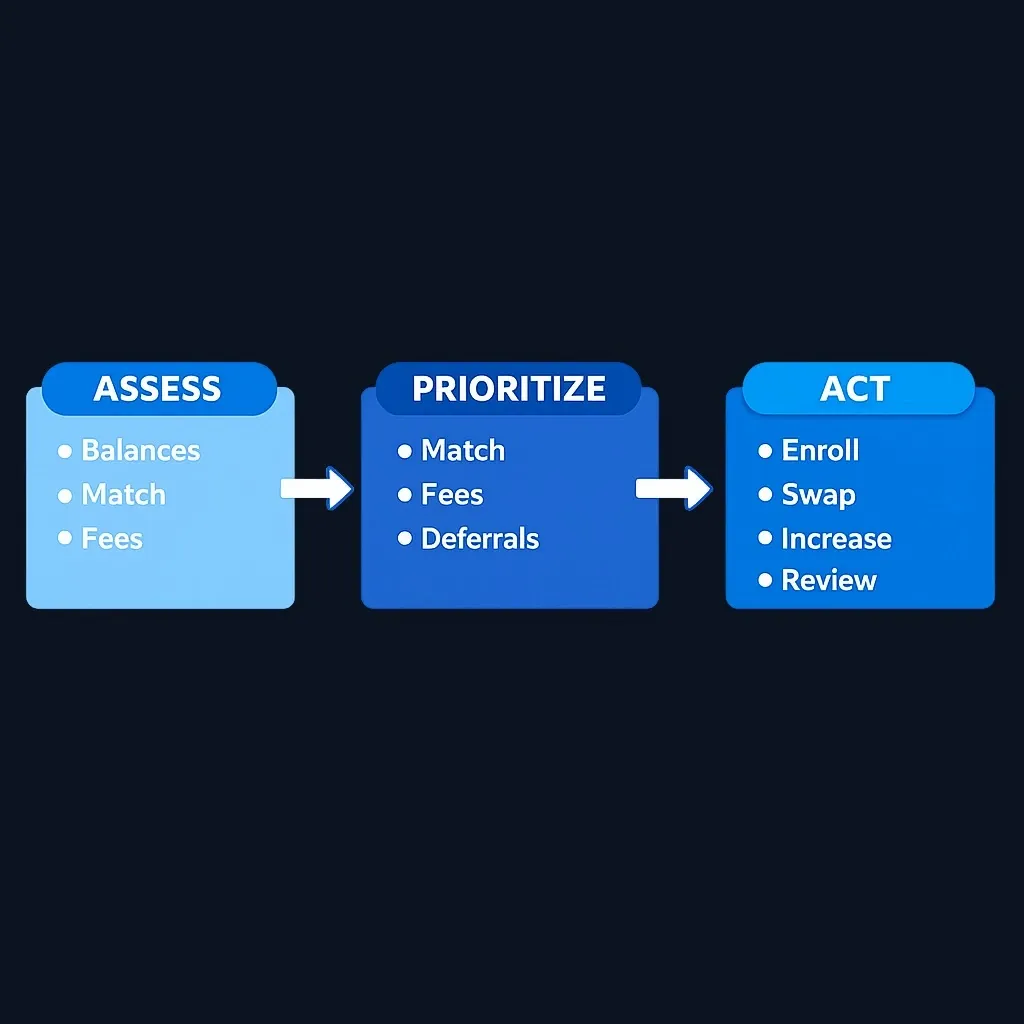
Step 1 — Assess
Inventory what you have:
- All 401(k) accounts, balances, and whether they’re active or rolled over.
- Current deferral rate and employer-match formula.
- Fund lineup, fees, and default investment for non-action-takers.
- Emergency savings and other liquid cushions.
- Time horizon and planned retirement timing.
Useful prompt: Create a one-page summary listing balances, deferral rates, and match terms for each employer plan you’ve used.
Step 2 — Prioritize
Rank actions by likely impact and feasibility:
- Top priority: Capture full employer match.
- Next: Replace high-fee options and consolidate tiny, dormant accounts.
- Then: Increase deferrals in line with cash-flow capacity and upcoming raises.
How to rank: For each potential change, estimate the friction (easy/medium/hard) and expected impact (low/medium/high). Start with changes that are easy and high impact.
Step 3 — Act
Implement the highest-priority items first and schedule follow-ups:
- Enroll or adjust to receive your full match.
- Swap out expensive funds for lower-cost equivalents when available.
- Enable or commit to automatic deferral increases.
- Set quarterly or semiannual reviews and rebalance annually.
Short follow-through checklist
- Confirm employer-match capture each pay period.
- Save the plan fee disclosures and compare them to low-cost alternatives.
- Consolidate small accounts and update beneficiary designations.
- Keep a simple rebalancing schedule (e.g., annual).
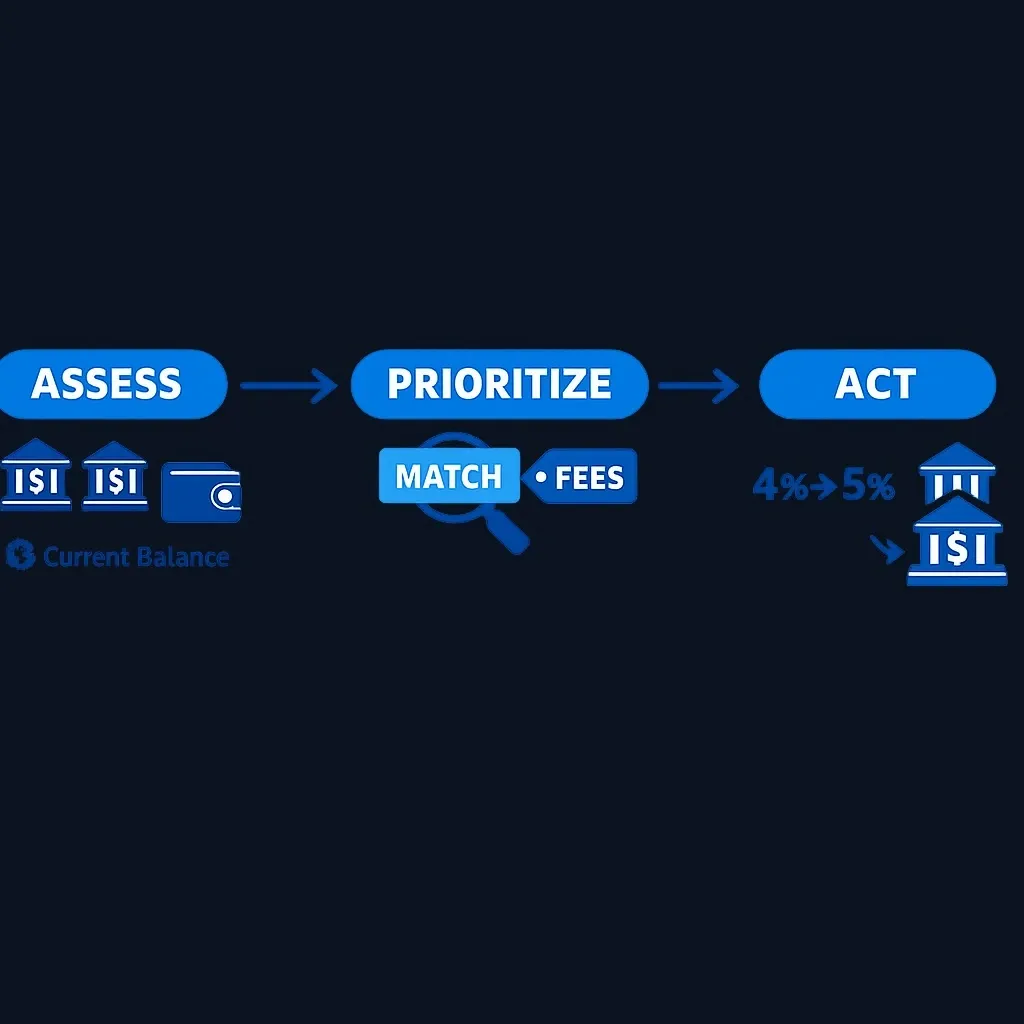
Example application
Case: Mid-career saver sees they’re below the median for their age band. Using Assess → Prioritize → Act they:
- Inventory accounts and confirm match rules.
- Prioritize match capture and fee reduction.
- Increase deferrals modestly and consolidate two small old accounts within months.
What to know before deciding
This section lists checks you should complete before changing contribution rates, altering allocations, or initiating rollovers.
Administrative checks
- Review your plan’s summary plan description and fee disclosures to know what actions the plan allows (for instance, whether in-service rollovers or loans are permitted).
- Confirm employer-match formula and vesting schedule—these affect the net benefit of staying with or leaving a job.
- Understand distribution consent and small-balance rules; the IRS describes certain distribution-consent circumstances and thresholds.
Personal and tax considerations
- Consider your time horizon and liquidity needs before increasing exposure to market risk.
- Evaluate tax impacts of traditional versus Roth deferrals based on expected future tax rates.
- Keep an emergency fund sufficient to avoid tapping retirement savings for short-term needs.
Educational and risk-aware note: This content is educational, not personal financial or investment advice. Consider your objectives, time horizon, taxes, liquidity, and risk tolerance before making changes. Investing involves risk, including loss of principal.
Common constraints and their fixes
- Constraint: High living expenses prevent higher deferrals. Fix: Start with a small, sustainable increase and automate future raises to avoid lifestyle friction.
- Constraint: Multiple small accounts with different custodians. Fix: Consolidate accounts where fees and investment options justify it.
- Constraint: Confusing plan menus. Fix: Use a simple core allocation (broad domestic equity, international equity, and fixed income) and rebalance annually.
FAQs About 401(k) Balances
Each answer is concise and practical.
What is the average 401(k) balance by age?
Reported averages vary widely by data source and sample method; averages can be much higher than medians because a small number of very large accounts raise the mean. Look for median and percentile data from reputable sources that publish methodology before using any headline number.
How do I calculate my retirement savings needs?
Estimate retirement spending and expected income sources under several scenarios, then test taxes, inflation, longevity, market returns, health costs, and withdrawal timing. A single replacement-rate or withdrawal-rate rule is only an assumption and should not be treated as a guaranteed sustainable amount.
What are the benefits of contributing to a 401(k)?
A 401(k) typically offers tax-advantaged retirement saving and often an employer match, which is effectively additional compensation. It also provides automatic payroll deferral, which simplifies long-term saving. Check your plan’s specifics for tax treatment and match rules.
How can I increase my 401(k) contributions if I’m behind?
Start with low-friction moves: enable auto-escalation if available, increase deferrals after raises, and capture the full employer match first. Also, review household spending to find modest reallocation opportunities toward saving. If significant catch-up is necessary, consult a financial professional to evaluate tax and cash-flow tradeoffs.
Conclusion and Next Steps
Key takeaways
- The median 401(k) balance rises with age and gives a realistic picture of where typical savers stand; always confirm the population and methodology behind any published median.
- Use the Assess → Prioritize → Act framework to convert a median comparison into prioritized actions: capture matches, cut avoidable fees, and increase deferrals incrementally.
- Before making administrative changes, review your plan documents, understand vesting and distribution rules, and confirm tax implications.
Practical next steps you can take this week
- Pull your most recent plan statements for all 401(k) accounts and create a one-page inventory.
- Confirm whether you are receiving the full employer match and, if not, adjust contributions to capture it.
- Schedule an annual reminder to review fund fees, allocation, and beneficiary designations.
Finelo provides financial education, not financial or investment advice. If you need personalized guidance, consider consulting a qualified financial advisor who can factor in your full financial picture.
InvestingFinancial Education
Practice investing with Finelo
Build practical investing skills with guided lessons, simulator practice, and structured challenges.
About the author
Finelo Team
The Finelo Team creates practical investing and trading education designed to help beginners learn faster with structured challenges, simulator practice, and bite-sized lessons.
Keep reading — Related articles

Investing
Yield to Call vs Yield to Maturity: Assumptions and Bond Risks
Yield to call (YTC) estimates a bond's yield if the issuer redeems it on an eligible call date; yield to maturity (YTM) estimates yield if it remains outstanding to final maturity.
Finelo Team
Investing
Will My Employer Know If I Take a 401(k) Loan?
Who this page is for: readers new to 401(k) loans who want a practical, privacy‑focused explanation — what your employer can see, how to limit visibility, and the financial tradeoffs to weigh.
Finelo Team

Investing
What Medical Expenses Qualify for a 401(k) Hardship Withdrawal?
Before you decide, confirm three things with your plan administrator:
Finelo Team


