Momentum factor investing is a rules-based strategy that buys securities whose prices have recently performed strongly, on the premise that recent relative winners tend to keep outperforming in the near term. Instead of picking stocks on gut feel, momentum strategies rank a universe of stocks by past returns and hold the top-ranked names, refreshing the list on a schedule.
Momentum Factor Investing: How It Works and When It Fails

Learn what momentum factor investing is, how momentum funds are built, the risks of trend reversals, and a decision framework for using the momentum factor.
8 min read
Practice investing with Finelo
Build practical investing skills with guided lessons, simulator practice, and structured challenges.
Want to learn more?
Build practical investing skills with guided lessons, simulator practice, and structured challenges.
Explore FineloExplore Finelo's 28-day challenges
Turn learning into a daily habit with guided challenge paths.
This page is for investors who keep hearing about "factors" and want to understand the momentum factor specifically: what it is, why it might work, how it can go wrong, and how to decide whether it belongs in a portfolio. Read the mechanics and the risk section before anything else. This article is educational, not financial advice.
What momentum factor investing is
A factor is a measurable characteristic that is believed to explain why certain groups of securities outperform or underperform the broader market, a definition the SEC's investor bulletin on smart beta and non-traditional index funds uses when describing how these funds are built. Value, quality, size, and dividends are common examples. Momentum is the factor built on recent price performance.

FINRA's investor guide to momentum investing describes the underlying idea: trading stocks that are moving rapidly higher or lower and exiting before prices reverse. Factor investing systematizes that instinct. Rather than one trader timing entries and exits, a momentum index applies fixed ranking rules across hundreds of stocks and rebalances mechanically.
The idea behind momentum
Why would past winners keep winning? The common explanations fall into two groups:
- Behavioral. Investors underreact to new information at first, then pile in as a trend becomes obvious. Early underreaction and later herding both extend price moves beyond what instant, rational repricing would produce.
- Structural. Large institutions build positions gradually to limit market impact, spreading demand over weeks or months. Fund flows chase recent performance, adding more buying to stocks already rising.

Neither mechanism guarantees anything. FINRA's guide is blunt that momentum is a form of market timing, that indicators can give false signals in volatile markets, and that even sophisticated practitioners cannot predict sudden geopolitical or macroeconomic shocks. Treat the explanations as reasons the pattern has existed historically, not as a promise it will persist.
How momentum strategies are built
A typical rules-based momentum strategy makes four design choices:
- Universe. Which stocks are eligible, for example large- and mid-caps in a broad index.
- Lookback window. The period used to measure past performance. A widely used convention measures returns over roughly the past 12 months while excluding the most recent month, since very short-term moves often reverse.
- Ranking and selection. Stocks are sorted by lookback return, and the top slice, often adjusted for volatility, enters the portfolio.
- Rebalancing schedule. The ranking refreshes periodically, commonly twice a year or quarterly, replacing names whose momentum has faded.
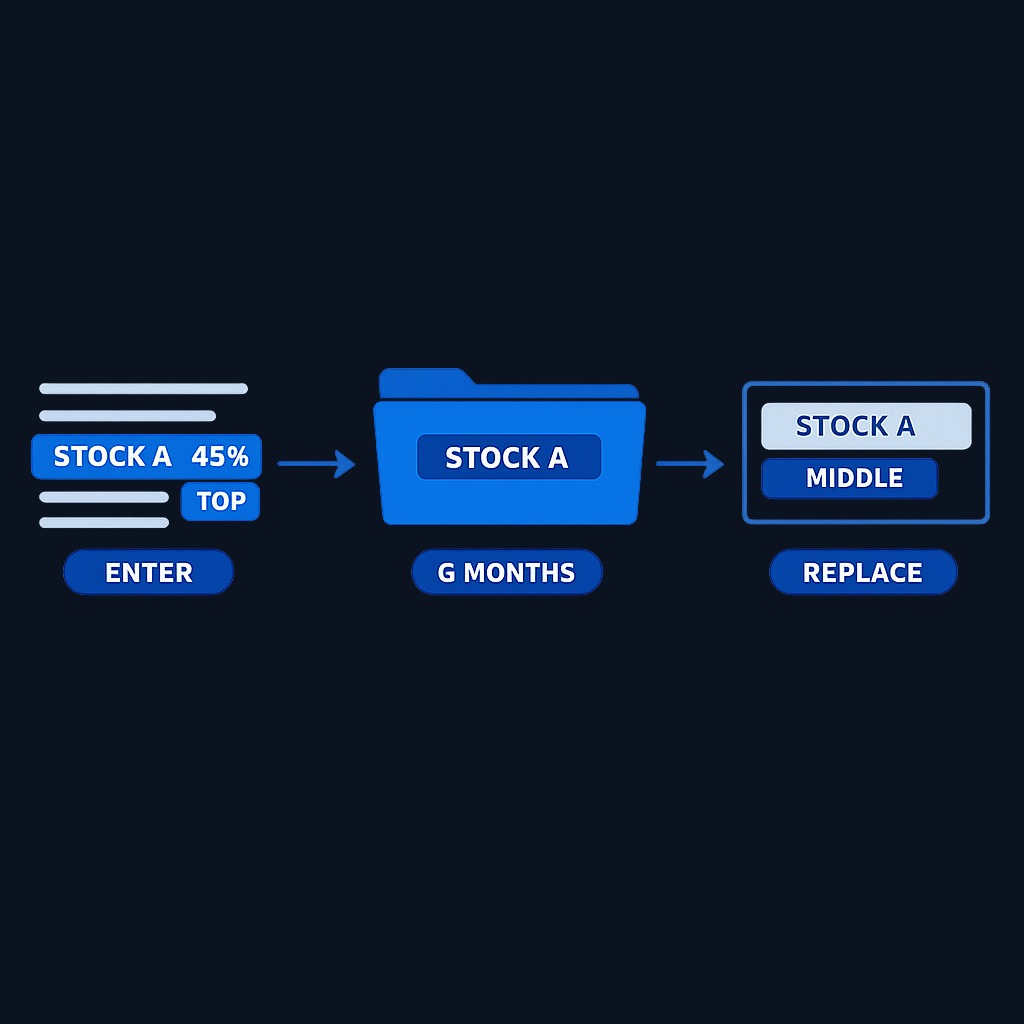
A worked example: suppose a universe of 500 stocks is ranked by 12-month return excluding the last month. Stock A returned 45%, placing it in the top decile, so it enters the portfolio. Six months later its trailing return has faded to the middle of the pack, and the rebalance swaps it out for a fresher winner. No forecast, no story, just rules applied on schedule. Smart beta momentum funds package exactly this kind of custom index, remaining passively managed even though the index rules are active-looking.
Momentum vs other factors
| Factor | What it buys | Typical failure mode |
|---|---|---|
| Momentum | Recent relative winners | Sharp reversals at market turning points |
| Value | Stocks cheap vs fundamentals | Long stretches of underperformance in growth-led markets |
| Quality | Profitable firms with strong balance sheets | Lagging in speculative rallies |
| Size | Smaller companies | Higher volatility and liquidity risk |
| Low volatility | Steadier price behavior | Trailing strongly rising markets |
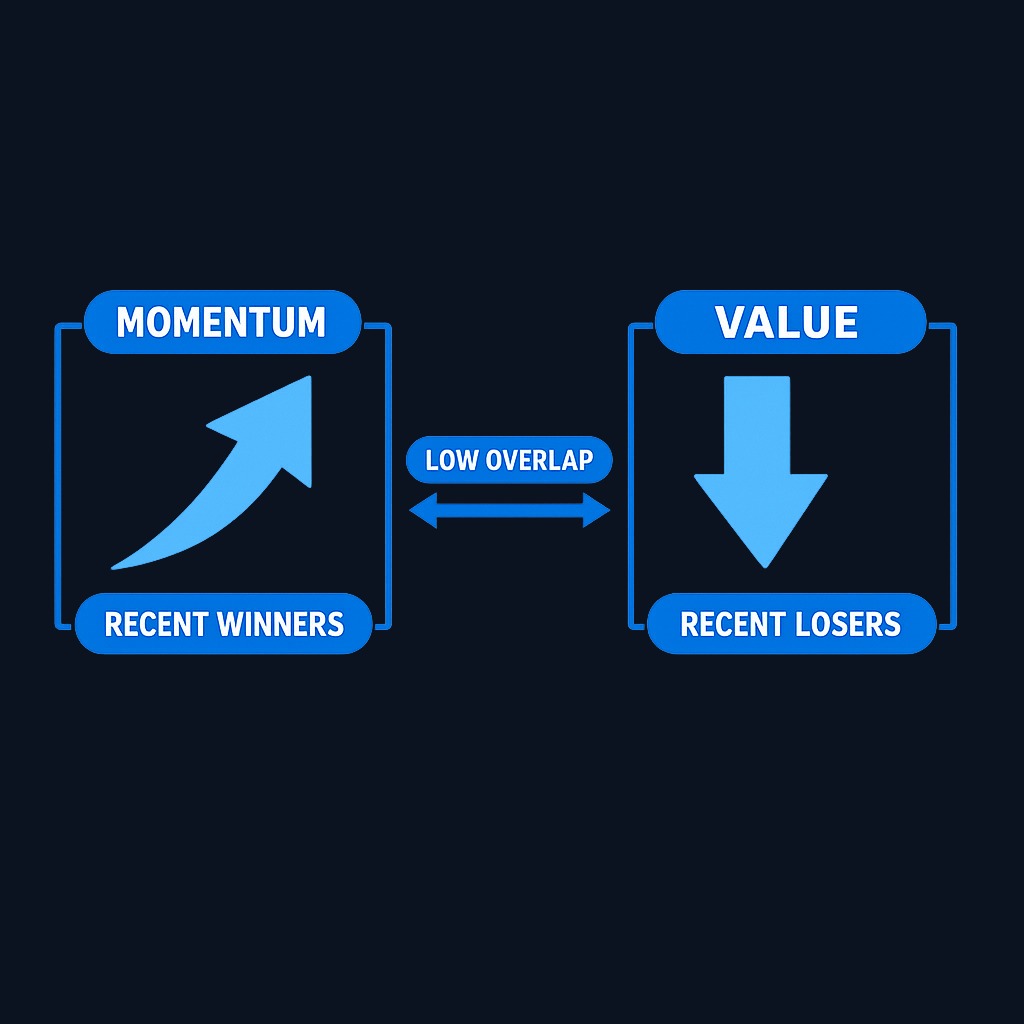
Momentum tends to behave differently from value: momentum buys what has been working, while value buys what has been ignored. That low overlap is one reason multi-factor portfolios combine them, letting one factor's weak stretch partially offset another's. Every factor, momentum included, goes through multi-year periods of underperformance, so combining or committing long term matters more than picking the "best" factor.
Practice investing with Finelo
Build practical investing skills with guided lessons, simulator practice, and structured challenges.
Risks: reversals, turnover, and costs
Momentum's risk profile has specific, well-documented sharp edges:
- Reversal risk. Momentum portfolios are positioned toward whatever has been working. When the market regime flips suddenly, such as at the bottom of a bear market, the strategy is often loaded with defensive recent winners just as beaten-down names snap back hardest. These reversals can be fast and severe.
- False signals. Per FINRA's momentum guide, momentum indicators can mislead in volatile, choppy markets where trends keep aborting.
- Turnover and costs. Momentum is a high-turnover factor by nature, since rankings change constantly. FINRA's smart beta guidance notes that smart beta indexes rebalance more frequently than market-cap-weighted indexes and that this turnover can increase investor costs. In taxable accounts, frequent selling can also raise the tax bill.
- Concentration. A momentum fund can cluster heavily in whatever sector has been hot, reducing diversification exactly when a sector-specific shock would hurt most, the concentration risk FINRA flags for smart beta products generally.
- Back-tested claims. Many factor products lean on hypothetical historical results. Back-testing neither predicts nor perfectly replicates performance, a caution FINRA makes explicitly.

How investors access the momentum factor
There are two broad routes. The first is do-it-yourself momentum trading: screening for strong recent performers, timing entries and exits, and monitoring positions continuously. FINRA notes this demands significant time, quick reactions to global events, and years of practice, and results still are not guaranteed.
The second is rules-based momentum index funds and ETFs, the smart beta route. These remove the minute-to-minute timing burden: the index rules decide what to hold and when to rebalance. The tradeoffs are fund fees, tracking a rigid rule set through uncomfortable stretches, and the turnover and concentration characteristics above. For most non-professional investors comparing the two, the practical questions are cost, discipline, and whether they would actually follow a manual strategy through a losing streak.
What to know before deciding
FINRA suggests six questions before buying any smart beta product, and they map neatly onto momentum funds: What exactly is the strategy and index methodology? What are the total costs, including the effect of turnover? What are the claimed advantages, and do they fit your goals? What are the specific risks, including sector concentration? How liquid is the fund and its holdings? And are the performance figures back-tested rather than live? Read the fund's prospectus and the index provider's methodology page before committing money, and check how the fund behaved during past sharp market reversals.
Decision framework: adding momentum exposure
- Confirm your base is set. A diversified core portfolio and an emergency cushion come before any factor tilt.
- Decide the vehicle. Rules-based fund vs manual trading. If you cannot commit daily attention, the fund route is the realistic option.
- Size it as a tilt, not a core. Factor exposures are usually satellites around a market-cap core, sized so a bad factor stretch is survivable.
- Pre-commit to a holding period. Momentum's edge, if it persists, shows up across cycles. Decide in advance how many years you will give it.
- Set a review rule. Re-examine costs, concentration, and your own discipline annually, not after every drawdown headline.
The most common mistake is unsystematic momentum: buying whatever rose last month with no ranking rules, no rebalancing schedule, and no exit plan. That is performance chasing, and it keeps none of the discipline that defines momentum factor investing.
Conclusion and next steps
Momentum factor investing turns "buy what is working" into a disciplined, rules-based strategy: rank by past returns, hold the winners, rebalance on schedule. Its historical appeal comes with sharp, well-documented risks, including reversals, turnover costs, and concentration, and nothing about the factor is guaranteed.
Next steps: read the methodology page of any momentum index fund you are considering, check its sector weights and turnover, and stress-test your own patience against a multi-year weak stretch. To build the foundations first, Finelo offers beginner-friendly lessons on market concepts like trends, diversification, and risk.
Frequently asked questions
What is the momentum factor in simple terms?
It is the tendency, observed historically, for stocks with strong recent relative performance to keep outperforming in the near term. Momentum strategies systematize this by ranking stocks on past returns and holding the top-ranked names under fixed rules.
How is momentum factor investing different from day trading?
Day trading makes discretionary, intraday timing decisions. Momentum factor investing applies mechanical ranking and rebalancing rules over months, usually through a fund tracking a momentum index. Both involve timing risk, but the factor approach removes minute-to-minute decisions.
Why do momentum strategies crash at market turning points?
Because the portfolio always reflects the old trend. At a sharp regime change, recent winners stall while recently crushed stocks rebound hardest, so a portfolio full of yesterday's winners can lag badly until rebalancing catches up.
Is momentum better than value investing?
Neither is reliably better; they tend to work at different times. Momentum buys recent strength, value buys neglected cheapness, and each endures long weak stretches. Many investors combine them precisely because their cycles differ.
momentumfactorinvestingwhenfails
Practice investing with Finelo
Build practical investing skills with guided lessons, simulator practice, and structured challenges.
About the author
Finelo Team
The Finelo Team creates practical investing and trading education designed to help beginners learn faster with structured challenges, simulator practice, and bite-sized lessons.
Keep reading — Related articles
Investing
Tax-gain harvesting vs. tax-loss harvesting
Compare realizing investment gains with realizing losses, including holding periods, wash sales, offsets, and portfolio tradeoffs.
Finelo Team
Investing
Stable value fund vs. money market fund
Compare investment structure, contract protections, transfer restrictions, net yields, and access inside a retirement account.
Finelo Team

Investing
Single-life vs. joint-life annuity
Compare income for one lifetime with continued payments to a survivor, using equal premiums and matching guarantee terms.
Finelo Team