Common stock gives you ownership in a company with voting rights and unlimited upside if the share price grows, but dividends are optional and you stand last in line if the company fails. Preferred stock trades most of that upside and voting power for steadier, fixed dividends and a higher claim on assets. That is the core of preferred stock vs common stock in one paragraph.
Preferred Stock vs Common Stock: Key Differences Explained

Common stock gives you ownership in a company with voting rights and unlimited upside if the share price grows, but dividends are optional and you stand last in line if the company fails. Preferred stock trades most of…
7 min read
Practice investing with Finelo
Build practical investing skills with guided lessons, simulator practice, and structured challenges.
Want to learn more?
Build practical investing skills with guided lessons, simulator practice, and structured challenges.
Explore FineloExplore Finelo's 28-day challenges
Turn learning into a daily habit with guided challenge paths.
This page is for beginner investors deciding which type of share fits their goals. You will learn how each security works, the differences that actually matter, the pros and cons of both, real-world scenarios, and a decision framework to apply. This content is educational, not financial advice.
What is preferred stock?
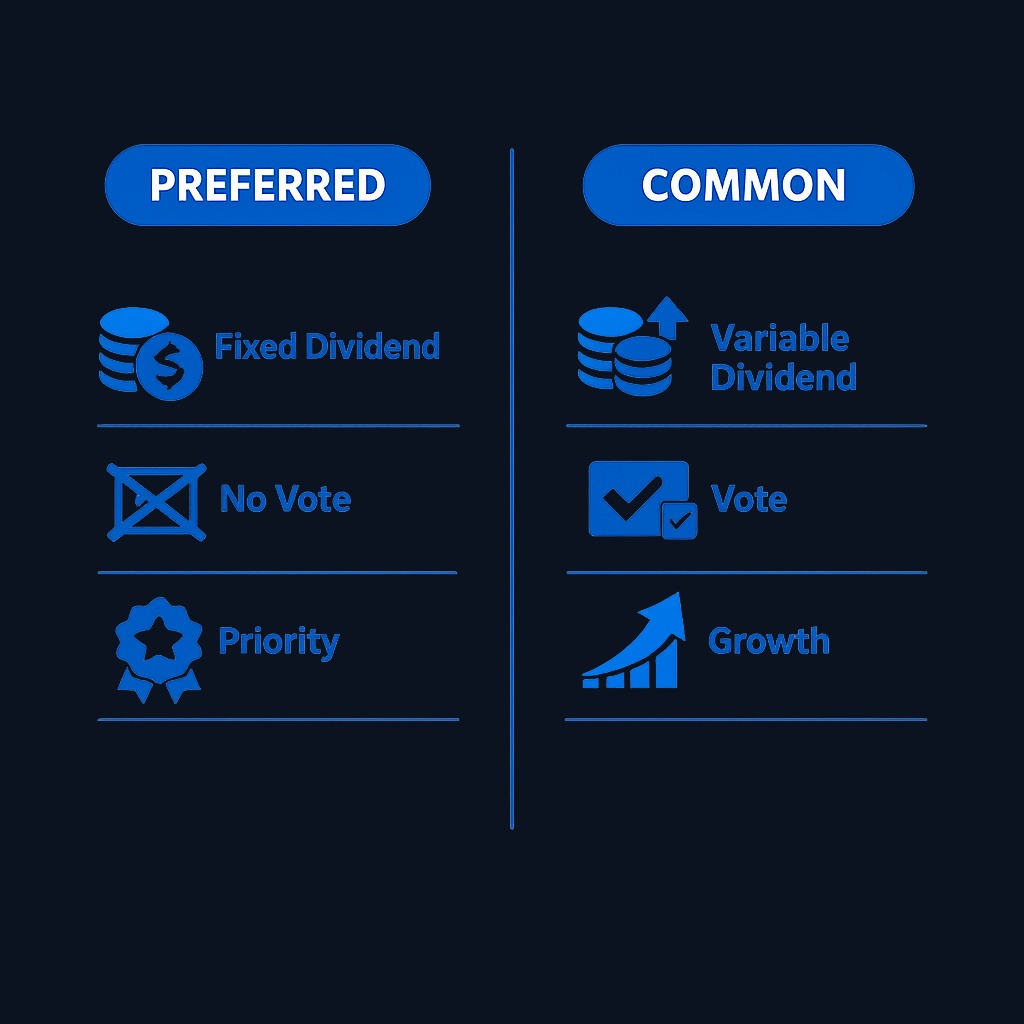
Preferred stock is an ownership share that behaves partly like a bond. Holders usually receive a fixed dividend, set as a percentage of the share's par value, paid before any dividend reaches common shareholders. That priority is where the "preferred" name comes from.
Most preferred shares carry no voting rights, so preferred shareholders rarely influence board elections or corporate policy. In exchange, they get seniority: if a company liquidates, preferred holders are paid after creditors and bondholders but before common shareholders.
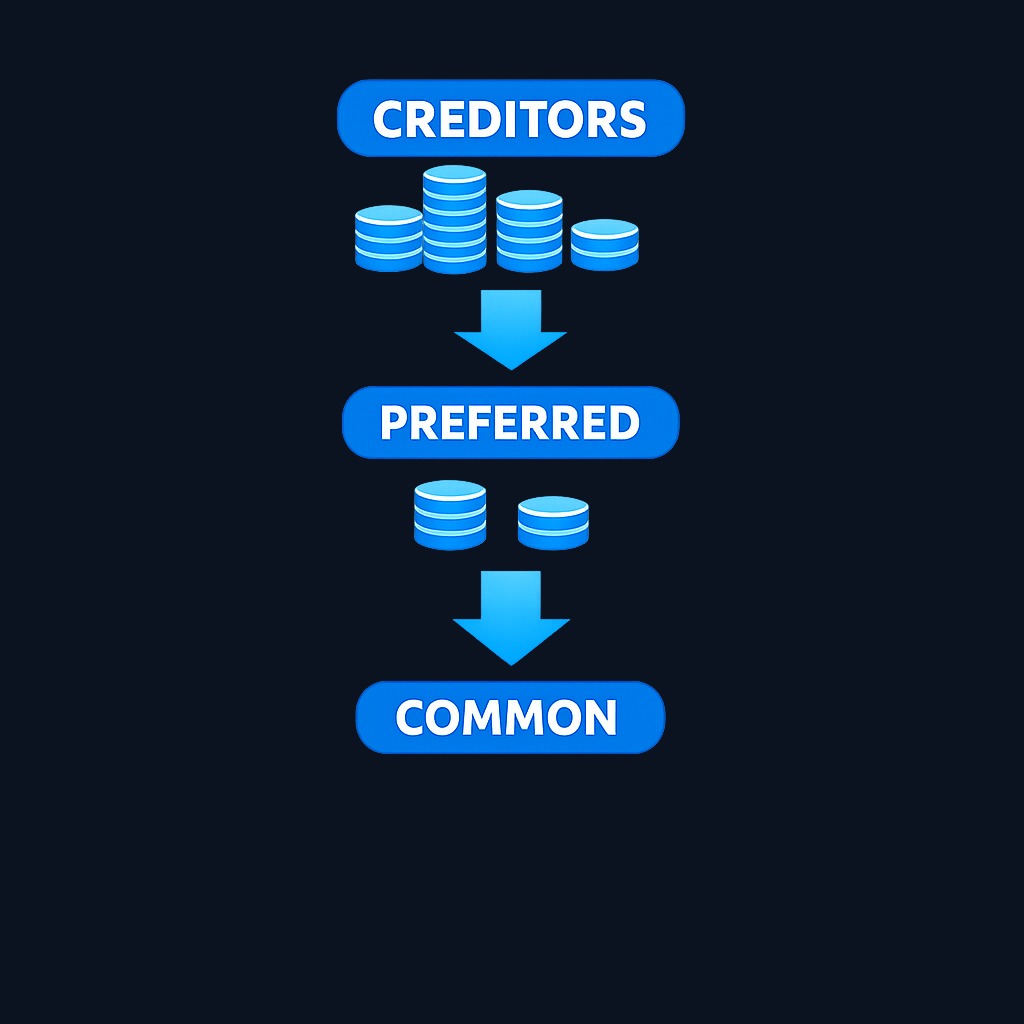
Preferred stock also comes in flavors worth knowing:
- Cumulative preferred accrues any skipped dividends, which the company must pay in full before common shareholders receive anything.
- Convertible preferred can be exchanged for a set number of common shares, adding growth potential.
- Callable preferred can be repurchased by the company at a set price after a set date, which caps long-run upside.
Because the dividend is fixed, preferred share prices tend to be sensitive to interest rates, much like bonds: when prevailing rates rise, existing fixed payouts look less attractive and prices often drift down.

What is common stock?
Common stock is the security most people mean when they say they own shares. Each share is a slice of ownership that typically carries one vote for the board of directors and major corporate decisions, plus a claim on profits that comes through price appreciation and any dividends the board chooses to declare.
Nothing about the common dividend is promised. A company may pay one, raise it, cut it, or skip it entirely as its earnings and plans change. The reward for that uncertainty is unlimited participation in growth: if the business compounds in value for a decade, common shareholders capture that rise in the share price.
The risk mirrors the reward. Common shareholders sit at the very back of the payout line in a bankruptcy, behind lenders, bondholders, and preferred holders, and often recover little or nothing when a company fails. Day to day, common shares also swing more with the market's mood, earnings news, and the company's performance.
Key differences between preferred and common stock
| Feature | Common stock | Preferred stock |
|---|---|---|
| Voting rights | Usually yes | Usually no |
| Dividends | Variable, not guaranteed | Fixed rate, paid first |
| Growth potential | Unlimited with the business | Limited; price acts bond-like |
| Claim in liquidation | Last | Ahead of common, behind debt |
| Price volatility | Higher | Generally lower |
| Interest-rate sensitivity | Indirect | Direct and significant |
Two differences deserve emphasis. First, income: preferred shareholders can usually predict their cash flow, while common shareholders cannot. Second, control: common shareholders collectively steer the company through votes, while preferred shareholders are mostly passengers. Neither structure is better in the abstract; they serve different jobs in a portfolio.
Pros and cons of preferred stock
Advantages:
- Predictable, fixed dividend income paid before common dividends.
- Higher claim on assets if the company is liquidated.
- Typically lower price volatility than common shares.
- Cumulative versions protect missed payments; convertible versions add upside.
Disadvantages:
- Little or no voting power over company decisions.
- Limited price appreciation even when the business thrives.
- Sensitive to rising interest rates, which can push prices down.
- Callable terms let the issuer buy shares back just when they become valuable.
- Dividends, while prioritized, are still not an ironclad legal guarantee like bond interest.
Preferred stock tends to appeal to income-focused investors who want more yield than many bonds offer and can accept equity-style risk to get it.
Practice investing with Finelo
Build practical investing skills with guided lessons, simulator practice, and structured challenges.
Pros and cons of common stock
Advantages:
- Unlimited long-term growth potential as the company's value compounds.
- Voting rights and a voice in corporate governance.
- Usually far more liquid, with tighter spreads and easier trading.
- Dividends can grow over time as profits rise.
Disadvantages:
- Dividends are optional and disappear first in hard times.
- Highest volatility of the two, with drawdowns that test patience.
- Last claim on assets in bankruptcy, so losses can reach 100%.
- Returns depend heavily on market sentiment, not just business results.
For most long-horizon investors building wealth, common stock is the default engine of returns, with risk managed through diversification and time rather than security structure.
Real-life applications and examples
Consider how the same investment plays out in three scenarios:
- Strong growth. A company's value triples over eight years. Common shareholders roughly triple their money as the share price follows the business. Preferred holders collected their fixed dividends the whole time but see only modest price gains, since their payout never grew.
- Dividend stress. A recession squeezes cash flow and the board suspends dividends. Common shareholders may get nothing for years. Holders of cumulative preferred shares accrue the missed payments and must be made whole before common dividends restart.
- Failure. The company liquidates. Creditors and bondholders are paid first from whatever remains, preferred shareholders next, and common shareholders last, often receiving nothing.
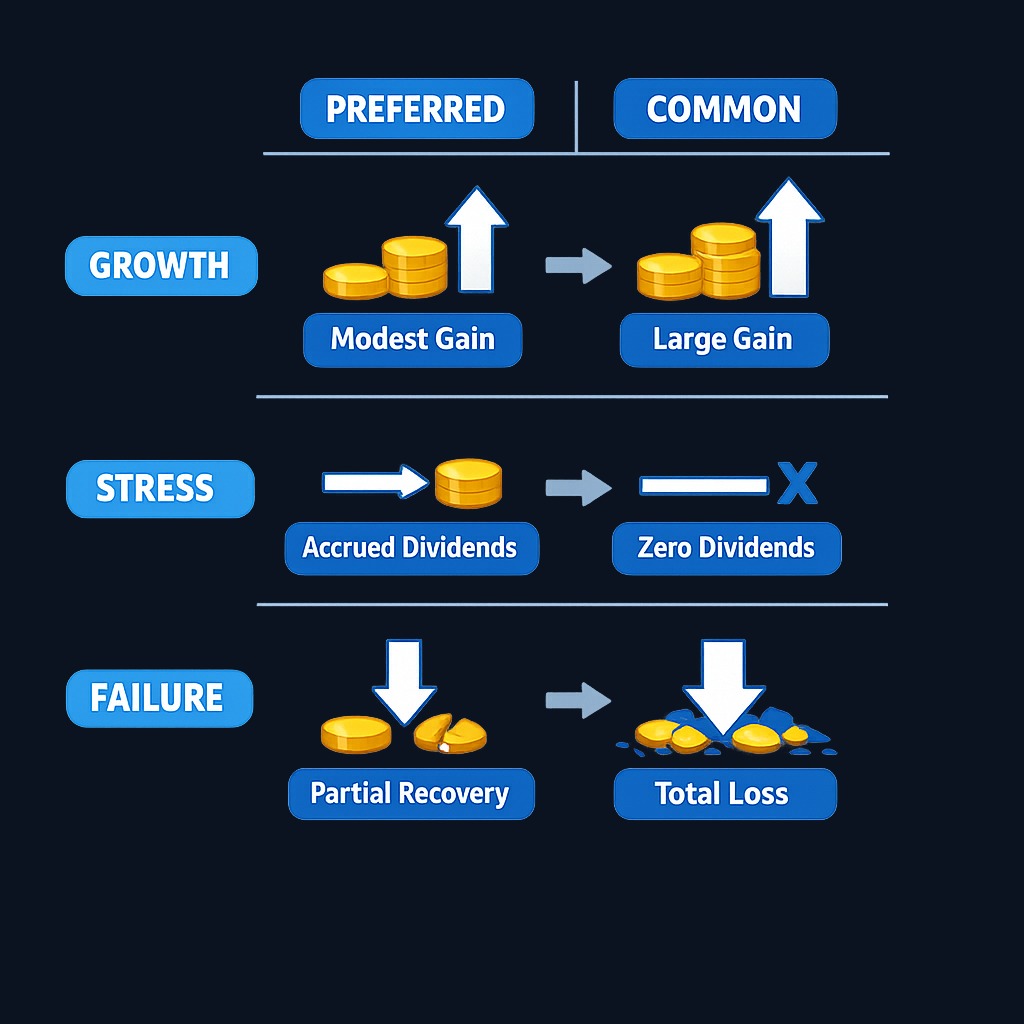
In practice, banks, utilities, and real estate firms are among the most frequent preferred issuers, and many investors reach preferred shares through dedicated funds and ETFs rather than picking individual issues. Institutional investors also negotiate preferred terms in venture deals precisely because of the liquidation priority shown above.
Tradeoffs and caveats
Every advantage above has a matching cost, and a few caveats apply to both securities:
- Income vs growth is a real tradeoff. The fixed preferred dividend that feels safe in a downturn becomes an opportunity cost in a boom, when common shares run ahead.
- Seniority is relative. Preferred stock outranks common stock but still sits behind every bond and loan; in severe failures, both share classes can be wiped out.
- Liquidity differs by issue. Some preferred series trade thinly, which widens spreads and complicates exits; most large-company common shares trade heavily every day.
- Terms hide in the fine print. Call dates, conversion ratios, and cumulative status change an issue's risk profile more than its headline yield suggests, so read the prospectus.
- Rates and taxes shift the math. Interest-rate moves reprice preferred shares, and dividend taxation varies by account type and jurisdiction; check both against your situation.
Decision framework: which stock should you choose?
Work through these questions in order:
- What is the money for? Long-term growth points to common stock; steady income points to preferred.
- What is your time horizon? Decades favor common shares, which need time to ride out volatility. Shorter income-focused horizons fit preferred payouts.
- How much volatility can you hold through? If a 30% drawdown would make you sell, the calmer preferred profile may protect you from your own reactions.
- Do you care about voting? Governance participation requires common shares.
- What is your rate outlook and tax picture? Rising rates pressure preferred prices, and dividend tax treatment differs by situation, so review both before committing. Verify any specific issue's terms, such as cumulative or callable features, in the company's official documents.
Before buying either, make sure your foundation is set: regulators encourage keeping a liquid emergency fund so a surprise expense never forces you to sell investments at a bad time. Many investors ultimately hold both types: common stock for growth, preferred stock for income, sized to their goals and risk tolerance.
Conclusion and next steps
Common stock buys growth potential, voting rights, and volatility; preferred stock buys payment priority, fixed income, and rate sensitivity. The right choice depends on whether the money's job is compounding or cash flow, and holding both is a legitimate strategy rather than a compromise.
Next steps: look up one company that issues both share classes, compare the two securities' yields and terms, and decide which job each would do in your portfolio. To build the underlying skills step by step, Finelo offers beginner-friendly investing education on shares, dividends, and risk.
Frequently asked questions
Is preferred stock safer than common stock?
It is senior, which is not the same as safe. Preferred holders get paid before common holders in dividends and liquidation, and prices swing less. But preferred shares still carry equity risk, issuer credit risk, and interest-rate risk, so losses remain possible.
Why would anyone buy stock with no voting rights?
Because most individual investors' votes rarely decide outcomes, while the preferred dividend arrives regardless of how meetings go. Investors who prioritize income often gladly trade a symbolic vote for payment priority and a fixed yield.
Can I convert preferred stock into common stock?
Only if the shares are explicitly convertible. Convertible preferred specifies a conversion ratio, letting holders switch into common shares and participate in growth. Standard preferred shares have no such option, so check the terms of the specific issue before buying.
Do preferred shareholders always receive their dividends?
No. A board can suspend preferred dividends under financial stress. Cumulative preferred protects holders by accruing unpaid amounts that must be paid before common dividends resume; non-cumulative shares lose skipped payments permanently.
preferredstockcommon
Practice investing with Finelo
Build practical investing skills with guided lessons, simulator practice, and structured challenges.
About the author
Finelo Team
The Finelo Team creates practical investing and trading education designed to help beginners learn faster with structured challenges, simulator practice, and bite-sized lessons.
Keep reading — Related articles

Investing
Tax-gain harvesting vs. tax-loss harvesting
Compare realizing investment gains with realizing losses, including holding periods, wash sales, offsets, and portfolio tradeoffs.
Finelo Team

Investing
Stable value fund vs. money market fund
Compare investment structure, contract protections, transfer restrictions, net yields, and access inside a retirement account.
Finelo Team

Investing
Single-life vs. joint-life annuity
Compare income for one lifetime with continued payments to a survivor, using equal premiums and matching guarantee terms.
Finelo Team


