Monetary policy and fiscal policy both influence the economy, but different institutions control them. Monetary policy is a central bank’s use of financial and monetary tools. Fiscal policy is a government’s use of taxes and spending. The Federal Reserve uses these same definitions. Neither policy is always “better.” Monetary policy is designed to influence broad financial conditions. Fiscal policy can direct money or tax changes toward specific priorities.
Monetary Policy vs Fiscal Policy: Understanding the Differences
Monetary policy and fiscal policy both influence the economy, but different institutions control them. Monetary policy is a central bank’s use of financial and monetary tools. Fiscal policy is a government’s use of…
7 min read
Practice trading with Finelo
Practice in a simulator, learn with bite-sized lessons, and build confidence before risking real money.
Want to learn more?
Practice in a simulator, learn with bite-sized lessons, and build confidence before risking real money.
Explore FineloExplore Finelo's 28-day challenges
Turn learning into a daily habit with guided challenge paths.
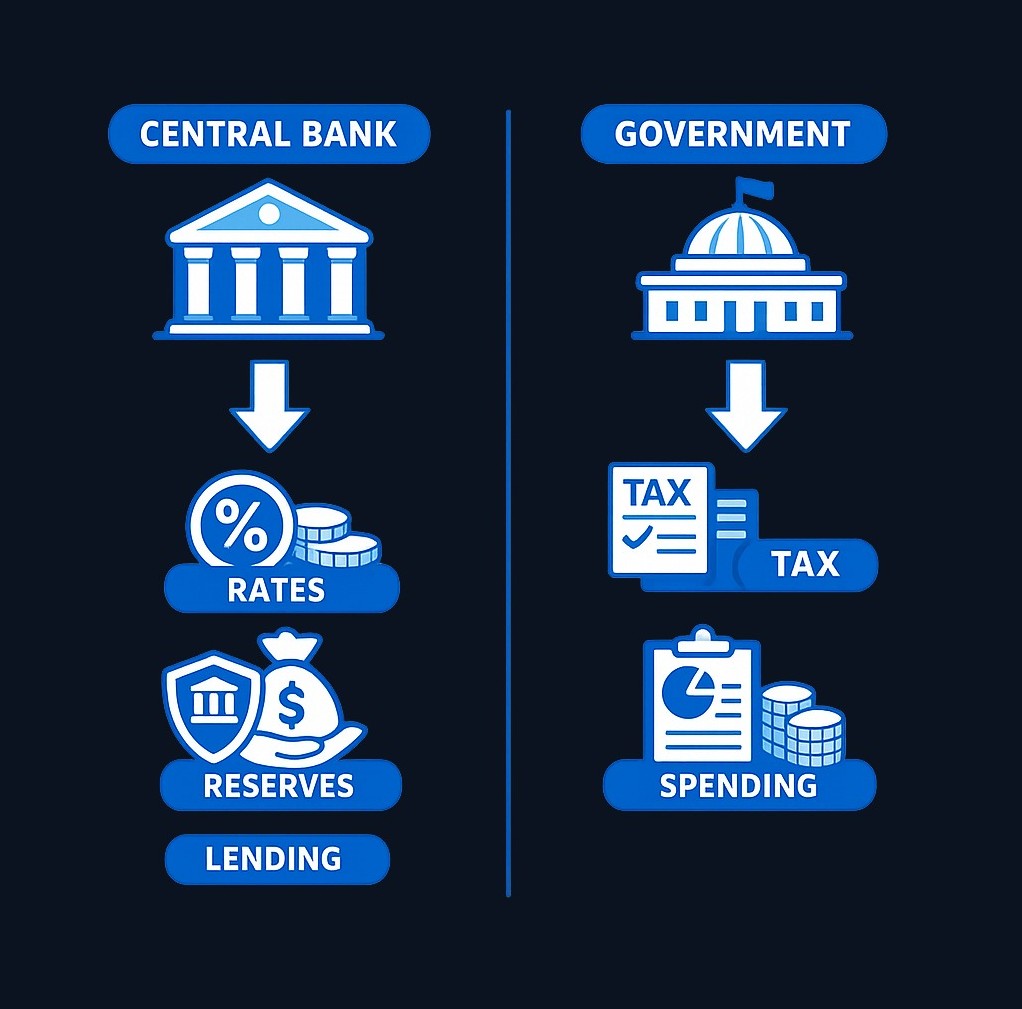
For students, investors, and anyone interpreting economic news, the practical question is not which policy wins. It is which authority is acting, which tool it is using, and how that action may move through borrowing, spending, employment, prices, and financial markets.
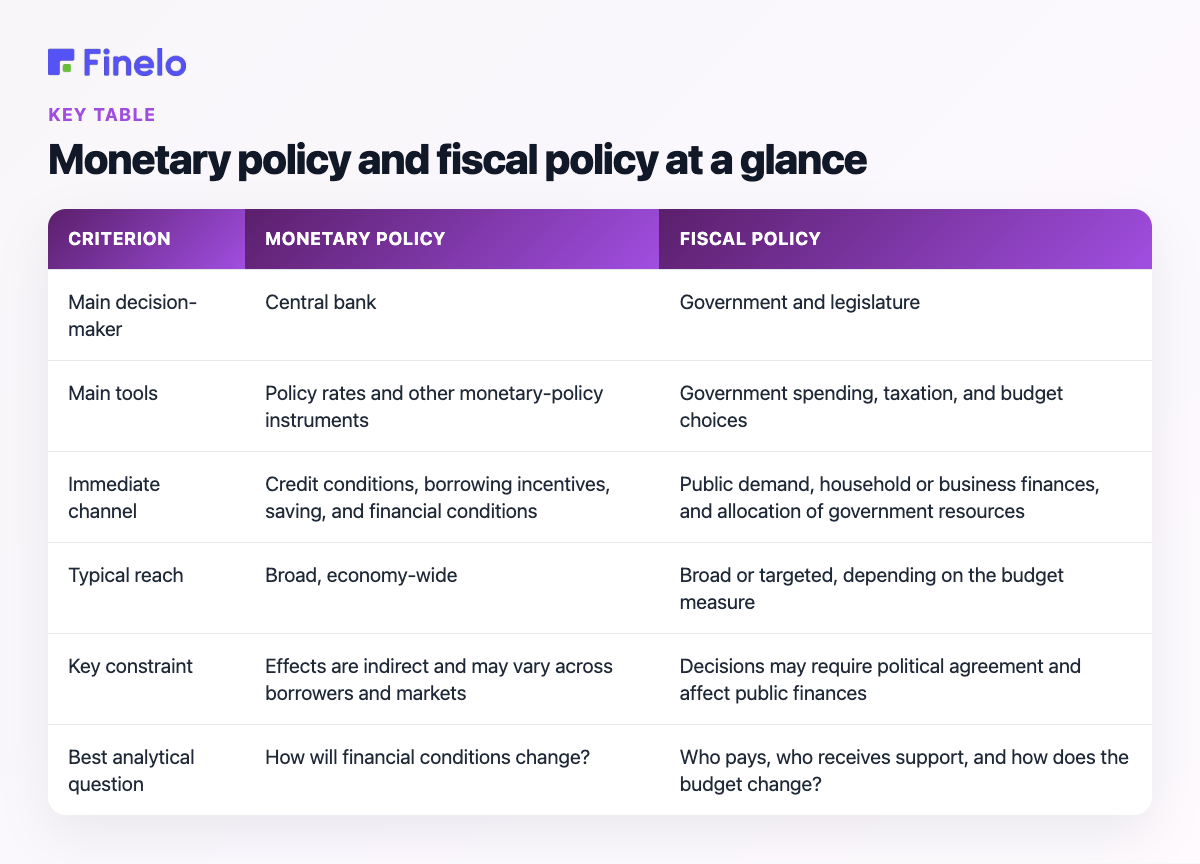
Monetary policy and fiscal policy at a glance
| Criterion | Monetary policy | Fiscal policy |
|---|---|---|
| Main decision-maker | Central bank | Government and legislature |
| Main tools | Policy rates and other monetary-policy instruments | Government spending, taxation, and budget choices |
| Immediate channel | Credit conditions, borrowing incentives, saving, and financial conditions | Public demand, household or business finances, and allocation of government resources |
| Typical reach | Broad, economy-wide | Broad or targeted, depending on the budget measure |
| Key constraint | Effects are indirect and may vary across borrowers and markets | Decisions may require political agreement and affect public finances |
| Best analytical question | How will financial conditions change? | Who pays, who receives support, and how does the budget change? |
The dividing line is institutional. The Federal Reserve says it uses a variety of tools to implement monetary policy. By contrast, HM Treasury controls public spending and helps set the direction of UK economic policy. This illustrates the government side of economic management.
What is monetary policy?
Monetary policy is the central bank’s approach to financial conditions. It can make borrowing relatively easier or harder. It can also change incentives to save, spend, or invest.
The Federal Reserve’s documented tools include open market operations, interest on reserves, lending operations, and reserve requirements. These tools do not send money directly to every household. Instead, they work through banks, credit, interest rates, and financial markets.
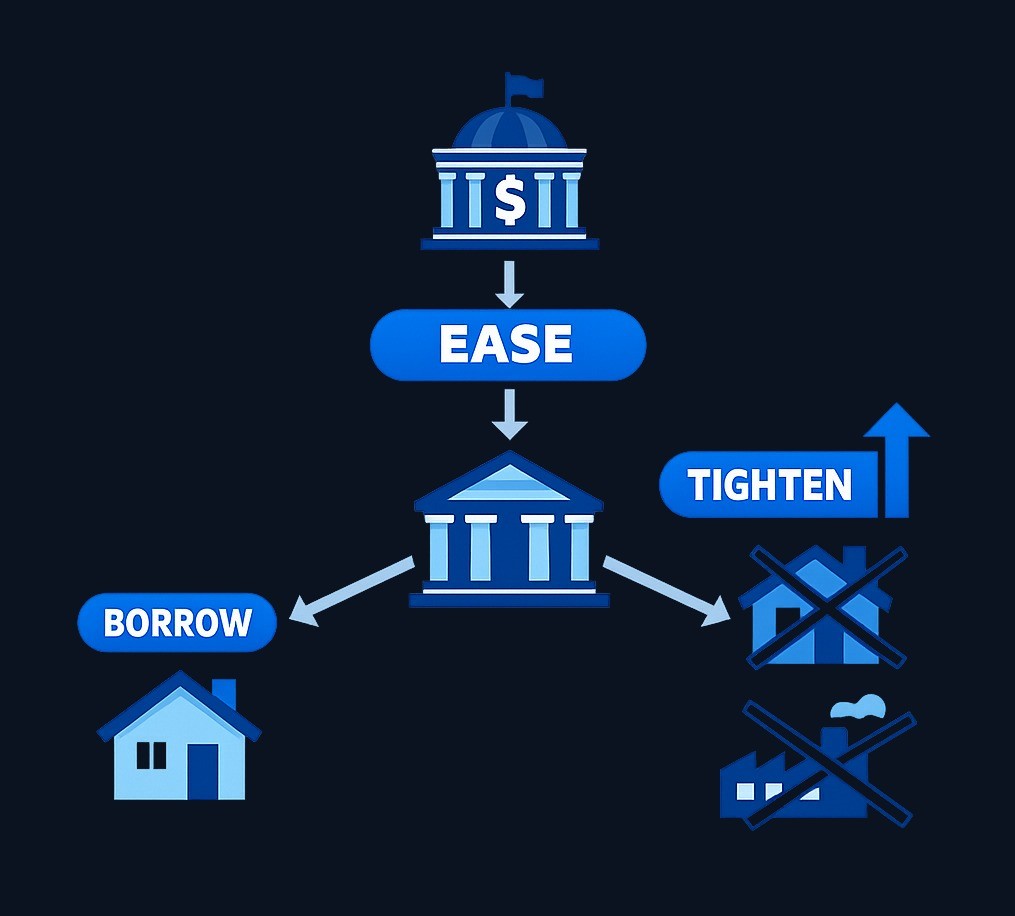
When policy becomes more supportive, credit conditions may loosen. Interest-sensitive spending may then become more attractive. When policy becomes more restrictive, financing may become less attractive and demand may cool. The process is not a simple switch. Households, companies, banks, and markets can respond at different speeds.
Strengths and limitations
Monetary policy has broad reach because financing conditions touch many parts of an economy. It can also change without rewriting a government budget. That makes it useful when policymakers want to influence overall demand rather than fund one program.
Its weakness is that the transmission is indirect. A change in financial conditions does not guarantee that every household will borrow, every company will invest, or every bank will lend. It can also affect groups differently: borrowers and savers do not experience the same change in the same way.
What is fiscal policy?
Fiscal policy is the government’s use of taxes and spending. Spending decisions determine where public money goes. Tax decisions affect how revenue is collected and how much income households or businesses retain.
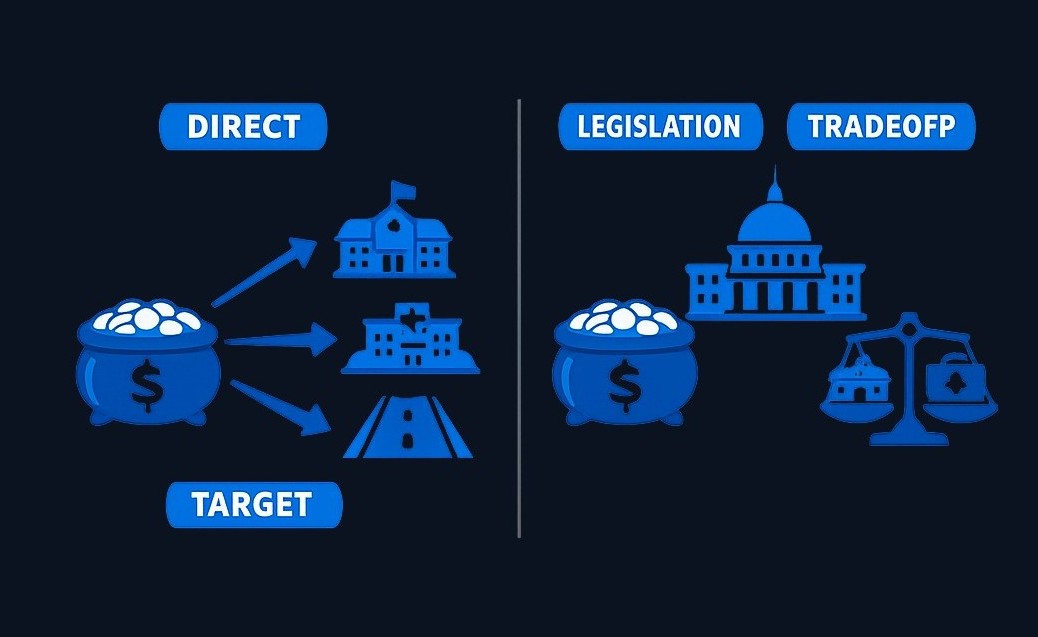
Fiscal measures can be broad, such as a general tax change. They can also target a program, service, project, or defined group. This ability to target resources is one of fiscal policy’s clearest differences from monetary policy.
Strengths and limitations
Fiscal policy can address a particular need directly. A government can purchase goods, fund services, or change a group’s tax burden. It can therefore influence both total demand and the distribution of resources. HM Treasury states that fiscal policy can add or withdraw demand through taxation and public expenditure.
The tradeoff is implementation. Budget measures may require legislation, administrative capacity, and political agreement. Choices also create opportunity costs: money allocated to one priority is unavailable for another unless revenue, borrowing, or other spending changes.
How the two policies affect the economy
Both policies can be described as expansionary or contractionary.
-
An expansionary stance aims to support economic activity. Monetary authorities may ease financial conditions, while governments may increase spending or reduce taxes.
-
A contractionary stance aims to restrain demand. Monetary authorities may tighten financial conditions, while governments may reduce spending growth or increase taxes.
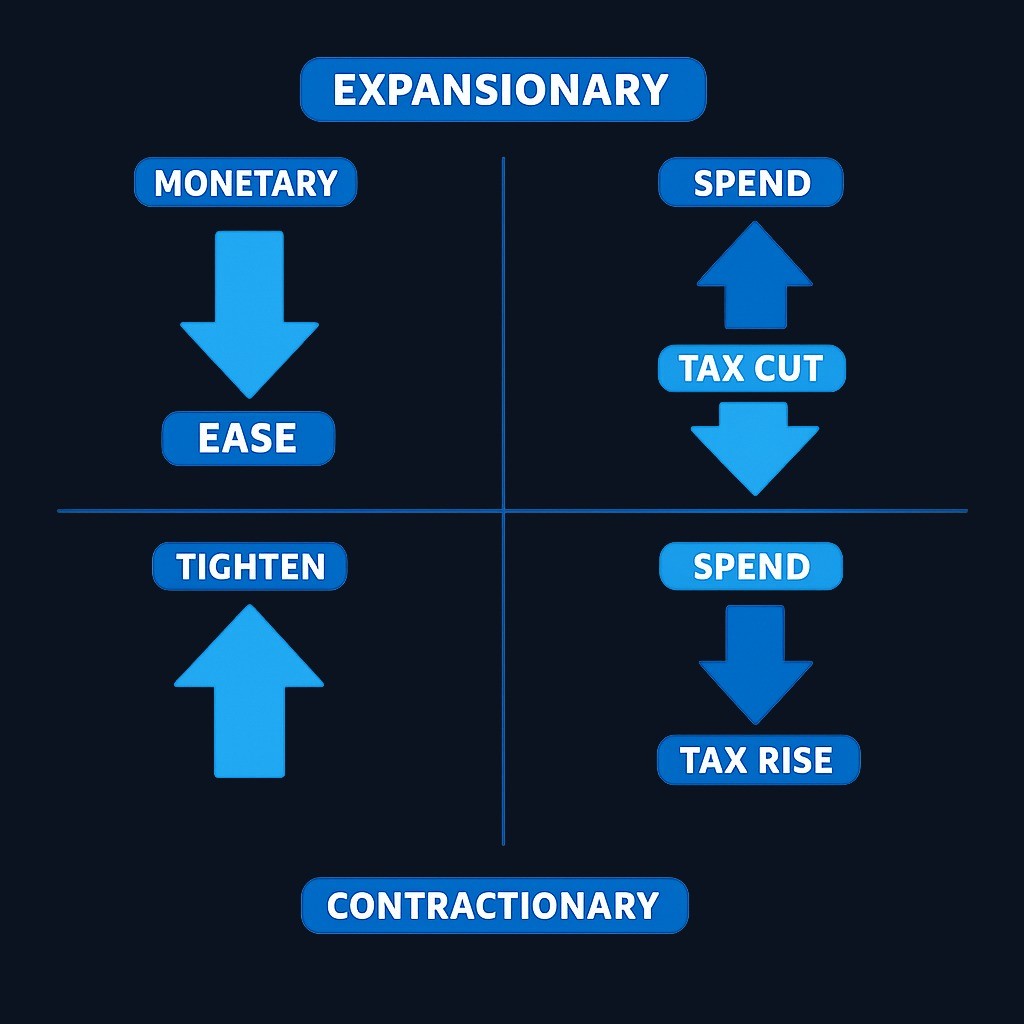
These actions reach everyday life through different routes. Monetary policy may show up in borrowing costs and savings incentives. It can also affect financial conditions more widely. Fiscal policy may appear in tax bills, public services, benefits, government contracts, and infrastructure spending.
For investors, the distinction matters because “policy is tightening” can describe two different mechanisms. A central-bank action changes the financial environment. A fiscal action changes government revenue or expenditure. Market effects also depend on expectations and wider economic conditions. A policy label alone is not an investment signal.
Practice trading with Finelo
Practice in a simulator, learn with bite-sized lessons, and build confidence before risking real money.
Can monetary and fiscal policy work together?
Yes. Different institutions control the policies, but their effects meet in the same economy. The Federal Reserve explains that fiscal policy affects its economic outlook through growth, employment, and inflation.
Imagine a sharp downturn. A central bank might make financial conditions more supportive. At the same time, a government might use spending or tax measures to support demand. Both policies would point toward expansion, but they would use different channels. In another situation, fiscal policy might support demand while monetary policy restrains it.
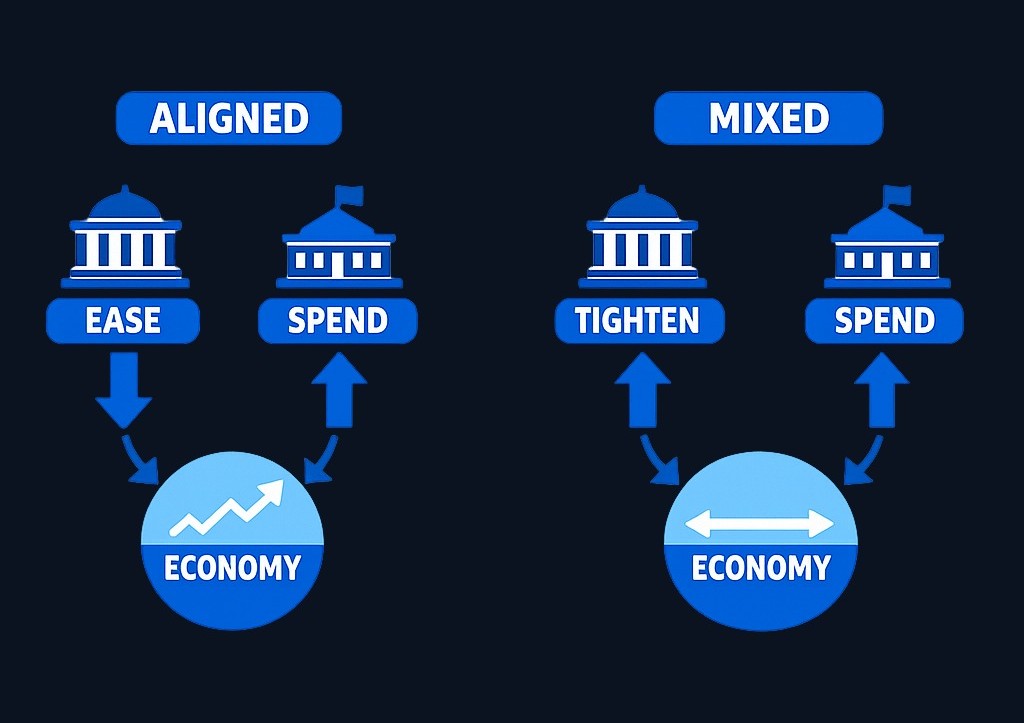
Coordination does not mean the institutions have identical responsibilities. A useful way to interpret the policy mix is to ask:
- Is each policy expansionary, neutral, or contractionary?
- Are both policies pushing in the same direction?
- Is the intervention broad or targeted?
- Which households, businesses, or sectors encounter the effect first?
- What practical or institutional limits could weaken the response?
This framework is more informative than assuming that one policy automatically cancels out the other.
Decision table: which policy fits which problem?
| If the goal is to understand… | Focus first on… | Why |
|---|---|---|
| Economy-wide borrowing and financial conditions | Monetary policy | Central-bank tools operate through the monetary and financial system |
| A tax change or public program | Fiscal policy | The effect comes directly from a budget decision |
| A response to a broad downturn | Both | Financial conditions and government demand may reinforce or oppose each other |
| Distributional effects | Fiscal policy, then monetary policy | Taxes and spending can be explicitly targeted, while monetary effects may still differ across groups |
| Possible market implications | The combined policy mix | Markets respond to policy, expectations, economic conditions, and risk—not a label in isolation |
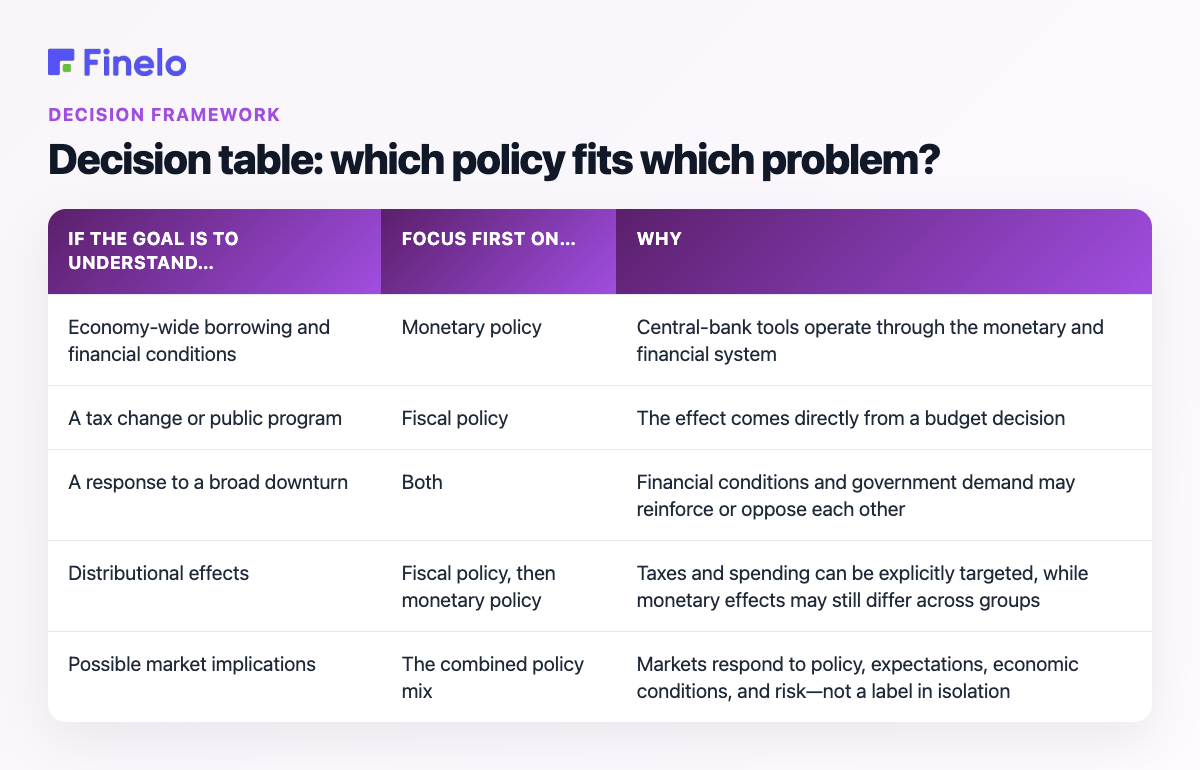
There is no universal winner in “monetary policy vs fiscal policy.” The better instrument depends on the objective. Monetary policy is better suited to influencing broad financial conditions. Fiscal policy is better suited to changing government spending, taxation, or the allocation of public resources. Large economic challenges may call for both, even when each institution acts independently.
Official examples of each policy in practice
The United States provides a clear monetary-policy example. Congress gave the Federal Reserve monetary-policy responsibilities and authorized tools that include open market operations, interest on reserves, lending, and reserve requirements. This shows how a central bank acts through the financial system rather than through the government budget.
The United Kingdom provides a fiscal-policy example. HM Treasury is responsible for public spending and economic-policy direction. In its 2025 Budget, the government described fiscal stance in terms of taxation, public expenditure, demand, growth, and inflation. This shows how a government can use its budget to add demand or withdraw it.
These examples are useful because they separate the institution from the objective. “Support the economy” is an objective. A central-bank operation and a government spending measure are different ways to pursue it. Their effectiveness depends on the problem, timing, design, and economic setting.
The bottom line
The simplest distinction is this: monetary policy changes the financial setting in which economic decisions are made, while fiscal policy changes the government’s own spending and revenue choices. To understand their economic impact, examine the policy mix, not either tool in isolation.
Finelo approaches this comparison as financial education, helping readers organize economic concepts before applying them to market analysis. The next step is to use the framework above whenever a new policy decision appears: name the institution, classify the tool, trace the transmission channel, and avoid treating an economic announcement as personalized financial advice.
Frequently asked questions
Is changing interest rates monetary or fiscal policy?
Changing a central bank’s policy rate is monetary policy. A government changing taxes or spending is fiscal policy.
Who controls monetary and fiscal policy?
Central banks control monetary policy within their legal mandates. Governments and legislatures control fiscal policy through taxation, spending, and budget decisions. The precise institutional process varies by country.
Which policy acts faster?
There is no dependable answer for every situation. A decision may be announced quickly but take time to change behavior. Monetary policy must pass through finance and spending decisions. Fiscal policy may face legislative and administrative steps, but it can target a measure directly once implemented.
What should readers watch after a policy announcement?
Identify the authority, tool, direction, intended audience, and likely transmission channel. Then separate the announcement from its eventual effects. For investing decisions, consider policy as one input among many and assess risk and suitability rather than assuming a predictable market outcome.
Financial LiteracyBeginnerEconomicsPersonal Finance
Practice trading with Finelo
Practice in a simulator, learn with bite-sized lessons, and build confidence before risking real money.
About the author
Finelo Team
The Finelo Team creates practical investing and trading education designed to help beginners learn faster with structured challenges, simulator practice, and bite-sized lessons.
Keep reading — Related articles

Financial Literacy
UGMA vs UTMA Accounts: Taxes, Control, and Which Fits Your Child
U.S. scope: This article discusses United States institutions, product conventions, and dollar examples unless stated otherwise. Rules can vary by state and provider and may change. The UK…
Finelo Team
Financial Literacy
Teaching Kids About Money by Age: A Practical Plan from 5 to 18
U.S. scope: This article discusses United States institutions, product conventions, and dollar examples unless stated otherwise. Rules can vary by state and provider and may change. The UK…
Finelo Team
Financial Literacy
Renting vs Buying a Home: The Break‑Even Math for Young Families
Neither renting nor buying is universally better — it’s a math problem plus a life question. Buying trades large up‑front and exit costs plus ongoing ownership expenses for equity,…
Finelo Team