For U.S. readers: This article discusses U.S. rules and financial products. State rules and individual eligibility may differ.
Mortgage Recast vs Refinance: Costs, Eligibility, and Tradeoffs
A mortgage recast keeps the existing loan but recalculates the required payment after a principal reduction, if the servicer and loan terms permit it.
6 min read
Practice trading with Finelo
Practice in a simulator, learn with bite-sized lessons, and build confidence before risking real money.
Want to learn more?
Practice in a simulator, learn with bite-sized lessons, and build confidence before risking real money.
Explore FineloExplore Finelo's 28-day challenges
Turn learning into a daily habit with guided challenge paths.
Quick answer
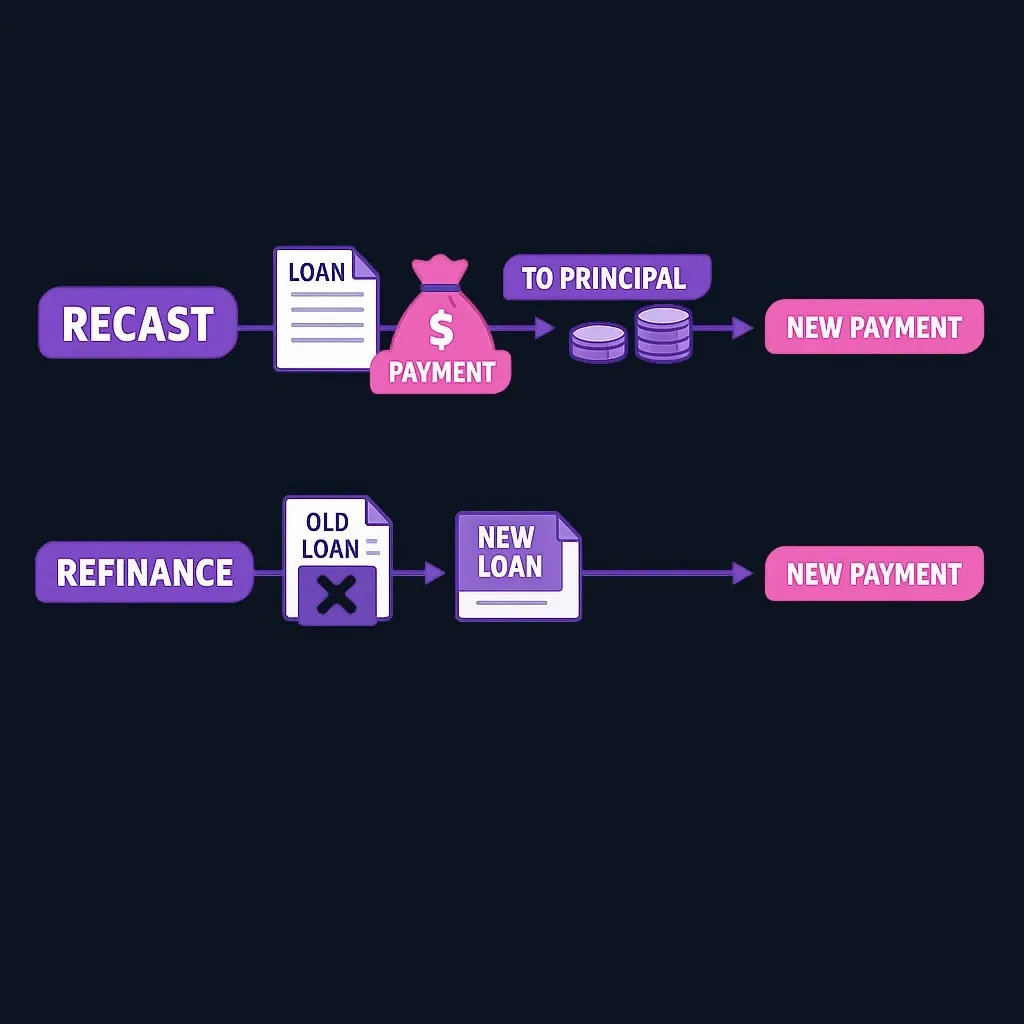
A mortgage recast keeps the existing loan but recalculates the required payment after a principal reduction, if the servicer and loan terms permit it. A refinance pays off the existing mortgage with a new loan that can have a different rate, term, fees, or structure. A recast cannot deliver a new interest rate; a refinance introduces new underwriting and closing costs. Compare written, account-specific figures rather than relying on a general rule. Finelo provides financial education, not financial, legal, tax, or mortgage advice.
How a recast works
In a recast, a borrower makes or has already made a principal payment, then asks the servicer to re-amortize the remaining balance over the remaining scheduled term. If approved, the required principal-and-interest payment generally decreases while the note rate and maturity date remain unchanged.
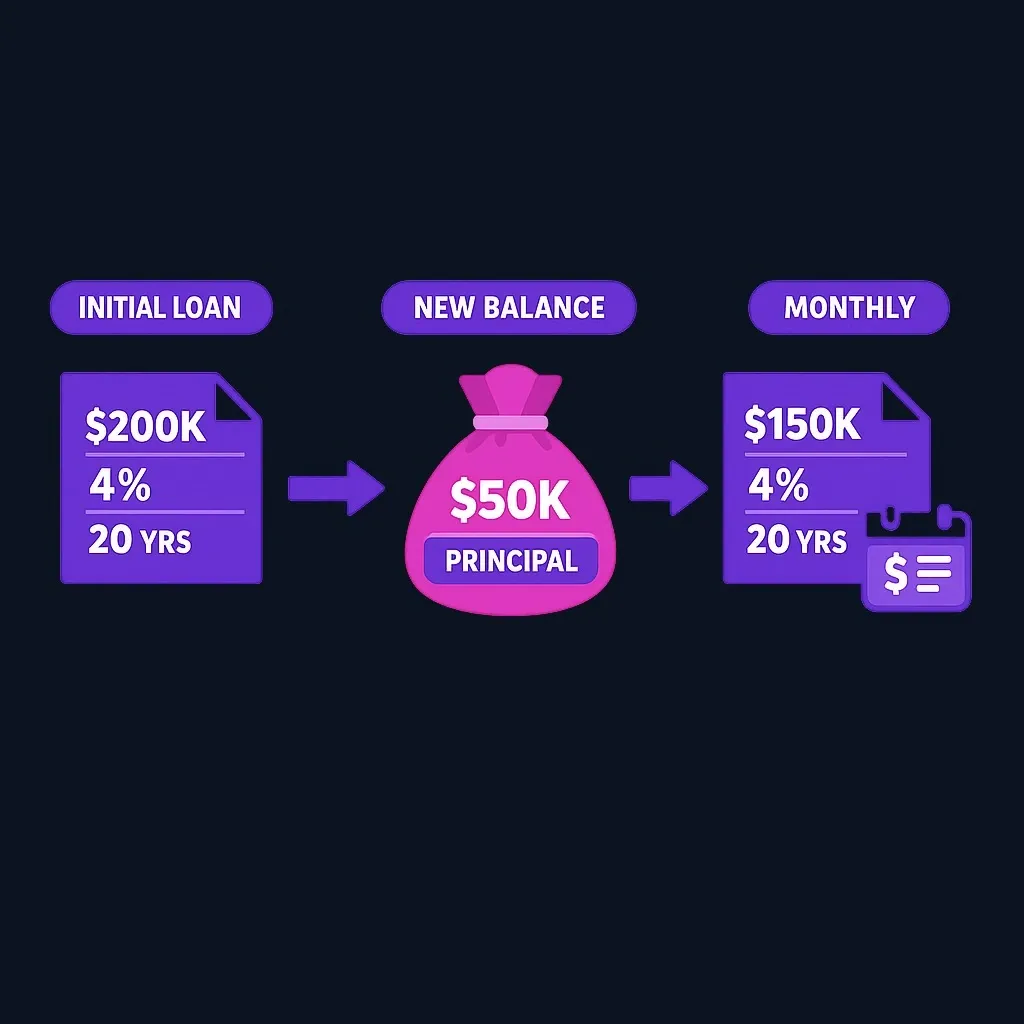
Recast policy is not uniform. The servicer may specify:
- eligible loan types;
- minimum principal reduction;
- processing fee;
- payment-status requirements;
- frequency limits or waiting periods;
- processing time; and
- effects on escrow or mortgage-insurance administration.
Obtain the policy and a payment illustration in writing before sending money specifically for a recast. An extra principal payment alone does not necessarily trigger re-amortization.
How a refinance works
A refinance is a new mortgage transaction. The proceeds pay off the existing loan, and the borrower begins making payments under the new note. A refinance can change the rate, term, fixed or adjustable structure, borrower list, or amount borrowed, subject to eligibility and law.
The new transaction may involve credit review, income and asset documentation, an appraisal or valuation, title work, recording charges, origination fees, points, prepaid items, and a new escrow setup. A lower advertised rate does not prove the refinance lowers total cost.
Side-by-side comparison
| Question | Recast | Refinance |
|---|---|---|
| Is the existing loan replaced? | No | Yes |
| Can the note rate change? | Generally no | Yes |
| Can the scheduled maturity change? | Generally no | Yes, depending on the new term |
| Is a principal payment required? | Commonly required under servicer policy | Not inherently, although cash may be due at closing |
| Is full underwriting required? | Often less extensive, but policy varies | Generally yes |
| Are closing costs involved? | Usually a servicing fee rather than full closing costs | Typically includes new-loan closing costs |
| Main information source | Existing servicer and loan documents | Formal Loan Estimate and Closing Disclosure |
Compare the cash flows
Use account-specific numbers for the same evaluation horizon.
Recast inputs
- lump-sum principal payment;
- servicer fee;
- new required payment;
- remaining term and existing rate;
- interest that would be paid under the new schedule; and
- liquidity left after the lump sum.
Refinance inputs
- new rate and term;
- lender credits or points;
- all closing costs and prepaid items;
- new monthly payment;
- mortgage insurance, if any;
- cash required or cash received at closing; and
- expected time before sale or another refinance.
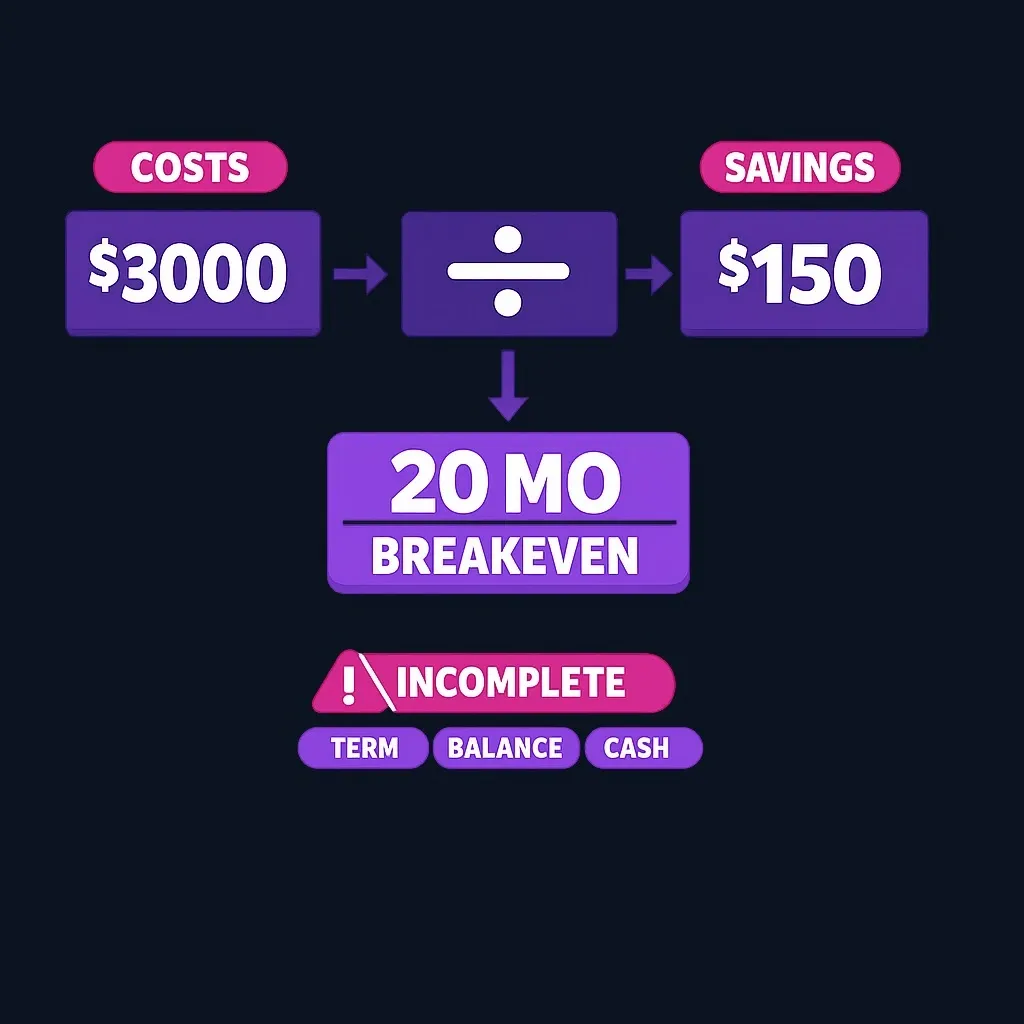
A simple refinance break-even estimate divides eligible upfront costs by monthly payment savings. That estimate is incomplete if the loan term changes, costs are financed, principal differs, or cash flow after the break-even date matters. A full comparison should examine the remaining balance and cumulative cash paid at the same future date.
The CFPB's official Loan Estimate explainer helps borrowers compare new-loan disclosures.
Practice trading with Finelo
Practice in a simulator, learn with bite-sized lessons, and build confidence before risking real money.
Decision questions
- Is the existing mortgage eligible for recast?
- What written payment illustration will the servicer provide?
- Would the principal payment leave adequate reserves?
- Does the refinance solve a problem a recast cannot, such as changing the rate or term?
- How long is the borrower likely to keep the loan?
- Are quotes based on the same loan amount, property use, lock period, and assumptions?
- How do the options affect mortgage insurance, escrow, taxes, and future flexibility?
These questions support a comparison; they do not determine a universally correct choice.
Hypothetical examples
Preserving an existing rate
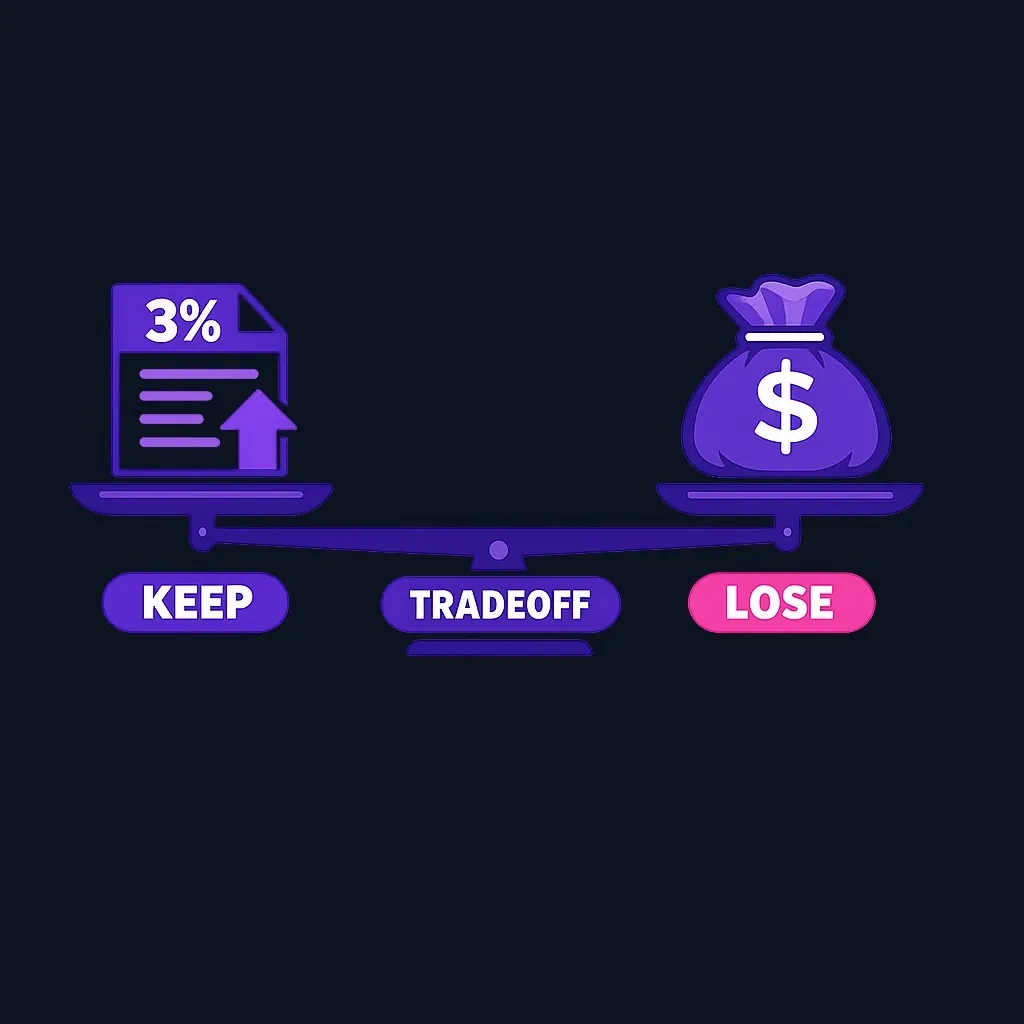
A borrower has an existing fixed rate below current offers and receives a lump sum. If the loan qualifies, a recast could lower the required payment without replacing the rate. The borrower should still compare the value of lower payments with the loss of liquid reserves.
Changing the loan structure
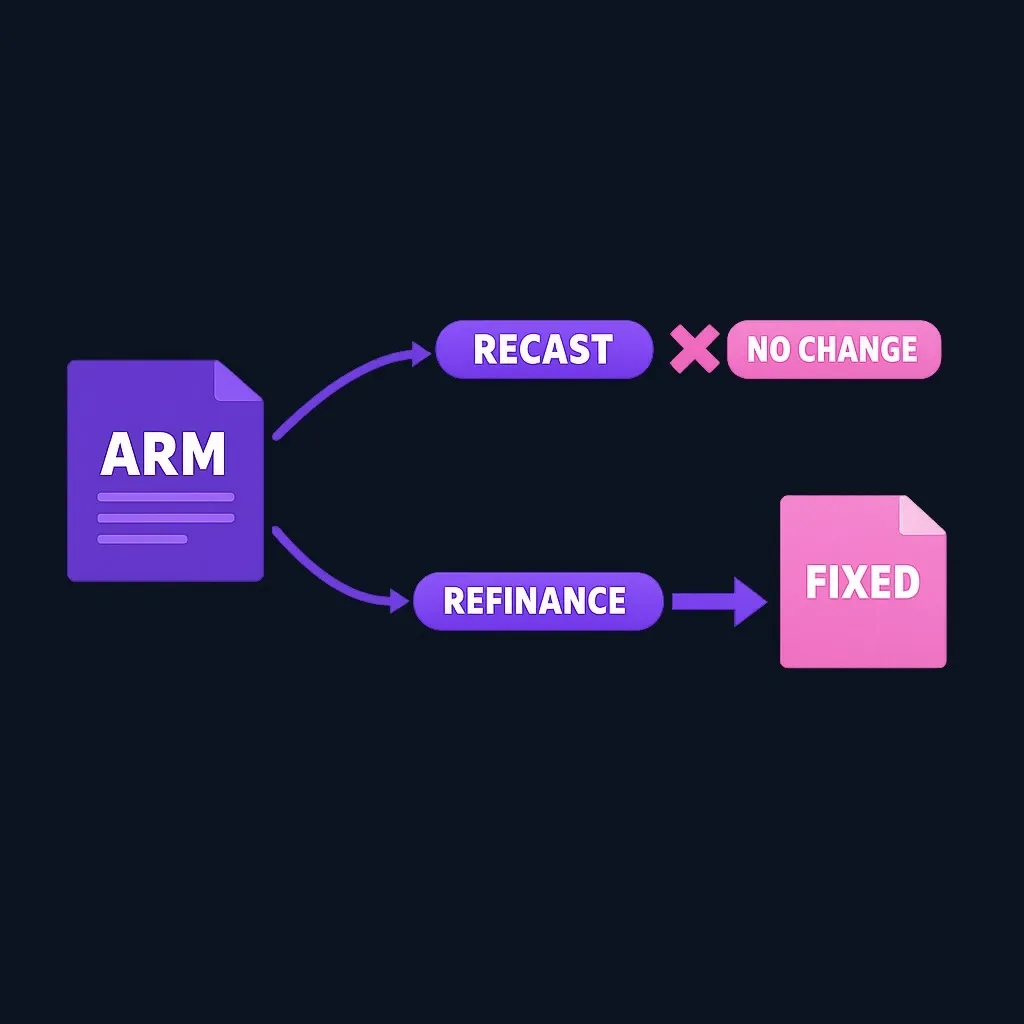
A borrower wants to replace an adjustable-rate loan with a fixed-rate loan. A recast cannot change the note's rate structure, so only a new loan or another contractual modification could address that objective. Whether a refinance is worthwhile depends on actual costs and underwriting.
These are hypothetical illustrations, not customer results or recommendations.
Common mistakes
- Sending a large principal payment before confirming that the loan can be recast.
- Treating a lower monthly payment as proof of lower lifetime cost.
- Comparing rates without points, lender credits, fees, and term length.
- Financing closing costs and then ignoring the larger new balance.
- Extending the term without comparing the balance at the same future date.
- Using all available cash and leaving no emergency reserve.
- Assuming a recast automatically removes mortgage insurance or changes escrow.
- Relying on an advertisement instead of a formal Loan Estimate.
FAQ
Does a recast reduce the interest rate?
Generally, no. It recalculates the payment using the existing rate and remaining term. Confirm the exact treatment with the servicer.
Does a recast save interest?
A principal reduction can reduce future interest because interest is calculated on a lower balance. The re-amortization itself mainly changes the required payment. Continuing to pay more than the new minimum would produce a different payoff path.
Is refinancing always expensive?
Costs vary, and a “no-closing-cost” refinance usually means costs are covered through a higher rate, lender credit, or larger balance rather than disappearing. Review the Loan Estimate.
Which option is better when rates have fallen?
A recast does not change the rate. A refinance may offer a lower rate, but the relevant question is whether the new loan's total cost and structure improve the borrower's position over the expected holding period.
Conclusion
A recast is an existing-loan servicing option; a refinance is a new mortgage. Get a written recast illustration, obtain comparable Loan Estimates, preserve liquidity, and compare costs and balances over the same horizon. The correct result depends on the actual loan documents and quotes.
For more educational home-finance material, visit the Finelo Blog.
Financial LiteracyFinancial Education
Practice trading with Finelo
Practice in a simulator, learn with bite-sized lessons, and build confidence before risking real money.
About the author
Finelo Team
The Finelo Team creates practical investing and trading education designed to help beginners learn faster with structured challenges, simulator practice, and bite-sized lessons.
Keep reading — Related articles

Financial Literacy
Mercury Books Review 2026: Is It Worth It for Startups?
Mercury Books brings double-entry accounting into Mercury. Review its $35 pricing, reports, AI features, integrations, and migration limits.
Finelo Team

Financial Literacy
Why is My FICO Score Lower Than My Credit Score?
Example takeaway: seeing a higher score in a bank app doesn’t guarantee lenders will see the same FICO number at application time; lenders often pull a specific FICO version from a specific bureau.
Finelo Team

Financial Literacy
Why Is My FICO Score Higher Than My Credit Score?
Brief educational note: this article is educational, not financial or investment advice; investing and credit decisions involve risk and possible loss.
Finelo Team


