Accounting note: Operating income depends on the issuer's presentation and excludes financing and taxes; it is not always identical to EBIT. Net income includes non-operating items, interest, and taxes under the applicable accounting framework. Dividends are cash distributions authorized under corporate law and board policy; they are not paid from a literal current-period “net income pool.”
Operating Income vs. Net Income: Key Differences That Matter
Operating income is the profit a company earns from its core business after operating expenses, while net income is what remains after every cost - interest, taxes, and one-time items included. Comparing operating income…
9 min read
Practice investing with Finelo
Build practical investing skills with guided lessons, simulator practice, and structured challenges.
Want to learn more?
Build practical investing skills with guided lessons, simulator practice, and structured challenges.
Explore FineloExplore Finelo's 28-day challenges
Turn learning into a daily habit with guided challenge paths.
Operating income is the profit a company earns from its core business after operating expenses, while net income is what remains after every cost - interest, taxes, and one-time items included. Comparing operating income vs net income tells you whether a company's profits come from running the business well or from accounting events around it. This page is for investors learning to read income statements, students of financial analysis, and business owners tracking their own performance. Work through the definitions, calculations, and decision rules below, then practice on real statements with Finelo, an investing-education app with interactive lessons.
Operating income vs net income at a glance
| Aspect | Operating income | Net income |
|---|---|---|
| What it measures | Profit from core business operations | Final profit after all expenses |
| Includes interest and taxes? | No | Yes |
| Includes one-time gains and losses? | No | Yes |
| Statement position | Middle of the income statement | Bottom line |
| Nickname | EBIT (roughly) | The bottom line |
| Best for judging | Operational efficiency | Total profitability for shareholders |
What is operating income?
Operating income is revenue minus the costs of actually running the business: cost of goods sold, wages, rent, marketing, research, and depreciation. It deliberately excludes financing costs and taxes, because those depend on decisions and circumstances outside daily operations.
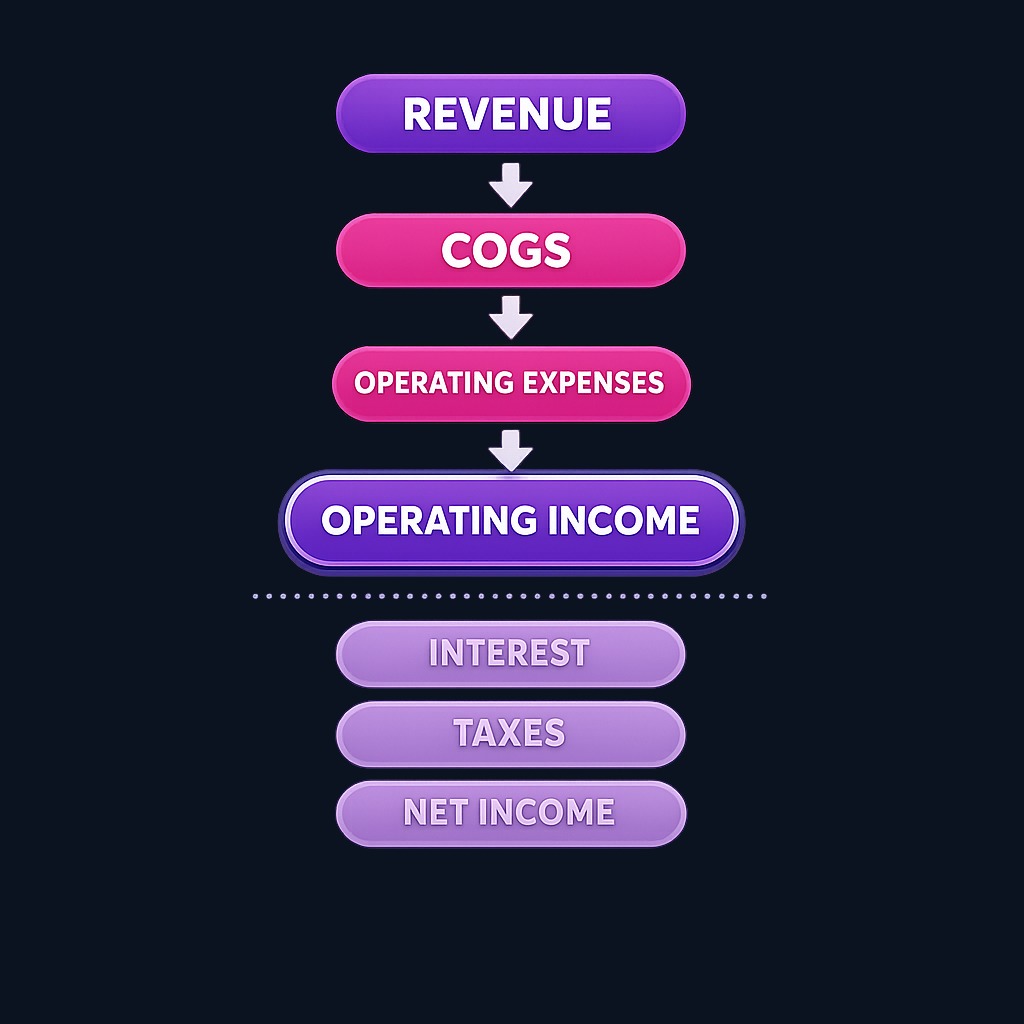
That isolation is its strength. A company's management controls pricing, sales, production costs, and overhead. Operating income measures how well those controllable levers perform, which is why analysts treat it as the cleanest reading of business quality. It is often called EBIT - earnings before interest and taxes - though technically EBIT can also include non-operating income, a small distinction that matters mostly to accountants.
Operating margin - operating income divided by revenue - lets you compare efficiency across companies of different sizes and against a company's own history.
What is net income?
Net income is the residual after recognized expenses, interest, taxes, and applicable non-operating items under the reporting framework. It is used in earnings per share and the P/E ratio. A dividend is a board-authorized cash distribution subject to corporate-law, solvency, retained-earnings, and financing constraints—not a draw from a literal current-period net-income pool.
Net income answers the shareholder's question: after everything, how much did this company earn for its owners? But its completeness is also its weakness. A profitable quarter might reflect a one-time land sale rather than strong operations, and a loss might come from a non-cash write-down rather than failing products.
Key differences between operating income and net income
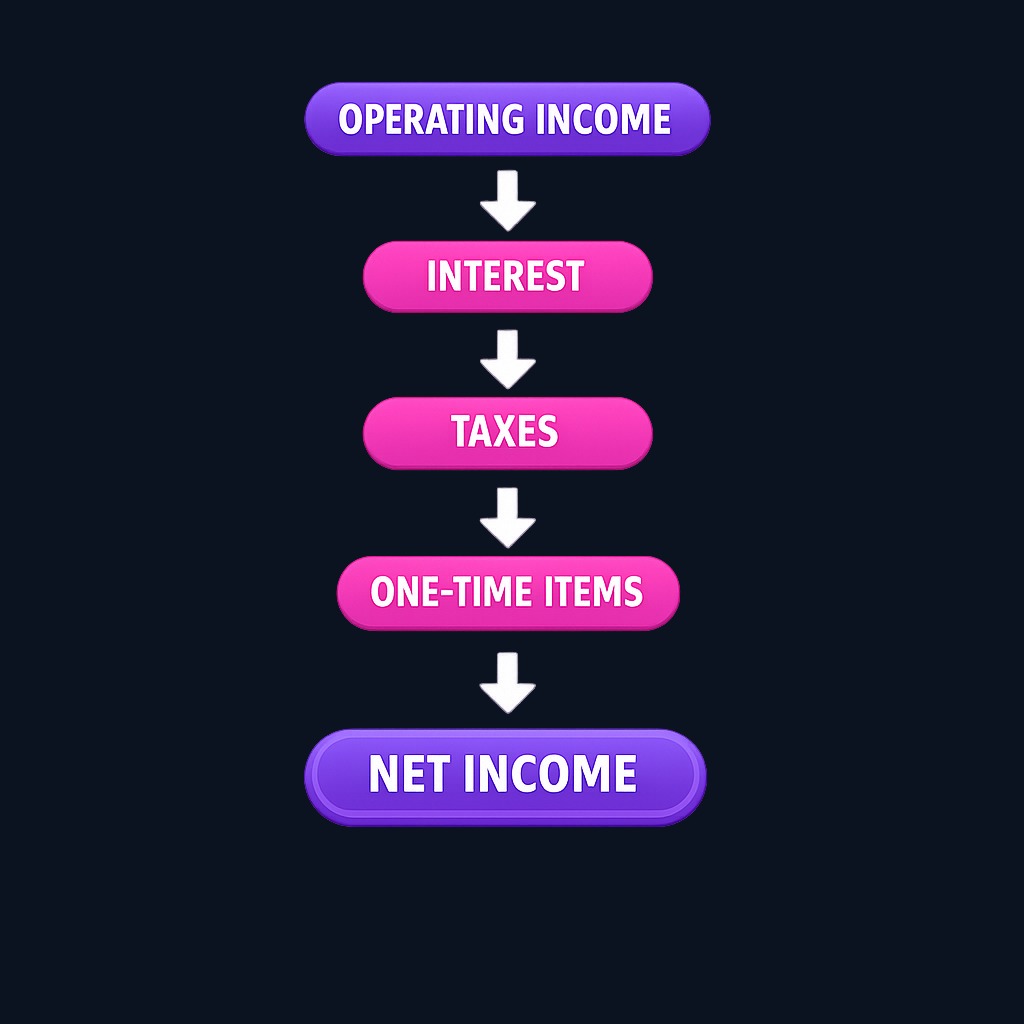
Three layers separate the two numbers.
Financing costs. Interest expense reflects how a company chose to fund itself, not how it operates. Two identical businesses with different debt loads will report identical operating income but very different net income.
Taxes. Tax bills vary with jurisdiction, credits, and timing - factors that say little about the business itself.
Non-operating and one-time items. Gains on investments, currency effects, impairments, and restructuring charges all land between operating income and the bottom line. These items are frequently large and rarely repeat.
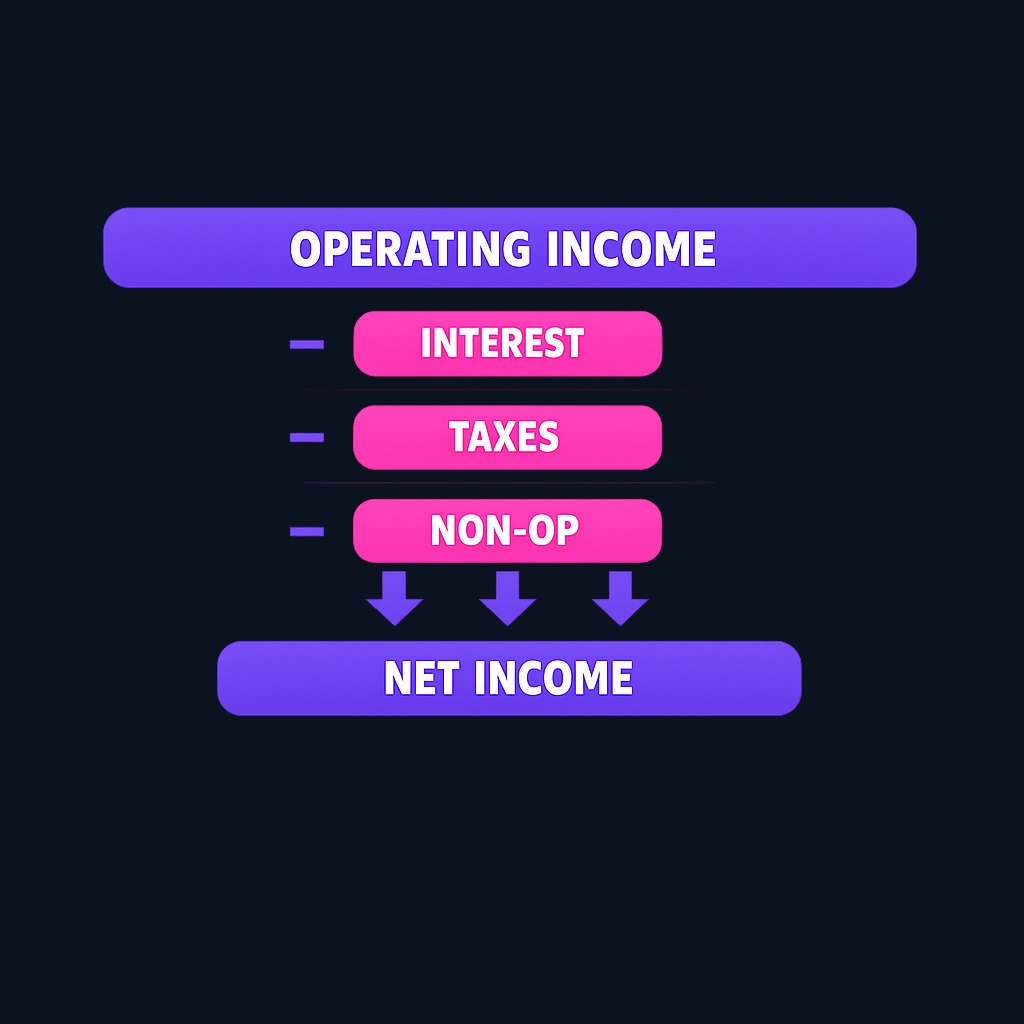
Because of these layers, the gap between the two figures is itself informative. A consistently wide gap deserves investigation: heavy debt service, unusual tax situations, or a habit of "one-time" charges that somehow recur every year.
How to calculate operating income and net income
Both formulas come straight off the income statement:
Operating income = Revenue − Cost of goods sold − Operating expenses
Net income = Operating income + Non-operating income − Interest − Taxes
A worked example. A retailer reports the following for the year:
- Revenue: $10,000,000
- Cost of goods sold: $6,000,000
- Operating expenses (salaries, rent, marketing, depreciation): $2,500,000
- Interest expense: $300,000
- One-time gain on a property sale: $200,000
- Taxes: $350,000
Operating income = 10,000,000 − 6,000,000 − 2,500,000 = $1,500,000 (a 15 percent operating margin).
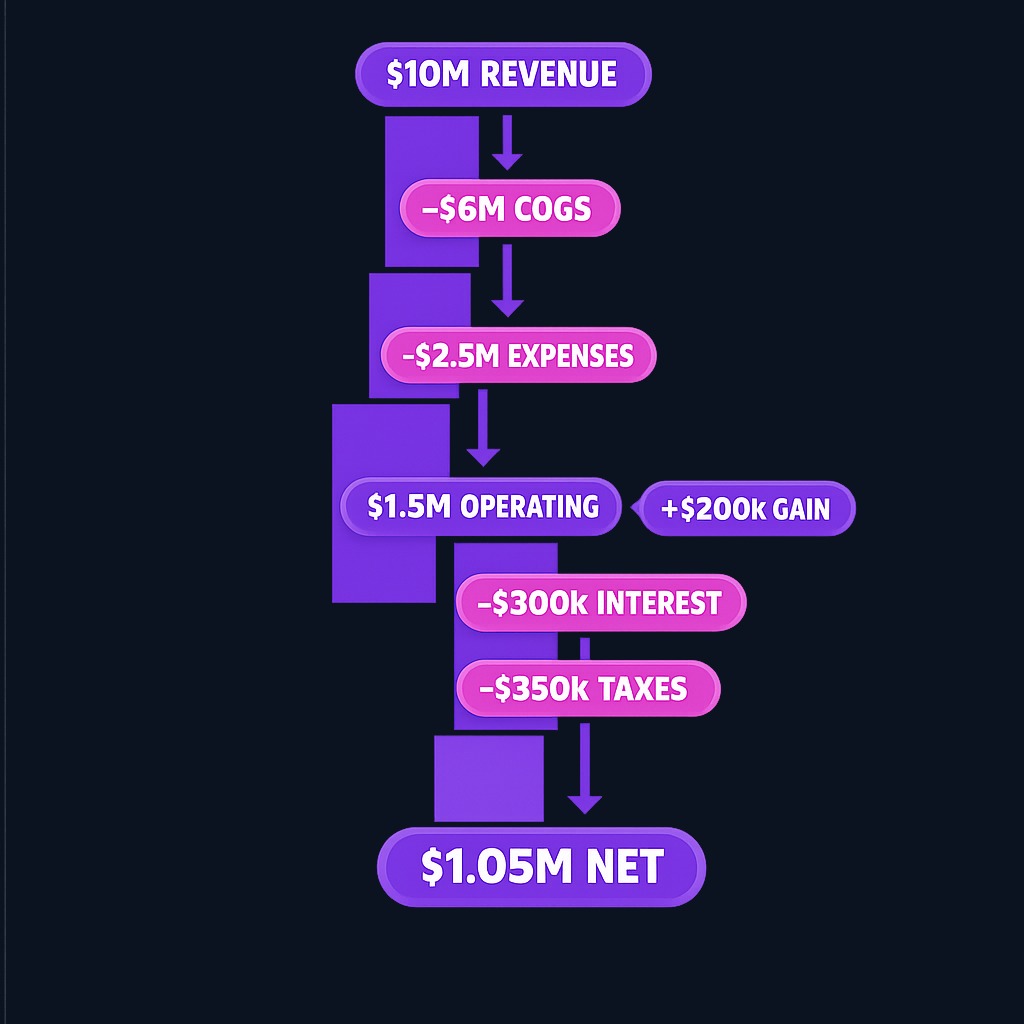
Net income = 1,500,000 + 200,000 − 300,000 − 350,000 = $1,050,000.
Notice how the property sale flatters the bottom line. An investor looking only at net income would credit the business with profit that its stores did not earn. For US-listed companies, you can pull the full income statement from annual and quarterly reports on SEC EDGAR and run this comparison yourself in minutes.
Practice investing with Finelo
Build practical investing skills with guided lessons, simulator practice, and structured challenges.
Why each metric matters
For investors, operating income reveals trend quality. Rising operating income with stable margins signals genuine business improvement; rising net income alone can be engineered. Valuation work in fundamental analysis usually starts from operating measures for exactly this reason.
For lenders, operating income indicates the earnings available to service debt before financing costs - a company can't pay interest out of one-time gains forever.
For business owners, operating income is the management report card, while net income determines what can actually be reinvested or distributed.
For comparisons, operating income travels better across companies, since capital structures and tax situations differ; net income is the right lens for shareholder returns within a single company over time.
Common misconceptions and real-world reading
- "Net income is cash." It is not. Non-cash charges like depreciation and accruals mean a company can report solid net income while cash shrinks, or vice versa. Cash flow statements exist for this reason.
- "Operating income ignores real costs." Interest and taxes are real, but excluding them serves a purpose: isolating operational performance from financing and tax strategy.
- "A higher net income always means a better year." One-time items can make a mediocre year look strong. Check what produced the profit.
- "EBITDA and operating income are the same." EBITDA adds back depreciation and amortization on top of operating income; the two can diverge sharply in asset-heavy businesses.
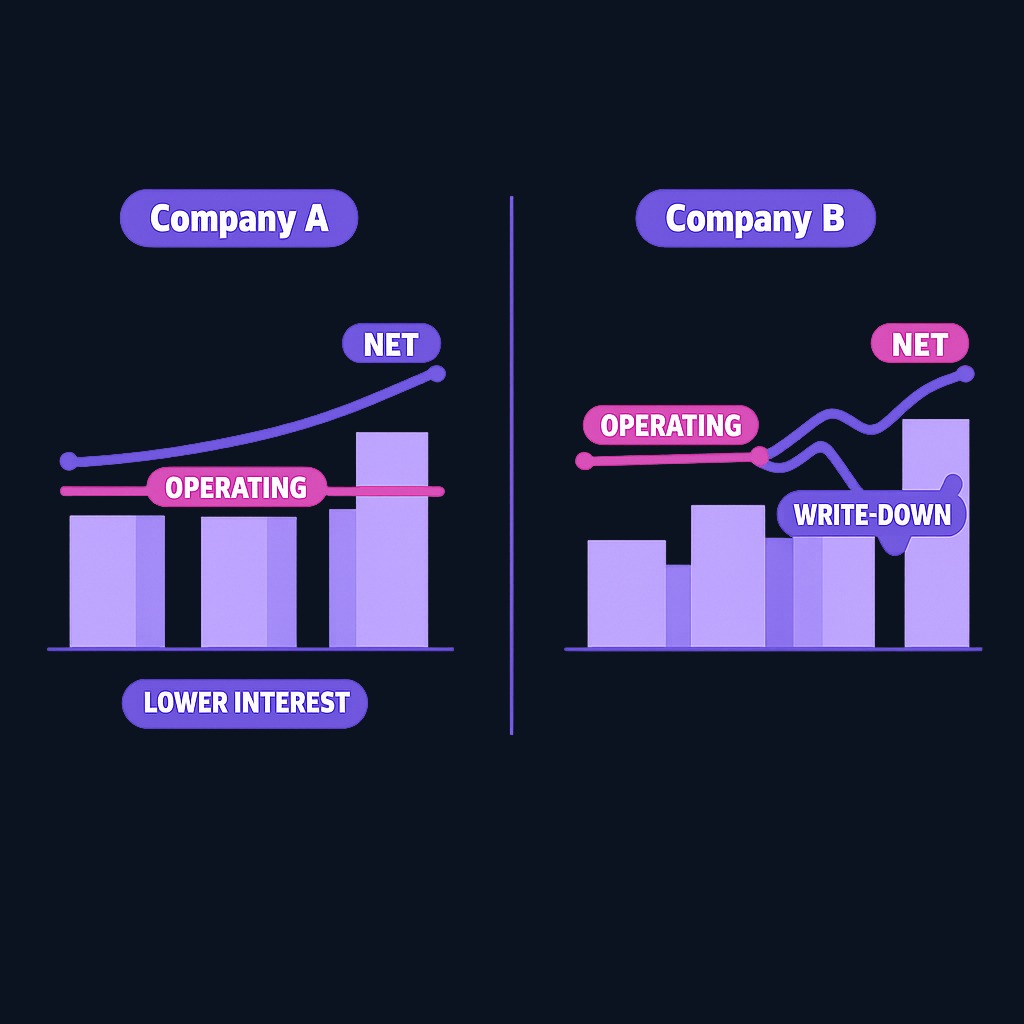
Two real-world patterns are worth recognizing. Consider first a pattern worth recognizing. A company reports growing net income for three straight years while operating income stagnates - the growth turns out to come from shrinking interest costs after a refinancing and a lower tax rate. Nothing wrong occurred, but the core business did not improve, and the market will eventually price that reality.
Reverse case: a company posts a headline net loss driven by a one-time impairment while operating income quietly grows 12 percent. Investors who read only the bottom line flee; readers of the full income statement of a stock see an improving business absorbing a non-cash charge.
What to know before deciding
- Always read both numbers together, plus the line items between them; the gap tells the story.
- Compare operating margins against direct competitors, not across industries with different cost structures.
- Treat recurring "one-time" charges with suspicion - some companies restructure annually.
- Cross-check profitability against operating cash flow to catch accrual-driven distortions.
- For small businesses, the same discipline applies: separate what the business earns from how it is financed and taxed.
Decision framework: which metric to use when
Match the metric to the question. Judging management execution or comparing rivals? Use operating income and its margin. Estimating what shareholders actually earned, or calculating EPS and payout capacity? Use net income. Screening for turnarounds? Look for operating income improving beneath a noisy bottom line. Assessing debt safety? Start from operating income, since it approximates the earnings available before financing costs. And when the two metrics tell conflicting stories over multiple periods, trust the operating trend first - financing and tax effects can be changed, but a weakening core business is the harder problem.
FAQ
Can net income be higher than operating income?
Yes. One-time gains, investment income, or tax benefits can push the bottom line above operating profit. When that happens regularly, examine whether the extra profit is sustainable - it usually is not.
Is operating income the same as EBIT?
Nearly. Operating income covers profits from core operations only, while EBIT technically includes non-operating income as well. For most companies the two are close, and analysts often use the terms interchangeably.
Which number matters more for stock valuation?
Both feed different tools. Net income drives EPS and the P/E ratio, while operating income anchors margin analysis and enterprise-value multiples. Serious valuation work reads them together with cash flow.
Where do I find these figures for a public company?
On the income statement in quarterly (10-Q) and annual (10-K) reports, available free through SEC EDGAR or the company's investor relations site. Operating income appears mid-statement; net income is the final line.
Next steps
Operating income shows how well the machine runs; net income shows what the owners keep. Read them as a pair, investigate the space between them, and be skeptical whenever the bottom line grows while the operating line does not. The fastest way to internalize the difference is repetition: pull three companies' income statements this week, compute both figures and both margins, and explain the gap in one sentence each. Structured practice turns that from homework into habit.
InvestingFundamental AnalysisFinancial StatementsBeginner
Practice investing with Finelo
Build practical investing skills with guided lessons, simulator practice, and structured challenges.
About the author
Finelo Team
The Finelo Team creates practical investing and trading education designed to help beginners learn faster with structured challenges, simulator practice, and bite-sized lessons.
Keep reading — Related articles
Investing
Tax-gain harvesting vs. tax-loss harvesting
Compare realizing investment gains with realizing losses, including holding periods, wash sales, offsets, and portfolio tradeoffs.
Finelo Team

Investing
Stable value fund vs. money market fund
Compare investment structure, contract protections, transfer restrictions, net yields, and access inside a retirement account.
Finelo Team

Investing
Single-life vs. joint-life annuity
Compare income for one lifetime with continued payments to a survivor, using equal premiums and matching guarantee terms.
Finelo Team