The EU has cleared Paramount Skydance's roughly $110bn takeover of Warner Bros Discovery — but a US court has just hit pause, and the target's shares are still trading below the cash offer on the table. Here is where the deal stands, and the market mechanics behind that gap.
Paramount's $110bn Warner Bros Takeover: EU Approval, a US Pause, and the Merger Math
The EU cleared Paramount's roughly $110bn Warner Bros Discovery takeover, but a US court just paused it — and the stock still trades below the cash offer. Here's where the deal stands, and the market mechanics behind the gap.
7 min read
Practice trading with Finelo
Practice in a simulator, learn with bite-sized lessons, and build confidence before risking real money.
Want to learn more?
Practice in a simulator, learn with bite-sized lessons, and build confidence before risking real money.
Explore FineloExplore Finelo's 28-day challenges
Turn learning into a daily habit with guided challenge paths.
On July 22, 2026, the European Commission gave the merger a conditional green light, approving it after Paramount agreed to end a major film-distribution partnership with Universal Pictures in Europe within 13 months and to steer clear of a similar venture for a decade, according to the Commission and reporting from the BBC, Reuters, and Bloomberg. Regulators had worried that sharing distribution with a rival would hand the combined company too much sway over cinema releases.
But the European approval is only half the story. In the US, the deal is on hold: a coalition of a dozen states, led by California, filed an antitrust lawsuit in mid-July to block it, and days later a federal court issued a temporary restraining order pausing the takeover while those claims are heard. Warner Bros Discovery shares fell about 4% on the pause.
This article is for information and education only and is not financial advice. Nothing here is a recommendation to buy, sell, or hold any security, and mergers can change terms or fall through at any time.
Where the deal stands
The picture right now is a patchwork of approvals and roadblocks:
- EU: approved with conditions. Cleared July 22, contingent on Paramount ending its European distribution tie-up with Universal.
- US Department of Justice: supportive. The DOJ signaled in June that it backed the merger.
- US states: fighting it. Twelve states, led by California, sued in mid-July, arguing the deal would cause "substantial harm to movie theatres, basic cable distributors, and, ultimately, audiences."
- US court: paused. A federal judge issued a temporary restraining order so the states' claims can be weighed. Lawyers quoted in the coverage stressed the order is "just a short pause" and does not decide the case.
- UK: watching. UK regulators are weighing their own intervention over local news, children's TV, and streaming competition.
- The unions: opposed. The Writers Guild of America says the merged company would gain outsized power over wages and job opportunities.
Paramount, for its part, says the tie-up will benefit viewers, pledging to release at least 30 films in cinemas a year — roughly double its current output.
Why Warner Bros stock trades below the $30 offer
Here is the part that puzzles a lot of newer investors. Paramount has an all-cash offer on the table valuing Warner Bros Discovery at around $30 a share, according to Paramount's own announcements. So why hasn't the stock simply jumped to $30 and stayed there?
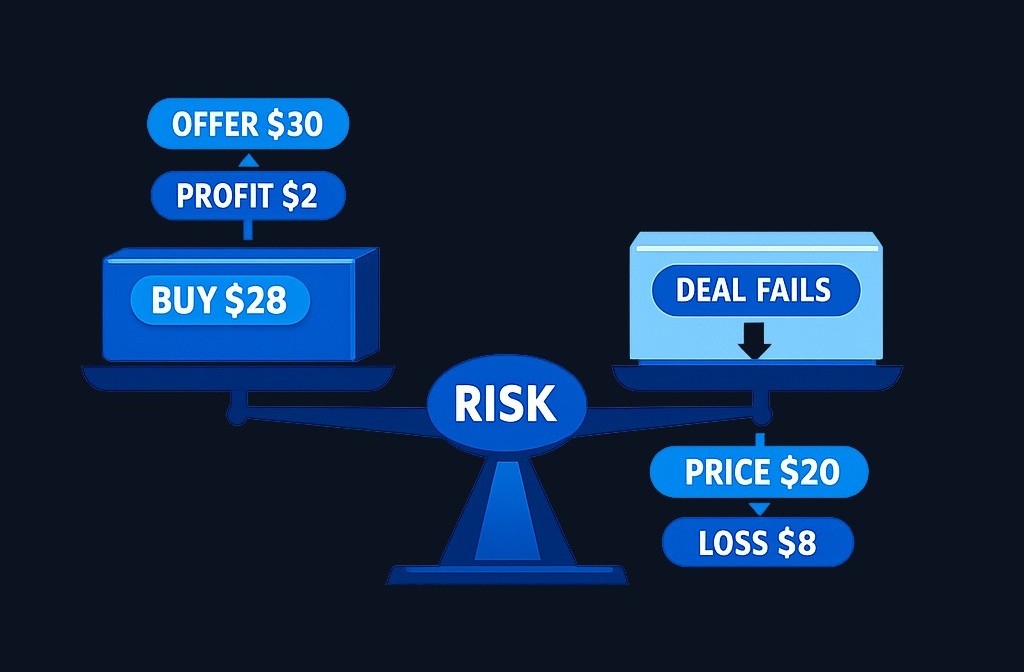
Because a signed deal is not a done deal. When a company agrees to be bought for cash at a fixed price, its shares usually trade at a slight discount to that price right up until the moment the deal actually closes. That gap — the difference between the market price and the agreed offer — is known as the merger, or risk, arbitrage spread, and it exists for two reasons: the time value of waiting for the money, and, more importantly, the risk that the deal falls apart before it completes.
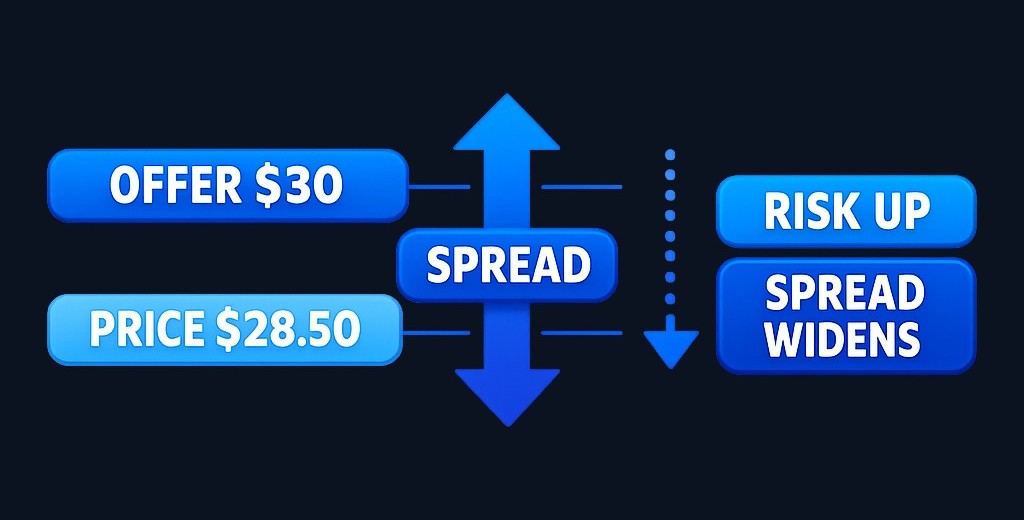
The size of that gap moves with the odds. When the path looks clear, the spread narrows and the stock drifts toward the offer price. When something threatens the deal — a lawsuit, a regulator, or, as happened here, a judge hitting pause — the perceived risk rises, the spread widens, and the shares dip. That is essentially what the roughly 4% drop on the court's pause was: the market repricing the odds that the deal closes on the current terms.
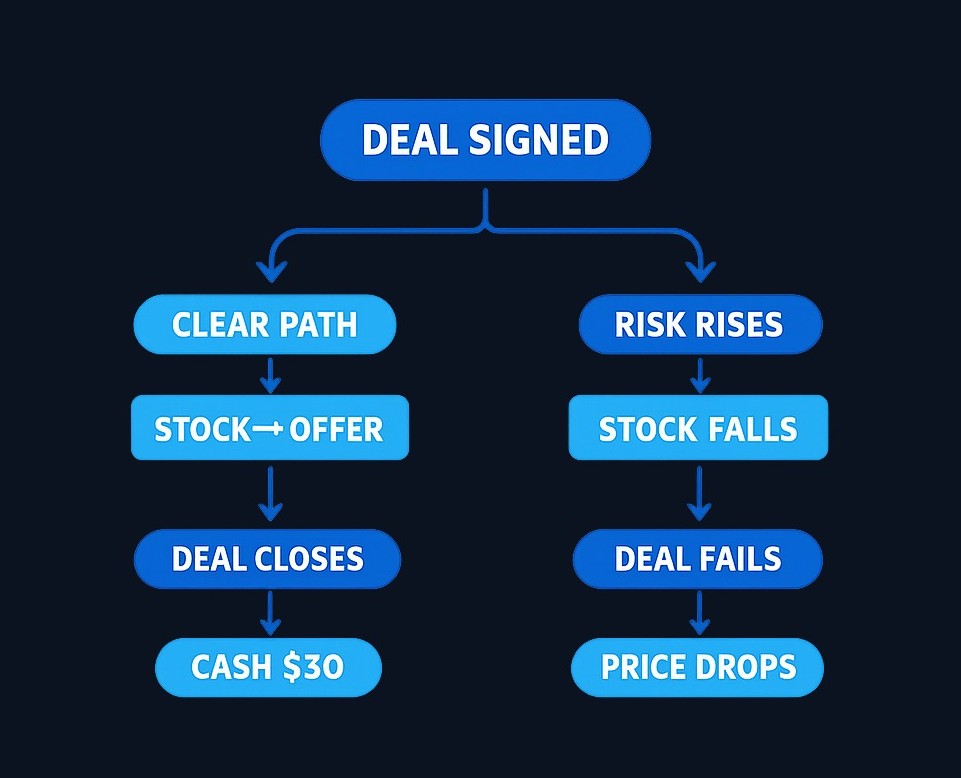
If the merger ultimately completes, holders of the shares receive the cash offer. If it collapses, the stock can fall back toward where it traded before the deal — which is exactly the risk the spread has been pricing in all along. Betting on that gap closing is a recognized (and risky) strategy some hedge funds run; it is not a beginner move, and it is not something this article is suggesting anyone do.
Practice trading with Finelo
Practice in a simulator, learn with bite-sized lessons, and build confidence before risking real money.
The "ticking fee": a countdown with a price tag
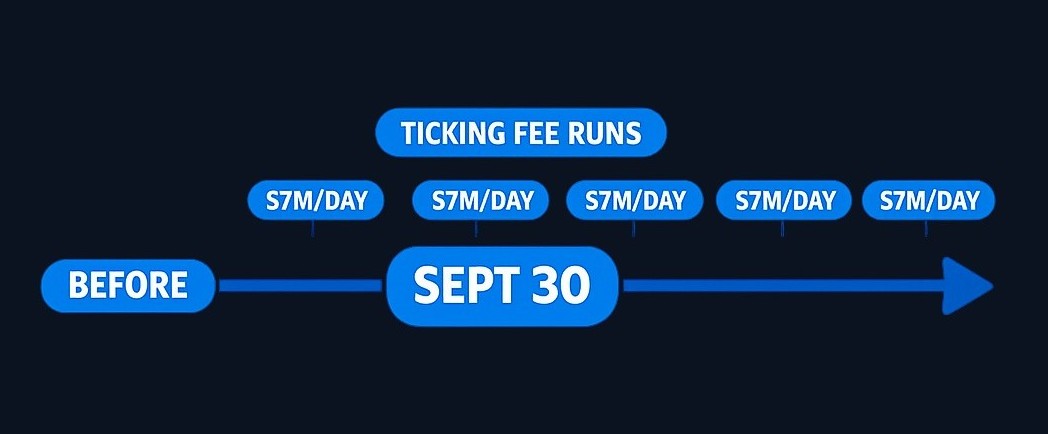
The pause is not just a legal inconvenience — it comes with a meter running. Under the merger agreement, if the deal is not completed by September 30, Paramount owes Warner Bros shareholders a "ticking fee" of roughly $7 million a day until it closes, as reported by the BBC and others.
A ticking fee is a clause that compensates the target's shareholders for delay, essentially charging the buyer for every extra day the deal drags on past a set date. It is a common feature in large, regulation-heavy takeovers precisely because approvals and lawsuits can push timelines around. For the market, it is also a signal: it puts a concrete dollar figure on the cost of exactly the kind of hold-up now playing out in court.
What to watch next
For anyone following the story, a few markers will shape what happens from here:
- September 30 — the date the ticking fee kicks in if the deal has not closed.
- The US court case — whether the temporary pause hardens into a longer block, or clears, as the states' antitrust theory is tested.
- UK regulators — whether they open a formal intervention.
- The spread itself — how far Warner Bros shares sit below the offer price is a live, real-time read on how likely the market thinks the deal is to close.
Why this matters beyond one deal
Media consolidation gets a lot of attention, but the more durable lesson here is about how markets price uncertainty. An all-cash offer looks like a fixed number, yet the stock keeps floating below it — a reminder that in markets, price reflects probability, not just the sticker on a deal. The same logic shows up whenever a takeover is announced: the gap between the market price and the offer is the crowd's running estimate of whether the deal survives contact with regulators, courts, and time.
If you want the underlying concepts, Finelo has explainers on what a tender offer is, how the stock market works, and what a hedge fund is — the kind of fund that often trades merger spreads. None of this is a view on Paramount, Warner Bros, or their shares; it is a way to read the news more clearly.
Finelo is an educational product, not a brokerage. This article is for education and information only and is not financial advice. Company and deal details are based on news reports as of late July 2026 and may change; verify the latest developments before drawing any conclusions.
Sources: BBC, Reuters, CNBC, Forbes, Bloomberg, Axios, The Motley Fool, TheWrap, and Paramount / Warner Bros Discovery announcements.
Frequently asked questions
Why is Warner Bros Discovery trading below Paramount's offer price?
Because the deal has not closed. A cash offer sets a price, but the shares trade at a discount to it until the merger is actually complete, reflecting the time until payout and the risk the deal falls through. When that risk rises — such as when a court paused the deal — the discount widens and the stock dips.
What is a ticking fee?
It is a clause that compensates a target's shareholders for delay in closing a deal. In this case, Paramount owes roughly $7 million a day to Warner Bros shareholders if the merger is not completed by September 30, until it closes.
Is the deal approved or blocked?
Both, in different places. EU regulators approved it with conditions, and the US Department of Justice signaled support, but twelve US states are suing to block it and a federal judge has temporarily paused it. The pause does not decide the case.
What is merger arbitrage?
It is a strategy of trying to profit from the gap between a target company's market price and the announced deal price, betting on whether the deal closes. It carries real risk — if the deal collapses, the stock can fall sharply — and is generally used by professional investors, not beginners.
MergersStocksMarket BasicsBeginner
Practice trading with Finelo
Practice in a simulator, learn with bite-sized lessons, and build confidence before risking real money.
About the author
Finelo Team
The Finelo Team creates practical investing and trading education designed to help beginners learn faster with structured challenges, simulator practice, and bite-sized lessons.
Keep reading — Related articles

News
The September Effect Explained: What the Stock Market Data Really Says
September has delivered the S&P 500's weakest average monthly return since 1928, but the result is not a reliable trading signal. Here is how to read the seasonality data.
Finelo Team
News
Nvidia–Hugging Face Deal: What the $12.9 Billion Agreement Changes
Nvidia agreed to acquire Hugging Face for $12.93 billion while promising to keep the platform open. Here is what the price, developer reach, and neutrality pledge mean.
Finelo Team
News
Lululemon Stock Falls to 2018 Levels After Its Q2 Earnings Report
Lululemon shares fell below $100 after revenue declined, comparable sales dropped, and management cut its outlook. The report offers a practical lesson about brand moats and falling knives.
Finelo Team