A tender offer is a public invitation to security holders to sell stock or debt under fixed terms. The buyer may be the company itself or an outside bidder. Each holder decides whether to participate. Tender offers often seek a large block of securities and may support a share buyback, an acquisition, or another change in ownership.
What is a Tender Offer? A Complete Overview

A tender offer is a public invitation to security holders to sell stock or debt under fixed terms. The buyer may be the company itself or an outside bidder. Each holder decides whether to participate. Tender offers…
6 min read
Practice investing with Finelo
Build practical investing skills with guided lessons, simulator practice, and structured challenges.
Want to learn more?
Build practical investing skills with guided lessons, simulator practice, and structured challenges.
Explore FineloExplore Finelo's 28-day challenges
Turn learning into a daily habit with guided challenge paths.
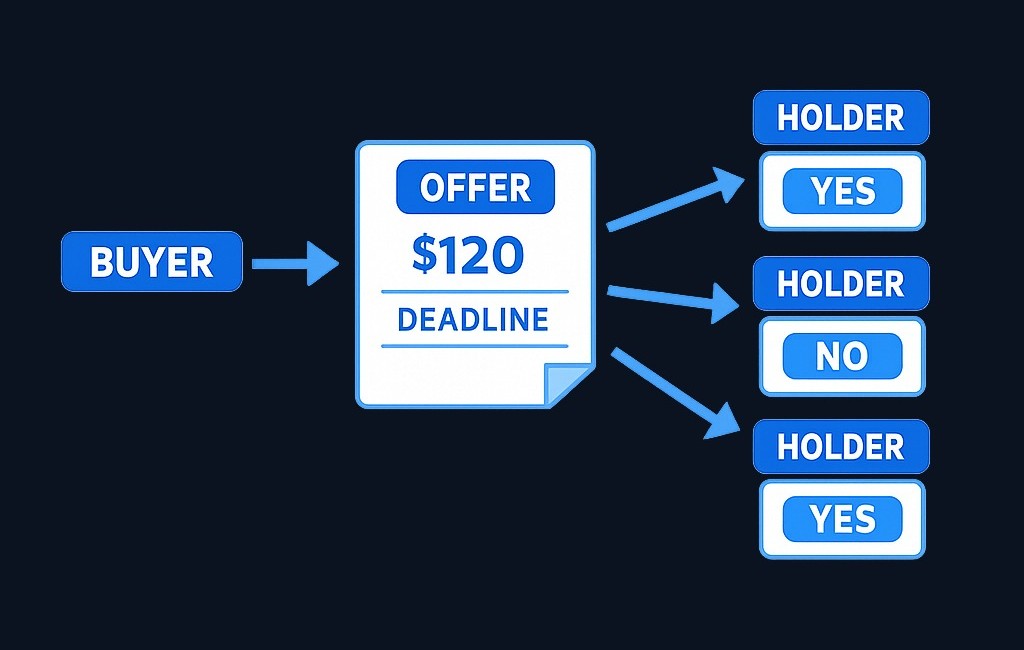
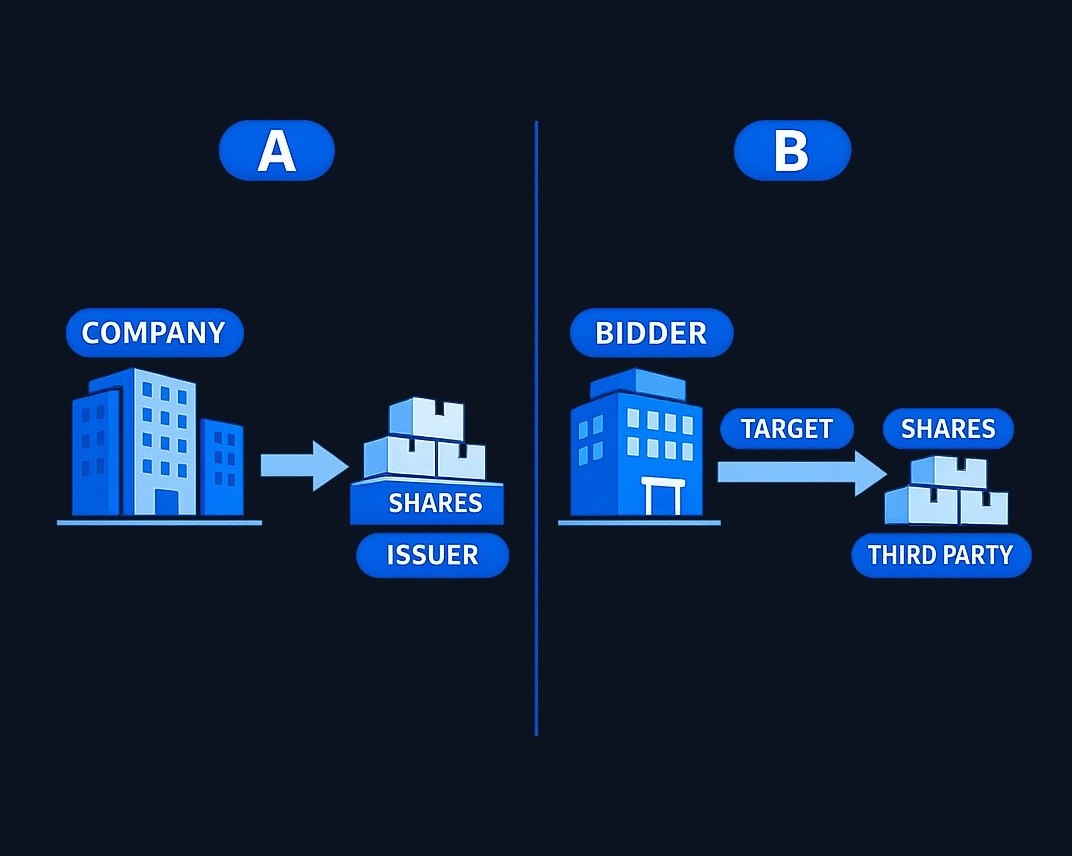
The SEC’s Investor.gov site calls a company’s offer for its own securities an issuer tender offer. It calls an outside bidder’s offer for another company’s securities a third-party tender offer (Investor.gov). For shareholders, the practical task is to compare the offer with the choice to keep or sell their shares another way.
How does a tender offer work?
The bidder announces the offer and gives eligible security holders instructions. The terms usually state the price, the securities sought, the deadline, and any conditions. The offer remains open for a limited period, and its price and other terms are fixed. Investor.gov says the purchase price is usually above the current market price to encourage holders to sell. An offer may also require a minimum number or value of securities to be tendered (Investor.gov).
The tender offer process usually creates five questions for an investor:
- Who is the bidder? Is it the issuer or a third party?
- What is being purchased? The offer may seek common stock, other equity, or debt securities.
- What will the investor receive? Compare the stated price or consideration with the current market price and other choices.
- What conditions apply? A minimum tender condition can affect whether the purchase happens.
- When must the holder act? Missing the deadline can remove the option to participate.
Tendering means submitting securities for purchase under the offer’s terms. It does not mean privately negotiating a different price. It also may not guarantee that every submitted share will be bought. The offer documents explain what happens if shareholders tender more or fewer shares than the bidder seeks.
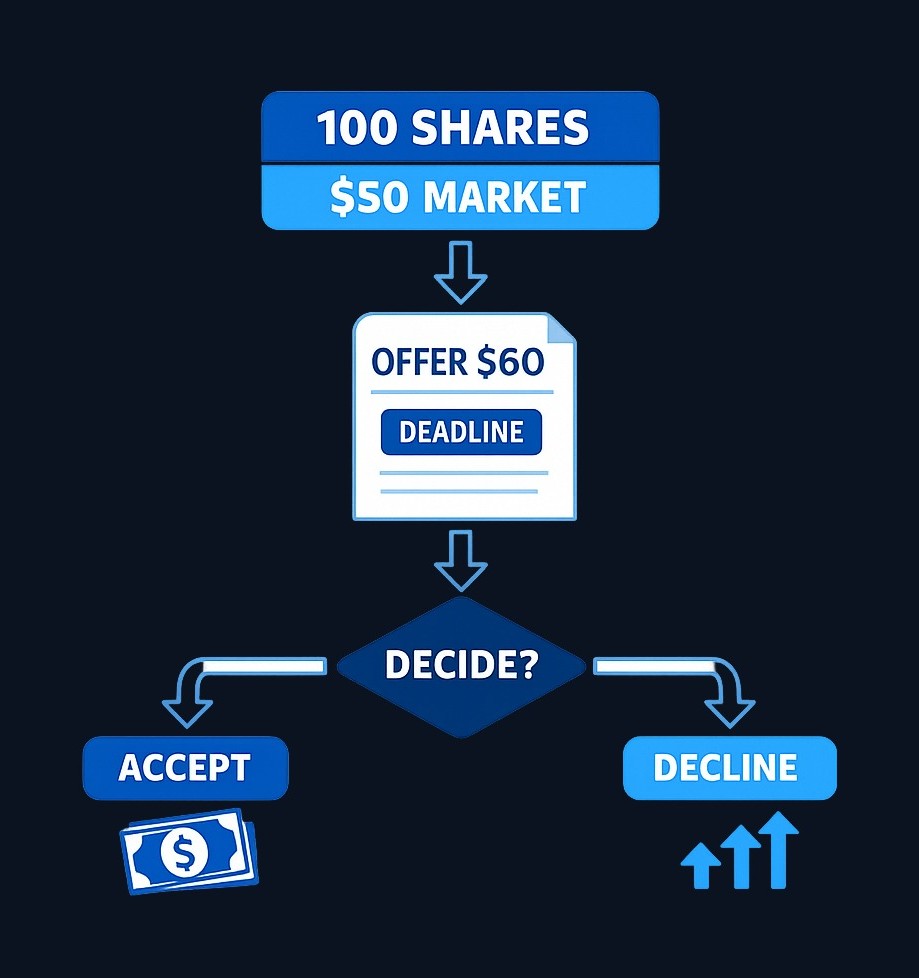
Here is a simple hypothetical example. A company offers to repurchase part of its outstanding stock at a stated price. A shareholder owns 100 shares. Before accepting, the shareholder compares the offer price with the market price, checks the deadline and conditions, and considers the cost of giving up future ownership. The premium matters, but it is only one part of the decision.
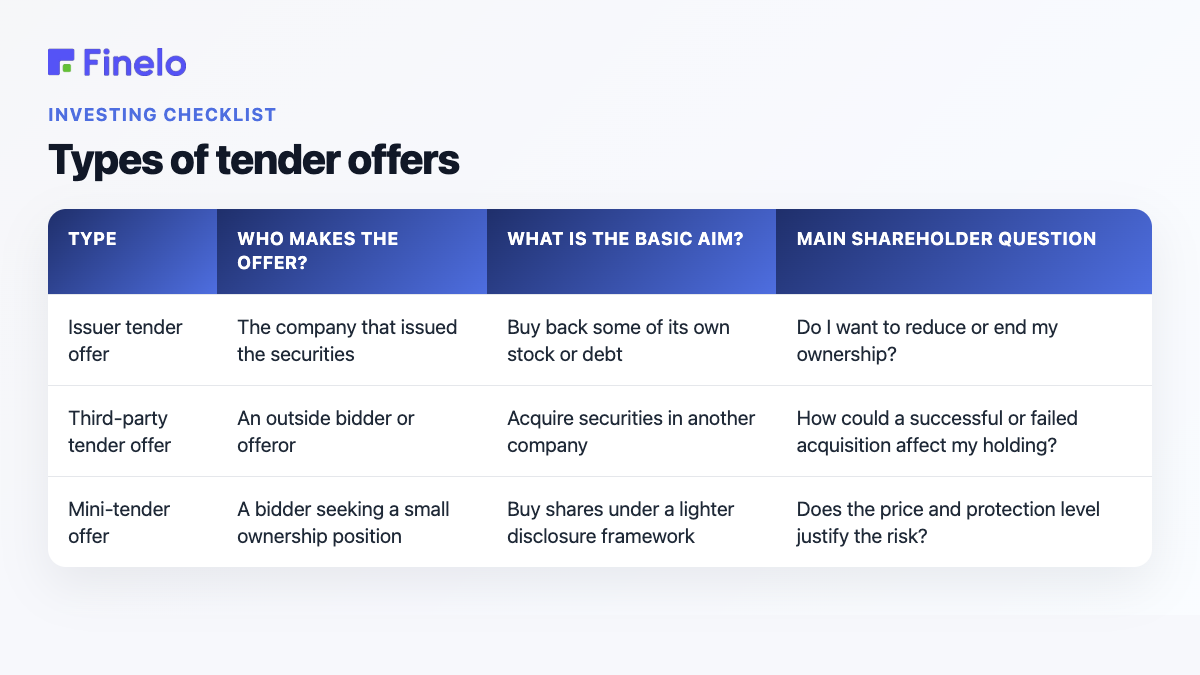
Types of tender offers
Tender offers can be grouped by the identity of the buyer and the size of the proposed purchase.
| Type | Who makes the offer? | What is the basic aim? | Main shareholder question |
|---|---|---|---|
| Issuer tender offer | The company that issued the securities | Buy back some of its own stock or debt | Do I want to reduce or end my ownership? |
| Third-party tender offer | An outside bidder or offeror | Acquire securities in another company | How could a successful or failed acquisition affect my holding? |
| Mini-tender offer | A bidder seeking a small ownership position | Buy shares under a lighter disclosure framework | Does the price and protection level justify the risk? |
Investor.gov defines a mini-tender offer as one that would leave the bidder owning less than 5% of a company’s stock. It warns that the offer price may be below the market price, even though investors may assume it includes a premium (Investor.gov).
An offer may seek equity or company-issued debt. Investors should identify exactly what they would surrender and receive. Similar names do not make two offers economically equal.
Practice investing with Finelo
Build practical investing skills with guided lessons, simulator practice, and structured challenges.
SEC rules and shareholder rights
Tender offers operate within federal securities rules. According to Investor.gov, most tender offers require filings that disclose information about the bidder and the terms. Those documents include Schedule TO and an Offer to Purchase. Bidders must also notify security holders about the offer (Investor.gov).
These materials deserve a careful read. Marketing language may highlight the premium or the chance to sell. The formal documents provide the details needed to judge the offer.
SEC rules also provide protections in many traditional tender offers:
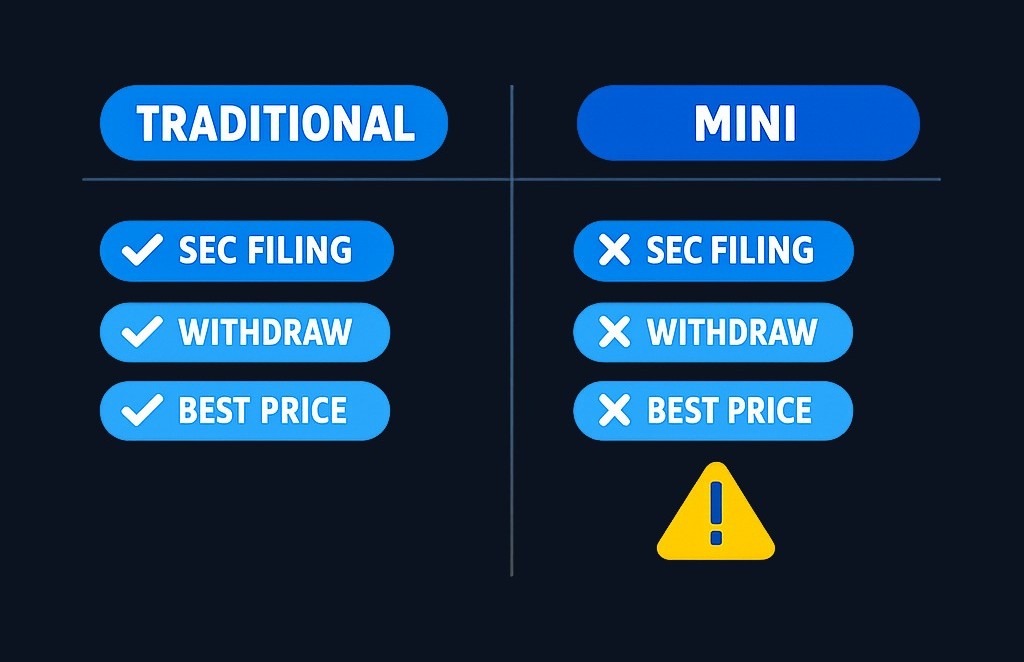
- Withdrawal rights may let holders withdraw tendered securities during specified periods.
- The offer must be available to all holders of the relevant class of securities.
- The best-price rule prevents the bidder from offering different prices to different tendering holders.
These protections are described by Investor.gov. Their exact application depends on the offer, so shareholders should check the documents instead of assuming every transaction works the same way.
Mini-tender offers need extra caution. Investor.gov says bidders in these offers do not have to provide the same detailed documents required in a traditional tender offer. They also do not have to file offer documents with the SEC or give investors withdrawal rights (Investor.gov). That can leave a shareholder with less information and less ability to change course.
Should you accept a tender offer?
There is no single answer for every shareholder. An attractive premium can support a sale, but price alone does not settle the decision. Accepting ends or reduces your exposure to the investment. Declining keeps that exposure, along with its possible gains and losses.
Review these points before you tender shares:
- Compare the offer price with the current market price.
- Calculate the value after possible fees and taxes.
- Check the deadline and every material condition.
- Identify whether the offer is for all or only some of your shares.
- Read what happens if the offer is oversubscribed or the minimum condition is not met.
- Confirm whether and when you can withdraw.
- Consider what you expect to own after the transaction.
- Verify the offer through official documents and your established broker or account provider.
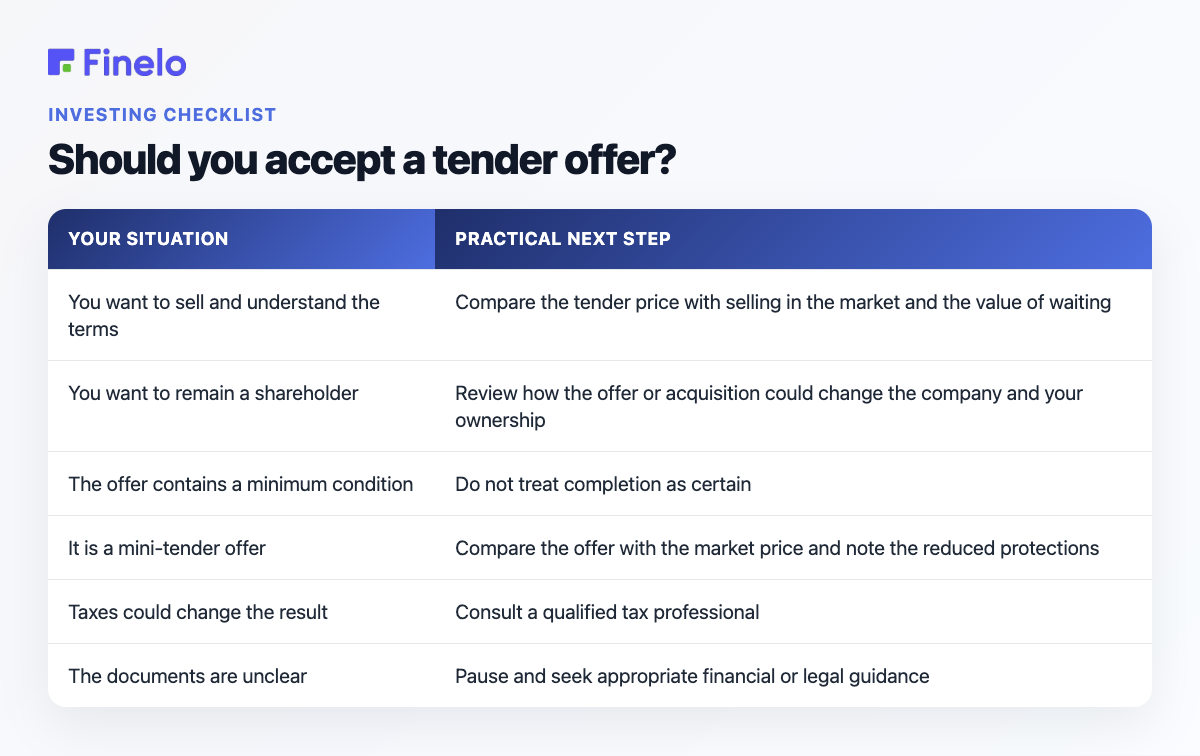
The following decision table can help organize the next step:
| Your situation | Practical next step |
|---|---|
| You want to sell and understand the terms | Compare the tender price with selling in the market and the value of waiting |
| You want to remain a shareholder | Review how the offer or acquisition could change the company and your ownership |
| The offer contains a minimum condition | Do not treat completion as certain |
| It is a mini-tender offer | Compare the offer with the market price and note the reduced protections |
| Taxes could change the result | Consult a qualified tax professional |
| The documents are unclear | Pause and seek appropriate financial or legal guidance |
Risks exist on both sides. By accepting, you may sell below a later market price or give up future participation in the company. By declining, you remain exposed to market moves and the outcome of the transaction. Neither choice guarantees a profit.

Tender offer examples
These hypothetical cases show how the structure changes the decision.
Issuer buyback: A company offers to buy a set amount of its own outstanding shares. The offer has a deadline and a minimum condition. One investor accepts to reduce a concentrated position. Another keeps the stock because continued ownership fits a longer-term plan. The same offer can lead to different reasonable choices.
Third-party acquisition: An outside bidder makes a tender offer for a target company’s shares. A holder compares the stated consideration with the value and uncertainty of remaining invested. The holder also reads the Offer to Purchase to understand the bidder, conditions, and possible outcome.
Mini-tender: A shareholder receives an offer that looks official but is below the market price. The investor checks a current market quote and recognizes that the proposal is not a premium offer. Reviewing the details prevents a rushed sale under weaker protections.
These examples are not predictions. Stock prices can react to new information, competing offers, changing expectations, and the final result. No tender offer produces a guaranteed market outcome.
Frequently asked questions
What happens if I do not respond to a tender offer?
You generally do not tender your securities if you take no action. You continue to hold them unless another event changes that position. The later effect depends on the transaction, so read the offer documents.
Can I negotiate the tender offer price?
Individual holders usually choose whether to accept the fixed terms. The best-price protection in many traditional offers also means a bidder cannot pay different tendering holders different prices ([Investor.gov](https://www.investor.gov/introduction-investing/investing-basics/glossary/tender-offer)).
How do I check whether a tender offer is legitimate?
Start with the official offer materials. For most tender offers, look for the Schedule TO and Offer to Purchase described by Investor.gov. Confirm the communication through your broker or another established channel. Do not rely only on an email, logo, or urgent message.
What should I do before the deadline?
Read the full offer, compare the price and alternatives, check the conditions, and calculate the possible net result. If the decision is material or unclear, ask an appropriate financial, legal, or tax professional. This Finelo overview is educational and does not provide personalized financial advice.
InvestingBeginnerCorporate ActionsMarkets
Practice investing with Finelo
Build practical investing skills with guided lessons, simulator practice, and structured challenges.
About the author
Finelo Team
The Finelo Team creates practical investing and trading education designed to help beginners learn faster with structured challenges, simulator practice, and bite-sized lessons.
Keep reading — Related articles

Investing
I Bonds vs EE Bonds in 2026: Rates, Rules, and Which to Buy for the Long Run
Series I and Series EE savings bonds are both U.S. Treasury retail savings bonds sold on TreasuryDirect. They share ownership, tax treatment, and redemption rules; the key difference is the…
Finelo Team
Investing
Coverdell ESA vs 529 Plan: Limits, Flexibility, and Which to Choose
Quick answer (one minute) Both a Coverdell Education Savings Account (Coverdell ESA) and a 529 plan let money grow tax‑free and be withdrawn tax‑free for qualified education expenses. The…
Finelo Team
Investing
CD vs High Yield Savings Account: Where to Park Your Cash in 2026
Hero answer — CD vs high yield savings account in one line A CD (certificate of deposit) and a high yield savings account are both low‑risk, federally insured homes for cash — the difference…
Finelo Team