A Ponzi scheme presents itself as an investment and uses money from newer investors to pay supposed returns to earlier investors. A pyramid scheme is built around recruitment: participants bring in more people, whose money keeps the structure going. The simplest difference is therefore investment deception versus recruitment-driven compensation. Both depend on a continuing supply of new money, both can use persuasive promises, and both expose participants to serious losses.
Ponzi Schemes vs. Pyramid Schemes: Understanding the Differences
A Ponzi scheme presents itself as an investment and uses money from newer investors to pay supposed returns to earlier investors. A pyramid scheme is built around recruitment: participants bring in more people, whose…
7 min read
Practice investing with Finelo
Build practical investing skills with guided lessons, simulator practice, and structured challenges.
Want to learn more?
Build practical investing skills with guided lessons, simulator practice, and structured challenges.
Explore FineloExplore Finelo's 28-day challenges
Turn learning into a daily habit with guided challenge paths.
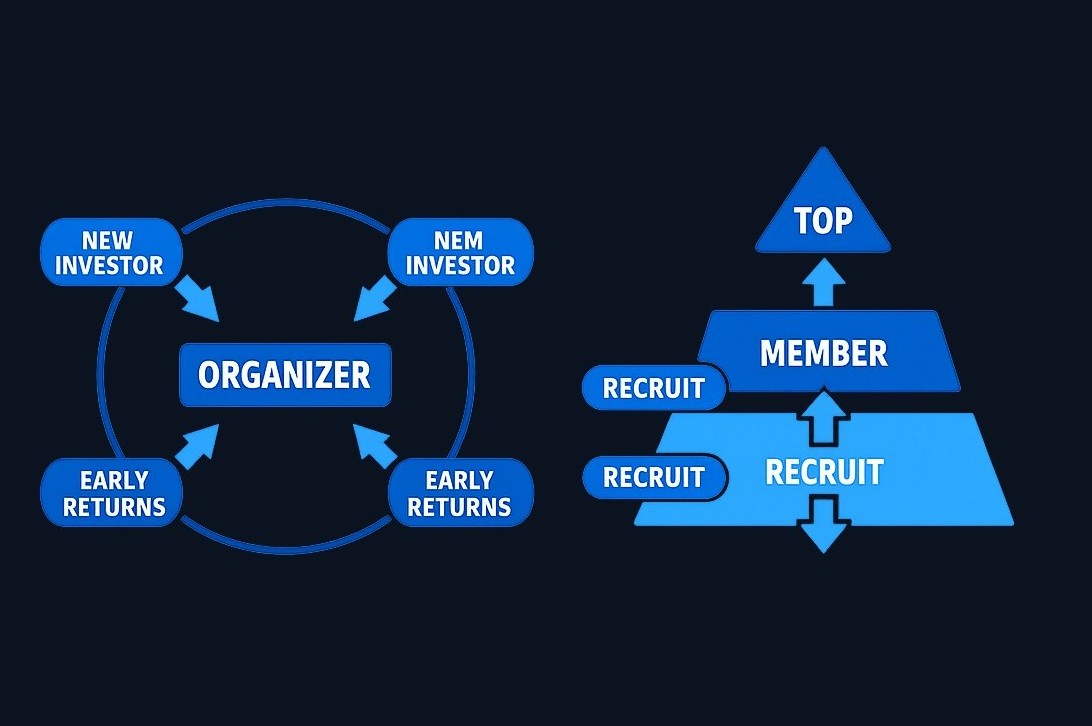
This comparison is for anyone evaluating an investment offer, side-income pitch, membership program, or opportunity that seems unusually rewarding.
Key differences between Ponzi and pyramid schemes
| Question | Ponzi scheme | Pyramid scheme |
|---|---|---|
| What does the offer resemble? | An investment opportunity | A business, membership, or earning opportunity |
| Who usually manages the money flow? | A central organizer | The organizer plus expanding layers of participants |
| What keeps it operating? | New investment deposits | New recruits and their payments |
| What is the participant encouraged to focus on? | Reported returns and leaving money invested | Recruiting others and moving upward in the structure |
| Main warning sign | Attractive returns that are not clearly supported by legitimate earnings | Rewards that depend more on recruitment than genuine customer demand |
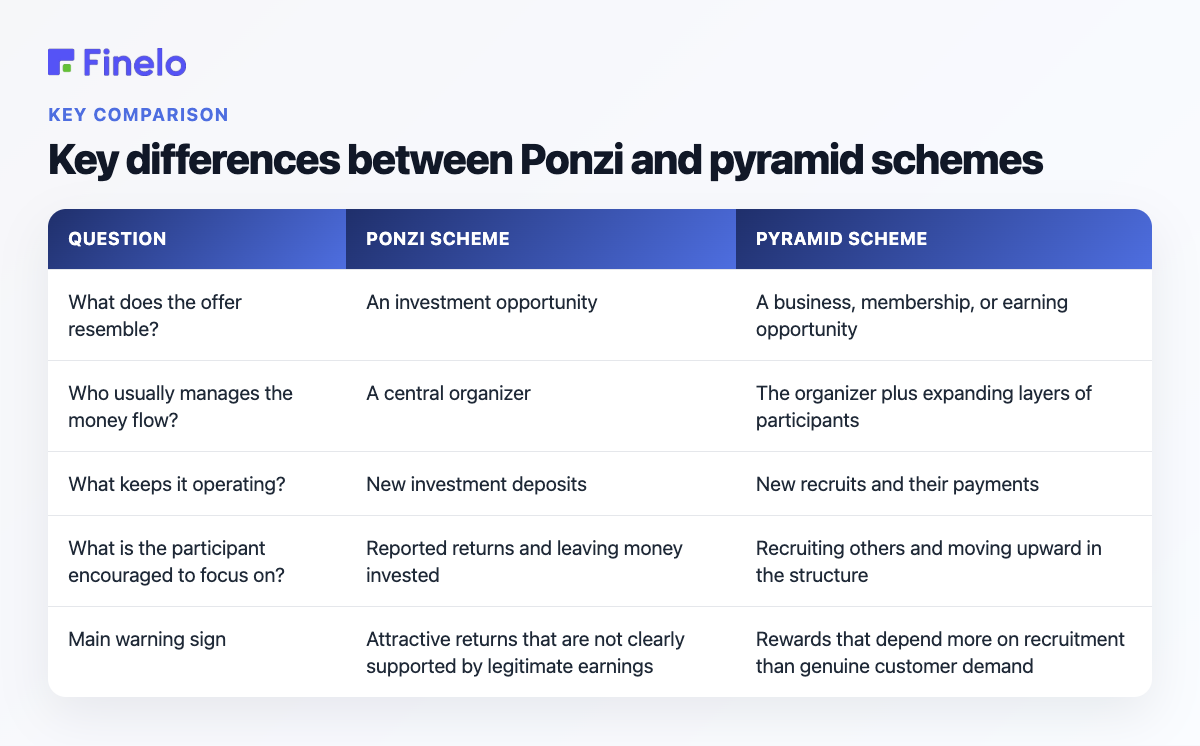
The labels matter less than the cash flow. Ask where payments come from and what must keep growing. If the answer is “new participants,” examine the offer carefully.
What is a Ponzi scheme?
The U.S. Securities and Exchange Commission describes a Ponzi scheme as an investment fraud in which purported returns to existing investors come from funds contributed by new investors. The same guidance notes that organizers may promote high returns with little or no risk and that, without legitimate earnings, the scheme needs a constant flow of new money.
A simplified example looks like this:
- An organizer accepts money for a supposed investment.
- Early participants receive payments described as profits or returns.
- Those payments encourage trust, reinvestment, or word-of-mouth referrals.
- New deposits fund withdrawals and payments instead of a genuine profit-producing activity.
- The arrangement becomes unstable when incoming money no longer covers outgoing demands.
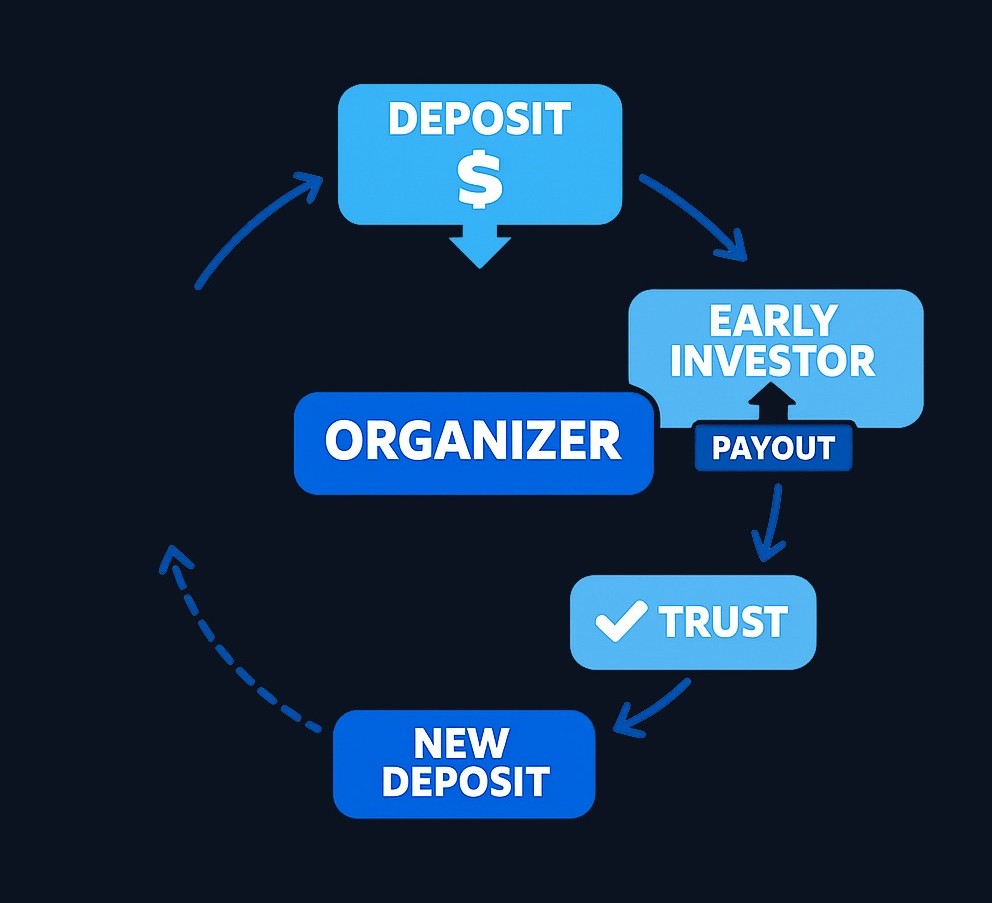
The central organizer normally controls the story and the money. Participants may believe their funds are invested, so they do not necessarily know that payments are being recycled from newer deposits.
What is a pyramid scheme?
A pyramid scheme is a recruitment-based scam. Its structure expands in layers: existing participants are encouraged to bring in new participants, and money entering at lower levels supports rewards higher in the structure.
Products, services, training, or membership benefits may be discussed, but the practical test is what drives compensation. If the opportunity works only when participants continually recruit paying newcomers, recruitment is the economic engine.
The risk is not theoretical. In an official account of a prosecuted pyramid promotional scheme, the UK Competition and Markets Authority warned that the vast majority of consumers stand to lose money.
The story being sold
Ponzi schemes sell confidence in an investment. The organizer claims to have a strategy, asset, or special method that produces returns. Pyramid schemes sell participation and advancement. Recruits are invited to earn by building a network beneath them.
The participant’s role
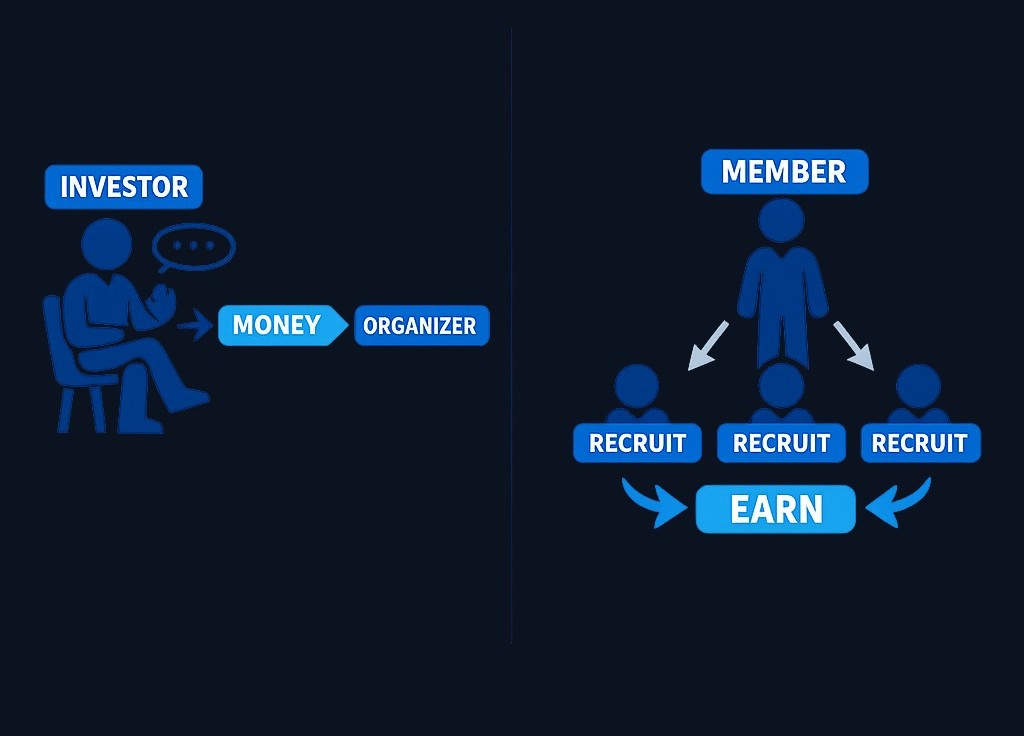
In a Ponzi arrangement, a participant can remain passive after handing over money. In a pyramid structure, the participant is usually expected to recruit, promote the offer, or bring more money into the network.
Control of the scheme
A Ponzi scheme is usually centralized. The organizer collects funds and controls reported results and payments. A pyramid scheme spreads recruitment through multiple levels. Promoters at the top may still shape the rules and messaging.
Psychological pressure
Both structures can exploit social proof. Visible payments or enthusiastic participants make an opportunity appear credible. A Ponzi pitch leans on trust in the organizer and fear of missing attractive returns. A pyramid pitch may add social pressure because recruitment can move through personal networks. Popularity does not prove that the activity is sustainable.
Practice investing with Finelo
Build practical investing skills with guided lessons, simulator practice, and structured challenges.
Risks involved in both schemes
Both schemes can cause direct financial loss. A Ponzi participant may lose the original deposit and any returns that appeared only on paper. A pyramid participant may lose joining fees, repeat payments, or money spent trying to remain eligible for rewards.
The harm can spread beyond one payment. Participants may keep adding money because earlier payments create confidence. They may also involve friends or relatives before they understand how the arrangement works. In its account of a prosecuted pyramid promotional scheme, the UK Competition and Markets Authority said the vast majority of consumers stand to lose money.
There is also a decision risk: a polished presentation can distract from the basic cash-flow question. Do not treat testimonials, visible payouts, or a professional-looking website as proof. Trace the claimed earnings back to a genuine source of revenue.
How to identify Ponzi and pyramid schemes
Pause when several of these signs appear together:
- Returns or earnings seem unusually dependable while the source of profit remains vague.
- Questions about how money is generated receive complicated, evasive, or changing answers.
- You are pressured to act quickly, keep the opportunity secret, or rely on trust instead of documents.
- The promoter emphasizes bringing in people more than serving genuine customers.
- Rewards depend on paying fees, buying access, or maintaining a position in a network.
- Statements and account balances cannot be matched to assets or activity you can independently understand.
- Withdrawing money is delayed, discouraged, or made conditional on recruiting or reinvesting.
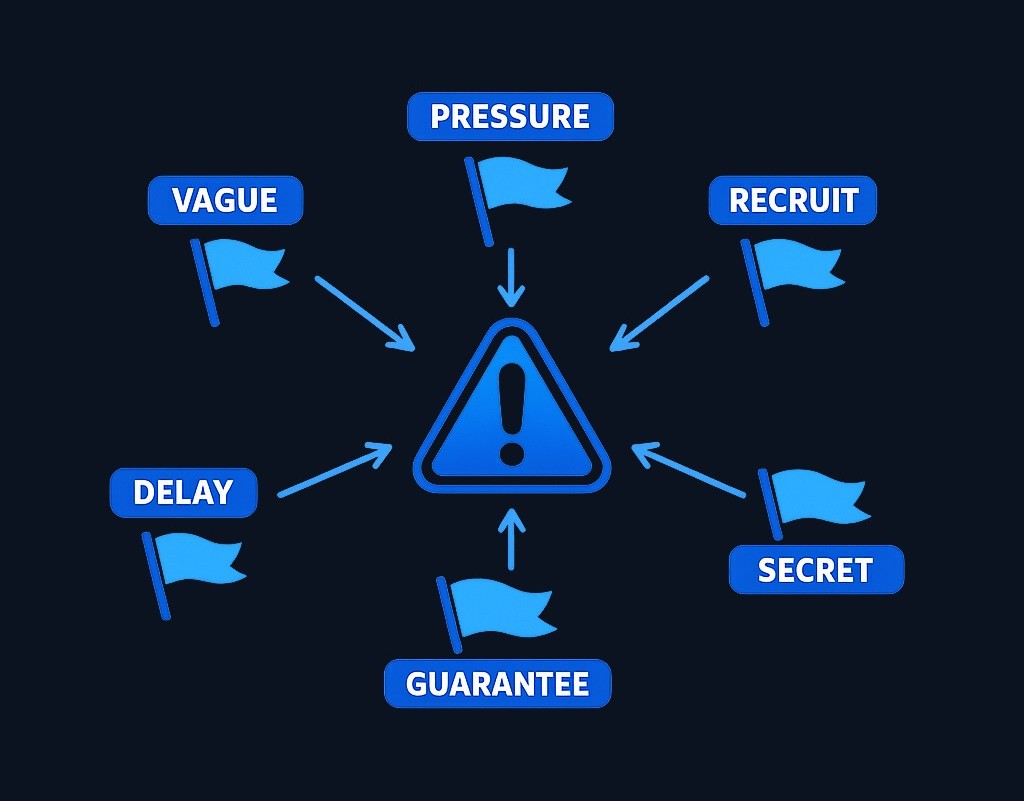
The SEC highlights guaranteed high returns and “too good to be true” offers as fraud red flags. Every investment has some degree of risk. A guarantee of high returns with no meaningful risk is a reason to stop and verify.
One clue alone does not classify an offer. Look at the complete picture. Where does the money come from? Who controls it? What must keep growing? Can an independent professional verify the explanation?
Legal implications and reporting
Do not send more money to unlock a withdrawal, preserve a bonus, or recover an earlier payment. Save contracts, statements, messages, payment records, names, dates, and the exact claims made. Do not recruit anyone else while you investigate.
In the United States, the SEC directs people who suspect a Ponzi scheme or another possible securities-law violation to its Tips, Complaints & Referrals form. For a suspected pyramid promotional scheme in the UK, the Competition and Markets Authority directs the public to Action Fraud. Its guidance also says victims can consult a lawyer or another legal representative for help seeking recovery.
Elsewhere, contact the securities regulator, consumer-protection authority, or law-enforcement body for your jurisdiction. If substantial money or possible liability is involved, consider independent legal advice. Available procedures and remedies depend on the facts and location.
Conclusion and next steps
Use one clear rule: follow the money. A Ponzi scheme routes new investment money to earlier investors. A pyramid scheme depends more directly on recruiting new paying participants. Both become dangerous when continued payments require continued growth.
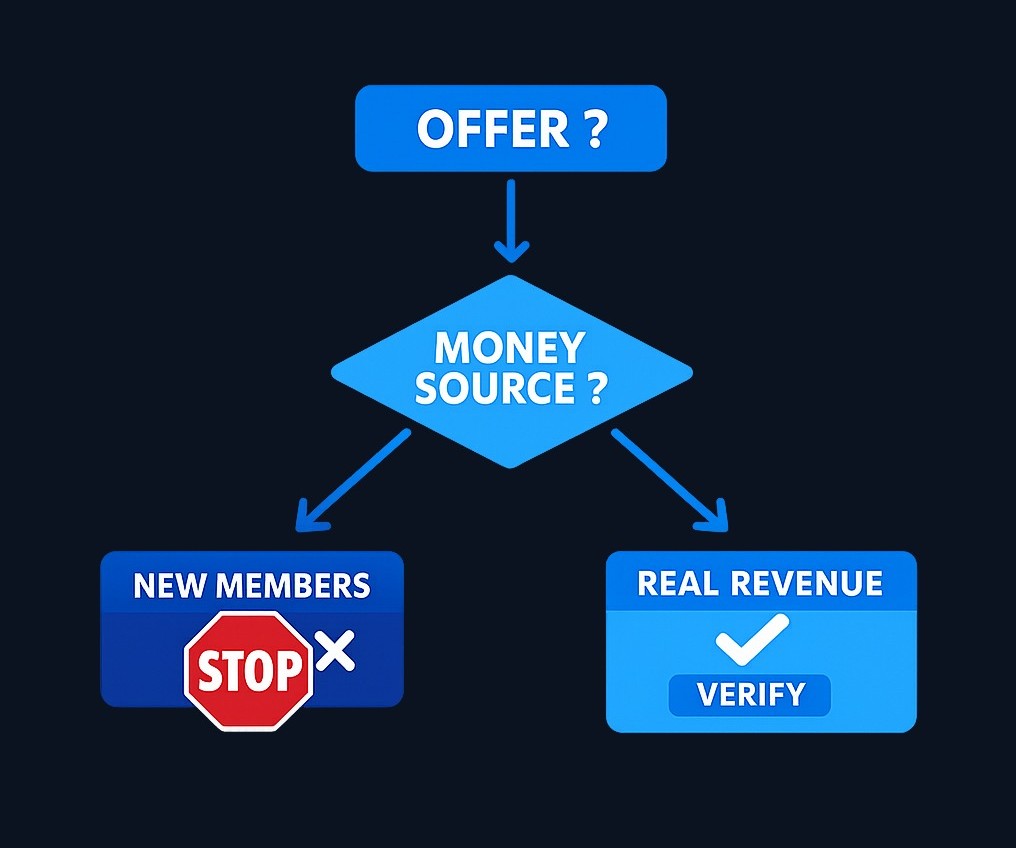
Before paying, slow down. Ask for a plain explanation of the revenue source, costs, withdrawal terms, and participant obligations. Verify the promoter and the offer through independent channels. If the answers do not hold together, do not add money or recruit others.
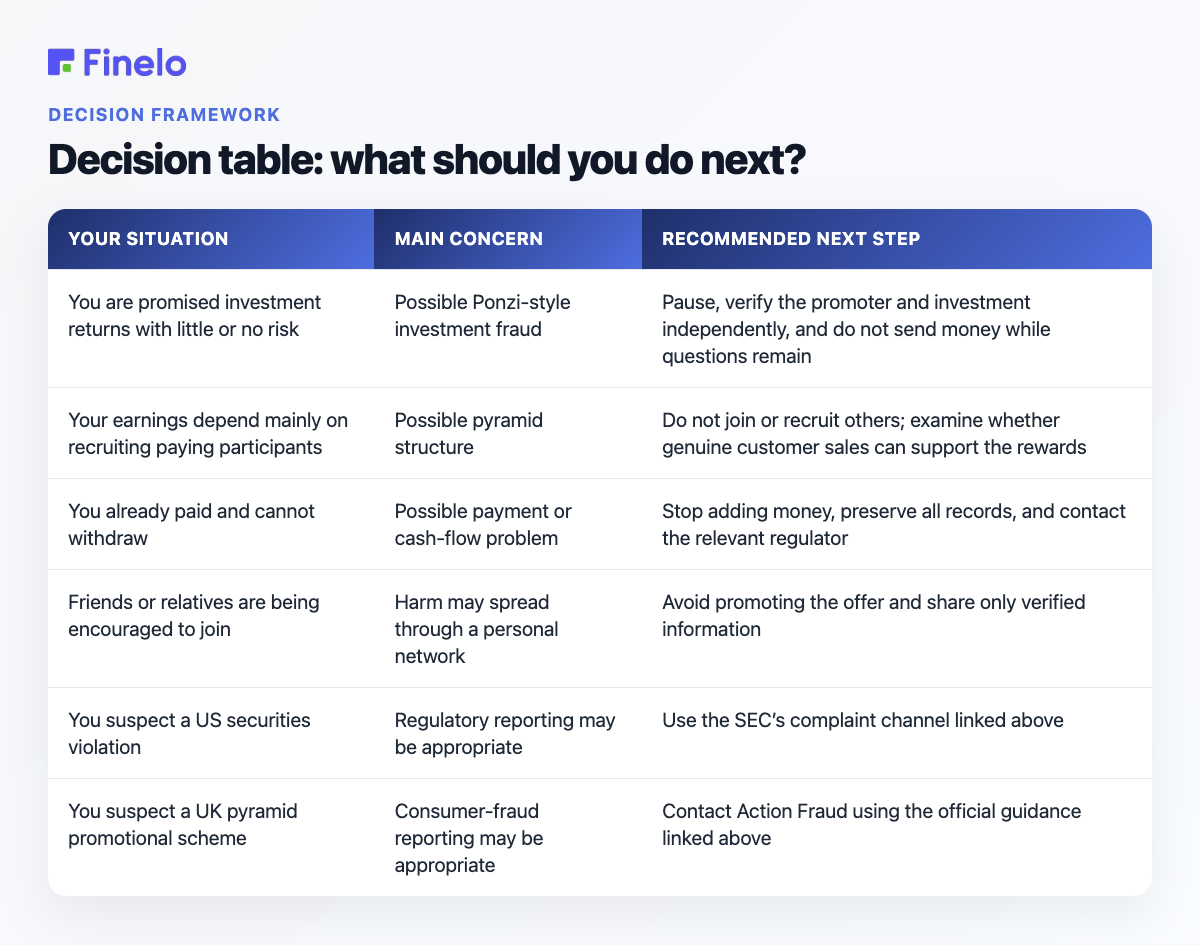
Decision table: what should you do next?
| Your situation | Main concern | Recommended next step |
|---|---|---|
| You are promised investment returns with little or no risk | Possible Ponzi-style investment fraud | Pause, verify the promoter and investment independently, and do not send money while questions remain |
| Your earnings depend mainly on recruiting paying participants | Possible pyramid structure | Do not join or recruit others; examine whether genuine customer sales can support the rewards |
| You already paid and cannot withdraw | Possible payment or cash-flow problem | Stop adding money, preserve all records, and contact the relevant regulator |
| Friends or relatives are being encouraged to join | Harm may spread through a personal network | Avoid promoting the offer and share only verified information |
| You suspect a US securities violation | Regulatory reporting may be appropriate | Use the SEC’s complaint channel linked above |
| You suspect a UK pyramid promotional scheme | Consumer-fraud reporting may be appropriate | Contact Action Fraud using the official guidance linked above |
Finelo offers investment-learning resources. Education can help you ask better questions, but it does not replace independent verification or personalized professional advice.
Frequently asked questions
Are Ponzi and pyramid schemes the same?
No. A Ponzi scheme disguises payments from new investors as investment returns. A pyramid scheme relies more directly on participants recruiting additional paying participants. Their structures differ, but both depend on new money continuing to enter.
Can a pyramid scheme involve a real product?
An offer can mention or include products and still raise concerns. The decisive question is whether rewards are supported by genuine customer demand or mainly by recruitment, required purchases, and participant payments.
Why do people trust these schemes?
They may see other people receiving money, hear confident explanations, or be approached by someone they know. Those signals can feel reassuring, but they do not establish where the payments originated or whether the arrangement can continue.
What is the safest first response to a suspicious offer?
Pause. Do not add money or recruit others. Preserve the evidence, independently examine the cash-flow explanation, and report suspected fraud to the relevant authority.
InvestingBeginnerInvestor ProtectionMarkets
Practice investing with Finelo
Build practical investing skills with guided lessons, simulator practice, and structured challenges.
About the author
Finelo Team
The Finelo Team creates practical investing and trading education designed to help beginners learn faster with structured challenges, simulator practice, and bite-sized lessons.
Keep reading — Related articles

Investing
I Bonds vs EE Bonds in 2026: Rates, Rules, and Which to Buy for the Long Run
Series I and Series EE savings bonds are both U.S. Treasury retail savings bonds sold on TreasuryDirect. They share ownership, tax treatment, and redemption rules; the key difference is the…
Finelo Team
Investing
Coverdell ESA vs 529 Plan: Limits, Flexibility, and Which to Choose
Quick answer (one minute) Both a Coverdell Education Savings Account (Coverdell ESA) and a 529 plan let money grow tax‑free and be withdrawn tax‑free for qualified education expenses. The…
Finelo Team
Investing
CD vs High Yield Savings Account: Where to Park Your Cash in 2026
Hero answer — CD vs high yield savings account in one line A CD (certificate of deposit) and a high yield savings account are both low‑risk, federally insured homes for cash — the difference…
Finelo Team