Portfolio diversification explained simply: how spreading investments across assets, sectors, and regions can manage risk — and what diversification cannot guarantee.
•12 min read
Practice investing with Finelo
Build practical investing skills with guided lessons, simulator practice, and structured challenges.
Portfolio diversification means spreading your money across different types of investments so your financial future does not depend on one company, one sector, or one market trend. For beginners, the goal is not to “pick the perfect mix,” but to understand how stocks, bonds, funds, cash, and other assets can behave differently over time.
Explore Finelo's 28-day challenges
Turn learning into a daily habit with guided challenge paths.
This guide is for new investors who want a plain-English explanation before making decisions with real money. The recommended next step after reading is to practice portfolio thinking in a learning environment, compare options carefully, and verify risk, costs, and suitability before investing. You can explore Finelo’s investing education resources through the Finelo app and compare user experiences on the Finelo reviews page.
Important: This article is educational only and is not financial advice. Diversification can help manage risk, but it does not remove risk or guarantee returns.
Key takeaways
Portfolio diversification is a risk-management idea, not a shortcut to better results. A diversified portfolio may include different asset classes, industries, regions, and investment styles so that a single setback has less influence on the whole account.
For beginners, the most useful starting point is usually a simple question: “What am I too dependent on?” If your money is mostly in one stock, one employer, one crypto asset, one country, or one theme, your portfolio may be more concentrated than you realize.
A basic learning path is to understand asset allocation, build a sample portfolio on paper, review the tradeoffs, and only then consider whether any real investment fits your goals, time horizon, risk tolerance, and costs.
What is diversification?
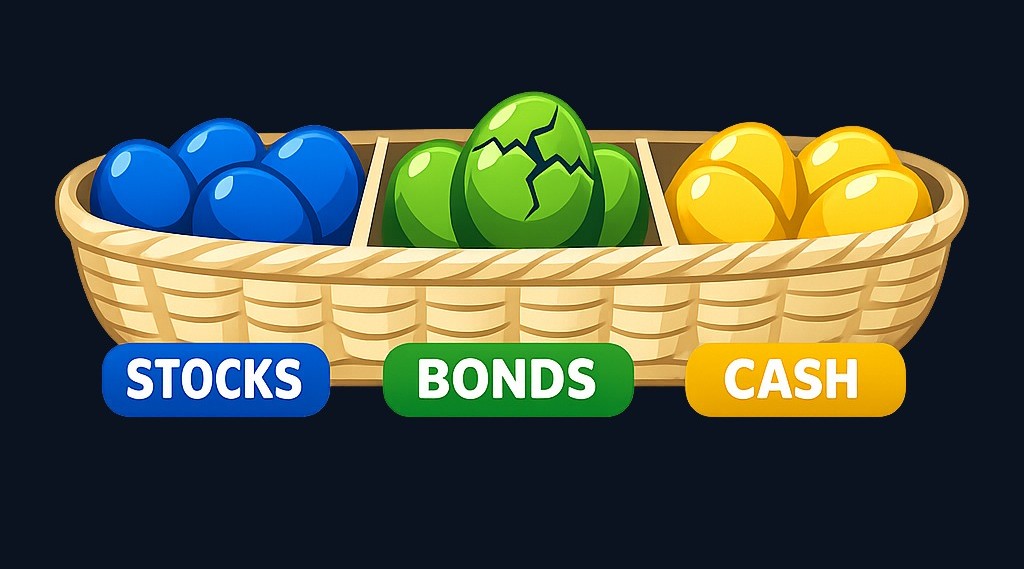
Diversification is the practice of spreading investments across multiple holdings so that your portfolio is not overly exposed to one source of risk. In everyday language, it is the investing version of not putting all your eggs in one basket. If one part of the basket breaks, the entire plan is less likely to fall apart.
Diversification means spreading investments across multiple holdings, reducing exposure to any single risk source. Like eggs in separate
A portfolio can be diversified in several ways. You can diversify by asset class, such as stocks, bonds, cash, real estate funds, or other investment categories. You can also diversify inside an asset class, such as owning shares across different industries instead of relying only on technology companies, energy companies, or banks.
For many beginners, funds can make this easier because a single mutual fund or exchange-traded fund may hold many underlying investments. That does not automatically make every fund suitable, low-risk, or inexpensive, but it can reduce the need to research individual securities one by one.
Fast fact: Diversification is about reducing avoidable concentration risk. It does not protect against every market decline, and a diversified portfolio can still lose value.
Why diversification matters
The main reason diversification matters is that different investments respond differently to economic conditions. A company’s stock may fall because of weak earnings, a regulatory issue, a failed product, or broader market pressure. Bonds may react to interest rate changes, credit concerns, and inflation expectations. Cash may feel stable in nominal terms, but it can lose purchasing power when prices rise.
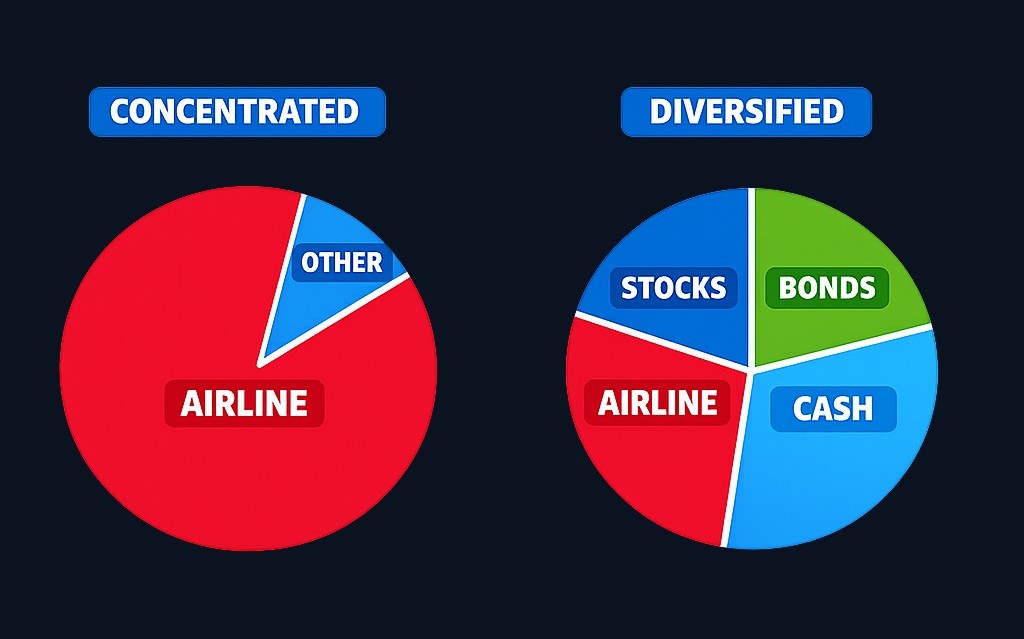
When a portfolio is concentrated, one bad outcome can dominate everything else. Imagine someone who owns only one airline stock. Their result depends heavily on fuel costs, travel demand, labor issues, debt levels, and the company’s management decisions. If that investor instead owns a broader mix of companies, bonds, and cash, the airline’s performance still matters if it is included, but it no longer controls the whole story.
A concentrated portfolio depends heavily on one investment's performance. A diversified portfolio spreads that dependency across
Diversification also helps beginners avoid confusing luck with skill. A single stock can rise quickly and make a new investor feel confident, but that does not prove the approach is durable. A more balanced portfolio encourages thinking in terms of process: allocation, risk, time horizon, costs, and review habits.
Still, it is worth being precise. Diversification may reduce the impact of a single failing investment, but it does not guarantee gains, prevent losses, or remove the discomfort of volatility. Broad markets can fall together during stressful periods, and even well-diversified investors need to understand that risk is part of investing.
What to know before deciding
Before deciding how to diversify, beginners should understand the difference between portfolio construction and investment selection. Portfolio construction asks, “What roles should different assets play in my overall plan?” Investment selection asks, “Which specific fund, stock, bond, or account should I use?” The first question usually comes before the second.
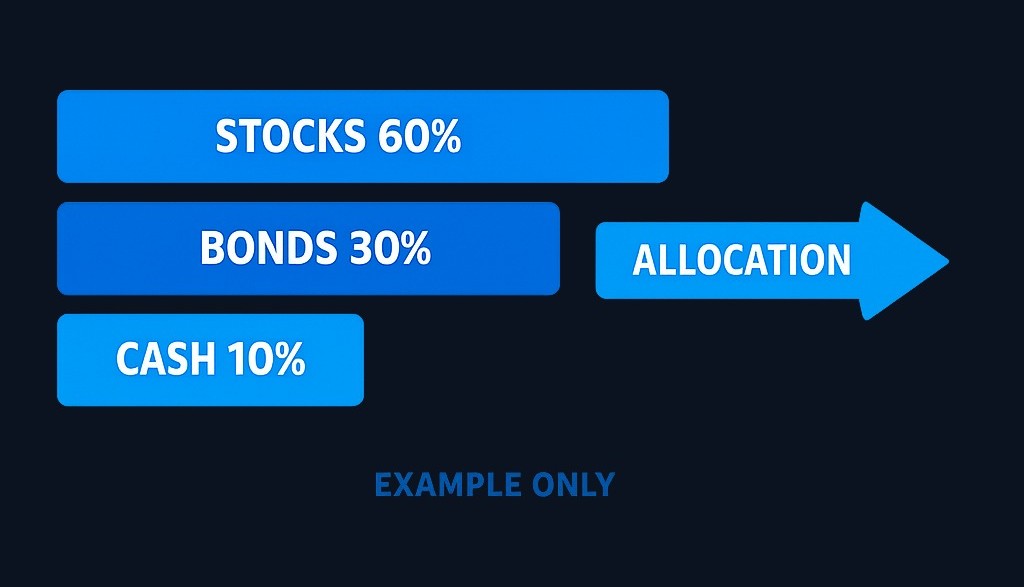
Asset allocation is the broad mix of asset types in a portfolio. For example, a hypothetical beginner learning portfolio might compare stocks for long-term growth potential, bonds for income and relative stability, and cash for short-term needs. This is only an illustration, not a recommended allocation. The right mix depends on personal factors such as time horizon, risk tolerance, liquidity needs, tax situation, and costs.
Asset allocation defines the broad mix of asset types in your portfolio before selecting specific investments. The right allocation depends
Time horizon matters because money needed soon usually cannot tolerate the same volatility as money intended for decades from now. A person saving for a home down payment next year has a different problem from someone investing for retirement many years away. If the time horizon is short, a sharp market drop may not leave enough time to recover before the money is needed.
Risk tolerance is not just a quiz result. It includes how you behave when markets fall, how secure your income is, how much emergency savings you have, and whether you understand what you own. Many beginners overestimate their comfort with volatility during rising markets and discover their real tolerance only when prices move against them.
Costs also matter. Fund fees, trading costs, spreads, taxes, and account charges can affect results over time. Before using any investment product or education platform, check the current pricing, billing terms, and support resources directly from the provider. ## Decision framework
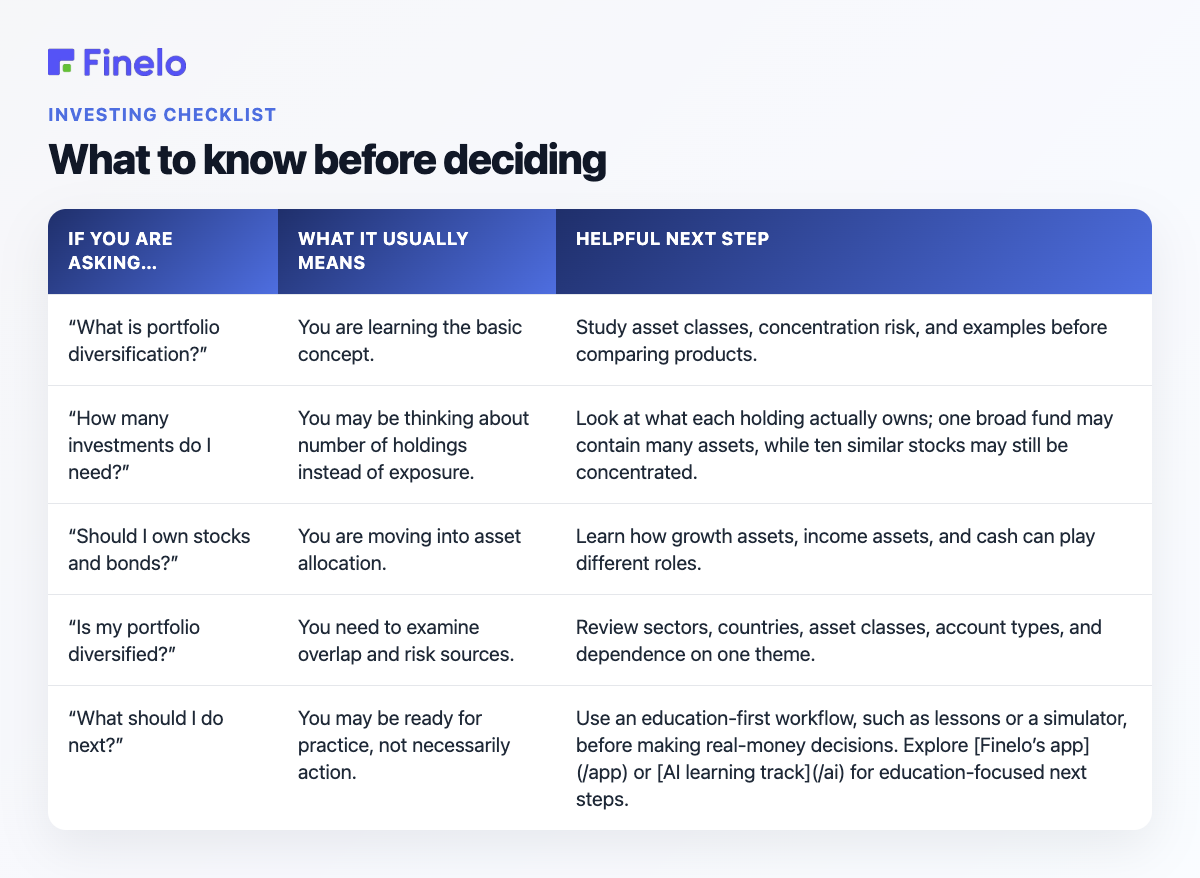
A beginner does not need a complex model to start thinking clearly. A useful framework is to match your current question with the next safe learning step. The table below is educational and does not recommend any specific investment.
If you are asking…
What it usually means
Helpful next step
“What is portfolio diversification?”
You are learning the basic concept.
Study asset classes, concentration risk, and examples before comparing products.
“How many investments do I need?”
You may be thinking about number of holdings instead of exposure.
Look at what each holding actually owns; one broad fund may contain many assets, while ten similar stocks may still be concentrated.
“Should I own stocks and bonds?”
You are moving into asset allocation.
Learn how growth assets, income assets, and cash can play different roles.
“Is my portfolio diversified?”
You need to examine overlap and risk sources.
Review sectors, countries, asset classes, account types, and dependence on one theme.
“What should I do next?”
You may be ready for practice, not necessarily action.
Use an education-first workflow, such as lessons or a simulator, before making real-money decisions. Explore Finelo’s app or AI learning track for education-focused next steps.
Reference table from this guide — What to know before deciding.
The most common beginner mistake is assuming that more holdings automatically mean more diversification. If you own five different technology stocks, you have five holdings, but they may still respond to the same market forces. Likewise, two funds with different names can hold many of the same companies underneath, creating hidden overlap.
A better question is: “What risks am I exposed to, and are they intentional?” Concentration in one employer’s stock, one country, one sector, one currency, or one investing theme can be acceptable for some people in some circumstances, but it should be understood rather than accidental.
A simple diversified portfolio example
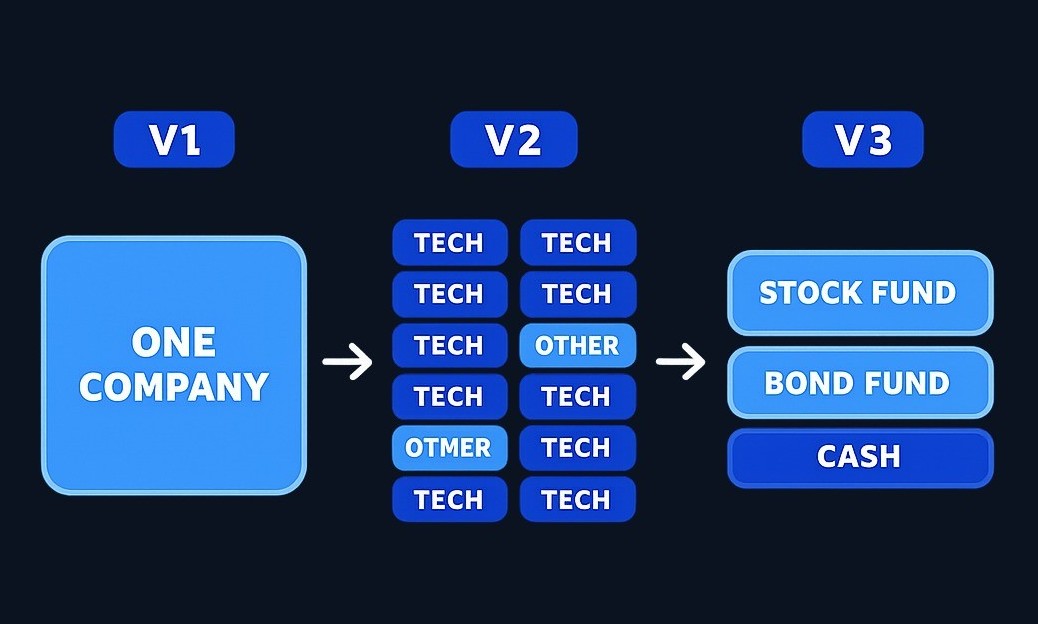
Consider a beginner named Maya who is learning how portfolio basics work. She has heard about several popular stocks from friends, but she notices that most of them are in the same industry. Instead of deciding immediately, she creates a paper portfolio to compare three approaches.
In the first version, Maya puts the entire sample portfolio into one company. This is easy to understand, but it depends almost entirely on that company’s future. In the second version, she chooses ten companies, but eight are in the same sector. That feels more diversified, yet the portfolio may still move heavily with that sector’s news.
In the third version, Maya compares a broader mix: a stock fund with exposure to many companies, a bond fund, and a cash allocation for short-term stability. This example is not a recommended portfolio and does not say what Maya should buy. It simply shows how portfolio construction changes the question from “Which stock do I like?” to “What role does each part play?”
Maya's three sample portfolios show how structure changes risk. Version 1 depends entirely on one company. Version 2 spreads across
That shift is important. Beginners often focus on exciting investments first and risk management later. A portfolio mindset reverses the order: understand the purpose of each asset, the downside you can tolerate, the time frame, and the costs before choosing specific investments.
Practice investing with Finelo
Build practical investing skills with guided lessons, simulator practice, and structured challenges.
Once the concept is clear, the practical work is mostly about observation and discipline. You do not need to predict the market to identify obvious concentration. Start by listing what you own, what each investment contains, and why it is there.
A beginner-friendly checklist can help:
List every holding. Include individual stocks, funds, retirement accounts, cash, crypto assets, and employer stock if applicable.
Group by asset class. Separate stocks, bonds, cash, real estate exposure, and other categories.
Check sector and company overlap. Two different funds may own similar large companies.
Consider geography. A portfolio focused only on one country may behave differently from one with broader global exposure.
Review your time horizon. Money needed soon should be treated differently from long-term investing money.
Look at fees and taxes. Costs can reduce investment outcomes and should be understood before buying.
Write down your reason. If you cannot explain why an asset is in the portfolio, you may need more learning before acting.
This process is not about creating a perfect allocation on the first try. It is about making hidden assumptions visible. Once you can see your exposures, you can ask better questions and seek qualified guidance when needed.
If you are still learning, consider using educational resources before making decisions with real money. Finelo is an investment learning and financial education product. You can also explore related learning pages such as Finelo app, Finelo AI learning, and Finelo reviews.
Common mistakes to avoid
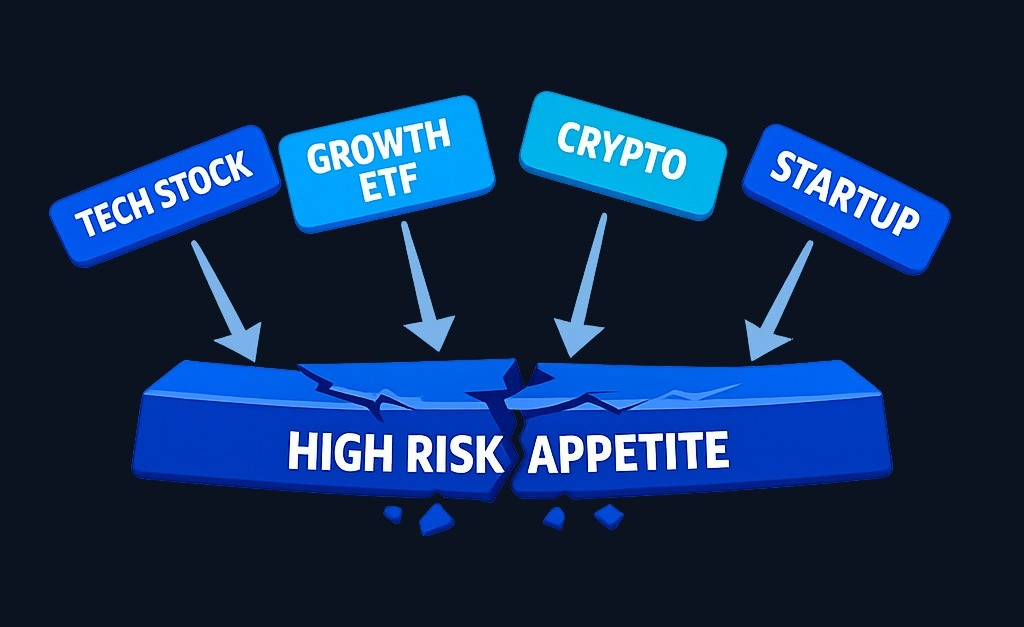
One common mistake is confusing diversification with owning whatever is popular. A beginner might buy a trendy stock, a thematic ETF, a cryptocurrency, and a few growth companies and assume the portfolio is spread out. But if all of those assets depend on investor appetite for high-risk growth, they may fall together during a market downturn.
Assets that seem different can share hidden risk factors. When all holdings depend on the same market sentiment (like appetite for high-
Another mistake is ignoring cash needs. Investing money that may be needed soon can force someone to sell during a bad moment. Diversification helps with portfolio risk, but it does not solve a short-term liquidity problem. Emergency savings and near-term expenses require separate planning.
Beginners can also over-diversify in a way that becomes hard to manage. Holding too many overlapping funds may create clutter without adding much protection. The goal is not to collect investments; it is to build a structure you understand.
Finally, avoid treating any article, app, influencer, or example portfolio as personalized advice. Educational content can explain concepts and help you ask better questions, but personal suitability depends on your full financial picture. Consider consulting a qualified financial professional for advice tailored to your circumstances.
Related questions beginners often have
Portfolio diversification connects to several nearby ideas: asset allocation, rebalancing, risk tolerance, index funds, long-term investing, and portfolio review habits. These topics are often discussed together because they influence one another.
For example, asset allocation sets the broad mix, while rebalancing is the process of adjusting that mix over time if market movement changes it. A portfolio that begins with a balanced structure may become more stock-heavy after a strong equity market or more conservative after a decline. Rebalancing has costs and tax considerations, so it should be understood before being used.
Index funds and broad market funds are also part of many beginner conversations because they can provide exposure to many securities through one product. However, “broad” does not always mean “right for you.” The fund’s holdings, fees, risks, tracking method, and account type all matter.
The larger point is that diversification is not a one-time box to check. It is a habit of asking whether your portfolio still matches your goals, timeline, risk capacity, and understanding.
Next steps
Portfolio diversification is one of the first concepts beginners should understand because it changes how you think about investing. Instead of asking only which investment looks attractive, you begin asking how each asset fits into the whole portfolio, what risks you are taking, and whether those risks match your time horizon.
If you are new to investing, your next step does not have to be buying anything. Learn the vocabulary, practice with examples, compare costs, and verify suitability before making decisions. For an education-first path, visit the Finelo app, explore Finelo AI learning, or read Finelo reviews to understand how other learners describe the platform.
Frequently asked questions
What is portfolio diversification in simple terms?
Portfolio diversification means spreading your investments across different assets so one holding does not control your entire outcome. A beginner might think about spreading exposure across companies, industries, asset classes, and regions rather than relying on a single stock or trend.
Does diversification guarantee better returns?
No. Diversification does not guarantee profits, prevent losses, or ensure better returns than a concentrated portfolio. Its main purpose is to manage risk by reducing dependence on any single investment or narrow category.
What is the difference between diversification and asset allocation?
Asset allocation is the broad mix of asset classes, such as stocks, bonds, and cash. Diversification is the broader practice of spreading risk across and within those categories. Asset allocation is one of the main tools used to build a diversified portfolio.
Can I be diversified with only one fund?
Sometimes a single broad fund may hold many underlying investments, but you still need to understand what it owns, what it costs, and what risks it carries. One fund can be diversified in one sense and still be concentrated in another, such as being focused on one country, sector, or asset class.
How often should beginners review diversification?
A common learning approach is to review whenever your goals, time horizon, income situation, or holdings change. Some investors also review on a set schedule, such as annually or semiannually, but the right cadence depends on the person and account type.
What should I do after learning the basics?
Start by practicing the concept before making real-money changes. Write down a sample portfolio, identify its asset classes, look for overlap, and note which risks you understand. To continue learning, explore the Finelo app, review Finelo user feedback, or compare education-focused investing resources.
The Finelo Team creates practical investing and trading education designed to help beginners learn faster with structured challenges, simulator practice, and bite-sized lessons.