The short answer: private equity (PE) buys established companies to improve and resell them, while venture capital (VC) funds young startups hoping a few grow enormously. Private equity generally targets mature businesses that need restructuring or fresh growth capital. Venture capital backs early-stage companies whose value lies almost entirely in their future potential.
Private Equity vs. Venture Capital: A Detailed Comparison
The short answer: private equity (PE) buys established companies to improve and resell them, while venture capital (VC) funds young startups hoping a few grow enormously. Private equity generally targets mature…
6 min read
Practice investing with Finelo
Build practical investing skills with guided lessons, simulator practice, and structured challenges.
Want to learn more?
Build practical investing skills with guided lessons, simulator practice, and structured challenges.
Explore FineloExplore Finelo's 28-day challenges
Turn learning into a daily habit with guided challenge paths.
Both invest in companies that aren't traded on public stock exchanges, and both aim to sell their stakes later at a profit. Everything else — company age, ownership level, risk math, and day-to-day involvement — splits sharply. This comparison walks through each difference, then gives founders and curious investors a decision framework for which world fits their situation.
Key Differences Between Private Equity and Venture Capital
Start with the shared foundation. Private equity, in the broad sense, means investing in company shares that aren't publicly listed, with capital typically supplied by institutions and wealthy individuals. Venture capital is technically a subset of that private-markets world. In everyday usage, though, "PE" and "VC" name two distinct professions with opposite instincts.
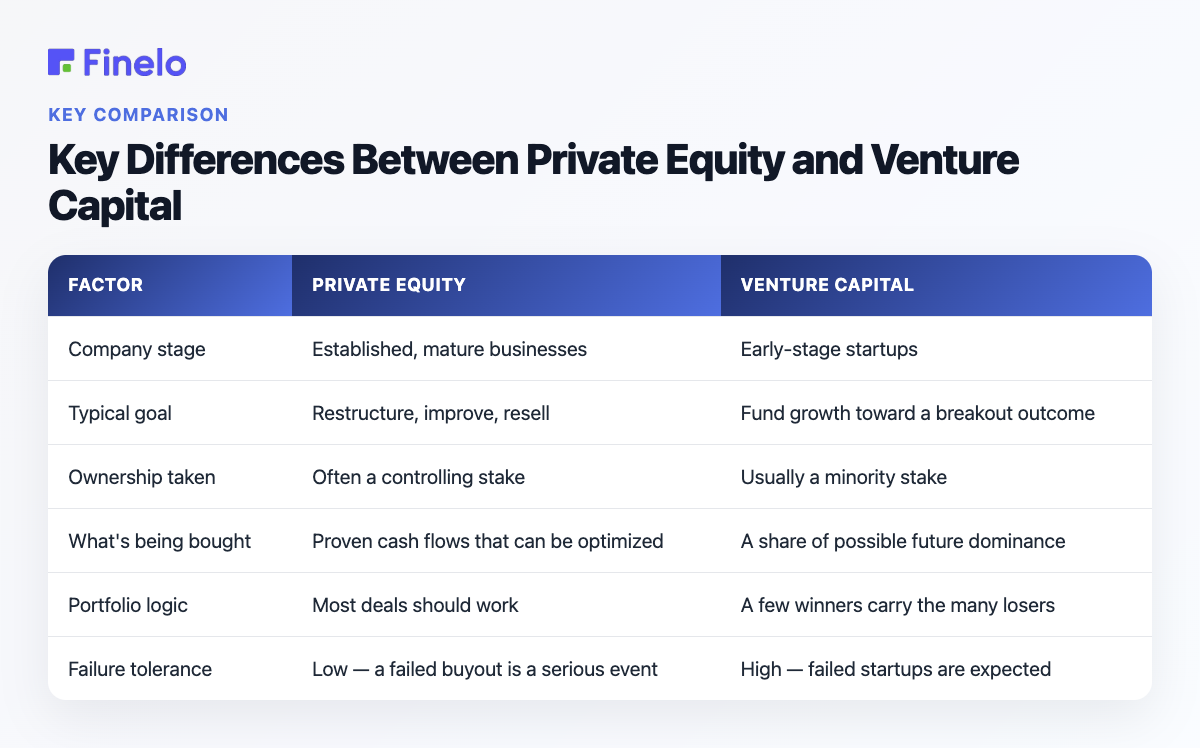
| Factor | Private equity | Venture capital |
|---|---|---|
| Company stage | Established, mature businesses | Early-stage startups |
| Typical goal | Restructure, improve, resell | Fund growth toward a breakout outcome |
| Ownership taken | Often a controlling stake | Usually a minority stake |
| What's being bought | Proven cash flows that can be optimized | A share of possible future dominance |
| Portfolio logic | Most deals should work | A few winners carry the many losers |
| Failure tolerance | Low — a failed buyout is a serious event | High — failed startups are expected |
Two rows deserve unpacking.
Control. A PE firm typically wants enough ownership to change things: replace management, cut costs, redirect strategy. That's the whole thesis — buy a decent business, run it better, exit. A VC firm usually takes a minority position across many startups. It influences through board seats and advice, not command.
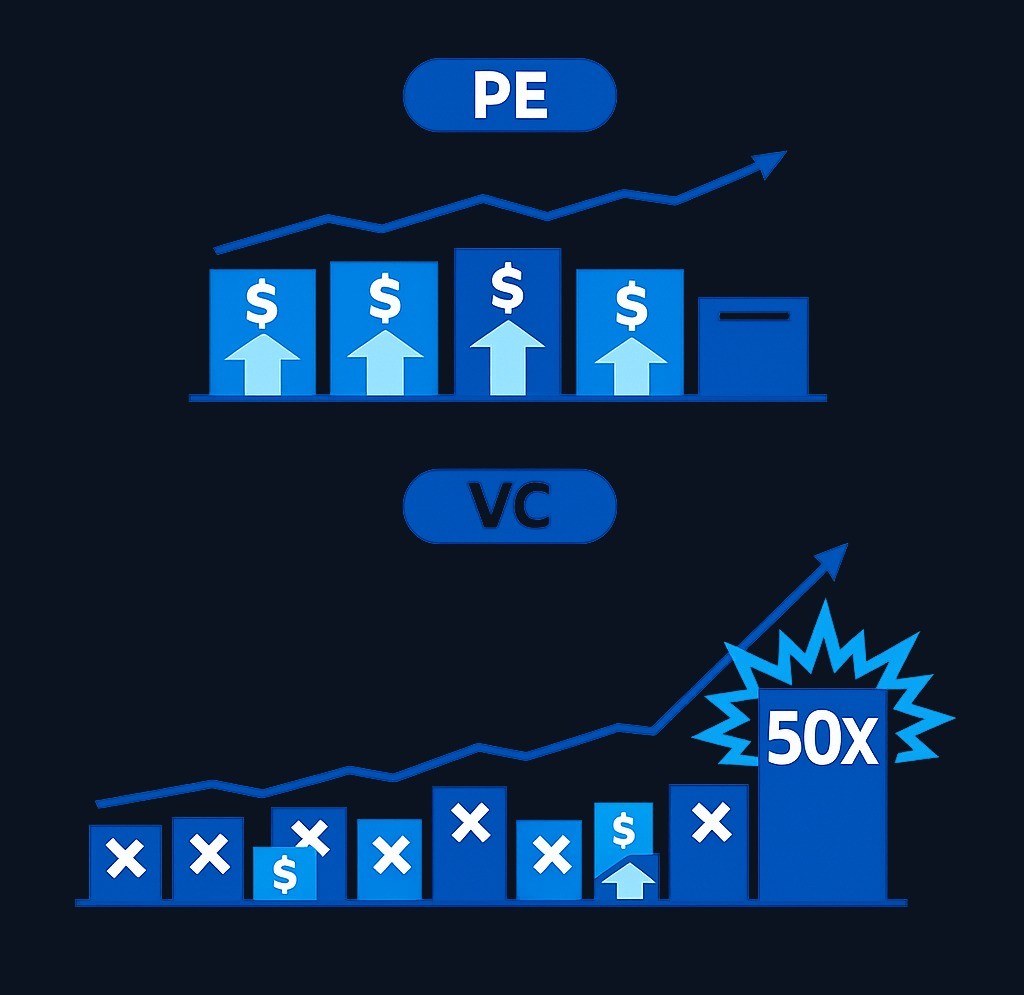
Portfolio math. PE aims for steady, repeatable wins; underwriting assumes the business already works. VC accepts that most bets will return little, because one breakout can pay for the entire fund. This single difference in math explains nearly every behavioral difference between the two — from how they negotiate to how they react when a company struggles.
Investment Strategies: How PE and VC Operate
The PE playbook centers on the buyout. A typical cycle looks like this:
- Acquire a company, often using a mix of investor capital and borrowed money.
- Improve it: streamline operations, professionalize management, expand into new markets, or merge it with similar businesses.
- Hold for a multi-year improvement period.
- Exit by selling to another buyer or taking the company public.
The return comes from buying well, improving genuinely, and often from leverage amplifying gains. Leverage cuts both ways, though. Debt that magnifies profits in good years magnifies distress when revenue dips — which is why PE prefers businesses with stable, predictable cash flows that can service borrowing.
The VC playbook centers on staged funding rounds:
- A startup raises a seed round to prove an idea.
- Successive rounds — Series A, B, C — follow as evidence accumulates.
- Each round prices the company higher if progress holds, and investors add or step back.
VCs invest at every stage knowing the picture is incomplete: the product may not scale, the market may not materialize, competitors may win. In exchange for that uncertainty, they buy in at valuations that can multiply many times over if the company succeeds.
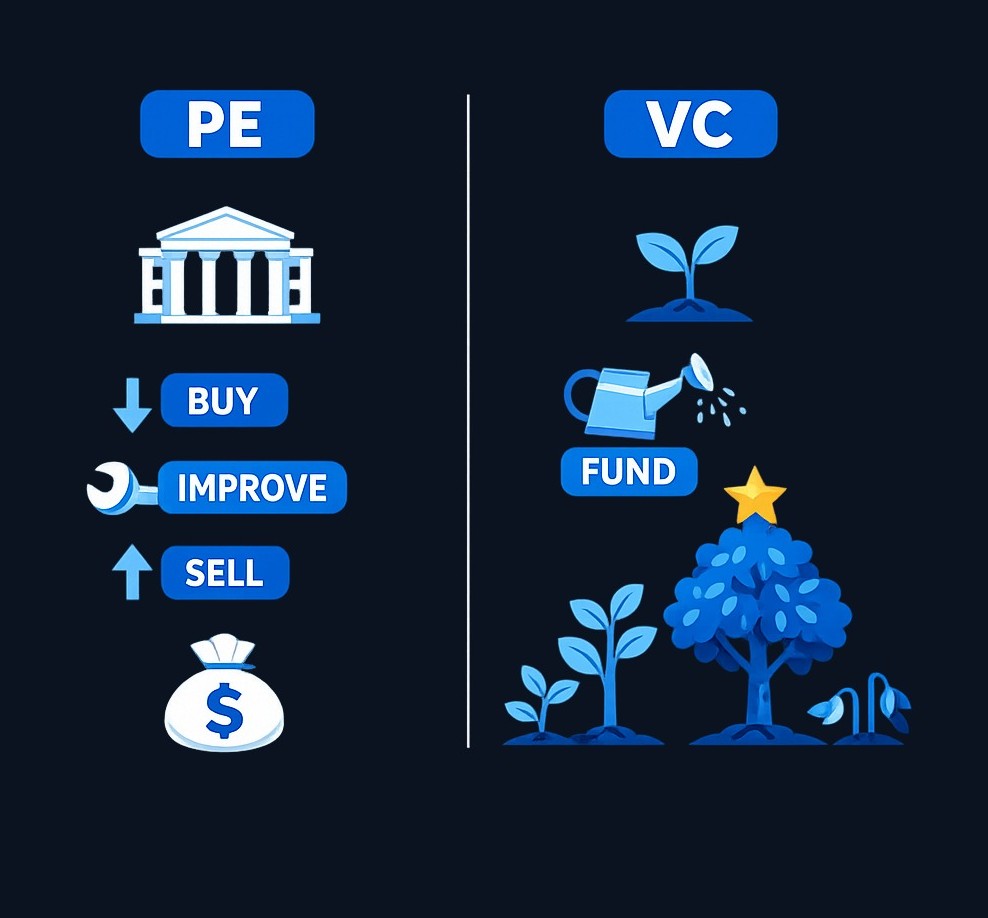
A useful mental contrast: PE performs surgery on companies with a track record; VC plants seeds and tends the few that sprout. One's craft is fixing what exists, the other's is selecting what might exist.

Target Companies: Who Do They Invest In?
PE looks for durability. The classic target has:
- Years of revenue history and real profits, or a clear path to them
- Stable demand — think manufacturing, healthcare services, consumer staples, business services
- Tangible assets and loyal customers
- Improvable inefficiency: outdated systems, an unfocused product line, or a founder ready to retire
What attracts a PE firm isn't excitement; it's a solid business that could run better under new ownership.
VC looks for scalability. The classic target has:
- A young team attacking a large market with something new
- Economics — usually software — where revenue can grow far faster than costs
- A plausible path to becoming many times bigger, fast
- Little or no profit today, which is expected and accepted
A niche business with a comfortable ceiling, however profitable, rarely interests a VC — the portfolio math demands outcomes large enough to matter.
The consequence for founders is direct. If your company is pre-revenue with a big vision, PE has nothing to buy — there are no cash flows to optimize. If your company is a steady, profitable regional business, VC has nothing to fund — there's no plausible 50x outcome. Matching your company's shape to the investor's math saves months of misdirected pitching, and mismatched pitches are among the most common fundraising mistakes.
Practice investing with Finelo
Build practical investing skills with guided lessons, simulator practice, and structured challenges.
Risk Profiles: Understanding the Risks Involved
Both carry real risk, but the risks live in different places.
PE risk is concentrated and leveraged. Deals are large and few, so a single failed buyout hurts the fund badly. Debt adds fragility: an economic downturn that cuts a portfolio company's revenue can turn a manageable loan into an existential problem. The bet is that operational skill and stable cash flows keep that scenario rare.
VC risk is distributed and binary. Any individual startup investment is more likely to fail than a buyout — young companies die from a hundred causes. But each position is small relative to the fund, and the model prices in failure. The real risk for a VC fund isn't losing on most startups; it's missing the one winner that was supposed to pay for everything.
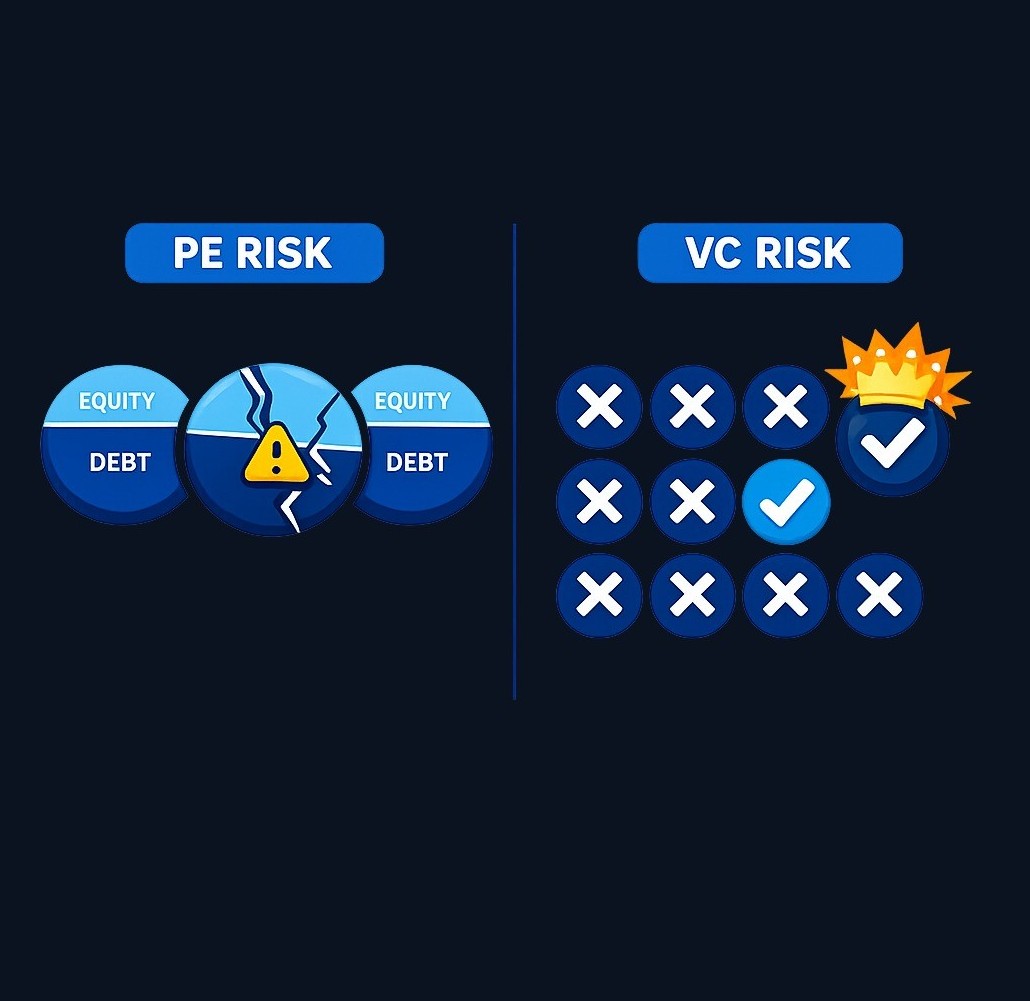
For anyone studying these industries: both are also illiquid. Money commits for years, and there's no exchange to sell on if you change your mind. That illiquidity, more than anything else, is what separates private-market investing from buying public stocks or funds.
Operational Involvement: How PE and VC Firms Engage
PE firms operate. With control comes responsibility. PE owners commonly:
- Install new executives and restructure departments
- Renegotiate supplier and customer contracts
- Set aggressive financial targets and track them closely
- Deploy in-house operations teams whose whole job is improving portfolio companies
For employees of an acquired company, a PE buyout often means visible change within months.
VC firms advise. A venture investor with a minority stake can't dictate. Instead, they:
- Take board seats and shape strategy through governance
- Help recruit key executives and engineers
- Open doors to customers, partners, and later-round investors
- Coach founders through decisions they've seen dozens of times
The founder still runs the company — good VCs amplify a team rather than replace it.
The founder's trade-off is autonomy versus resources at different intensities. Selling to PE usually means handing over the steering wheel in exchange for liquidity and operational muscle. Raising VC means keeping the wheel but adding passengers with opinions — and expectations of very fast driving.
Choosing Between Private Equity and Venture Capital
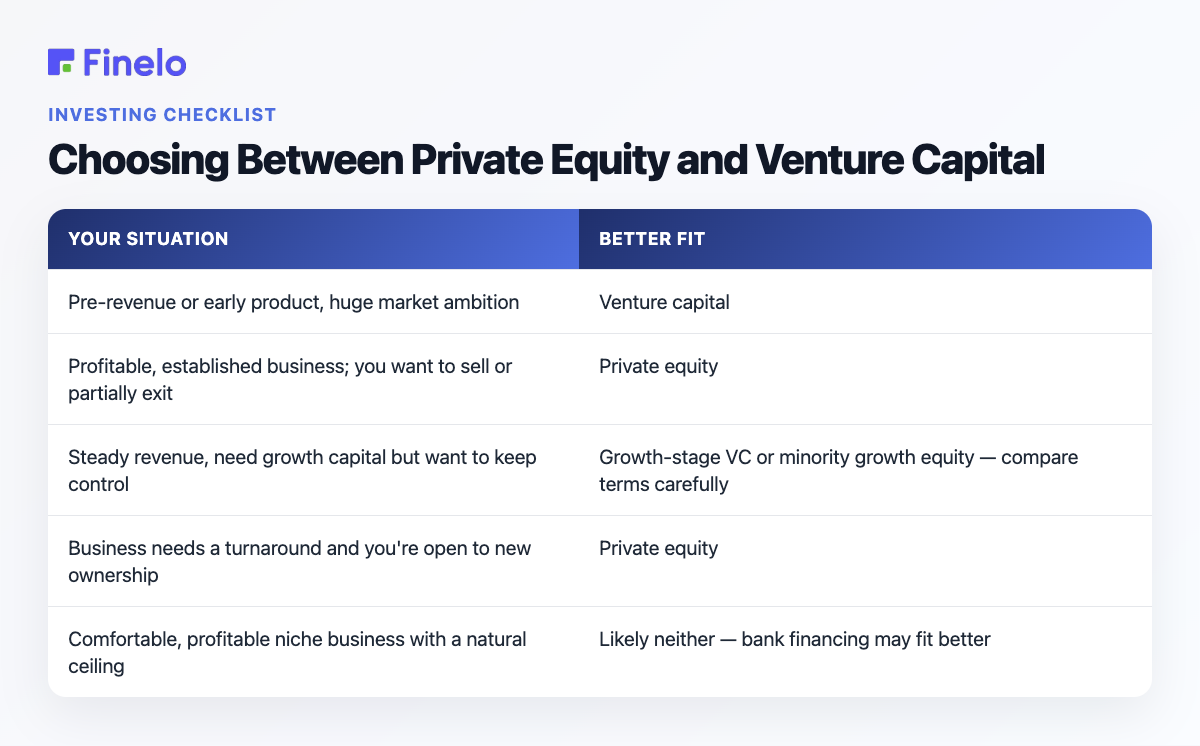
For a founder deciding which door to knock on, match your situation to the row:
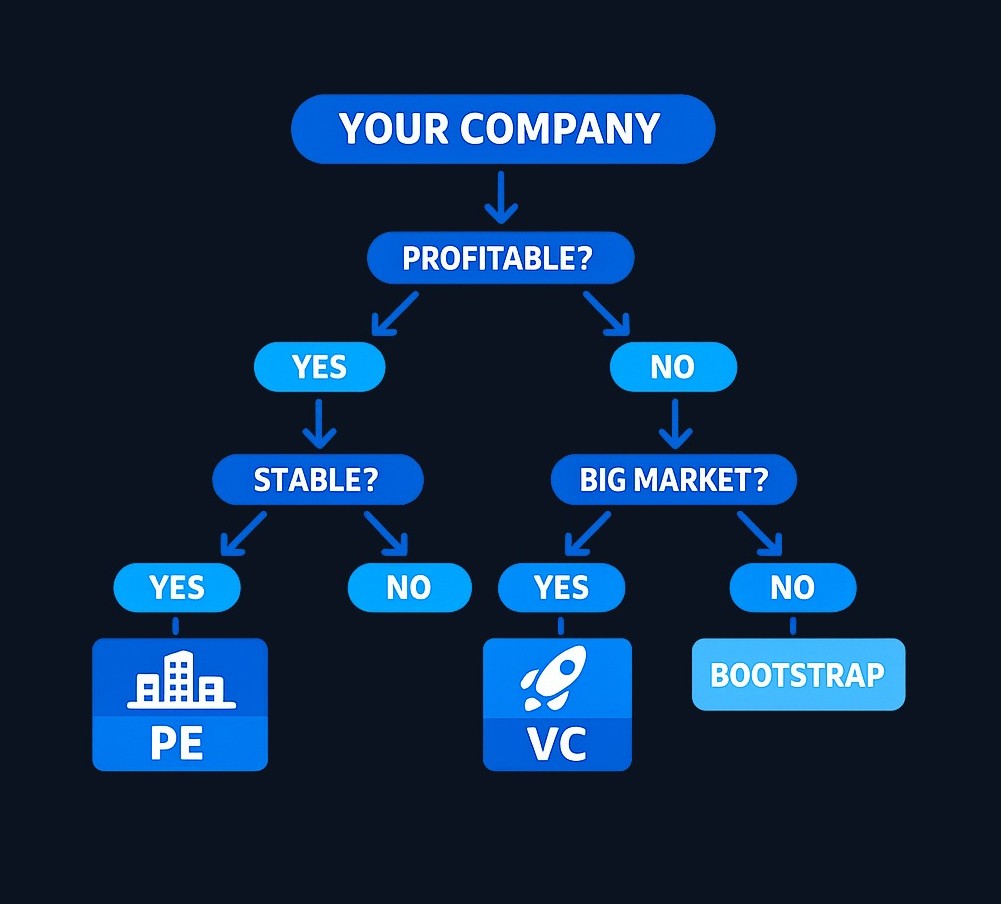
| Your situation | Better fit |
|---|---|
| Pre-revenue or early product, huge market ambition | Venture capital |
| Profitable, established business; you want to sell or partially exit | Private equity |
| Steady revenue, need growth capital but want to keep control | Growth-stage VC or minority growth equity — compare terms carefully |
| Business needs a turnaround and you're open to new ownership | Private equity |
| Comfortable, profitable niche business with a natural ceiling | Likely neither — bank financing may fit better |
For an aspiring investor or career-switcher, the choice is temperamental. PE rewards analytical rigor, operational judgment, and comfort with debt structures. VC rewards pattern recognition, network-building, and comfort with being wrong most of the time. Both demand long time horizons and tolerance for illiquidity.
For an everyday investor, the honest note: direct access to PE and VC funds is generally limited to institutions and wealthy individuals, and the risks are substantial. Understanding how these investors think is still valuable — their incentives shape the companies, jobs, and products around you, and they explain why some businesses chase growth while others chase efficiency.
Frequently asked questions
How long do PE and VC investments usually last?
Both are multi-year commitments. PE firms typically hold a company through an improvement cycle before selling; VCs may stay invested from an early round all the way to an acquisition or public listing. In both worlds, capital is locked up for years, not months.
What role do venture capitalists play in the companies they back?
Advisors with skin in the game: board participation, help with hiring, introductions to customers and future investors, and guidance drawn from seeing many startups. They influence rather than control, since they usually hold minority stakes.
Can the same firm do both PE and VC?
Yes — large investment firms often run separate funds for buyouts and venture bets. The strategies stay distinct even under one roof, because the skills and portfolio math differ so much.
Which is riskier?
Per company, venture capital — startups fail far more often than established businesses. Per portfolio, the comparison narrows: VC spreads many small bets, while PE concentrates fewer, larger, debt-amplified ones. Different shapes of risk, not simply more and less. Both industries are complex, and this comparison is educational — not investment or fundraising advice. Verify any fund's terms, risks, and suitability with qualified professionals before committing money or equity. If you're building the investing knowledge to understand markets like these, Finelo's Wealth Growth [Quiz](https://finelo.com/) can match you with a learning path for your level.
InvestingBeginnerPrivate MarketsMarkets
Practice investing with Finelo
Build practical investing skills with guided lessons, simulator practice, and structured challenges.
About the author
Finelo Team
The Finelo Team creates practical investing and trading education designed to help beginners learn faster with structured challenges, simulator practice, and bite-sized lessons.
Keep reading — Related articles

Investing
Yield to Call vs Yield to Maturity: Assumptions and Bond Risks
Yield to call (YTC) estimates a bond's yield if the issuer redeems it on an eligible call date; yield to maturity (YTM) estimates yield if it remains outstanding to final maturity.
Finelo Team
Investing
Will My Employer Know If I Take a 401(k) Loan?
Who this page is for: readers new to 401(k) loans who want a practical, privacy‑focused explanation — what your employer can see, how to limit visibility, and the financial tradeoffs to weigh.
Finelo Team

Investing
What Medical Expenses Qualify for a 401(k) Hardship Withdrawal?
Before you decide, confirm three things with your plan administrator:
Finelo Team