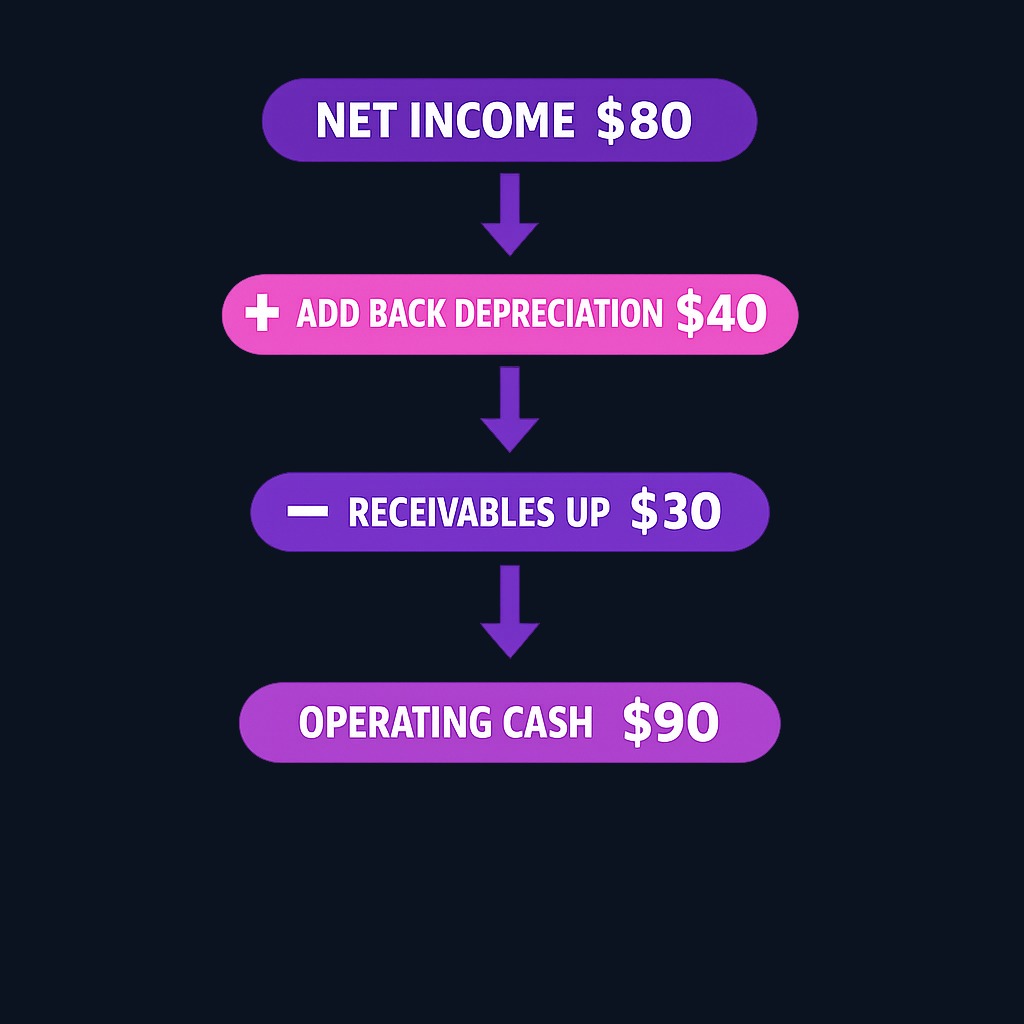
This article focuses on the reconciliation inside the cash-flow statement rather than repeating a general net-income-versus-free-cash-flow comparison. Under the indirect method, the company starts with net income and adjusts for noncash items and changes in operating assets and liabilities to arrive at cash provided by operating activities.
How to Reconcile Net Income to Operating Cash Flow

This article focuses on the reconciliation inside the cash-flow statement rather than repeating a general net-income-versus-free-cash-flow comparison. Under the indirect method, the company starts with net income and…
8 min read
Practice investing with Finelo
Build practical investing skills with guided lessons, simulator practice, and structured challenges.
Want to learn more?
Build practical investing skills with guided lessons, simulator practice, and structured challenges.
Explore FineloExplore Finelo's 28-day challenges
Turn learning into a daily habit with guided challenge paths.
A practical reconciliation checklist
- Add back noncash expenses such as depreciation and amortization, then inspect whether the related assets still require substantial capital spending.
- Reverse gains and losses whose cash proceeds belong in investing activities, such as a gain on an asset sale.
- Subtract increases in receivables and inventory because they use operating cash; add decreases, subject to business context.
- Add increases in accounts payable and accrued liabilities because they conserve cash in the period; investigate whether payment delays are sustainable.
- Treat stock compensation, deferred taxes, provisions, contract assets, and other adjustments according to the issuer's policy and footnotes.
- Reconcile the subtotal to the filed statement and compare the adjustments across several like periods.
The exercise explains where accrual earnings and operating cash diverged. It does not establish that operating cash flow is “truer”: collection timing, supplier payments, classification choices, factoring, and one-off working-capital movements can all alter a period.
Net income is a company's accounting profit: revenue minus all expenses, including non-cash charges, computed under accrual rules. Cash flow is the money that actually moved in and out during the period. A business can report strong net income while bleeding cash, or report losses while generating plenty of it. This page is for investors learning to read financial statements and for anyone comparing companies whose "profit" and "cash" tell different stories. Below you will find clear definitions, a side-by-side comparison, a worked example with numbers, and a framework for which figure to trust when. Read it, then open one real company's statements and trace the gap yourself.
The net income vs cash flow question comes down to timing and accounting choices, so start with what each number includes.
What is net income?
Net income, the bottom line of the income statement, equals revenue minus the cost of goods sold, operating expenses, interest, taxes, and non-cash charges like depreciation. It follows accrual accounting: revenue is recorded when earned, not when collected, and expenses are recorded when incurred, not when paid.

Accrual profit is genuinely useful. It matches costs to the revenue they produce, smooths lumpy payments, and makes periods comparable. Earnings per share, the P/E ratio, and most profitability metrics in fundamental analysis are built on it.
But net income contains estimates and judgment calls: depreciation schedules, provisions, write-downs, and revenue recognized before cash arrives. That flexibility is why profit is described as an opinion, while cash is a fact.
What is cash flow?
Cash flow records actual money movement. The cash flow statement splits it into three sections:
- Operating cash flow - cash generated by the core business: collections from customers minus cash paid to suppliers, employees, and the tax authority.
- Investing cash flow - cash spent on or received from assets, such as equipment purchases or sales.
- Financing cash flow - cash raised from or returned to lenders and shareholders: borrowing, repayments, share issues, buybacks, and dividend payments.
Free cash flow, a widely used derived figure, is operating cash flow minus capital expenditures: the cash left over after maintaining and growing the asset base. Companies pay bills, fund growth, and survive downturns with cash, not with accounting profit.

Key differences between net income and cash flow
| Dimension | Net income | Cash flow |
|---|---|---|
| Basis | Accrual accounting | Actual cash movement |
| Timing | Revenue when earned, expenses when incurred | Money when it actually moves |
| Non-cash items | Includes depreciation, amortization, provisions | Excludes them |
| Vulnerability | Estimates and judgment can shade it | Harder to dress up over long periods |
| Primary statement | Income statement | Cash flow statement |
| Typical use | Profitability metrics, EPS, valuation multiples | Liquidity, dividend capacity, survival analysis |
A worked example. A small manufacturer sells $500,000 of goods in December on 90-day payment terms. Its December income statement shows the revenue and, after $420,000 of matched expenses, an $80,000 net income. Its December cash flow shows nothing from those sales; the cash arrives in March. If the company must pay suppliers in January, it can be profitable on paper and unable to pay its bills at the same time. That squeeze, not a lack of profit, is how growing businesses fail.

The reverse happens too. A company with heavy depreciation charges can report thin net income while operating cash flow stays strong, because depreciation reduces profit without consuming a single current dollar.

Practice investing with Finelo
Build practical investing skills with guided lessons, simulator practice, and structured challenges.
Why the difference matters for investors
Comparing the two numbers over several years is one of the fastest quality checks in investing:
- Profit persistently above operating cash flow is a caution flag. Earnings may lean on aggressive revenue recognition or under-collected receivables.
- Cash flow persistently at or above profit suggests earnings are conservative and collections are healthy.
- Dividends and buybacks are funded from cash, so payout durability is judged against free cash flow, not EPS.
- Debt service is a cash obligation. Lenders are paid from cash flow; net income does not service loans.
Both statements for U.S.-listed companies are filed publicly and free to read through the SEC's EDGAR filing system, so the comparison costs nothing but attention. Reconciling the two, the cash flow statement literally starts with net income and adjusts it, teaches more about a business than either number alone.
What to know before deciding
Neither figure is "the real one"; they answer different questions. Net income asks whether the business model is profitable once costs are matched to revenue. Cash flow asks whether the company can pay its obligations and fund itself today. Young, fast-growing companies often show weak cash flow because they invest ahead of collections, while mature companies should convert profit to cash reliably. Single periods mislead in both directions, so judge trends over multiple years and read the footnotes when the gap widens suddenly. This comparison is educational context for analysis, not a substitute for reading the actual statements.
Decision framework: which number should you look at?
- Valuing a stable, profitable company? Start with net income and earnings multiples, then confirm with free cash flow.
- Judging whether a dividend is safe? Free cash flow versus the payout, over several years.
- Assessing a fast-growing or capital-hungry business? Operating cash flow trends tell you whether growth is self-funding.
- Screening for earnings quality? Compare cumulative net income to cumulative operating cash flow over 3-5 years; a persistent shortfall deserves investigation.
- Analyzing a struggling company? Cash runway comes first; a loss-maker with strong cash can survive, a profit-maker without cash cannot.
FAQ
Can a company have positive net income and negative cash flow?
Yes, and it is common in fast-growing businesses. Sales booked on credit raise profit immediately, while the cash arrives months later and inventory purchases consume cash now. Sustained long enough, that pattern causes failure despite reported profits.
Can cash flow be positive while net income is negative?
Yes. Large non-cash charges like depreciation or write-downs can push net income below zero while the business still collects more cash than it spends. Asset-heavy and recently restructured companies often show this pattern.
Which matters more, net income or cash flow?
Both, for different questions. Net income measures whether the business model is profitable; cash flow measures whether the company can fund itself and its payouts. Long-term investors compare the two to judge earnings quality.
What is free cash flow?
Free cash flow is operating cash flow minus capital expenditures. It approximates the cash genuinely available for dividends, buybacks, debt repayment, or reinvestment after keeping the asset base healthy.
Conclusion and next steps
Net income tells you what a company earned on paper; cash flow tells you what actually landed in its accounts. The gap between them is where accounting meets reality, and reading both is the difference between knowing a company's story and knowing its condition. Pick one company you follow, pull its latest income and cash flow statements, and trace how profit reconciles to cash. Once you have done that a few times, no single headline number will fool you again.
InvestingFundamental AnalysisFinancial StatementsBeginner
Practice investing with Finelo
Build practical investing skills with guided lessons, simulator practice, and structured challenges.
About the author
Finelo Team
The Finelo Team creates practical investing and trading education designed to help beginners learn faster with structured challenges, simulator practice, and bite-sized lessons.
Keep reading — Related articles

Investing
Tax-gain harvesting vs. tax-loss harvesting
Compare realizing investment gains with realizing losses, including holding periods, wash sales, offsets, and portfolio tradeoffs.
Finelo Team

Investing
Stable value fund vs. money market fund
Compare investment structure, contract protections, transfer restrictions, net yields, and access inside a retirement account.
Finelo Team

Investing
Single-life vs. joint-life annuity
Compare income for one lifetime with continued payments to a survivor, using equal premiums and matching guarantee terms.
Finelo Team