Last editorial review: September 28, 2026
Roth IRA recharacterization vs. conversion
Distinguish changing an IRA contribution’s treatment from converting retirement money, including taxes, deadlines, and reversibility.
9 min read
Practice investing with Finelo
Build practical investing skills with guided lessons, simulator practice, and structured challenges.
Want to learn more?
Build practical investing skills with guided lessons, simulator practice, and structured challenges.
Explore FineloExplore Finelo's 28-day challenges
Turn learning into a daily habit with guided challenge paths.
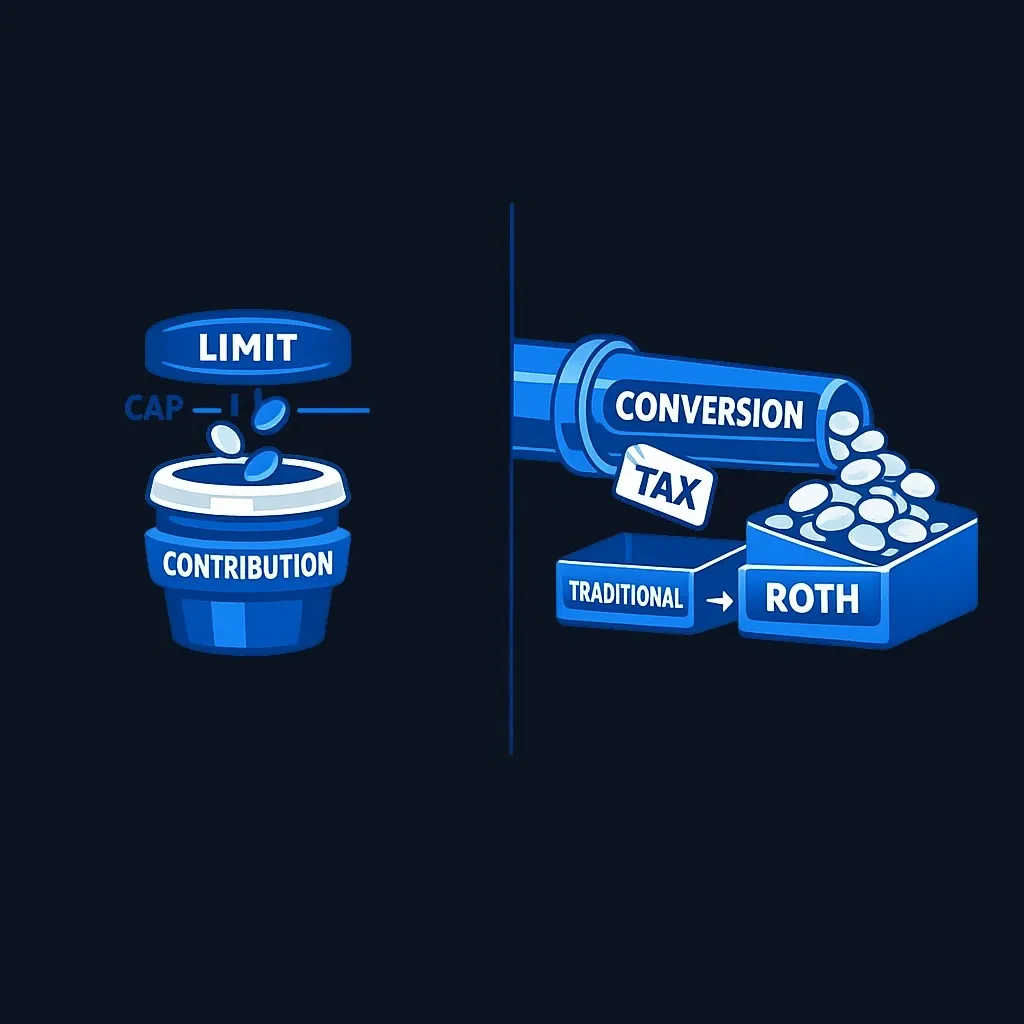
A recharacterization changes how an eligible IRA contribution is treated, as though it had originally gone into the other type of IRA. A conversion moves eligible existing retirement money into a Roth IRA. These transactions solve different problems.
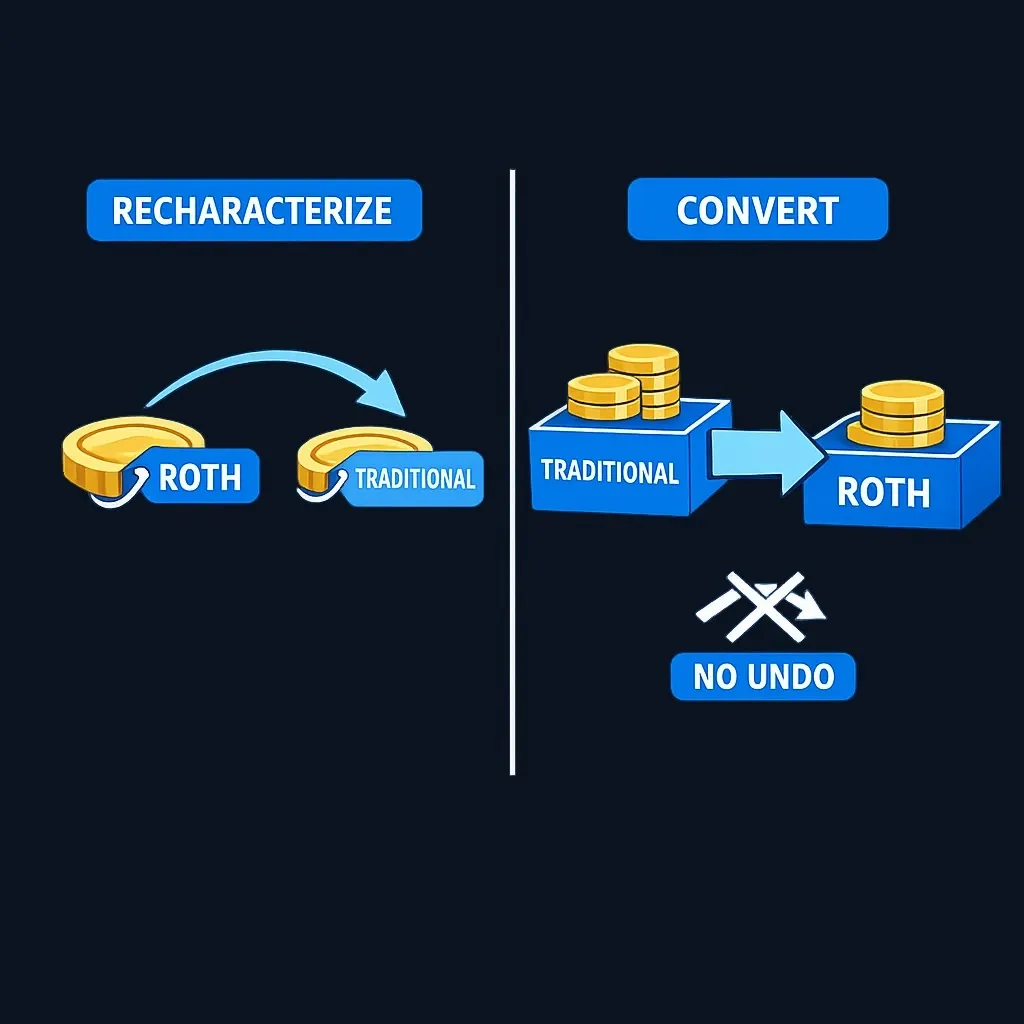
A Roth conversion made after 2017 cannot be reversed through recharacterization. A market decline after converting does not restore that old option.
Compare the purpose
| Question | Recharacterization | Conversion |
|---|---|---|
| What changes? | The treatment of an eligible contribution | The tax treatment of existing retirement assets |
| Typical reason | Correct or change a contribution's account type | Move eligible money to a Roth account |
| Current tax effect | Depends on contribution treatment and deductibility | Taxable portion is generally included in income |
| Annual contribution limit | Still applies to the original contribution | Does not cap the conversion as if it were a new contribution |
The IRS IRA FAQs and Publication 590-A describe these rules.
Correct the right transaction
If income makes a regular Roth contribution ineligible, recharacterization may be one available correction. It generally involves a trustee-to-trustee transfer of the contribution and attributable earnings or losses by the applicable deadline. A return of an excess contribution is another distinct procedure.
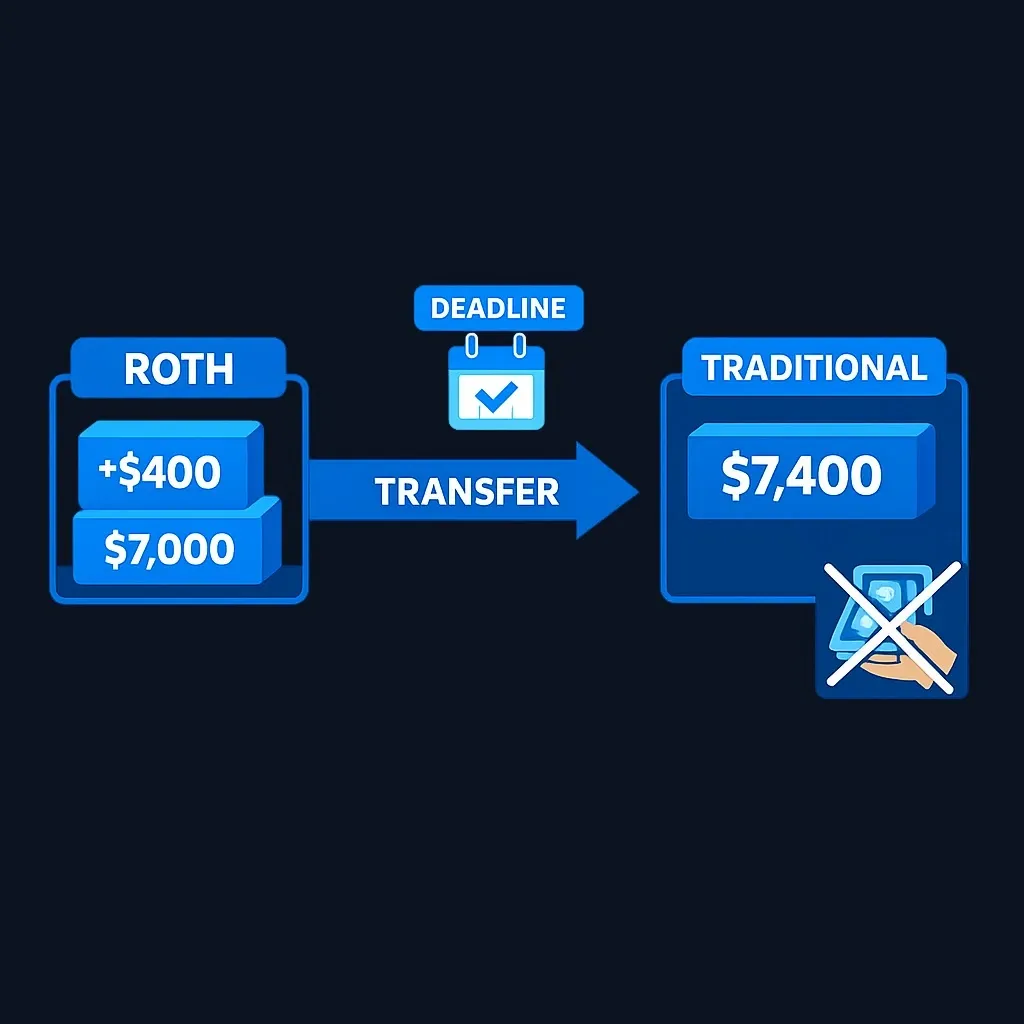
Do not simply withdraw and redeposit money without telling the custodian what correction you intend. The processing and reporting need to match the transaction.
Before converting
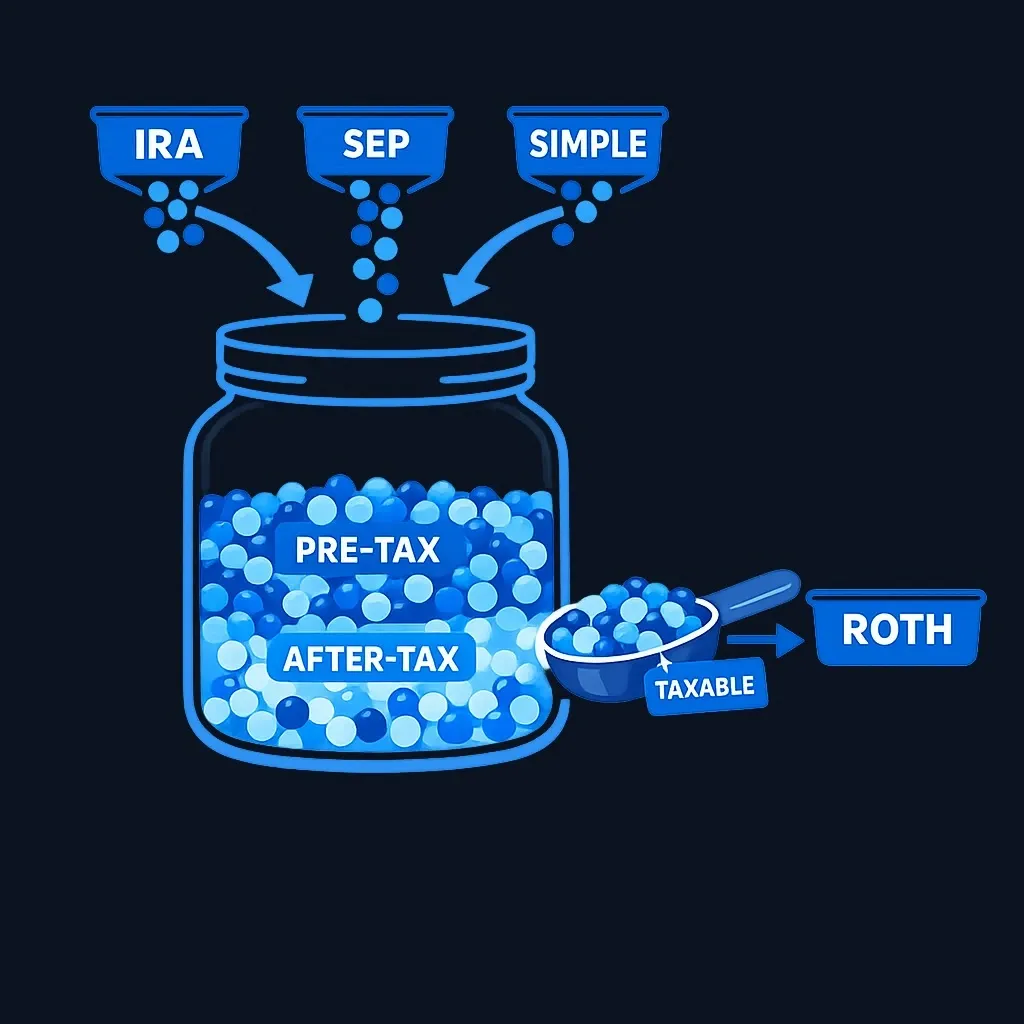
Determine the account's pre-tax and after-tax amounts. Nondeductible IRA contributions do not automatically make a conversion tax-free when other pre-tax IRA money exists. Required minimum distributions, if applicable, cannot be converted.
Ask the custodian which forms and deadlines apply and keep the tax records. If the objective is correcting a contribution, resolve that first. If the objective is moving retirement assets to Roth treatment, estimate the conversion's current tax cost before authorizing it.
Identify the transaction from the records
Start with the year, amount, and type of the original deposit. Was it a regular annual contribution, a rollover, or a conversion? Those labels have different tax consequences. A request to “move my Roth money back” is too imprecise for a custodian to determine the intended correction safely.
For an eligible regular contribution recharacterization, ask the custodian about transferring the contribution together with the attributable earnings or loss and recording it for the correct tax year. Do not simply withdraw a dollar amount and make a new deposit without understanding the reporting and deadlines. The account's value may have changed since the contribution.
For a conversion, identify pre-tax amounts and any nondeductible IRA basis. The taxable portion may depend on other traditional, SEP, and SIMPLE IRA balances under the applicable pro-rata rules. A separate account label does not necessarily isolate only the after-tax dollars for tax purposes.
Keep contribution eligibility separate from conversion planning
An income change can make a planned regular Roth contribution ineligible while leaving conversion questions subject to different rules. Likewise, the annual contribution limit is not a cap on the amount of eligible existing assets that can be converted. Avoid solving one issue with a transaction intended for the other.
Keep the tax return and custodian records aligned. A change processed after year-end can still relate to a prior-year contribution, depending on the rules and deadline. Retain confirmations and tell the tax preparer exactly what occurred so forms are reconciled rather than treated as unrelated deposits and withdrawals.
Practice investing with Finelo
Build practical investing skills with guided lessons, simulator practice, and structured challenges.
Key Differences Between Recharacterization and Conversion
- Purpose and intent: Recharacterization is corrective—used when you want contributions treated differently retroactively. Conversion is elective—used to change the account’s tax treatment going forward.
- Timing and permanence: A recharacterization changes how a past contribution is reported; a conversion changes where assets live going forward and usually represents a lasting change in tax classification.
- Operational constraints: Some custodians or products apply limits or special rules when assets move between IRA types; review your account terms before attempting either move.
- Practical outcome: Recharacterization changes the contribution’s tax reporting and may require an amended return if you already filed. Conversion creates its own reporting obligations for the transferred assets.
Concrete example (conceptual): if you mistakenly put a contribution into a Roth when you weren’t eligible, a recharacterization treats that deposit as if it had gone to a traditional IRA instead. If instead you decide you prefer Roth treatment for an existing traditional IRA balance, a conversion shifts that balance into a Roth account for future growth under Roth rules.
How to compare your options
Use this checklist to evaluate which path makes sense for you:
- Was the goal to undo a contribution or correct eligibility? If yes, favor recharacterization.
- Are you aiming to change the tax treatment going forward (and willing to accept any tax consequences)? If yes, conversion may be appropriate.
- Do your account terms, employer plan rules, or product guarantees restrict moves between account types? Check custodian disclosures first.
- How does the move interact with your time horizon and liquidity needs? Converting to Roth shifts future withdrawals; recharacterizing treats the original contribution as made to the other IRA type.
- Do you need to correct tax-year reporting or forms? Get professional help to align reporting across tax years.
Apply these criteria in order: eligibility/need to undo → long-term tax timing → custodian constraints → reporting complexity.
When to choose each option
When to choose recharacterization:
- You made a contribution you later discover was ineligible and prefer it treated as a different type of contribution.
- You want an eligible regular contribution treated as made to the other IRA type by the tax-return due date, including applicable extensions. A timely filed return can also allow a six-month corrective period under IRS rules; confirm the deadline and whether an amended return is needed.
When to choose conversion:
- You want assets to grow under Roth rules going forward and are prepared for any tax consequences of moving pre-tax assets into Roth treatment.
- You’re optimizing long-term tax diversification (Roth vs pretax buckets) and accept the operational steps required.
Decision point example (qualitative): If your main objective is to correct a bookkeeping or eligibility mistake for a recent contribution, recharacterization is the narrow fix. If your goal is strategic—pay taxes now to obtain potentially tax-free withdrawals later—conversion aligns with that objective.
Tradeoffs and caveats
- Custodian and product constraints: Some accounts or products include guarantees or transfer rules that apply when you convert or recharacterize; read your account agreement and ask your custodian before initiating a move.
- Reporting complexity: Both actions affect tax reporting. Keep careful records and coordinate with your tax preparer to ensure consistent treatment across tax forms and years.
- Timing and market movement: Market swings between the time you decide and the time a move completes can change the dollar amount affected. Factor that into the decision—especially for large balances.
- Irreversibility: A Roth conversion made after 2017 cannot be recharacterized back to a traditional IRA. Make the tax and cash-flow decision before converting.
- Limits on contributions: Contribution limits affect how much you can put into IRAs across account types—be aware of annual contribution limits when planning moves.
Practical tip: Before acting, get a written statement from your custodian describing how they’ll process the move and what tax reporting they will generate.
Step-by-Step Guide to Recharacterization and Conversion
The exact steps vary by custodian; below is a practical checklist that captures the typical workflow and decision points you should address before initiating either move: Common preparatory steps (both options)
- Confirm your objective—recharacterize an eligible regular contribution or convert existing assets.
- Review your account agreement and product disclosures for restrictions or guarantees that may be affected.
- Assemble documentation: recent account statements, contribution records, and correspondence.
- Talk with a tax professional to understand reporting needs and tax timing.
If recharacterizing (conceptual)
- Contact the custodian and request recharacterization procedures for the contribution in question.
- Verify the effective date the custodian will use and how investment gains or losses will be handled.
- Obtain written confirmation of how the recharacterization will be reported to you and the IRS.
If converting (conceptual)
- Instruct the custodian to move specified assets or amounts from the traditional-style account into a Roth-style account.
- Decide whether to convert cash or specific investments (custodial practices vary).
- Confirm how the custodian reports the conversion for tax purposes and get written confirmation.
Use the custodian’s instructions for processing, and IRS rules for tax eligibility, deadlines, and reporting. An institution’s operational procedure does not override the tax rules.
Common Mistakes to Avoid
- Assuming all custodians process recharacterizations/conversions the same way—procedures and limitations differ; always verify with your custodian.
- Overlooking contribution limits when moving or replacing amounts—annual IRA contribution limits affect planning.
- Failing to document the transaction path and dates—missing or inconsistent documentation complicates tax reporting.
- Ignoring market timing—large conversions in volatile markets can cause significant short-term tax consequences if values change between decision and execution.
- Treating a conversion as easily reversible—confirm operational and tax consequences before initiating.
What is the difference between a recharacterization and a conversion?
A recharacterization treats a past contribution as if it were originally made to the other IRA type; a conversion moves existing assets from one IRA type into a Roth-style account for future Roth treatment.
Can I undo a Roth conversion if I change my mind?
No. A post-2017 Roth conversion cannot be undone by recharacterization. Correcting an eligible regular contribution is a different transaction.
How do contribution limits affect this decision?
The annual limit applies to regular contributions across traditional and Roth IRAs. A recharacterization does not create a second contribution allowance. An eligible conversion of existing retirement assets is not capped by that annual regular-contribution limit.
Should I get professional help before converting or recharacterizing?
Yes. Both moves can affect tax reporting and long-term strategy. Talk with your custodian and a tax professional to confirm procedures, tax implications, and reporting obligations.
For the separate question of when to convert, compare Roth conversion before or after retirement.
This guide covers U.S. rules. Finelo provides financial education, not personalized financial, investment, tax, or legal advice.
InvestingU.S. GuideFinancial Education
Practice investing with Finelo
Build practical investing skills with guided lessons, simulator practice, and structured challenges.
About the author
Finelo Team
The Finelo Team creates practical investing and trading education designed to help beginners learn faster with structured challenges, simulator practice, and bite-sized lessons.
Keep reading — Related articles

Investing
Tax-gain harvesting vs. tax-loss harvesting
Compare realizing investment gains with realizing losses, including holding periods, wash sales, offsets, and portfolio tradeoffs.
Finelo Team

Investing
Stable value fund vs. money market fund
Compare investment structure, contract protections, transfer restrictions, net yields, and access inside a retirement account.
Finelo Team

Investing
Single-life vs. joint-life annuity
Compare income for one lifetime with continued payments to a survivor, using equal premiums and matching guarantee terms.
Finelo Team