Last editorial review: September 28, 2026
Should you delay your first RMD?
Compare taking the first required distribution on time with delaying until the following April, which can create two RMDs in one year.
9 min read
Practice investing with Finelo
Build practical investing skills with guided lessons, simulator practice, and structured challenges.
Want to learn more?
Build practical investing skills with guided lessons, simulator practice, and structured challenges.
Explore FineloExplore Finelo's 28-day challenges
Turn learning into a daily habit with guided challenge paths.
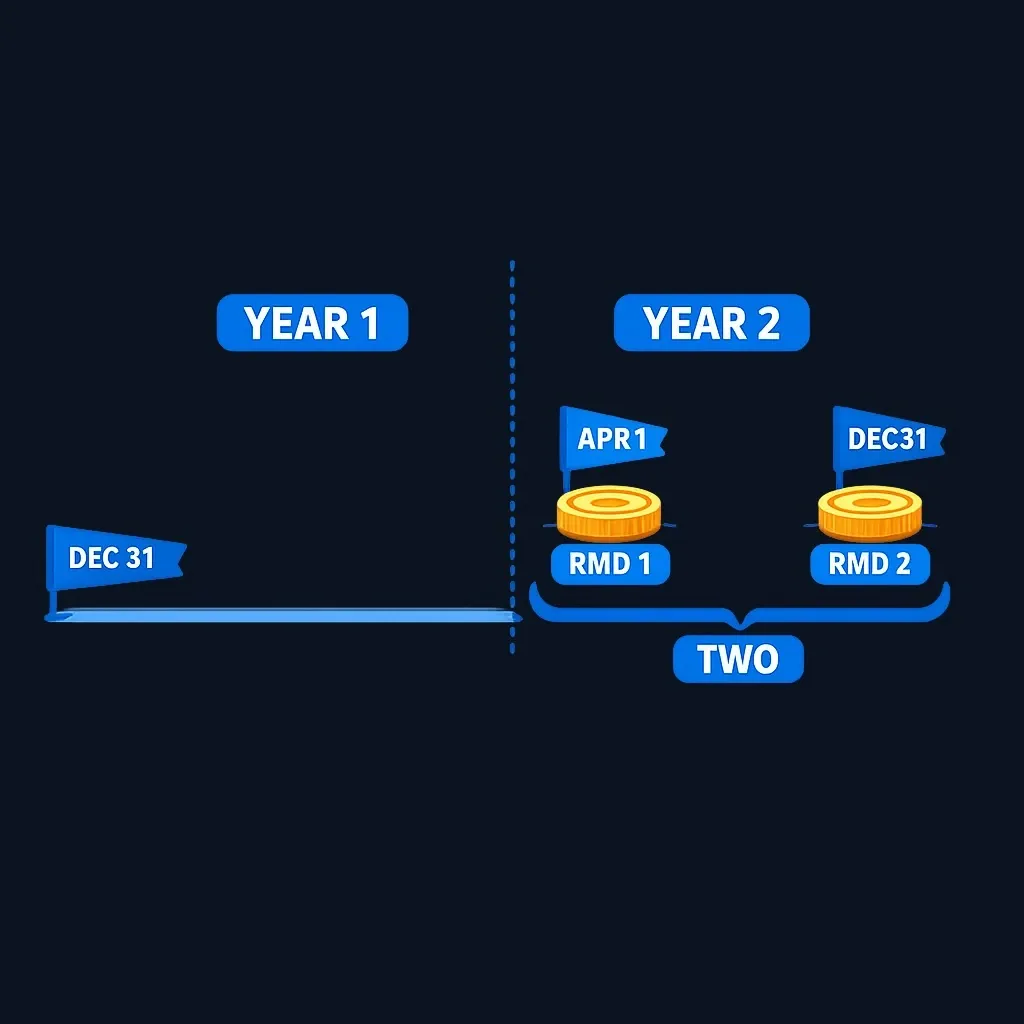
You can generally delay your first required minimum distribution until April 1 of the following year. The next year's RMD is still due by December 31. That can put two taxable withdrawals into one calendar year.
The useful question is whether concentrating income helps or hurts your two-year tax picture.
Confirm which deadline applies
For many current retirees, RMDs begin for the year they turn 73; the starting age depends on birth year. Some workplace plans allow qualifying employees who are still working for that employer to postpone RMDs until retirement; this exception generally does not apply to more-than-5% owners. IRA rules differ, and Roth accounts generally have no lifetime owner RMDs. Inherited accounts follow separate rules.
Use the IRS RMD FAQs to confirm your account type and required beginning date.
Compare both years
| Choice | First year | Following year |
|---|---|---|
| Take the first RMD by December 31 | First RMD included | Next RMD included |
| Delay until the following April 1 | No first RMD received that year | Both distributions included |
Suppose the first RMD is $30,000 and the next is $32,000. Delaying puts $62,000 into the second year. These are hypothetical amounts; each RMD is calculated separately using the applicable balance and factor.
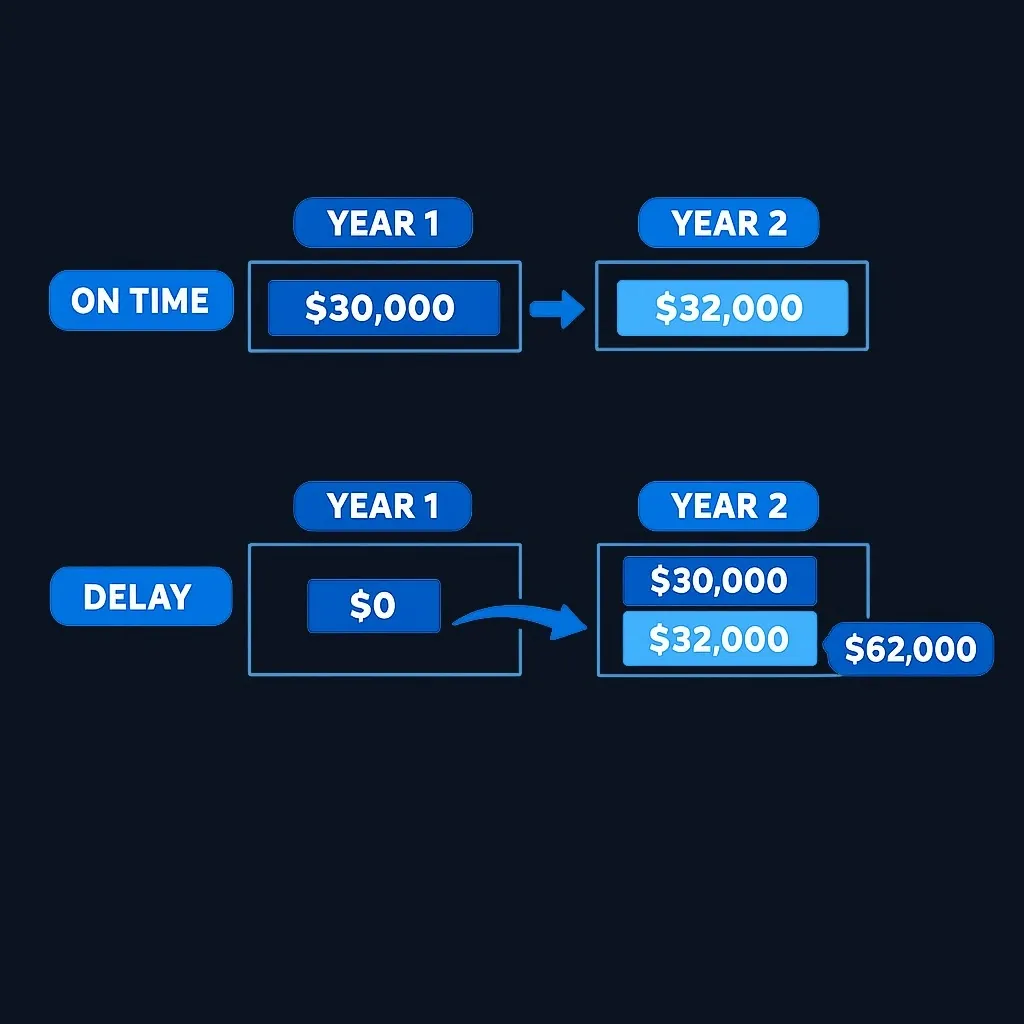
Two distributions do not automatically double your total tax across both years. The outcome depends on other income, deductions, tax brackets, and income-related costs.
Include effects beyond the tax bill
A larger income year can affect Medicare income-related premiums and the taxable portion of Social Security. Keeping money invested longer also involves market risk; delay does not guarantee a better investment outcome.
Calculate the two schedules using your actual expected income. Check whether funds are available inside each account to meet the deadline and whether aggregation is allowed for those accounts.
If you choose to delay, set reminders for both deadlines and confirm the custodian's processing time. An automatic withdrawal arrangement should be checked against your actual required amount rather than assumed to handle every account correctly.
Build two complete calendar-year projections
In the first version, take the initial RMD in the year it is for. In the second, use the permitted first-distribution delay. Include the next year's separately calculated RMD in both versions, together with wages, pensions, Social Security, investment income, and other expected distributions.
The amounts will not necessarily be equal because each year's RMD calculation uses its applicable balance and factor. A comparison assuming identical withdrawals is only a hypothetical illustration. Ask each custodian or plan administrator to identify the amount, calculation year, deadline, and account from which it must be satisfied.
Look beyond the tax on the withdrawal alone
Adding income can affect other calculations as well as ordinary income tax. Medicare income-related premiums generally use tax-return income from two years earlier, and Social Security taxation has its own calculation. The timing of an RMD's tax effect and the timing of a related cost can therefore differ.
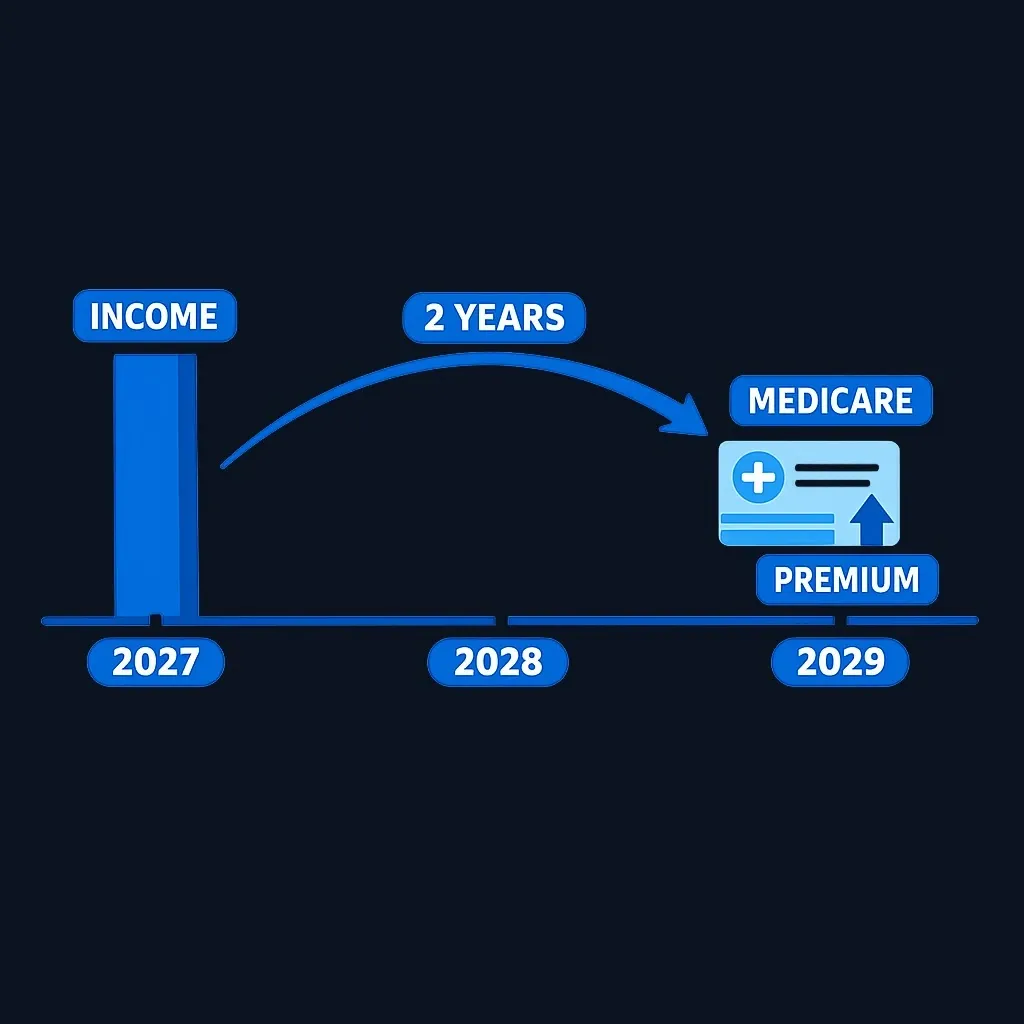
If the first year includes a one-time source of income that will disappear, delaying may deserve a closer look. If both years are otherwise similar, concentrating distributions may offer little benefit. Evaluate the difference in total outcomes across the two years rather than describing two distributions in one year as automatically doubling the lifetime tax.
Practice investing with Finelo
Build practical investing skills with guided lessons, simulator practice, and structured challenges.
Set a distribution plan even if you do not need the cash
An RMD requirement does not mean the money must immediately be spent. After applicable tax and account rules are addressed, the funds can support ordinary cash needs or be held outside the retirement account. Distinguish the requirement to distribute from a personal preference to remain invested.
Arrange the payment early enough to resolve processing problems. Confirm withholding, the destination account, and any account-aggregation rules that apply. Keep the year-end statements and distribution confirmations. A sound timing decision includes both the tax analysis and a practical method for meeting every required deadline.
Why Consider Delaying Your First RMD?
Delaying the first RMD can be tempting. Common reasons include a temporary lower need for cash, expecting a lower tax year ahead, or preferring fewer distributions while still working. But the main practical tradeoff is timing: delaying until April 1 of the following year means your next required withdrawal is still due by December 31 of that same following year. That creates a year with two RMDs and higher taxable income for that year.
Benefits of delaying (when it can help)
- Short-term cash flow: If you do not need the money in the first year, delaying postpones the taxable event.
- Expectation of lower income next year: If you reasonably expect your taxable income to be lower in the year you postpone into, delaying could reduce the total tax paid across the two years.
- Market timing preferences: Some people prefer to leave assets invested longer for potential growth before drawing them down.
Downsides of delaying (what to watch for)
- Two RMDs in one calendar year: Taking both the delayed first RMD and the next-year RMD in the same year increases taxable income for that year and can push you into a higher marginal tax bracket.
- Impact on means-tested benefits and surtaxes: Higher reported income in the double-RMD year can affect Medicare premiums, subsidies, and other income-sensitive benefits.
- Irreversible tax consequences: Once distributions occur and taxes are paid, those funds are no longer tax-deferred.
Quick checklist: Should you consider delaying?
- Do you expect substantially lower taxable income next year? — possibly delay.
- Will receiving two RMDs in the same year materially increase your tax bill or affect benefits? — avoid delay.
- Do you need the funds this year for living expenses? — take the RMD.
- Are you still working and covered by a qualified plan that allows you to postpone RMDs past the start year? — check the plan’s rules and applicable IRS requirements.
The Rules Surrounding RMDs
The IRS sets rules for when and how RMDs must be taken. The agency explicitly allows delaying your first RMD until April 1 of the year after your required beginning year, but after that the general deadline for RMDs is December 31 of each calendar year.
Key rule points (what to remember)
- First RMD timing: You may delay your first RMD until April 1 of the following year when the first-RMD delay applies.
- Subsequent RMDs: After that first-distribution year, RMDs are generally due by December 31 each year.
- Account aggregation and source rules: RMD rules differ by account type (IRAs vs employer plans) and whether you may aggregate across multiple accounts; verify account-specific guidance with your plan administrator and the IRS page linked above.
Penalties and compliance
Failing to take required distributions can trigger an IRS excise tax. The IRS FAQ page explains compliance requirements and consequences for missed distributions; consult that guidance for exact penalty details and relief procedures.
Tax Implications of Delaying Your RMD
Delaying your first RMD changes the timing of taxable income. Taxes on RMDs are owed in the year you receive distributions. If you postpone the first RMD to April 1 of the following year, that year will usually include two taxable distributions: the delayed first RMD and the second-year RMD taken by December 31. That concentrated income can raise your marginal tax rate and total taxes owed for that year.
How delaying affects tax-sensitive items
- Marginal tax bracket: Concentrating distributions can push taxable income into a higher bracket for that year.
- Medicare and subsidies: A higher modified adjusted gross income (MAGI) in the double-RMD year can increase Medicare Part B/D premiums or affect premium tax credits.
- Social Security taxation: Additional income in one year can increase the taxable portion of Social Security benefits.
Hypothetical timing scenarios
Below are three concise, realistic scenarios that demonstrate outcomes from choosing to delay or not. These are illustrative examples for learning; they are not individualized advice.
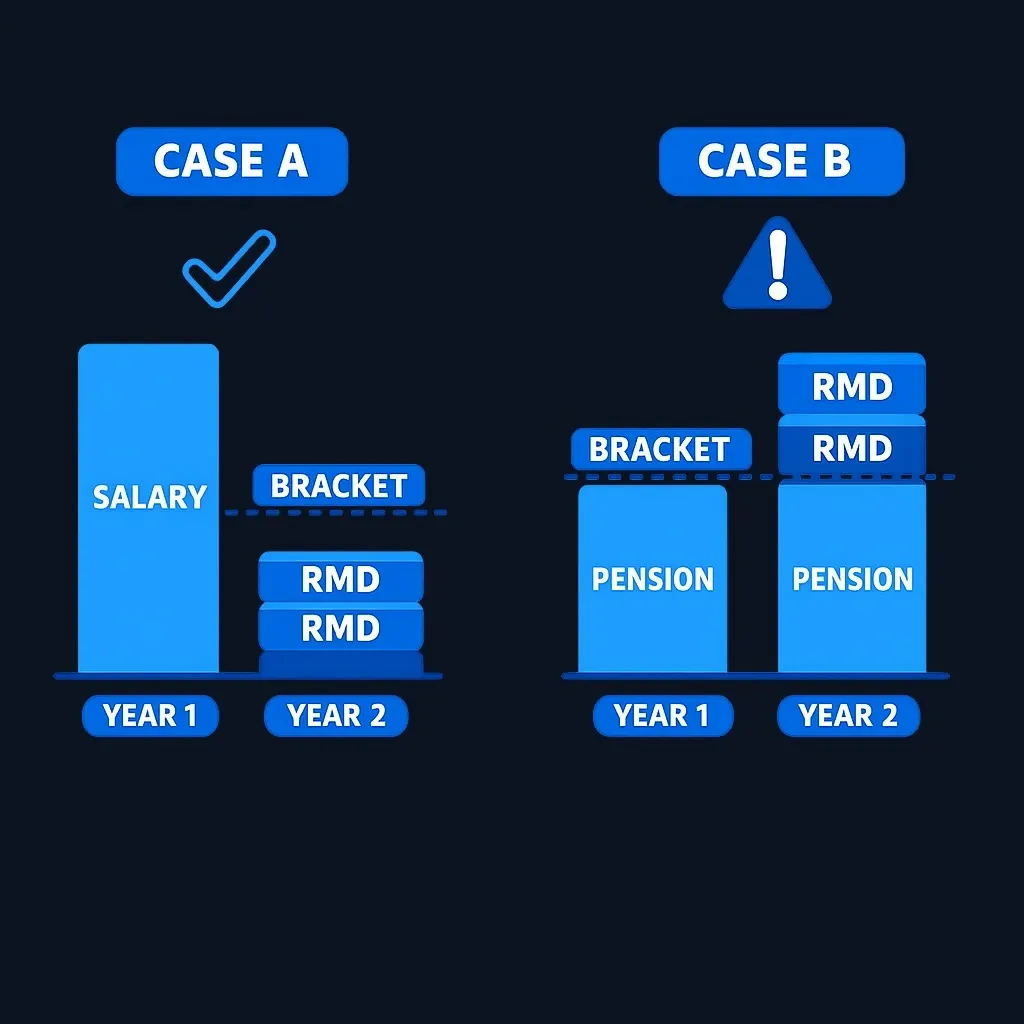
Case A — Single retiree who expects lower income next year (benefit from delaying)
- Profile: Retiree A expects a large salary in the current year but plans to stop working before the next year.
- Choice: Delay the first RMD until April 1 of the next year.
- Outcome: Year of double distributions occurs in a lower-income year, potentially producing a lower combined tax than taking one RMD while still earning salary. This scenario can make delaying worthwhile if the projected income drop is substantial.
Case B — Couple with steady retirement income (often worse to delay)
- Profile: Retiree B and spouse have stable pensions and Social Security that create steady taxable income across years.
- Choice: Delay first RMD to April 1 of next year.
- Outcome: The double-RMD year pushes taxable income higher, possibly increasing marginal taxes and Medicare premiums. For steady-income households, delaying can increase income-related costs and should be modeled across both years.
Case C — Multiple accounts and aggregation considerations
- Profile: Retiree C holds multiple IRAs and a 401(k) from a former employer.
- Choice point: RMD rules allow specific aggregation and account-source rules that differ by account type.
- Practical note: An owner can generally calculate each IRA’s RMD separately and take the total from one or more of those IRAs. Certain 403(b) contracts also allow aggregation; 401(k) and 457(b) RMDs must be satisfied separately from each plan. Do not combine inherited-account requirements without checking their separate rules.
What happens if I delay my first RMD?
You may delay your first RMD until April 1 of the year after your required beginning year, but if you delay you will still owe the following year’s RMD by December 31 of that same year — resulting in two RMDs in one year.
How does delaying my RMD affect my taxes?
Delaying concentrates taxable distributions into one calendar year, which can raise your taxable income for that year and increase marginal tax liability and other income-based costs. Estimate with your actual RMDs and marginal rates to see the effect.
What are the penalties for not taking my RMD?
The IRS sets penalties for failure to take required distributions. Consult the IRS RMD guidance for exact excise tax rules, relief, and correction procedures.
Can I take my RMD from multiple accounts?
RMD rules vary by account type. Some accounts allow aggregation of RMDs (for example, certain IRA rules), while employer plan accounts have different source rules. Check your plan documents and the IRS guidance for the specifics that apply to your accounts.
If conversions are part of the same retirement plan, read Roth conversion before or after retirement.
This guide covers U.S. rules. Finelo provides financial education, not personalized financial, investment, tax, or legal advice.
InvestingU.S. GuideFinancial Education
Practice investing with Finelo
Build practical investing skills with guided lessons, simulator practice, and structured challenges.
About the author
Finelo Team
The Finelo Team creates practical investing and trading education designed to help beginners learn faster with structured challenges, simulator practice, and bite-sized lessons.
Keep reading — Related articles

Investing
Tax-gain harvesting vs. tax-loss harvesting
Compare realizing investment gains with realizing losses, including holding periods, wash sales, offsets, and portfolio tradeoffs.
Finelo Team

Investing
Stable value fund vs. money market fund
Compare investment structure, contract protections, transfer restrictions, net yields, and access inside a retirement account.
Finelo Team

Investing
Single-life vs. joint-life annuity
Compare income for one lifetime with continued payments to a survivor, using equal premiums and matching guarantee terms.
Finelo Team